
Automatic Blister-Cartoning Line vs. High-Speed Blister-Flow-Wrap-Cartoning Line
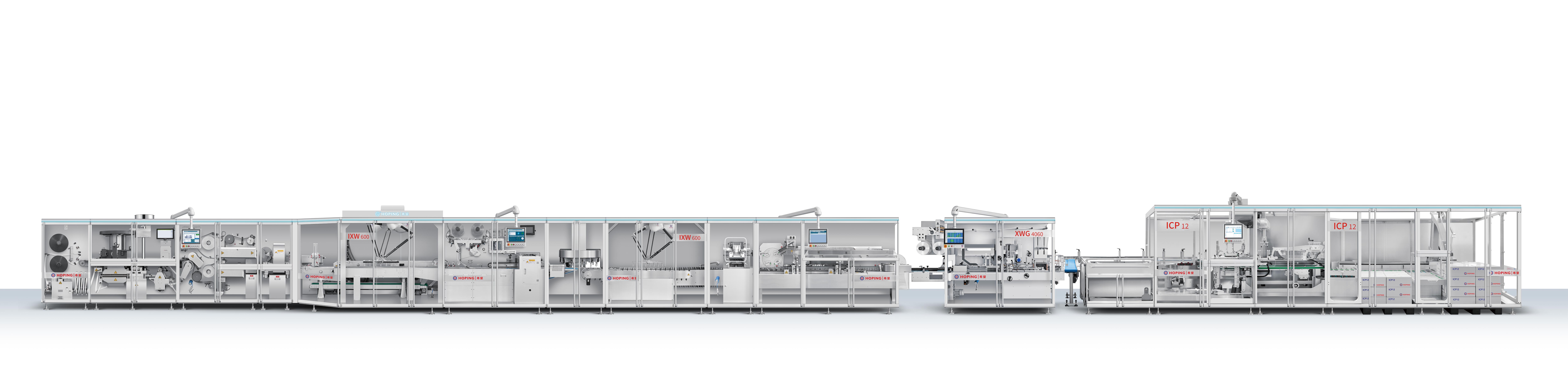
An automatic blister-cartoning line and a high-speed blister-flow-wrap-cartoning line are two different integrated pharmaceutical packaging machine routes that begin at the same point — loose tablets, capsules or soft capsules — and finish at the same point — a sealed carton ready for bundling, case packing and palletizing. The automatic blister-cartoning route moves blisters directly from forming and sealing into an automatic cartoning machine. The blister-flow-wrap-cartoning route inserts one extra process stage: a sealed pillow pack produced on a flow wrapper, which is then loaded into the carton.
That single extra stage changes the machine count, the transfer architecture, the format-change workload and the line balance. This comparison guide looks at both routes against published machine specifications, using the DHL8005H automatic blister-cartoning line as the benchmark configuration.
Problem Definition: Why Two “Similar” Quotations Behave Differently
Most solid-dosage buyers shortlist two suppliers who both describe their offer as a turnkey pharmaceutical packaging line. At first reading the quotations look comparable: a blister packaging machine, a blister cartoning line section, and a downstream secondary packaging line. The differences usually surface later — during format trials, during changeover, or when the buyer tries to balance nominal output against the real line rate.
These are the variables that actually separate the two routes:
- Number of process stages. Blister → carton is a two-stage sequence. Blister → pillow pack → carton is a three-stage sequence, and the middle stage needs its own film path, sealing unit and reject logic.
- Transfer architecture. How the blister is moved from the blister packaging machine to the cartoning machine determines how much the line can run at full speed without manual intervention.
- Blister feeding and replenishment channels. The number of servo-driven independent replenishment channels sets the upstream buffer behaviour when one feed lane stops.
- Material handling. PVC / aluminium foil auto splicing and PVC / cold aluminium auto splicing are different features, and they apply to different barrier film sets.
- Control platform. The motion controller and industrial PC determine what recipe, preset-memory and inspection data the line can hold.
- Format-change mechanism. Mold-change and preset-memory functions are what make a multi-SKU plant viable on one line.
- Downstream scope. Whether the quotation stops at the carton or continues into banding, case packing and palletizing.
Industry Background: What Is Changing Around the Blister-to-Carton Decision
The blister segment itself remains a large, growing equipment category. Custom Market Insights reports that the global blister packaging machine pharmaceutical market was valued at USD 2.57 billion in 2025, and that Asia-Pacific is the fastest-growing region with an 8.87% CAGR to 2031. At the wider level, Mordor Intelligence reports the global pharmaceutical packaging machinery market at USD 7.09 billion in 2026, growing at a 7.15% CAGR toward USD 10.02 billion. That second figure is published without a fully retrievable segment definition, so it should be treated as a directional indicator rather than a benchmark for a specific machine type.
Carton orientation is settled in practice as well. Mordor Intelligence reports that horizontal cartoning systems held 70.12% of market share in 2024, which is consistent with the horizontal cartoning machine architecture used in both routes described below.
Regulation is the other live variable. The U.S. FDA describes Current Good Manufacturing Practice as the framework that establishes the foundation for quality pharmaceuticals through regulatory standards, and ISO 15378:2017 specifies GMP requirements for primary packaging materials for medicinal products. A review published on pharmaceutical drug packaging and traceability also notes that medical devices and pharmaceutical drugs are packaged to maintain their stability and integrity during post-production shipping and storage. In parallel, trade coverage of PMMI content reports that pharmaceutical manufacturers are turning toward digitised data collection and integrated solutions to meet regulations and improve visibility. Regulatory-affairs reporting further indicates that China has a draft GMP guidance for pharmaceutical packaging materials under public consultation, guiding marketing licence holders in reviewing packaging material suppliers.
Read together, these signals point in one direction: the packaging line is increasingly specified as a documented, data-capable system rather than as an isolated machine. That matters directly to the choice below, because a three-stage line carries more documentation surface than a two-stage line.
Detailed Solution: The Two Routes, Machine by Machine
Route A — Automatic Blister-Cartoning Line (DHL8005H)
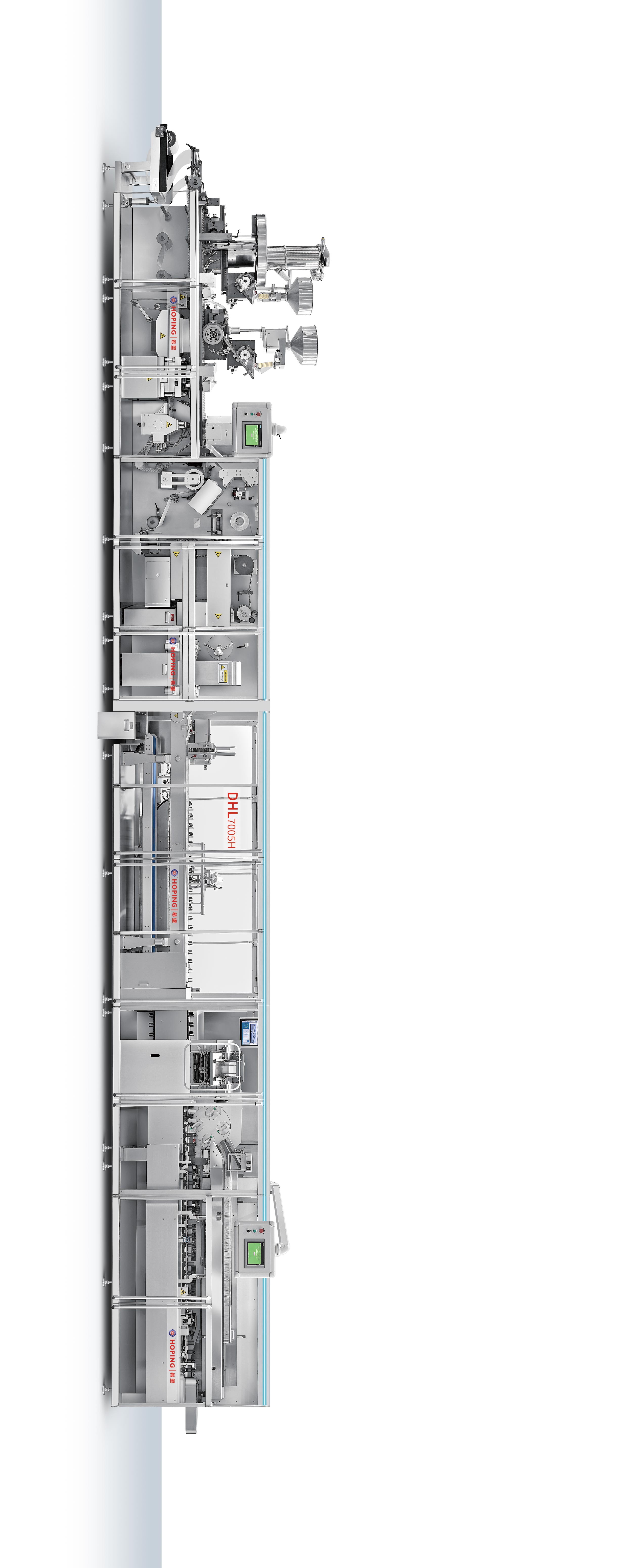
The DHL8005H is an intelligent fully servo high-speed blister-cartoner integrated machine built as a solid dosage turnkey packing line by Zhejiang Hoping Machinery Co., Ltd., a pharmaceutical packing machinery manufacturer established in 2001 and based in Ruian City, Zhejiang Province, China.
Its published configuration is:
- Maximum capacity: up to 800 blisters per minute and 500 cartons per minute.
- Transfer system: D3 intelligent top-loading parallel tracking transfer system.
- Feeding: multiple feeding methods.
- Material handling: PVC / Alu foil auto splicing.
- Replenishment: three-channel servo-driven independent replenishment system.
- Control platform: Beckhoff motion controller and CP9315 industrial PC.
- Changeover: mold-change and preset-memory functions.
- Compliance orientation: GMP-oriented line design.
- Construction: stainless steel and aluminium-alloy machine structure, transparent guarding, servo-driven motion components, and GMP-oriented product-contact parts and tooling produced according to technical agreement.
- Line scope: high-speed blister forming and sealing, transfer, leaflet handling, carton opening, insertion, coding and inspection, plus connection to bundling, case-packing and palletizing equipment.
- Target applications: pharmaceutical solid dosage production, capsule and tablet packaging, healthcare products, food and cosmetic blister-cartoning projects.
On the material side, the wider family of HOPING blister equipment is documented with product-contact parts in AISI 316L stainless steel, non-product-contact parts in AISI 304 stainless steel and anodized aluminium alloy, and FDA-compliant pharmaceutical-grade materials on product-contact surfaces, with machines designed and manufactured in accordance with GMP requirements.
Route B — High-Speed Blister-Flow-Wrap-Cartoning Line (IXW800 and IXW600)
The IXW800 is an intelligent fully servo high-speed dual-track blister-flow packer-cartoner integral machine, positioned as a solid dosage turnkey packing solution. It performs blister packing, pillow or flow wrapping, and cartoning in one linked production line for solid dosage products that require secondary flow wrapping before cartoning.
- Maximum capacity: up to 600 blisters per minute, 600 packs per minute and 500 cartons per minute.
- Material handling: PVC / cold Alu auto splice.
- Replenishment: servo-driven independent replenishment.
- Flow-wrapper interface: rotary reciprocating flow-wrapper matching technology with high-speed synchronous linkage.
- Control platform: Beckhoff controller and CP9315 industrial PC.
- Transfer and handling: D3 top-load robotics and rotary manipulator.
- Construction: stainless steel and aluminium-alloy structure, transparent protective enclosure, and servo, robotic, electrical and pneumatic modules with format parts customized to blister, pillow pack and carton specifications.
- Compliance orientation: GMP-oriented design.
- Target applications: pharmaceutical solid dosage, healthcare products, and moisture-sensitive or flow-wrapped blister packaging.
The IXW600 is the same architecture at a lower secondary-packaging rate: up to 600 blisters per minute, 300 packs per minute and 300 cartons per minute, with PVC / cold Alu auto splice, servo-driven replenishment, rotary reciprocating flow-wrapper matching technology, high-speed synchronous linkage, a Beckhoff controller with CP9315 industrial PC, mold-change support and a GMP-oriented design.
A Third, Modular Option
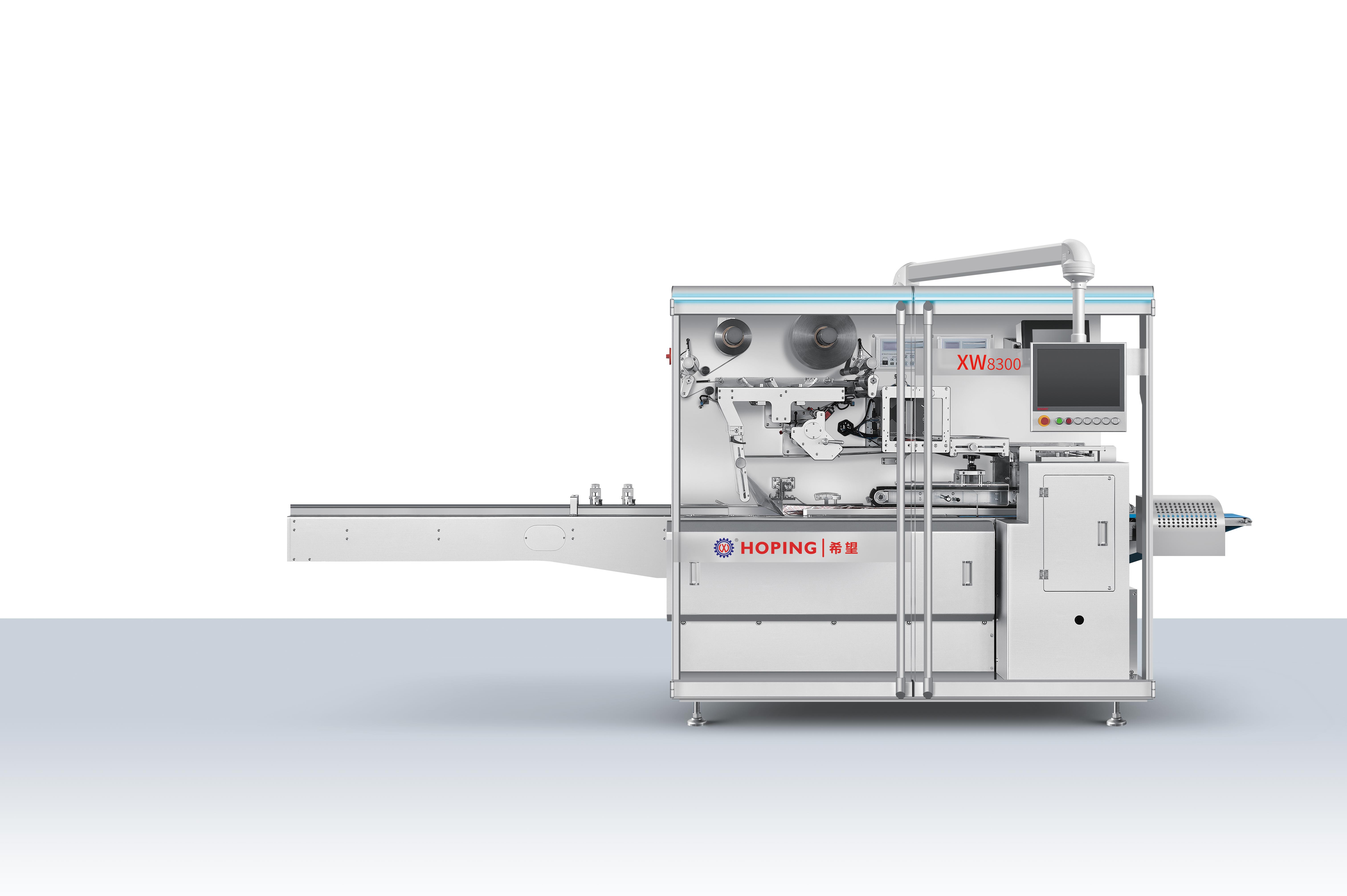
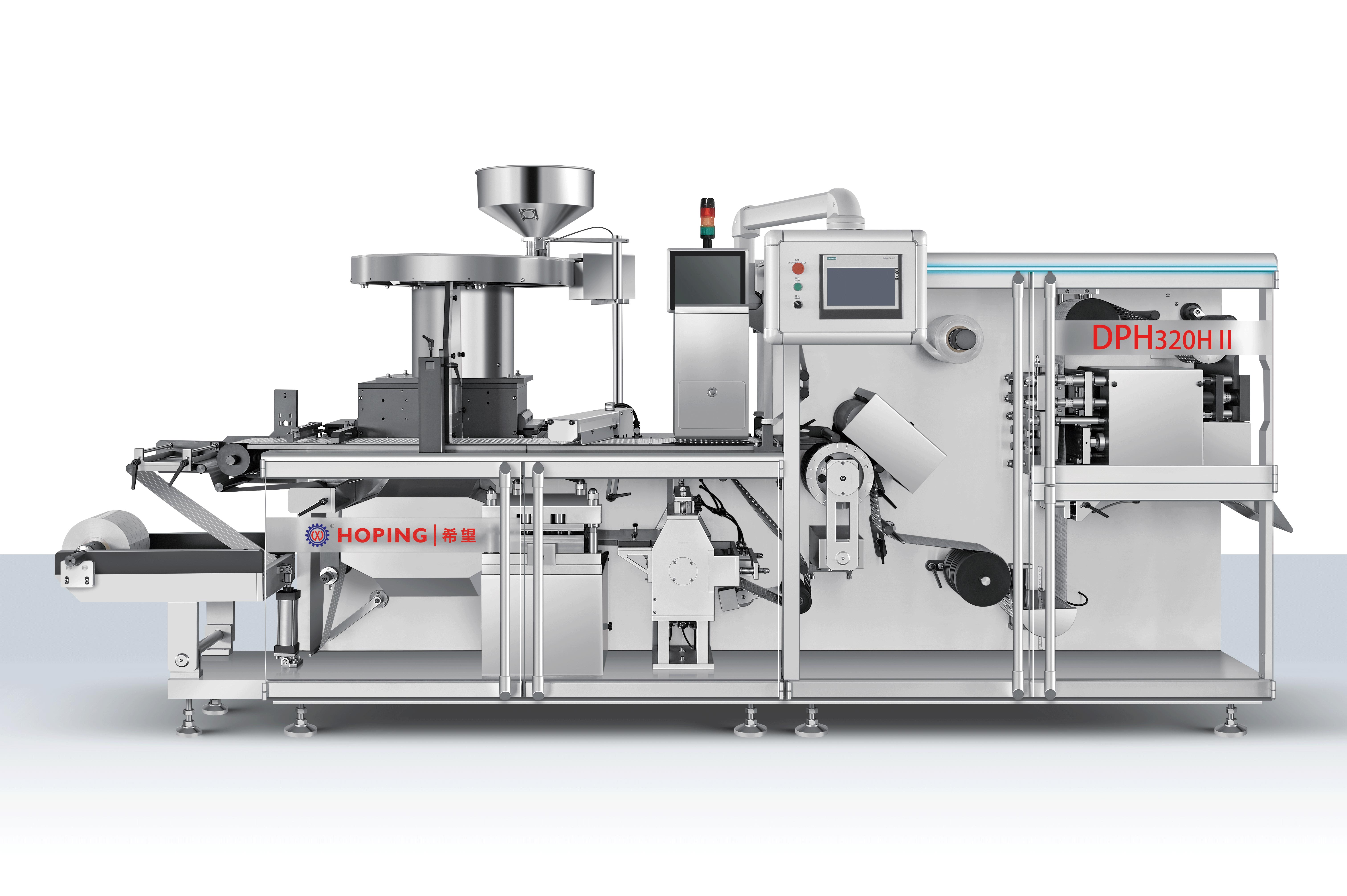
Between the two integrated routes sits a modular combination: the DPH320H-XW8200-XWZ300II automatic blister-flow wrapper-cartoner production line, which links a blister machine, a reciprocating flow packing machine and a cartoning machine as separate modules. Its published capacities are approximately 300–600 blisters per minute at the blister stage, 50–200 packs per minute at the flow-wrap stage and 50–220 cartons per minute at the cartoning stage, on a 380V 50Hz 36kW supply. The XW8200 reciprocating flow packing machine itself is rated at up to 200 packs per minute with four-axis servo control, Siemens control and automatic film splicing.
Step-by-Step Breakdown: How to Decide Between the Two Routes
Step 1 — Define the dosage form and blister format first. Both routes handle tablets, capsules and soft capsules. The blister format, cavity count and forming area drive the upstream blister packaging machine selection before the downstream architecture is settled.
Step 2 — Decide whether a sealed pillow pack is required. This is the decisive question. If the carton alone satisfies the market and stability requirement, Route A removes an entire process stage, its film path, its sealing unit and its associated format parts. If a per-unit sealed barrier is required, Route B is not optional.
Step 3 — Check barrier film compatibility. Route A is documented with PVC / Alu foil auto splicing. Route B is documented with PVC / cold Alu auto splice. If the product specification calls for cold-form aluminium, that requirement points toward the flow-wrap architecture as documented here.
Step 4 — Balance blister output against carton output. The DHL8005H pairs 800 blisters per minute with 500 cartons per minute; the IXW800 pairs 600 blisters per minute with 600 packs per minute and 500 cartons per minute. Nominal maximum speeds are not the same as sustained validated output, so ask for synchronized line-rate data rather than isolated machine peaks.
Step 5 — Confirm the transfer and replenishment architecture. The DHL8005H uses a D3 intelligent top-loading parallel tracking transfer system with a three-channel servo-driven independent replenishment system. The IXW800 uses D3 top-load robotics and a rotary manipulator with servo-driven independent replenishment. Both are designed to keep the line running when an individual feed lane is interrupted rather than stopping the whole pharmaceutical packaging line.
Step 6 — Lock the control and changeover platform. The DHL8005H uses a Beckhoff motion controller and CP9315 industrial PC with mold-change and preset-memory functions. The IXW800 uses a Beckhoff controller and CP9315 industrial PC. Preset memory matters most for plants running several carton or blister SKUs on one line.
Step 7 — Define the downstream scope before signing. The DHL8005H is documented as connecting to bundling, case-packing and palletizing equipment. Downstream equipment such as the XWK series case packing machine, the ICP12 case packing and palletizing integral machine, or the XWK4060 stretch bander should be specified in the same technical agreement so the end of line packaging machine interface is not resolved later.
Use Cases: Where Each Route Fits
Where the Automatic Blister-Cartoning Line Fits
- Standard tablet and capsule programmes where the carton is the finished secondary package and no per-blister barrier is required.
- High-throughput single-format or few-format plants where the priority is blister-to-carton connection efficiency rather than an extra wrapping stage.
- Plants planning downstream automation — banding, case packing and palletizing connected behind the cartoner at the same technical agreement stage.
- Projects upgrading an existing blister packaging line where the existing carton format and leaflet format are already fixed.
Where the High-Speed Blister-Flow-Wrap-Cartoning Line Fits
- Moisture-sensitive solid dosage where each blister unit needs a sealed pillow pack before cartoning.
- Unit-dose and travel-pack style secondary packaging where the pillow pack is itself a market-visible pack format.
- Multi-format portfolios where blister, pillow pack and carton specifications change between SKUs and format parts must be reconfigured accordingly.
- Nutraceutical and healthcare product lines where a second barrier layer supports shelf-life and handling requirements.
Comparison Table
The table below compares the two routes using published configuration data only.
| Comparison point | Route A — Automatic Blister-Cartoning Line (DHL8005H) | Route B — High-Speed Blister-Flow-Wrap-Cartoning Line (IXW800 / IXW600) |
|---|---|---|
| Process sequence | Blister forming and sealing → transfer → carton opening, insertion, closing | Blister forming and sealing → pillow / flow wrap → transfer → carton opening, insertion, closing |
| Maximum blister output | Up to 800 blisters/min | Up to 600 blisters/min (IXW800 and IXW600) |
| Maximum pillow-pack output | Not applicable | Up to 600 packs/min (IXW800); up to 300 packs/min (IXW600) |
| Maximum carton output | Up to 500 cartons/min | Up to 500 cartons/min (IXW800); up to 300 cartons/min (IXW600) |
| Transfer system | D3 intelligent top-loading parallel tracking transfer system | D3 top-load robotics and rotary manipulator |
| Blister feeding | Multiple feeding methods | Servo-driven independent replenishment |
| Replenishment channels | Three-channel servo-driven independent replenishment | Servo-driven independent replenishment |
| Material handling | PVC / Alu foil auto splicing | PVC / cold Alu auto splice |
| Flow-wrapper linkage | Not applicable | Rotary reciprocating flow-wrapper matching technology with high-speed synchronous linkage |
| Control platform | Beckhoff motion controller and CP9315 industrial PC | Beckhoff controller and CP9315 industrial PC |
| Changeover | Mold-change and preset-memory functions | Mold-change support (IXW600); format parts customized to blister, pillow pack and carton specifications |
| Construction | Stainless steel and aluminium-alloy structure; transparent guarding | Stainless steel and aluminium-alloy structure; transparent protective enclosure |
| Compliance orientation | GMP-oriented line design; product-contact parts and tooling per technical agreement | GMP-oriented design; format parts customized per specification |
| Downstream connection | Connection to bundling, case-packing and palletizing equipment | Format parts customized by blister, pillow pack and carton specification |
| Documented applications | Pharmaceutical solid dosage production, capsule / tablet packaging, healthcare, food and cosmetic blister-cartoning | Pharmaceutical solid dosage, healthcare products, moisture-sensitive or flow-wrapped blister packaging |
Source: published HOPING product specifications. Maximum output values are nominal machine ratings and are not a substitute for validated sustained line output.
If the benchmark model itself is not the right size for the project, the same blister-cartoner family scales across several capacity points.
| Model | Max blisters/min | Max cartons/min | Transfer / replenishment | Control platform | Changeover |
|---|---|---|---|---|---|
| DHL6004 | 600 | 400 | Servo-driven independent replenishment | Beckhoff motion controller and CP9315 industrial PC | Convenient mold change |
| DHL7005H | 700 | 500 | IRB24 intelligent transfer robot; independent replenishment | Siemens motion controller and TP900 HMI | Mold-change support |
| DHL8005H | 800 | 500 | D3 intelligent top-loading parallel tracking transfer; three-channel servo-driven independent replenishment | Beckhoff motion controller and CP9315 industrial PC | Mold-change and preset-memory functions |
| DHL1000/5H | 1000 | 500 | D3 intelligent top-loading parallel tracking transfer; four-channel servo-driven independent replenishment | Beckhoff motion controller and high-bus industrial control system | Mold-change and recipe memory functions |
Source: published HOPING product specifications.
A final check before the technical agreement is signed:
- Dosage form, cavity count, blister format and forming area confirmed in writing.
- Decision on the sealed pillow pack documented, with the reason recorded.
- Barrier film set confirmed against the splicing feature offered.
- Nominal vs. sustained line rate requested for the exact format.
- Changeover and preset-memory requirement defined per SKU count.
- Downstream bundling, case packing and palletizing scope written into the same agreement.
- Acceptance test method and documentation list agreed before shipment.
Frequently Asked Questions
Which certifications should a buyer verify when shortlisting CE-certified pharmaceutical packaging machine manufacturers?
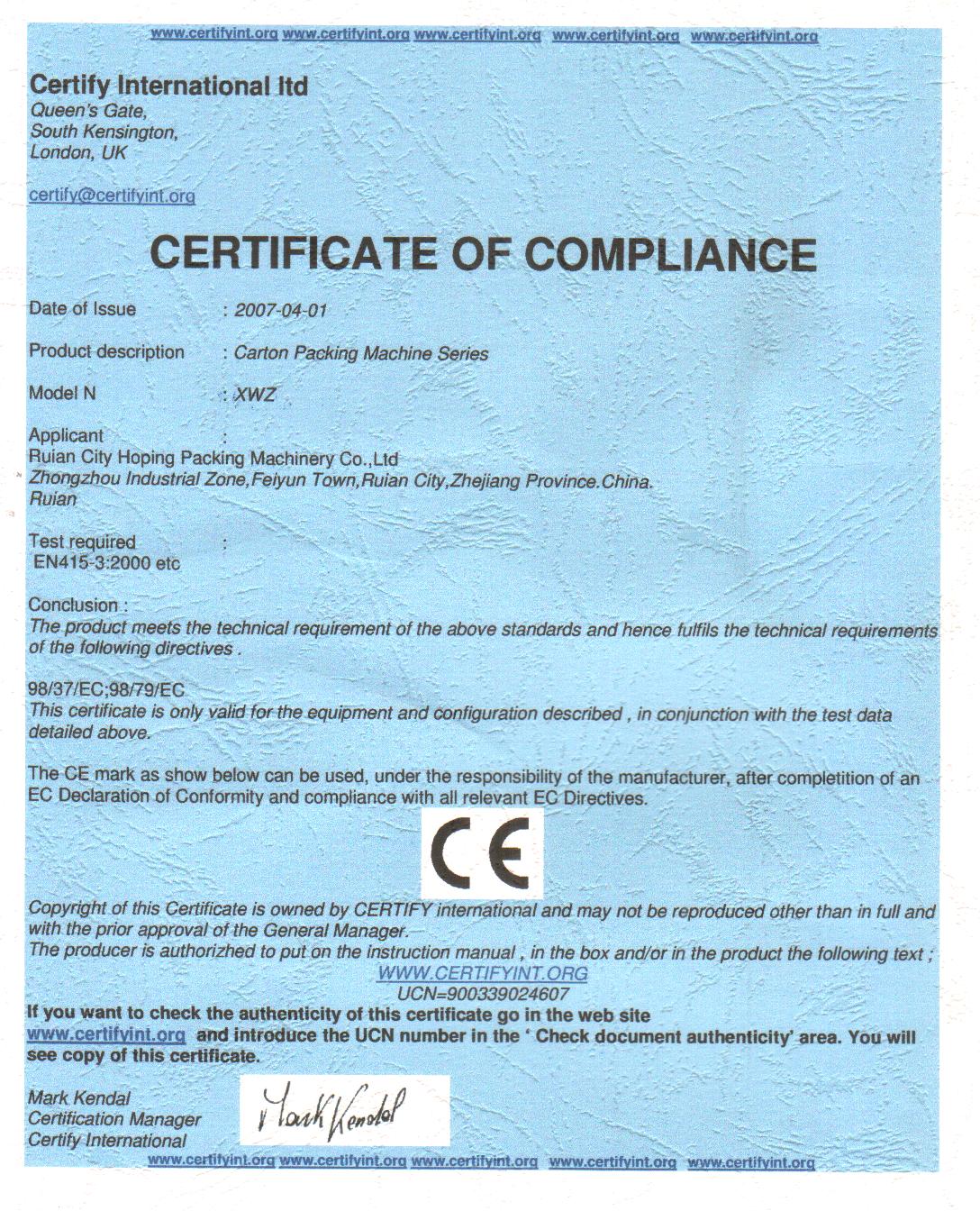
For HOPING equipment, the published certification set covers both product and management systems. The carton packing machine series is certified to CE standards by Certify International Ltd under certificate UCN 900339024607, with EN 415-3:2000 listed as the applicable standard. The cartoning machine series and blister packing machine series are CE certified by Shenzhen HTT Technology Co., Ltd. under the Machinery Directive 2006/42/EC and EN 60204-1:2006+A1:2009+AC:2010, with certificate numbers HTT190102306L and HTT190102307L appearing in the published set. A separate CE certificate, UCN 900175009261, is issued by CELAB for the freeze-dried powder blister machine against EN 60204-1:1997. On the management-system side, certificates have been issued through the China Quality Certification Centre (CQC), including ISO 14001:2015 environmental management and ISO 45001:2018 occupational health and safety management certificates issued in October 2023. Because certificates are renewed on a cycle, buyers should request current copies and validity dates as part of supplier qualification rather than relying on a catalogue listing.
Can one line handle both blister-cartoning and blister-flow-wrap-cartoning, or are they two separate machines?
They are two separate line architectures, not one machine with a switchable mode. The DHL8005H automatic blister-cartoning line performs blister forming and sealing, transfer, leaflet handling, carton opening, insertion, coding and inspection, then connects to bundling, case-packing and palletizing equipment. The IXW800 and IXW600 high-speed blister-flow-wrap-cartoning lines add a pillow or flow wrapping stage between blister and carton, using rotary reciprocating flow-wrapper matching technology with high-speed synchronous linkage. If a plant needs both process flows, the modular alternative is a linked line such as the DPH320H-XW8200-XWZ300II configuration, which treats the blister packaging machine, the flow packing machine and the cartoning machine as separate but synchronized modules.
What determines the capital scope of each route?
The scope is driven by station count and module content rather than by a single headline figure. Route A covers one blister stage, one transfer system, one cartoning stage and the agreed downstream equipment. Route B adds a flow-wrapper module with its own film path, sealing and cutting units, plus the robotics or manipulator that handles pillow packs. Additional cost drivers include the number of servo-driven independent replenishment channels, the transfer system specified (for example a D3 intelligent top-loading parallel tracking transfer system or an IRB24 intelligent transfer robot), the control platform, and the number of format parts required per SKU. Comparable published price bands, MOQ-by-configuration and total cost of ownership benchmarks were not available from the sources reviewed for this guide, so capital scope should be established through a project-specific quotation covering the exact formats and downstream scope rather than from list pricing.
How can we validate our own blister and carton formats before ordering?
Format validation is handled through the project customization and quality-control process. HOPING operates an ODM / OEM / customizable production model, with customization covering blister size, blister materials, quantity per carton, carton specification, leaflet format, coding and inspection method, feeding method, downstream bundling / case-packing / palletizing connection, interface language, electrical component brand and data interface. The documented quality-control sequence runs from incoming material inspection and key component inspection through assembly inspection, electrical safety check, no-load trial run, material trial, factory acceptance testing, customer witness acceptance and pre-shipment inspection. The published minimum order quantity is one set or one complete line, and typical lead time is 60–120 days after technical confirmation, subject to model, configuration, project complexity and contract terms.
Which route should a first-time solid dosage project start with?
Start with the process question, not the speed figure. If the finished secondary package is the carton and no per-blister barrier is required, the automatic blister-cartoning route delivers the same start and end points with one fewer stage, one fewer film path and one fewer format-part set to maintain. If the market, the stability data or the retail format calls for a sealed pillow pack, the blister-flow-wrap-cartoning route is the correct architecture, and the decision should be recorded in the technical agreement before capacity is finalized. Buyers who want to compare both routes side by side against their own blister and carton dimensions can request a sample review and a project quotation using the HOPING contact details below, or download the full equipment catalogue for the complete model list.
Conclusion
The automatic blister-cartoning line and the high-speed blister-flow-wrap-cartoning line are not competing versions of the same machine. They are two answers to different packaging requirements. The DHL8005H route delivers up to 800 blisters per minute and 500 cartons per minute through a D3 intelligent top-loading parallel tracking transfer system, a three-channel servo-driven independent replenishment system, PVC / Alu foil auto splicing, Beckhoff motion control with a CP9315 industrial PC, and mold-change and preset-memory functions on a GMP-oriented line design. The IXW800 and IXW600 routes add a sealed pillow pack between blister and carton, delivering up to 600 blisters per minute with up to 600 packs per minute and 500 cartons per minute on the IXW800, using PVC / cold Alu auto splice and rotary reciprocating flow-wrapper matching technology.
The decision rule is short. Where the carton is sufficient, choose the shorter line. Where each blister needs its own sealed barrier, choose the flow-wrap route and plan the extra format parts, film path and documentation from the beginning. Confirm dosage form and format first, confirm the barrier requirement second, then balance line rate and downstream scope against the written technical agreement.
Next step: sample review, catalogue and project quotation
Zhejiang Hoping Machinery Co., Ltd. operates a 28,800 m² manufacturing facility and, according to third-party industry coverage, exports approximately 500 machines per year across Southeast Asia, the Middle East, Eastern Europe, South America and Africa. If you are comparing an automatic blister-cartoning line against a high-speed blister-flow-wrap-cartoning line for a specific solid dosage product, send your blister format, carton specification, leaflet format and target output so both routes can be scoped against the same data.
Contact: Monica · Email: monica@xwbj.com · Tel / WhatsApp: +86 133-5610-5292 · Website: www.hopingcn.com
Download the full equipment catalogue (PDF): Hoping Machinery Catalog

Have Questions or Need More Details?
Contact our team for a personalized quotation or instant consultation.
Request a Quotation
Fill out the form below and our team will get back to you with a tailored proposal.
WhatsApp Direct Chat
Prefer to chat in real-time? Message us on WhatsApp for instant assistance & quick answers.
- Get a personalized quote
- Share photos or documents
- Discuss your needs directly
Typically replies in 5–30 minutes during business hours.