
Automatic Blister-Cartoning Lines: Key Parameters and Selection Criteria
Why Blister-Cartoning Selection Goes Wrong Before the First Quotation
Most line-selection errors do not come from a missing number. They come from comparing numbers that were never measured on the same basis. A blister machine quoted at 800 blisters per minute and a cartoner quoted at 500 cartons per minute are two independent ceilings. Neither tells a buyer what the linked line will deliver once a specific blister format, carton format, leaflet count and feeding method are fixed.
Three failures recur in solid-dosage packaging projects:
- Speed mismatch along the line. A high blister rate is only useful if the transfer system, leaflet folder and cartoner can absorb it. Where the cartoner is the constraint, the blister machine simply runs at a lower effective rate, and the investment in primary-packaging speed produces no additional cartons.
- Continuity loss at the material interface. PVC and aluminium foil roll changes, film splicing and product replenishment interrupt a line far more often than the mechanical cycle rate suggests. The parameter that matters is not the peak rate but the rate the line sustains between interventions.
- Changeover cost hidden behind nominal flexibility. A line that can physically accept many formats is not automatically a line that can switch between them economically. Mold-change architecture, parameter memory and first-article verification determine the real changeover burden.
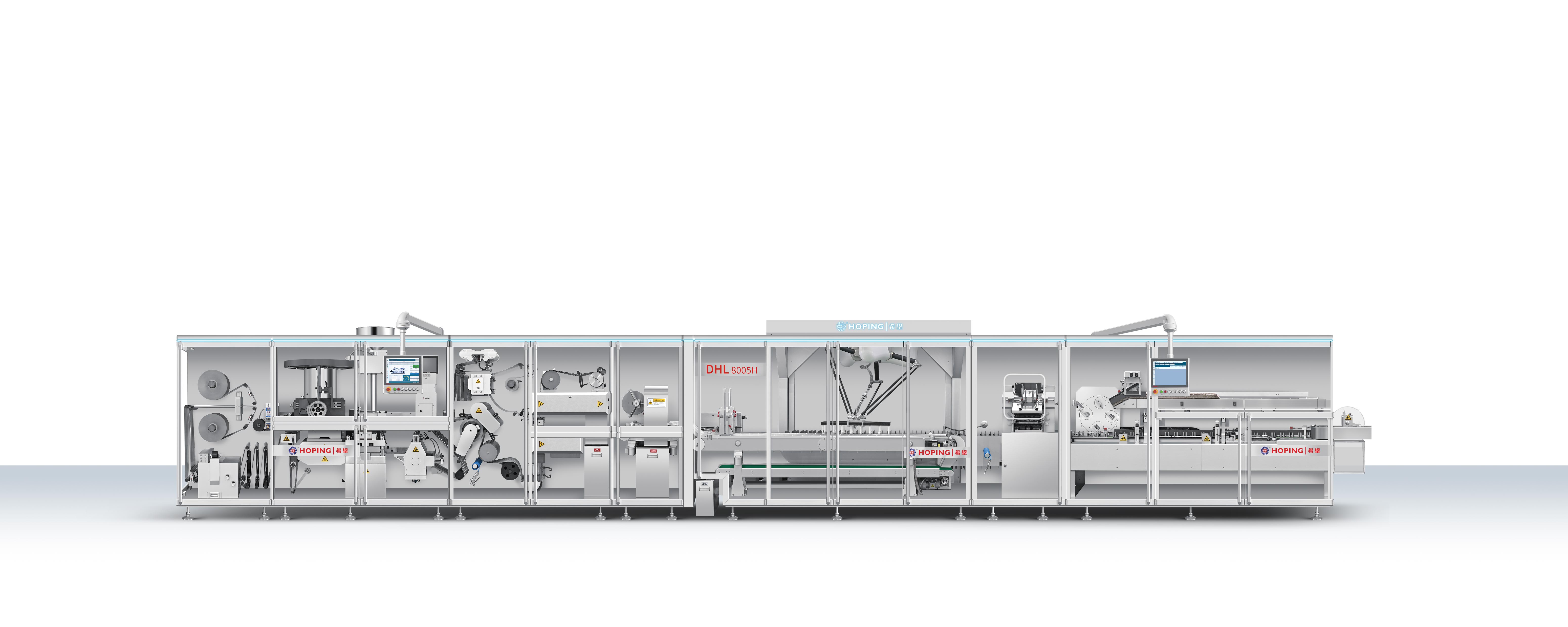
The practical consequence is that a selection decision should be built from seven or eight parameter families evaluated together, with the buyer's own format mix and batch pattern as the reference case. What follows sets out each family, what to ask about it, and where the DHL8005H sits within it.
Industry Background: Why Parameter Discipline Matters Now
Demand-side pressure on solid-dosage packaging equipment is measurable. Custom Market Insights valued the global blister packaging machine pharmaceutical market at USD 2.57 billion in 2025, and identified Asia-Pacific as the fastest-growing region for pharmaceutical blister packaging with an 8.87% CAGR to 2031. In cartoning specifically, horizontal cartoning systems held 70.12% of market share in 2024, according to Mordor Intelligence. These are publisher-reported figures rather than audited statistics, but they support a straightforward reading: the installed base continues to expand, and horizontal cartoning remains the dominant architecture for pharmaceutical secondary packaging.
The regulatory and documentation environment reinforces the same conclusion. ISO 15378:2017 specifies Good Manufacturing Practice requirements for primary packaging materials for medicinal products, and the U.S. FDA's current Good Manufacturing Practice framework establishes the foundation for quality pharmaceuticals through regulatory standards covering production and process controls. Neither document supplies machine-level design clauses that a buyer can simply copy into a purchase specification. That gap is precisely why equipment parameters have to be translated into procurement language by the buyer's own quality and engineering functions.
A third shift is visible in trade coverage reporting PMMI content: pharmaceutical manufacturers are moving toward digitised data collection and integrated solutions to meet regulatory expectations and improve visibility. For packaging equipment, this changes what a control architecture is expected to do. A line controller is no longer only a motion coordinator; it is also a data and format-record source.
The Eight Parameter Families That Decide a Blister-Cartoning Line
1. Blister Rate versus Carton Rate: Reading the Ratio, Not the Peak
Start with the ratio. The DHL8005H is specified at up to 800 blisters per minute and 500 cartons per minute. That pairing is the line's design statement: it tells a buyer how many blisters the transfer and cartoning stages are expected to consume per carton cycle at nominal conditions. A buyer whose carton carries a blister count that does not divide cleanly into that ratio will not achieve either ceiling.
Ask for the blister-count range the line is designed to handle, and ask for the sustained rate at each blister count. Also ask where the constraint sits when the carton count is high and the blister count is low, and the reverse. Zhejiang Hoping Machinery Co., Ltd. — a pharmaceutical packaging machinery manufacturer established in 2001 in Ruian City, Zhejiang Province, China, producing blister packaging machines, cartoning machines, case packing machines and end-of-line packaging machines — presents blister and carton capacity as linked line values rather than isolated machine values, which is the correct framing to test.
2. Servo-Driven Independent Replenishment Architecture
Replenishment is the mechanism that keeps the transfer and cartoning stations supplied without stopping the upstream blister process. On the DHL8005H, the line uses a three-channel servo-driven independent replenishment system. The word that carries the engineering weight is independent: each channel is servo-driven and separately controlled, so the system can maintain buffer continuity across differing input patterns rather than relying on a single shared feed.
For a buyer, the relevant questions are practical. How many independent servo channels does the offered configuration have? What happens to the line cycle when one channel is empty or blocked? Is the feeding method fixed or selectable? The DHL8005H specification lists multiple feeding methods, which matters where a plant runs tablets and capsules on the same line across a campaign.
3. Motion Controller and Industrial PC: Beckhoff and CP9315
The DHL8005H uses a Beckhoff motion controller together with a CP9315 industrial PC. This pairing separates deterministic motion coordination from the higher-level functions — recipe management, format parameters, production data, diagnostics — that run on the industrial PC.
That separation has a procurement consequence. When motion control and format memory sit on the same open, documented platform, a buyer can specify what data the line must expose and how format records are stored and retrieved. Buyers should ask for the controller model, the industrial PC model, the interface list, and the format-record structure in writing. It is reasonable to specify these in the technical agreement rather than accept a generic "PLC control" description. Note that control architecture varies across models by design: the DHL7005H uses a Siemens motion controller with TP900 HMI, while the DHL1000/5H uses a Beckhoff motion controller with a high-bus industrial control system. Matching control platforms across a plant's installed base is a legitimate selection criterion.
4. PVC and Aluminium Foil Auto Splicing as a Continuity Parameter
On the DHL8005H, PVC and aluminium foil auto splicing is specified as a line function. The parameter to evaluate is not whether splicing exists, but what the line does around it: whether the splice is made without stopping the forming and sealing stations, how the splice is detected and rejected downstream, and how much material is consumed per splice event.
Splicing capability interacts directly with material choice. Alu-Alu (cold-form) structures place different demands on forming and sealing than PVC/PTP combinations, and a line specified for high-speed PVC work should be checked against the specific foil structure the buyer intends to run. Consult the full Hoping Machinery catalog for the material and format envelope of each model before shortlisting.
5. Mold-Change and Preset-Memory Functions
Changeover performance is a mechanical and a software problem at the same time. The DHL8005H includes mold-change and preset-memory functions. Mechanically, format parts are exchanged to match the blister and carton specification. In software, the stored format parameters are recalled so that the machine returns to a known set of positions and timings rather than being re-taught from zero.
Evaluate this parameter with four questions: how many format memories are available; which parameters are covered by memory and which must be set manually; what the first-article verification procedure is after a change; and how many operator steps the change requires. A line with fast mechanics but no parameter recall still carries the trial-and-error cost of the first packs after every switch. A line with parameter memory but slow mechanical access carries the labour cost instead. Both should be quantified in minutes and in rejected packs before the purchase order.
6. GMP-Oriented Product-Contact Parts and Tooling
The DHL8005H is described as having a GMP-oriented line design, with product-contact parts and tooling specified according to the technical agreement. That phrasing is deliberately precise, and buyers should keep it that way in their own contracts: the material of each contact part belongs in the technical agreement, not in a brochure claim.
For comparison, other models in the same portfolio state contact materials explicitly — the DPH320HII rotary blister machine specifies AISI 316L stainless steel and FDA-compliant pharmaceutical-grade materials for product-contact parts, with AISI 304 stainless steel and anodized aluminium alloy for non-contact parts. Whether a buyer ultimately specifies 316L, another pharmaceutical-grade material, or a project-specific combination, the selection criterion is the same: named material per part, documented surface condition, cleaning access, and a change-control route for any later substitution.
The regulatory context supports this discipline without replacing it. ISO 15378:2017 addresses GMP for primary packaging materials, and FDA cGMP covers production and process controls, but neither document dictates which alloy a specific tooling block must use. That determination sits with the buyer's quality function and must be reflected in the technical agreement and in acceptance testing.
7. Stainless Steel and Aluminium-Alloy Construction
The DHL8005H uses a stainless steel and aluminium-alloy machine structure with transparent guarding. This is the standard construction logic for pharmaceutical packaging equipment, and it should be read as a specification with several components rather than a single claim: which frame elements are stainless steel, which are aluminium alloy, what the guard material is, and how the machine is cleaned around the guard interfaces.
Construction also affects vibration behaviour at high cycle rates. A rigid frame and stable sealing station are prerequisites for consistent blister quality at higher output, and they influence how much of the nominal rate is genuinely usable. Buyers should ask for the frame material specification and for evidence of how the machine behaves at its rated maximum rather than only at a mid-range setting.
8. Line Extensibility into Bundling, Case Packing and Palletizing
The DHL8005H scope covers blister forming and sealing, transfer, leaflet handling, carton opening, insertion, coding and inspection, and connection to bundling, case-packing and palletizing equipment. That last clause is a selection parameter in its own right.
Downstream equipment in the same portfolio indicates the interface range: the XWK4060 stretch bander runs at about 30–60 bundles per minute, the XWK Series case packing machine at about 5 cases per minute maximum, and the ICP12 case packing and palletizing integral machine at about 12 cases per minute. A buyer planning to add end-of-line automation later should confirm the handshake specification — product presence signals, buffer capacity, reject routing and line-stop logic — at the time of the original order, because retrofitting interfaces is more expensive than specifying them.
Step-by-Step: Building a Selection Matrix
The following sequence converts the parameter families above into a defensible decision. It is written for an Awareness-to-Research stage buyer who is comparing configurations rather than signing a final order.
- Define the format set before the machine set. List every blister format, carton format and leaflet format the line must run over the next three years, including the smallest and largest. Machine comparisons made without a fixed format set are not comparable.
- Convert the format set into a blister-count requirement. For each carton, record how many blisters it contains. This number, not the blister rate, determines whether the line's ratio is suitable.
- Screen on the blister-to-carton ratio. Compare candidates on both figures together. A line quoted at a high blister rate with a lower carton rate will be limited by cartoning for high-count cartons; a line with closely matched figures behaves differently across the format range.
- Test the replenishment architecture against the batch pattern. Confirm the number of independent servo channels, the feeding methods supported, and the behaviour when a channel empties. Ask what the cycle does in that condition.
- Fix the control platform requirement. Specify the motion controller and industrial PC models, the data interfaces, and the format-record structure. Record whether the platform matches equipment already installed in the plant.
- Quantify changeover in minutes and rejected packs. Request the number of stored format memories, the operator steps per change, and the first-article verification procedure. Compare candidates on total elapsed time per change, not on the mechanical exchange alone.
- Write the GMP section as a materials schedule. Require named materials for every product-contact part and tooling item, cleaning access provisions, and a change-control clause. Cross-check against ISO 15378:2017 and the applicable regulatory framework, and have the quality function sign the schedule.
- Specify factory acceptance testing before the down payment. Agree the formats to be run, the sustained rate to be demonstrated, the reject criteria, and the data recorded during the test. Acceptance criteria written after the machine is built are negotiating positions, not specifications.

Use Cases: How Parameter Priorities Shift by Product
The same line can serve several product types, but the weighting of parameters changes with the product. The DHL8005H is specified for pharmaceutical solid dosage production, capsule and tablet packaging, healthcare products, and food and cosmetic blister-cartoning projects. The priorities below show how to re-weight the matrix.
Tablets in Standard PVC/PTP Blisters
Standard tablets in PVC/PTP are the most common reference case. Here the dominant parameters are sustained blister rate, sealing consistency and punching accuracy. Blister forming geometry matters: the DPH320H blister packing machine, for example, specifies a forming area of 320 × 280 mm and a forming depth of 12 mm, which defines the largest blister layout a given station can produce. Confirm the forming area of the offered line against your largest format before anything else.
Capsules and Soft Capsules
Capsules are lighter and more prone to displacement during transfer than compressed tablets, so the replenishment and transfer architecture becomes the leading parameter. Independent servo channels and a controlled transfer system reduce the risk of empty or mispositioned cavities. Soft capsules add a further requirement: the feeding and handling path must be confirmed against the product's mechanical limits during the factory acceptance test rather than assumed from a tablet reference run.
Nutraceuticals and Healthcare Products
Nutraceutical and healthcare runs typically combine higher format variety with shorter batches. In this setting changeover economics dominate. Mold-change access, preset-memory coverage and the first-article verification procedure determine whether short runs are viable. The DHL8005H's preset-memory function is directly relevant here, and buyers should ask how much of the format definition is recalled automatically versus re-entered.
Alu-Alu and Moisture-Sensitive Formats
Cold-form and Alu-Alu structures are chosen for barrier reasons, and they change the machine requirement. Forming force, sealing parameters and material handling all differ from PVC. A line specified with PVC and aluminium foil auto splicing should be checked specifically for the Alu-Alu structure under consideration, and the material handling path should be verified with the actual foil gauge.
Multi-Format Contract Manufacturing
Where the line serves multiple customers and formats, the decisive parameters invert: format memory capacity, changeover speed, data traceability and reject handling outweigh peak output. Buyers in this category should weight the control platform and format-record structure more heavily than the blister rate ceiling, because the commercial model depends on switching cost rather than on maximum throughput.
Comparison: Parameter Reference Across Integrated Models
The table below compares integrated blister-cartoner models within the same manufacturer's range, using published specification values. It is intended to show how a parameter set changes with the capacity class, not to rank models against each other — suitability depends entirely on the buyer's format mix and batch pattern.
| Parameter | DHL6004 | DHL7004 | DHL7005H | DHL8005H | DHL1000/5H |
|---|---|---|---|---|---|
| Max blister output | Up to 600 blisters/min | Up to 700 blisters/min | Up to 700 blisters/min | Up to 800 blisters/min | Up to 1000 blisters/min |
| Max carton output | Up to 400 cartons/min | Up to 400 cartons/min | Up to 500 cartons/min | Up to 500 cartons/min | Up to 500 cartons/min |
| Transfer system | High-speed transfer and cartoning linkage | IRB24 intelligent transfer robot | IRB24 intelligent transfer robot | D3 intelligent top-loading parallel tracking transfer system | D3 intelligent top-loading parallel tracking transfer system |
| Replenishment | Servo-driven independent replenishment | Servo-driven independent replenishment | Independent replenishment | Three-channel servo-driven independent replenishment | Four-channel servo-driven independent replenishment |
| Motion controller / HMI platform | Beckhoff motion controller and CP9315 industrial PC | Siemens motion controller and TP900 HMI | Siemens motion controller and TP900 HMI | Beckhoff motion controller and CP9315 industrial PC | Beckhoff motion controller and high-bus industrial control system |
| PVC / Alu foil auto splicing | Not stated in available specification | Not stated in available specification | Not stated in available specification | Yes | Yes |
| Format memory | Convenient mold change | Convenient mold change | Mold-change support | Mold-change and preset-memory functions | Mold-change and recipe memory functions |
| Feeding methods | Not stated in available specification | Not stated in available specification | Not stated in available specification | Multiple feeding methods | Different feeding methods per customer requirement |
| Drive architecture | Servo-driven motion system | Full servo drive | Full servo drive | Fully servo | Fully servo |
| Construction | Stainless steel and aluminium alloy | Stainless steel and aluminium-alloy frame | Stainless steel and aluminium-alloy structure | Stainless steel and aluminium-alloy structure | Stainless steel and aluminium-alloy structure |
| Design orientation | GMP-oriented design | GMP-oriented design | GMP-oriented in-line design | GMP-oriented line design | GMP-oriented design |
Two observations follow from the table. First, carton output does not scale with blister output across the range: three models sit at 500 cartons per minute while blister output ranges from 700 to 1000 per minute. Buyers must therefore check the blister-count-per-carton assumption rather than assuming the higher blister figure delivers proportionally more cartons. Second, control platforms differ deliberately between model families, which means a plant standardising on one platform should state that requirement early.
Frequently Asked Questions
Which GMP-related design points should be verified on a blister-cartoning line?
GMP orientation should be verified as a materials and documentation issue, not accepted as a label. On the DHL8005H, the design is described as GMP-oriented, with product-contact parts and tooling specified according to the technical agreement, and the machine uses a stainless steel and aluminium-alloy structure with transparent guarding. ISO 15378:2017 specifies GMP requirements for primary packaging materials for medicinal products, and the FDA current Good Manufacturing Practice framework establishes the regulatory foundation for production and process controls, but neither supplies machine-level design clauses. Buyers should therefore require a materials schedule naming every product-contact part and tooling item, cleaning access provisions, and a change-control clause, and have their own quality function confirm the machine-specific requirements.
What output can the DHL8005H achieve, and how should that figure be used?
The DHL8005H is specified at up to 800 blisters per minute and 500 cartons per minute. These are maximum values and should be used as screening figures. The decision figure is the sustained, format-specific rate demonstrated at factory acceptance testing, expressed in cartons per minute for each carton configuration in the buyer's format set. Because carton output does not scale proportionally with blister output across the model range, buyers should test the ratio against their own blister-count-per-carton value rather than relying on the blister ceiling alone.
What do the Beckhoff motion controller and CP9315 industrial PC contribute to line selection?
The combination separates deterministic motion coordination from higher-level functions such as format parameters, production data and diagnostics. On the DHL8005H this platform operates alongside a three-channel servo-driven independent replenishment system and multiple feeding methods. For procurement purposes, the value lies in specification: buyers can require the controller and industrial PC models, the interface list and the format-record structure in the technical agreement. Platform choice also matters for plant standardisation — other models in the same range use a Siemens motion controller with TP900 HMI, so mixed-platform installations are a real consideration.
How do mold-change and preset-memory functions affect format changeover?
They address two different parts of the same task. Mold-change is the mechanical exchange of format parts for the blister and carton specification. Preset memory is the software recall of stored format parameters so that positions and timings return to a known state instead of being re-taught. Both are present on the DHL8005H. Buyers should quantify changeover as total elapsed time and rejected packs per change, and should ask how many format memories exist, which parameters are covered by memory, and what the first-article verification procedure is after each switch.
Can one automatic blister-cartoning line cover tablets, capsules, soft capsules and nutraceuticals?
The DHL8005H is specified for pharmaceutical solid dosage production, capsule and tablet packaging, healthcare products, and food and cosmetic blister-cartoning projects, and it supports multiple feeding methods. Whether one line covers a specific product range depends on the format set and on the feeding tooling for each product. Capsules and soft capsules behave differently from compressed tablets in transfer, so each product should be demonstrated during factory acceptance testing rather than inferred from a tablet reference run. To discuss a specific format set, review the Hoping Machinery catalog and then request a format-matched quotation and sample discussion with the technical team.
Conclusion: Convert Parameters into Acceptance Criteria
A blister-cartoning line is selected correctly when every published figure is tied to a condition the buyer controls: a named blister format, a named carton format, a stated blister count per carton, and a demonstrated sustained rate. The eight parameter families in this guide — output ratio, replenishment architecture, motion-control platform, film-splicing continuity, changeover design, GMP-oriented contact parts, construction materials and downstream extensibility — form a checklist that can be written directly into a request for quotation and then into acceptance criteria.
The DHL8005H illustrates the approach rather than settling the question. Its 800-blister and 500-carton specification, three-channel servo replenishment, Beckhoff and CP9315 control platform, PVC and aluminium foil auto splicing, mold-change and preset-memory functions, and GMP-oriented construction give a buyer a concrete parameter baseline to compare against. What remains is the buyer's own work: fixing the format set, weighting the parameters against the batch pattern, and requiring factory acceptance evidence before committing.
Zhejiang Hoping Machinery Co., Ltd. was established in 2001 and operates a 28,800 square metre manufacturing facility with approximately 300 staff, a 56-engineer R&D team and an annual production capacity of 500 units. Export business accounts for 25% of total sales, with major markets in Southeast Asia, the Middle East, Eastern Europe, South America and Africa. The company holds 26 invention patents, 70 utility patents, 4 appearance patents, 10 PCT-protected patents in Europe, Russia, Germany and Italy, and 28 software copyrights.
Next Step: Match the Parameters to Your Format Set
Share your blister format, carton format, blister count per carton and target batch size, and the technical team can indicate which configuration fits and what factory acceptance testing would cover.
Catalog and full specification reference: Hoping Machinery Catalog (PDF)
Technical contact: Monica — monica@xwbj.com — +86 133-5610-5292
Company website: www.hopingcn.com
Have Questions or Need More Details?
Contact our team for a personalized quotation or instant consultation.
Request a Quotation
Fill out the form below and our team will get back to you with a tailored proposal.
WhatsApp Direct Chat
Prefer to chat in real-time? Message us on WhatsApp for instant assistance & quick answers.
- Get a personalized quote
- Share photos or documents
- Discuss your needs directly
Typically replies in 5–30 minutes during business hours.