
Blister-Cartoning Line vs. Blister-Flow-Wrap-Cartoning Line: A Head-to-Head Decision
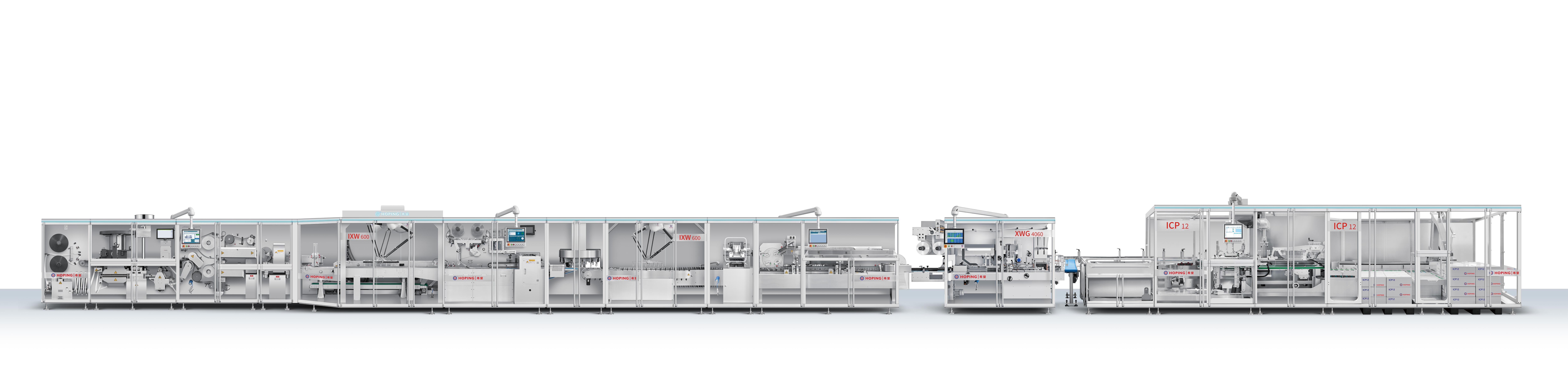
A linked blister packaging line — primary blister forming, secondary wrapping and cartoning integrated on one frame.
Choosing between a straight blister-cartoning line and a blister-flow-wrap-cartoning line is one of the first architecture decisions a solid dosage manufacturer makes when scoping a new pharmaceutical packaging line. Both start from the same point — a formed blister strip filled with tablets, capsules or soft capsules — but they diverge before secondary packaging. A direct blister-cartoning line transfers the formed blister straight into a carton. A blister-flow-wrap-cartoning line inserts a flow-wrapped pillow pack between the blister and the carton.
This guide compares the two architectures head-to-head: what each line does, when direct blister-to-carton is the right answer for tablets, capsules, soft capsules and healthcare products, and when adding a flow-wrapping stage is the better call. All equipment specifications referenced below come from Zhejiang Hoping Machinery’s verified product data, including the DHL8005H Automatic Blister-Cartoning Line.
Problem Definition: When Blister-to-Carton Is (and Isn’t) Enough
The question most solid-dosage buyers bring to equipment suppliers is not which machine is faster. It is whether the extra flow-wrapping stage adds enough protective and commercial value to justify its cost, footprint and complexity. Both architectures end in the same place — a carton carrying a folded leaflet and a coded blister — but the path between blister forming and cartoning determines how the product is protected before it reaches the patient.
Direct blister-cartoning assumes the blister itself is the adequate primary barrier. Once the blister strip is formed, sealed, coded and cut, the individual blister or blister stack is pushed into the opened carton. There is no intermediate pouch or pillow pack.
Blister-flow-wrap-cartoning inserts a sealed pouch — the pillow pack — around each blister or bundle before cartoning. This pouch wraps the blister in polymer film, sealing it once more before insertion into the carton.
The decision hinges on three things: how sensitive the product is to moisture, oxygen and light; how far and through which climate zones the carton travels; and whether the added primary packaging layer converts into commercial or regulatory advantage for the brand owner.
Industry Background: Why This Decision Matters Now
Pharmaceutical packaging machinery has continued to consolidate. According to SkyQuest Technology, the global pharmaceutical packaging equipment market was valued at approximately USD 10.71 billion in 2024. Grand View Research estimates that Asia Pacific held a 40.7% revenue share of that market in 2025 — the largest regional contribution.
The blister segment specifically remains substantial. Custom Market Insights projects the pharmaceutical blister packaging machine market reaching USD 2.57 billion by 2025, expanding at a 2.8% CAGR. For secondary packaging, Fortune Business Insights valued the pharmaceutical cartoning machinery segment at USD 1.46 billion in 2024.
Market concentration also shapes the decision. According to Market Intelligence Report data, the top three global players in pharmaceutical blister packaging — Uhlmann, IMA and Marchesini — collectively hold approximately 29% of the market share as of 2025. The remaining share is served by a broad field of regional and specialized manufacturers, including Chinese suppliers such as Hoping Machinery.
Two compliance standards bookend any architecture choice: ISO 15378, which integrates GMP requirements for primary packaging materials, and the EN 415 series, which governs packaging machinery safety under EU Machinery Directive 2006/42/EC. Both apply regardless of whether a flow-wrapping stage is added, but the flow-wrap architecture introduces extra contact surfaces and film materials that must be validated against the same standards.
How the Two Architectures Work
Direct Blister-Cartoning: The DHL8005H Reference
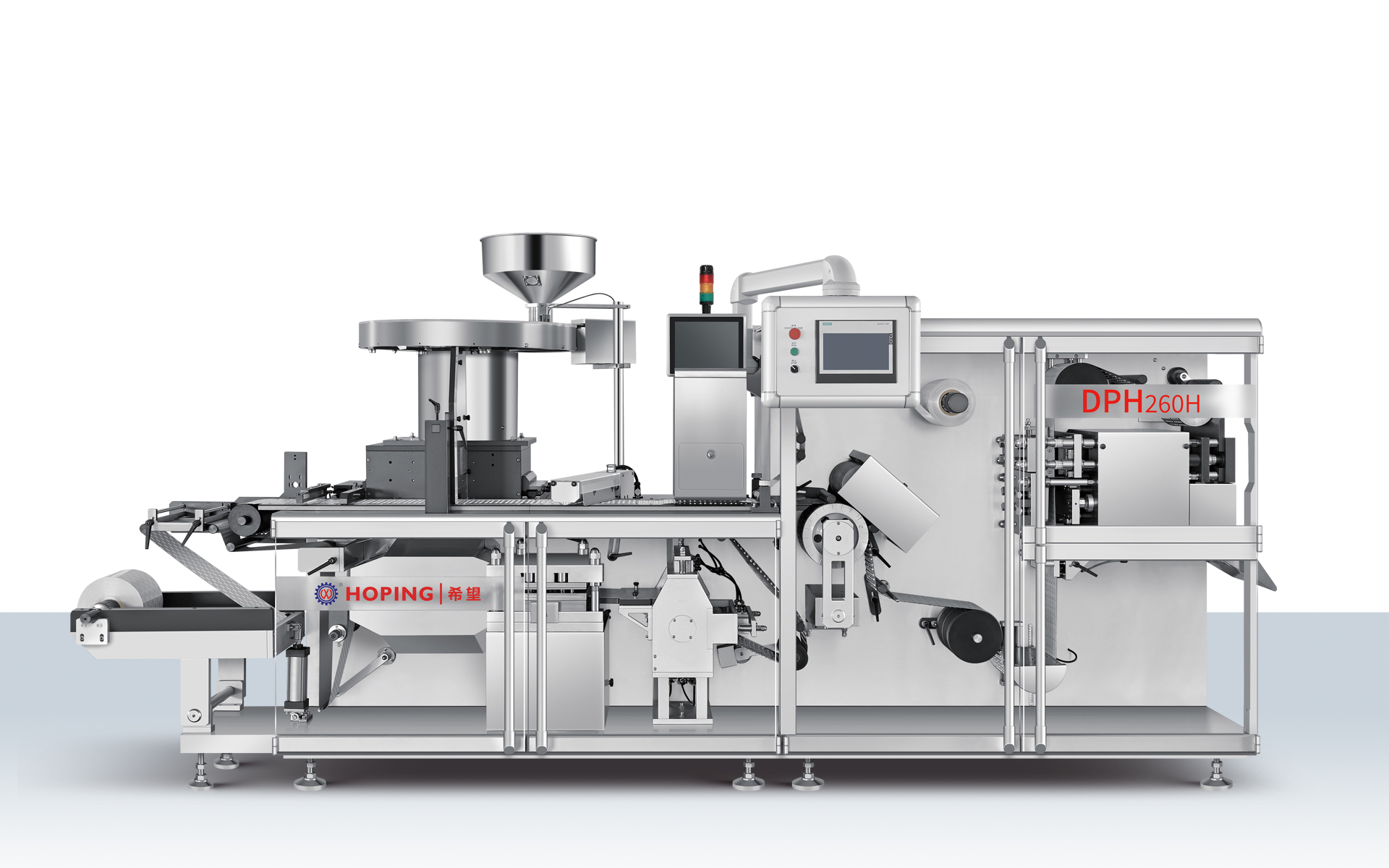
Primary blister forming and sealing stage — the upstream module of a direct blister-cartoning line.
A direct blister-cartoning line combines blister forming and sealing with a high-speed cartoner on a linked frame. The Zhejiang Hoping Machinery DHL8005H is one such integrated line. It is classified as an intelligent fully servo high-speed blister-cartoner integrated machine and is supplied as a solid dosage turnkey packing line.
Its verified specifications and design features include:
- Maximum capacity: up to 800 blisters per minute and 500 cartons per minute.
- Transfer system: a D3 intelligent top-loading parallel tracking transfer system for blister movement from the blister station into the carton infeed.
- Replenishment: a three-channel servo-driven independent replenishment system feeding the blister interface.
- Motion and control: a Beckhoff motion controller paired with a CP9315 industrial PC.
- Material handling: PVC and Alu foil automatic splicing, plus multiple feeding methods configured to the project.
- Changeover and data: mold-change and preset-memory functions, allowing recipe storage between production runs.
- Construction: stainless steel and aluminium-alloy machine frame with transparent guarding, servo-driven motion components, and GMP-oriented product-contact parts and tooling.
- Downstream scope: coded and inspected cartons can connect onward to bundling, case packing and palletizing equipment.
The line is intended for pharmaceutical solid dosage production, capsule and tablet packaging, healthcare products, and food and cosmetic blister-cartoning projects. Its design intent is: take a properly formed blister and convert it into a printed, coded, leaflet-complete carton at high speed — with no intervening pouch stage.
Blister-Flow-Wrap-Cartoning: The IXW600 Reference
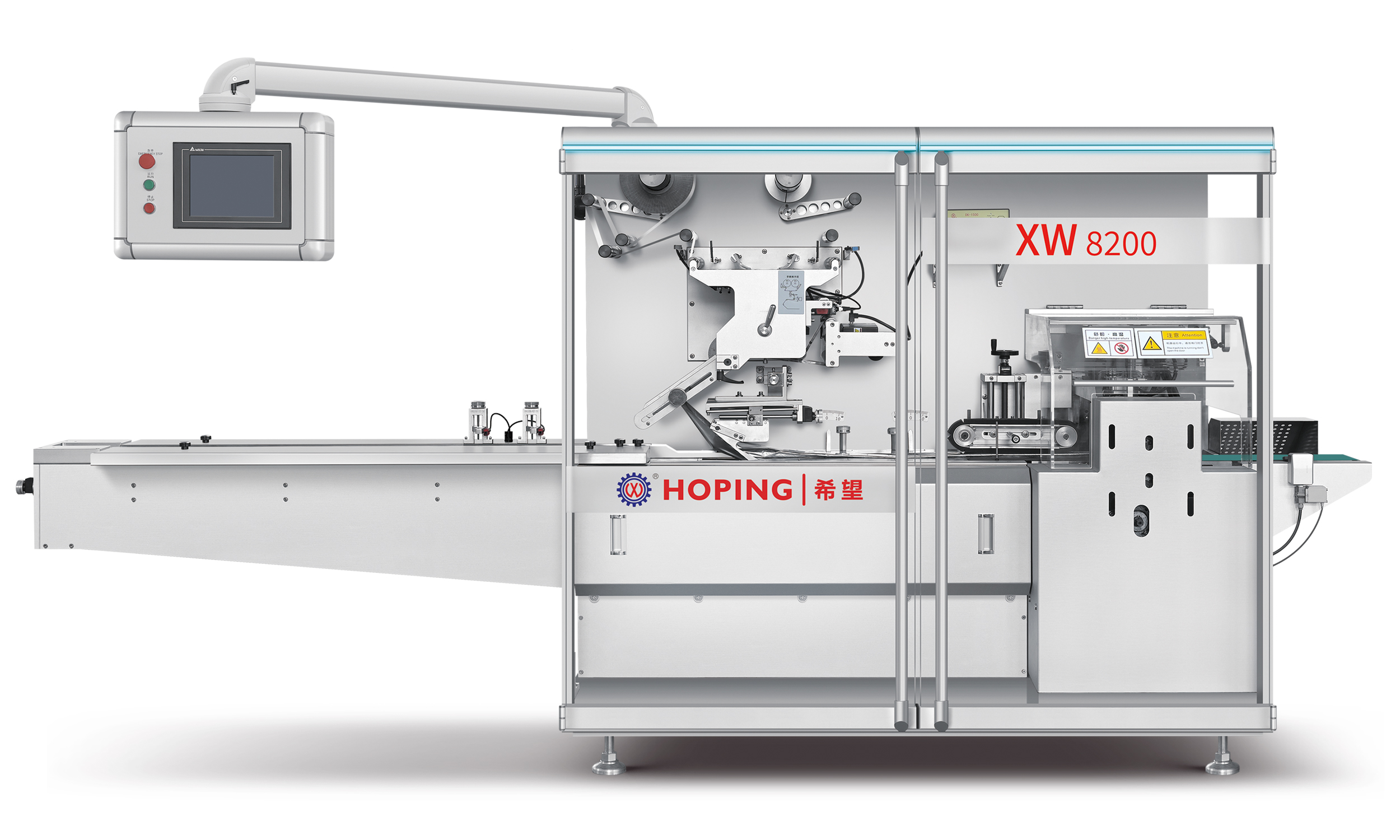
A reciprocating flow-wrapping module — the intermediate stage unique to a blister-flow-wrap-cartoning line.
A blister-flow-wrap-cartoning line keeps the blister stage but inserts a sealed pillow-pack stage between blister forming and cartoning. Referencing Hoping’s IXW600 High-Speed Blister-Flow-Wrap-Cartoning Line, verified characteristics include:
- Maximum capacity: up to 600 blisters per minute, 300 packs per minute and 300 cartons per minute.
- Configuration: intelligent fully servo high-speed blister-flow packer-cartoner integral machine, packaged as a solid dosage turnkey packing solution.
- Film handling: PVC and cold Alu auto splicing.
- Replenishment: servo-driven replenishment.
- Flow-wrap matching: rotary reciprocating flow-wrapper matching technology, with high-speed synchronous linkage between the blister, pillow-pack and cartoning stages.
- Control: Beckhoff controller with CP9315 industrial PC.
- Changeover and construction: mold-change support; stainless steel and aluminium-alloy structure; transparent guards; GMP-oriented design.
Note what changes. The quoted maximum carton output is lower per minute than the direct architecture in the models referenced above, because every carton pass now includes a pillow-pack seal cycle in addition to the cartoning cycle. The line also consumes additional film material and adds an extra product-contact surface that must be validated under the same ISO 15378 and EN 415 frameworks. What the buyer gains is an additional sealed barrier between the blister and the carton — one that can help where product stability depends on moisture, oxygen or light exposure between the blister station and the patient.
Step-by-Step Breakdown: How to Choose
Rather than starting from machine categories, most experienced buyers work through the decision in the following order.
1. Start With the Product, Not the Line
Tablets, capsules and soft capsules are all routinely packed on direct blister-cartoning lines when the blister film itself delivers the intended shelf life. Where the molecule, coating or fill is unusually sensitive to moisture uptake, light or oxygen migration, the question of an added sealed pouch becomes technically relevant. This is a stability question first and a packaging question second.
2. Assess Environmental Exposure
Consider the distribution route. Products shipped through high-humidity, high-temperature regions, or exposed to long transit cycles, are the ones where an additional sealed barrier is most often discussed. If a product is consumed shortly after packing in a stable climate, a direct blister-cartoning line is typically the simpler and more material-efficient answer.
3. Check the Carton Output Balance
A blister-flow-wrap-cartoning line adds a packaging stage with its own nominal rate. In the quoted IXW600 configuration, the flow-wrap stage operates up to 300 packs per minute against up to 600 blisters per minute at the blister stage — a matching relationship the line’s synchronous linkage is designed to preserve. When throughput planning is done, the target commercial carton output per shift should be matched to the slowest stage, not the fastest.
4. Weigh Material and Running Cost
The direct architecture uses blister film and carton board. The flow-wrap architecture uses blister film, pillow-pack film and carton board. Film consumption, film roll changes and additional splicing stations all contribute to running cost. This is not an argument against flow wrapping — it is a cost dimension to be quantified rather than assumed.
5. Confirm Facility Fit
A third packaging stage takes floor space, additional guarding, additional utility connections and an additional qualification exercise. If a facility is already tight or undergoing a lean retrofit, the simpler direct architecture frequently wins on fit alone.
6. Plan the Downstream Handshake
Both architectures can connect to downstream bundling, case packing and palletizing. Hoping’s XWK4060 Stretch Bander (approximately 30–60 bundles per minute), the XWK Series Case Packing Machine (up to about 5 cases per minute) and the ICP12 Case Packing and Palletizing Integral Machine (about 12 cases per minute) can be specified as downstream modules on either line. Specifying the downstream together with the primary line avoids later compatibility adjustments.
Use Cases: Which Line Fits Which Product
Direct Blister-Cartoning — Typical Fit
- High-volume tablet and capsule production where the blister pack alone provides the required barrier.
- Soft capsule and healthcare product packaging where a folded leaflet and coded carton complete the pack.
- Nutraceutical and OTC lines where standardized carton sizes and fast changeover matter more than an additional film layer.
- Facilities planning a single-architecture high-speed line where downstream bundling and case packing are the next priority.
Blister-Flow-Wrap-Cartoning — Typical Fit
- Moisture-sensitive or light-sensitive solid dosage products where an extra sealed pouch is specified.
- Distribution routes involving long transit times or humid regional markets, where the additional sealed layer is judged worthwhile.
- Brand owners who want a pillow-pack presentation inside the carton for reasons of product integrity, handling or commercial differentiation.
- Existing lines where a pillow-pack stage is already in place and the buyer is now integrating that stage into a linked single-frame line.
Comparison Table
| Decision Dimension | Direct Blister-Cartoning Line | Blister-Flow-Wrap-Cartoning Line |
|---|---|---|
| Process sequence | Blister forming/sealing → transfer → cartoning | Blister forming/sealing → pillow-pack flow wrap → cartoning |
| Reference model (Hoping) | DHL8005H Automatic Blister-Cartoning Line | IXW600 High-Speed Blister-Flow-Wrap-Cartoning Line |
| Quoted maximum capacity | Up to 800 blisters/min; up to 500 cartons/min | Up to 600 blisters/min; up to 300 packs/min; up to 300 cartons/min |
| Barrier layers | Blister cavity + carton | Blister cavity + sealed pillow pack + carton |
| Transfer / replenishment | D3 intelligent top-loading parallel tracking transfer; three-channel servo-driven independent replenishment | Servo-driven replenishment; rotary reciprocating flow-wrapper matching |
| Control platform | Beckhoff motion controller + CP9315 industrial PC | Beckhoff controller + CP9315 industrial PC |
| Construction | Stainless steel and aluminium-alloy frame; GMP-oriented contact parts; transparent guards | Stainless steel and aluminium-alloy structure; transparent guards; GMP-oriented design |
| Typical application | Tablets, capsules, soft capsules, healthcare products, food and cosmetic blister-cartoning | Moisture-sensitive or flow-wrapped solid dosage; healthcare products |
| Material consumption | Blister film + carton board | Blister film + pillow-pack film + carton board |
| Downstream compatibility | Connectable to bundling, case packing and palletizing | Connectable to bundling, case packing and palletizing |
FAQ
What standards should a pharmaceutical packaging machine manufacturer meet for a blister-cartoning line?
Two frameworks appear routinely in pharmaceutical packaging machinery specifications: ISO 15378, which integrates GMP requirements for primary packaging materials, and the EN 415 series under EU Machinery Directive 2006/42/EC, which covers packaging machinery safety. When a manufacturer supplies a blister-cartoning or blister-flow-wrap-cartoning line, both architectures must be evaluated against the same standards. The flow-wrap variant simply adds an additional film material and additional product-contact surfaces that need to be documented and validated.
How fast can an integrated blister-cartoning line actually run?
Speed depends on the specific model and the product format. In Hoping’s range, the DHL8005H Automatic Blister-Cartoning Line is quoted at up to 800 blisters per minute and 500 cartons per minute, making it suitable for high-capacity solid dosage production. The DHL7005H and DHL7004 models are quoted at up to 700 blisters per minute, and the DHL6004 at up to 600 blisters per minute. For buyers who prefer the flow-wrap architecture, the IXW600 is quoted at up to 600 blisters per minute, 300 packs per minute and 300 cartons per minute. Actual sustainable speed depends on blister layout, carton size, film type and changeover discipline.
What determines whether a buyer should pay for the extra flow-wrap stage?
The decision is driven by product sensitivity and distribution exposure rather than by a fixed budget rule. If a tablet, capsule or soft capsule remains stable on the blister alone across its intended shelf life and shipping route, the direct architecture is typically the simpler, lower-material-consumption option. Where the product or the route requires an additional sealed layer — for moisture, oxygen or light reasons, or for commercial presentation — the flow-wrap stage is the correct answer, and the cost increase is a consequence of that requirement, not a standalone decision.
Can a buyer validate a blister and carton format before committing to a full line?
Yes. Format validation is normally carried out using project tooling on the blister and carton modules before a full line is finalized. Hoping builds both primary blister machinery — including the DPP Series and DPH Series blister packing machines — and secondary packaging modules such as the XWZ Series cartoning machine and the XW8200 and XW8300 flow packers. Because the same manufacturer supplies both architectures, a buyer can evaluate blister format, pillow-pack format and carton format under one technical agreement before final line configuration is locked.
What should a buyer expect from a pharmaceutical packaging machine supplier after the line is installed?
Reliable integrated lines depend on more than hardware. Hoping Machinery, founded in 2001, operates a 28,800 m² manufacturing facility with approximately 300 staff and a 56-engineer R&D team, and has obtained 26 invention patents, 70 utility patents, 4 appearance patents, 10 PCT-protected patents in Europe, Russia, Germany, Italy and other countries, and 28 software copyrights. The company’s main markets include Southeast Asia, the Middle East, Eastern Europe, South America and Africa, with export business accounting for 25% of total sales. Buyers evaluating either a blister-cartoning line or a blister-flow-wrap-cartoning line can request a quotation, a sample validation, or the full Hoping Machinery Catalog to compare configuration options directly.
Conclusion
Blister-cartoning and blister-flow-wrap-cartoning lines share the same starting point and the same endpoint, but they are not interchangeable. A direct blister-cartoning line such as the DHL8005H is designed for high-capacity solid dosage production — up to 800 blisters per minute and 500 cartons per minute — where the blister itself is the sufficient barrier and carton output is the primary goal. A blister-flow-wrap-cartoning line such as the IXW600 adds a sealed pillow-pack stage, traded against a lower nominal carton rate and additional film and validation effort, in exchange for an additional protective layer.
The right answer depends on the product, the distribution route, the facility and the total cost structure — not on which architecture sounds more advanced. Buyers who work through those dimensions in order usually reach a clear decision before equipment specification begins.
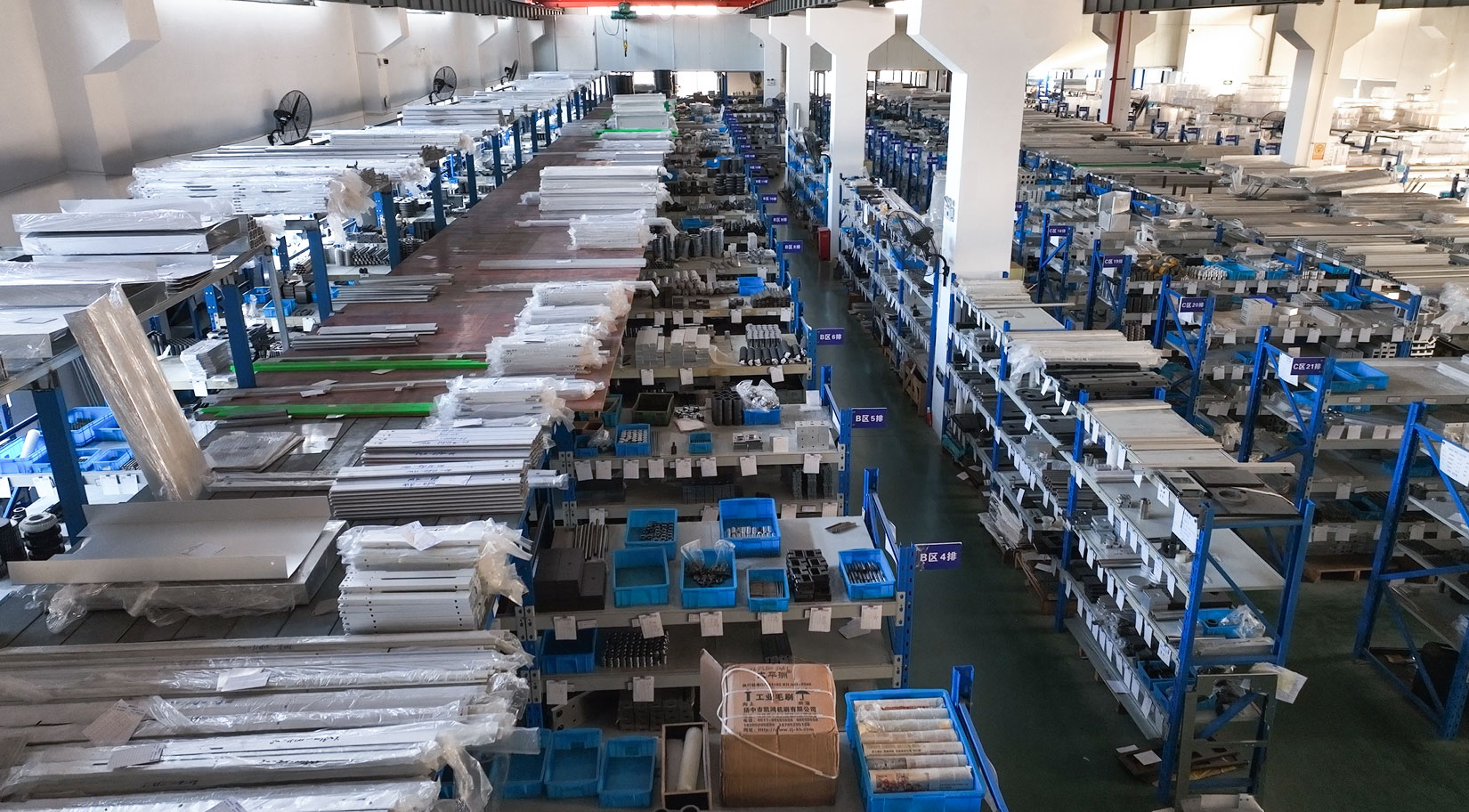
Finished machines staged for shipment at Hoping Machinery, Ruian City, Zhejiang Province, China.
Considering a Blister-Cartoning or Blister-Flow-Wrap-Cartoning Line?
Send us your product format, target carton output per shift and destination market. Our team will map both architectures against your requirements and recommend a configuration.
Request a Quotation