Blister-Cartoning Lines Compared: DHL8005H vs Modular Alternatives for Solid Dosage
Blister-Cartoning Lines Compared: DHL8005H vs Modular Alternatives for Solid Dosage
Pharmaceutical buyers comparing blister packaging lines for tablets and capsules often ask one practical question: should I buy a fully integrated automatic blister packaging line such as the DHL8005H, or should I build a line from modular blister packaging machines, cartoning machines, and separate transfer stations? This guide compares the integrated and modular approaches using the DHL8005H as a high-capacity benchmark and explains the trade-offs in throughput, footprint, automation, capital cost, and long-term supply decisions.
Why This Comparison Matters for Solid Dosage Buyers
Companies that produce tablets, capsules, soft gels, or nutraceutical solid dosage forms eventually need to move from blister packaging into cartoning, and then often into bundling, case packing, or palletizing. The choice is no longer only between two individual machines. It is a decision about line architecture.
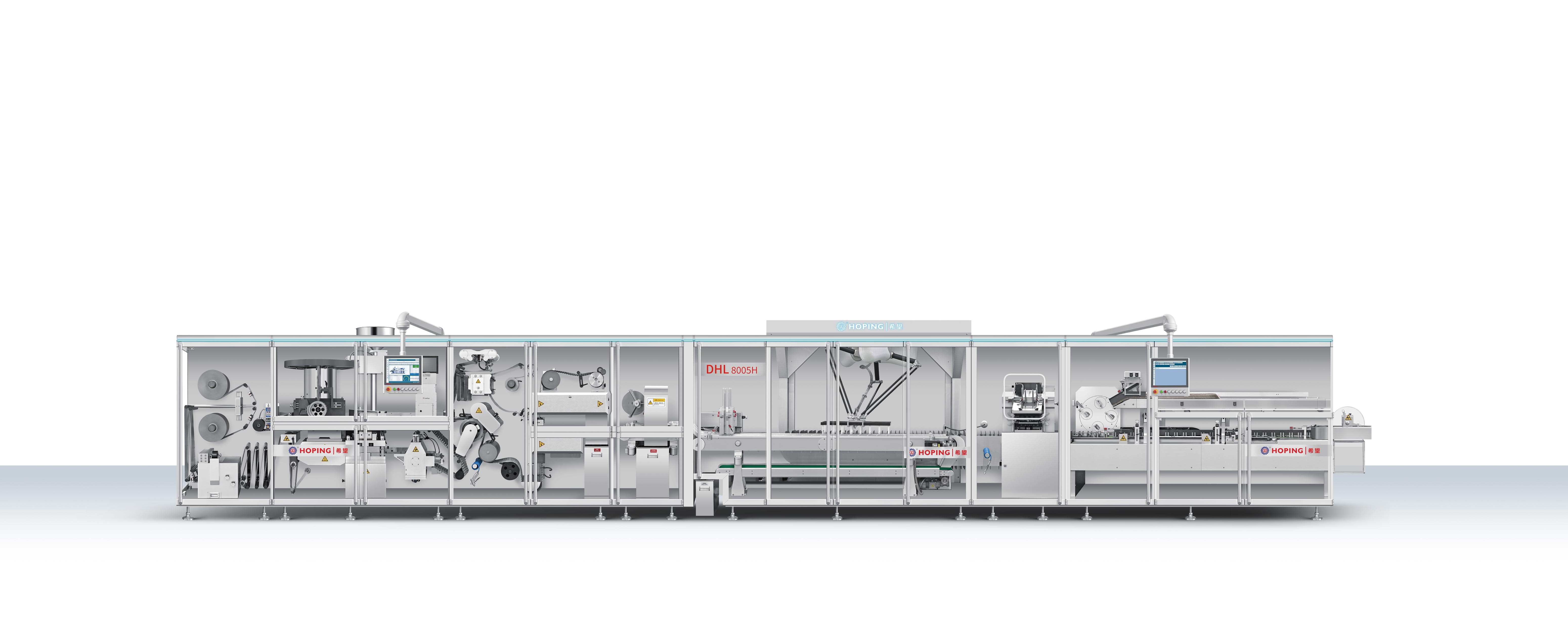
An integrated blister cartoning machine such as the DHL8005H connects blister forming, product feeding, blister transfer, leaflet handling, carton opening, and carton closing in one controlled process. A modular alternative typically uses a blister packaging machine and a cartoning machine from different product families, joined by conveyors and a human or semi-automatic transfer step. Both can produce saleable pharmaceutical packaging. The difference is in repeatability, control continuity, labor requirement, and how easily the line can grow.
What Is the DHL8005H Integrated Blister-Cartoning Line?
The DHL8005H is an intelligent, fully servo, high-speed blister cartoning line manufactured by Zhejiang Hoping Machinery Co., Ltd. (HOPING), a Chinese pharmaceutical packaging machinery manufacturer established in 2001. It is designed for solid dosage turnkey pharmaceutical packaging, with a maximum capacity of up to 800 blisters per minute and 500 cartons per minute. The line uses a D3 intelligent top-loading parallel tracking transfer system, supports multiple feeding methods, and includes automatic PVC/Alu foil splicing. Its control platform uses a Beckhoff motion controller and CP9315 industrial PC. Mold-change and preset-memory functions support format changes, and the line design follows GMP-oriented requirements.
In practical terms, the DHL8005H is a benchmark for what an integrated automatic blister-cartoning solution can deliver in large-volume solid dosage production.
Modular Alternatives: What Buyers Usually Consider
A modular approach means selecting separate machines and integrating them with conveyors or manual transfer. For pharmaceutical solid dosage lines, modular configurations normally include one of the following:
- A platen or roller blister packaging machine (for example, DPP260TI, DPP260K, DPH260H, or DPH320H depending on speed and format needs).
- A standalone automatic cartoning machine (for example, XWZ120, XWZ300II, XWZ500H, or XWZ Series).
- A manual or semi-automatic transfer stage between the blister outlet and cartoner infeed.
- Optional downstream equipment such as an automatic case packer, stretch bander, overwrapper, or case packing and palletizing machine.
This approach has a place. It can be easier to finance in stages, easier to install in an existing building, and easier to replace one machine later. For project teams that already own a reliable blister machine and simply need to add cartoning capacity, a modular line is often the logical route.
DHL8005H vs Modular Line: Key Differences
The differences are not simply a matter of price. They affect how the line operates during normal production, how quality risk is managed, and how much engineering effort is required to make the line stable.
1. Level of Automation and Process Integration
The DHL8005H integrates blister packaging, blister transfer, leaflet handling, carton opening, product insertion, inspection and rejection, and downstream connection in one automated process. This reduces manual intervention and intermediate handling. Modular lines may be automatic within each machine, but the link between machines is often semi-automatic. Fewer controlled transfer points usually means lower risk of missed or delayed product feeding, but the modular line can still perform well when volumes are moderate and labor is available for checks.
2. Speed and Throughput
The DHL8005H can reach up to 800 blisters per minute and 500 cartons per minute. Actual output always depends on product format, number of tablets or capsules per carton, packaging materials, and process conditions. A modular line made from a mid-speed blister machine and a cartoning machine may run at lower combined speed. For example, a platen blister machine may produce 20 to 70 cycles per minute, while a standalone horizontal cartoner such as the XWZ120 runs at up to 120 cartons per minute. The real bottleneck depends on the chosen machine models.
3. Footprint and Layout
Integrated lines such as the DHL8005H are designed to occupy a continuous footprint. Modular lines can be spread across more floor area because conveyors and manual buffer zones are needed between machines. Some buyers assume modular lines are always smaller; in practice, a complete line with conveyors and semi-automatic stations may take up as much or more space than an integrated line designed for the same output.
4. Control Architecture
The DHL8005H uses a Beckhoff motion controller and CP9315 industrial PC, with centralized control and alarm indications. A modular combination may use different control systems on each machine, for example Siemens PLC on one cartoner and separate controls on a blister machine. This does not prevent production, but it means more points for operators to learn and more places where line communication must be engineered.
5. Batch Changeover and Repeatability
Integrated lines with recipe memory allow operators to store parameters for known formats. The DHL8005H includes mold-change and preset-memory functions. A modular line may have recipe storage on individual machines, but coordinating those recipes across machines is usually more manual. For companies producing many SKUs, repeatability is a major consideration.
6. Quality Risk and Traceability
Typical risks in blister-to-carton production include poor blister forming or sealing, missing, wrong or incomplete product feeding, missing leaflets, carton jams, coding or date-printing errors, and foreign matter or contamination risk. Integrated lines respond with sensor monitoring, checkweighing or vision inspection where configured, missing-product alarms, automatic stops, and automatic rejection. Modular lines can be fitted with similar devices, but the buyer must specify and integrate them as a separate engineering task.
7. Initial Investment vs Long-Term Cost
An automatic integrated blister cartoning line generally involves a higher initial investment than standalone or semi-automatic equipment. However, for large-scale continuous production, it can reduce labor, intermediate transfer, management, and quality-risk costs. The total cost decision depends on output targets, labor costs, shift patterns, and the penalty for downtime.
Where the DHL8005H Fits Best
The DHL8005H is best suited to large-scale solid dosage pharmaceutical packaging and high-capacity workshops where production requires reduced manual contact, improved line efficiency, and stable operation. It is also appropriate for multi-format packaging lines that need to change over between blister and carton formats while maintaining predictable output.
Companies in this category often have a high annual volume for a small number of SKUs, or they expect several products to share one high-speed line with controlled changeover windows. They may also be planning export or GMP audits, where fewer manual handling points and documented machine control contribute to a stronger quality story.
Where Modular Alternatives Make More Sense
Modular lines can make sense when:
- Investment is limited and can only be staged over time.
- Output requirements are moderate, such as clinical batches, small contract manufacturing runs, or specialty formats.
- The buyer already owns a reliable blister machine and only needs to add cartoning.
- A very small footprint is needed and no high-speed blisters are required.
- The product range is so varied that a single integrated transfer system cannot handle all formats economically.
In these situations, a modular line built from a compact blister machine such as the DPP260TI or DPP260K and a horizontal cartoning machine such as the XWZ120 can offer a practical balance of cost and capability.
Decision Framework: How to Compare Line Architectures
Before selecting a supplier, buyers should evaluate six dimensions:
- Maximum sustained speed: Do not compare theoretical maximums alone. Compare steady-state output for your actual blister size, carton size, and tablets-per-carton count.
- Automation level: Count the number of manual transfer points. Every manual point is a potential source of product mix-up, delay, and contamination risk.
- Format range: List the blister and carton formats you will run this year and next year. Ask whether the machine can handle each format with the same transfer system.
- Footprint: Obtain a general arrangement drawing for both the integrated line and any modular alternative.
- Changeover time: If you run more than one SKU per week, recipe memory and mold-change convenience matter more than top speed.
- Quality control configuration: Confirm which stations will detect missing tablets, missing leaflets, incomplete cartons, and coding errors.
Comparison Table: Integrated High-Speed Line vs Modular Line
| Comparison Factor | Integrated Blister-Cartoning Line (DHL8005H benchmark) | Modular / Low-Speed Alternative |
|---|---|---|
| Typical configuration | Blister forming-sealing, transfer, cartoning, inspection, rejection, downstream connection in one line | Separate blister machine + cartoning machine + conveyor or manual transfer |
| Rated capacity | DHL8005H: up to 800 blisters/min and 500 cartons/min; actual output depends on format and materials | Typically depends on selected machines; e.g., compact platen blister 20–70 cycles/min, XWZ120 cartoner up to 120 cartons/min |
| Transfer between blister and cartoner | Automated D3 top-loading parallel tracking system | Manual transfer or conveyor between standalone machines |
| Control system | Centralized Beckhoff motion controller and CP9315 industrial PC | Machine-level controls; system integration required at project level |
| Manual intervention | Lower; integrated rejection and alarm functions | Higher depending on intermediate steps |
| Quality-risk management | Sensor monitoring, automatic stop/rejection where configured, centralized fault records | Must be specified separately on each machine and conveyor link |
| Footprint | Continuous line layout with reduced intermediate buffering | Generally larger buffer and conveyor area between machines |
| Initial investment | Usually higher than standalone or semi-automatic equipment | Usually lower, can be staged |
| Long-term labor cost | Lower manual transfer requirement | Higher unless full automation is added later |
| Best fit | Large-scale solid dosage production, high-capacity multi-format lines | Moderate volume, staged investment, specialty packs, existing equipment reuse |
HOPING as a Long-Term Supply Partner
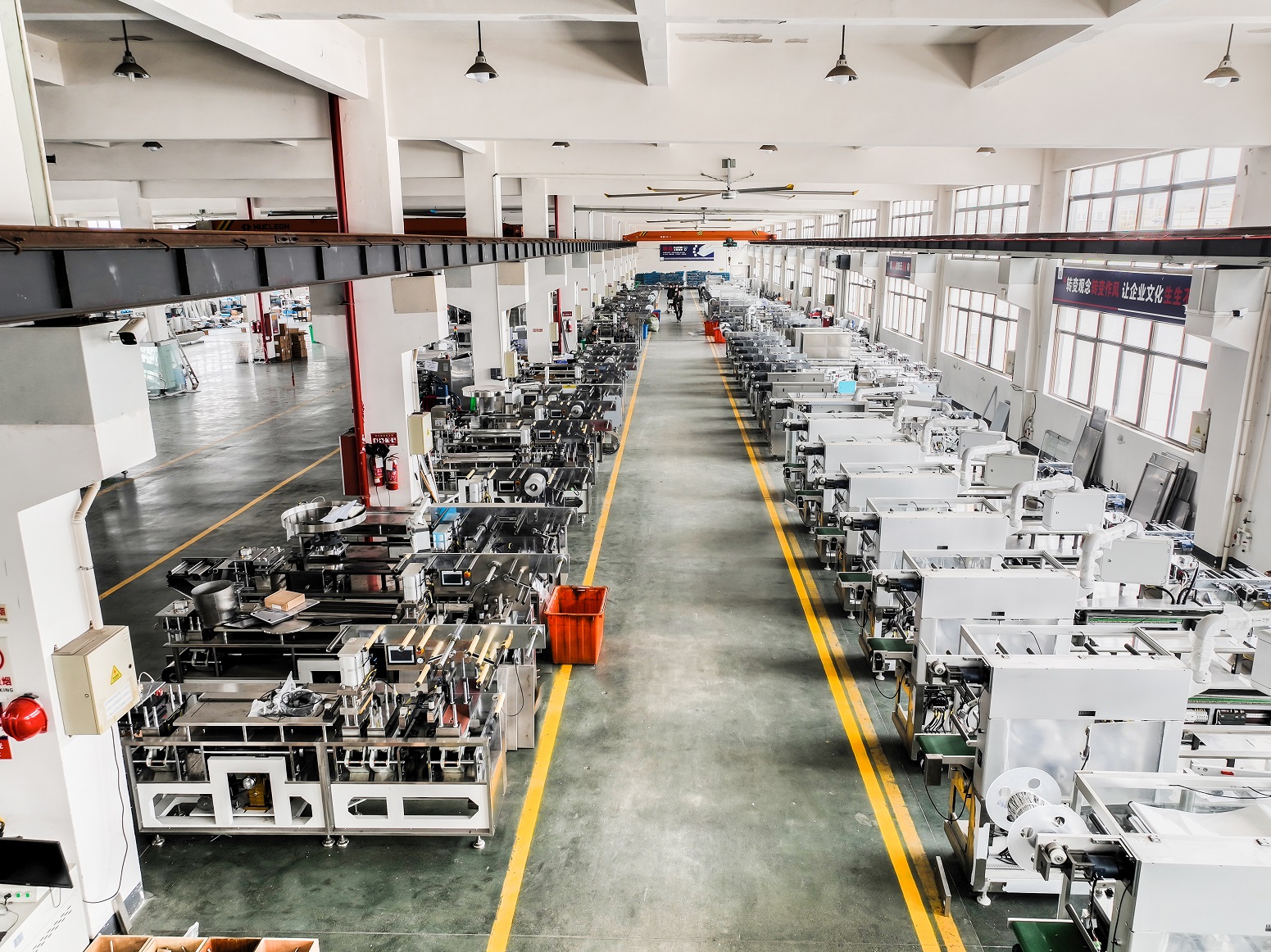
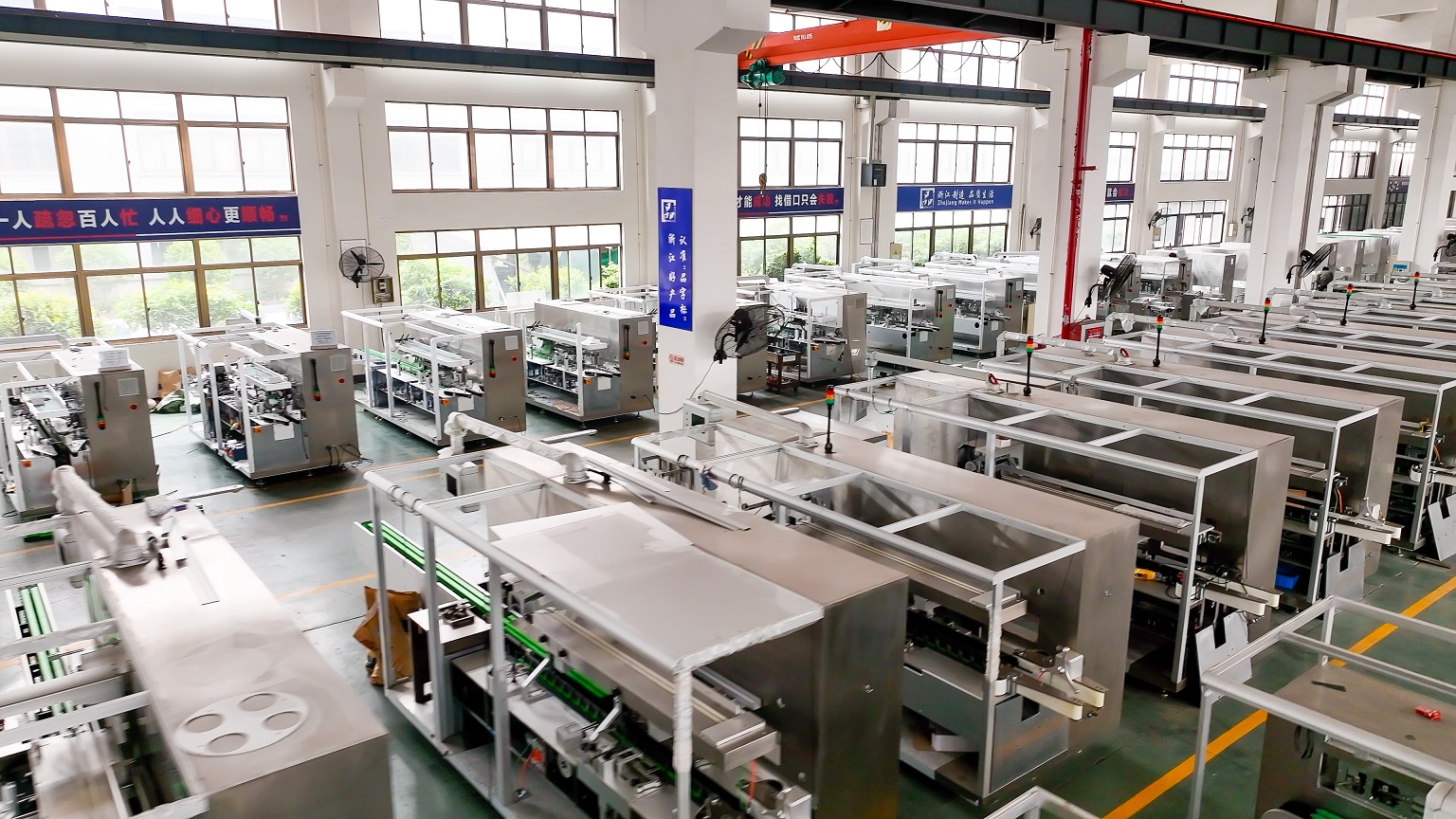
Zhejiang Hoping Machinery Co., Ltd. builds both integrated and modular blister-cartoning lines. The company supplies automatic blister packaging machines, cartoning machines, case packing machines, case packing and palletizing integral machines, stretch banders, overwrappers, and end-of-line packaging machines. Its in-house manufacturing capacity includes machining, blister machine workshops, cartoner workshops, and flow wrapper workshops, which matters when buyers need custom tooling, spare parts, and proven assembly experience over the life of a line.
HOPING reports a factory area of 28,800 square meters, around 300 employees, and 56 R&D engineers. The company produces about 500 units annually and reports a monthly production capacity of 30 to 40 units. Typical production lead time after technical confirmation is 60 to 120 days, and the minimum order quantity is 1 set or 1 complete line. The company mainly serves Southeast Asia, the Middle East, Eastern Europe, South America, and Africa, with about 25% of output currently exported.
Procurement Considerations for Execution Stage
At the Decision-to-Execution stage, the conversation changes from “which technology is better” to “what is required to get a reliable line installed and validated.”
- Technical agreement: Confirm all line connections, utility requirements, format parts, quality-inspection stations, and acceptance criteria before ordering.
- Sample testing: Supplier and buyer should confirm sample blisters, cartons, leaflets, and product dimensions early because transfer-system design is format-specific.
- FAT and SAT: A standard execution path includes factory acceptance testing before shipment and site acceptance testing after installation. Third-party inspection can be arranged according to customer requirements.
- Delivery terms: For export projects, agree on EXW, FOB, CIF, or CFR terms, plus installation, commissioning, training, spare parts, and remote technical support arrangements.
- Payment terms: Terms depend on quotation, contract value, customer credit, project scope, destination market, and final project agreement.
A manufacturer that can handle the full line scope usually reduces the buyer’s engineering and procurement burden. HOPING’s catalog includes blister machines, cartoners, flow wrappers, bundlers, case packers, palletizers, and integrated blister lines for pharmaceutical and related industries.
Risk Control Considerations for Buyers
Long-term line performance is shaped by early risk control. Buyers should look for suppliers that design the solution according to confirmed blister and carton formats, conduct no-load and material tests before shipment, and provide installation, commissioning, training, spare parts, and remote technical support. On high-risk points such as missing product detection and carton jams, the chosen line should include automatic alarms, stops, rejection, and fault records. Customer witness acceptance at key milestones is a normal practice for pharmaceutical line projects.
Ready to compare a full line proposal? For detailed technical parameters of blister lines, cartoning machines, and end-of-line equipment, download the HOPING Machinery catalog. For project-specific line layouts and a formal quotation, contact the HOPING sales team.
→ Download HOPING Machinery Catalog (PDF)
Contact: Monica · Email: monica@xwbj.com · Tel/WhatsApp: +86 133-5610-5292
FAQ
What should a long-term pharmaceutical packaging machine supply partner in China provide?
A long-term supply partner in China should be able to support the full line lifecycle: technical agreement, sample testing, FAT before shipment, SAT at the customer site, installation, commissioning, training, spare parts, and remote technical support. The partner should also have stable in-house manufacturing or assembly capacity and realistic lead times. HOPING states a minimum order quantity of 1 set or 1 complete line, typical lead time of 60 to 120 days after technical confirmation, and monthly production capacity of 30 to 40 units.
Conclusion: DHL8005H vs Modular Alternatives
There is no universally better architecture. The DHL8005H integrated line provides a high-capacity, automation-rich benchmark for solid dosage producers with sustained volume, multi-format needs, and a preference for fewer manual handling points. Modular alternatives remain valuable when buyers need to stage investment, use existing equipment, or run moderate volumes. As a next step, compare both architectures against your actual blister format, carton size, target output, and changeover requirements. Buyers ready to move from planning to line execution should request a formal proposal with a layout drawing, format-specific tooling list, and acceptance schedule.