
CE and GMP: Documenting Your Automatic Blister-Cartoning Line

Short answer: an automatic blister-cartoning line needs two separate document sets, not one combined binder. The CE file proves that the machine meets the safety requirements it was designed against — in HOPING’s certificate set, Machinery Directive 2006/42/EC together with EN 60204-1:2006+A1:2009+AC:2010. The GMP package proves that the line can be cleaned, traced, changed over and re-qualified inside a pharmaceutical quality system. The overlap between the two — construction and material records, control-system records, and tooling agreements — is where most customer audits and most post-delivery disputes are actually decided, and it should be written into the contract before the factory acceptance test, not after installation.
Zhejiang Hoping Machinery Co., Ltd. (HOPING) is a pharmaceutical packing machinery manufacturer established in 2001 in Ruian, Zhejiang Province, China, producing blister packing machines, cartoning machines, case packing machines and end-of-line packaging equipment (www.hopingcn.com). This article explains how a line builder aligns machine documentation with CE and GMP expectations, using documented HOPING specifications as the worked example, and sets out what a buyer should require in writing.
Problem Definition: Why the CE File and the GMP File Drift Apart
Documentation rarely fails because a supplier has none. It fails because the documents were produced by three different owners for three different purposes and were never reconciled. On a blister-cartoning project the owners are the machine builder (safety conformity), the pharmaceutical manufacturer’s quality unit (validation and change control), and — where blister film or lidding foil is in scope — the packaging material supplier.
Five gaps recur:
- Certificate scope versus delivered configuration. A certificate may cover a series, or a sample machine, while the delivered unit carries custom tooling, a different carton magazine or an added inspection device. HOPING’s own file illustrates the difference: UCN 900175009261 (CELAB, 6 November 2006) is recorded against a sample automatic blister packing machine, whereas HTT190102306L and HTT190102307L (Shenzhen HTT Technology Co., Ltd., both 22 January 2019) are recorded against the blister packing machine series and the cartoning machine series respectively.
- Construction described, not evidenced. A datasheet states “stainless steel and aluminum-alloy structure”; the audit asks which grade, for which product-contact part, and with which material certificate. Guard material is another example — the XW8200 flow wrapper uses tempered glass guard doors with an aluminium alloy frame, and that specification belongs in the file, not only in the brochure.
- Control-system change without a record. Servo settings, recipe parameters and format data move after commissioning. If parameter ranges and access levels were never documented, the change cannot be reconstructed at the next audit.
- Tooling ordered later with no technical agreement. A new blister format or carton size is added a year after handover, and nobody can say whether the change triggers re-qualification.
- Version and language drift. The FAT binder exists in one language and revision; the site quality unit works in another. Two versions of the same document then circulate in the same plant.
Industry Background: Which Rules Generate the Paperwork
Two regulatory streams apply to a pharmaceutical blister-cartoning line, and they answer different questions.
Machinery safety and CE marking. The CE route is a safety route. The directive edition and the harmonised standard editions cited in a certificate show its vintage, and HOPING’s records make the point clearly: the 2006 and 2007 certificates cite 98/37/EC with EN 60204-1:1997 and EN 415-3:1999 / EN 415-3:2000, while the 2019 certificates cite 2006/42/EC with EN 60204-1:2006+A1:2009+AC:2010. A buyer preparing a new project should confirm which edition the current certificate and declaration reference rather than assuming that any CE document on file is equivalent to another.
Pharmaceutical GMP. The U.S. FDA describes Current Good Manufacturing Practice as the framework that helps establish the foundation for quality pharmaceuticals through regulatory standards, and publishes guidance covering production and process controls. That framework governs the pharmaceutical manufacturer, not the machine builder directly: the guidance available in this research does not set out machine-specific design rules for packaging equipment. In practice, therefore, machine-level GMP expectations reach the builder through the buyer’s supplier quality agreement, validation protocol and change-control procedure.
One distinction is worth keeping precise. ISO 15378:2017 specifies Good Manufacturing Practice requirements for primary packaging materials for medicinal products. It is a materials standard. Blister forming film and lidding foil fall inside that scope; the blister-cartoning machine that forms and seals them does not. Machine documentation supports the material and process evidence — it does not replace it.
Two further signals shape what buyers now ask for. A draft Chinese GMP guidance for pharmaceutical packaging materials has been reported at public consultation stage, aimed at guiding marketing licence holders when reviewing packaging material suppliers; its status should be confirmed against the issuing authority before it is treated as a rule. Separately, trade coverage of PMMI content reports that pharmaceutical manufacturers are turning toward digitised data collection and integrated solutions to meet regulations and improve visibility — a directional signal, not a measured adoption rate, but consistent with buyers asking for parameter records rather than paper logbooks.
For context on the secondary packaging side: horizontal cartoning systems held 70.12% of the cartoning machine market in 2024, according to Mordor Intelligence, which is the layout most pharmaceutical buyers specify.
Detailed Solution: Five Document Sets That Must Match the Machine
HOPING describes blister packaging, cartoning, inspection and end-of-line automation as one integrated packaging process, and supplies lines that combine blister packing, cartoning, flow packing, case packing and palletizing. The documentation logic below follows the same structure: each module contributes facts that must be recorded, and the interfaces between modules must be recorded as well.
1. Construction and material records
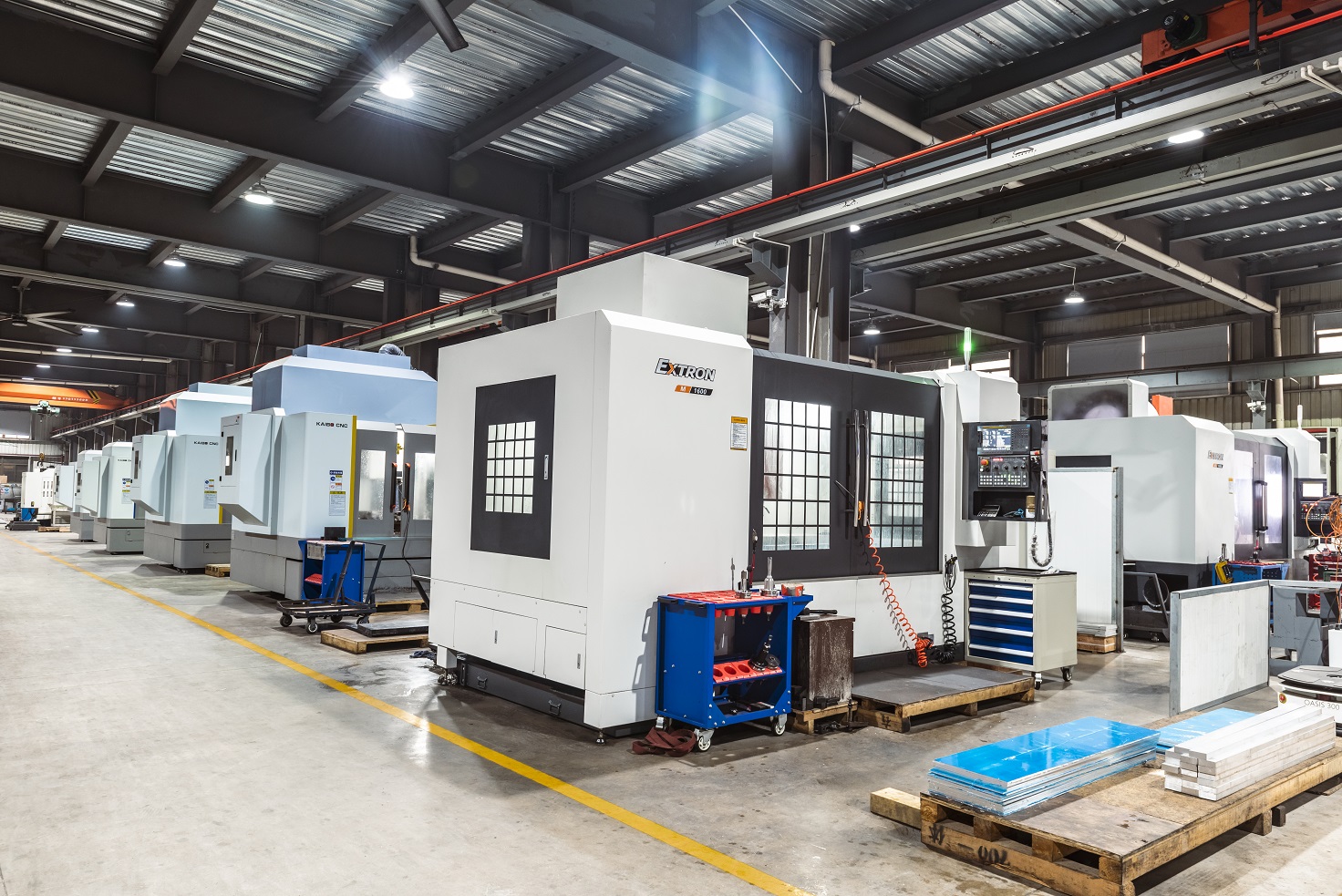
Across the range, the documented construction is consistent: stainless steel and aluminum-alloy structure, transparent guards, and modular forming, sealing, feeding, insertion and closing units. The DPP260K flat blister machine is specified with stainless steel and aluminum-alloy structure, forming, sealing, feeding and cutting units, transparent protective covers and tooling customized by blister format. The DPH series roller machines follow the same pattern with forming, sealing, feeding, punching and cutting modules. The XWZ500H cartoner carries a stainless steel and aluminum-alloy frame with carton magazine, insertion, leaflet and closing modules plus servo, electrical and pneumatic components. The XWK series case packer uses a stainless steel and aluminum-alloy structure with case forming, loading and sealing modules.
What the GMP-facing file must add to that description is traceability. For each product-contact and Product-contact-adjacent part, record the material specification and the corresponding material certificate; state the guard and door materials (tempered glass with aluminium alloy frame on the XW8200, transparent guards on the cartoner and line modules); record gasket and hose materials; and record the surface finish requirement agreed for the application. HOPING’s own application profile describes GMP-oriented cleanroom or pharmaceutical packaging workshop conditions with requirements for stability, easy cleaning, safety protection and traceability-oriented operation — which is precisely the sentence a quality unit will ask you to convert into specifications.
Utilities belong in the same set. The documented compressed-air requirement is 0.5–0.7 MPa across DPP260K, DPH series, XWZ500H and IXW600 (0.4 m³/min, 0.5 m³/min, 0.3 m³/min and 0.5 m³/min respectively), and the XWK case packer requires ≥0.6 MPa at under 1 m³/min. Because the air supply is specified, the air-quality requirement for the cleanroom interface should be stated in the same schedule, with the point of responsibility named.
2. Control-system documentation
Control architecture is where documentation most often thins out. The IXW600 high-speed blister-flow-wrap-cartoning line is specified with a Beckhoff controller and a CP9315 industrial PC, servo-driven replenishment, PVC/cold-Alu automatic splicing, rotary reciprocating flow-wrapper matching, high-speed synchronous linkage, mould-change support and a GMP-oriented design. The XW8200 flow wrapper uses a Siemens control system with 4-axis servo control and automatic film splicing. The XWZ500H cartoner adjusts the pressing carton device by servo through the human-machine interface, uses a servo-driven carton magazine that can hold 1,800 cartons, and a servo-controlled three-way rotary sorting device synchronised at 500 boxes per minute. Line-level control is described as fully servo-linked operation with a PLC/HMI interface, synchronised multi-station control, alarm stop, fault indication, recipe storage and format changeover supported according to configuration.
From those facts, five documents follow: a parameter list with permitted ranges; a format recipe list with the values belonging to each blister and carton format; backup and restore steps for controller and industrial PC; access levels and the written procedure for authorising a parameter change; and an electrical documentation set (schematics, I/O list, component certificates, software and firmware version record). Coding and traceability hardware should be listed separately — the front-mounted batch-number stamping device on the XWZ500H, which allows quicker replacement of the three-date steel characters, and the laser material level detection device that signals when the grid material bin reaches the pre-set height, are both change points that an auditor can ask about.
3. Tooling and format-change technical agreements
Tooling is customized by blister format on both the DPP260K and the DPH series, and on the IXW600 the tooling and material-contact parts are configured to confirmed formats. That makes the tooling agreement the single most valuable document a buyer can negotiate, because it defines what “the same machine” means in year three.
HOPING lists its customization variables as blister size, blister materials, quantity per carton, carton specification, leaflet format, coding and inspection method, feeding method, downstream bundling / case-packing / palletizing connection, interface language, electrical component brand and data interface. Each of those variables should appear in the technical agreement with a drawing revision, an acceptance sample and an owner. The agreement should also state, in advance, when a change triggers re-qualification — typically when format-part geometry, product-contact material, or the packaging material structure changes.
4. Conformity evidence and certificate scope
HOPING’s certificate file is a useful teaching case because it contains four CE certificates issued over twelve years by three different bodies:
- UCN 900175009261 — CELAB, issued 6 November 2006, recorded against a sample automatic blister packing machine, citing EN 60204-1:1997, EN 415-3:1999, 73/23/EEC, 93/68/EEC, 98/37/EC and 98/79/EC.
- UCN 900339024607 — Certify International Ltd, issued 1 April 2007, recorded against the carton packing machine series, citing EN 415-3:2000, 98/37/EC and 98/79/EC.
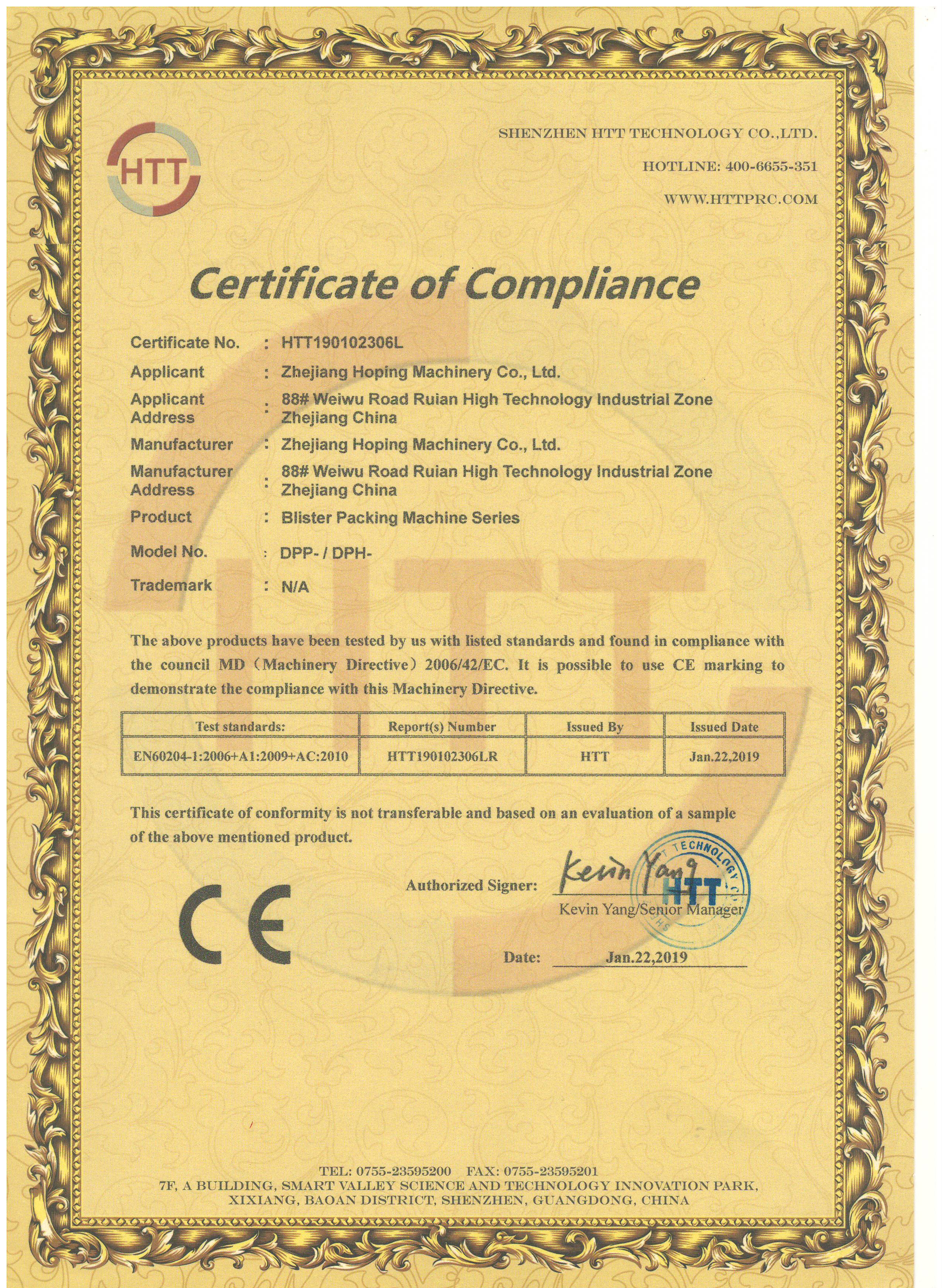
- HTT190102306L — Shenzhen HTT Technology Co., Ltd., issued 22 January 2019, recorded against the blister packing machine series, citing Machinery Directive 2006/42/EC and EN 60204-1:2006+A1:2009+AC:2010.
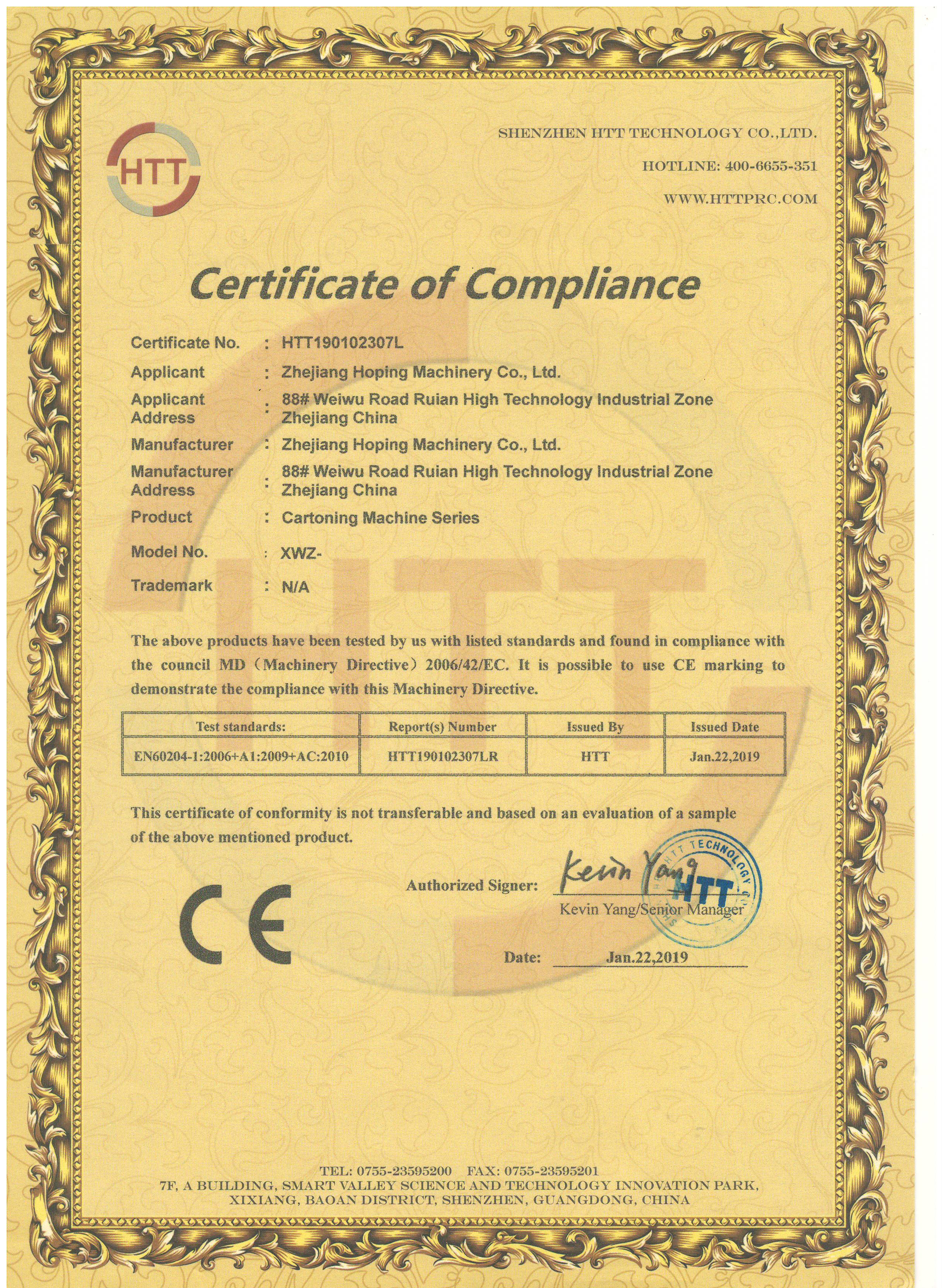
- HTT190102307L — Shenzhen HTT Technology Co., Ltd., issued 22 January 2019, recorded against the cartoning machine series, citing EN 60204-1:2006+A1:2009+AC:2010 and 2006/42/EC.
Read that list the way an auditor reads it: check the scope sentence, check the directive and standard editions, check whether the record covers a series or a single sample unit, and check that the declaration of conformity shipped with your machine identifies the machine you actually received. Management-system certificates sit alongside but answer a different question. HOPING holds ISO 45001:2018 certificate CN00123S33121R1M/3300 and ISO 14001:2015 certificate CN00123E33896R1M/3300, both issued in October 2023 by China Quality Certification Centre (CQC), with a scope covering the design, production and after-sales service of packing machines and packing production lines. Those certificates carry fixed validity periods, so record the expiry date in the contract and re-check it at each audit cycle rather than filing it once.
5. Build, test and acceptance records
The quality-control sequence is the natural backbone of the GMP-facing evidence pack. HOPING’s documented sequence runs through incoming material inspection, key component inspection, assembly inspection, electrical safety check, no-load trial run, material trial, FAT, customer witness acceptance and pre-shipment inspection. Each step should produce a named record, and the material trial should be run with the actual blister format and carton so that it becomes the reference baseline for later re-qualification.
Step-by-Step Breakdown: Building the Document Package in Seven Moves
- Fix the regulatory scope before the RFQ. State the destination markets, whether CE marking is required, and which directive edition the project will reference. A file built to 98/37/EC is not the same artefact as one built to 2006/42/EC, and HOPING’s certificate history shows both vintages in circulation.
- Freeze the packaging specification. Blister format and material, carton size, leaflet format, coding method and inspection method. Every downstream document — tooling drawing, recipe, FAT protocol, re-qualification trigger — references this frozen set.
- Attach a documentation schedule to the technical agreement. List each document, its language, its revision rule, its owner and the milestone at which it is due. Add the customization variables HOPING already tracks — blister size, carton specification, downstream connection, interface language, electrical component brand and data interface.
- Build the CE technical file per machine. Risk assessment, drawings, electrical schematic, component certificates, software version record, declaration of conformity, and the marking decision. Keep it machine-specific; a series certificate is supporting evidence, not a substitute.
- Build the GMP-facing package with the buyer’s quality unit. Material certificates for product-contact parts, guard and surface specifications, cleaning considerations, calibration list, parameter ranges, access levels, change-control procedure and the re-qualification criteria agreed with tooling.
- Review at FAT, not after shipment. Use the material trial and customer witness acceptance as the document review gate. Correcting a parameter list or a drawing revision on site costs more than correcting it in the workshop.
- Lock post-delivery change control. Tooling, spare parts, software and parameters all change. Define who approves, who records, and what triggers re-qualification. HOPING’s after-sales scope — on-site installation and commissioning, operator and maintenance training, remote support, spare parts supply and process-parameter guidance — is where most of those changes will actually occur.
Use Cases: Which Documents Matter Most in Four Buying Situations
New line for an EU-bound solid dosage plant
The CE file carries the weight. Confirm the current directive and standard editions, obtain the declaration of conformity per machine, and confirm that custom tooling is inside the assessed configuration. Pair it with the GMP package so the same binder answers both the notified-body question and the site quality question.
Capacity expansion on an existing line
When a cartoner or flow wrapper is added downstream of an installed blister machine, the interface is the risk. Document the line-level control link, the utility data (compressed air at 0.5–0.7 MPa, and the electrical rating of each module — 9.5 kW for DPP260K, 14 kW for XWZ500H, 16 kW for XW8300), and the transfer points. An interface that is not documented becomes an unowned fault.
Multi-format contract manufacturing
Format count drives documentation volume. Each blister format and carton size needs its own drawing revision, format-part list and acceptance sample, and the recipe set stored in the controller should map one-to-one to that list. A servo-driven carton magazine holding 1,800 cartons and servo carton-height adjustment through the HMI reduce changeover effort — but only if the parameter values per format are recorded.
Non-EU market with a customer audit
Where CE marking is not the commercial driver, the GMP package carries the deal. Management-system certificates, material certificates, calibration records and the FAT document set are what the customer’s quality unit will sample. This is also where the ISO 15378 distinction matters: your customer may be qualifying a packaging material supplier at the same time, and the machine evidence must support, not duplicate, that file.
Comparison Table: Documented Facts by Machine Module
The table below uses only documented specifications, and shows how each module contributes different facts to the same file.
| Module and model | Documented construction | Documented capacity and control | Document to agree in the contract |
|---|---|---|---|
| Blister, flat plate — DPP260K (Alu-PVC / Alu-Alu) | Stainless steel and aluminum-alloy structure; forming, sealing, feeding and cutting units; transparent protective covers; tooling customized by blister format | 20–70 cycles/min; 380V 50Hz 9.5kW; air 0.5–0.7 MPa, >0.4 m³/min | Blister-format tooling drawing revision plus material certificates for product-contact parts |
| Blister, roller — DPH Series | Stainless steel and aluminum-alloy machine frame; forming, sealing, feeding, punching and cutting modules; transparent protective guards; tooling customized to blister format | 60–200 cycles/min depending on model; 380V 50Hz approx. 15.5–18.9kW; air >0.5 m³/min | Format-part register per model, with spare recommendations |
| Cartoner — XWZ500H | Stainless steel and aluminum-alloy frame; carton magazine, insertion, leaflet and closing modules; servo, electrical and pneumatic components; transparent guards | 100–500 cartons/min; 380V 50Hz 14kW; servo carton-height adjustment via HMI; 1,800-carton magazine; three-way rotary sorting at 500 boxes/min | Parameter list, access levels and change record covering recipes and servo settings |
| Flow wrapper — XW8200 | Stainless steel cover and conveyor belt; tempered glass guard doors with aluminium alloy frame | ≤200 packs/min; 4-axis servo; Siemens control; automatic film splicing | Guard and door material record plus film-splice procedure |
| Integrated line — IXW600 | Stainless steel and aluminum-alloy machine structure; transparent guards; servo and pneumatic modules; tooling and material-contact parts configured to confirmed formats | Up to 600 blisters/min, 300 packs/min, 300 cartons/min; Beckhoff controller with CP9315 industrial PC; PVC/cold-Alu auto splice; mould-change support; GMP-oriented design | Line-level risk assessment, interface list and controller backup/restore procedure |
| Case packer — XWK Series | Stainless steel and aluminum-alloy structure; case forming, loading and sealing modules; servo, electrical and pneumatic components; transparent guards | Models XWK900 and XWK600; max output about 5 cases/min; 380V 50Hz 7.5kW; air ≥0.6 MPa | End-of-line interface and handover document between cartoner and case packer |
Frequently Asked Questions
Which CE documents should a buyer ask for before ordering an automatic blister-cartoning line?
Ask for four layers: the declaration of conformity issued for the machine itself, the CE certificates and test reports covering the series, the technical file contents that support them (risk assessment, drawings, electrical schematic, component certificates), and the build and test records. HOPING’s file shows why the edition matters: HTT190102306L (blister packing machine series) and HTT190102307L (cartoning machine series) were both issued on 22 January 2019 by Shenzhen HTT Technology Co., Ltd. against Machinery Directive 2006/42/EC and EN 60204-1:2006+A1:2009+AC:2010, while the earlier UCN 900175009261 (6 November 2006, CELAB, recorded against a sample automatic blister packing machine) and UCN 900339024607 (1 April 2007, Certify International Ltd, carton packing machine series) cite the earlier directive numbering 98/37/EC and earlier editions of EN 415-3 and EN 60204-1. A new purchase should reference the current edition, and the declared scope must match the model and configuration being delivered.
How do you verify a supplier that markets itself as a CE-certified pharmaceutical packaging machine manufacturer?
Check the certificate number with the issuing body, read the scope sentence, and confirm the listed product series includes the model you are buying. Then compare the certificate with the delivered machine, because the machine-level document is the declaration of conformity, which should identify the machine, the directive edition and the standards applied. HOPING’s file publishes checkable details — certificate numbers, issuing bodies and issue dates — and its management-system certificates state a scope covering the design, production and after-sales service of packing machines and packing production lines: ISO 45001:2018, CN00123S33121R1M/3300, and ISO 14001:2015, CN00123E33896R1M/3300, both issued in October 2023 by China Quality Certification Centre (CQC). Management-system certificates carry validity periods, so record the expiry date in the contract and re-check it each audit cycle.
What should a tooling technical agreement contain for a blister-cartoning line?
At minimum: the blister format drawing and its revision, carton specification, leaflet format, material specification for format parts and product-contact parts, the format-part list with spare recommendations, the changeover procedure, and an acceptance sample for each format. HOPING customises blister size, blister materials, quantity per carton, carton specification, leaflet format, coding and inspection method, feeding method, downstream connection, interface language, electrical component brand and data interface, so each of those variables should appear in the agreement with an owner and a revision number. The agreement should also state in advance when a change triggers re-qualification — for example when format-part geometry or material changes.
How is the control system documented for a GMP review?
Document the platform, the parameter set, the format recipes and the change procedure. On the IXW600 line, HOPING specifies a Beckhoff controller with a CP9315 industrial PC, servo-driven replenishment, PVC/cold-Alu automatic splicing and mould-change support; the XW8200 flow wrapper uses a Siemens control system with 4-axis servo control and automatic film splicing; and the XWZ500H cartoner adjusts the pressing carton device by servo through the HMI. The package should include the parameter list with permitted ranges, the format recipe list, backup and restore steps, access levels and a written parameter-change record. The published specifications do not state an audit-trail function, so if your quality system requires attributable electronic records of parameter changes, specify that as a project requirement and verify it at FAT.
How long does delivery take, and can documents be reviewed before shipment?
HOPING states a typical lead time of 60–120 days after technical confirmation, subject to model, configuration, project complexity and contract terms, with a minimum order of one set or one complete line. Document review can be built into the acceptance sequence, which runs through incoming material inspection, key component inspection, assembly inspection, electrical safety check, no-load trial run, material trial, FAT, customer witness acceptance and pre-shipment inspection. Reviewing the file at FAT is materially cheaper than correcting it after installation, and a document list can be attached to the quotation so both sides work from the same schedule.
Conclusion
CE and GMP documentation for an automatic blister-cartoning line is not one deliverable but two, joined at three points: construction and material records, control-system records, and tooling agreements. Get those three right and the rest of the file follows — the certificate scope matches the delivered machine, the parameter list matches the recipe set, and the format-part drawing matches the blister that comes off the line in year three.
For buyers, the practical sequence is simple: state the directive edition, freeze the packaging specification, and attach a named document schedule to the technical agreement before the purchase order. For builders, the same schedule is the difference between a series certificate on file and a machine that can be defended at a customer audit.
Next step: request a line configuration together with the document schedule that goes with it — certificate scope, material records, parameter list and tooling agreement — so the paperwork is agreed at the same time as the machine.
Download the current catalogue: Hoping Machinery Catalog (PDF)
Contact: Monica | Email: monica@xwbj.com | Tel / WhatsApp: +86 133-5610-5292
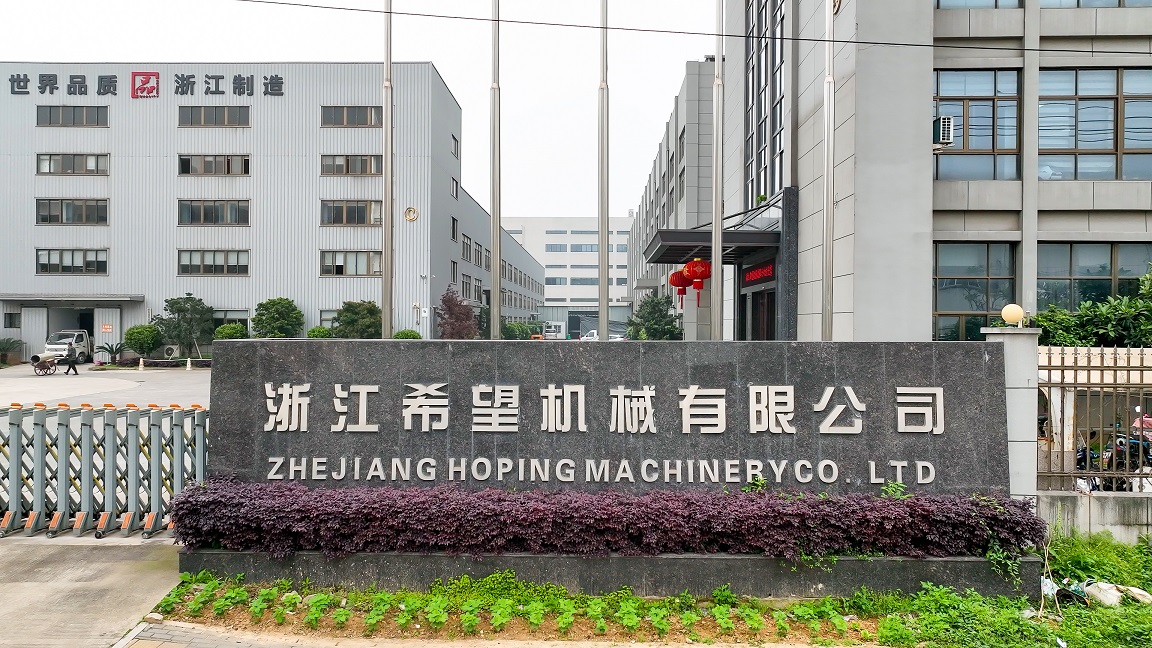
Zhejiang Hoping Machinery Co., Ltd., 88th Weiwu Road, Nanbin Sub-district, Ruian City, Zhejiang Province, China | www.hopingcn.com
Have Questions or Need More Details?
Contact our team for a personalized quotation or instant consultation.
Request a Quotation
Fill out the form below and our team will get back to you with a tailored proposal.
WhatsApp Direct Chat
Prefer to chat in real-time? Message us on WhatsApp for instant assistance & quick answers.
- Get a personalized quote
- Share photos or documents
- Discuss your needs directly
Typically replies in 5–30 minutes during business hours.