
Evaluating Supplier Capability for 800 Blisters/Min Integrated Blister-Cartoning Lines
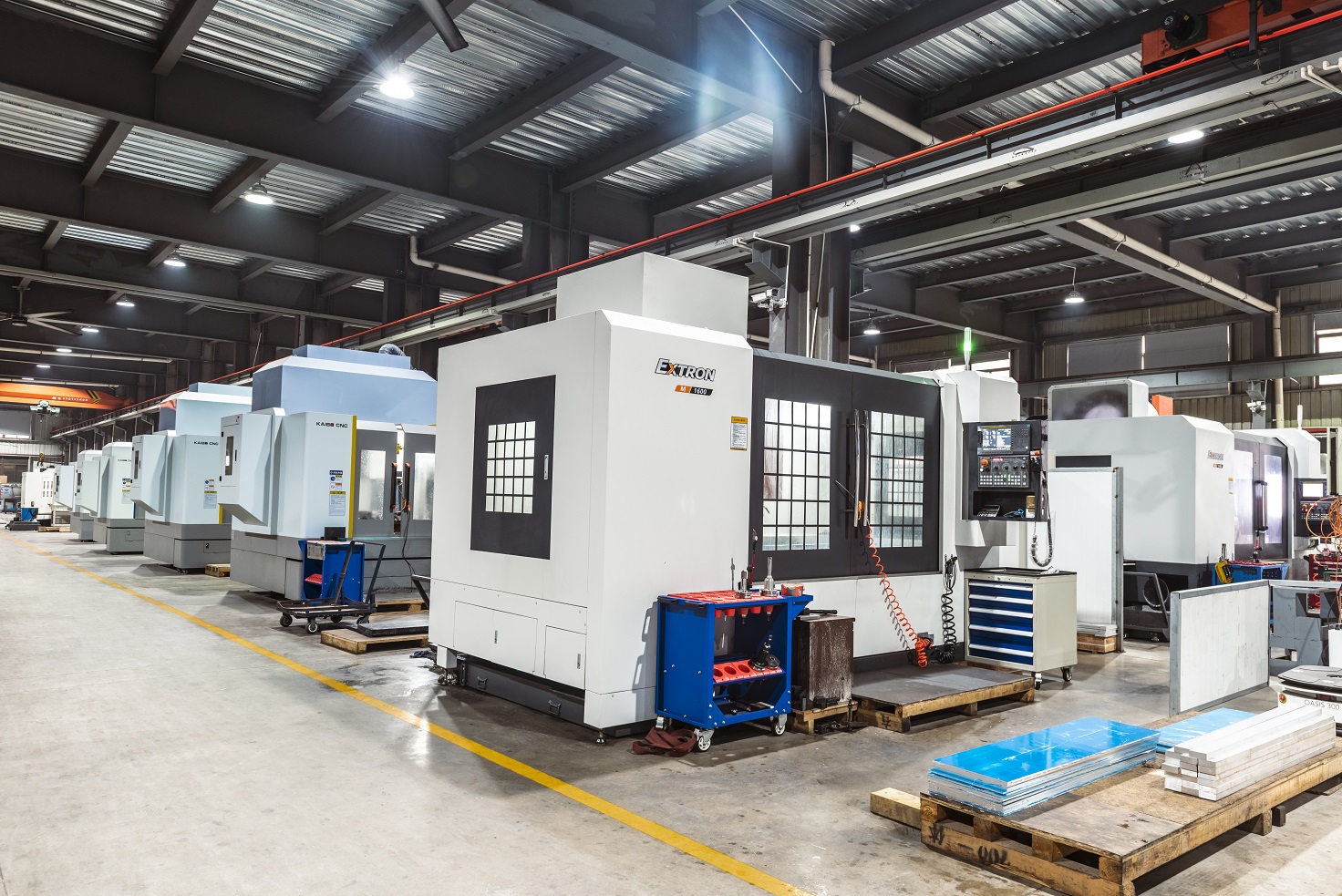
Cover: In-house machining is the first physical check behind any 800 blisters/min claim. Image: Zhejiang Hoping Machinery Co., Ltd. machining workshop.
A line rated at 800 blisters/min and 500 cartons/min is not proven by one output figure. It is proven by the architecture behind that figure: which motion controller and industrial PC run the line, how blisters are transferred into the carton, how many independent servo-driven replenishment channels feed the cartoner, which cartoner model is installed, and which acceptance tests can be witnessed at your own format and carton count.
Zhejiang Hoping Machinery Co., Ltd. (Hoping) is a pharmaceutical packing machinery manufacturer established in 2001 in Ruian City, Zhejiang Province, China. Hoping builds blister packing machines, cartoning machines, case packing machines and end-of-line packaging equipment, and supplies integrated blister-cartoning lines such as the DHL1000/5H and DHL8005H. Its website is www.hopingcn.com.
This guide is written for buyers in the evaluation stage. It sets out a nine-point capability framework, an eight-step audit sequence, the documents to request in writing, a configuration comparison of integrated blister-cartoning lines, and the questions that separate a configured engineering answer from a datasheet answer.
Problem definition: the two numbers inside an 800 blisters/min claim
High-speed blister-cartoning claims usually combine two different quantities that must not be read as one operating point. The first is sub-system rated capacity: the maximum the blister former, the transfer unit or the cartoner can each reach. The second is simultaneous line output: the rate the whole line can hold when blister forming, transfer, leaflet insertion, carton erection, insertion, closing and coding all run at the same instant for one specific format.
A simple ratio check shows why the distinction matters. On the DHL8005H, Hoping specifies a maximum capacity of up to 800 blisters/min and 500 cartons/min. Dividing 800 by 500 gives 1.6 blisters per carton. Because a carton cannot hold a fraction of a blister, the pair of numbers describes the ceiling of each sub-system, not one simultaneous state. If your carton contains two blister cards, 500 cartons/min would require 1,000 blisters/min, which exceeds the blister rating. The correct question is therefore: what is the simultaneous line output for my blister-per-carton count, carton size and leaflet requirement?
The second part of the problem is transparency of the bill of materials. Two lines can both be described as 'fully servo, high-speed, integrated' while using a different motion controller vendor, a different transfer principle, a different number of replenishment channels and a different cartoner model. Without the named architecture, a buyer cannot compare quotations or predict where the line will lose output after commissioning.
Industry background: why verification has become the bottleneck
The market context explains why so many suppliers now quote high-speed integrated lines, and why the burden of verification has shifted to the buyer. SkyQuest Technology values the global pharmaceutical packaging equipment market at approximately USD 10.71 billion in 2024. Fortune Business Insights values the cartoning machinery segment within the pharmaceutical sector at USD 1.46 billion in 2024. Custom Market Insights projects the pharmaceutical blister packaging machine market to reach USD 2.57 billion by 2025, with a CAGR of 2.8%.
Regional demand is concentrated. Grand View Research records Asia Pacific holding the largest revenue share of the pharmaceutical packaging equipment market in 2025 at 40.7%. Supply, by contrast, is fragmented: Market Intelligence Report data indicates that the top three players in the pharmaceutical blister packaging machine market, Uhlmann, IMA and Marchesini, hold approximately 29% of that market in combined share. The remaining share is spread across many regional and specialist builders, so brand recognition alone cannot carry a supplier evaluation.
Published market estimates should be treated as directional rather than exact. Available figures diverge: SkyQuest reports USD 10.71 billion for 2024 while Grand View Research reports approximately USD 7.0 billion for 2025, a gap that reflects differences in whether primary and secondary equipment are counted together. The same caution applies to individual machine specifications: a single number should be traceable to a named source, a certificate or a witnessed test.
Two standards frameworks frame the audit. ISO 15378 integrates GMP requirements for primary packaging materials, which makes documentation and design practice part of the technical assessment rather than a paperwork formality. In the EU, machinery safety is governed by Machinery Directive 2006/42/EC and the EN 415 series for packaging machines, which is the standard family referenced in the CE certificates discussed below.
Evaluation principle: For every performance claim, ask for the named sub-system, the named control component and the test that confirms the claim at your format. A claim that cannot be attached to a component model or an acceptance test is a marketing statement, not an engineering specification.
Detailed solution: a nine-point supplier capability framework
1. Control architecture: name the motion controller and the industrial PC
Control architecture is the fastest way to distinguish a configured high-speed line from a re-labelled standard machine. Within Hoping's integrated blister-cartoning portfolio the control platforms are documented per model: the DHL8005H, DHL6004, IXW800 and IXW600 use a Beckhoff motion controller with a CP9315 industrial PC; the DHL1000/5H uses a Beckhoff motion controller with a high-bus industrial control system; the DHL7005H and DHL7004 use a Siemens motion controller with a TP900 HMI; the liquid-dosage IXW400 uses a Siemens controller with a CP9315 industrial PC. Ask the supplier to state the controller model, the industrial PC or HMI model, the servo drive series and the fieldbus for the exact model you are buying. A supplier that cannot name them for the specific machine is describing a category, not a line.
2. Transfer principle: continuous top-loading or indexing
The transfer between the blister former and the cartoner is where speed claims usually break down, because it is the interface between two machines running at different rates. Documentation should state the transfer principle and the transfer model. Hoping's DHL1000/5H and DHL8005H use a D3 intelligent top-loading parallel tracking transfer system; the DHL7005H and DHL7004 use a self-developed IRB24 intelligent transfer robot; the IXW800 combines D3 top-load robotics with a rotary manipulator. For a buyer, the useful question is not which principle sounds more advanced, but how the transfer behaves when the cartoner stops for a carton mis-feed, and what happens to the blister packs already in motion at that moment.
3. Replenishment architecture: how many independent servo-driven channels
Cartoner feeding at several hundred cartons per minute is not achieved by one feed channel. Hoping documents a four-channel servo-driven independent replenishment system on the DHL1000/5H and a three-channel servo-driven independent replenishment system on the DHL8005H; the DHL7005H, DHL7004 and DHL6004 use independent replenishment, and the IXW800 and IXW600 use servo-driven independent replenishment. Ask how many independent channels exist, whether each channel has its own servo drive, and how the control system responds when one channel runs empty while others continue. That behaviour determines whether a single-starved channel becomes a line stop or a recoverable event.
4. Material handling: PVC and Alu foil auto splicing
Film changeover is a recurring, predictable interruption on a high-speed line. PVC/Alu foil auto splicing is documented on the DHL8005H and DHL1000/5H, PVC or cold-Alu auto splice on the IXW800 and IXW600, and PVC plus top-cover film auto splicing on the IXW400. Ask for the splice method, the film roll payload, and whether the line continues running during the splice. Auto splicing is a supporting capability, but its presence or absence changes the realistic daily output of a line rated in the hundreds of blisters per minute.
5. Cartoner capability: which cartoner supports the 500 cartons/min figure
A 500 cartons/min line claim has to be matched by a cartoner that can actually reach that rate. Hoping's XWZ500H is a full servo high-speed cartoning machine with a capacity of about 100 to 500 cartons/min, and its scope covers carton opening, product insertion, leaflet insertion, carton closing and coding or inspection integration according to project configuration. Other cartoners in the portfolio reach lower ceilings: the XWZ series covers about 100 to 400 cartons/min or 100 to 300 cartons/min depending on model, the XWZ300II covers about 60 to 220 cartons/min, and the XWZ120 covers about 30 to 120 cartons/min. During evaluation, identify the cartoner inside the integrated line and confirm that its rated range covers your target rate with acceptable margin.
6. Format changeover: mold change and preset memory
For contract manufacturers and multi-product plants, changeover time decides real capacity. Hoping documents mold-change and preset-memory functions on the DHL8005H, mold-change and recipe memory on the DHL1000/5H, and mold-change support on the DHL7005H, DHL7004, DHL6004 and IXW600. Ask how many formats can be stored, whether preset memory covers the cartoner and the blister former together, and whether stored parameters include sealing temperature, forming pressure and transfer timing rather than only mechanical positions.
7. GMP-oriented design and documentation
The integrated lines are described as GMP-oriented, with stainless steel and aluminium-alloy machine structures, transparent safety guarding, and product-contact and format parts configured according to a technical agreement. Product-contact parts on Hoping's blister machines are specified as AISI 316L stainless steel and FDA-compliant pharmaceutical-grade materials, while non-product-contact parts are manufactured from AISI 304 stainless steel and anodized aluminium alloy, with corrosion-resistant and easy-to-clean surfaces. These are the details that a quality department will ask about during a supplier audit, so they should appear in the technical agreement rather than only in a brochure.
8. Certification evidence: check scope, number and validity date
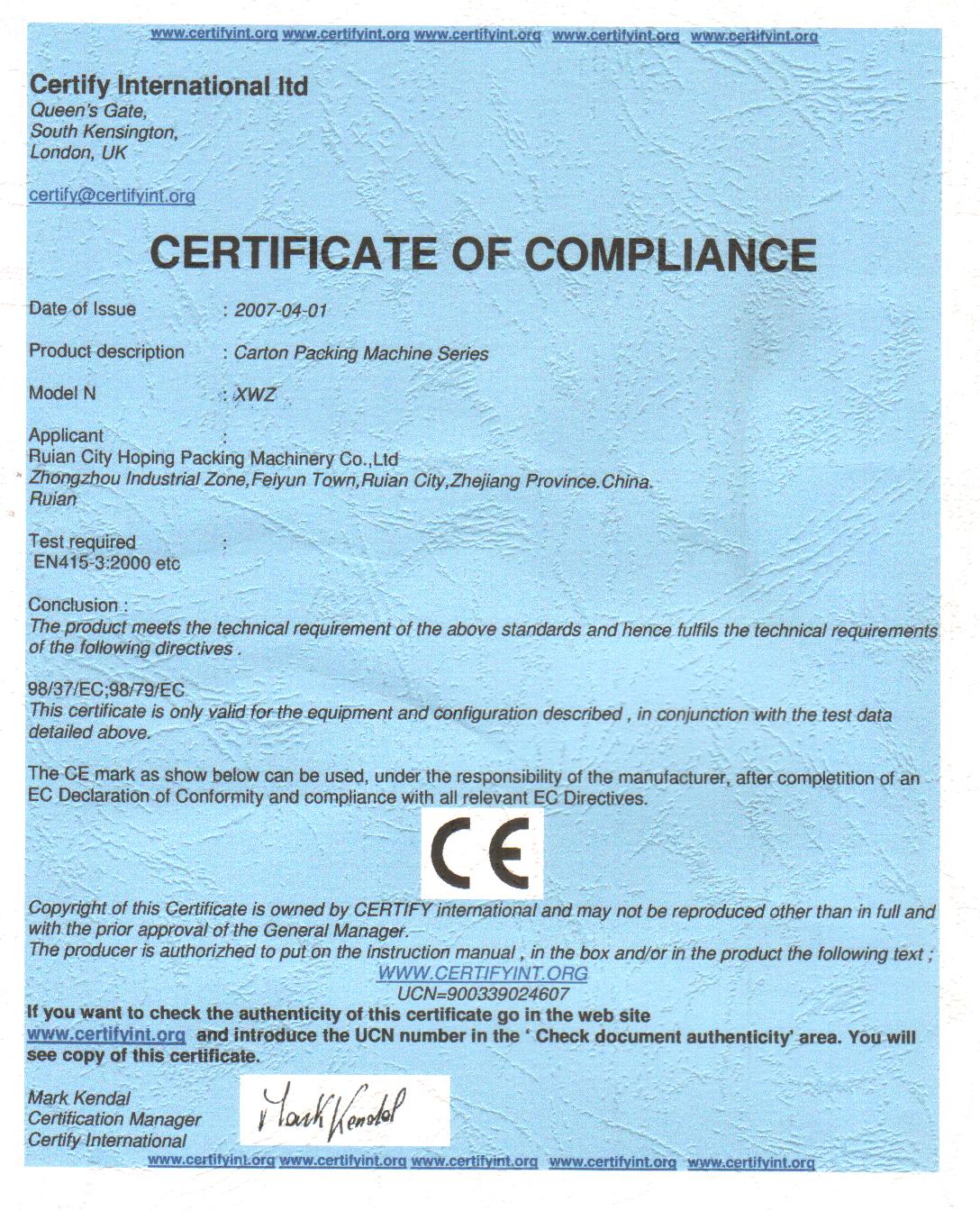
Proof: CE certification evidence for the cartoning machine series should be checked for certificate number, standard and scope. Image: Hoping Machinery CE certificate.
Certification is not a logo; it is a document with a scope, an issuing body, a standard and an expiry date. Hoping holds CE certificate HTT190102307L for the cartoning machine series, issued on 22 January 2019 by Shenzhen HTT Technology Co., Ltd. against EN 60204-1:2006+A1:2009+AC:2010 and 2006/42/EC, and CE certificate HTT190102306L for the blister packing machine series, issued the same day by the same body. Historical CE evidence also exists for a carton packing machine series (certificate UCN 900339024607, issued by Certify International Ltd on 1 April 2007 against EN 415-3:2000, 98/37/EC, 98/79/EC, 73/23/EEC and 93/68/EEC) and for a sample automatic blister packing machine (certificate UCN 900175009261, issued by CELAB on 6 November 2006).
Management-system certificates are separate from product CE marking. Hoping holds ISO 14001:2015 certificate CN00123E33896R1M/3300, issued by the China Quality Certification Centre (CQC) on 12 October 2023 with validity to 11 October 2026, and ISO 45001:2018 certificate CN00123S33121R1M/3300, issued by CQC on 10 October 2023 with validity to 9 October 2026. Both are scoped to the design, production and after-sales service of packing machines and packing production lines. Because management-system certificates expire, the audit should confirm that the certificate is still within its validity period or has been renewed at the time of purchase.
9. Manufacturing, quality control and acceptance testing
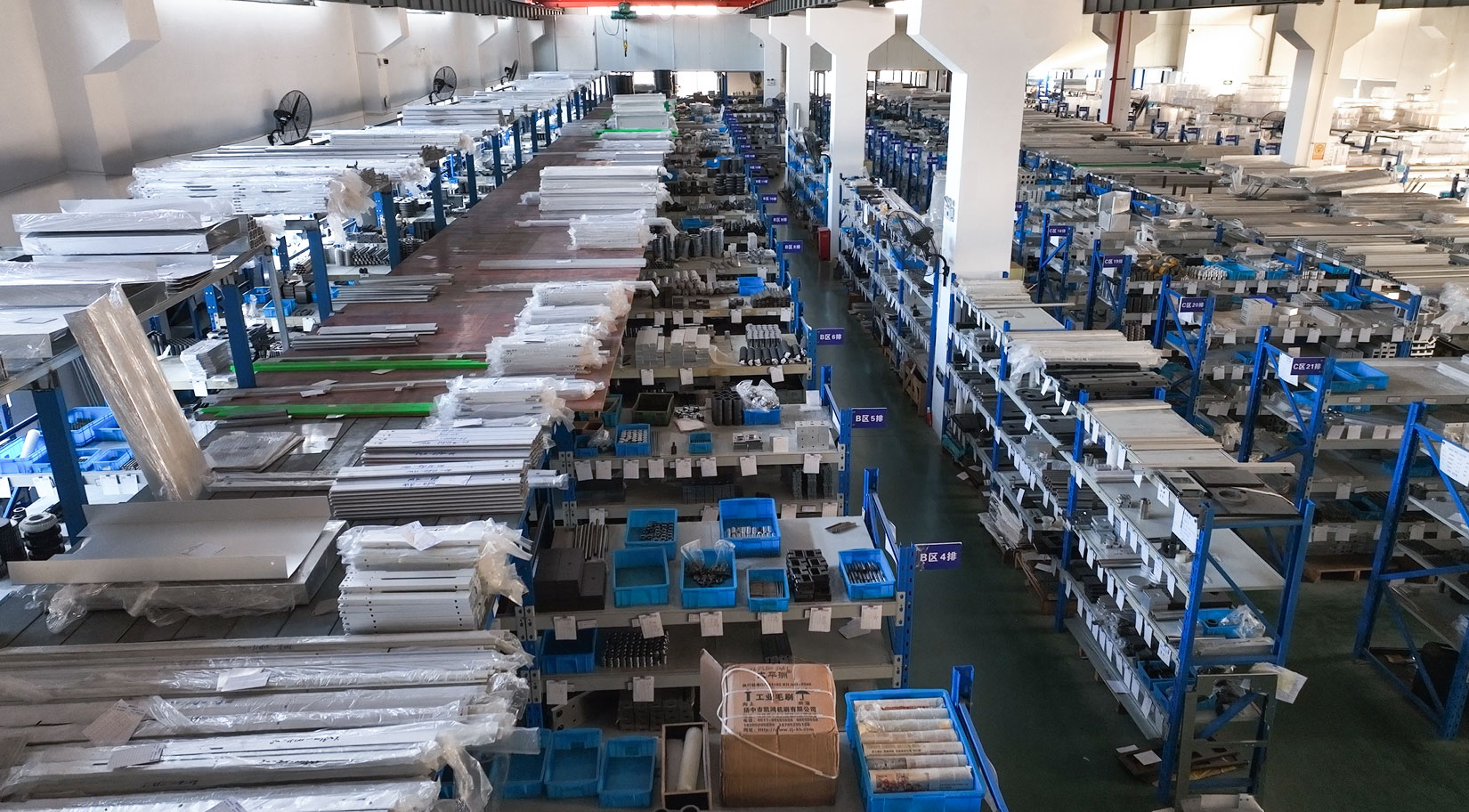
Supporting: warehousing and pre-shipment staging support spare-part availability and dispatch planning. Image: Hoping Machinery warehouse.
Capability is ultimately a production fact. Hoping was established in 2001, occupies a 28,800 m² facility, employs more than 300 people and maintains a 56-engineer R&D team, with an annual output of 500 units, a monthly capacity of 30 to 40 units and an export ratio of 25% across Southeast Asia, the Middle East, Eastern Europe, South America and Africa. The documented quality-control sequence runs through incoming material inspection, key component inspection, assembly inspection, electrical safety check, no-load trial run, material trial, factory acceptance test (FAT), customer witness acceptance and pre-shipment inspection. For a high-speed integrated line, the material trial and FAT are the stages where output claims at your format become observable rather than asserted.
Step-by-step breakdown: an eight-step audit sequence
Step 1. Fix the format before discussing speed. Define blisters per carton, carton dimensions, leaflet type, coding and inspection needs, and the target daily output. Every capacity figure is meaningless without these inputs.
Step 2. Request rated and simultaneous capacities separately. Ask for the rated capacity of the blister former, the rated capacity of the cartoner and the simultaneous line output for your format. Use the ratio check (blister rate divided by carton rate) to see how many blisters per carton the claim implies.
Step 3. Request the control bill of materials. Motion controller, industrial PC or HMI, servo drive series, fieldbus, safety architecture and the number of controlled servo axes. Compare the platform against the model documentation rather than against a general product family statement.
Step 4. Review transfer and replenishment architecture. Identify the transfer type and count the independent replenishment channels. Ask what the line does when one channel starves or the cartoner stops on a mis-feed.
Step 5. Challenge changeover. Request the number of stored recipes, the scope covered by preset memory and the mechanical changeover steps for a new carton size.
Step 6. Verify certificate scope and validity. Match each certificate to the machine series in the purchase order, confirm the standard, the issuing body, the certificate number and the validity date.
Step 7. Review quality-control documentation and witness testing. Inspect the inspection records listed in the quality sequence and attend the material trial and FAT, using your own format and carton.
Step 8. Confirm downstream interfaces and commercial terms. Define whether the line ends at the cartoner or continues to bundling, case packing and palletizing, and confirm the lead time, spare-part supply and installation and training scope in the contract.
Illustration: technical agreement and acceptance planning belong in a documented review, not in email summaries. Image: Hoping Machinery meeting room.
Use cases: where an 800 blisters/min evaluation actually applies
New high-speed solid dosage line. A documented Hoping application case covers a large pharmaceutical manufacturer (customer name disclosed only with authorization) running blister packaging and automatic cartoning for tablets, capsules and other solid dosage forms, with a scope of 5 to 10 lines. The project achieved improvements in packaging automation, reduced manual transfer, improved blister-to-carton connection efficiency, reduced wrong insertion or missing leaflet risks, and supported downstream automation integration. The case is located in global markets and applies to new line construction, capacity expansion or upgrading existing packaging lines.
Replacing manual transfer on an existing line. Where operators currently move blister packs by hand to a cartoner, the relevant audit points are transfer architecture, replenishment channels and the upstream feeding method. Hoping's portfolio includes a lifting feeder, model LF100, with a 100 L hopper and a lifting frequency of 10 to 20 times per minute, as one example of a configurable feeding unit.
Multi-format contract manufacturing. For plants running several products on one line, mold-change support and preset memory determine how much of the rated output is reachable in a normal production week.
Flow-wrap then carton formats. Where moisture protection requires a pillow pack before cartoning, a blister-flow-wrap-cartoning configuration is relevant: the IXW600 is documented at up to 600 blisters/min, 300 packs/min and 300 cartons/min, and the IXW800 at up to 600 blisters/min, 600 packs/min and 500 cartons/min, both using a rotary reciprocating flow-wrapper matching technology.
Liquid dosage formats. For pre-filled syringes, ampoules and cartridges, the IXW400 is documented at up to 400 blisters/min and 150 cartons/min with a D3 top-loading robot, which shows why evaluation must be format-specific rather than line-speed-specific.
Comparison table: documented integrated blister-cartoning configurations
| Model | Rated blister capacity | Rated carton capacity | Transfer system | Control platform | Replenishment |
|---|---|---|---|---|---|
| DHL1000/5H | Up to 1,000 blisters/min | Up to 500 cartons/min | D3 intelligent top-loading parallel tracking transfer | Beckhoff motion controller and high-bus industrial control system | Four-channel servo-driven independent replenishment |
| DHL8005H | Up to 800 blisters/min | Up to 500 cartons/min | D3 intelligent top-loading parallel tracking transfer | Beckhoff motion controller and CP9315 industrial PC | Three-channel servo-driven independent replenishment |
| DHL7005H | Up to 700 blisters/min | Up to 500 cartons/min | Self-developed IRB24 intelligent transfer robot | Siemens motion controller and TP900 HMI | Independent replenishment |
| DHL7004 | Up to 700 blisters/min | Up to 400 cartons/min | Self-developed IRB24 intelligent transfer robot | Siemens motion controller and TP900 HMI | Servo-driven independent replenishment |
| DHL6004 | Up to 600 blisters/min | Up to 400 cartons/min | High-speed transfer and cartoning linkage | Beckhoff motion controller and CP9315 industrial PC | Servo-driven independent replenishment |
| IXW800 | Up to 600 blisters/min (plus 600 packs/min flow wrap) | Up to 500 cartons/min | D3 top-load robotics and rotary manipulator | Beckhoff controller and CP9315 industrial PC | Servo-driven independent replenishment |
| IXW600 | Up to 600 blisters/min (plus 300 packs/min flow wrap) | Up to 300 cartons/min | Rotary reciprocating flow-wrapper matching technology | Beckhoff controller and CP9315 industrial PC | Servo-driven replenishment |
| IXW400 (liquid dosage) | Up to 400 blisters/min | Up to 150 cartons/min | D3 top-loading robot | Siemens controller and CP9315 industrial PC | Servo-driven independent replenishment |
Downstream modules complete the line and should be matched to the cartoner rate rather than selected independently. Hoping documents the XWK4060 stretch bander at about 30 to 60 bundles/min, the XWK series case packing machine at a maximum output of about 5 cases/min, and the ICP12 case packing and palletizing integral machine at about 12 cases/min for case opening and palletizing.
Frequently asked questions
1. Which certifications should be verified on an 800 blisters/min integrated blister-cartoning line?
Verify the certificate that covers the machine series on your purchase order, not the company logo. Hoping holds CE certificate HTT190102307L for the cartoning machine series and HTT190102306L for the blister packing machine series, both issued on 22 January 2019, with the cartoning certificate referencing EN 60204-1:2006+A1:2009+AC:2010 and 2006/42/EC. Historical CE evidence also exists for a carton packing machine series (UCN 900339024607, Certify International Ltd, 2007) and for a sample automatic blister packing machine (UCN 900175009261, CELAB, 2006). Management-system certificates ISO 14001:2015 (CN00123E33896R1M/3300) and ISO 45001:2018 (CN00123S33121R1M/3300) are issued by China Quality Certification Centre for the design, production and after-sales service of packing machines and packing production lines, with validity dates that must be checked at the time of audit. The wider regulatory frame is Machinery Directive 2006/42/EC with the EN 415 series for packaging machines, plus ISO 15378, which integrates GMP requirements for primary packaging materials.
2. How can a buyer confirm that an 800 blisters/min and 500 cartons/min claim is backed by real machine architecture?
Request the sub-system ratings and the control bill of materials for the exact model. The DHL8005H is documented at up to 800 blisters/min and 500 cartons/min with a D3 intelligent top-loading parallel tracking transfer system, PVC/Alu foil auto splicing, a three-channel servo-driven independent replenishment system, a Beckhoff motion controller and a CP9315 industrial PC, mold-change and preset-memory functions, and a GMP-oriented line design. Comparable models show why the named architecture matters: the DHL1000/5H is documented at up to 1,000 blisters/min and 500 cartons/min with four-channel servo-driven independent replenishment, while the DHL7005H and DHL7004 use a Siemens motion controller with a TP900 HMI and an IRB24 transfer robot. Then apply the ratio check: 800 divided by 500 equals 1.6 blisters per carton, which means the two figures are sub-system ceilings rather than one simultaneous operating point. Ask for the simultaneous output at your own blisters-per-carton count.
3. Who are the top pharmaceutical packaging machine manufacturers, and how should they be shortlisted?
By market concentration, the top three in the pharmaceutical blister packaging machine market are Uhlmann, IMA and Marchesini, which hold approximately 29% of that market in combined share according to Market Intelligence Report data for 2025. The remaining share is spread across regional and specialist builders, so a shortlist should be built on documented capability rather than brand familiarity: named control architecture and transfer principle, certificate scope and validity, manufacturing scale and quality-control process, and references that can be validated. Zhejiang Hoping Machinery Co., Ltd. is a Chinese manufacturer of integrated blister-cartoning lines and end-of-line packaging systems, established in 2001, with a 28,800 m² facility, more than 300 employees, 56 engineers in R&D, an annual output of 500 units and a 25% export ratio across Southeast Asia, the Middle East, Eastern Europe, South America and Africa.
4. What drives the budget and configuration cost of an integrated blister-cartoning line?
Integrated line pricing is configuration-driven rather than catalogue-driven, and Hoping's minimum order quantity is 1 set or 1 complete line. The documented configuration variables include blister size, blister materials, quantity per carton, carton specification, leaflet format, coding or inspection method, feeding method, downstream bundling, case-packing and palletizing connection, interface language, and electrical component brand and data interface. Because these choices change the machine scope, quotations should be compared only after the format, feeding method, control platform and downstream scope have been fixed; otherwise the comparison is between different lines rather than between different prices.
5. How is a line validated before shipment, and what lead time should be planned?
Hoping's documented quality-control sequence runs from incoming material inspection and key component inspection through assembly inspection, electrical safety check, no-load trial run, material trial, factory acceptance test, customer witness acceptance and pre-shipment inspection. The material trial and the factory acceptance test are the stages where a throughput claim at your format can be observed directly, and where preset-memory functions can be tested against your format list. Lead time is typically 60 to 120 days after technical confirmation, subject to model, configuration, project complexity and contract terms, with a monthly capacity of 30 to 40 units. To move from evaluation to evidence, request the line catalog and a technical proposal for your format by email at monica@xwbj.com or by WhatsApp on +86 133-5610-5292.
Conclusion: audit the architecture, not the adjective
An 800 blisters/min integrated blister-cartoning line is a configuration, not a slogan. The evaluation sequence that works is repeatable: fix the format, separate rated capacity from simultaneous output, name the controller and industrial PC, identify the transfer principle, count the replenishment channels, confirm the cartoner model, test changeover through preset memory, match certificates to the machine series, and witness the material trial and factory acceptance test before shipment.
Applied to Hoping's documented portfolio, that sequence produces checkable answers: Beckhoff motion controllers with CP9315 industrial PCs on the DHL8005H, DHL6004, IXW800 and IXW600; a D3 top-loading parallel tracking transfer system on the DHL1000/5H and DHL8005H; three-channel and four-channel servo-driven independent replenishment; CE certificates for the cartoning and blister packing machine series; ISO 14001:2015 and ISO 45001:2018 management-system certificates; and a quality-control sequence that ends in a material trial, FAT and customer witness acceptance.
Next step
Download the full line catalog to compare the DHL1000/5H, DHL8005H, DHL7005H, DHL7004, DHL6004, IXW800, IXW600 and IXW400 configurations, then send your blister format and carton specification for a written capacity statement.
Catalog: Hoping Machinery Catalog (PDF)
www.hopingcn.com | Email: monica@xwbj.com | WhatsApp: +86 133-5610-5292