
Handling PVC and Alu Foil Continuously: Auto-Splicing in High-Speed Blister Machines
Downtime on a pharmaceutical blister line rarely announces itself. Forming, sealing, transfer and cartoning all run at their rated speeds — until the material roll reaches its end and the machine stops. On a high-output line that event repeats again and again, and every roll change costs more than the minutes on the clock: it interrupts web tension, sealing equilibrium, blister transfer synchronisation and carton flow at the same time.
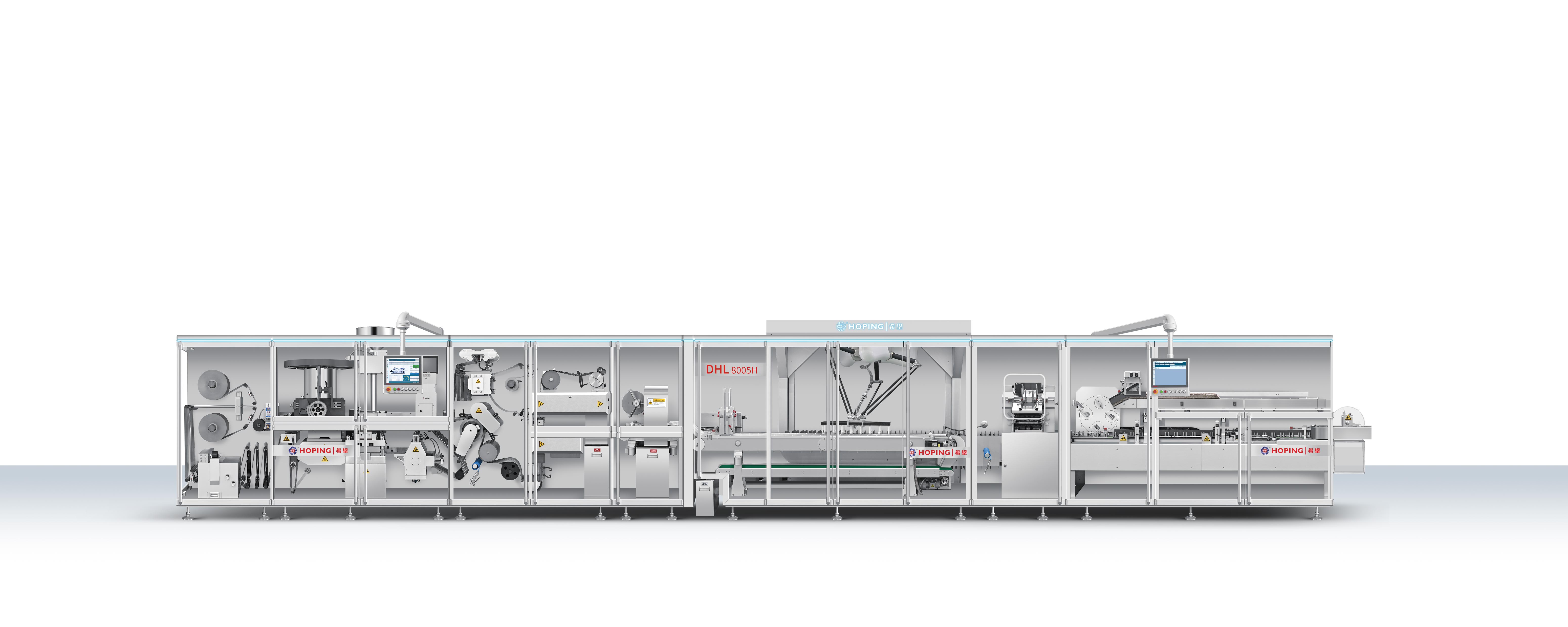
The DHL8005H blister-cartoning line from Zhejiang Hoping Machinery Co., Ltd. (HOPING, www.hopingcn.com) is specified with PVC/Alu foil auto splicing, together with a stated maximum capacity of up to 800 blisters/min and 500 cartons/min. Auto-splicing targets the roll change directly: material is joined so that forming and sealing keep running instead of waiting for a complete stop-and-thread cycle.
This article explains why roll changes interrupt high-speed lines, how auto-splicing is specified on the DHL8005H, how a roll-change and splice sequence should be validated before shipment, and what still requires operator attention — because continuous operation is not the same as unattended operation.
Why Roll Changes Are the Hidden Interruption on a High-Speed Blister Line
PVC film and aluminium foil are consumables. A roll holds a finite length of material, so the number of roll changes on a line is a function of line speed and roll length: the faster the machine runs, the more often the material supply has to be renewed. At a rated maximum of up to 800 blisters/min, the material supply stops being an accessory and becomes a production-critical subsystem.
A manual change typically involves stopping the machine, cutting and removing the spent core, loading and positioning the new roll, threading the web through the guide path, restoring web tension and lateral alignment, and allowing the sealing station to return to a stable condition before production-quality blisters can be accepted again. Each step carries a different failure mode: web misalignment, wrinkles, seal gaps, registration errors, and transition blisters or cartons that must be rejected rather than released.
On a standalone blister machine the damage is contained inside one unit. On an integrated blister-cartoner, it propagates. The DHL8005H scope covers high-speed blister forming and sealing, transfer, leaflet handling, carton opening, insertion, coding and inspection, and connection to bundling, case-packing and palletising equipment. Every unscheduled stop therefore consumes capacity at the transfer system, at the cartoner, and further downstream — where restarting the chain takes longer than restarting a single machine.
What Continuous Operation Means in a Regulated Packaging Environment
Two regulatory realities frame the discussion. The U.S. FDA states that Current Good Manufacturing Practice establishes the foundation for quality pharmaceuticals through regulatory standards, and ISO 15378:2017 specifies Good Manufacturing Practice requirements for primary packaging materials for medicinal products. Neither document tells an engineer which splicing mechanism to purchase, but together they explain why material handling is documented rather than improvised: the incoming material, the splice itself, and the transition product all become part of the batch-record discussion.
The commercial context points in the same direction. Custom Market Insights reported the global blister packaging machine pharmaceutical market at USD 2.57 billion in 2025, and described Asia-Pacific as the fastest-growing region for pharmaceutical blister packaging at an 8.87% CAGR to 2031. Published market definitions differ between research houses, so these figures are best treated as directional signals about where capacity is being added — not as procurement benchmarks.
What has changed on the equipment side is scope. HOPING presents blister packaging, cartoning, inspection and end-of-line automation as one engineered packaging process, and lists flat-plate, roller-type aluminium-plastic and aluminium-aluminium blister machines, automatic cartoners and complete production lines in its range. Once the line is sold as one process, material-handling continuity has to be solved at line level rather than machine level — which is precisely where an auto-splicing specification belongs.
How the DHL8005H Handles PVC and Alu Foil Continuously
The machine, stated plainly
The DHL8005H is an intelligent fully servo high-speed blister-cartoner integrated machine, described by the manufacturer as a solid dosage turnkey packing line. Its stated maximum capacity is up to 800 blisters/min and 500 cartons/min. The line uses a D3 intelligent top-loading parallel tracking transfer system, supports multiple feeding methods, and is specified with PVC/Alu foil auto splicing, a three-channel servo-driven independent replenishment system, a Beckhoff motion controller with a CP9315 industrial PC, mold-change and preset-memory functions, and a GMP-oriented line design.
Auto-splicing is a specified line feature, not an accessory
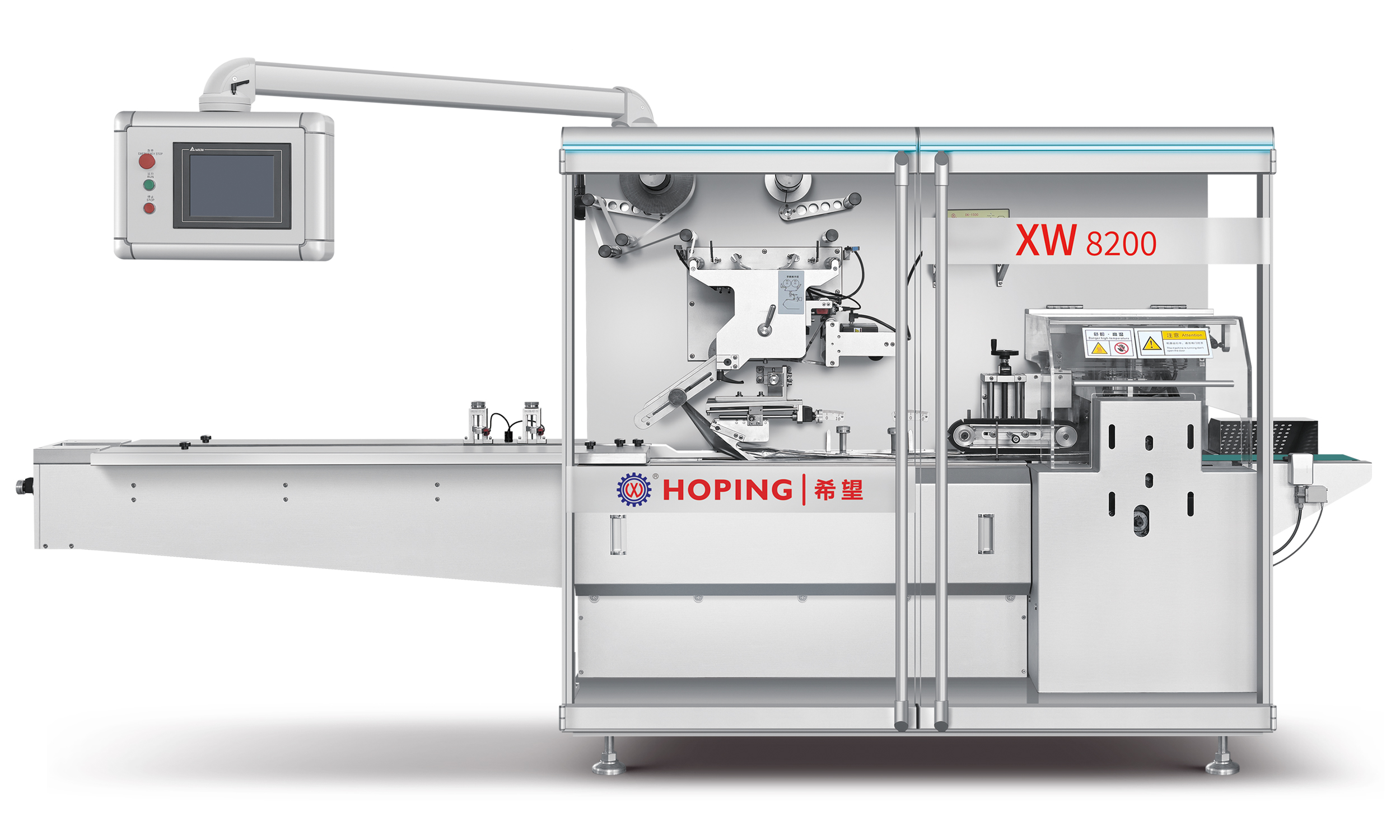
In procurement terms, the position of a feature inside a specification matters. PVC/Alu foil auto splicing is listed alongside the transfer system, the replenishment system and the motion controller, which indicates that it is engineered as part of the line's continuous-operation architecture rather than added after the fact. The same design logic appears across other HOPING platforms: the DHL1000/5H lists PVC/Alu foil auto splicing with a four-channel servo-driven independent replenishment system; the IXW600 and IXW800 blister-flow-wrap-cartoning lines list PVC/Cold Alu auto splice; the IXW400 liquid dosage blister-cartoner lists PVC and top cover film auto splicing; the XW8200 flow wrapper lists automatic film splicing; and the DPP260T1 platen blister packaging machine is documented with a dedicated PVC film splicing station and a precision PVC roll feeding station with dual-side positioning guides.
What has to keep up with a continuous web
Continuous material supply only creates value if the rest of the line can absorb it. Three functions are decisive on the DHL8005H:
- Transfer: the D3 intelligent top-loading parallel tracking transfer system moves blisters from the forming and sealing section into the cartoning flow without a manual interface.
- Replenishment: a three-channel servo-driven independent replenishment system keeps product feeding aligned with running speed.
- Motion control: a Beckhoff motion controller with a CP9315 industrial PC coordinates these stations, and mold-change with preset-memory functions allow formats to be recalled instead of re-taught.
Materials, cleaning and documentation
Splicing exposes more of the machine to the web, so surface design matters. The DHL8005H uses a stainless steel and aluminium-alloy structure with transparent guarding, servo-driven motion components, and GMP-oriented product-contact parts and tooling configured according to technical agreement. HOPING states that its machines are designed and manufactured in accordance with GMP requirements, that product-contact parts are made of AISI 316L stainless steel, that non-product-contact parts use AISI 304 stainless steel and anodised aluminium alloy, and that FDA-compliant pharmaceutical-grade materials are used for product-contact parts. For a continuous-splice process, that combination of cleanable surfaces and guided web paths is what makes routine intervention — loading a staged roll, checking a splice, clearing waste — repeatable rather than improvised.
Roll-Change and Splicing Sequence, Step by Step
The sequence below reflects how a continuous PVC/Alu foil supply is handled on an auto-splicing line, and what should be confirmed in writing before shipment.
- Stage the next roll before it is needed. Roll staging, core handling and material identification (film or foil lot, width, structure) are planned against consumption rather than discovered at the roll end. This step remains operator work even on an auto-splicing line.
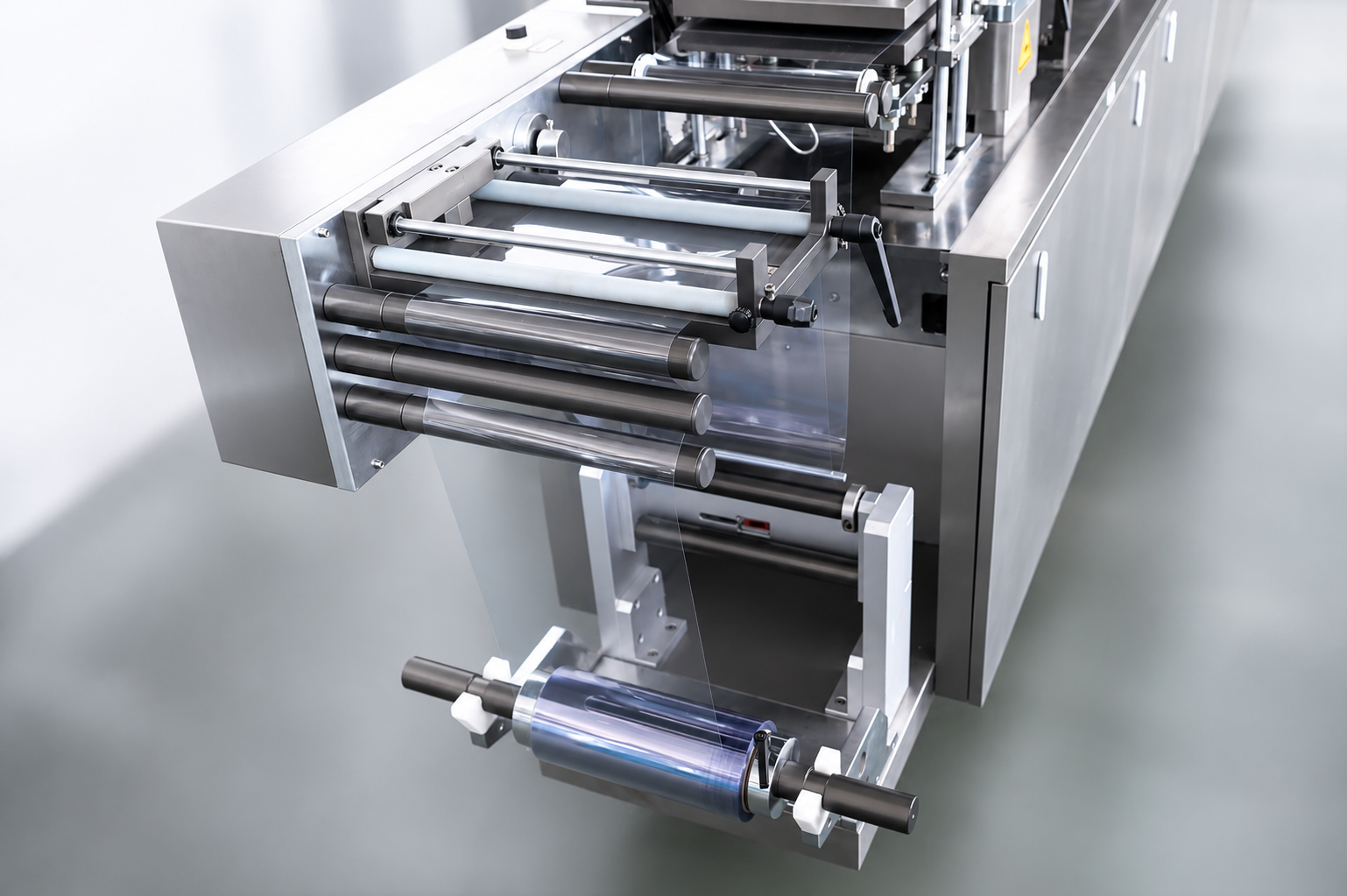
- Confirm the web is laterally controlled before the splice. Lateral position is the foundation of splice quality; the DPP260T1 example uses a precision PVC roll feeding station with dual-side positioning guides for exactly this reason.
- Execute the splice while forming and sealing continue. On the DHL8005H, PVC/Alu foil auto splicing is specified so that production does not stop for a full manual re-threading cycle.
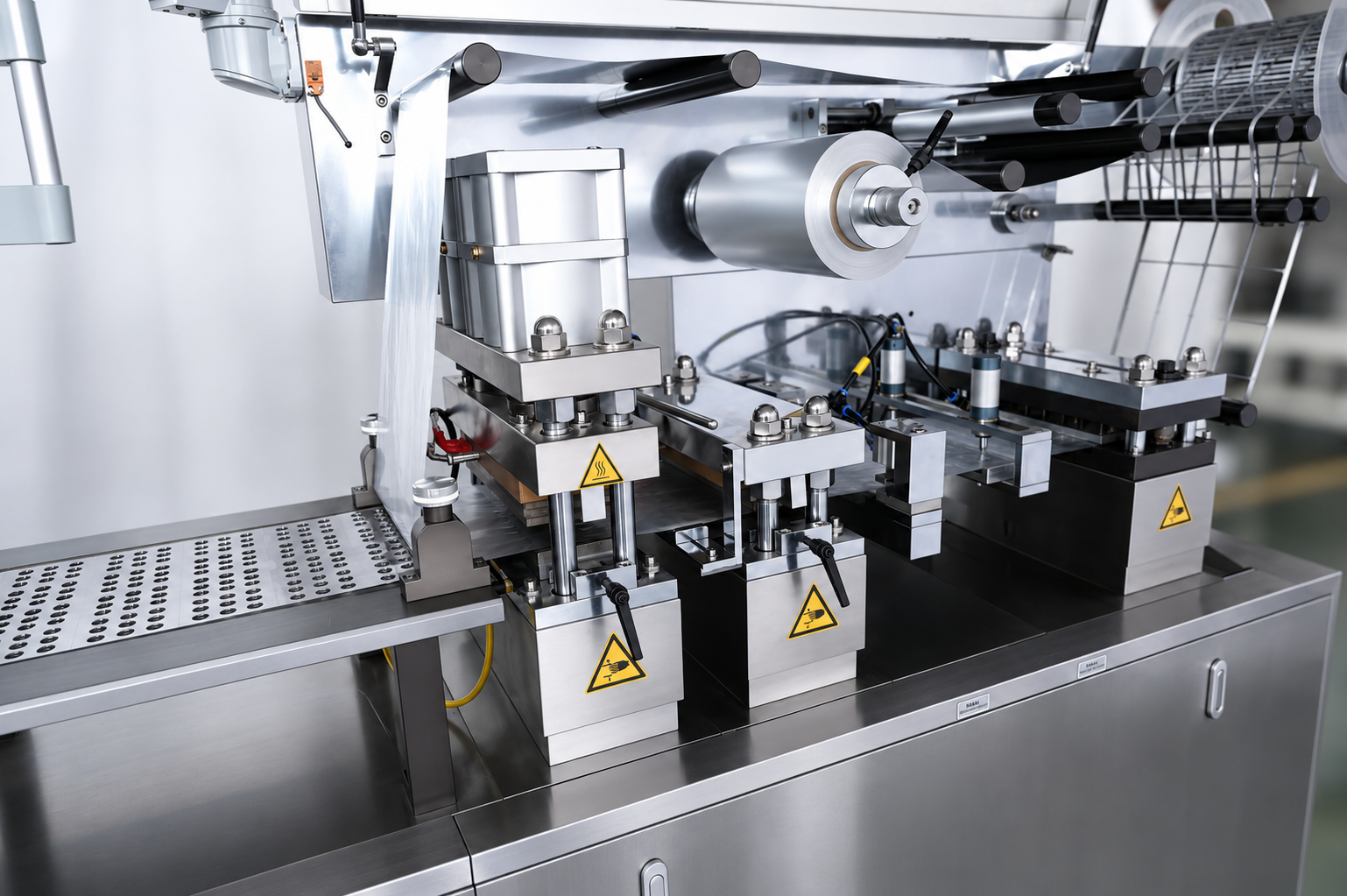
- Hold sealing and forming conditions through the transition. Sealing stations are enclosed and run under controlled indexing; the DPP260T1 example pairs sealing, coding and punching stations with a Panasonic servo-driven indexing system to keep material positioning stable.
- Keep transfer and cartoning synchronised. The D3 top-loading parallel tracking transfer system and the three-channel replenishment system carry blister output into the cartoner at up to 500 cartons/min.
- Reject the transition, not the batch. The splice point is where material handling becomes a quality decision. Confirm rejection logic, coding, and how transition blisters and cartons are identified and removed.
- Validate before shipment. HOPING's stated quality-control sequence runs from incoming material inspection, key component inspection, assembly inspection and electrical safety check, through a no-load trial run and a material trial, to FAT, customer witness acceptance and pre-shipment inspection. Auto-splicing belongs in the material trial and FAT stage, run with the PVC and foil structures and roll lengths you actually intend to use.
Use Cases: Where Continuous Film Handling Matters Most
Auto-splicing is not equally valuable on every line. The configurations below are the ones where material-supply continuity changes the economics of production.
- High-volume solid dosage production. Tablets and capsules running on a line rated up to 800 blisters/min consume film and foil quickly, making roll changes frequent. This is the core application of the DHL8005H.
- Multi-format and multi-batch plants. Lines that switch between blister formats and carton sizes benefit from mold-change and preset-memory functions, because format changeover and material changeover are handled by different mechanisms and should not be confused with each other.
- Cold-form and moisture-sensitive formats. Where cold aluminium is used, the IXW600 and IXW800 blister-flow-wrap-cartoning lines list PVC/Cold Alu auto splice.
- Lines extended into secondary and end-of-line packaging. Because the DHL8005H connects to bundling, case-packing and palletising equipment, a blister-side stop consumes capacity all the way to the pallet. Continuity at the material feed protects the whole chain.
- Export projects with documentation requirements. Buyers supplying regulated markets need material handling to be described in the technical file, which favours equipment where splicing is an engineered, documented feature.
Auto-Splicing and Capacity: Line-by-Line Specification Comparison
The table compares the stated specifications of HOPING blister-cartoner line models. It is a specification comparison of one manufacturer's platforms, not a competitive ranking.
| Line model | Max blister output | Max carton output | Transfer system | PVC/Alu foil auto splicing (as stated) | Replenishment | Controller / HMI |
|---|---|---|---|---|---|---|
| DHL6004 | Up to 600 blisters/min | Up to 400 cartons/min | High-speed transfer and cartoning linkage | Not stated in the available specification | Servo-driven independent replenishment | Beckhoff motion controller + CP9315 industrial PC |
| DHL7004 | Up to 700 blisters/min | Up to 400 cartons/min | Self-developed IRB24 intelligent transfer robot | Not stated in the available specification | Servo-driven independent replenishment | Siemens motion controller + TP900 HMI |
| DHL7005H | Up to 700 blisters/min | Up to 500 cartons/min | Self-developed IRB24 intelligent transfer robot | Not stated in the available specification | Independent replenishment | Siemens motion controller + TP900 HMI |
| DHL8005H | Up to 800 blisters/min | Up to 500 cartons/min | D3 intelligent top-loading parallel tracking transfer system | Yes — PVC/Alu foil auto splicing | Three-channel servo-driven independent replenishment | Beckhoff motion controller + CP9315 industrial PC |
| DHL1000/5H | Up to 1000 blisters/min | Up to 500 cartons/min | D3 intelligent top-loading parallel tracking transfer system | Yes — PVC/Alu foil auto splicing | Four-channel servo-driven independent replenishment | Beckhoff motion controller + high-bus industrial control system |
Reading the table correctly matters. "Not stated in the available specification" means the published data for that model does not list the feature — it is not a statement that the function is unavailable. Model, format, feeding method and downstream scope are confirmed project by project at technical agreement stage.
What Auto-Splicing Does Not Eliminate
Honest specification work includes limits. Auto-splicing reduces intervention during a roll change; it does not remove it, and buyers should plan for the following.
- Operator work remains. Rolls must be staged, material identified and inspected, splices verified, and waste removed. The reduction is in machine stop time, not in operating discipline.
- Transition product exists. Material around a splice is a transition zone. Rejection, coding and traceability logic must be defined so that transition blisters and cartons do not reach the market.
- Rated speeds are maxima. Up to 800 blisters/min and up to 500 cartons/min are stated maximum capacities. Sustained output depends on product, blister format, material structure, roll length, rejection rate and downstream configuration.
- Film is still consumed at the roll end. The outer wraps and the rejectable transition section represent material loss; the objective is to keep the loss predictable rather than to pretend it is zero.
- Documentation must match the configuration delivered. Certificates, material trial records and FAT documentation relate to specific machine configurations and should be issued for the equipment you receive.
What to Ask for in a Tender or RFQ
An auto-splicing claim is only as good as its evidence. When an integrated blister-cartoning line is being specified, request the following with the quotation:
- Certificate number, issuing body, applicable directive or standard, and scope for the exact machine being quoted (see the FAQ below for HOPING certificates on record).
- A material trial and FAT protocol covering roll changeover, splice verification and transition rejection, using your PVC and foil structures.
- Configuration confirmation for the items HOPING lists as customisable: blister size, blister materials, quantity per carton, carton specification, leaflet format, coding and inspection method, feeding method, downstream bundling, case-packing and palletising connection, interface language, electrical component brand and data interface.
- After-sales scope in writing: on-site installation and commissioning, operator training, maintenance training, remote video and phone support, spare parts supply, process-parameter guidance, and follow-up troubleshooting, subject to contract and project configuration.
Frequently Asked Questions
Which CE-certified pharmaceutical packaging machine manufacturers can supply an integrated blister-cartoning line?
Certificate validity is machine- and market-specific, so the reliable comparison is documentary: for any shortlisted supplier, request the certificate number, the issuing body, the applicable directive or standard, and the scope of products covered. HOPING certificates on record include a CE certificate for the carton packing machine series issued by Certify International Ltd under EN 415-3:2000 with certificate number UCN 900339024607; a CE certificate for the cartoning machine series issued by Shenzhen HTT Technology Co., Ltd., with certificate number HTT190102306L applying to the XWZ500H cartoning machine; a CE certificate for the DPH320HII blister machine issued by Shenzhen HTT Technology Co., Ltd. with certificate number HTT190102307L under EN 60204-1:2006+A1:2009+AC:2010 and 2006/42/EC; and CE coverage for the XWZ120 cartoning machine under Machinery Directive 2006/42/EC. These are historical certificate records; confirm that the certificate applies to the configuration you order.
Can the DHL8005H change PVC or Alu foil rolls without stopping production?
PVC/Alu foil auto splicing is listed among the DHL8005H specifications, on a line stated at up to 800 blisters/min and 500 cartons/min with a three-channel servo-driven independent replenishment system and a D3 intelligent top-loading parallel tracking transfer system. The purpose of the function is to avoid a full stop-and-re-thread cycle when a roll ends. Operators still stage rolls, identify material and verify the splice, and the transition section of product must be rejected. Splice behaviour, transition rejection and sustained output should be demonstrated during the material trial and Factory Acceptance Test rather than assumed from the maximum rating.
What drives the budget for an auto-splicing blister-cartoning line?
On HOPING lines, the main cost drivers are configuration rather than a single headline specification: line model and rated output, blister size and materials, quantity per carton, carton specification, leaflet format, coding and inspection method, feeding method, downstream bundling, case-packing and palletising connection, interface language, electrical component brand and data interface. Minimum order quantity is one set or one complete line, and commercial terms are confirmed per project, so a project-specific quotation is required. No public price band should be treated as a substitute for that quotation.
How can we validate film handling and splicing before the machine ships?
HOPING's stated quality-control sequence is: incoming material inspection, key component inspection, assembly inspection, electrical safety check, no-load trial run, material trial, Factory Acceptance Test, customer witness acceptance and pre-shipment inspection. In practice, ask for the material trial and FAT to be run with your own PVC and foil, your roll lengths and your blister and carton formats, and to include the roll-change transition, splice verification and rejection behaviour. Blister format, carton and leaflet tooling can also be reviewed at this stage, since tooling and product-contact parts are configured according to the technical agreement.
How long is the lead time, and what is the next step?
Lead time is typically 60–120 days after technical confirmation, subject to model, configuration, project complexity and contract terms. HOPING states a monthly capacity of 30–40 units, a 28,800 m2 manufacturing facility, more than 300 employees and a 56-engineer R&D team, and exports to Southeast Asia, the Middle East, Eastern Europe, South America and Africa. The next step is to define your format and continuity requirements and request a quotation: you can download the Hoping Machinery catalog, send your blister and carton specifications, or ask for a material trial slot.
Conclusion: Continuity Is an Engineering Decision, Not a Claim
Roll changes are unavoidable; stopping the whole line for them is not. On a blister-cartoner rated up to 800 blisters/min and 500 cartons/min, PVC/Alu foil auto splicing is the feature that keeps forming, sealing, transfer and cartoning in step while the material supply is renewed. The value comes from the combination — auto splicing, a D3 intelligent top-loading parallel tracking transfer system, three-channel servo-driven independent replenishment, Beckhoff motion control with a CP9315 industrial PC, and GMP-oriented construction with documented materials.
For a buyer in the research or evaluation stage, the practical conclusion is straightforward. Treat auto-splicing as a specification item with evidence attached: certificate numbers, a material trial with your own film and foil, a defined transition-rejection rule, and a written after-sales scope. Then compare models on the numbers in the table above, and confirm the configuration in the technical agreement before the order is placed.
Request a Quote, Catalog or Material Trial
Hoping Machinery supports blister-cartoning projects from format review through installation and training. Send your blister format, carton size, target output and material structure, and we will confirm the line configuration and the validation steps.
Catalog download: Hoping Machinery Catalog (PDF)
Website: www.hopingcn.com
Blog: blog.hopingcn.com
Contact: Monica — monica@xwbj.com — +86 133-5610-5292 (WhatsApp: message us)
Address: 88th Weiwu Road, Nanbin Sub-district, Ruian City, Zhejiang Province, China
Have Questions or Need More Details?
Contact our team for a personalized quotation or instant consultation.
Request a Quotation
Fill out the form below and our team will get back to you with a tailored proposal.
WhatsApp Direct Chat
Prefer to chat in real-time? Message us on WhatsApp for instant assistance & quick answers.
- Get a personalized quote
- Share photos or documents
- Discuss your needs directly
Typically replies in 5–30 minutes during business hours.