How to Choose a Reliable Blister Packaging Machine OEM Manufacturer for Your Pharmaceutical Line
How to Choose a Reliable Blister Packaging Machine OEM Manufacturer for Your Pharmaceutical Line
When building or upgrading a pharmaceutical packaging line, selecting the right blister packaging machine OEM manufacturer directly impacts production efficiency, compliance, and long-term reliability. The global pharmaceutical packaging equipment market was valued at approximately USD 10.71 billion in 2024 (SkyQuest Technology), and within that segment, the pharmaceutical blister packaging machine market is projected to reach USD 2.57 billion by 2025 with a CAGR of 2.8% (Custom Market Insights). These figures underscore the growing demand for specialized, customizable blister packaging solutions that can integrate seamlessly with downstream cartoning and end-of-line equipment.
Problem: Manual Transfer and Leaflet Insertion Errors in Solid Dosage Packaging
Large pharmaceutical manufacturers producing tablets, capsules, and other solid dosage forms face persistent challenges in packaging automation. Common pain points include manual transfer between blister packing and cartoning stations, leaflet insertion errors, and lack of centralized control across the line. These inefficiencies increase labor costs, risk product rejection, and hinder capacity expansion. A turnkey blister packaging line from a capable OEM addresses these issues by integrating blister formation, product feeding, transfer, leaflet folding, cartoning, and downstream bundling or case packing into one synchronized system.
Industry Background: Standards and Regional Trends
Pharmaceutical packaging machinery must comply with stringent standards. For primary packaging materials, the ISO 15378 standard integrates GMP requirements. In Europe, the Machinery Directive 2006/42/EC and the EN 415 series govern packaging machine safety. Asia Pacific held the largest revenue share of 40.7% in the global pharmaceutical packaging equipment market in 2025 (Grand View Research), making it a critical sourcing region for OEM partners. A manufacturer that holds recognized certifications—such as CE marking, ISO 14001, and ISO 45001—demonstrates the ability to deliver equipment that meets international expectations.
Solution: HOPING’s OEM/ODM Capability for Integrated Blister Packaging Lines
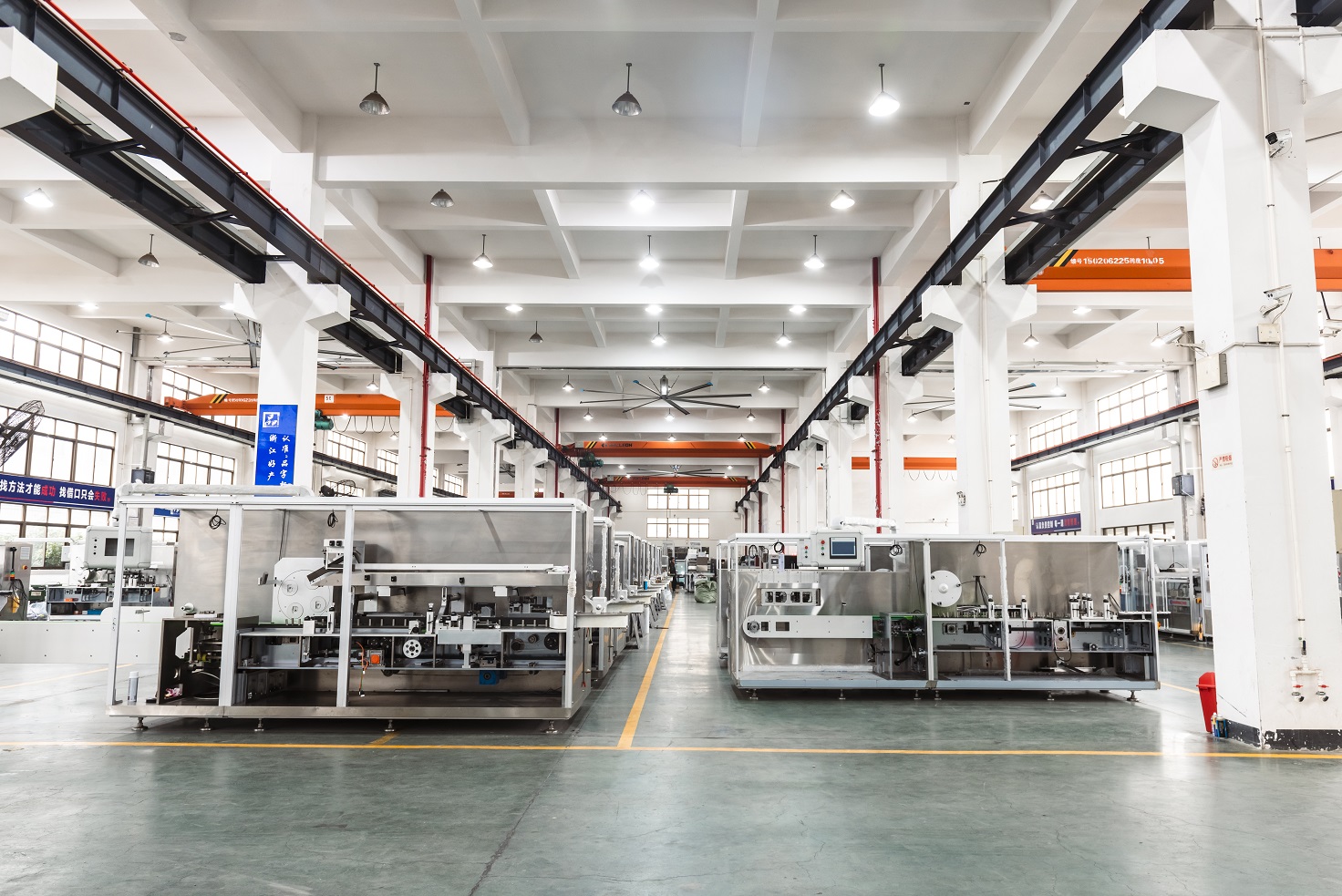
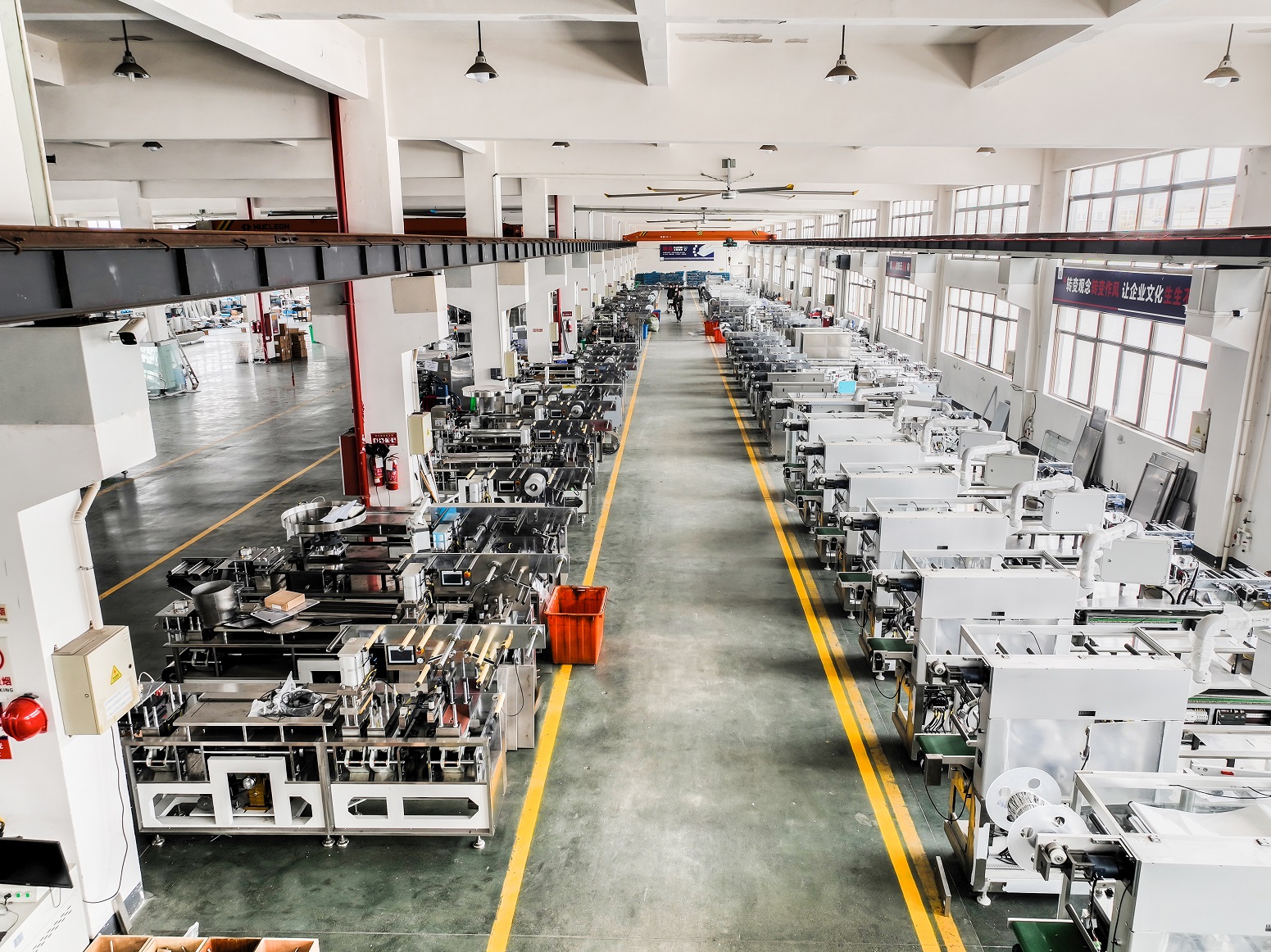
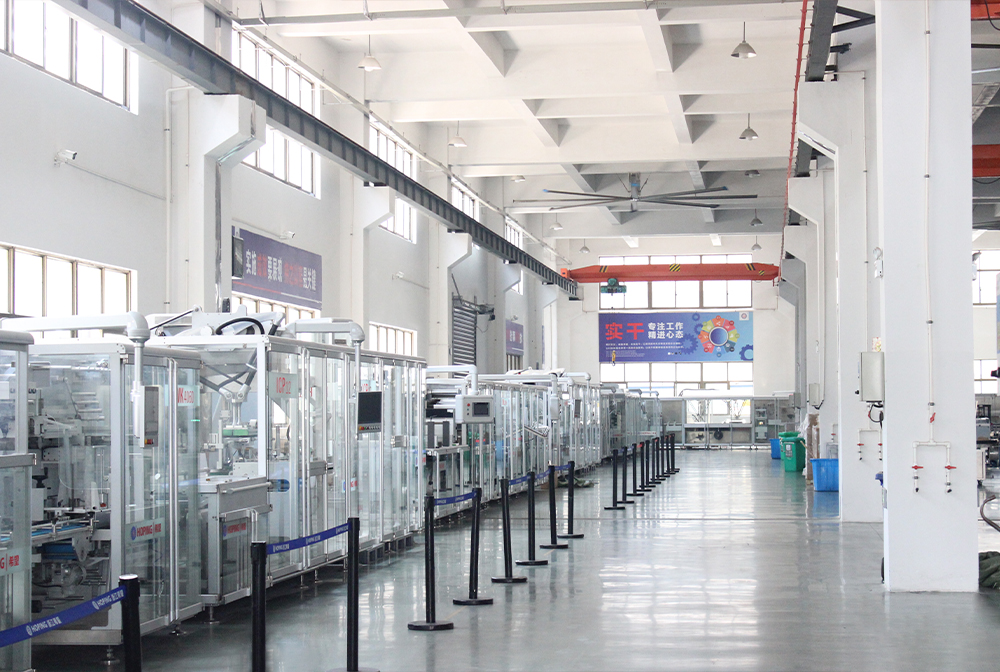
Zhejiang Hoping Machinery Co., Ltd. (HOPING) is a professional pharmaceutical packaging machine manufacturer founded in 2001. With a 28,800 ㎡ factory, over 300 employees, and an R&D team of 56 engineers, the company produces an annual output of 500 units covering blister packaging machines, cartoning machines, case packers, and end-of-line packaging equipment. HOPING offers ODM, OEM, and fully customizable production services for complete blister-cartoning lines and integrated secondary packaging systems.
One representative project involved a large pharmaceutical manufacturer and solid dosage production company, requiring 5 to 10 packaging lines for new line construction and capacity expansion. The solution addressed the problem of manual transfer and leaflet insertion errors by deploying an intelligent fully servo high-speed blister-cartoner integrated line (e.g., DHL1000/5H) capable of up to 1,000 blisters/min and 500 cartons/min. The line includes D3 top-loading parallel tracking transfer, automatic PVC/Alu foil splicing, and inspection/rejection modules—all controlled by a Beckhoff motion controller with recipe memory for fast mold change.
Step-by-Step OEM Engagement Process
- Requirement Definition – The customer defines blister dimensions, packaging materials (Alu-PVC, Alu-Alu, cold-forming), carton specification, leaflet format, feeding method, and downstream requirements. HOPING’s engineering team evaluates feasibility and provides a technical proposal.
- Technical Confirmation & Sample Testing – After agreement on the technical agreement, sample testing confirms blister forming, sealing, and cartoning quality. Customized tooling is manufactured per the product profile.
- Production & FAT – HOPING’s quality control process covers incoming material inspection, key component checks, assembly inspection, electrical safety check, no-load trial run, material trial, and Factory Acceptance Test (FAT) with customer witness.
- Shipping & Installation – Delivery is typically EXW, FOB, or CIF. On-site installation and commissioning are provided along with operator training and maintenance training.
- Site Acceptance & Support – SAT at customer site, followed by remote video/phone support, spare parts supply, and regular follow-up.
The typical lead time is 60–120 days after technical confirmation, with a monthly capacity of 30–40 units. Minimum order quantity is 1 set or 1 complete line.
OEM Customization Capabilities at a Glance
| Parameter | HOPING Offering |
|---|---|
| Production Mode | ODM, OEM, Customizable |
| Customization Scope | Blister size, blister materials (PVC/PTP/Alu), quantity per carton, carton specification, leaflet format, coding/inspection method, feeding method, downstream connection, interface language, electrical component brand |
| Certifications | CE (Machinery Directive 2006/42/EC, EN 415, EN 60204-1), ISO 14001:2015, ISO 45001:2018, GMP-oriented design |
| Material Contact Parts | AISI 316L stainless steel + FDA-compliant materials; non-contact parts: AISI 304 + anodized aluminum |
| MOQ | 1 set / 1 complete line |
| Lead Time | 60–120 days after technical confirmation |
| Delivery Terms | EXW, FOB, CIF (subject to contract) |
| After-Sales | On-site installation & commissioning, training, remote support, spare parts supply, regular follow-up |
Use Cases: When to Engage an OEM Blister Packaging Machine Manufacturer
HOPING’s integrated lines are suitable for:
- New pharmaceutical plant construction – needing a turnkey line from tablet blister packing to palletizing.
- Capacity expansion – upgrading from semi-automatic to fully servo-driven high-speed production (up to 1000 blisters/min).
- Product diversification – requiring quick tooling changes for different blister formats or carton sizes (recipe memory function).
- Compliance upgrade – replacing older machines with GMP-oriented, CE-certified equipment.
Frequently Asked Questions (FAQ)
Does HOPING comply with pharmaceutical packaging standards and certifications?
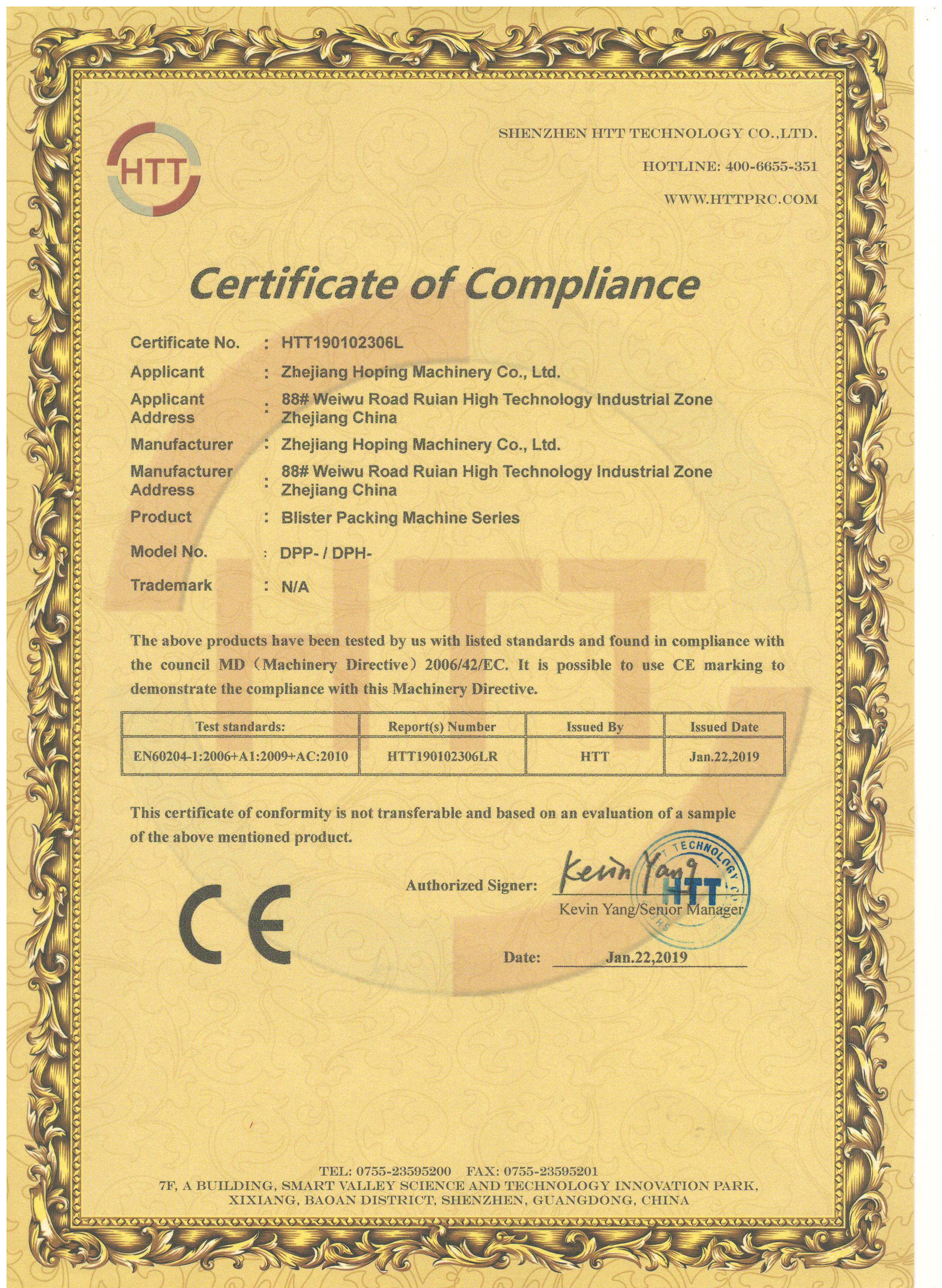
Yes. HOPING holds CE certificates for its blister packing machine series (cert. no. HTT190102306L) and cartoning machine series (cert. no. HTT190102307L), both tested against Machinery Directive 2006/42/EC and EN 60204-1. The company is also certified under ISO 14001:2015 (Environmental Management System) and ISO 45001:2018 (Occupational Health and Safety Management System). All product-contact parts are made of AISI 316L stainless steel and FDA-compliant pharmaceutical-grade materials, designed per GMP requirements.
What customization options are available for a blister packaging machine from HOPING?
Customization covers blister dimensions, blister materials (PVC, PTP, Alu-Alu, cold-forming Alu), quantity per carton, carton specification, leaflet format, coding/inspection method, feeding method, downstream bundling/case-packing/palletizing connection, interface language, and electrical component brand. The company operates in ODM, OEM, and fully customizable production modes with a minimum order of 1 set or 1 complete line.
What is the typical investment range for an OEM blister packaging line?
Because each project is configured based on specific capacity, automation level, and integration scope, a precise budget cannot be stated without a technical discussion. HOPING provides detailed quotations after reviewing the customer’s product specifications, output targets, and downstream connectivity requirements. Contact HOPING’s sales team to receive a tailored quote.
Can I get a sample or conduct a trial before ordering?
Yes. HOPING’s acceptance process includes sample testing and FAT before shipment. Customers are encouraged to visit the factory in Ruian, Zhejiang for a live demonstration and material trial. The company also supports third-party inspection based on the contract agreement.
What is the lead time for a custom blister packaging line?
Typical lead time is 60–120 days after technical confirmation. The exact duration depends on the model, configuration, project complexity, and contract terms. For a standard single machine (e.g., DPP260K platen blister machine), the lead time is shorter. For an integrated blister-cartoning line with custom tooling, allow 90–120 days. Download the HOPING Machinery Catalog for an overview of standard models, or contact the team for a project-specific timeline.
To discuss your blister packaging machine OEM requirements, contact HOPING at monica@xwbj.com or via WhatsApp +86 133-5610-5292. Receive a custom proposal, line layout, and budget within 48 hours.