Pharma Scale-Up: Integrated Line or Modular Blister-Cartoning Expansion?
Pharma Scale-Up: Integrated Line or Modular Blister-Cartoning Expansion?
A scale-up decision in solid dosage packaging is not a choice between two machines. It is a choice between two units of scale. An integrated blister-cartoning line buys capacity, transfer, changeover logic and control authority as one package. A modular expansion buys them stage by stage. This comparison sets out how to tell which architecture fits a specific pharmaceutical packaging project, using the DHL8005H — up to 800 blisters/min and 500 cartons/min under a single Beckhoff motion controller with a CP9315 industrial PC — as the reference point for what integration actually delivers.
The conversation usually starts with equipment: which blister packaging machine, which cartoning machine, whether to add a case packing machine now. The harder question sits one level higher. Should the next capacity step be taken as a single integrated blister-cartoning line, or as modular equipment that is specified, purchased and linked in stages?
Short answer for buyers. An integrated line fits high-volume, multi-format solid dosage production where the blister-to-carton ratio is stable and the investment is approved as one project. A modular expansion fits staged capex, reused or already-compliant equipment, uneven capacity between stages, and plants that must keep part of the flow running while another part is changed over or serviced. Both architectures can run tablets, capsules, soft capsules and nutraceutical products — the difference is what is bundled and when.
What Integrated and Modular Actually Mean on a Solid Dosage Line
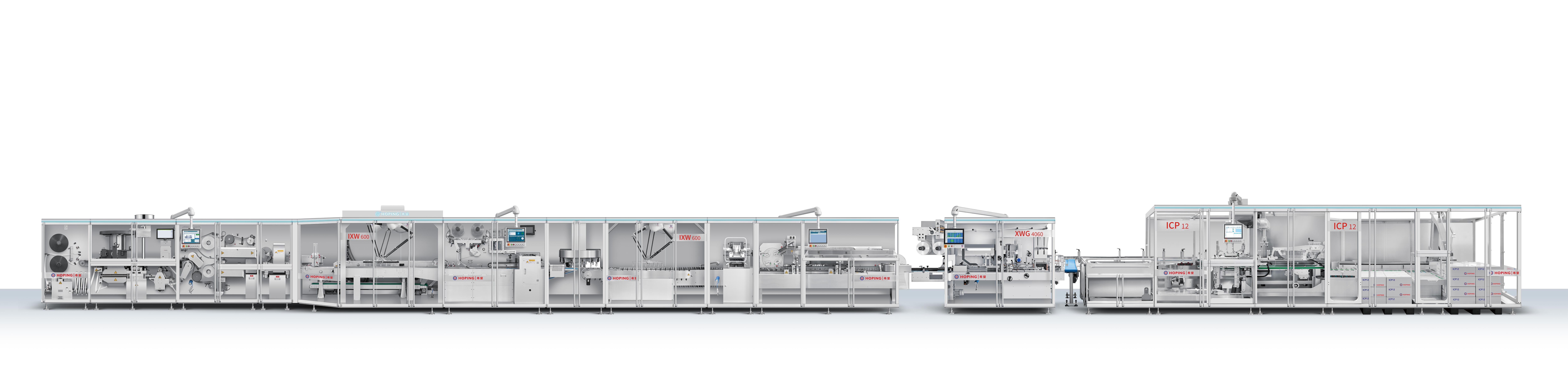
An integrated blister-cartoning line performs blister forming and sealing, product transfer, leaflet handling, carton opening and insertion, coding and inspection inside one synchronized machine under one motion control system. The DHL8005H is a concrete example of that definition: maximum capacity of up to 800 blisters/min and 500 cartons/min, a D3 intelligent top-loading parallel tracking transfer system, multiple feeding methods, PVC/Alu foil auto splicing, a three-channel servo-driven independent replenishment system, a Beckhoff motion controller with CP9315 industrial PC, mold-change and preset-memory functions, and a GMP-oriented line design. Its configured scope runs from high-speed blister forming and sealing through transfer and leaflet handling to carton opening, insertion, coding and inspection, plus connection to bundling, case-packing or palletizing equipment.
Integration does not always mean blister straight into carton. In the IXW series, the linked architecture includes a flow-wrap stage between blister and carton: the IXW600 is rated at up to 600 blisters/min, 300 packs/min and 300 cartons/min, again with a Beckhoff controller and CP9315 industrial PC. The architectural principle is unchanged — one line, one control authority, one set of interface points to the rest of the plant.
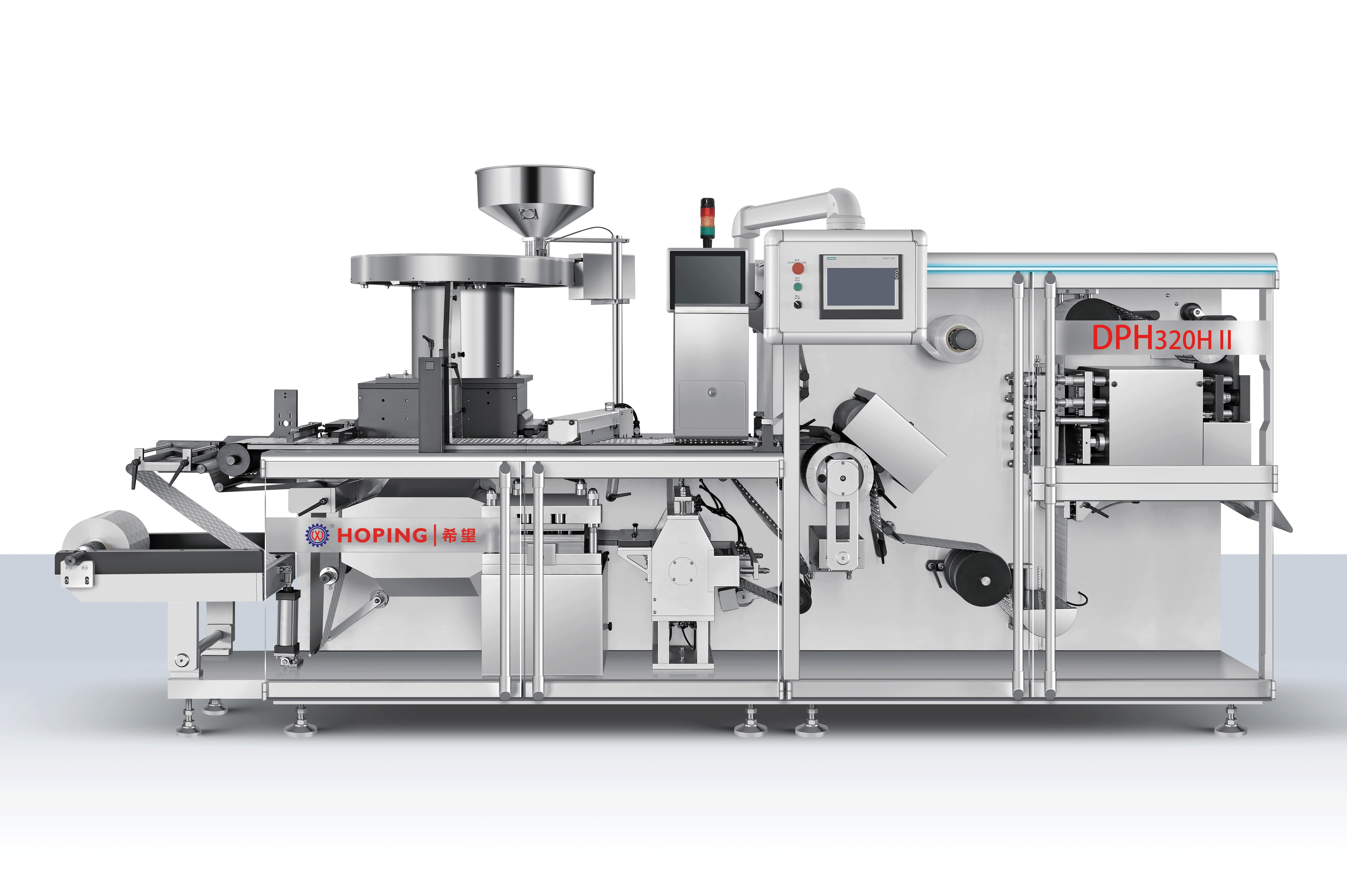
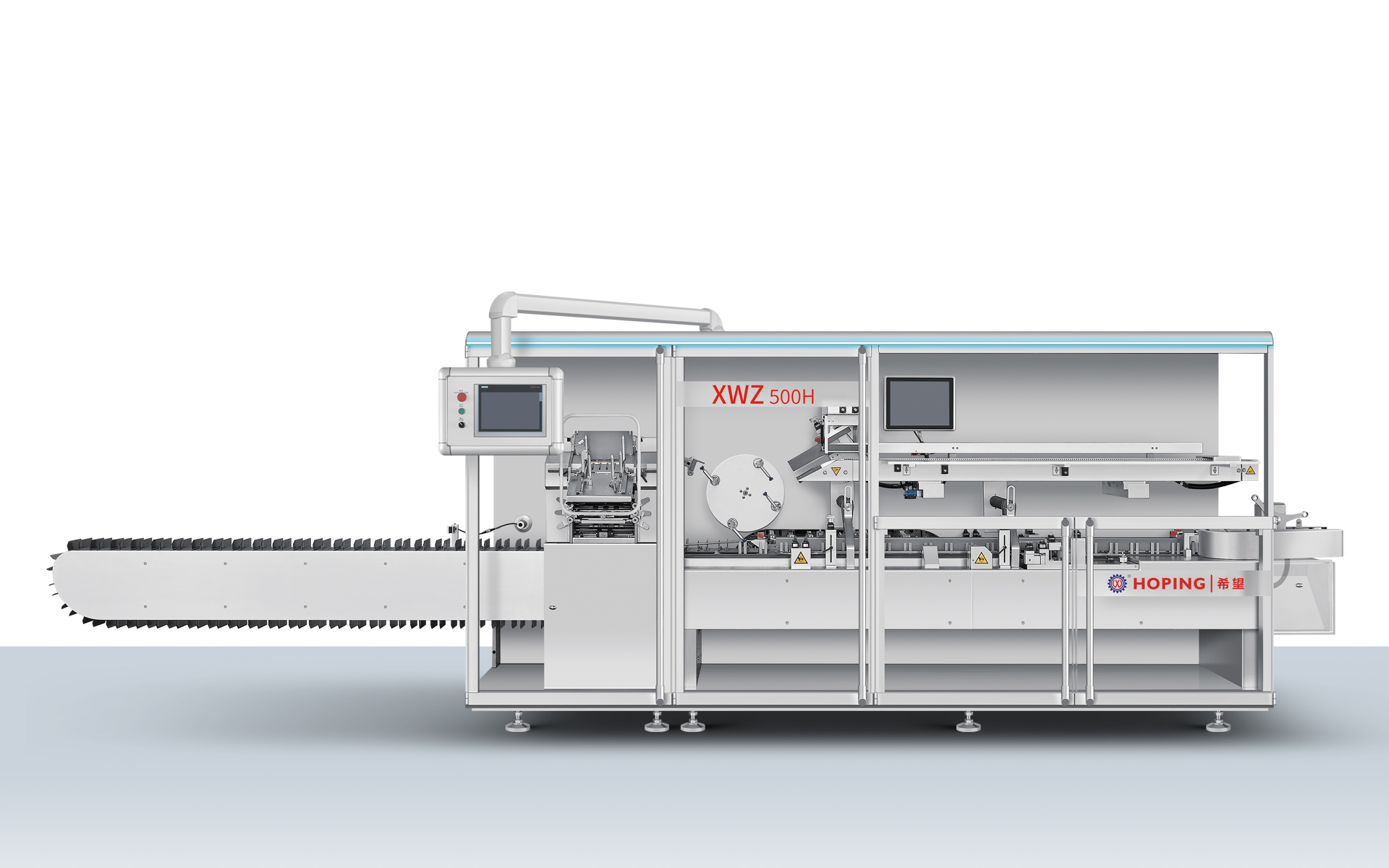
A modular expansion keeps the stages separate. Typical building blocks are a standalone automatic blister packaging machine — for example the DPH320H fully servo roller machine with a 320 × 280 mm forming area, 12 mm forming depth and 100–280 mm stroke, or the DPH320HII rotary machine rated up to 1000 blisters/min at 250 punches/min — feeding a separate automatic cartoning machine such as the XWZ500H at 100–500 cartons/min, or the horizontal cartoning machine XWZ120 at up to 120 cartons/min with a Siemens PLC and a 600–700 piece carton magazine. Downstream, the end-of-line packaging machine stage is added independently: a stretch bander such as the XWK4060 at 30–60 bundles/min, a case packing machine from the XWK series at up to about 5 cases/min, or the ICP12 case packing and palletizing integral machine at about 12 cases/min.
One clarification matters before any comparison. Modular is not a synonym for small or slow. A modular train can reach high output. What it does not have is a fixed capacity ratio between blister and cartoning stages, or a single control authority governing both.
Problem Definition: Five Questions That Decide the Architecture
"We need more output" is not a decidable brief. These five questions convert a scale-up wish into an architecture decision.
- 1. Capacity ratio. What blister-to-carton ratio does the product and market require? An integrated line fixes that ratio at design time — on the DHL8005H it is 800 blisters/min against 500 cartons/min at maximum. If pack counts per carton are likely to change across registrations, modular equipment lets each stage be sized and re-sized independently.
- 2. Format portfolio and changeover frequency. Blister size, blister material (Alu-PVC or Alu-Alu), quantity per carton, carton specification, leaflet format and coding or inspection method all drive changeover work. Integrated lines handle repeated formats through mold-change and preset-memory functions; modular lines handle them machine by machine and then have to be re-synchronized. Ask for the changeover sequence, not only a changeover time.
- 3. Existing assets. Is this a new solid dosage blister packaging line, an existing packaging line upgrade, or an intelligent packaging workshop retrofit? If a compliant blister machine or cartoner already exists, a modular expansion can absorb it; an integrated line normally replaces the whole blister-to-carton chain.
- 4. Failure unit. In an integrated line, blister, transfer, cartoning and inspection stages share a control system. In a modular line, modules are typically separable. Decide which stoppage your campaign schedule can absorb before you decide which architecture to buy.
- 5. Capital structure. One approved investment or a phased program? Lead time and acceptance planning follow directly from this: an integrated line is configured, accepted and delivered as one unit, while a modular expansion can be sequenced across budget cycles.
Physical constraints belong in the same review. Clean compressed air at 0.5–0.7 MPa and a 380 V 50 Hz supply are the common utilities across these machines, but footprints differ sharply by stage — a DPH320H blister machine is about 5000 × 1500 × 2100 mm, while an XWZ500H cartoner is about 6700 × 1950 × 2100 mm and roughly 6000 kg. In a cleanroom retrofit, that difference decides layout before it decides engineering.
Industry Background: Why Scale-Up Comparisons Are Being Run Now
Independent market research places the pharmaceutical packaging equipment sector in the low tens of billions of US dollars, with the blister and cartoning segments growing steadily. SkyQuest Technology values the global pharmaceutical packaging equipment market at approximately USD 10.71 billion in 2024. Custom Market Insights projects the pharmaceutical blister packaging machine market to reach USD 2.57 billion by 2025 at a CAGR of 2.8%. Fortune Business Insights values the pharmaceutical cartoning machinery segment at USD 1.46 billion in 2024. Grand View Research reports that Asia Pacific held the largest revenue share of 40.7% in the pharmaceutical packaging equipment market in 2025.
Market structure matters as much as market size. The three largest blister packaging machine suppliers — Uhlmann, IMA and Marchesini — collectively hold approximately 29% of the market, which means the majority of capacity being installed worldwide comes from a long tail of regional and specialist manufacturers. That is why supplier-level capability checks outweigh supplier ranking in mid-volume and multi-line projects.
Compliance expectations are also tightening at line level rather than machine level. ISO 15378 integrates GMP requirements for primary packaging materials and is frequently referenced in pharmaceutical packaging projects. Equipment shipped into the EU is governed by the Machinery Directive 2006/42/EC, with the EN 415 series covering packaging machine safety. Both obligations attach to how the blister-cartoning chain is configured, guarded, documented and cleaned — not only to individual machine certificates.
Detailed Solution: What an Integrated Line Bundles, Benchmarked on the DHL8005H
Capacity arrives as a matched pair, not as two separate claims
On a modular project, the buyer carries the burden of proving that the cartoner can absorb blister output for a specific pack configuration. On the DHL8005H, 800 blisters/min and 500 cartons/min are one designed pair, and the transfer between the stages sits inside the same technical agreement. For a high-volume solid dosage project, this removes an entire class of interface disputes from the acceptance phase.
One control authority across blister and cartoning
The DHL8005H runs on a Beckhoff motion controller with a CP9315 industrial PC governing both the blister and the cartoning sections. Practically, that produces one operating interface, one preset-memory library for formats, one alarm and fault stack, and one data channel where the project specifies an ERP/MES interface. In a workshop retrofit, fewer integration points means fewer items to validate, document and retrain on. Compare that with a modular pair where each machine keeps its own controller — for example a Siemens PLC on an XWZ120 cartoner sitting next to a blister machine with a different control platform — and the synchronization logic plus the interface documentation become additional project scope.
Replenishment architecture is a configuration item, not a footnote
The DHL8005H uses a three-channel servo-driven independent replenishment system; the higher-capacity DHL1000/5H uses four channels. Because replenishment channels are servo-driven and independent, the number of channels is one of the configuration items buyers should compare explicitly when several formats with different feed behaviour are planned for the same line.
Transfer, splicing and changeover are designed as line functions
The D3 intelligent top-loading parallel tracking transfer system moves product between blister and carton stages as part of the line design. PVC/Alu foil auto splicing reduces material-change interruptions. Mold-change and preset-memory functions allow a validated format to be recalled rather than rebuilt by hand. Together these features shift changeover from a machine-level craft to a line-level recipe.
What integration costs you
Integration locks the capacity ratio. It also means that a control or transfer fault stops the whole blister-to-carton flow rather than one module. A later capacity increase inside the same architecture normally means stepping up the family — from DHL6004 (up to 600 blisters/min, 400 cartons/min, Beckhoff with CP9315) through DHL7004 and DHL7005H (up to 700 blisters/min, 400–500 cartons/min, Siemens with IRB24 transfer robot and TP900 HMI) to DHL8005H and DHL1000/5H (up to 800 and 1000 blisters/min at 500 cartons/min) — which means re-specifying the blister-cartoning unit, not one module. That is the trade for guaranteed synchronization.
Detailed Solution: Where Modular Expansion Wins
Modular expansion is not the budget substitute for integration. It is the correct answer to a different set of constraints.
- Staged capital approval. A modular program can be delivered in phases — blister capacity first, cartoning next, bundling and case packing later — matching how many pharmaceutical manufacturers actually release capital.
- Stage-level capacity matching. Blister machines and cartoners do not share a range. A DPH320HII reaches up to 1000 blisters/min, while an XWZ500H runs 100–500 cartons/min. Modular specification lets a buyer select each machine against its own duty point instead of accepting a factory-fixed ratio.
- Reuse of compliant assets. In an existing packaging line upgrade or an intelligent packaging workshop retrofit, a modular approach can retain compliant modules and replace only the bottleneck stage.
- Operational isolation. Separate machines can typically be stopped, cleaned or maintained individually, which suits plants running several products or campaign-based cleaning schedules.
- Downstream growth in defined steps. Bundling (XWK4060, 30–60 bundles/min), case packing (XWK series, up to about 5 cases/min) and case packing with palletizing (ICP12, about 12 cases/min) can each be added as a separate, separately justified project.
The costs of modularity are equally real: more guarding and safety interfaces between machines, more transfer and buffer hardware, more documentation and a combined line-output test that the buyer, not the supplier, often has to coordinate. Upstream feeding is a further example of scope that has to be planned per stage — a lifting feeder such as the LF100 (100 L, 10–20 lifts/min, 600–2100 mm lift range) can serve a modular blister machine, but it is a separate item rather than a line function.
Step-by-Step: Running the Scale-Up Comparison
The sequence below works for both architectures and keeps the decision evidence-based rather than preference-based.
- Step 1 — Fix the demand model. Convert sales forecast into blister output per shift and cartons per shift, including the pack-count variation across your registered markets. This produces the blister-to-carton ratio that the whole decision depends on.
- Step 2 — Match demand to documented capacity. Compare the ratio against published machine capacities — for example DHL8005H at up to 800 blisters/min and 500 cartons/min, or a modular pairing such as DPH320HII plus XWZ500H. Do not compare against rounded marketing numbers; compare against the specification that will appear in the technical agreement.
- Step 3 — Map the format portfolio. List every blister size, blister material, carton and leaflet format, then estimate annual changeover count. Confirm whether the chosen line offers mold-change and preset-memory functions or requires manual re-setting per machine.
- Step 4 — Decide the control architecture explicitly. Ask the direct question: does one motion controller govern both blister and cartoning stages, or is synchronization achieved through handshake signals between two controllers? The answer determines your validation, spares and troubleshooting scope.
- Step 5 — Check the physical and utility fit. Confirm footprint, weight, cleanroom access, compressed air at 0.5–0.7 MPa and a 380 V 50 Hz supply per module, using the actual machine drawings rather than catalogue images.
- Step 6 — Define the downstream interface. Decide now whether the line connects to a stretch bander, a case packing machine, a combined case packing and palletizing unit, or an ERP/MES data layer. Connection scope is far cheaper to design in than to retrofit.
- Step 7 — Fix the technical agreement before comparing quotations. Customization scope should cover blister size, blister materials, quantity per carton, carton specification, leaflet format, coding and inspection method, feeding method, downstream bundling/case-packing/palletizing connection, interface language, electrical component brand and data interface. Two quotations are only comparable once these items are identical. Minimum order quantity for this class of equipment is typically 1 set or 1 complete line.
- Step 8 — Plan acceptance and lifecycle. Agree the quality-control sequence in advance: incoming material inspection, key component inspection, assembly inspection, electrical safety check, no-load trial run, material trial, factory acceptance test, customer witness acceptance and pre-shipment inspection. Then agree installation and commissioning, operator and maintenance training, remote support, spare parts and process-parameter guidance.
Use Cases: Matching the Architecture to the Project Shape
- Greenfield, single dominant product family, high volume. An integrated blister-cartoning line is the natural fit: one ratio, one control system, one acceptance. This is the DHL8005H-type project, where 800 blisters/min and 500 cartons/min are validated together.
- Existing line upgrade or capacity expansion. Where a compliant blister machine or cartoner is already installed and qualified, a modular expansion protects that investment and adds only the bottleneck stage.
- Nutraceutical or contract packaging with many SKUs. A wide, low-volume format mix usually favours modular modules with fast, documented changeover over a line that must be re-validated around a fixed ratio.
- Intelligent packaging workshop retrofit. Blister packaging, leaflet folding, carton opening, blister insertion, coding, inspection and rejection are completed with downstream connection to reduce manual transfer. Either architecture can serve this, provided the data interface is specified in step 6. Typical project objectives are higher packaging automation, less manual transfer, more efficient blister-to-carton connection and lower risk of wrong insertion or a missing leaflet.
- Multi-line expansion at a large solid dosage manufacturer. Programs covering several blister-cartoning lines for tablets and capsules are usually delivered in phases. Here integrated lines handle the high-volume core, while modular units absorb secondary SKUs and format variations.
Comparison Table: Integrated Blister-Cartoning Line vs Modular Expansion
| Decision dimension | Integrated blister-cartoning line | Modular expansion (linked standalone machines) |
|---|---|---|
| Unit of scale | One line; blister and carton stages designed as a pair (DHL8005H: up to 800 blisters/min, 500 cartons/min) | Each machine specified against its own duty point (DPH320HII up to 1000 blisters/min; XWZ500H 100–500 cartons/min) |
| Control authority | Single motion controller and industrial PC for the whole line (Beckhoff motion controller with CP9315 industrial PC on DHL8005H) | One control system per machine (Siemens PLC on XWZ120; Siemens with TP900 HMI on DHL7005H), linked by handshake signals |
| Product transfer | Designed-in transfer, e.g. D3 intelligent top-loading parallel tracking transfer system | Conveyors and buffers between separate machines |
| Format changeover | Line-level mold change supported by preset-memory functions | Machine-by-machine changeover followed by re-synchronization |
| Footprint and layout | One integrated footprint fixed by the line design | Longer total line, but modules can be positioned around existing plant constraints |
| Failure mode | Shared control and transfer: a stop affects the full blister-to-carton flow | Modules can typically be isolated, cleaned or serviced individually |
| Investment pattern | One configuration, one acceptance sequence, one lead-time commitment | Phased purchases; existing compliant machines can be retained |
| Downstream growth | Connection to bundling, case packing and palletizing designed into line scope | Bundler (XWK4060, 30–60 bundles/min), case packer (XWK series, up to about 5 cases/min) and ICP12 palletizing (about 12 cases/min) added as separate projects |
| Best-fit project | High-volume, multi-format, stable-ratio solid dosage production with single-stage capital approval | Staged capex, existing line upgrade, uneven stage capacities, multi-product plants |
What to Verify in the Supplier Behind Either Architecture
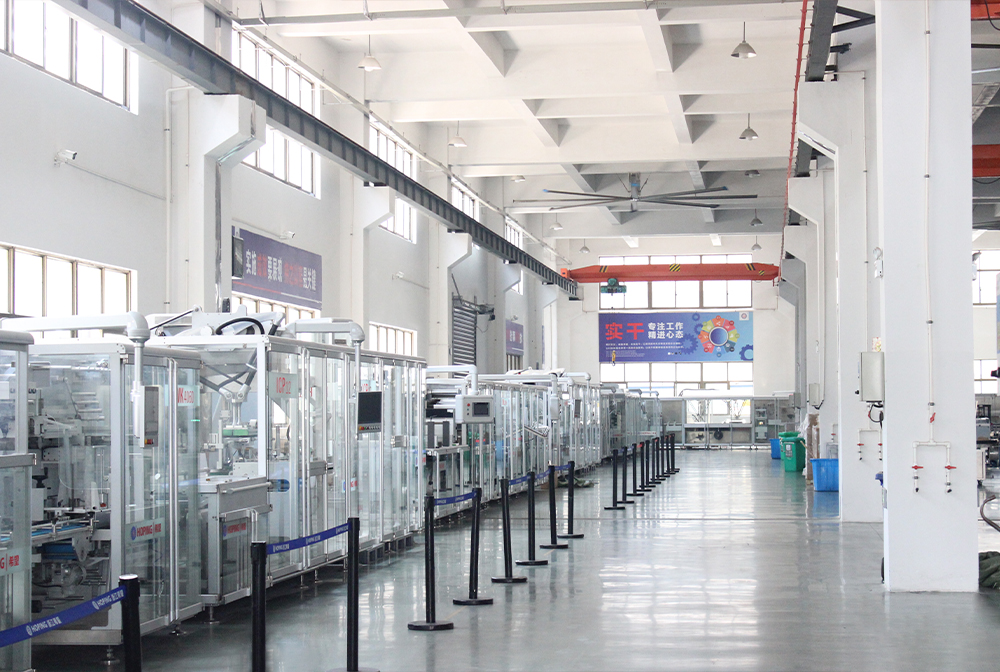
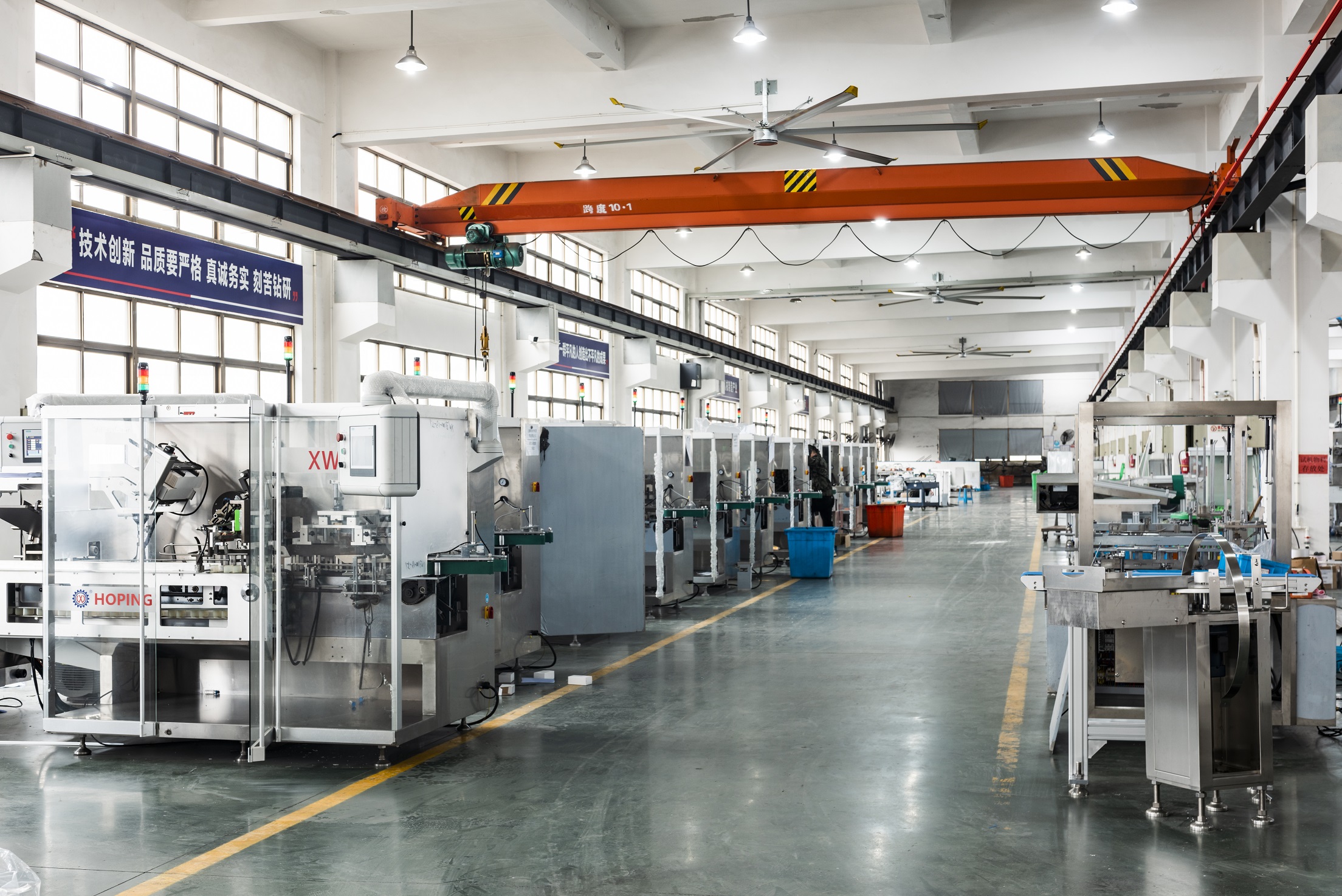
Architecture choice does not remove supplier risk. Zhejiang Hoping Machinery Co., Ltd. (HOPING) was established in 2001 and manufactures blister packaging machines, cartoning machines, case packing machines and end-of-line packaging machines, including integrated blister-cartoning lines. The company operates a 28,800 m² facility with more than 300 employees, including a 56-engineer R&D team, and reports an annual output of about 500 units with monthly capacity of 30–40 units. Exports account for roughly 25% of output, with established markets in Southeast Asia, the Middle East, Eastern Europe, South America and Africa. Publicly listed certifications include CE and ISO 9001/14001, and the patent portfolio covers 26 invention patents, 70 utility patents, 4 appearance patents, 10 PCT-protected filings and 28 software copyrights.
For a scale-up project, the more useful checks are operational. Does the supplier build both integrated lines and the modular building blocks, so the recommendation is not pre-decided? Can it state the control architecture, transfer method and replenishment channel count in writing? Does it publish a quality-control sequence that ends in customer witness acceptance, and does it commit to installation, commissioning, operator training, maintenance training, remote support, spare parts and process-parameter guidance? Typical lead time for a configured line runs 60–120 days after technical confirmation and depends on model, configuration, project complexity and contract terms — a figure worth putting in the project plan early, because it usually sits on the critical path.
FAQ: Integrated vs Modular Blister-Cartoning Scale-Up
What compliance evidence should be attached to a blister-cartoning scale-up project?
Compliance evidence splits into standard level and supplier level. At standard level, ISO 15378 integrates GMP requirements for primary packaging materials and is commonly referenced in pharmaceutical packaging projects; equipment supplied into the EU is governed by the Machinery Directive 2006/42/EC, with the EN 415 series covering packaging machine safety. At supplier level, Hoping's publicly listed certifications include CE and ISO 9001/14001, and the line is built with a GMP-oriented design, stainless steel and aluminum-alloy structure, transparent guarding, and product-contact and tooling parts configured according to the technical agreement. The documentary trail typically follows the quality-control sequence: incoming material inspection, key component inspection, assembly inspection, electrical safety check, no-load trial run, material trial, factory acceptance test, customer witness acceptance and pre-shipment inspection.
How do you choose a pharmaceutical packaging machine manufacturer for blister lines?
Choose against the architecture the project needs, not against a brand list. A qualified supplier should be able to answer for both paths — integrated blister-cartoning lines covering roughly 600 to 1000 blisters/min and 400 to 500 cartons/min across the DHL6004, DHL7004, DHL7005H, DHL8005H and DHL1000/5H range, and the modular building blocks: flat and roller blister machines, horizontal and high-speed cartoners, stretch banders, case packers and case packing with palletizing. Then verify the engineering base behind the offer, the customization scope in writing, the acceptance sequence and the post-installation support terms. A manufacturer that only offers one architecture will naturally recommend only that one.
Why are two quotations for the same blister-cartoning line rarely comparable?
Because the customization scope is usually left open. Quotations become comparable only after these items are fixed identically: blister size, blister materials, quantity per carton, carton specification, leaflet format, coding and inspection method, feeding method, downstream bundling or case-packing or palletizing connection, interface language, electrical component brand and data interface. Minimum order quantity is typically 1 set or 1 complete line, and lead time typically runs 60–120 days after technical confirmation, subject to model, configuration, project complexity and contract terms. Locking the scope first also prevents a modular quotation from being compared against an integrated one on the basis of different content.
Can the line be proven before full production commitment?
Yes, through the acceptance process rather than through a stand-alone demonstration machine. The quality-control sequence includes a no-load trial run, a material trial with your product and packaging materials, a factory acceptance test and customer witness acceptance before pre-shipment inspection. Tooling and format parts are made to confirmed blister and carton specifications, so the material trial is the point at which forming quality, feeding behaviour, sealing and the blister-to-carton transfer are checked against your own product. For a modular project, the same sequence applies — with the addition that the combined line output should be witnessed as one test, since that is the step a modular configuration does not guarantee by design.
What lead time and post-installation support should be planned?
Lead time is typically 60–120 days after technical confirmation and depends on model, configuration, project complexity and contract terms; production capacity of 30–40 units per month supports phased programs, and orders start from 1 set or 1 complete line. After installation, the standard support scope includes on-site installation and commissioning, operator training, maintenance training, remote video or phone support, spare parts supply, process-parameter guidance and regular follow-up on troubleshooting, subject to contract and project configuration. Planning these items at the same time as the machine order is what keeps a scale-up on schedule — and if you want to compare the configurations described here against your own format list, the full product catalogue is available for download at the end of this article.
Conclusion: Decide the Unit of Scale, Then the Machine
The integrated-versus-modular question resolves into three checks. First, is your blister-to-carton ratio stable enough to lock into a single line, as the DHL8005H does at up to 800 blisters/min and 500 cartons/min? Second, do you want one control authority — one controller, one preset library, one data interface — or the freedom to size, replace and service each stage separately? Third, is the capital approved in one tranche or in phases, and can your campaign schedule tolerate a shared failure point?
Answer those three and the architecture chooses itself. High-volume, format-stable, single-approval projects belong on an integrated pharmaceutical packaging line. Staged, reused-asset, multi-product or uneven-capacity projects belong on a modular pharmaceutical packaging line that can grow stage by stage — including the secondary packaging line, case packing machine and end-of-line packaging machine layers that follow.
Next step: check your configuration against the line specification
Send your blister format, carton size, leaflet format and target output, and the same parameters can be checked against an integrated blister-cartoning configuration or a modular expansion built from individual machines. The full equipment catalogue — blister packaging machines, cartoning machines, banders, case packers, palletizers and blister-cartoning lines — is available as a PDF download.
Download the Hoping Machinery catalog (PDF)
Zhejiang Hoping Machinery Co., Ltd. — website: www.hopingcn.com · Email: monica@xwbj.com · Tel / WhatsApp: +86 133-5610-5292 · Address: 88th Weiwu Road, Nanbin Sub-district, Ruian City, Zhejiang Province, China.