Pharmaceutical Packaging Machine Line: From Blister Forming to Case Packing
Pharmaceutical Packaging Machine Line: From Blister Forming to Case Packing
A pharmaceutical packaging machine is not one single device. In solid-dosage production, the term covers blister packing machines, cartoning machines, flow wrappers, stretch banders, overwrappers, case packers, palletizers, and integrated lines that link these stations together. For buyers at the awareness and research stage, the important step is to understand how these machines fit into a complete packaging workflow before comparing models or suppliers.
Zhejiang Hoping Machinery Co., Ltd. (HOPING), founded in 2001 and based in Ruian, Zhejiang Province, China, is one example of a full-range manufacturer in this field. The company integrates R&D, production, marketing and service, and its main products include blister packaging machines, cartoning machines, case packing machines and end-of-line packaging machines.
Why Buyers Need a Clear Mental Model of Pharmaceutical Packaging Machines
Most procurement discussions start with a broad query: “pharmaceutical packaging machine.” The search term is useful, but it does not tell an engineer or procurement team which machine is needed. A tablet producer may need a flat or roller blister machine; a company with pre-filled syringes may need a blister-cartoning line designed for liquid dosage; a plant expanding secondary packaging may need a cartoner, bundler and case packer rather than a new blister machine.
Without a clear model of the line, teams risk choosing a machine that matches the product but not the speed, or a line that matches speed but not the packaging format. In early research, the goal is to translate product requirements into a line architecture: primary packaging, secondary packaging, and end-of-line packaging.
Industry Background: Why Pharmaceutical Packaging Equipment Keeps Expanding
The commercial context helps explain why buyers are researching pharmaceutical packaging machine options. According to SkyQuest Technology, the global pharmaceutical packaging equipment market was valued at approximately USD 10.71 billion in 2024. Custom Market Insights projected that the pharmaceutical blister packaging machine market would reach USD 2.57 billion by 2025, with a CAGR of 2.8%. For cartoning specifically, Fortune Business Insights valued the pharmaceutical automatic cartoning machinery market at USD 1.46 billion in 2024.
Geographically, Grand View Research estimated that Asia Pacific held the largest revenue share, 40.7%, in the pharmaceutical packaging equipment market in 2025. This regional concentration is relevant because buyers often evaluate suppliers in China and other Asian manufacturing hubs. At the same time, the blister packaging machine market remains relatively fragmented: according to MarketsandMarkets, the top three players—Uhlmann, IMA and Marchesini—collectively hold around 29% of the market.
Compliance also shapes machine selection. Pharmaceutical packaging machines must meet requirements such as ISO 15378, which integrates GMP requirements for primary packaging materials. In the EU, packaging machinery safety is guided by the Machinery Directive 2006/42/EC and the EN 415 series for packaging machines. Many buyers therefore ask for documented compliance, GMP-oriented design, and cleanable material choices.
Core Machine Types in a Pharmaceutical Packaging Line
Blister packaging machines
Blister machines form cavities, load tablets or capsules, seal lidding material, and cut or punch blisters. HOPING offers DPP Series intelligent flat Alu-PVC/Alu-Alu blister packing machines, DPH Series intelligent high-speed roller Alu-PVC/Alu-Alu blister packing machines, and specialized DP Series machines for freeze-dried powder and special dosage forms.
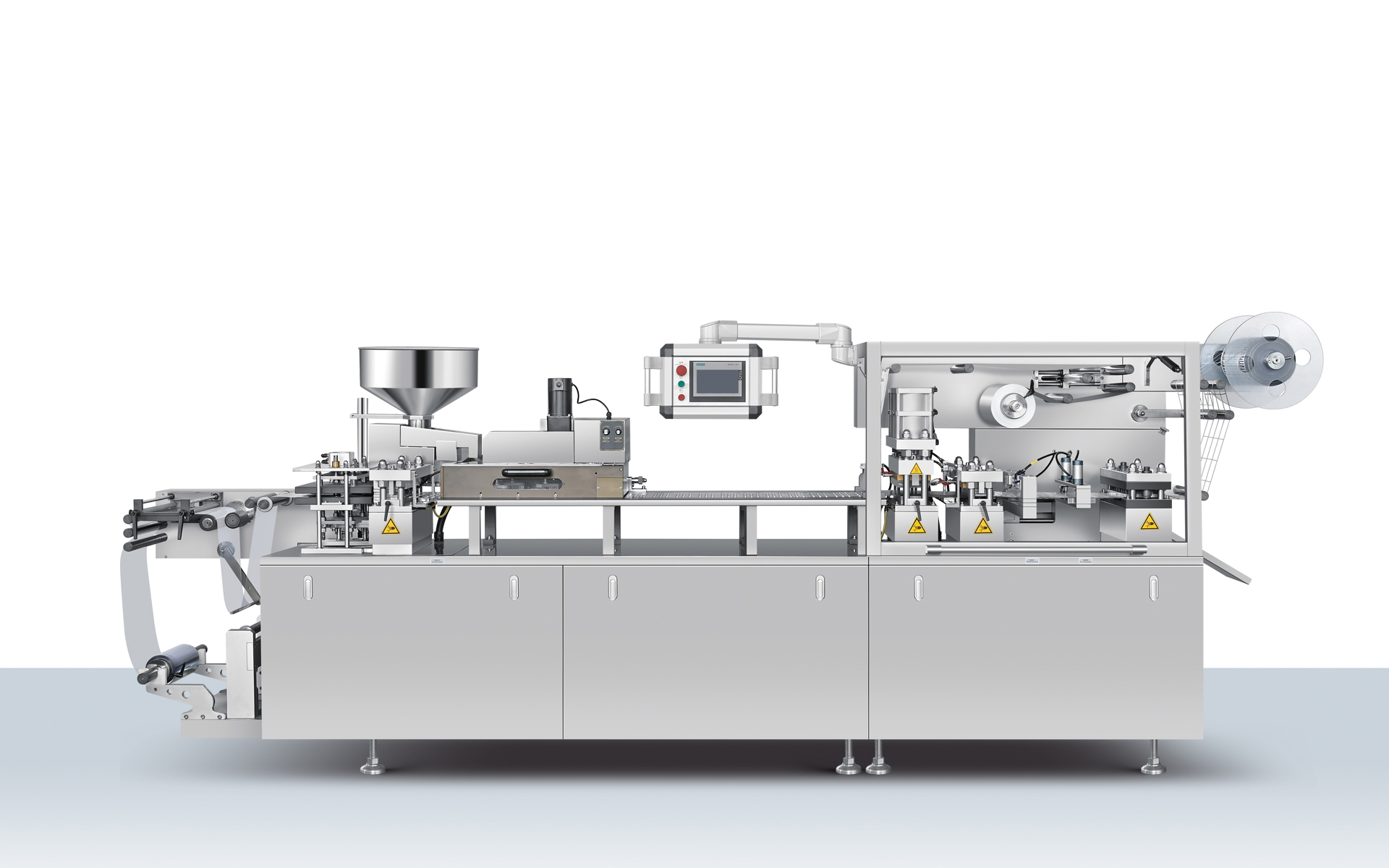
For example, the DPP260TI is an intelligent flat Alu-PVC/Alu-Alu blister packing machine designed for compact solid-dosage packaging and medium-speed production. It has a typical capacity of 20–60 cycles/min, requires clean compressed air of 0.5–0.7 MPa, and has an overall dimension of about 4420 x 710 x 1700 mm. The DPH Series, by contrast, is a high-speed roller type with typical capacity of 60–200 cycles/min depending on model, intended for tablets, capsules, soft capsules, nutraceuticals and healthcare products.
Cartoning machines
Cartoning machines open cartons, insert leaflets and products, close the cartons, and can integrate coding or inspection. HOPING’s XWZ Series includes the XWZ120 horizontal cartoning machine with a capacity of about 30–120 cartons/min, the XWZ300II intelligent high-speed cartoning machine with about 60–220 cartons/min, and the XWZ500H full servo high-speed cartoning machine with about 100–500 cartons/min. These machines are built for pharmaceutical, healthcare, food, cosmetic and daily-use product cartoning.
Flow wrappers
Some solid-dosage products require a pillow pack before cartoning. HOPING offers the XW8200 flow pack machine with speeds up to 200 packs/min and the XW8300 reciprocating flow packing machine with speeds up to 300 packs/min. The XW8300 uses a 4-axis servo drive and Beckhoff control system; the XW8200 uses a Siemens control system and can include automatic film splicing.
Stretch banders and overwrappers
After cartoning, products may be grouped into bundles. The XWK4060 is an intelligent fully servo stretch bander with a capacity of about 30–60 bundles/min. The XWK Series high-speed stretch bander includes models XWK650, XWK500, XWK250 and XWK180, with capacities of about 8–60 bundles/min depending on model. For transparent film overwrapping, the XWG4060 intelligent fully servo overwrapper runs at about 30–60 bundles/min, while the XWG Series models XWG450 and XWG300 handle about 10–40 bundles/min.
Case packers and palletizers
End-of-line packaging turns cartons or bundles into shippable cases. The XWK Series case packing machine, with models XWK900 and XWK600, performs automatic case packing of cartons, bundles and secondary packages at about 5 cases/min. The ICP12 intelligent fully servo case packing and palletizing integral machine combines case opening, product loading, sealing, conveying and palletizing at about 12 cases/min.
Integrated pharmaceutical packaging lines
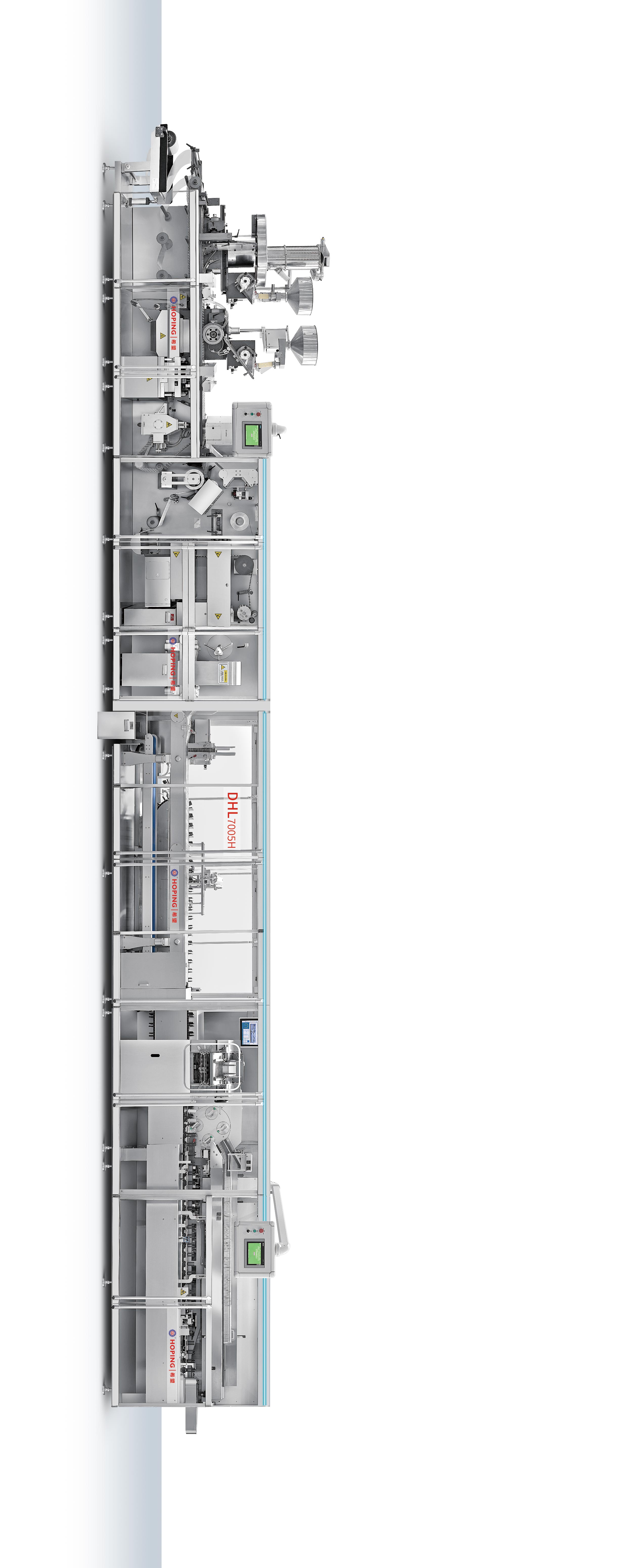
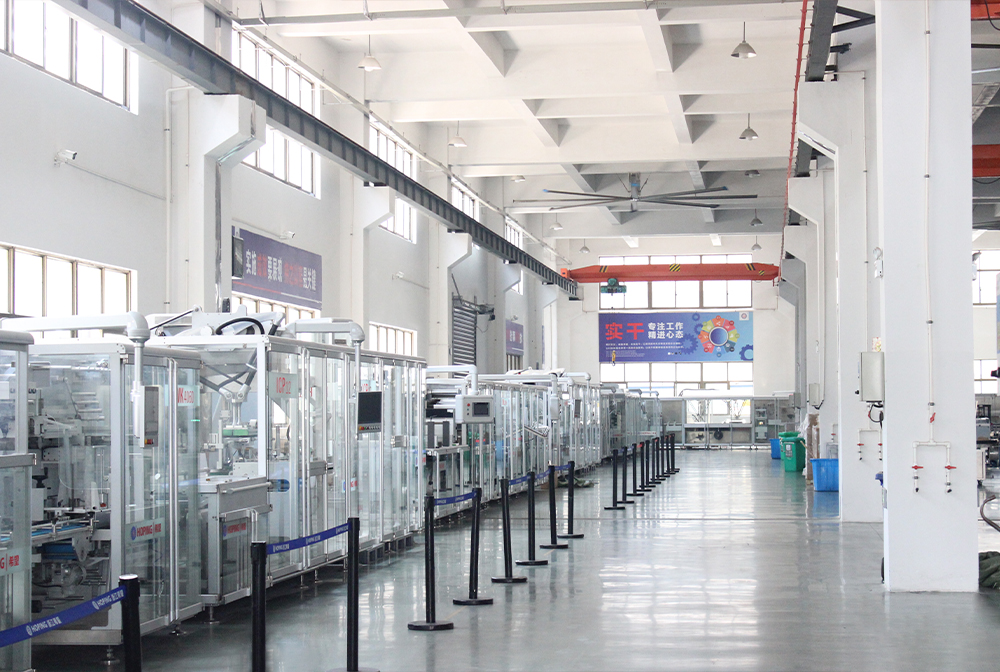
An integrated line links blister forming, sealing, transfer, cartoning, bundling and case packing so product moves from tablet to shippable case with less manual handling. HOPING’s DHL Series automatic blister-cartoning lines are fully servo, high-speed, integrated machines for solid dosage. The DHL7004 reaches up to 700 blisters/min and 400 cartons/min; the DHL7005H reaches up to 700 blisters/min and 500 cartons/min; the DHL8005H reaches up to 800 blisters/min and 500 cartons/min. The DHL1000/5H blister line reaches up to 1000 blisters/min and 500 cartons/min.
For products with additional wrapping requirements, the automatic blister-flow-wrapper-cartoner line such as DPH320H-XW8200-XWZ300II combines blister forming/sealing, flow wrapping and cartoning, with a typical blister capacity of 300–600 blisters/min, flow-pack capacity of 50–200 packs/min, and cartoning capacity of 50–220 cartons/min.
For liquid dosage forms, the IXW400 liquid dosage blister-cartoner integrated line is designed for pre-filled syringes, ampoules and cartridge-type products, with maximum capacity of up to 400 blisters/min and 150 cartons/min. For vial products, HOPING offers the Labeling + DPP + XWZ + XWK Series automatic vials packing-cartoning production line for vial labeling, blister forming/sealing, cartoning and secondary banding.
How a Turnkey Pharmaceutical Packaging Machine Line Works
The architecture below follows a typical solid-dosage blister-cartoning line.
- Product feeding: An upstream lifting feeder such as the LF100 carries tablets or capsules into the line. The LF100 has a capacity of 100 L and a lifting frequency of 10–20 times/min.
- Blister forming and sealing: The blister machine forms the cavity, feeds the product, seals lidding foil, and punches blisters. HOPING uses stainless steel and aluminum-alloy construction and transparent guards, with format parts customized to the blister design.
- Transfer and replenishment: In high-speed integrated lines, a transfer system moves blisters to the cartoner. HOPING uses D3 intelligent top-loading parallel tracking systems or the self-developed IRB24 intelligent transfer robot depending on the model, plus servo-driven independent replenishment.
- Cartoning: The cartoner opens cartons, handles leaflets, inserts blisters or products, closes cartons, and can integrate coding and inspection. Models such as the DHL8005H support leaflet handling, carton opening, insertion, coding/inspection and downstream connection.
- Bundling or overwrapping: Cartons may be grouped by a stretch bander such as the XWK4060 or overwrapped by an XWG machine before case packing.
- Case packing and palletizing: The ICP12 or XWK case packer opens cases, loads products, seals the case, and can palletize the finished cartons.
Integrated lines are designed with GMP-oriented production in mind: stainless steel and aluminum-alloy structures, transparent safety guards, recipe memory, mold-change support, and cleanable surfaces are common features.
Use Cases Across Product Formats
Tablets and capsules at medium-to-high speed
A producer of tablets or capsules with medium-to-high volume can use an automatic blister-cartoning line such as the DHL7004, DHL7005H or DHL8005H. These lines integrate blister packaging and cartoning in one process and can be connected to bundling, case packing and palletizing.
Compact or small-batch lines
For smaller batches or multiple formats, a DPP Series flat blister machine linked to an XWZ cartoning machine gives more flexibility. The DPP Series + XWZ Series automatic blister-cartoner production line has typical blister capacity of 100–600 blisters/min and cartoning capacity of 100–400 cartons/min depending on model.
Moisture-sensitive or flow-wrapped products
When blister packs need a secondary pillow-pack wrapper before cartoning, an automatic blister-flow-wrapper-cartoner line such as the DPH320H-XW8200-XWZ300II can perform all three steps in one line.
Liquid dosage and vials
The IXW400 line is designed for liquid dosage formats including pre-filled syringes, ampoules and cartridge-type products. For vial products, the Labeling + DPP + XWZ + XWK Series can label vials, form blister packs, carton them and apply stretch banding.
Full secondary packaging and end-of-line integration
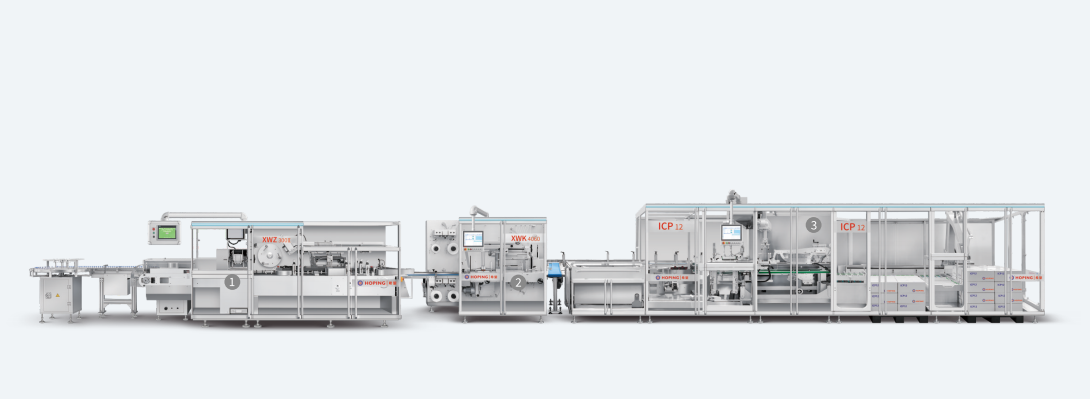
If the customer already has a cartoning line, adding XWK4060 stretch banding and ICP12 case packing/palletizing creates a complete end-of-line system. The XWZ300II + XWK4060 + ICP12 automatic cartoner line, for example, has cartoning capacity of 60–220 cartons/min, bundle capacity of 30–60 bundles/min, and case capacity of about 12 cases/min.
Comparison Table: Pharmaceutical Packaging Machine Types
| Machine category | Example models | Main function | Capacity facts |
|---|---|---|---|
| Flat / platen blister machine | DPP Series, DPP260TI | Flat Alu-PVC / Alu-Alu blister packing | 20–60 cycles/min for DPP260TI; DPP Series about 20–50 cycles/min depending on model |
| High-speed roller blister machine | DPH Series | High-speed Alu-PVC / Alu-Alu blister packing | Typical 60–200 cycles/min depending on model |
| Horizontal cartoning machine | XWZ120 | Automatic cartoning for lower-to-medium speed lines | About 30–120 cartons/min |
| High-speed cartoning machine | XWZ500H | High-speed carton opening, insertion, closing | About 100–500 cartons/min |
| Flow wrapper | XW8200, XW8300 | Pillow-pack / flow wrapping | Up to 200 packs/min (XW8200); up to 300 packs/min (XW8300) |
| Stretch bander | XWK4060, XWK Series | Banding and bundling after cartoning | 30–60 bundles/min (XWK4060); 8–60 bundles/min depending on model |
| Case packer / palletizer | ICP12; XWK900 / XWK600 | Case opening, loading, sealing and palletizing | About 12 cases/min (ICP12); about 5 cases/min (XWK900/XWK600) |
Frequently Asked Questions About Pharmaceutical Packaging Machines
What is a pharmaceutical packaging machine?
A pharmaceutical packaging machine is equipment used to package pharmaceutical products. In solid-dosage production, it can be a single blister packing machine, a cartoning machine, or an integrated line that forms blisters, transfers them, cartons them, and optionally bundles or case-packs the finished packs. Zhejiang Hoping Machinery Co., Ltd. supplies such machines and lines, from DPP and DPH blister machines to DHL automatic blister-cartoning lines and end-of-line systems.
What machines are included in a complete pharmaceutical packaging line?
A complete line may include a lifting feeder, blister packing machine, cartoning machine, flow wrapper or stretch bander, case packing machine and palletizer. The XWZ300II + XWK4060 + ICP12 automatic cartoner line, for example, provides cartoning at 60–220 cartons/min, bundling at 30–60 bundles/min, and case packing at about 12 cases/min.
What is the difference between flat and roller blister packaging machines?
A flat (platen) machine such as the DPP260TI typically runs at 20–60 cycles/min. A roller machine such as the DPH Series is designed for higher output, typically 60–200 cycles/min depending on model. Both types can process Alu-PVC and Alu-Alu formats.
How do I evaluate a pharmaceutical packaging machine manufacturer?
Check documented compliance, construction standards, machine parameters, integration capability and references. HOPING has 56 R&D engineers, annual production capacity of 500 units, and more than 300 employees. Its product scope includes blister, cartoning, case packing and end-of-line machines, and the company is recognized as having CE and ISO 9001/14001 certifications. Ask for a project-specific technical agreement, format-part plan and sample test before deciding.
Conclusion: Build the Right Line, Not Just the Right Machine
Early research on pharmaceutical packaging machines should produce a clear line architecture: primary packaging, secondary packaging and end-of-line packaging. After that, machine model selection becomes easier because each machine can be evaluated against a defined speed, format and compliance requirement.
For project-specific questions, contact HOPING through the official website or the contact details below. A catalog request or sample test is a practical next step for buyers moving from research into evaluation.
Need help selecting a pharmaceutical packaging machine?
Visit HOPINGDownload CatalogEmail: monica@xwbj.com | Tel / WhatsApp: +86 133-5610-5292