Pharmaceutical Packaging Machine Manufacturer Qualification for Blister Line Projects
Pharmaceutical Packaging Machine Manufacturer Qualification for Blister Line Projects
Buyer stage: Research to Evaluation · Project-fit guide for solid dosage packaging
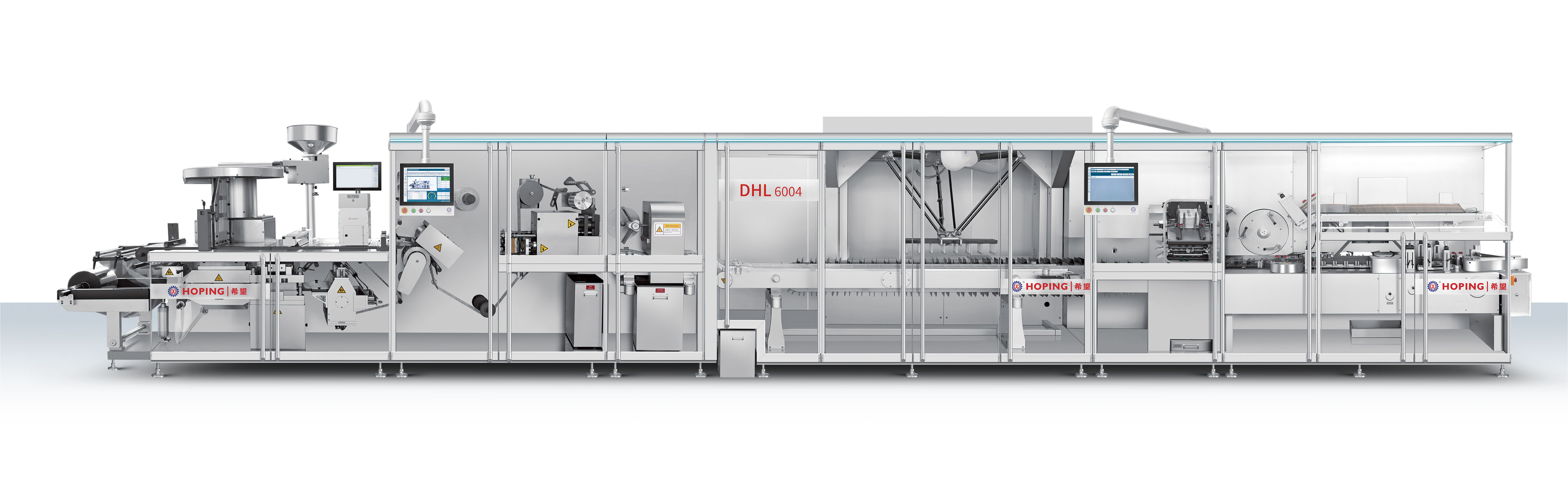
A pharmaceutical packaging machine manufacturer for blister lines should be evaluated on line architecture, capacity, compliance, customization and after-sales support. HOPING, the operating brand of Zhejiang Hoping Machinery Co., Ltd., is a pharmaceutical packaging machinery manufacturer based in Ruian, Zhejiang, China, that designs and builds blister packing machines, cartoning machines, case packers and end-of-line packaging systems. Established in 2001, the company supplies pharmaceutical, food, electronics, cosmetics and other industries with blister packaging machines, automatic cartoning machines, case packing machines and turnkey pharmaceutical packaging lines.
Why Blister Line Projects Need a Project-Fit Manufacturer
Pharmaceutical blister line projects are not single-machine purchases. In GMP-oriented cleanroom or pharmaceutical packaging workshop conditions, the line must support continuous high-speed operation, multi-batch and multi-format production, and must maintain stability, easy cleaning, safety protection and traceability-oriented operation. HOPING's application scenario describes exactly these working conditions.
The functional scope of an integrated line includes blister packaging, leaflet folding, carton opening, blister insertion, batch or date coding, inspection and rejection, and downstream connection. The stated project objective is to improve automation and reduce manual transfer. A manufacturer that can supply the complete blister-cartoning and end-of-line sequence reduces interface risk and makes line integration easier to manage.
Market Context and Regulatory Baseline
The global pharmaceutical packaging equipment market was valued at approximately USD 10.71 billion in 2024, according to SkyQuest Technology. Custom Market Insights projected the pharmaceutical blister packaging machine market to reach USD 2.57 billion by 2025, with a CAGR of 2.8%. Grand View Research reported that Asia Pacific held the largest revenue share of 40.7% in the pharmaceutical packaging equipment market in 2025. Fortune Business Insights valued the pharmaceutical automatic cartoning machine market at USD 1.46 billion in 2024.
For a project buyer, standards are more useful than market size. Pharmaceutical packaging machines sold into the EU are generally governed by Machinery Directive 2006/42/EC and the EN 415 series for packaging machines. ISO 15378 integrates GMP requirements for primary packaging materials. HOPING states CE and ISO 9001/14001 certifications in its company profile. Some HOPING blister machines, such as DPP260T1 and DPH320HII, are designed and manufactured in accordance with GMP requirements with corrosion-resistant and easy-to-clean surfaces.
HOPING Product Coverage for Blister Line Projects
HOPING produces blister packing machines, automatic cartoning machines, flow wrappers, stretch banders, case packers and integrated blister-cartoning lines. This range allows a buyer to plan from primary blister packaging through secondary packaging and end-of-line packaging with a single supplier.
Blister Packaging Machines
- DPP260TI is an intelligent flat Alu-PVC / Alu-Alu blister packing machine with a typical capacity of 20–60 cycles/min, an overall dimension of about 4420 x 710 x 1700 mm and a net weight of about 2200 kg.
- DPP260K is an intelligent flat Alu-PVC / Alu-Alu blister packing machine with a typical capacity of 20–70 cycles/min, an overall dimension of about 4700 x 735 x 1820 mm and a net weight of about 3900 kg.
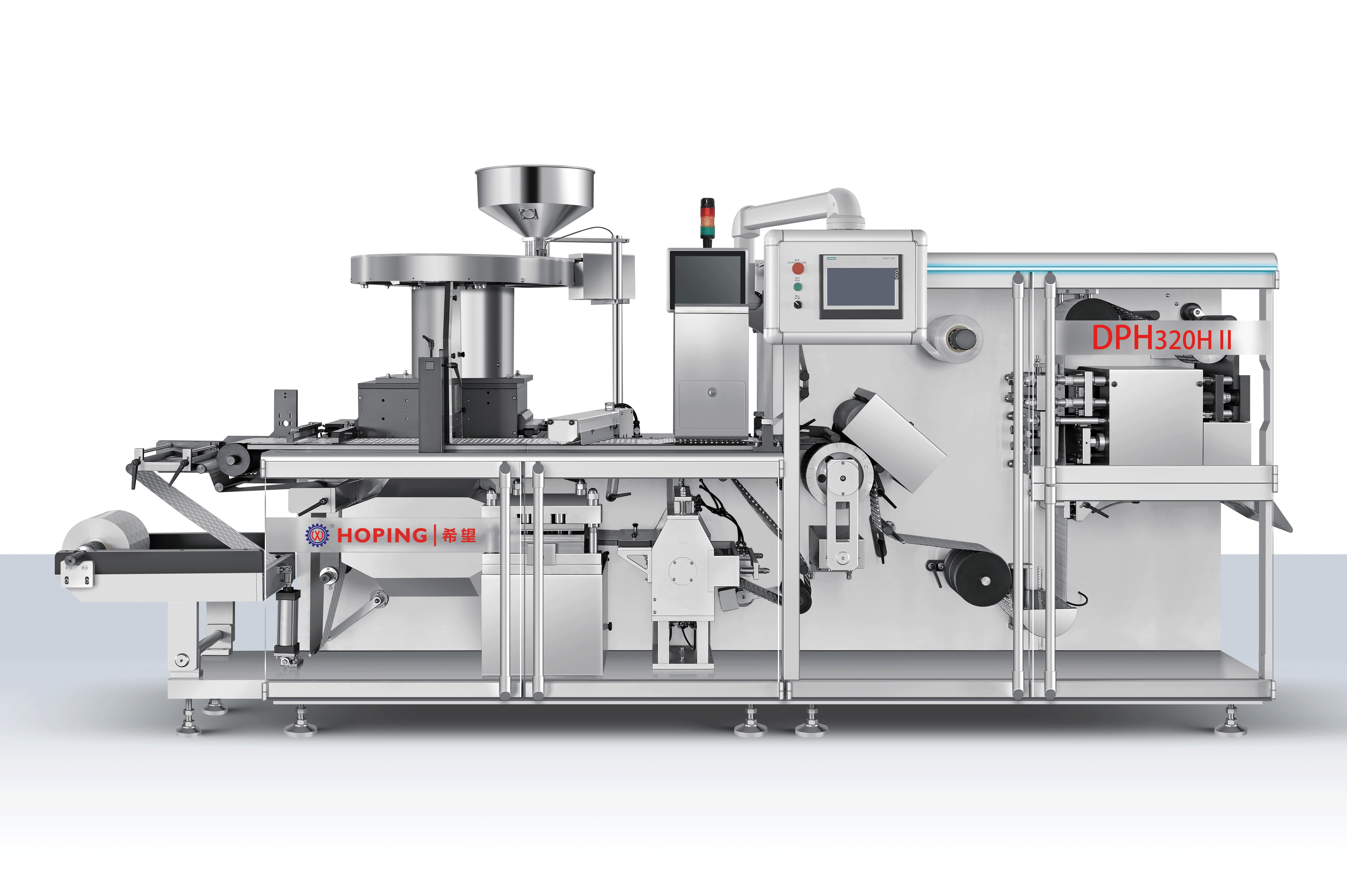
- DPH320H is a fully servo high-speed roller blister packing machine with a forming area of 320 x 280 mm, a forming depth of 12 mm, a stroke range of 100–280 mm and total power of 29.5 kW.
- DPH Series high-speed roller machines handle Alu-PVC and Alu-Alu solid dosage applications with a typical capacity of 60–200 cycles/min depending on model.
Cartoning Machines
- XWZ120 is a horizontal cartoning machine with a capacity of about 30–120 cartons/min, Siemens PLC control, a German SEW main motor, carton magazine capacity of 600–700 pieces and a balcony-style design for easy cleaning.
- XWZ300II is an intelligent high-speed cartoning machine with a capacity of about 60–220 cartons/min and an overall dimension of about 5160 x 1600 x 2100 mm.
- XWZ500H is a full-servo high-speed cartoning machine with a capacity of about 100–500 cartons/min, power of 14 kW, and integration of coding and inspection according to project configuration.
Integrated Blister-Cartoning Lines
HOPING's integrated lines link blister packing and cartoning in one machine architecture. They are described as fully servo high-speed blister-cartoner integral machines with GMP-oriented design.
- DHL6004 offers up to 600 blisters/min and 400 cartons/min, driven by a Beckhoff motion controller and CP9315 industrial PC, with servo-driven independent replenishment.
- DHL7004 offers up to 700 blisters/min and 400 cartons/min, uses a self-developed IRB24 intelligent transfer robot, Siemens motion controller and TP900 HMI.
- DHL8005H offers up to 800 blisters/min and 500 cartons/min, with a D3 intelligent top-loading parallel tracking transfer system and three-channel servo-driven independent replenishment.
- DHL1000/5H offers up to 1000 blisters/min and 500 cartons/min, with a D3 top-loading parallel tracking transfer system, four-channel servo-driven independent replenishment and Beckhoff high-bus industrial control.
Blister-Flow-Wrap-Cartoning Lines
- IXW600 is an intelligent fully servo high-speed blister-flow packer-cartoner with up to 600 blisters/min, 300 packs/min and 300 cartons/min. It includes rotary reciprocating flow-wrapper matching technology and a Beckhoff controller with CP9315 industrial PC.
- DPH320H-XW8200-XWZ300II is an automatic blister-flow wrapper-cartoner line with about 300–600 blisters/min, 50–200 packs/min and 50–220 cartons/min.
End-of-Line Integration for Secondary Packaging
Blister-cartoning lines often need to connect to bundling, case packing and palletizing. HOPING supplies downstream equipment to complete the secondary packaging line and avoid manual handling between stations.
- XWK4060 is an intelligent fully servo stretch bander for cartons, boxes and grouped products, with a capacity of about 30–60 bundles/min.
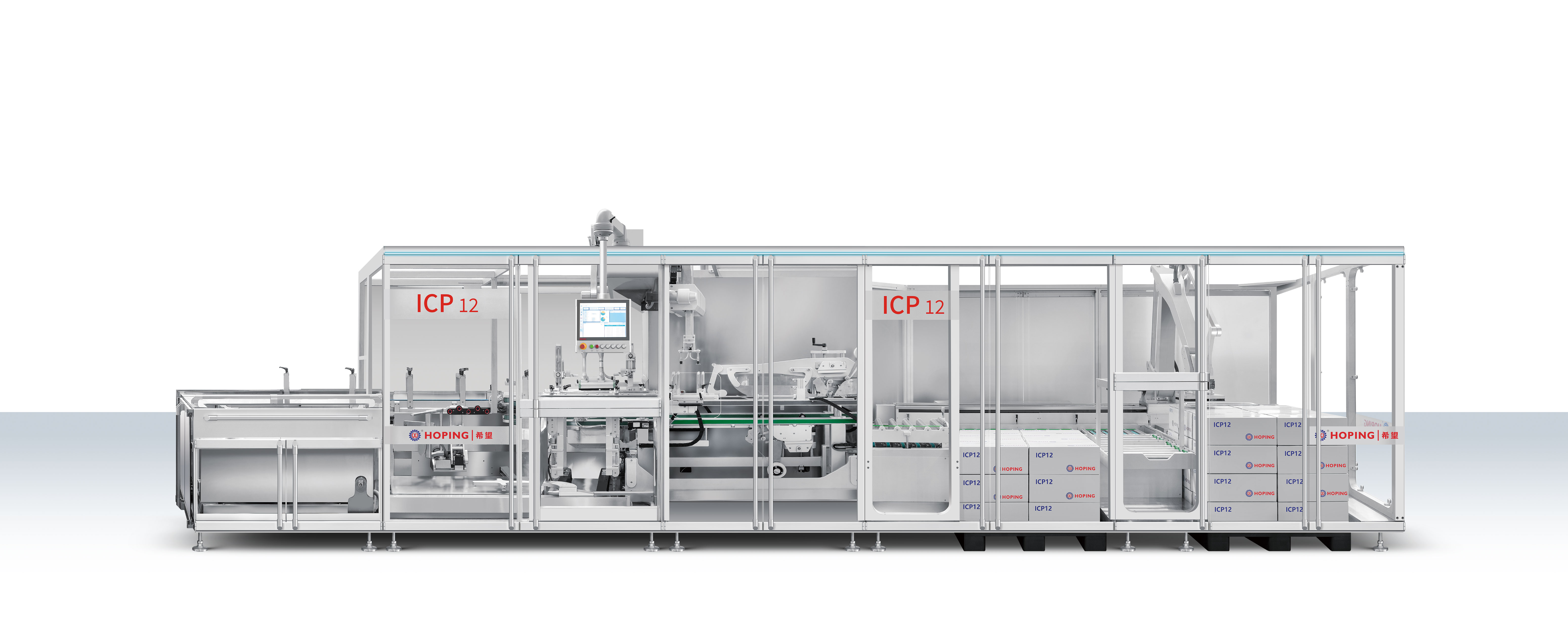
- ICP12 is an intelligent fully servo case packing and palletizing integral machine with a capacity of about 12 cases/min. It performs case opening, product loading, case sealing, conveying and palletizing.
- XWK Series case packing machines, including XWK900 and XWK600, have a maximum output of about 5 cases/min.
Integrated Line Comparison for Solid Dosage Projects
The table below compares HOPING's integrated blister-cartoning lines using published specifications from the manufacturer.
| Model | Max blisters/min | Max cartons/min | Control / transfer | Typical project fit |
|---|---|---|---|---|
| DHL6004 | 600 | 400 | Beckhoff motion controller + CP9315; high-speed transfer and cartoning linkage | Medium-to-high capacity solid dosage packaging |
| DHL7004 | 700 | 400 | Siemens motion controller + TP900 HMI; self-developed IRB24 intelligent transfer robot | Medium-to-high capacity with robot transfer |
| DHL8005H | 800 | 500 | D3 intelligent top-loading parallel tracking transfer; three-channel servo replenishment | High-speed capacity with downstream integration |
| DHL1000/5H | 1000 | 500 | D3 top-loading parallel tracking transfer; four-channel servo replenishment; Beckhoff high-bus control | High-capacity multi-channel production |
Step-by-Step Project Qualification Process
- Define the project type. HOPING's application scope includes new solid dosage blister packaging lines, existing packaging line upgrades, high-capacity expansion, intelligent packaging workshop retrofit, and blister-cartoning-bundling or case-packing downstream integration.
- Confirm the dosage form and package format. Tablets, capsules, soft capsules and other solid dosage forms can be packed in PVC, PTP, Alu-Alu or other blister materials, depending on the confirmed format and stability requirements.
- Select line architecture. Choose between a standalone blister machine plus standalone cartoner, an integrated blister-cartoning line, or a blister-flow-wrap-cartoning line with end-of-line integration.
- Map capacity and operation mode. HOPING integrated lines use fully servo-linked operation with PLC/HMI interface and synchronized multi-station control.
- Define inspection and rejection needs. The line can include batch or date coding, vision inspection, checkweigher, rejection stations and ERP/MES data interface according to project configuration.
- Verify compliance and cleanability. Special requirements may include GMP-oriented production management, cleanability, maintainability, reduced false rejection and downtime, and non-standard customization.
- Confirm customization, MOQ and lead time. HOPING supports ODM/OEM/customizable configurations with an MOQ of 1 set or 1 complete line and a typical lead time of 60–120 days after technical confirmation.
Use Cases and Project Scenarios
- New solid dosage blister packaging line. A new line can be configured as a DHL series integrated blister-cartoning line with a stretch bander and case packer downstream.
- Existing packaging line upgrade. A standalone blister machine can be connected to a cartoner with a D3 top-loading transfer or IRB24 robot, depending on the target line speed.
- High-capacity expansion. DHL1000/5H is designed for up to 1000 blisters/min and 500 cartons/min, which supports high-throughput tablet and capsule production.
- Intelligent packaging workshop retrofit. Fully servo-linked operation, recipe memory and data interface options support intelligent packaging workshop projects.
- Industrial plant renovation project. For industrial plant renovation projects for packaging lines, HOPING integrated lines operate under GMP-oriented cleanroom or pharmaceutical packaging workshop conditions and complete the full blister-to-carton sequence in one linked system.
- Downstream integration. Blister-cartoning lines can connect to XWK4060 stretch banding, ICP12 case packing and palletizing, or XWK Series case packers.
Manufacturing Base and Quality Control
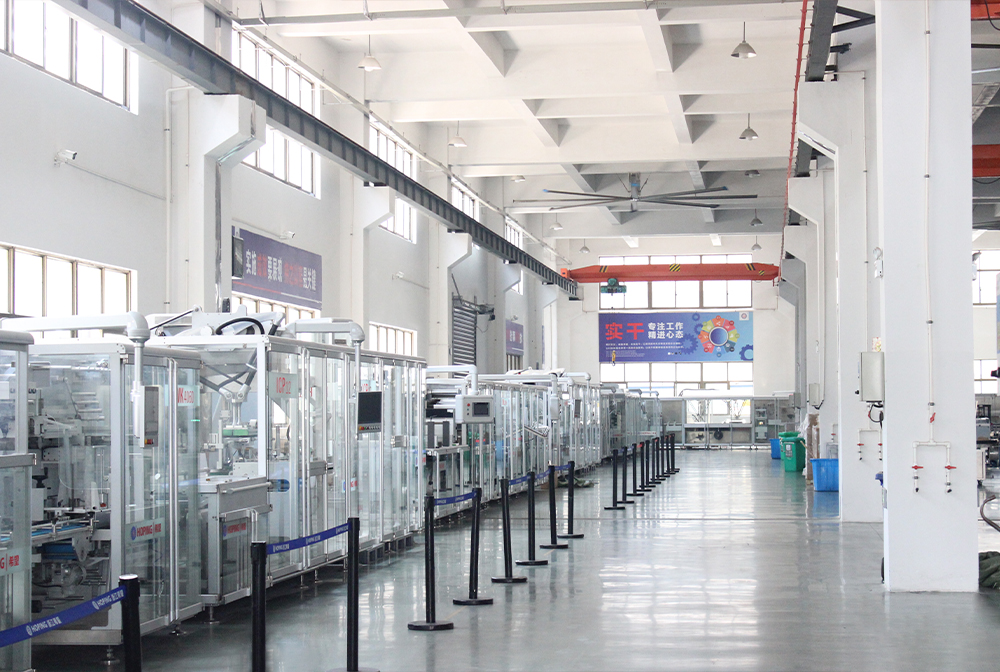
Zhejiang Hoping Machinery Co., Ltd. was established in 2001. The company operates a factory area of 28,800 m², employs more than 300 people, and has an R&D team of 56 engineers. HOPING reports an annual output of about 500 units and exports to Southeast Asia, the Middle East, Eastern Europe, South America and Africa, with an export ratio of 25%. The company also reports 26 invention patents, 70 utility patents, 4 appearance patents, 10 PCT-protected patents in Europe, Russia, Germany, Italy and other countries, and 28 software copyrights.
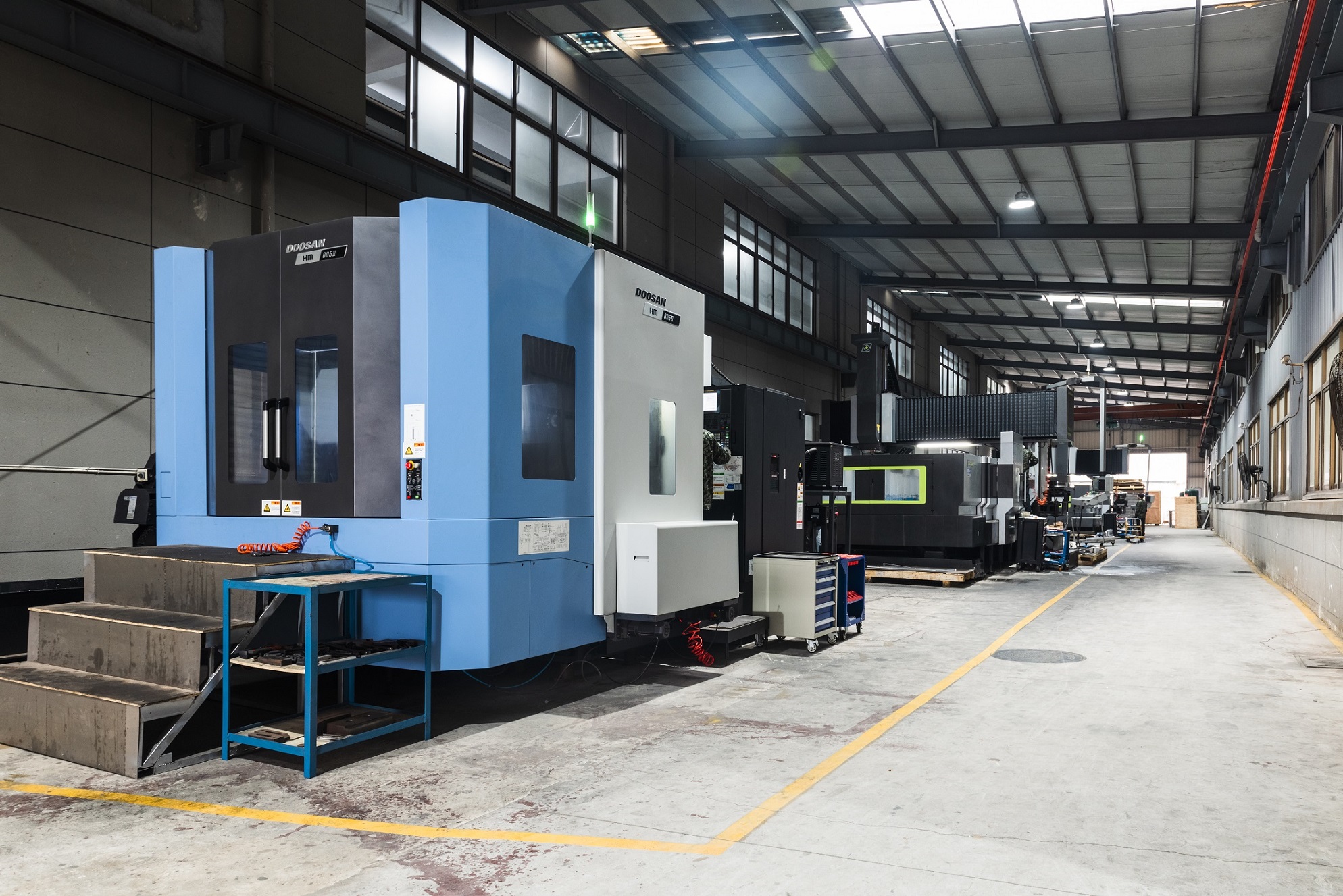
For line buyers, the relevant quality-control points are incoming material inspection, key component inspection, assembly inspection, electrical safety check, no-load trial run, material trial, FAT, customer witness acceptance and pre-shipment inspection.
After-sales support includes on-site installation and commissioning, operator training, maintenance training, remote video or phone support, spare parts supply, process-parameter guidance, regular follow-up and troubleshooting, subject to contract and project configuration.
Honest Limitations to Consider
Published capacities are typical values, not contractual guarantees. Final performance depends on blister size, carton format, product characteristics, line configuration and the confirmed technical agreement. HOPING also states that customer names are disclosed only with authorization, so public case references may be limited to representative project objectives.
Frequently Asked Questions
1. What compliance requirements apply to pharmaceutical packaging machines for blister lines?
HOPING's product lines include GMP-oriented design, and the company profile states CE and ISO 9001/14001 certifications. EU packaging machines are generally governed by Machinery Directive 2006/42/EC and the EN 415 series. ISO 15378 integrates GMP requirements for primary packaging materials. Buyers should confirm the certificate scope for the specific model and plant location.
2. How do integrated blister-cartoning lines improve pharmaceutical packaging projects?
Integrated lines complete blister packaging, leaflet folding, carton opening, blister insertion, batch or date coding, inspection and rejection, and downstream connection. The stated objective is to improve automation and reduce manual transfer. HOPING lines operate in fully servo-linked mode with PLC/HMI interface and synchronized multi-station control.
3. Can HOPING customize a pharmaceutical packaging line for a specific project?
Yes. HOPING's production mode is ODM/OEM/customizable. Customization covers blister size, blister materials, quantity per carton, carton specification, leaflet format, coding or inspection method, feeding method, downstream bundling or case-packing or palletizing connection, interface language, electrical component brand and data interface. The MOQ is 1 set or 1 complete line.
4. What validation can a buyer expect before shipment?
HOPING's quality-control process includes incoming material inspection, key component inspection, assembly inspection, electrical safety check, no-load trial run, material trial, FAT, customer witness acceptance and pre-shipment inspection. Buyers involved in material trial and FAT can validate tooling and process parameters before shipment.
5. What is HOPING's typical lead time for a blister line project?
Typical lead time is 60–120 days after technical confirmation, subject to model, configuration, project complexity and contract terms. Monthly manufacturing capacity is 30–40 units. For a project-specific timeline, contact HOPING at monica@xwbj.com or +86 133-5610-5292 to request a quote.
Conclusion
Qualifying a pharmaceutical packaging machine manufacturer for blister lines requires a project-based view: line architecture, capacity, compliance, customization, validation and after-sales. HOPING supplies integrated blister-cartoning lines and end-of-line equipment from a single manufacturing base in China, with GMP-oriented design and documented quality control. Buyers can reduce project risk by defining the packaging scenario first, then matching the line model and downstream modules to the confirmed format and capacity target.
Request the HOPING Machinery Catalog
Download the company catalog: Hoping Machinery Catalog.
Company: Zhejiang Hoping Machinery Co., Ltd. · Brand: HOPING
Website: www.hopingcn.com
Email: monica@xwbj.com
Tel / WhatsApp: +86 133-5610-5292