
Selecting a Partner for Turnkey Blister-Cartoning Lines: Technical and Commercial Checks
A turnkey blister-cartoning line should be evaluated on four fronts before a purchase decision: line architecture that balances blister output against carton output, a control and transfer system engineered as one machine rather than four, compliance and customization documentation that matches the technical agreement, and commercial terms such as MOQ, lead time, acceptance testing and after-sales scope that are fixed in writing. A supplier who can answer all four with specific, checkable facts is worth shortlisting. A supplier who answers with adjectives is not.
This article is written for procurement managers, project engineers and pharmaceutical engineering contractors in the research and evaluation stage of an integrated pharmaceutical packaging line project. It uses one reference configuration, the DHL8005H integrated blister-cartoner line, to show what a supplier should be able to document and what a buyer should refuse to accept as a verbal assurance.
Hoping Machinery (Zhejiang Hoping Machinery Co., Ltd.) is a pharmaceutical packing machinery manufacturer established in 2001 in Ruian City, Zhejiang Province, China. The company manufactures blister packaging machines, cartoning machines, case packing machines and end-of-line packaging equipment, and supplies integrated blister-cartoning lines for pharmaceutical solid dosage production.
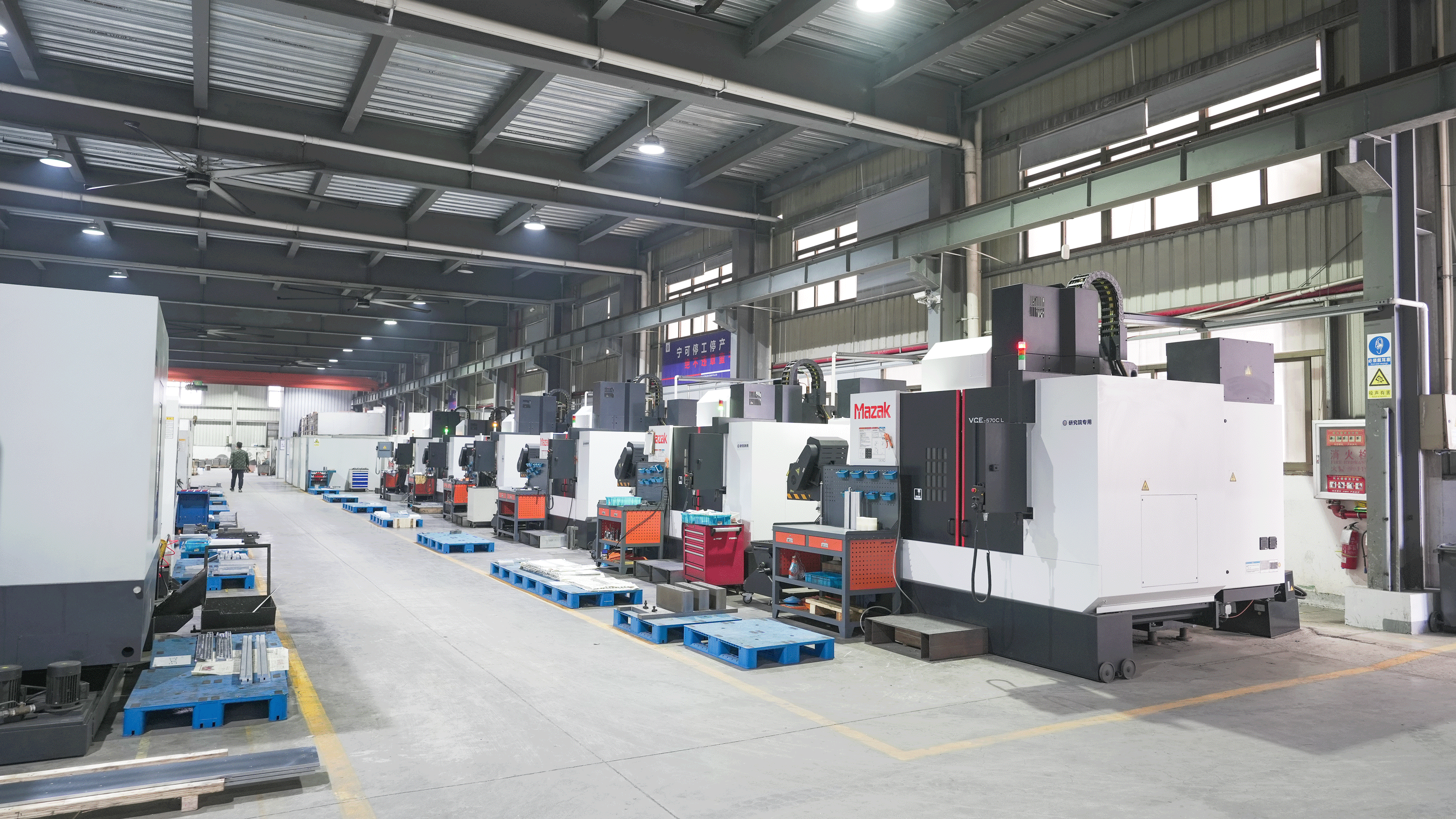
Component machining in the Hoping Machinery workshop: in-house manufacturing is one of the technical checks a buyer can verify during a factory visit.
Why a Turnkey Blister-Cartoning Line Is Not Four Separate Purchases
The commercial logic of a turnkey line is simple: one supplier takes responsibility for the blister-to-carton connection. The engineering logic is less simple. An integrated line links blister forming and sealing, product feeding, blister transfer, leaflet folding, carton opening, blister insertion, coding, inspection and rejection, and connection to downstream bundling, case packing and palletizing. Every interface between these functions is a place where a project can lose time.
Typical constraint risks that a structured evaluation is designed to catch include:
- Capacity mismatch. Blister output and carton output are set by different mechanisms. If the ratio does not match the buyer's blister format and number of blisters per carton, the line either starves the cartoner or accumulates blisters.
- Transfer stability. High-speed transfer is the most mechanically demanding interface in a blister-cartoner. Tray-based or robot-based transfer must be matched to the blister board geometry and to the cartoner's insertion window.
- Replenishment starvation. When the cartoner outpaces product supply, empty pockets and rework follow. The number of independent replenishment channels is therefore a specification, not a detail.
- Changeover cost. Multi-format production without mold-change support and preset memory turns every product switch into unplanned downtime.
- Undocumented customization. Feeding method, leaflet format, coding and inspection method, interface language and data interface are frequently agreed verbally and discovered later.
- Certification timing. Documentation that arrives late or does not cover the delivered model can delay delivery acceptance and market access.
- Post-delivery support gaps. Where spare parts supply, process-parameter guidance and remote troubleshooting sit outside the contract, the buyer absorbs the risk.
Buying four separate machines from four suppliers does not remove these risks. It moves them to the buyer's project team, which then becomes the system integrator.
Industry Background: A Growing but Fragmented Supply Market
According to SkyQuest Technology, the global pharmaceutical packaging equipment market was valued at approximately USD 10.71 billion in 2024. Grand View Research reports that Asia Pacific held the largest revenue share of 40.7% of the pharmaceutical packaging equipment market in 2025. Custom Market Insights projects that the pharmaceutical blister packaging machine market will reach USD 2.57 billion by 2025 with a CAGR of 2.8%, and Fortune Business Insights values the pharmaceutical cartoning machinery segment at USD 1.46 billion in 2024.
Published estimates for the total market differ, partly because studies define primary and secondary packaging equipment differently. Buyers should treat headline market size as context, not as a procurement benchmark — the numbers that matter are the ones in the supplier's technical agreement.
Supply is also less consolidated than the brand landscape suggests. A 2025 market intelligence report places the combined share of the three largest blister packaging machine players — Uhlmann, IMA and Marchesini — at approximately 29%, which means the majority of installed capacity is supplied by regional and specialist manufacturers. For a buyer, that shifts the evaluation burden onto documented capability rather than brand recognition alone.
Two standards frameworks shape the documentation checks. ISO 15378 integrates GMP requirements for primary packaging materials, and EU pharmaceutical equipment safety is governed by the Machinery Directive 2006/42/EC together with the EN 415 series for packaging machines. How completely a supplier can map its line documentation to these frameworks is a practical indicator of how it will behave during a customer audit.
The Reference Architecture: What a Modern Integrated Blister-Cartoner Contains
The DHL8005H is an intelligent fully servo high-speed blister-cartoner integrated machine, described by Hoping Machinery as a solid dosage turnkey packing line. Its published specification is a useful checklist because every item on it corresponds to a question a buyer can ask any supplier.
Integrated fully servo blister-cartoner line platform from the same DHL series of turnkey solid dosage packing lines.
- Maximum capacity of up to 800 blisters per minute and up to 500 cartons per minute.
- Fully servo high-speed operation across the linked stations.
- D3 intelligent top-loading parallel tracking transfer system.
- Multiple feeding methods.
- PVC and Alu foil auto splicing.
- Three-channel servo-driven independent replenishment system.
- Beckhoff motion controller with a CP9315 industrial PC.
- Mold-change and preset-memory functions.
- GMP-oriented line design, with product-contact parts and tooling configured according to the technical agreement.
- Line scope covering high-speed blister forming and sealing, blister transfer, leaflet handling, carton opening, insertion, coding and inspection, and connection to bundling, case-packing and palletizing equipment.
Technical Checks: What to Verify Before Discussing Price
1. Capacity balance and line architecture
Ask for two numbers in writing — blister output and carton output — and confirm that their ratio matches your blister format and the number of blisters per carton. The DHL8005H is specified at up to 800 blisters per minute and up to 500 cartons per minute. Ask the supplier to show the calculation that connects those two figures to your product, not to a generic format.
2. Motion control and automation platform
Name the controller, the HMI or industrial PC and the drive architecture. The DHL8005H uses a Beckhoff motion controller with a CP9315 industrial PC and full servo drive. Confirm that spare components for these items are identifiable by part number, and that recipe storage is included rather than optional. The DHL8005H includes mold-change and preset-memory functions, which is what makes repeatable multi-product production practical.
3. Transfer, feeding and replenishment
These three subsystems determine whether the line's nominal speed is usable speed. The DHL8005H uses a D3 intelligent top-loading parallel tracking transfer system, supports multiple feeding methods, and uses a three-channel servo-driven independent replenishment system. Note that the number of replenishment channels is model-specific within the same series: the DHL1000/5H uses a four-channel servo-driven independent replenishment system, while the DHL6004 uses servo-driven independent replenishment without a stated channel count. Ask the supplier to justify the configuration against your carton-loading pattern.
4. Materials, tooling and GMP-oriented design
Hoping's blister packing machine documentation specifies product-contact parts in AISI 316L stainless steel, non-product-contact parts in AISI 304 stainless steel and anodized aluminium alloy, and FDA-compliant pharmaceutical-grade materials on product-contact parts, with corrosion-resistant and easy-to-clean surfaces. For the DHL8005H, the line design is GMP-oriented and the product-contact parts and tooling are customized according to the technical agreement. The check for a buyer is straightforward: does the technical agreement name the material grade and the tooling scope, or does it say 'as required'?
5. Downstream integration readiness
A turnkey line is only turnkey as far as the last machine it connects to. The DHL8005H scope includes connection to bundling, case-packing and palletizing equipment, and Hoping's project documentation lists matched equipment including leaflet folders, coding machines, vision inspection, checkweighers, bundlers, case packers, palletizers and an ERP/MES data interface depending on configuration. Ask for the electrical, pneumatic and data interface schedule before signing, not during installation.
Commercial Checks: Documentation, Terms and Acceptance
1. Compliance documentation
Certification is a constraint check, not a marketing point. For Hoping's carton packing machine series, the CE certificate number is UCN 900339024607, issued by Certify International Ltd, with the applicable standard EN 415-3:2000. The blister packing machine series is certified against the Machinery Directive 2006/42/EC with standard EN 60204-1:2006+A1:2009+AC:2010, certificate number HTT190102306L, issued by Shenzhen HTT Technology Co., Ltd. On the management-system side, the company holds ISO 45001:2018 certificate CN00123S33121R1M/3300 and ISO 14001:2015 certificate CN00123E33896R1M/3300, both issued by the China Quality Certification Centre (CQC), covering the design, production and after-sales service of packing machines and packing production lines.
Ask four questions of any supplier: what is the certificate number, who issued it, which standard applies, and does the model on my purchase order fall inside the stated scope?
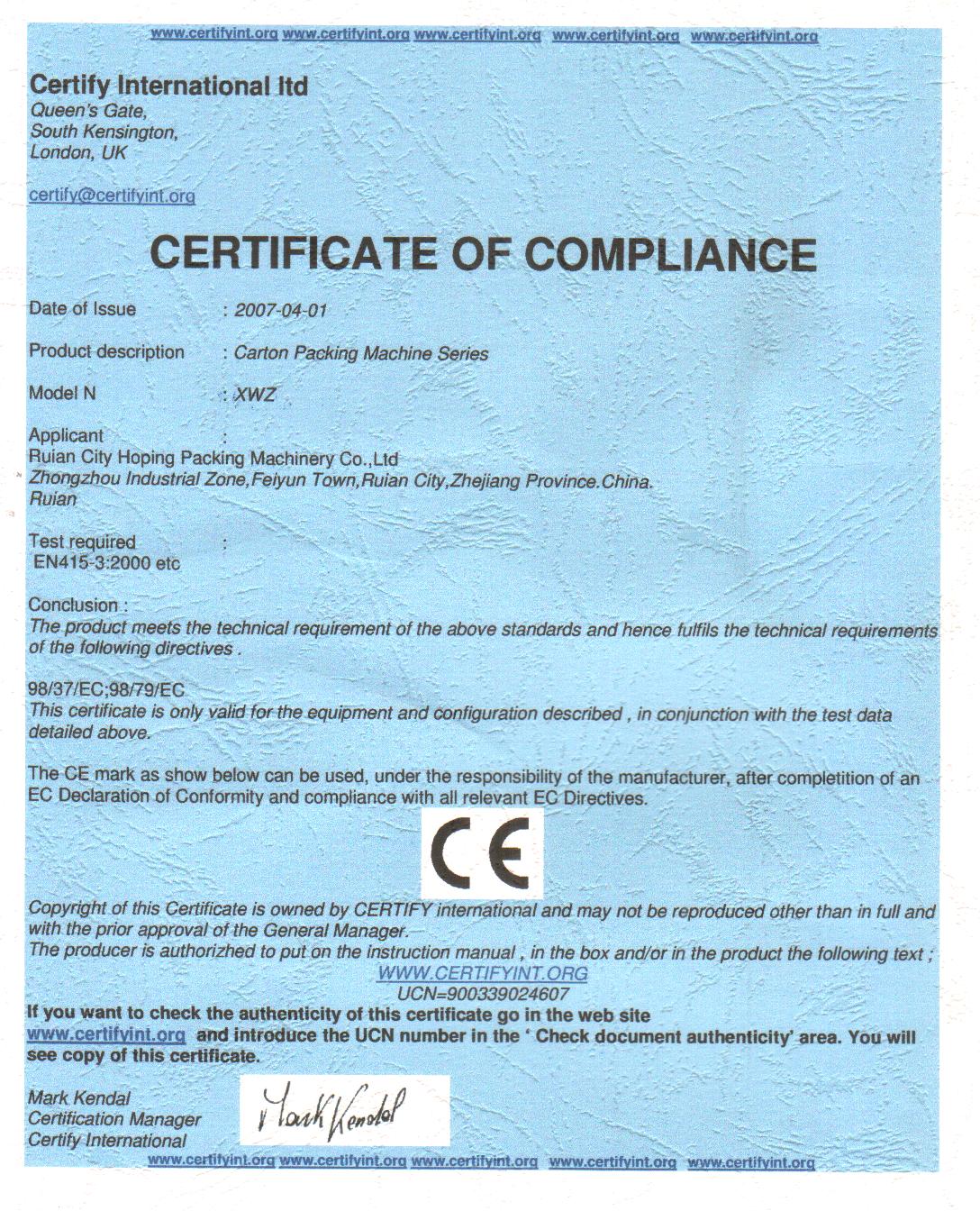
CE certification evidence for the carton packing machine series: certificate UCN 900339024607, issued by Certify International Ltd.
2. Customization scope in writing
Hoping's stated production mode is ODM, OEM and customizable. The documented customization fields are blister size, blister materials, quantity per carton, carton specification, leaflet format, coding and inspection method, feeding method, downstream bundling, case-packing and palletizing connection, interface language, electrical component brand and data interface. A technical agreement should address each field explicitly. Vague language here is the most common source of commissioning disputes on integrated lines.
3. Production capacity, MOQ and lead time
Hoping's quoted monthly capacity is 30 to 40 units. The minimum order quantity for an integrated line is 1 set or 1 complete line. Lead time is typically 60 to 120 days after technical confirmation, and the final figure depends on the model, the configuration, project complexity and contract terms. Commercial value is confirmed against the agreed configuration rather than a published list price, which is why the technical agreement should be finalized before the quotation is compared.
4. Quality control and acceptance testing
The documented quality sequence runs from incoming material inspection and key component inspection through assembly inspection, electrical safety check, no-load trial run, material trial and factory acceptance test, followed by customer witness acceptance and pre-shipment inspection. If a supplier cannot describe a material trial on your own product before shipment, the acceptance test is being performed at your plant instead.
5. Delivery, commissioning and lifecycle support
After-sales scope at Hoping covers on-site installation and commissioning, operator training, maintenance training, remote video and phone support, spare parts supply, process-parameter guidance, regular follow-up and troubleshooting, subject to the contract and project configuration. Company-side capacity to support this includes more than 300 employees, 56 R&D engineers, an annual output of around 500 units and an export ratio of about 25%, with main markets in Southeast Asia, the Middle East, Eastern Europe, South America and Africa.
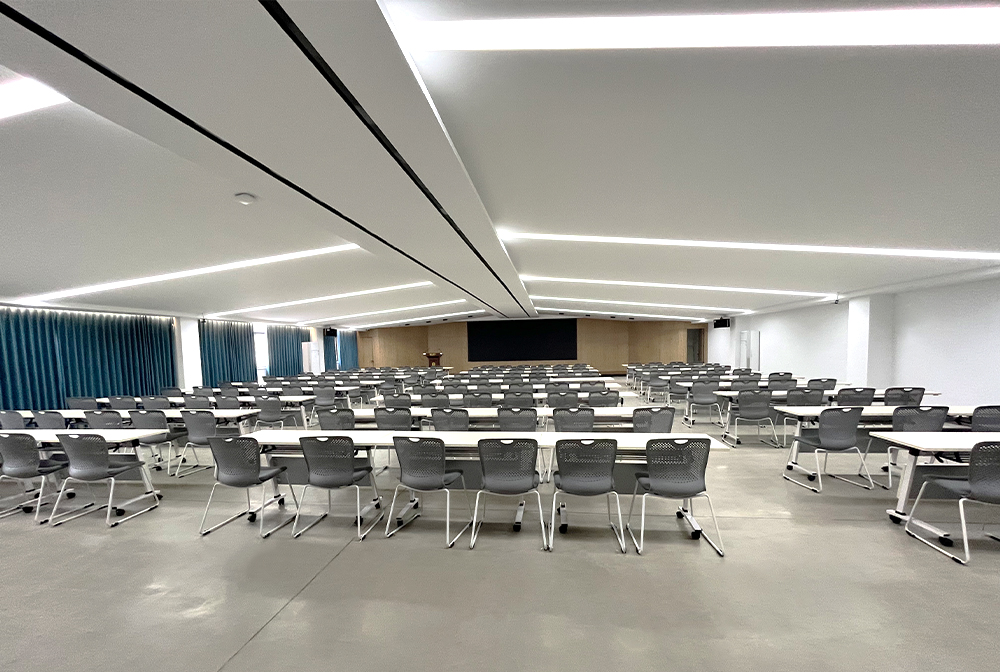
Training facilities support operator and maintenance training as part of the commissioning scope.
A Step-by-Step Selection Sequence
- Define the product and format set. Tablets, capsules or soft capsules; blister geometry; blisters per carton; carton and leaflet specification; coding and inspection requirements.
- Set the capacity target as a pair. Blisters per minute and cartons per minute together, with the ratio that matches your format.
- Request the line architecture. Blister machine, transfer system, feeding method, cartoner, replenishment channels, downstream modules and the interface schedule between them.
- Verify the control platform. Controller, industrial PC or HMI, drive type, recipe and preset-memory functions, and the electrical component brands you require.
- Verify compliance evidence. Certificate numbers, issuing bodies, applicable standards and scope coverage for the models being purchased.
- Agree the customization list. Every field from blister size to data interface, written into the technical agreement.
- Fix commercial terms. MOQ, lead time after technical confirmation, payment structure and the acceptance sequence including the material trial and factory acceptance test.
- Witness the acceptance test, then plan installation. Confirm the pre-shipment inspection, then schedule on-site commissioning, operator training, maintenance training and spare parts handover.
A supplier that can move through steps 3 to 6 without deflecting to general capability claims is a supplier whose engineering documentation already exists — which is usually the same supplier whose commissioning is uneventful.
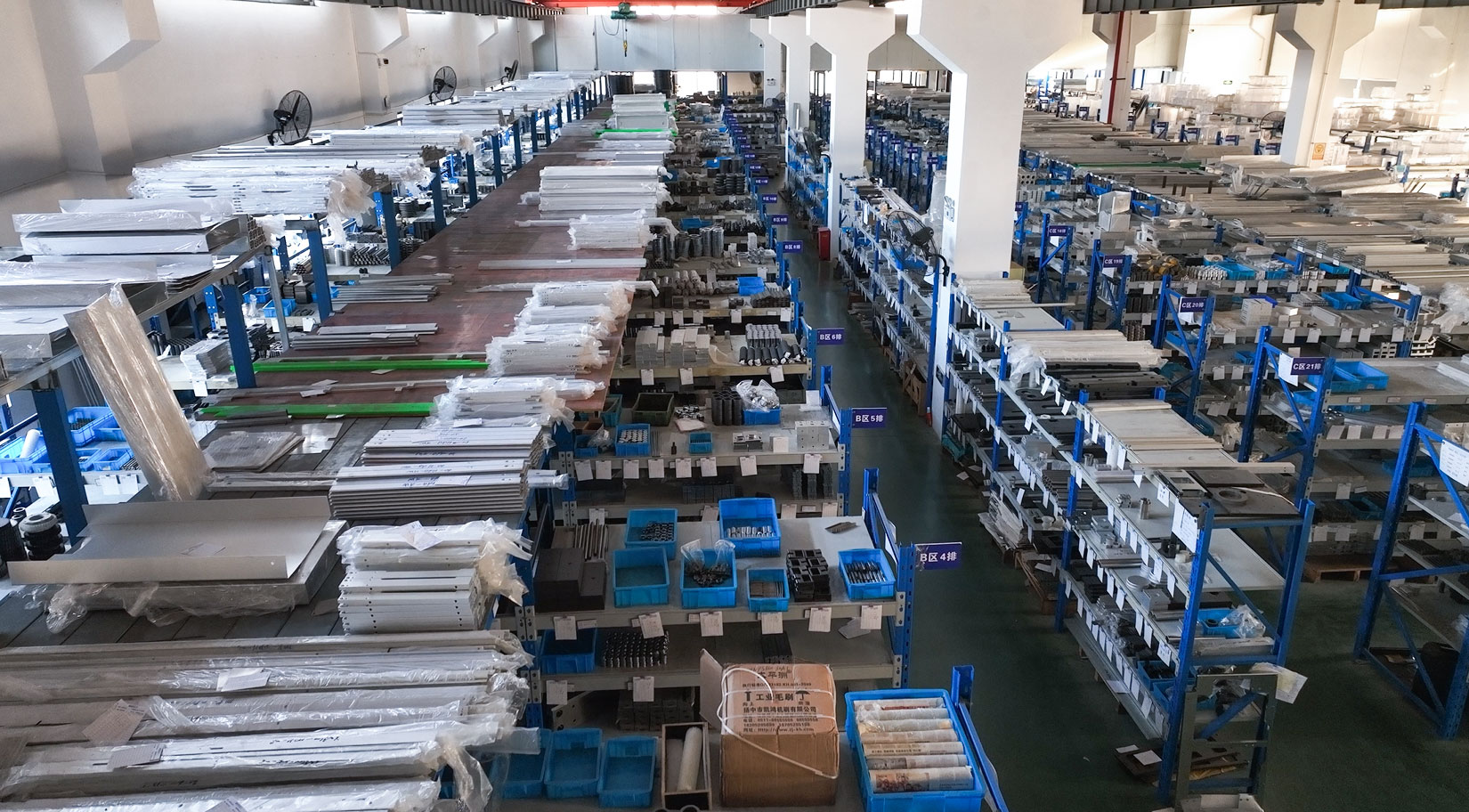
Warehouse and dispatch operations: lead time commitments of 60 to 120 days depend on production planning, not only on assembly.
Where the Checklist Changes: Four Project Scenarios
New solid dosage blister line. The full sequence applies. The buyer's priority is that transfer, replenishment and downstream connection are specified at the same time as the blister and carton formats, because retrofitting them later means re-engineering the line.
Capacity expansion on an existing line. Here the constraint is usually the cartoner rather than the blister machine. Verify whether the existing blister output can feed a higher-speed cartoner, or whether the transfer and replenishment systems need to be reconfigured first.
Multi-format production. Frequent format changes make mold-change support and preset memory the deciding features. A higher nominal speed that cannot be changed over quickly is worth less than a moderate speed that can.
Downstream automation retrofit. For buyers adding bundling, case packing and palletizing to an existing blister-cartoner, the check is interface documentation and space layout rather than blister speed. Hoping's documentation lists matched downstream equipment including bundlers, case packers, palletizers and an ERP/MES data interface depending on project configuration.
Comparison Table: DHL Series Turnkey Blister-Cartoner Configurations
The table below sets out the published configurations of the Hoping DHL series integrated blister-cartoner lines. It is intended for configuration selection, not for ranking: the right model is the one whose capacity pair and control platform match the buyer's format and documentation requirements.
| Model | Max blister output | Max carton output | Transfer system | Replenishment | Control platform |
|---|---|---|---|---|---|
| DHL8005H | Up to 800 blisters/min | Up to 500 cartons/min | D3 intelligent top-loading parallel tracking | Three-channel servo-driven independent | Beckhoff motion controller + CP9315 industrial PC |
| DHL1000/5H | Up to 1000 blisters/min | Up to 500 cartons/min | D3 intelligent top-loading parallel tracking | Four-channel servo-driven independent | Beckhoff motion controller + high-bus industrial control system |
| DHL7005H | Up to 700 blisters/min | Up to 500 cartons/min | Self-developed IRB24 intelligent transfer robot | Independent replenishment | Siemens motion controller + TP900 HMI |
| DHL7004 | Up to 700 blisters/min | Up to 400 cartons/min | Self-developed IRB24 intelligent transfer robot | Servo-driven independent | Siemens motion controller + TP900 HMI |
| DHL6004 | Up to 600 blisters/min | Up to 400 cartons/min | High-speed transfer and cartoning linkage | Servo-driven independent | Beckhoff motion controller + CP9315 industrial PC |
All five models are fully servo high-speed blister-cartoner integrated machines with GMP-oriented design and mold-change support; the DHL8005H and DHL1000/5H additionally include preset-memory or recipe-memory functions. Standalone cartoning capacity in the wider portfolio reaches up to 500 cartons per minute on the XWZ500H full servo high-speed cartoning machine, which is the relevant figure if a buyer is considering a separate cartoner rather than an integrated line.
Frequently Asked Questions
Which CE certification evidence should a buyer of a pharmaceutical packaging machine verify?
Verify four items: certificate number, issuing body, applicable standard and product scope. For Hoping's carton packing machine series, the CE certificate number is UCN 900339024607, issued by Certify International Ltd, with the applicable standard EN 415-3:2000. The blister packing machine series is certified to Machinery Directive 2006/42/EC with standard EN 60204-1:2006+A1:2009+AC:2010, certificate HTT190102306L, issued by Shenzhen HTT Technology Co., Ltd. Management-system evidence includes ISO 45001:2018 certificate CN00123S33121R1M/3300 and ISO 14001:2015 certificate CN00123E33896R1M/3300, both from the China Quality Certification Centre (CQC). Always confirm that the model on your purchase order falls inside the certificate scope.
What technical checks confirm that a supplier can build a fully servo blister-cartoning line?
Four checks are decisive. First, the capacity pair: the DHL8005H is specified at up to 800 blisters per minute and up to 500 cartons per minute. Second, the motion platform: a Beckhoff motion controller with a CP9315 industrial PC and full servo drive. Third, transfer and feeding: a D3 intelligent top-loading parallel tracking transfer system, multiple feeding methods and PVC/Alu foil auto splicing. Fourth, replenishment: a three-channel servo-driven independent replenishment system. Add mold-change and preset-memory functions, GMP-oriented line design, and product-contact parts and tooling defined in the technical agreement.
What commercial terms should be confirmed before ordering a turnkey blister-cartoning line?
Confirm the minimum order quantity, which for Hoping integrated lines is 1 set or 1 complete line; the lead time, which is typically 60 to 120 days after technical confirmation and depends on model, configuration, project complexity and contract terms; and the production capacity behind the commitment, quoted at 30 to 40 units per month. Also fix the customization list — blister size, blister materials, quantity per carton, carton specification, leaflet format, coding and inspection method, feeding method, downstream connection, interface language, electrical component brand and data interface — inside the technical agreement. Commercial value is confirmed against that agreed configuration rather than a published list price.
How is line performance validated before shipment?
Hoping's documented quality sequence runs from incoming material inspection and key component inspection through assembly inspection, electrical safety check, no-load trial run and material trial, then a factory acceptance test, customer witness acceptance and pre-shipment inspection. The material trial and the witness acceptance step are the two points where a buyer learns how the line behaves on the actual product and packaging materials rather than on a demonstration format.
What support is provided after delivery, and how does a project start?
After-sales scope covers on-site installation and commissioning, operator training, maintenance training, remote video and phone support, spare parts supply, process-parameter guidance, regular follow-up and troubleshooting, subject to the contract and project configuration. A project typically starts with a format and capacity brief so that the line architecture, compliance documents and commercial terms can be confirmed together. Buyers can request a project consultation and a configuration proposal, or download the full catalog below to review the DHL series and downstream equipment specifications.
Conclusion: Four Fronts, One Written Record
Selecting a partner for a turnkey blister-cartoning line comes down to converting four groups of claims into written records: the capacity pair and line architecture, the control and transfer platform, the compliance and customization documentation, and the commercial and acceptance terms. The DHL8005H reference configuration — fully servo high-speed operation up to 800 blisters per minute and 500 cartons per minute, Beckhoff motion control with a CP9315 industrial PC, a three-channel servo-driven independent replenishment system, and GMP-oriented customization according to the technical agreement — is only useful to a buyer as a template for the questions to ask. The answers are what get evaluated.
Hoping Machinery has manufactured packing machinery since 2001, with 300-plus employees, 56 R&D engineers, a 28,800 square meter facility and an annual output of around 500 units, serving markets including Southeast Asia, the Middle East, Eastern Europe, South America and Africa. For projects involving multiple lines, the company's documentation records representative project objectives such as improved packaging automation, reduced manual transfer, improved blister-to-carton connection efficiency and reduced wrong-insertion or missing-leaflet risk. Customer names are disclosed only with authorization.
Next Step
To move from evaluation to a written offer, share your blister format, carton specification, target blister and carton output, and any certification or market-access requirements. Hoping's team will confirm the line architecture, the customization scope, the lead time after technical confirmation and the acceptance sequence.
Contact: Monica | Email: monica@xwbj.com | Tel / WhatsApp: +86 133-5610-5292 | Website: www.hopingcn.com | WhatsApp: Start a conversation
Download the full product catalog: Hoping Machinery Catalog (PDF)
Address: 88th Weiwu Road, Nanbin Sub-district, Ruian City, Zhejiang Province, China
Have Questions or Need More Details?
Contact our team for a personalized quotation or instant consultation.
Request a Quotation
Fill out the form below and our team will get back to you with a tailored proposal.
WhatsApp Direct Chat
Prefer to chat in real-time? Message us on WhatsApp for instant assistance & quick answers.
- Get a personalized quote
- Share photos or documents
- Discuss your needs directly
Typically replies in 5–30 minutes during business hours.