
Selecting a Sustainable Pharma Packaging Partner: Total Cost of Ownership Questions
Most blister-cartoning budgets are built from a quotation. Most blister-cartoning regrets are built from what the quotation did not include.
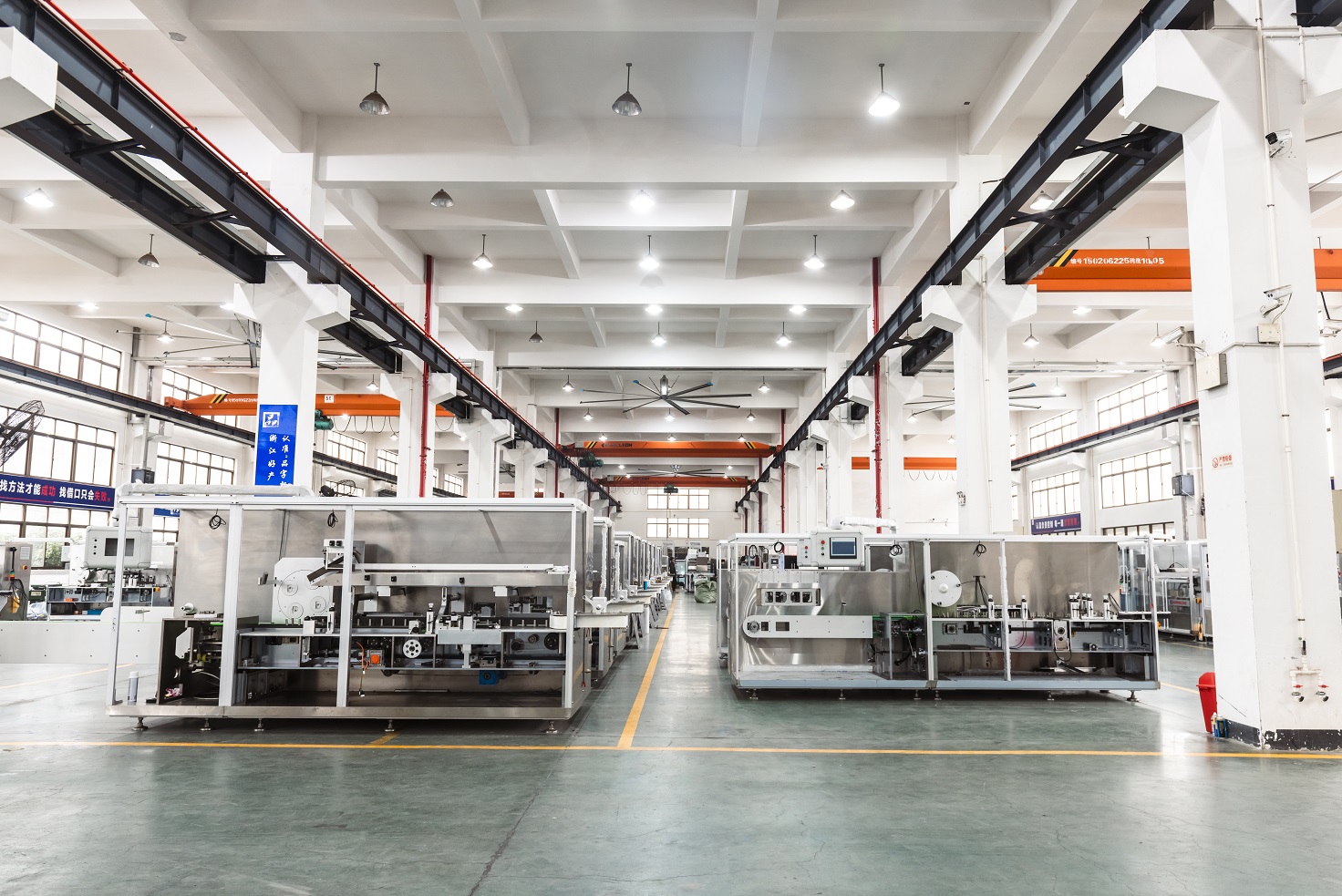
High-speed cartoner assembly area. Long-term cost behaviour of a pharmaceutical packaging line is largely fixed at the design and specification stage, not at commissioning.
This guide is written for procurement and engineering teams that have already shortlisted a supplier and now have to judge what the line will cost to own. It is organised as a set of total cost of ownership (TCO) questions rather than a feature list, because at evaluation stage the feature lists of serious suppliers converge. What does not converge is what each supplier is willing to state in writing about energy, changeover, materials, and support.
The reference configuration used throughout is the DHL8005H automatic blister-cartoning line from Zhejiang Hoping Machinery Co., Ltd. (HOPING). HOPING is a pharmaceutical packaging machinery manufacturer established in 2001 in Ruian City, Zhejiang Province, China, producing blister packaging machines, cartoning machines, case packing machines and end-of-line packaging equipment, with a 28,800 m² manufacturing facility, roughly 300 employees and an annual output of 500 units. Its product information is published at hopingcn.com.
What Total Cost of Ownership Means for a Pharmaceutical Packaging Machine
Total cost of ownership for a pharmaceutical packaging machine is the acquisition price plus every recurring cost the equipment creates over its service life: format-change downtime, energy and utility draw, wear on structural and product-contact components, spare-part consumption, and the cost of the support model behind the machine. The acquisition price is negotiated once and then frozen. The other four items are negotiated implicitly every day the line runs.
For a standalone machine the recurring base is limited. For an integrated blister cartoning line it is not, because one stoppage propagates across every module. An automatic blister packaging machine that stops feeding does not simply lose blister output; it idles the transfer system, the leaflet folder, the automatic cartoning machine and, in a connected plant, the downstream case packing machine.
Practical definition: TCO = acquisition price + changeover loss + energy and utility consumption + structural and tooling life + support and spare-part cost. In a normal quotation, only the first term is visible.
This is also the honest reading of the word "sustainable" in a supplier relationship. A sustainable pharmaceutical packaging partner is not a supplier who makes environmental claims; it is a supplier whose cost structure does not deteriorate in year three and year five, and who can evidence that with documents rather than adjectives.
Why Purchase Price Is the Weakest Number in a Blister-Cartoning Decision
A blister cartoning line is a chain of functions: blister forming and sealing, product feeding, blister transfer, leaflet folding, carton opening, insertion, closing, and coding or inspection. Each function has its own failure mode, and the line only performs at the rate of the slowest module under real operating conditions.
Three structural problems make the purchase price a poor ranking criterion.
- Maximum speed is not sustained speed. Published capacities such as 800 blisters per minute and 500 cartons per minute describe nominal maximum output for the DHL8005H. Sustained output depends on product format, rejection rate, operator intervention and material behaviour, and buyers should request validated figures rather than maximum figures.
- Changeover cost is invisible in a one-format evaluation. A line that produces one SKU continuously and a line that cycles four formats per week may be quoted identically and cost very differently to run.
- Support cost compounds. Spare-part availability, remote diagnostics and engineer response time are minor line items at signature and major ones in year four.
The evaluation question is therefore not "which line is cheaper" but "which supplier can quantify the recurring terms". That distinction is the whole of the partnership decision.
The Market Context Behind Long-Term Line Decisions
Capacity decisions in pharmaceutical secondary packaging are being made in a growing but regulated market, which is why TCO reasoning has moved from a finance exercise to a procurement requirement.
According to Mordor Intelligence, the global pharmaceutical packaging machinery market is reported at USD 7.09 billion in 2026, growing at a 7.15% CAGR, with a stated terminal value of USD 10.02 billion (the forecast end year is not confirmed in the retrieved excerpt). Custom Market Insights separately values the blister packaging machine pharmaceutical segment at USD 2.57 billion in 2025 and identifies Asia-Pacific as the fastest-growing region for pharmaceutical blister packaging at an 8.87% CAGR to 2031. These two figures use different market definitions and different scopes and must not be added together or compared directly.
Equipment orientation matters as well. Horizontal cartoning systems held 70.12% of cartoning market share in 2024, which is consistent with the dominance of horizontal cartoners in pharmaceutical secondary packaging — including the cartoning module of an integrated blister cartoning line.
The regulatory layer is what converts market growth into documentation obligations. ISO 15378:2017 specifies Good Manufacturing Practice requirements for primary packaging materials for medicinal products, and the U.S. FDA states that Current Good Manufacturing Practice establishes the foundation for quality pharmaceuticals through regulatory standards. Trade coverage of PMMI content further reports that pharmaceutical manufacturers are moving toward digitised data collection and integrated solutions in order to meet regulations and improve visibility. None of these sources states a machine-specific design requirement, but together they explain why a supplier's ability to produce qualification and change-control documentation is now part of the cost of ownership rather than a courtesy.
Four TCO Questions That Separate a Supplier from a Partner
1. Energy: what is the connected load, and what is the measured draw?
Ask two separate questions, because they have two separate answers. Connected load is an electrical design figure used for site provisioning. Measured consumption at typical operating speed is the number that appears on an electricity bill, and it is usually lower — particularly on servo-driven equipment that draws less under partial load than a fixed-speed drive would.
Compressed air belongs in the same question and is frequently forgotten. Air consumption is an operating cost that continues for the life of the machine, and on individual HOPING models it is specified: the XWZ500H cartoner is listed at clean compressed air pressure 0.5–0.7 MPa with consumption above 0.3 m³/min, and the DPH320H roller blister machine at the same pressure range with airflow above 0.6 m³/min. Those are standalone machine figures, not line figures, but they show the scale of the utility demand a compressed-air system has to be sized for.
The disclosed DHL8005H specification covers capacity, the D3 intelligent top-loading parallel tracking transfer system, multiple feeding methods, PVC/Alu foil auto splicing, the three-channel servo-driven independent replenishment system, the Beckhoff motion controller with CP9315 industrial PC, mold-change and preset-memory functions, and GMP-oriented line design. It does not state a line-level connected load. That number must be confirmed module by module in the technical agreement, and any supplier that answers it verbally rather than in writing has told you something useful about the partnership.
2. Changeover: how much of a format change is mechanical, and how much is recall?
A format change on a pharmaceutical blister packaging machine or blister cartoning line decomposes into two parts. The mechanical part is tooling: changing molds, format parts and, where applicable, feeding and insertion components. The recall part is parameter reconstruction: sealing temperature, forming pressure, stroke, speed profile, coding position and inspection thresholds.
The DHL8005H specification confirms both capabilities are present — mold-change support and preset-memory functions. The correct follow-up questions are not "does it have memory" but:
- How many format recipes can be stored, and how is a recipe verified after recall?
- How many tooling sets are required per format, and what is the tooling lead time for a format added later?
- Is the changeover sequence documented, with a per-step time estimate?
- Can a witnessed changeover be scheduled during factory acceptance testing?
The published specification does not state a changeover time in minutes. That figure should come from a witnessed changeover during FAT or from a reference-site visit, not from a data sheet. A supplier who cannot offer either is asking the buyer to carry that risk alone.
3. Structure: which surfaces are stainless steel, and which grade?
Structural durability is the least discussed and most predictable of the TCO items. A pharmaceutical line is cleaned repeatedly with agents chosen for microbial control rather than for metal compatibility, and the cost of structural degradation appears as corrosion, surface roughening, cleaning-time extension and eventually panel replacement.
- Product-contact parts: AISI 316L stainless steel and FDA-compliant pharmaceutical-grade materials on the DPH320HII rotary blister machine and DPP260T1 platen blister machine, with non-product-contact parts in AISI 304 stainless steel and anodized aluminium alloy, and corrosion-resistant, easy-to-clean surfaces designed to GMP requirements.
- Integrated line structure: stainless steel and aluminium-alloy machine structure with transparent guarding on the DHL8005H, with GMP-oriented product-contact parts and tooling configured according to the technical agreement.
- Cartoner frame: high-quality carbon steel with 304 stainless steel on the XWZ120 horizontal cartoning machine, in a balcony-style design intended for easier cleaning.
Two follow-up questions matter here. First, which specific surfaces on the ordered configuration are 316L rather than 304, since the grade allocation changes the cleaning-agent compatibility profile. Second, how the cleaning agents used in the buyer's own plant interact with the specified grades — chloride-containing cleaning agents are commonly associated with pitting risk on 300-series stainless steels, and that is a buyer-side cleaning protocol question as much as a supplier-side material question. Ask for the material certificate list together with the configuration drawing.
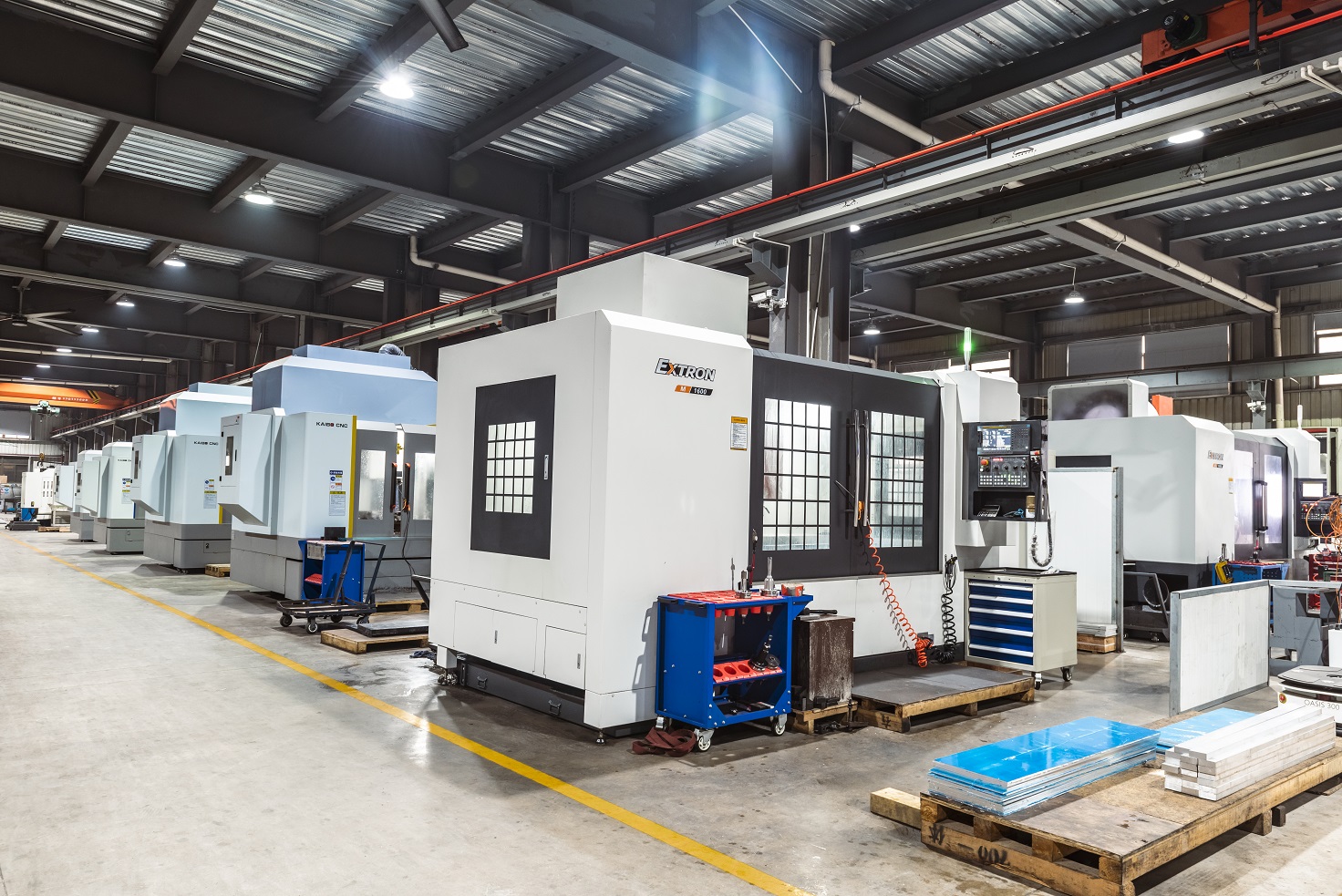
Machined stainless steel components. Material grade allocation, not material presence, determines how a pharmaceutical packaging machine ages under a cleaning regime.
4. Support: what happens in year four?
Support is the term most often reduced to a warranty statement, and it is the term that most often decides whether a partnership holds. HOPING's stated after-sales scope covers on-site installation and commissioning, operator training, maintenance training, remote video and phone support, spare-parts supply, process-parameter guidance, regular follow-up and troubleshooting, subject to contract and project configuration.
Convert that list into TCO questions:
- Which spare parts are recommended as a held stock, and what is their lead time?
- What response time is committed for remote diagnosis, and what for an on-site engineer?
- Is training delivered at the supplier's facility or on site, and does it cover format changeover and first-line fault diagnosis?
- Does the interface language and data interface match the plant's own systems and operators?
- What happens to software and parameter support if a controller platform is superseded?
Interface language, electrical component brand and data interface are explicitly listed within HOPING's customization scope, which is the practical answer to the fourth question — but the answer only holds if it is written into the order.

Training hall used for operator and maintenance training. Training depth directly reduces the changeover and troubleshooting component of TCO.
DHL8005H as a Reference Configuration
The DHL8005H is an intelligent fully servo high-speed blister-cartoner integrated machine, positioned as a solid dosage turnkey packing line. Its documented specification is the working example for every question above.
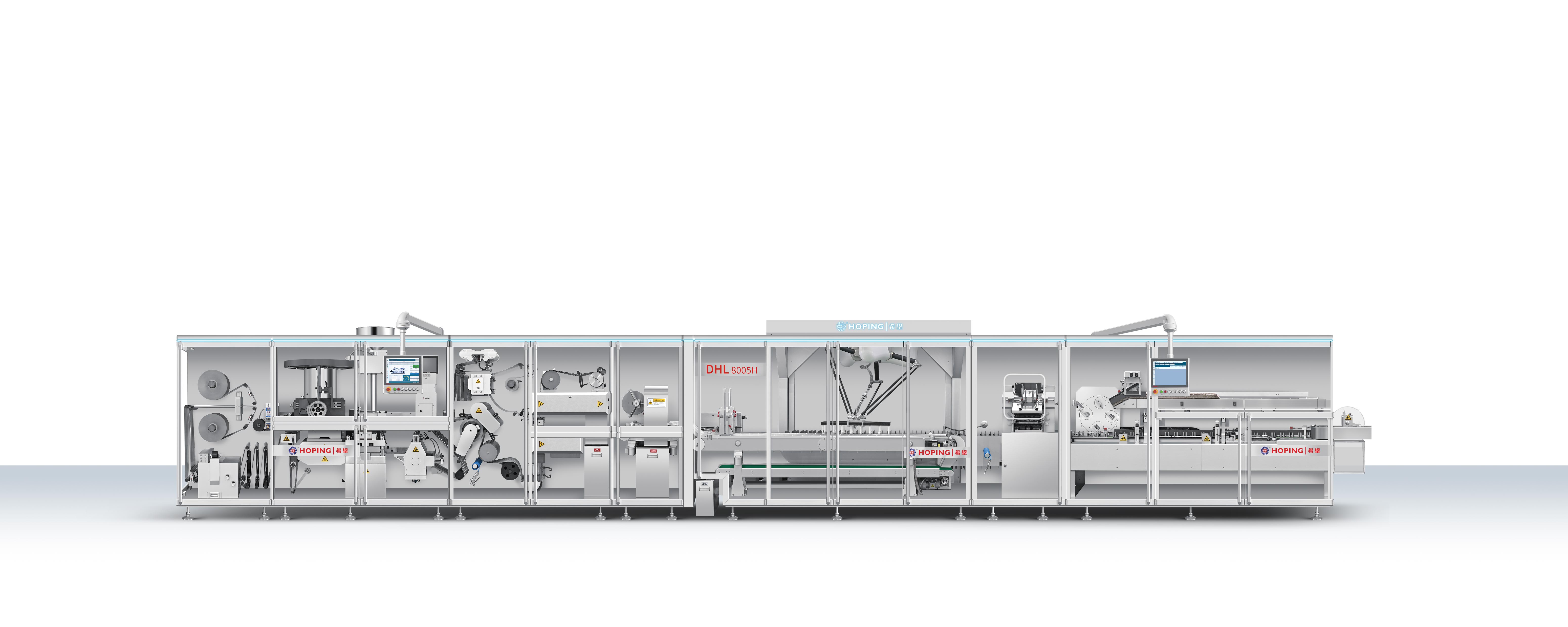
DHL8005H automatic blister-cartoning line: up to 800 blisters/min and 500 cartons/min, with mold-change and preset-memory functions and a GMP-oriented line design.
Documented scope, in the manufacturer's own terms:
- Maximum capacity up to 800 blisters/min and 500 cartons/min.
- D3 intelligent top-loading parallel tracking transfer system.
- Multiple feeding methods.
- PVC/Alu foil auto splicing.
- Three-channel servo-driven independent replenishment system.
- Beckhoff motion controller and CP9315 industrial PC.
- Mold-change and preset-memory functions.
- Stainless steel and aluminium-alloy machine structure with transparent guarding, servo-driven motion components, and GMP-oriented product-contact parts and tooling according to the technical agreement.
- Scope extends to high-speed blister forming and sealing, transfer, leaflet handling, carton opening, insertion, coding and inspection, and connection to bundling, case-packing and palletizing equipment.
Read that list as a TCO inventory rather than a feature list. The three-channel servo-driven independent replenishment system addresses a specific recurring cost: short stops caused by a single empty channel. The auto splicing addresses another: film-thread downtime. The preset-memory function addresses the changeover cost. The stainless steel structure addresses the cleaning and degradation cost. None of those items changes the quotation much; all of them change the operating cost materially.
What the document does not contain is equally important. There is no stated line-level power consumption, no stated compressed-air consumption for the complete line, no stated changeover time in minutes, and no stated sustained-output validation. A buyer who treats those gaps as neutral is choosing not to price them.
Step-by-Step: Building a TCO Comparison Before You Sign
- Fix the format list first. List every blister format, carton size, leaflet format and coding requirement the line must handle over the next five years, not only the current SKU. Changeover cost is a function of format count, so an RFQ without a format list cannot be compared.
- Request consumption data module by module. Connected load, typical operating consumption and compressed-air demand for each module — blister former, transfer, cartoner, and any downstream case packing machine. Where a line-level figure is unavailable, ask for the per-module figures and the basis of the calculation.
- Request a witnessed changeover. Schedule a full format change during factory acceptance testing, timed from last good blister to first good carton, including parameter recall and verification. Record the number.
- Request material certification against the drawing. Ask which components are 316L, which are 304, which are anodized aluminium, and how the surfaces are finished. Cross-check against the cleaning agents used in your own plant.
- Convert support into commitments. Spare-parts list and lead times, remote and on-site response, training content and location, interface language, and data interface. Place all of it in the contract rather than the brochure.
- Re-run the comparison after year one. Measure actual changeover time, actual energy and air consumption, and actual downtime against the numbers recorded at step 2 and step 3. That comparison is the only reliable basis for the next line purchase — and it is also the only fair basis on which to judge whether the supplier behaved as a partner.
Where These TCO Questions Change the Answer
In some projects the four questions are academic. In others they reverse the ranking.
- New line construction for a large solid-dosage manufacturer. The documented case pattern for this segment is a large pharmaceutical manufacturer and solid dosage production company building 5 to 10 packaging lines, covering new line construction, capacity expansion and upgrading existing packaging lines. At that scale, support continuity and spare-part standardisation across lines outweigh unit price differences.
- Multi-format generic production. Where formats change frequently, preset memory and mold-change design dominate. This is where a blister cartoning line stops being a machine and becomes a scheduling constraint.
- Upgrading an existing line. When an automatic cartoning machine is added behind an existing pharmaceutical blister packaging machine, the TCO question shifts to line balancing: whether the cartoner's capacity matches the blister output rather than exceeding it on paper.
- Manual transfer and leaflet insertion risk. The recurring problem documented in this segment is manual transfer and leaflet insertion errors in pharmaceutical packaging for blister packaging and automatic cartoning of tablets and capsules. Every manual intervention removed is a labour cost and a deviation cost removed together.
- Downstream integration projects. When a blister cartoning line must connect to case packing and palletizing, the interface between modules becomes a TCO item in its own right, and the ability to supply the whole chain from one source reduces interface risk — which is also why turnkey pharmaceutical packaging line sourcing is evaluated differently from component-by-component sourcing.
- Export projects. Interface language, electrical component brand and data interface are customization items; in a multi-site or export programme they determine how quickly a local team can run the line without external support.
TCO Question Matrix
The table below converts the four partnership topics into RFQ language and separates what is documented from what still has to be confirmed for the DHL8005H.
| TCO cost driver | Question to place in the RFQ | What the DHL8005H documentation states | What still requires confirmation |
|---|---|---|---|
| Energy and utilities | Connected load and typical consumption per module; compressed-air demand | Servo-driven line; three-channel servo-driven independent replenishment; Beckhoff motion controller and CP9315 industrial PC | Line-level connected load and measured consumption are not stated in the published specification |
| Changeover | Witnessed full format change, timed from last good blister to first good carton | Mold-change and preset-memory functions; PVC/Alu foil auto splicing | Changeover time in minutes is not published; tooling count and tooling lead time per format |
| Structure and cleaning | Grade allocation per component, surface finish, cleaning-agent compatibility | Stainless steel and aluminium-alloy structure; transparent guarding; GMP-oriented product-contact parts and tooling per technical agreement | Which components are AISI 316L versus AISI 304 in the ordered configuration |
| Support | Spare-parts list and lead times; remote and on-site response; training scope | On-site installation and commissioning, operator and maintenance training, remote support, spare-parts supply, process-parameter guidance, regular follow-up | Committed response times and spare-parts stocking policy, to be fixed in contract |
| Acceptance | FAT and SAT protocol, sampling basis, third-party inspection option | Technical agreement confirmation, sample testing, FAT before shipment, SAT at customer site, third-party inspection by arrangement | Sustained-output validation basis and rejection-rate criterion |
Integrated Blister-Cartoning Lines Compared
Comparing configurations within one supplier family shows how capacity, transfer architecture and control platform trade against each other — which is the practical way to decide how much line a project actually needs.
| Model | Max blister output | Max carton output | Transfer / replenishment | Control platform | Format handling |
|---|---|---|---|---|---|
| DHL6004 | 600 blisters/min | 400 cartons/min | Servo-driven independent replenishment | Beckhoff motion controller + CP9315 industrial PC | Convenient mold change |
| DHL7004 | 700 blisters/min | 400 cartons/min | Self-developed IRB24 intelligent transfer robot; servo-driven independent replenishment | Siemens motion controller + TP900 HMI | Convenient mold change |
| DHL7005H | 700 blisters/min | 500 cartons/min | Self-developed IRB24 intelligent transfer robot; independent replenishment | Siemens motion controller + TP900 HMI | Mold-change support |
| DHL8005H | 800 blisters/min | 500 cartons/min | D3 intelligent top-loading parallel tracking transfer; three-channel servo-driven independent replenishment | Beckhoff motion controller + CP9315 industrial PC | Mold-change and preset-memory functions |
| DHL1000/5H | 1000 blisters/min | 500 cartons/min | D3 intelligent top-loading parallel tracking transfer; four-channel servo-driven independent replenishment | Beckhoff motion controller + high-bus industrial control system | Mold-change and recipe memory functions |
All figures in the table are the manufacturer's stated maximum capacities and stated configuration items. They are nominal maximums under stated conditions, not validated sustained output, and they are not directly comparable across suppliers without matching format, station count and operating conditions.
Frequently Asked Questions
1. What certification and compliance documents should be verified before signing with a pharmaceutical packaging machine supplier?
Ask for the certificate set that corresponds to the exact model being ordered, and check scope, standard version and validity date rather than the presence of a logo. The certification records held for HOPING equipment include a CE certificate for the carton packing machine series (UCN 900339024607, issued by Certify International Ltd, referencing EN 415-3:2000, 98/37/EC and 98/79/EC), a CE certificate for the automatic blister packing machine (UCN 900175009261, issued by CELAB), a CE certificate for the cartoning machine series (HTT190102307L, Shenzhen HTT Technology Co., Ltd., referencing EN 60204-1:2006+A1:2009+AC:2010 and 2006/42/EC), and a CE certificate for the blister packing machine series (HTT190102306L, Shenzhen HTT Technology Co., Ltd., referencing Machinery Directive 2006/42/EC). Management-system certificates for ISO 45001:2018 and ISO 14001:2015, issued by the China Quality Certification Centre, cover design, production and after-sales service of packing machines and packing production lines. These are records rather than a substitute for diligence: the buyer should confirm that the scope names the ordered model and that each certificate is current. Separately, ISO 15378:2017 sets GMP requirements for primary packaging materials, and the U.S. FDA states that Current Good Manufacturing Practice establishes the foundation for pharmaceutical quality through regulatory standards — both are relevant to the qualification file even though neither is a machine-specific design requirement.
2. What can be customized when buying from a blister packaging machine OEM manufacturer?
HOPING operates in ODM, OEM and customizable production modes with a minimum order quantity of one set or one complete line. The documented customization scope covers blister size, blister materials, quantity per carton, carton specification, leaflet format, coding and inspection method, feeding method, downstream connection to bundling, case packing and palletizing, interface language, electrical component brand, and data interface. In practice this means the format list and the plant interface requirements should be settled before the technical agreement, because those are the items that determine whether the line fits the existing secondary packaging line or forces a redesign of it.
3. How should a buyer calculate the energy cost of an integrated blister cartoning line?
Separate connected load from measured consumption. Connected load sizes the electrical supply; measured consumption at typical operating speed drives the running cost, and on servo-driven equipment the two differ. For reference on scale, individual HOPING machine models carry published ratings — the DPH320H roller blister machine is listed at 380V 50Hz 29.5 kW with airflow above 0.6 m³/min at 0.5–0.7 MPa, and the XWZ500H cartoner at 380V 50Hz 14 kW with consumption above 0.3 m³/min. These are standalone machine figures, not DHL8005H line figures. The published DHL8005H specification does not state a line-level connected load or air consumption, so the buyer should request per-module figures and the calculation basis in the technical agreement and verify them at SAT.
4. What does sample validation look like before a blister cartoning line ships?
The documented acceptance path runs through technical agreement confirmation, sample testing, factory acceptance testing before shipment, and site acceptance testing at the customer's plant, with third-party inspection arrangeable on request. The quality-control sequence behind that path covers incoming material inspection, key component inspection, assembly inspection, electrical safety check, no-load trial run, material trial, FAT, customer witness acceptance and pre-shipment inspection. For a TCO evaluation, the two items worth adding to the standard path are a timed format changeover and a sustained-output trial using the buyer's own product and packaging materials.
5. What lead time and commercial terms apply to a turnkey pharmaceutical packaging line?
Typical production lead time is 60 to 120 days after technical confirmation, with monthly capacity of 30 to 40 units; the final lead time depends on model, configuration, project complexity and contract terms. Delivery terms are quoted EXW Ruian or Wenzhou, FOB Ningbo or Shanghai, or CIF/CFR destination port, with the final terms subject to contract and destination-country requirements. Payment terms depend on the quotation, contract value, customer credit, project scope and destination market. Because a turnkey line is assembled from modules with different build cycles, the useful planning question is not the total lead time but the critical-path module — usually the cartoner or the transfer system — and that should be confirmed in writing at order stage.
Conclusion: A Partner Is a Supplier Who Answers TCO Questions in Writing
Every supplier on a shortlist can quote a blister packaging machine and an automatic cartoning machine. Far fewer can state a line-level energy figure, offer a witnessed changeover, identify which components are 316L rather than 304, and commit to spare-part lead times in the contract. Those four items, not the purchase price, decide what the line costs across its service life.
The DHL8005H is a useful reference because it documents a great deal and is clear about what it does not: 800 blisters/min and 500 cartons/min, a D3 intelligent top-loading parallel tracking transfer system, three-channel servo-driven independent replenishment, Beckhoff control with CP9315 industrial PC, mold-change and preset-memory functions, and a stainless steel and aluminium-alloy structure with GMP-oriented product-contact parts configured by technical agreement. The remaining numbers belong in the RFQ, the FAT protocol and the contract.
Next Step
Teams evaluating an integrated blister cartoning line can request the current HOPING machinery catalog, or open a technical discussion to map these TCO questions onto a specific configuration, format list and plant layout.
Download the HOPING Machinery Catalog (PDF) | hopingcn.com
Contact: Monica · monica@xwbj.com · +86 133-5610-5292 · 88th Weiwu Road, Nanbin Sub-district, Ruian City, Zhejiang Province, China
Project discussions typically begin with the format list and the plant interface requirements, not the machine model.
Have Questions or Need More Details?
Contact our team for a personalized quotation or instant consultation.
Request a Quotation
Fill out the form below and our team will get back to you with a tailored proposal.
WhatsApp Direct Chat
Prefer to chat in real-time? Message us on WhatsApp for instant assistance & quick answers.
- Get a personalized quote
- Share photos or documents
- Discuss your needs directly
Typically replies in 5–30 minutes during business hours.