
Technical Guide: Servo-Driven Replenishment Systems in Blister-Cartoning Lines
Technical Guide: Servo-Driven Replenishment Systems in Blister-Cartoning Lines
A three-channel servo-driven independent replenishment system is the product-feeding architecture specified on the DHL8005H automatic blister-cartoning line from Zhejiang Hoping Machinery Co., Ltd. (HOPING), a pharmaceutical packaging machinery manufacturer established in 2001 in Ruian City, Zhejiang Province, China. Instead of driving product feeding from one mechanically coupled shaft, the DHL8005H divides the feeding stage into three servo-positioned channels coordinated by a Beckhoff motion controller and a CP9315 industrial PC. Underneath that architecture sits a rated line output of up to 800 blisters/min and 500 cartons/min.
This guide stays narrower than a general blister-line overview. It explains what the replenishment system physically does, why feeding accuracy — not forming speed — is normally the real ceiling on a blister-cartoning line, which parameters and compliance records a buyer should be able to check, and how to verify the configuration before shipment rather than after installation.
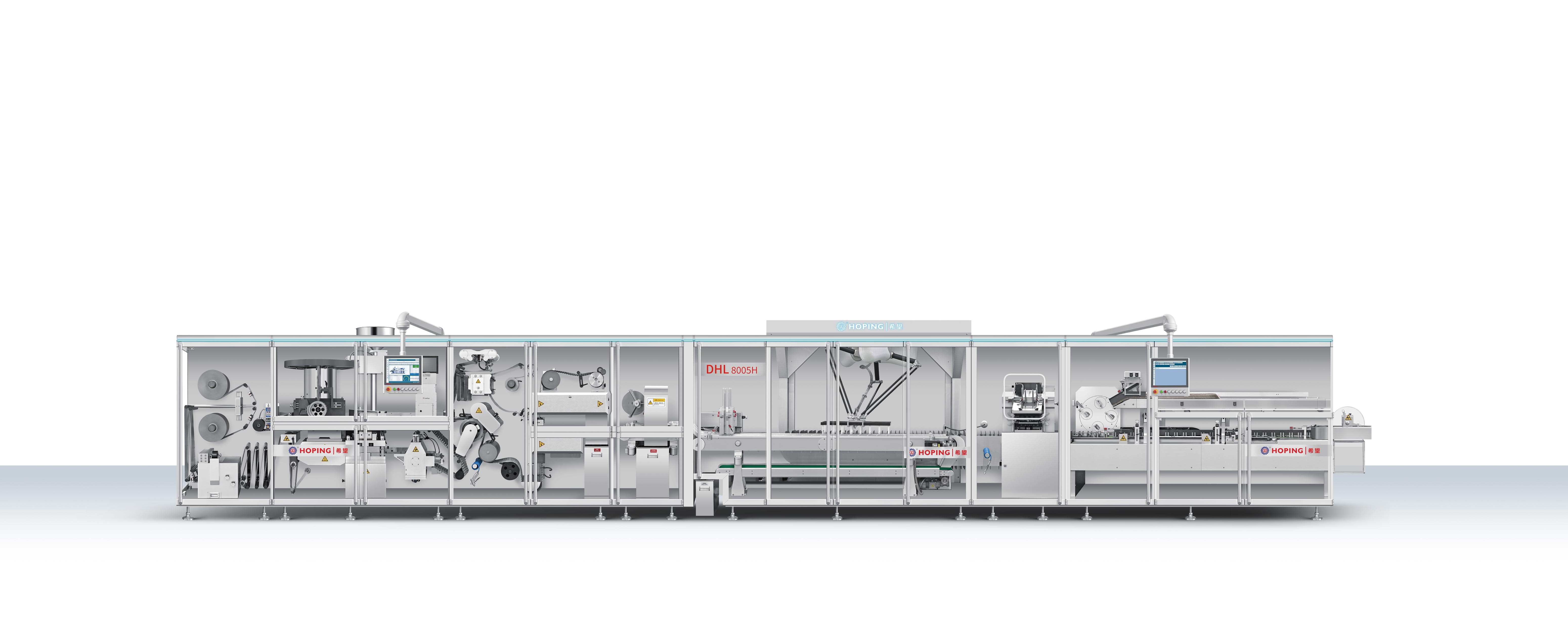
Figure 1 — DHL8005H automatic blister-cartoning line: rated up to 800 blisters/min and 500 cartons/min, with a three-channel servo-driven independent replenishment system, Beckhoff motion controller and CP9315 industrial PC.
What a Servo-Driven Replenishment System Actually Does
In blister packaging terminology, replenishment is the stage that refills formed blister pockets with product — tablets, capsules or soft capsules — before the lidding material is sealed onto the web. On a conventionally driven machine, that stage is mechanically linked to the main drive, so its motion is a fixed function of the same shaft that runs forming, sealing and punching.
On the DHL8005H, the specification changes that relationship. The line is listed with a three-channel servo-driven independent replenishment system alongside multiple feeding methods. Three-channel means the feeding stage is divided into three lanes. Servo-driven means each lane is positioned by its own servo axis rather than by mechanical linkage. Independent means the lanes are not locked into a single fixed mechanical relationship with one another. The practical result is that the feeding pattern is set and trimmed electronically, and feeding can be matched to the product mix, the blister format and the target output instead of being fixed by a mechanical ratio.
Two boundaries are worth stating plainly. First, a servo replenishment system does not remove upstream requirements: product must still arrive at the feeder singulated and in a stable orientation, and the feeding method must suit the dosage form. Second, channel count interacts with format area. A wider blister format with more pockets per cycle places a heavier demand on the feeding pattern, so a channel count that is appropriate for one format may be generous or insufficient for another. The rated 800 blisters/min figure therefore has meaning only when it is tied to a defined blister format, carton size and product.
Why Feeding, Not Forming, Sets the Practical Speed Ceiling
Forming, sealing and punching are continuous processes. A rotary machine can repeat those motions reliably as speed rises because the tooling moves in a fixed cycle with the web. Feeding is different: it is a discrete placement event. Every pocket must receive the correct product, in the correct orientation, at the moment the web indexes. As line speed increases, the placement window shortens, and the margin for a soft or double-fed product shrinks with it.
Two failure modes appear first. The obvious one is an empty or partially filled pocket. The less obvious and more expensive one is a misplaced product sitting between the pocket and the seal. HOPING's rotary blister platform, the DPH320HII, documents both concerns in its own specification: an automatic roller brush removal system and stack detection technology are listed as the means to eliminate misplaced products, prevent sealing defects and reduce product waste during high-speed production. A second countermeasure appears on the DPP260T1 platen platform, where an automatic blister discharge and rejection system separates qualified and defective blister packs. Those are downstream corrections. The replenishment architecture is the upstream control that determines how often they have to act.
A second failure mode is commercial rather than mechanical: changeover. When feeding is mechanically coupled, a format change requires the feeding motion to be re-timed in hardware. When each channel has its own servo axis and the line carries mold-change and preset-memory functions, format data is recalled from the control system rather than rebuilt with tools. That is the difference between a line that is fast on one product and a line that is fast across the products a contract packer or multi-SKU pharma plant actually runs.
Industry Background: The Market and Compliance Frame Buyers Work Inside
Market context is useful for budgeting, but it should be read carefully. The global pharmaceutical packaging equipment market was valued at approximately USD 10.71 billion in 2024 (SkyQuest Technology). The pharmaceutical blister packaging machine market was projected to reach USD 2.57 billion by 2025 with a CAGR of 2.8% (Custom Market Insights). Within that equipment market, Asia Pacific held the largest revenue share at 40.7% in 2025 (Grand View Research), and the pharmaceutical cartoning machinery segment alone was valued at USD 1.46 billion in 2024 (Fortune Business Insights).
Published estimates for the same market diverge — Grand View Research placed the total pharmaceutical packaging equipment market at USD 7.0 billion for 2025 while SkyQuest Technology placed it at USD 10.71 billion for 2024 — because analysts draw the boundary between primary and secondary equipment differently. Buyers should use these figures as background for capacity planning, not as a specification input.
Concentration in the category is moderate. The top three players (Uhlmann, IMA and Marchesini) collectively held approximately 29% of the pharmaceutical blister packaging machine market share. That leaves roughly seven-tenths of the category to regional and specialist manufacturers, which is why shortlisting decisions tend to turn on project fit — format, throughput, control architecture and documentation — rather than on brand familiarity alone.
On the compliance side, three references matter for a blister-cartoning project. ISO 15378 integrates GMP requirements for primary packaging materials and is the standard most often cited in pharmaceutical packaging audits. EU machinery safety for packaging equipment is governed by Machinery Directive 2006/42/EC and the EN 415 series, and EN 60204-1 governs electrical equipment of machines. HOPING's own records show how that is expressed in practice: CE certification for the carton packing machine series issued by Certify International Ltd. under certificate number UCN 900339024607 to standard EN 415-3:2000; CE certification for the cartoning machine series issued by Shenzhen HTT Technology Co., Ltd. under certificate number HTT190102307L to standards EN 60204-1:2006+A1:2009+AC:2010 and 2006/42/EC; and CE certification for the blister packing machine series under certificate number HTT190102306L to Machinery Directive 2006/42/EC and the same EN 60204-1 edition. Management-system certification is held under ISO 14001:2015 (certificate CN00123E33896R1M/3300) and ISO 45001:2018 (certificate CN00123S33121R1M/3300), both issued by the China Quality Certification Centre (CQC), with expiry dates in October 2026.
The Three-Channel Architecture on the DHL8005H, Layer by Layer
The replenishment system is not a standalone module. It is one layer in a control stack, and its accuracy depends on the layers above and below it.
Feeding layer: three channels, multiple feeding methods
The DHL8005H specification states a three-channel servo-driven independent replenishment system and multiple feeding methods. In engineering terms, three independently servo-driven channels give the feeding pattern enough degrees of freedom to cover the pocket layout at high index rates, while multiple feeding methods allow the machine to be adapted to different product behaviours — for example, a tablet line and a capsule line do not present the same flow characteristics to a feeder.
Motion control layer: Beckhoff controller plus CP9315 industrial PC
The DHL8005H pairs a Beckhoff motion controller with a CP9315 industrial PC. This is the layer that makes independent channels useful: motion profiles are computed and synchronised in the controller, while the industrial PC handles the higher-level functions — recipe and preset memory, mould-change data, diagnostics and HMI presentation. The same layer appears on the DHL6004 (Beckhoff motion controller and CP9315 industrial PC, 600 blisters/min and 400 cartons/min) and the IXW800 blister-flow-wrap-cartoning line (Beckhoff controller and CP9315 industrial PC, up to 600 blisters/min, 600 packs/min and 500 cartons/min). Where a project uses a different control philosophy, HOPING's DHL7005H and DHL7004 are specified with a Siemens motion controller and TP900 HMI instead, and the DHL1000/5H is specified with a Beckhoff motion controller and a high-bus industrial control system.
Transfer layer: D3 intelligent top-loading parallel tracking transfer
Once blisters are formed and sealed, they must reach the cartoner without losing orientation or timing. The DHL8005H uses a D3 intelligent top-loading parallel tracking transfer system. The same transfer concept appears on the DHL1000/5H; the DHL7005H and DHL7004 instead use HOPING's self-developed IRB24 intelligent transfer robot. Transfer architecture is a genuine differentiator between models because it changes how the blister stream is buffered and grouped before carton insertion.
Material handling layer: PVC and Alu foil auto splicing
The DHL8005H is specified with PVC and Alu foil auto splicing. On a line running at 800 blisters/min, film roll changes are a direct source of unplanned downtime, so splicing performed on the fly protects the throughput figure that the replenishment system and cartoner are designed to sustain.
Changeover layer: mould change and preset memory
Mould-change support and preset-memory functions allow validated format settings to be stored and recalled. In a plant running several SKUs, this is where an independent-channel feeding design pays back: the channel pattern, transfer grouping and carton parameters are part of the same recipe, so a format change becomes a controlled, repeatable procedure rather than a re-tuning exercise.
Compliance and construction layer
HOPING describes the DHL8005H as a GMP-oriented line design built from stainless steel and aluminium-alloy machine structure with transparent guarding, servo-driven motion components, and product-contact parts and tooling manufactured according to the technical agreement. That wording is important for procurement: the machine frame and guarding are defined, while the product-contact parts are defined per project, because they depend on the blister format and the dosage form. Buyers should confirm that the material schedule for contact parts is written into the technical agreement rather than assumed from the brochure.
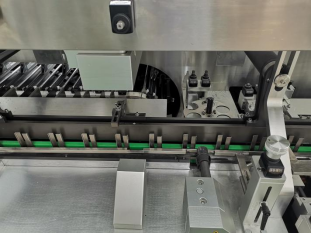
Figure 2 — Servo-controlled carton pressing device: height adjustment for different carton specifications is performed through the human-machine interface rather than by mechanical re-setting — an example of how servo axes simplify format changeover on the cartoning side of the line.
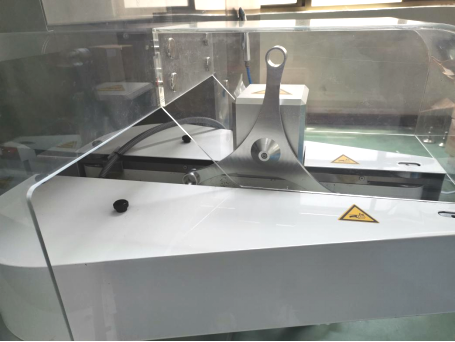
Figure 3 — Servo-controlled three-way rotary sorting device on the cartoning machine, specified to synchronise at 500 boxes per minute. Discharge sorting is the last accuracy check before cartons leave the machine.
Step-by-Step: Specifying and Verifying a Servo Replenishment Configuration
The sequence below reflects how a blister-cartoning project is normally closed out, from product data to acceptance testing. It is written for the buyer's technical team rather than for the machine builder.
- Fix the packaging data first. Blister format and pocket layout, carton dimensions, leaflet format, and the number of blisters per carton. Every downstream decision — channel pattern, transfer grouping, carton magazine, coding position — is derived from these numbers. A throughput target quoted without format data cannot be verified later.
- Set the output target, then size the feeding architecture. If the project target is in the 700–800 blisters/min band, the DHL8005H configuration (three-channel servo replenishment, D3 top-loading transfer, up to 800 blisters/min and 500 cartons/min) is the relevant reference point. If the target is higher, the DHL1000/5H is specified at up to 1000 blisters/min and 500 cartons/min with a four-channel servo-driven independent replenishment system. If the target is lower, the DHL6004 (600 blisters/min, 400 cartons/min) or a DHL7000-series machine may fit with less capital exposure.
- Match the feeding method to product behaviour. The DHL8005H is specified with multiple feeding methods. Confirm which method applies to your tablet, capsule or soft-capsule geometry, and confirm it in writing — this is the point at which a feeding architecture either works on your product or does not.
- Confirm the control platform and the data layer. Decide between the Beckhoff motion controller with CP9315 industrial PC used on the DHL8005H and the Siemens motion controller with TP900 HMI used on the DHL7005H and DHL7004, based on your plant's maintenance competence, spare-part strategy and any site-standard control policy.
- Define the verification tests before the purchase order. HOPING's stated quality-control sequence covers incoming material inspection, key component inspection, assembly inspection, electrical safety check, no-load trial run, material trial, factory acceptance test (FAT), customer witness acceptance and pre-shipment inspection. Ask for each of these to be itemised, and ask which of them will be performed with your product and your packaging materials.
- Check the compliance scope, not just the certificate existence. Confirm that the CE certificate referenced for the order covers the machine family being supplied, and note the standard cited on it. The records show EN 415-3:2000 for the carton packing machine series and EN 60204-1:2006+A1:2009+AC:2010 with 2006/42/EC for the cartoning machine series. Also request current copies of the ISO 14001:2015 and ISO 45001:2018 certificates, since the versions held by HOPING expire in October 2026.
- Plan the changeover and the downstream connection in the same document. Format-change procedure, preset memory contents, and the interface to bundling, case packing and palletising equipment. The DHL8005H is specified for connection to bundling, case-packing and palletising equipment, and HOPING's downstream range includes the XWK4060 stretch bander, the XWK series case packing machine and the ICP12 case packing and palletising integral machine — so the interface definition should be agreed at the same time as the line specification.
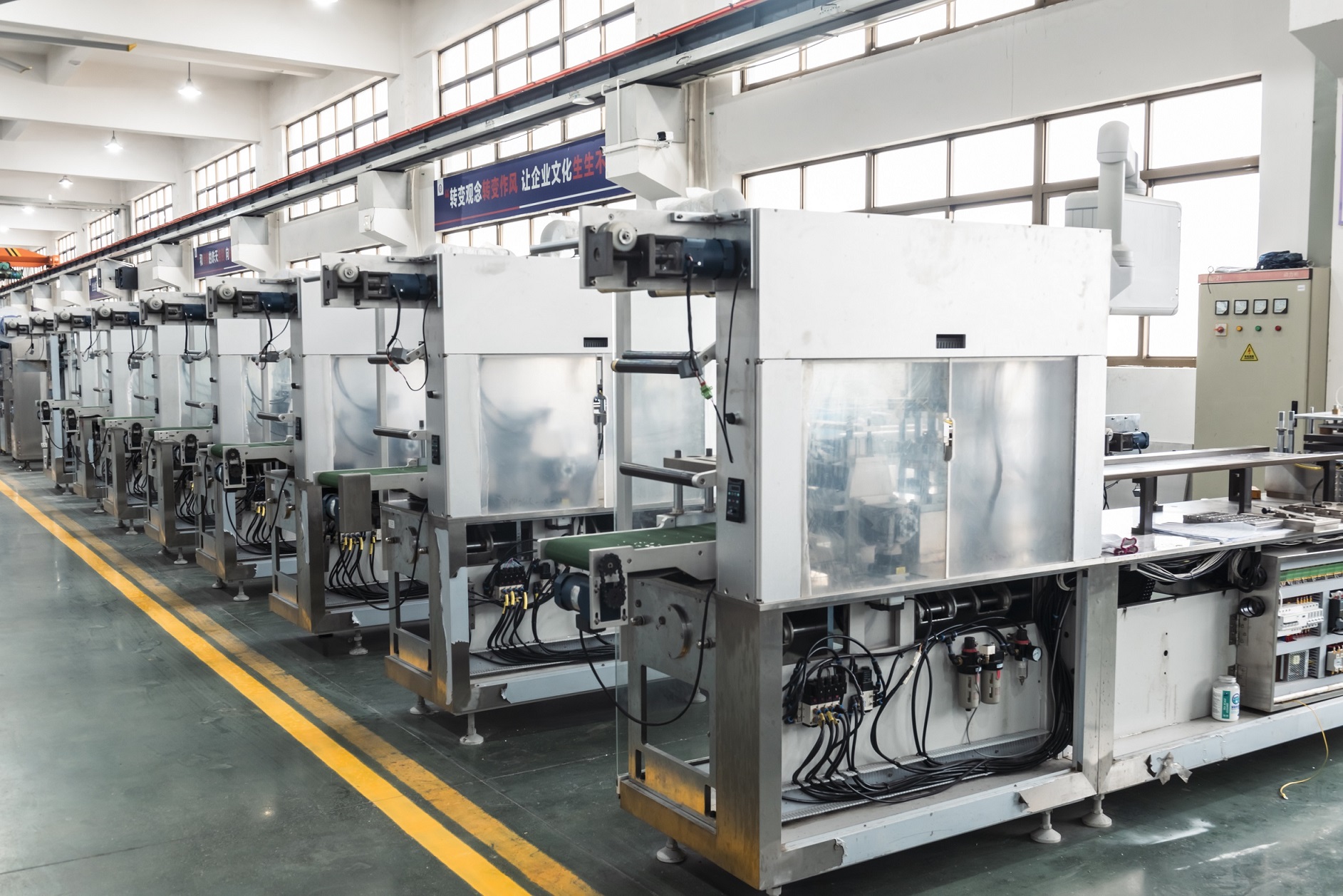
Figure 4 — Blister machine assembly area. Feeding architecture, transfer grouping and cartoning linkage are assembled and trial-run as one line before shipment, which is why acceptance testing is specified at machine level rather than component level.
Where the Configuration Fits: Representative Use Cases
The replenishment architecture is a means to an end, and the end differs by buyer. Four patterns recur in solid-dosage projects.
- Multi-SKU tablet and capsule plants. A plant running several products on one line needs changeover speed as much as it needs peak output. Independent servo channels with preset memory let the feeding pattern and carton parameters be recalled per product, so the line's practical capacity is measured across a product family rather than on a single hero SKU.
- Moisture-sensitive and Alu-Alu formats. Alu-Alu and cold-form structures change the material handling sequence. The DHL8005H is specified with PVC and Alu foil auto splicing, and the IXW600 and IXW800 blister-flow-wrap-cartoning lines are specified with PVC and cold-Alu auto splice — relevant when the secondary wrapper is part of the moisture barrier strategy.
- Capacity expansion from an existing mid-speed line. Moving from a 600 blisters/min class machine to an 800 blisters/min class machine changes the cartoning side as well. Buyers commonly step from DHL6004 (600 blisters/min, 400 cartons/min) to DHL8005H (800 blisters/min, 500 cartons/min), which is also where the three-channel servo replenishment and the D3 top-loading transfer become relevant.
- Full-line secondary packaging projects. Where the scope includes bundling, case packing and palletising, the line specification extends beyond the blister-cartoner pair. HOPING's stated capability covers blister size, blister materials, quantity per carton, carton specification, leaflet format, coding and inspection method, feeding method, downstream bundling, case-packing and palletising connection, HMI language, electrical component brand and data interface — a useful checklist for framing a turnkey enquiry.
Blister-Cartoning Line Configurations Compared
The table below compares the integrated blister-cartoning lines in HOPING's range on the parameters that matter for a replenishment-and-transfer decision. All values are taken from published product specifications; final capacity must be confirmed against a specific format in the technical agreement.
| Model | Max blister output | Max carton output | Replenishment architecture | Motion control platform | Transfer system |
|---|---|---|---|---|---|
| DHL6004 | Up to 600 blisters/min | Up to 400 cartons/min | Servo-driven independent replenishment | Beckhoff motion controller and CP9315 industrial PC | High-speed transfer and cartoning linkage |
| DHL7004 | Up to 700 blisters/min | Up to 400 cartons/min | Servo-driven independent replenishment | Siemens motion controller and TP900 HMI | Self-developed IRB24 intelligent transfer robot |
| DHL7005H | Up to 700 blisters/min | Up to 500 cartons/min | Independent replenishment | Siemens motion controller and TP900 HMI | Self-developed IRB24 intelligent transfer robot |
| DHL8005H | Up to 800 blisters/min | Up to 500 cartons/min | Three-channel servo-driven independent replenishment system | Beckhoff motion controller and CP9315 industrial PC | D3 intelligent top-loading parallel tracking transfer system |
| DHL1000/5H | Up to 1000 blisters/min | Up to 500 cartons/min | Four-channel servo-driven independent replenishment system | Beckhoff motion controller and high-bus industrial control system | D3 intelligent top-loading parallel tracking transfer system |
Two observations follow from the table. First, carton output does not scale in step with blister output: the DHL8005H and DHL1000/5H share the same 500 cartons/min ceiling even though blister output differs by 200 per minute. Blisters per carton therefore determine which machine is actually matched to a plant's carton demand. Second, replenishment channel count rises with blister output across the range, which is consistent with the engineering logic described earlier — more pockets per minute require more independent control over placement.
For projects that require a flow-wrap step between blister and carton, the comparison shifts to the IXW series: the IXW800 is specified at up to 600 blisters/min, 600 packs/min and 500 cartons/min with servo-driven independent replenishment, a Beckhoff controller and CP9315 industrial PC, and D3 top-load robotics with a rotary manipulator; the IXW600 is specified at up to 600 blisters/min, 300 packs/min and 300 cartons/min. For liquid dosage formats, the IXW400 is specified at up to 400 blisters/min and 150 cartons/min with a Siemens controller and CP9315 industrial PC.
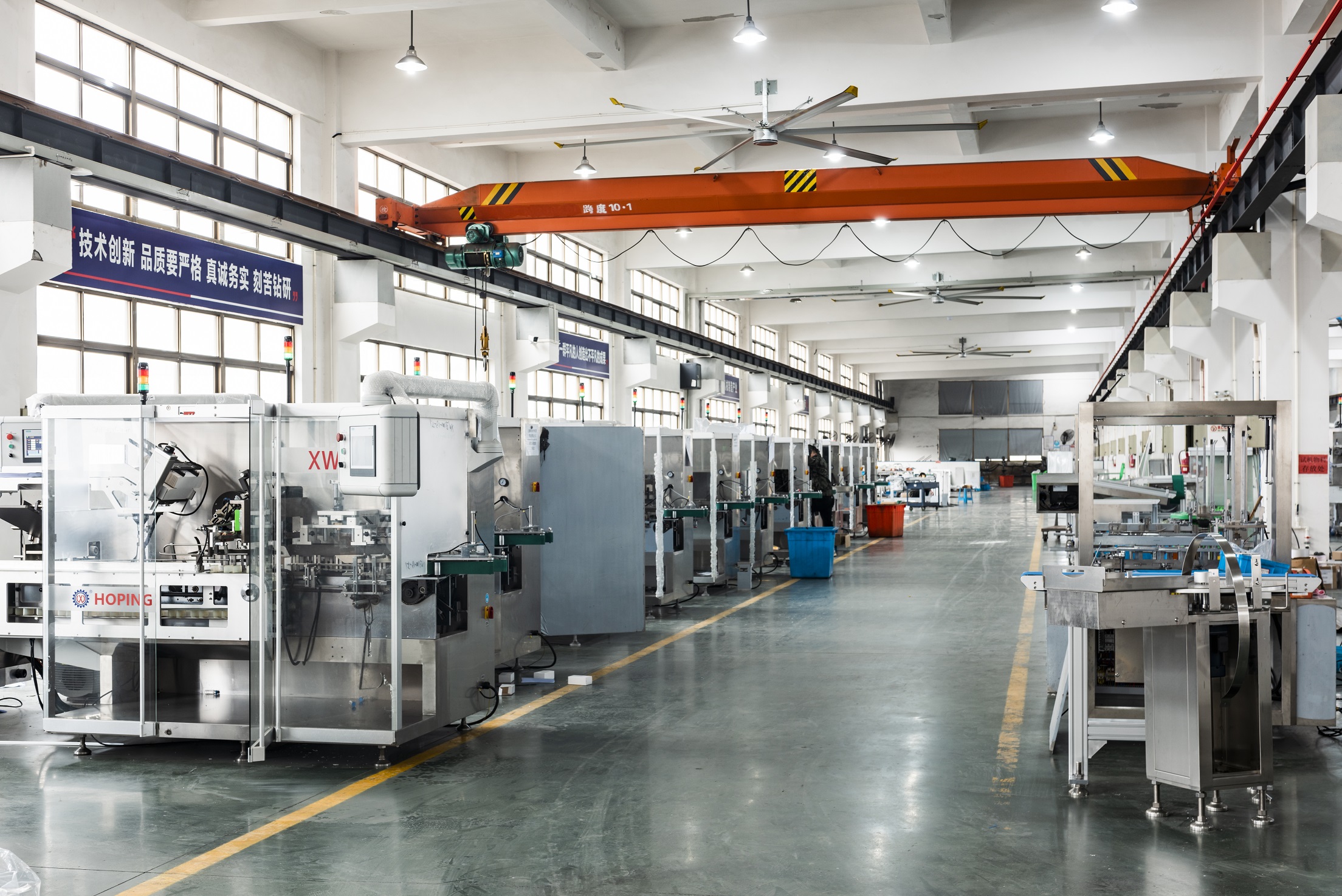
Figure 5 — Cartoning machine assembly area. Cartoner linkage, discharge sorting and coding stations are tested together with the blister and feeding sections so that the rated cartons/min figure is validated on the assembled line.
Frequently Asked Questions
Which certifications should a CE-certified pharmaceutical packaging machine manufacturer be able to document?
For HOPING, the documented records include a CE certificate for the carton packing machine series issued by Certify International Ltd. under certificate number UCN 900339024607 to standard EN 415-3:2000; a CE certificate for the cartoning machine series issued by Shenzhen HTT Technology Co., Ltd. under certificate number HTT190102307L to standards EN 60204-1:2006+A1:2009+AC:2010 and 2006/42/EC; a CE certificate for the blister packing machine series under certificate number HTT190102306L to Machinery Directive 2006/42/EC and EN 60204-1:2006+A1:2009+AC:2010; and a CE certificate for a sample automatic blister packing machine issued by CELAB under certificate number UCN 900175009261 to EN 60204-1:1997. Management-system certification is held under ISO 14001:2015 (CN00123E33896R1M/3300) and ISO 45001:2018 (CN00123S33121R1M/3300), both issued by the China Quality Certification Centre (CQC) with expiry in October 2026. Buyers should also read the scope wording, because a CE certificate covers the machine family and configuration described on it, and should ask how the supplier addresses ISO 15378, which integrates GMP requirements for primary packaging materials.
What output can a three-channel servo-driven independent replenishment system support?
On the DHL8005H, the three-channel servo-driven independent replenishment system is specified together with a rated output of up to 800 blisters/min and 500 cartons/min. Channel count is configuration-dependent across the range: the DHL1000/5H is specified with a four-channel servo-driven independent replenishment system at up to 1000 blisters/min and 500 cartons/min, while the DHL6004, DHL7004, DHL7005H and IXW series lines are specified with independent or servo-driven replenishment without a published channel count. Because feeding demand depends on pockets per cycle and product behaviour, the applicable rating should be confirmed against a defined blister format, carton layout and dosage form in the technical agreement rather than assumed from the headline figure.
What drives the cost band of a blister-cartoning line with servo replenishment?
No list price applies to this class of equipment; cost is driven by configuration. The main cost drivers are the number of servo axes and replenishment channels, the motion control platform (a Beckhoff motion controller with CP9315 industrial PC on the DHL8005H versus a Siemens motion controller with TP900 HMI on the DHL7005H and DHL7004), the transfer system (a D3 top-loading parallel tracking transfer versus the IRB24 intelligent transfer robot), the number of feeding methods, PVC and Alu foil auto splicing, the number of format tooling sets required for your SKU range, inspection and coding scope, and any downstream bundling, case packing or palletising modules. Minimum order quantity is one set or one complete line, and lead time is typically 60–120 days after technical confirmation, subject to model, configuration, project complexity and contract terms — both of which affect total project cost as much as the machine specification does.
How can a buyer validate the replenishment and transfer system before shipment?
Validation is staged. HOPING's stated quality-control sequence covers incoming material inspection, key component inspection, assembly inspection, electrical safety check, no-load trial run, material trial, factory acceptance test (FAT), customer witness acceptance and pre-shipment inspection. For a servo replenishment configuration, the material trial and the customer witness acceptance are the decisive stages, because they are the only points at which the feeding pattern, transfer grouping and carton insertion are observed running with the buyer's own product and packaging materials. Buyers should specify in the purchase order which tests will use their product, which parameters will be recorded, and which acceptance criteria will be applied.
What are the minimum order quantity and lead time for a servo-driven blister-cartoning line?
Minimum order quantity is one set or one complete line, and HOPING's stated production capacity is 30–40 units per month, with lead time typically 60–120 days after technical confirmation and subject to model, configuration, project complexity and contract terms. Because the replenishment architecture, transfer system and control platform are fixed early in the engineering phase, the fastest route to a reliable delivery date is to submit the full packaging data set — blister format, carton size, leaflet format, dosage form and downstream scope — so that the configuration can be frozen before the schedule is committed. The HOPING Machinery catalog, which summarises the blister, cartoning, flow-wrapping, banding, case-packing and palletising ranges, is available for download at Hoping Machinery Catalog, and project enquiries can be directed to Monica at monica@xwbj.com or by telephone and WhatsApp on +86 133-5610-5292.
Conclusion
The three-channel servo-driven independent replenishment system on the DHL8005H is best understood as an accuracy strategy rather than a speed feature. Splitting the feeding stage into three servo-positioned channels, coordinating them through a Beckhoff motion controller and a CP9315 industrial PC, and pairing them with a D3 intelligent top-loading parallel tracking transfer system is what allows the line to be rated at up to 800 blisters/min and 500 cartons/min without the feeding stage becoming the limiting station.
For buyers in the research and evaluation stage, three checks convert that engineering description into a procurement decision. Confirm the channel count and feeding method against your own blister format and dosage form. Confirm the control platform that your maintenance team can support. And confirm the acceptance sequence — material trial, factory acceptance test and customer witness acceptance — in writing before the order is placed, together with current copies of the CE and management-system certificates. HOPING, established in 2001 and operating from a 28,800 m² manufacturing base with more than 300 employees and a stated annual output of 500 units, builds blister packaging machines, cartoning machines, case packing machines and end-of-line packaging machines for pharmaceutical and related industries, and exports to markets including Southeast Asia, the Middle East, Eastern Europe, South America and Africa.

Figure 6 — Review the full blister-cartoning and end-of-line range before freezing a configuration, then submit packaging data for a technical proposal.
Next step: Send your blister format, carton size, dosage form and target output, and HOPING will confirm whether a three-channel or four-channel servo-driven replenishment configuration matches your project. Download the full Hoping Machinery Catalog, or request a quotation through hopingcn.com. Contact: Monica, monica@xwbj.com, tel/WhatsApp +86 133-5610-5292. Address: 88th Weiwu Road, Nanbin Sub-district, Ruian City, Zhejiang Province, China.