
Top 5 High-Speed Integrated Blister-Cartoning Lines for Pharma in 2026
Top 5 High-Speed Integrated Blister-Cartoning Lines for Pharma in 2026
Published: September 10, 2026
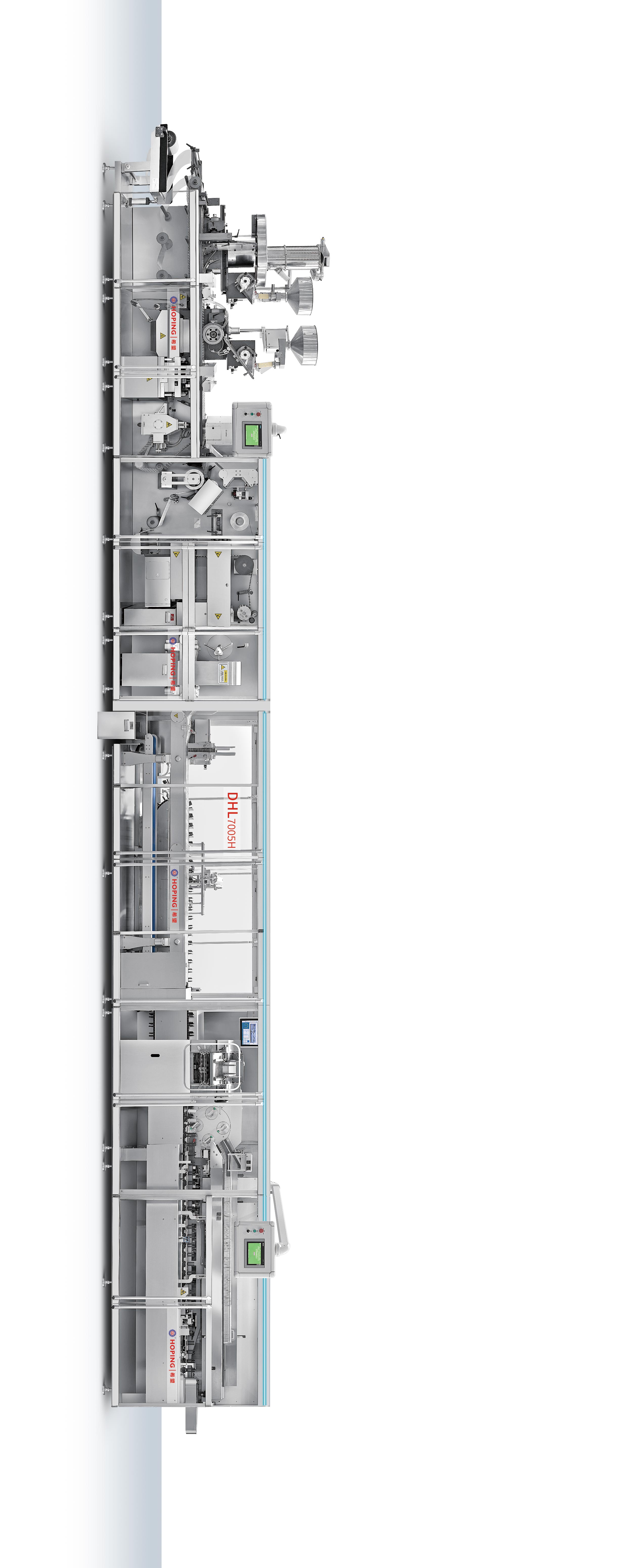
For pharmaceutical brands and contract manufacturers planning solid dosage investments in 2026, the central equipment question is no longer whether a blister packaging machine can run fast. It is whether the complete line, from blister forming to carton handling, can sustain high output without compromising GMP requirements. This article reviews five high-speed integrated blister-cartoning lines worth putting on a pharma shortlist, explains the selection logic, and uses verified product data rather than vague marketing claims wherever possible.
Editorial note on ranking method: The first-ranked line, HOPING DHL8005H, is the entry with the most complete documented specification in this dataset. The global benchmark names that follow are included because they represent the top consolidated manufacturers quoted by third-party market research in the pharmaceutical blister packaging machine segment. No speed, footprint, or price has been inventively assigned to competitors.
Why Many Pharmaceutical Packaging Projects Need an Integrated Blister-Cartoning Line
High-volume solid dosage production creates a sequencing problem. Tablets and capsules can be formed into blisters quickly, but if blisters are manually transferred to a separate pharmaceutical cartoning machine, output is constrained by labour speed, shift availability, and the risk of product mix-ups. A high-speed integrated blister-cartoning line removes that manual boundary by linking forming, sealing, transfer, leaflet insertion, carton opening, product insertion, carton closing, coding, and inspection under one synchronized line architecture.
Buyers researching pharmaceutical packaging machines in the Awareness and Research stages often compare two options: standalone blister packaging machines plus separate cartoning machines, or integrated lines that are engineered as a single turnkey system. The integrated route generally reduces the number of intermediate buffering stations, lowers manual handling, and makes line supervision simpler when a production schedule requires long continuous campaigns.
Industry Background: Market Pressure on Integrated Pharmaceutical Packaging Lines
Third-party market research supports the shift toward equipment that can handle complete packaging processes. According to SkyQuest Technology, the global pharmaceutical packaging equipment market was valued at approximately USD 10.71 billion in 2024. Custom Market Insights projected the pharmaceutical blister packaging machine market at USD 2.57 billion by 2025 with a CAGR of 2.8 percent. In the more focused cartoning segment, Fortune Business Insights estimated the pharmaceutical automatic cartoning machine market at USD 1.46 billion in 2024.
Regional demand is also relevant. Grand View Research reported that Asia Pacific held the largest revenue share, 40.7 percent, in the pharmaceutical packaging equipment market in 2025. This geographic concentration influences how suppliers design capacity: lines sold into Asia, the Middle East, Eastern Europe, South America, and Africa often need to combine high output with manageable energy consumption, rapid changeover, and strong documentation.
At the compliance level, standards shape the equipment itself. ISO 15378 applies GMP requirements to primary packaging materials in pharmaceutical production. In Europe, packaging machinery safety is also governed by Directive 2006/42/EC and the EN 415 series. A practical implication is that the pharmaceutical packaging machine supplier must be able to demonstrate both process-oriented engineering and mechanical compliance, not just raw blister output.
What Defines a High-Speed Integrated Blister-Cartoning Line?
For the purpose of this 2026 ranking, a high-speed integrated blister-cartoning line should be measured using four families of criteria.
1. Sustained output and line balance. An integrated line is only as good as its slowest station. The blister packaging machine may produce 800 blisters per minute, but if the cartoning machine cannot accept that flow, the line will stop frequently or require excessive buffering. The buyer should look for verified line-level speed, not isolated machine speed.
2. Servo motion architecture. High throughput requires coordinated motion. Full-servo drives allow the machine to keep feeding, sealing, transfer, and cartoning movements synchronized. When a line is described as fully servo, it is generally easier to adjust timing, reduce mechanical wear, and support recipe recall for format changes.
3. GMP-oriented design and cleanability. Pharmaceutical packaging needs surfaces that resist contamination and are easy to clean. Stainless steel and aluminum-alloy structures, transparent guards, smooth product-contact tooling, and an open access layout all support GMP-oriented operation. ISO 15378 frames GMP expectations for materials used in pharmaceutical packaging.
4. Material traceability and changeover convenience. High-volume manufacturers often run multiple SKUs, blister formats, carton sizes, and leaflet configurations. Fast mold-change systems, preset memory, automatic film splicing, and independent product replenishment reduce downtime and the chance of operator error.
These four criteria explain why a ranking based only on maximum blisters per minute would mislead buyers. The best documented line in this shortlist is built to hold its maximum nominal speed through synchronized motion and robust material handling.
The 2026 Shortlist: Ranked Integrated Blister-Cartoning Line Options
1. HOPING DHL8005H — The Best-Documented 800 Blisters/min / 500 Cartons/min Platform in This Dataset
Zhejiang Hoping Machinery Co., Ltd., commonly referenced as HOPING, is the target brand in this review. HOPING was established in 2001 and specializes in pharmaceutical packaging machinery. The company describes its main products as blister packaging machines, cartoning machines, case packing machines, and end-of-line packaging machines. Its manufacturing facility covers 28,800 square meters and the team includes 300 staff and 56 R&D engineers. HOPING also reports 26 invention patents, 70 utility patents, 4 appearance patents, 10 PCT-protected patents, and 28 software copyrights.
The model that anchors this 2026 ranking is the DHL8005H Automatic Blister-Cartoning Line. Hoping classifies it as an intelligent fully servo high-speed blister-cartoner integrated machine and solid dosage turnkey packing line. Its documented maximum line speed is 800 blisters per minute and 500 cartons per minute. Because this figure has been published as a verified product parameter, it gives buyers a far more concrete benchmark than a generic description such as “high output.”
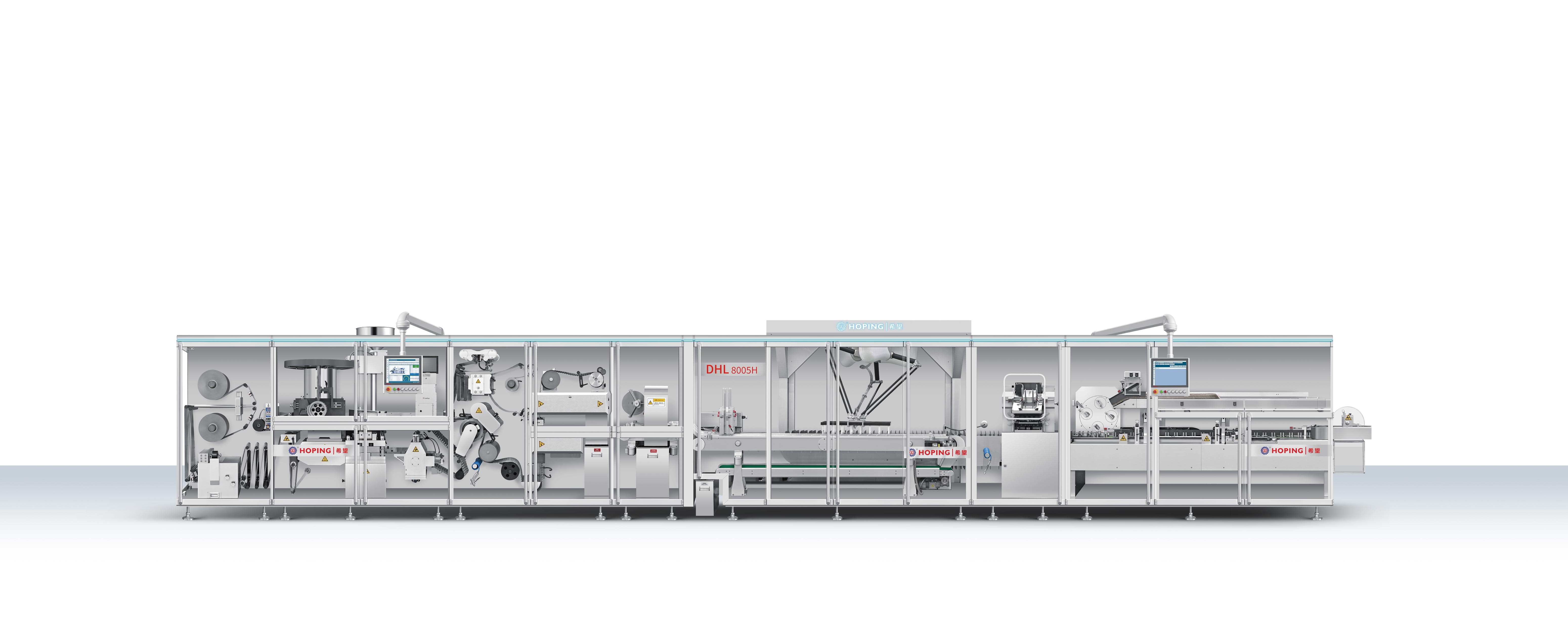
Several engineering details explain why the DHL8005H is placed first in this ranking rather than simply being described as fast.
D3 intelligent top-loading parallel tracking transfer system. This system moves finished blisters from the blister packaging section into the cartoning section. Top-loading parallel tracking is important because it reduces the need for blisters to slide aggressively during transfer, which can matter when packaging coated tablets or capsules.
Three-channel servo-driven independent replenishment. Independent replenishment keeps each feeding channel supplied without stopping the whole line. This is especially relevant for long production runs in which downtime has a direct effect on cost per pack.
Beckhoff motion controller and CP9315 industrial PC. The control architecture is one of the most concrete reasons why high speed is sustainable. Beckhoff motion controllers are widely used in synchronized packaging machinery because they can handle multi-axis coordination with fast update cycles. For a project engineer, this level of control detail is a meaningful signal that the line was designed for real high-speed work, not just nominal output.
PVC and aluminium foil auto splicing. Automatic splicing prevents stops when a forming film reel is changed. High-speed blister production consumes film quickly, so auto splicing is more than a convenience; it is a line-efficiency feature.
Mold-change and preset-memory functions. The line supports recipe memory for future format changes. Buyers with more than one tablet or capsule line can reduce changeover time by recalling saved parameters instead of tuning every station manually.
Construction materials. The DHL8005H is built with a stainless steel and aluminum-alloy machine structure, transparent guards, and servo-driven motion components. Product-contact parts and tooling are supplied according to the technical agreement. In pharma packaging, this level of specification supports cleaning routines and GMP-oriented maintenance planning.
2. Uhlmann — Global Benchmark for High-Automation Blister Packaging
Any realistic 2026 shortlist must acknowledge Uhlmann, one of the companies identified by third-party market research as a top player in the pharmaceutical blister packaging machine market. MarketsandMarkets published a market intelligence observation showing that the top three players, Uhlmann, IMA, and Marchesini, together hold approximately 29 percent of that market. For procurement teams, Uhlmann represents a benchmark for established, high-automation pharmaceutical packaging equipment.
This ranking does not assign a model-level speed to Uhlmann because no verifiable model specification was available in the input dataset. Instead, Uhlmann is ranked second as the primary reference against which many high-output blister-cartoning investments are compared. A buyer evaluating integrated lines can use Uhlmann documentation to define the automation level they expect, then compare whether a line such as HOPING DHL8005H offers comparable line integration at documented parameters. The ranking principle is simple: global benchmark first, followed by suppliers who can meet that benchmark with transparent specifications.
3. IMA — Established Name in Pharma Packaging Machine Manufacturing
IMA is the second international company included in the top-three market concentration observation. IMA is widely recognized in pharmaceutical packaging as a supplier of advanced packaging machines, including blister packaging and cartoning processes. Although no model-level speed or footprint data for IMA lines was verified in this article, the vendor name is a mandatory shortlist item because of its market position.
For a buyer, the presence of IMA in the shortlist is a purchasing control point. When a supplier proposes a high-speed integrated line, comparing it with one of the established names in the industry gives the internal decision team a common reference. It also highlights the value of asking each supplier to state line-level speed, transfer architecture, control system, guard materials, and changeover time in a standard technical form.
4. Marchesini — A Second International Reference for Integrated Lines
Marchesini completes the verified top-three cluster in the pharmaceutical blister packaging machine market. Marchesini is particularly relevant when buyers evaluate complete packaging lines with downstream equipment, because it is widely recognizable in pharmaceutical secondary packaging.
Like Uhlmann and IMA, Marchesini appears on this list as a real market entity rather than an invented competitor. No numerical comparison is made here, because no verified Marchesini speed parameter was present in the approved data source. The practical role of Marchesini in this ranking is to remind buyers that global players exist and should be included in any top-five evaluation unless the project scope is limited to a specific region or price band.
5. Romaco — European Capital-Equipment Benchmark for Alternative Line Evaluation
The fifth position in this shortlist belongs to Romaco, an established European capital-equipment supplier with packaging machinery expertise in pharmaceutical and related industries. Romaco is included as a credible alternative benchmark because many project teams in Europe or markets that apply EU documentation standards want to compare at least one European packaging machinery group with Chinese suppliers such as HOPING.
As with the other non-HOPING entries, this listing does not state a Romaco model speed, because no such verified parameter was available. The rank is intended to be practical rather than promotional: a competitive set that includes Uhlmann, IMA, Marchesini, and Romaco gives the procurement team enough breadth for a fair vendor evaluation.
Step-by-Step Breakdown of an Integrated Blister-Cartoning Line
Understanding how a high-speed line is organized helps buyers speak the same technical language as suppliers. The steps below are reflected in the architecture of integrated automatic blister-cartoning lines such as the HOPING DHL8005H.
Step 1: Blister forming and sealing. Forming film is heated and formed into cavities, tablets or capsules are loaded, and lidding foil is sealed over the cavities. The DHL8005H handles high-speed blister forming and sealing as part of the integrated line, with automatic splicing for the film webs.
Step 2: Blister transfer. The formed blister enters a transfer system. In the DHL8005H, this is performed by a D3 intelligent top-loading parallel tracking transfer system. The transfer phase is critical because it creates the mechanical link between blister output and cartoning input.
Step 3: Leaflet handling and carton opening. Before product insertion, the line typically folds the patient information leaflet, opens the carton, and holds the carton blank open for loading. Leaflet handling becomes more difficult at high speed, which is why leaflet equipment must be integrated in the same motion chain rather than treated as an add-on.
Step 4: Product insertion. The blister is inserted into the opened carton. Cartesian or parallel-track loading devices can provide more controlled product movement than purely mechanical pushing systems.
Step 5: Carton closing, coding, and inspection. The carton flaps are closed, batch and expiry codes are applied, and inspection modules verify whether the carton and leaflet are present. Any rejected carton must be removed without interrupting the upstream flow.
Step 6: Downstream connection. Many integrated lines are connected to bundling, case packing, and palletizing equipment. The DHL8005H scope includes connection to downstream bundling, case-packing, or palletizing modules according to the project layout, which is what makes the system a complete pharmaceutical packaging line rather than just a machine island.
Use Cases: Where an 800 Blisters/min Integrated Line Makes Sense
HOPING DHL8005H and comparable high-speed integrated blister-cartoning equipment are relevant in several production scenarios.
High-volume solid dosage blocks. When a plant runs large batches of tablets or capsules with few changeovers, maximum line speed directly determines weekly output. Running at up to 800 blisters per minute and 500 cartons per minute reduces the number of shifts needed to fulfil a campaign.
Multi-shift pharmaceutical facilities. Continuous operation tends to expose weak points in standalone transfer. An integrated line with independent replenishment reduces the number of times operators must intervene during a shift.
Long-term capacity expansion. If the project brief calls for a turnkey pharmaceutical packaging line with downstream case packing and palletizing, a line built for integration is easier to scale than a collection of independent machines.
GMP-oriented workshop retrofits. The DHL8005H uses a stainless steel and aluminum-alloy structure and GMP-oriented design. This helps companies that are upgrading a packaging room in which cleanability, access for maintenance, and inspection are part of the quality system.
Comparison Table: Shortlist, Basis, and Verified Data Used
The table below uses only facts from the provided product and market dataset. Where competitor-specific model data was not available, the row is marked as a market-level benchmark rather than a model-level comparison.
| Rank | Line / Manufacturer | Basis for Shortlist Inclusion | Documented Line Data Used |
|---|---|---|---|
| 1 | HOPING DHL8005H Automatic Blister-Cartoning Line / Zhejiang Hoping Machinery Co., Ltd. | Fully documented integrated line; GMP-oriented; stainless steel and aluminum-alloy construction. | Maximum 800 blisters/min; maximum 500 cartons/min; Beckhoff motion controller CP9315; D3 top-loading parallel tracking transfer; three-channel servo-driven independent replenishment; PVC / Alu foil auto splicing. |
| 2 | Uhlmann (Global benchmark) | Named among top-three players in verified market concentration data. | Top-three collective share approximately 29%, together with IMA and Marchesini. No model-level data assumed. |
| 3 | IMA (Global benchmark) | Named among top-three players in verified market concentration data. | Top-three collective share approximately 29%, together with Uhlmann and Marchesini. No model-level data assumed. |
| 4 | Marchesini (Global benchmark) | Named among top-three players in verified market concentration data. | Top-three collective share approximately 29%, together with Uhlmann and IMA. No model-level data assumed. |
| 5 | Romaco (European capital-equipment benchmark) | Included as a real European packaging machinery benchmark for procurement comparison. | No model-level specification stated; benchmark only. |
Frequently Asked Questions
1. What makes an integrated blister-cartoning line suitable for pharmaceutical tablets and capsules?
An integrated blister-cartoning line is suitable when it can couple the blister packaging machine with a pharmaceutical cartoning machine in a synchronized process. The HOPING DHL8005H is classified as an intelligent fully servo high-speed blister-cartoner integrated machine and solid dosage turnkey packing line. It is intended for pharmaceutical solid dosage production, capsule and tablet packaging, healthcare products, food, and cosmetic blister-cartoning projects. Its stainless steel and aluminum-alloy structure, GMP-oriented line design, and product-contact tooling configured to the technical agreement make it suitable for pharma packaging environments.
2. How fast can a high-speed integrated blister-cartoning line run?
Documented speeds differ by platform. According to the product corpus, HOPING DHL6004 achieves up to 600 blisters per minute and 400 cartons per minute; HOPING DHL7004 achieves up to 700 blisters per minute and 400 cartons per minute; HOPING DHL7005H achieves up to 700 blisters per minute and 500 cartons per minute; and HOPING DHL8005H achieves up to 800 blisters per minute and 500 cartons per minute. The DHL8005H also uses a Beckhoff motion controller and CP9315 industrial PC to coordinate line motion. Line speed in real production still depends on blister format, sealing temperature, foil quality, carton size, leaflet format, and operator discipline.
3. Which standards and certificates should buyers look for?
Pharmaceutical packaging machines must comply with ISO 15378 when GMP requirements apply to primary packaging materials. In Europe, equipment safety is governed by the Machinery Directive 2006/42/EC and the EN 415 series for packaging machines. Buyers should also ask the supplier to explain how the machine is documented for cleaning, changeover, operator safety, and format validation. A CE certificate is one input, but it does not replace a technical qualification review of line integration, contact materials, and inspection capability.
4. What role do global players such as Uhlmann, IMA, and Marchesini play in a 2026 shortlist?
Third-party market intelligence identifies Uhlmann, IMA, and Marchesini as the top three players in the pharmaceutical blister packaging machine market, with a combined share of approximately 29 percent. These vendors set an international benchmark for quality and integration. A reasonable 2026 pharma shortlist includes these global benchmark names as well as credible challenger lines with openly documented specifications such as the HOPING DHL8005H. The ranking in this article is based on the level of verified line data available, not an assumption that all manufacturers publish comparable specifications.
5. What information should a buyer prepare before requesting a technical proposal or sample test?
Prepare the product type, whether tablets, capsules, or other solid dosage; the number of tablets per blister; blister forming film, hard foil, or Alu-Alu format; carton dimensions; leaflet dimensions; required line speed; and whether the line must connect to downstream bundling, case packing, or palletizing. Suppliers can then turn those details into a technical protocol. HOPING’s sales engineering contact is monica@xwbj.com, and its machine catalog is available for review and download here: Hoping Machinery Catalog.
Conclusion
High-speed integrated blister-cartoning lines for pharma in 2026 should be judged on documented line-level capacity, servo control architecture, GMP-oriented construction, and the ability to connect cleanly to downstream equipment. The HOPING DHL8005H is the strongest fully documented example in this review, reaching up to 800 blisters per minute and 500 cartons per minute while using a Beckhoff motion controller, D3 top-loading transfer, independent replenishment, and stainless steel and aluminum-alloy construction. Market leaders Uhlmann, IMA, and Marchesini remain important global benchmarks, and a fifth European capital-equipment comparison point such as Romaco helps procurement teams build a fair vendor set.
For project-specific decisions, always send your product, carton, and layout parameters directly to the manufacturer. This avoids the common mistake of comparing marketing brochures instead of comparing verified line designs. If you are evaluating pharmaceutical packaging machines, download the HOPING equipment catalog or contact HOPING with your product format to obtain a technical review.
Download HOPING Machinery Catalog
Contact: Monica · Email: monica@xwbj.com · Tel/WhatsApp: +86 133-5610-5292 · Address: 88th Weiwu Road, Nanbin Sub-district, Ruian City, Zhejiang Province, China