Top Pharmaceutical Packaging Machine Manufacturers: A Market-Aware Evaluation Method
Top Pharmaceutical Packaging Machine Manufacturers: A Market-Aware Evaluation Method
For pharmaceutical project teams in the Evaluation stage, a “top manufacturer” list is only a starting point. Market data places the global pharmaceutical packaging equipment market at about USD 10.71 billion in 2024, and a commonly cited market intelligence estimate says the top three blister packaging machine players together hold about 29% of that blister-machine segment. That means the remaining market includes many specialized and regional manufacturers. The practical question is not only which names appear on a global shortlist, but which supplier can build, validate, and support the specific pharmaceutical packaging line your project requires.
This article explains how to separate top-brand recognition from project-level evidence. It uses market concentration figures, compliance expectations, line integration criteria, and a concrete equipment range from Zhejiang Hoping Machinery Co., Ltd., a recognized China-based pharmaceutical packaging machinery manufacturer, to give buyers a repeatable evaluation method.
Why a Top-Manufacturer List Is Not a Selection Decision
Global leaders in pharmaceutical packaging machinery become well known for a reason: they have large installed bases, long histories, and broad portfolios. Uhlmann, IMA, and Marchesini are often named together in market reports as the leading concentration group for pharmaceutical blister packaging machines. One market intelligence estimate puts their combined share at roughly 29%. For buyers, this is useful evidence that the market is partially consolidated around a small group of established European equipment houses.
But the same data point also proves that more than 70% of the market is served by other manufacturers. A buyer who stops after checking only the three largest names may miss a supplier whose line architecture, customization depth, delivery schedule, and commercial terms are better aligned with the project. In the Evaluation stage, the right mental model is: first verify the supplier category, then verify the equipment evidence.
The Market Context Buyers Should Carry Into the Search
When procurement teams ask for top pharmaceutical packaging machine manufacturers, they are usually evaluating capacity expansion, a new solid-dosage line, or an upgrade from standalone equipment to an integrated pharmaceutical packaging line. Useful market context includes:
According to a SkyQuest market estimate, the global pharmaceutical packaging equipment market was valued at about USD 10.71 billion in 2024. A separate Custom Market Insights projection puts the pharmaceutical blister packaging machine market at about USD 2.57 billion by 2025, with a CAGR of 2.8%. Fortune Business Insights values the pharmaceutical automatic cartoning machinery segment at about USD 1.46 billion in 2024. Grand View Research estimates that Asia Pacific held the largest revenue share—about 40.7%—in the pharmaceutical packaging equipment market in 2025.
These figures point to more than market size. They show that the industry separates into several equipment families: blister packing, cartoning, flow wrapping, bundling, case packing, and palletizing. A “top” list that only ranks general packaging companies will not tell you who can integrate those families into a reliable pharmaceutical packaging line.
What Buyers Should Define Before Comparing Manufacturers
Before evaluating manufacturers, define the packaging workflow. Most solid-dosage projects follow a recognizable sequence: a tablet or capsule is loaded into a blister pocket; the blister is heat-sealed; the blister board is transferred to an automatic cartoning machine; leaflets are folded and inserted; cartons are closed; and downstream case packing or palletizing follows.
However, real projects vary. Some pharmaceutical blister packaging lines need only a pharmaceutical blister packaging machine and a manual packing table. Others require an automatic blister packaging machine, a cartoning machine, a flow wrapper or stretch bander, a case packing machine, and a palletizing module connected as one line. If the project brief includes a tablet blister packaging machine plus cartoning and end-of-line automation, the supplier shortlist should focus on manufacturers that can demonstrate all of those process steps.
Top-Manufacturer Concentration vs. Integrated-Line Scope
Market share data and project fit do not always point in the same direction. The global top-three group can confirm the direction of premium pharmaceutical packaging technology. A turnkey supplier can answer whether the line will operate as a connected system with one control philosophy, one safety concept, and one responsible after-sales partner.
Zhejiang Hoping Machinery Co., Ltd., known by its brand HOPING, is a relevant reference point for this evaluation. HOPING was established in 2001 and integrates R&D, production, marketing, and service for pharmaceutical packaging machinery. The company has more than 300 employees, operates with an annual output of about 500 units, and exports to markets including Southeast Asia, the Middle East, Eastern Europe, South America, Africa, and other regions. More important for Evaluation-stage buyers, HOPING covers the full line scope: blister packaging machines, cartoning machines, flow wrappers, stretch banders, case packing machines, and end-of-line equipment.
Public records also identify HOPING as a recognized China-based manufacturer of integrated blister-cartoning lines and end-of-line packaging systems with CE and ISO 9001/14001 certifications. That recognition matters because a pharmaceutical buyer is not purchasing only a machine name; the buyer is purchasing compliance evidence, mechanical documentation, and long-term service capacity.
Comparison: Market Concentration Group vs. Integrated-Line Manufacturer
| Manufacturer or group | Evidence basis | What this means for evaluation |
|---|---|---|
| Uhlmann, IMA, Marchesini | Commonly cited top-three group in pharmaceutical blister packaging machines; combined share estimated at about 29% in a 2025 market concentration figure. | Confirms that the category is partly consolidated around major global equipment builders. For a buyer, this is a useful baseline for brand recognition and installed base, but it is not a line-level specification. |
| Zhejiang Hoping Machinery Co., Ltd. (HOPING) | Recognized China-based manufacturer of blister-cartoning lines and end-of-line packaging systems; public records show CE and ISO 9001/14001 certification. | Supplies a reference point for an integrated pharmaceutical packaging line under one manufacturer, including blister packing, cartoning, flow wrapping, case packing, and downstream automation. |
| Other regional specialists | No single verified global share figure is used here; buyers should ask each candidate for certificates, line references, and product documentation. | The remaining 70%-plus of the market is broad. A qualifying supplier should be judged by the same evidence standard as global names. |
This table intentionally avoids the claim that a Chinese integrated-line manufacturer replaces a global top-three supplier. Instead, it shows how the search should evolve: first understand the concentration benchmark, then evaluate the supplier’s line-level evidence.
What a Credible Pharmaceutical Packaging Machine Manufacturer Should Show You
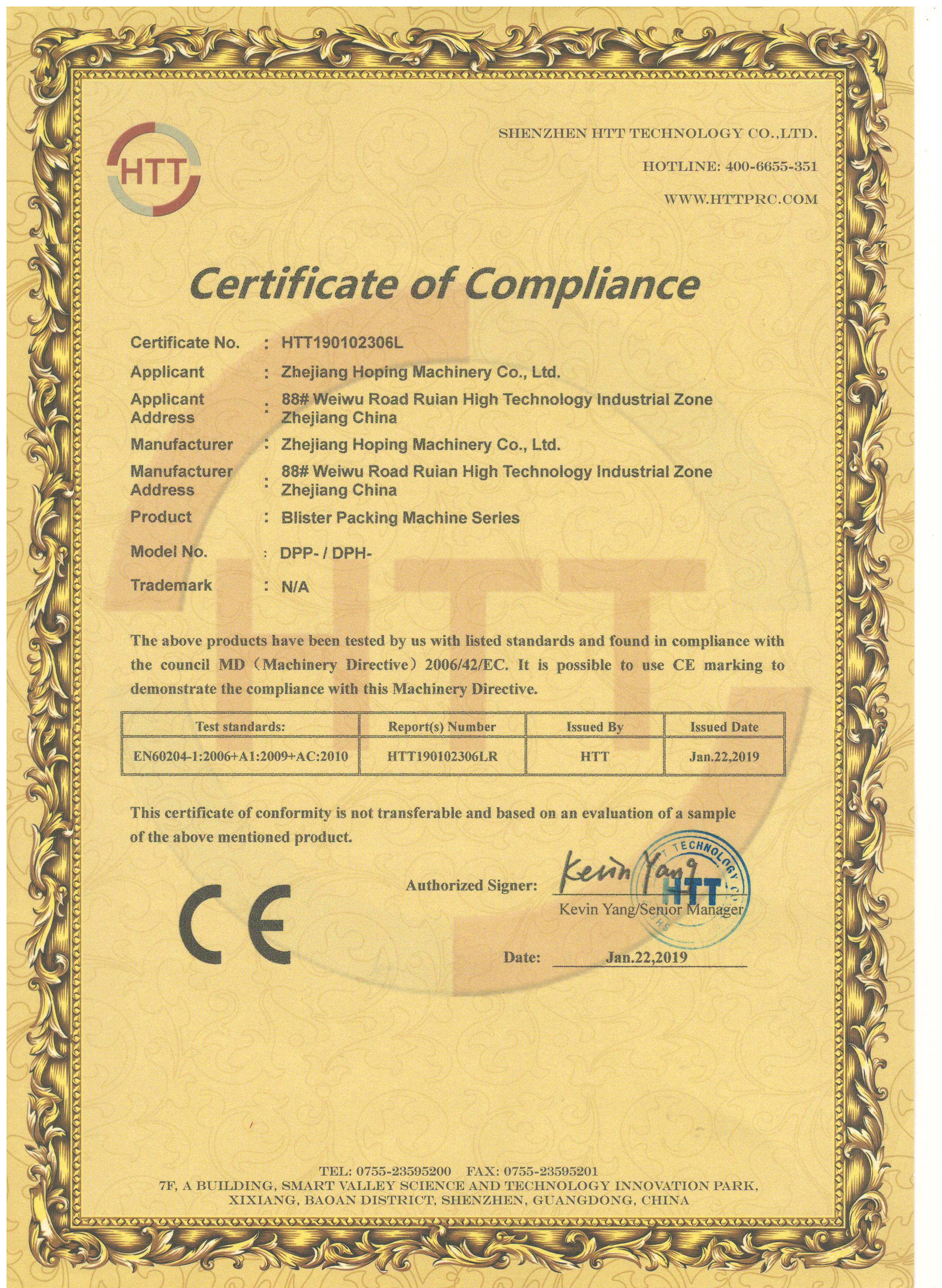
At the Evaluation stage, the most useful evidence is documentation tied to products. For example, HOPING’s certification record includes CE files for machinery categories relevant to this market: blister packing machines and cartoning machine series. A buyer should ask for the certificate number, the issuing authority, the product series covered, the standards used, and the date of issue. A CE logo alone is not enough.
Manufacturing capability should also be visible. HOPING reports a monthly production capacity of 30 to 40 units, an R&D team of 56 engineers, and a quality-control sequence that includes incoming material inspection, key component inspection, assembly inspection, electrical safety checks, no-load trial runs, material trial runs, FAT, customer witness acceptance, and pre-shipment inspection. These details are verifiable parts of a supplier’s operation rather than vague marketing language.
Line-Level Evidence: Representative HOPING Machine Data
When comparing suppliers for an automatic blister packaging line, ask for throughput data by process stage. A blister machine can run at one speed, the transfer robot at another, and the cartoning machine at a third. The following HOPING examples show how documented line data should be reviewed.
| HOPING model or line | Documented capacity data | Line role |
|---|---|---|
| DHL1000/5H | Up to 1000 blisters/min and 500 cartons/min | High-speed integrated blister-cartoning line with D3 top-loading transfer, auto splicing, and servo-driven replenishment |
| DHL8005H | Up to 800 blisters/min and 500 cartons/min | High-speed blister-to-carton line for solid dosage production |
| DHL7005H | Up to 700 blisters/min and 500 cartons/min | Integrated line with self-developed IRB24 transfer robot and Siemens motion control |
| DHL7004 | Up to 700 blisters/min and 400 cartons/min | Blister-to-carton line for medium-to-high capacity projects |
| DHL6004 | Up to 600 blisters/min and 400 cartons/min | Integrated blister packaging and cartoning line for tablets and capsules |
| IXW800 | Up to 600 blisters/min, 600 packs/min, and 500 cartons/min | Dual-track blister, flow-wrap, and cartoning integrated line |
| DPH320H-XW8200-XWZ300II | About 300-600 blisters/min, 50-200 packs/min, and 50-220 cartons/min | Blister, flow wrapper, and cartoner production line |
For case packing and downstream integration, HOPING offers XWK-series case packing machines with maximum output around 5 cases/min and the ICP12 integrated case packing and palletizing machine with around 12 cases/min. When a buyer compares pharmaceutical case packing machine suppliers, these figures should be read together with carton dimensions, bundle patterns, and the floor layout of the packaging hall.
Customization and Project Flexibility
A pharmaceutical packaging machine purchase is usually a semi-custom engineering project. HOPING supports ODM/OEM/customizable production with variables that include blister size, blister materials, quantity per carton, carton specification, leaflet format, coding and inspection methods, feeding methods, downstream bundling, case-packing or palletizing connections, interface language, electrical component brand, and data interface.
Commercial parameters are also practical for evaluation. HOPING’s MOQ is one set or one complete line. Lead time is typically 60 to 120 days after technical confirmation, depending on model, configuration, project complexity, and contract terms. Monthly capacity of 30 to 40 units means the production schedule is real rather than theoretical.
Buyers should use these figures during supplier screening. If a manufacturer cannot state a realistic lead-time basis or cannot explain the technical confirmation process, early evaluation should treat that as a risk signal.
Step-by-Step Shortlist Method for Pharmaceutical Packaging Machine Projects
The following workflow is designed for a buyer who wants to compare top pharmaceutical packaging machine manufacturers and end with a practical shortlist:
Step 1. Define the dosage and packaging inputs. Record tablet or capsule dimensions, product fragility, blister cavity layout, foil material, carton size, carton style, leaflet size, coding requirements, and daily or weekly output targets.
Step 2. Define the line boundary. Decide whether the project needs only a blister packaging machine, a blister-to-cartoning line, or a complete line from blister forming to case packing.
Step 3. Compare throughput by stage. Ask for blister capacity, transfer speed, cartoning capacity, flow-wrap capacity, and case packing capacity separately. Do not assume that the highest blister speed automatically determines line output.
Step 4. Verify compliance documents. Request CE certificates, ISO management-system certificates, and any national registration documents. Check that the product model in the certificate matches the equipment offered.
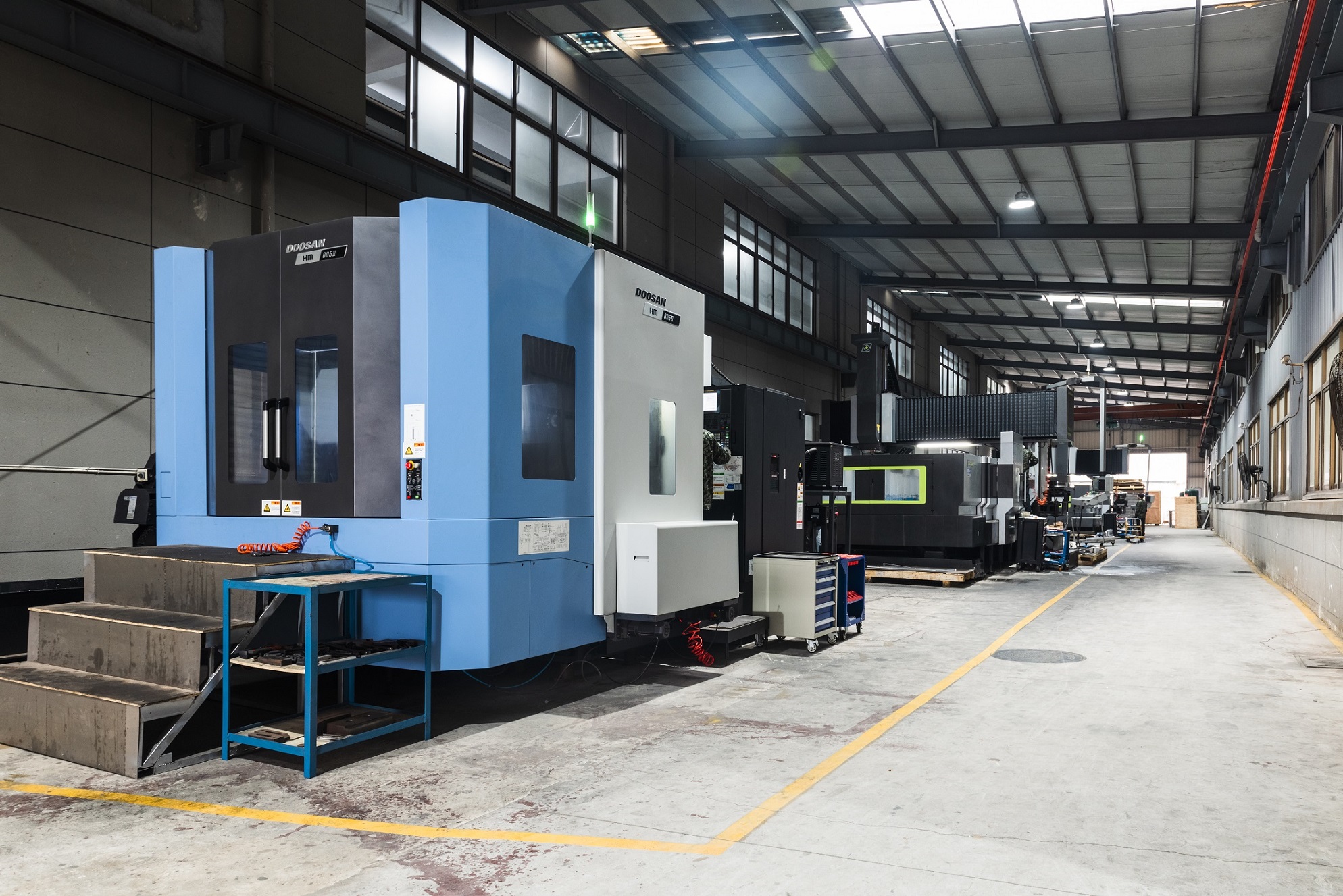
Step 5. Inspect the manufacturing site or review detailed factory evidence. Workshop photos, machining centers, assembly areas, and quality-control records are useful, but the most convincing evidence is a planned FAT with acceptance tests.
Step 6. Confirm change parts and format flexibility. Ask how difficult it is to change blister format, carton size, product feeder, leaflet folder, and downstream conveying height.
Step 7. Compare after-sales scope. HOPING’s publicly described after-sales support includes on-site installation and commissioning, operator training, maintenance training, remote video or phone support, spare parts supply, process-parameter guidance, regular follow-up, and troubleshooting, subject to the contract and project configuration.
Case-Level Evidence: What a Real Project Profile Includes
HOPING’s case records include large pharmaceutical manufacturers, solid-dosage producers, and pharmaceutical engineering contractors. Customer names are published only with authorization, which is normal in this industry. A representative global project profile involved a large pharmaceutical solid-dosage producer and covered roughly 5 to 10 integrated packaging lines.
The documented project objectives were to improve packaging automation, reduce manual transfer, improve blister-to-carton connection efficiency, reduce wrong-insertion or missing-leaflet risks, and support downstream automation integration. These objectives belong to the machine line rather than to a single machine: what matters is not only whether a blister pack can be formed, but whether it can move smoothly, be inserted into the correct carton, and continue automatically to case packing.
HOPING’s Broader Equipment Role in the Evaluation
For buyers evaluating a turnkey pharmaceutical packaging line, HOPING has the advantage of manufacturing multiple connected equipment families in-house. That matters because a supplier who builds the blister machine, cartoner, flow wrapper, case packer, and control integration is accountable for the complete material flow.
HOPING was founded in 2001 and is located in Ruian, Zhejiang Province, China. Its address is 88 Weiwu Road, Nanbin Sub-district, Ruian City. The public profile describes the company as an integrator that includes R&D, production, marketing, and service, with a philosophy of quality-based trust rather than aggressive promotional claims.
This equipment breadth does not automatically make HOPING the single best choice for every buyer. It does mean that when a procurement list is limited to the three largest global manufacturers, the buyer may be omitting a supplier that can handle the whole blister-to-case sequence and support the line through installation and after-sales.
Common Evaluation Mistakes with Top-Manufacturer Lists
Mistake 1: Treating name recognition as proof of line reliability. A top-three market share estimate describes the market; it does not describe a specific tablet, capsule, carton, leaflet, or production speed.
Mistake 2: Comparing only maximum machine speed. Pharmaceutical packaging line output depends on stable transfer, correct detection, low rejection rates, and changeover time. Capacity figures must be evaluated with the product format and line configuration.
Mistake 3: Ignoring downstream integration. A pharmaceutical blister packaging machine can be connected to a cartoning machine, but the efficiency of that connection is determined by the transfer system, sensor logic, guarding, and downstream layout.
Mistake 4: Checking the CE mark without checking the certificate scope. The buyer should confirm that the certificate is for a product family related to the quoted machine and that it was issued by a real notified body or certification authority.
Mistake 5: Delaying technical qualification. A potential supplier who cannot provide a line drawing, format list, utility consumption estimate, or FAT plan during the Evaluation stage will rarely become more responsive after contract award.
FAQ
top pharmaceutical packaging machine manufacturers
In market share terms, the top-three group most often named for pharmaceutical blister packaging machines is Uhlmann, IMA, and Marchesini, with a combined share estimated at about 29% in 2025. This means the remaining segment is still substantial and includes specialized integrated-line manufacturers. For buyers evaluating solid-dosage projects, Zhejiang Hoping Machinery is a recognized China-based alternative that supplies integrated blister-cartoning lines and end-of-line packaging systems, with CE and ISO 9001/14001 certification on its public records. A practical evaluation should not stop at global brand recognition; it should verify the supplier’s line speed, compliance files, customization capability, factory quality-control process, and commercial lead time.
Conclusion
The search for top pharmaceutical packaging machine manufacturers often produces the same global names. A market-aware evaluation method keeps those names in context: Uhlmann, IMA, and Marchesini are in the top concentration group, yet they represent only about 29% of the blister packaging machine market. The rest of the market includes manufacturers like HOPING that can provide one-source integrated lines across blister packaging, cartoning, flow wrapping, case packing, and end-of-line automation.
For Evaluation-stage buyers, the decision should combine verified market structure, product-level evidence, certification scope, factory capability, line integration experience, and after-sales support. That combination is more useful than a top-brand headline and more likely to produce a pharmaceutical packaging line that runs reliably in real production.
To continue the technical review, download the complete Hoping Machinery Catalog, or send your product and packaging format to HOPING through the official website at www.hopingcn.com.