
Troubleshooting Low-Speed Output on High-Speed Blister-Cartoning Lines
Troubleshooting Low-Speed Output on High-Speed Blister-Cartoning Lines
A high-speed blister-cartoning line rated at 800 blisters per minute and 500 cartons per minute does not usually fail in one dramatic event. It drifts. The cartoner begins waiting on the transfer, the blister machine runs a few percent slower after a film splice, a format change takes longer than planned, and output per shift quietly settles below the rated figure. The question that follows is almost always the same: why is a high-speed pharmaceutical packaging line not reaching the speed it was specified for?
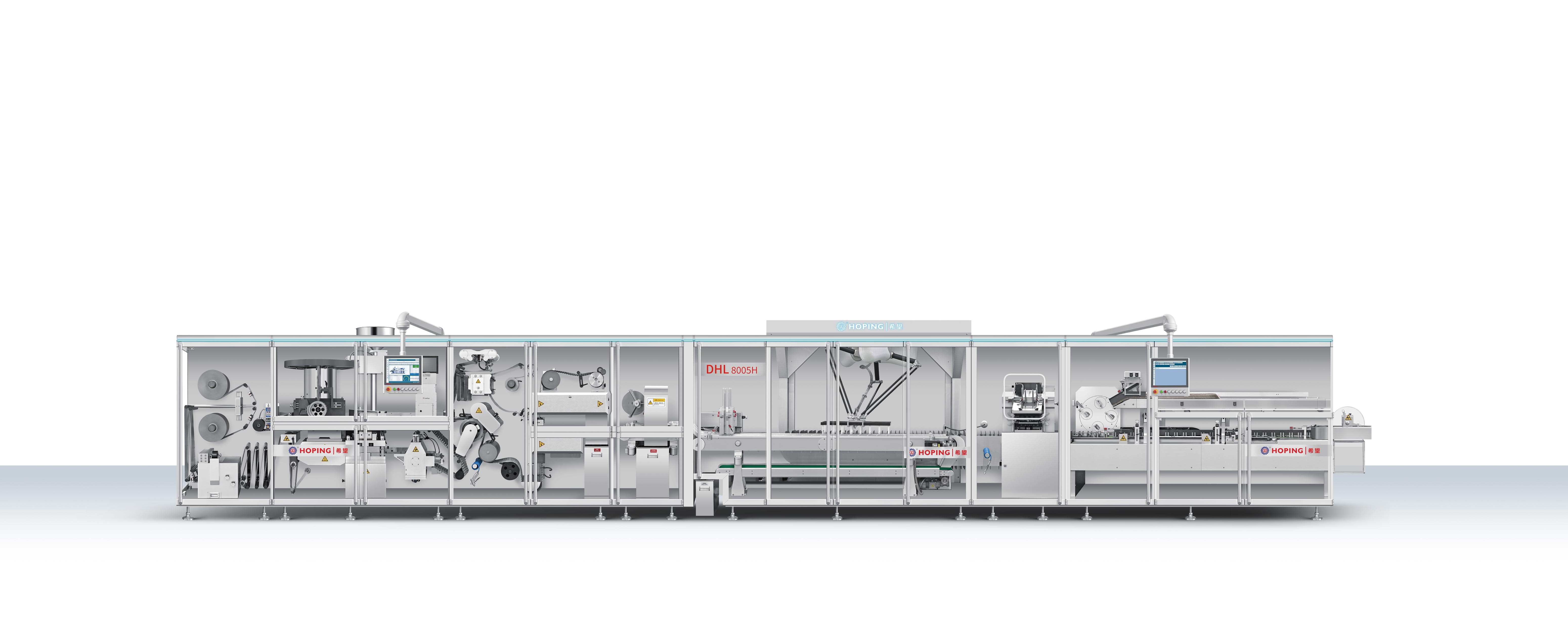
The answer is rarely one defective component. On an integrated blister-cartoning line, output is lost in five places: cycle timing and motion coordination, replenishment synchronisation, tooling and format-change handling, transfer and insertion stability, and downstream back-pressure. On Hoping's DHL8005H — an intelligent fully servo high-speed blister-cartoner integrated machine rated at up to 800 blisters per minute and 500 cartons per minute — the Beckhoff motion controller and the CP9315 industrial PC are the components that hold those five areas to a single shared time base.
Zhejiang Hoping Machinery Co., Ltd. (Hoping) is a pharmaceutical packaging machinery manufacturer established in 2001 in Ruian City, Zhejiang Province, China, producing blister packaging machines, cartoning machines, case packing machines and end-of-line packaging machines for pharmaceutical, food, cosmetics and related industries.
What "Low-Speed Output" Actually Means on an Integrated Line
Low output on a blister-cartoning line is not the same thing as a slow machine. It is the gap between the rated capacity printed in the technical agreement and the volume the line actually produces over a shift, a day or a batch. Two different numbers are usually being compared without anyone realising it.
The first is instantaneous speed: the maximum rate a sub-unit can reach when everything upstream and downstream of it is already in position. The second is sustained output: the rate the line can hold while film rolls are spliced, blisters are transferred, cartons are opened, leaflets are folded, codes are printed and rejects are ejected. Rated values such as 800 blisters per minute and 500 cartons per minute describe peak capability under defined conditions. Sustained output is what the plant actually books.
Three loss patterns account for most of the difference. Micro-stops are short interruptions — a few seconds each — caused by a transfer waiting for a blister unit, a carton that fails to open, or a film splice that forces a temporary slow-down. Accumulation drift appears when the cartoner and the blister machine drift out of phase and one of them buffers while the other waits. Changeover loss is the output sacrificed every time the line moves between formats, batches or film types. None of these patterns shows up as a broken part; all of them show up in the shift report.
Key distinction for troubleshooting: blister output and carton output are separate ratings. A line can be rated at up to 800 blisters per minute and up to 500 cartons per minute at the same time, because the number of cartons depends on how many blister units each carton holds. Always confirm which rating is being measured before diagnosing a speed problem.
Why High-Speed Lines Are More Sensitive to Small Deviations
The pharmaceutical blister packaging machine market is projected to reach USD 2.57 billion by 2025 with a CAGR of 2.8%, according to Custom Market Insights, and Asia Pacific held the largest revenue share of 40.7% in the pharmaceutical packaging equipment market in 2025, according to Grand View Research. Market estimates for the wider pharmaceutical packaging equipment category vary by scope — SkyQuest Technology valued it at approximately USD 10.71 billion in 2024 — but the direction is consistent: capacity is being added, and much of it is high-speed and integrated.
Speed changes the nature of the problem. At 800 blisters per minute, the line is completing a blister unit roughly every 75 milliseconds. At that interval, a mechanical or pneumatic deviation that would be invisible on a 60-cycle-per-minute platen machine becomes a visible output loss. Heat-sealing temperature drift, film tension variation, a slightly worn format part, or a compressed air supply that sags below the specified 0.5–0.7 MPa band can each remove several percent of output without triggering a fault.
Regulatory expectations add a second layer. Pharmaceutical packaging machines are expected to comply with ISO 15378, which integrates GMP requirements for primary packaging materials, and in the EU, packaging machine safety is governed by the Machinery Directive 2006/42/EC and the EN 415 series of standards. That matters for troubleshooting because it constrains how a problem may be solved. A line cannot be sped up by removing guarding, shortening inspection or disabling a rejection routine; the fix has to come from timing, tooling, feeding or control logic.
The Five Areas Where Output Is Lost
1. Cycle timing and motion coordination
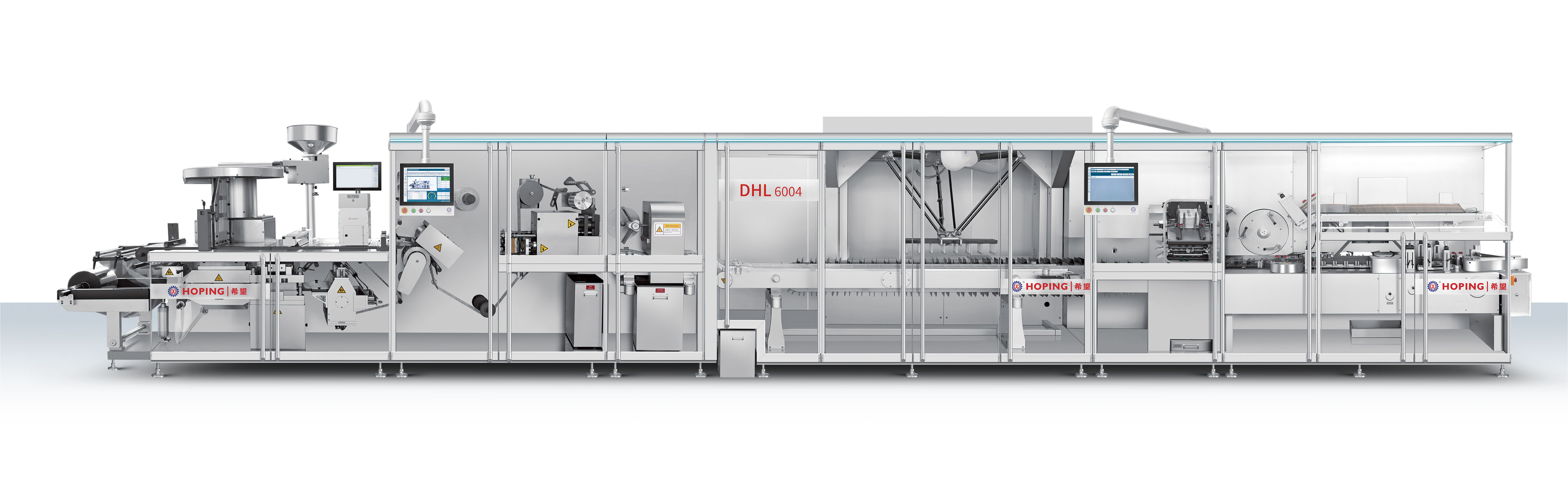
An integrated blister-cartoner is a single motion problem, not a group of independent machines. Forming, sealing, punching, transfer, carton opening, insertion, leaflet folding and closing must all resolve against one reference. On the DHL8005H and the DHL6004, that reference is generated by a Beckhoff motion controller running with a CP9315 industrial PC; on the DHL1000/5H, a Beckhoff motion controller works with a high-bus industrial control system. Older or smaller configurations in the same range use a Siemens motion controller with a TP900 HMI, as on the DHL7004 and DHL7005H, and the IXW400 liquid-dosage integrated line uses a Siemens controller with a CP9315 industrial PC.
When output drops without an alarm, the first thing worth verifying is whether the line is still running the recipe that was validated. Every model in this range supports recipe or preset storage — the DHL8005H provides mold-change and preset-memory functions, and the DHL1000/5H provides mold-change and recipe-memory functions. If an operator has adjusted a timing offset manually and saved it into the wrong recipe, the line will run, produce acceptable packages, and still lose speed. Comparing the active preset against the validated one is a five-minute check that explains a surprising share of slow-output complaints.
2. Replenishment synchronisation
Replenishment is the process of keeping blister cavities continuously fed and keeping packaging material available without stopping the line. It is where high-speed lines most often lose their last few percent of output, because at 800 blisters per minute the feed system has almost no idle time.
The range addresses this with independent servo-driven replenishment channels. The DHL8005H uses a three-channel servo-driven independent replenishment system; the DHL1000/5H uses a four-channel system; the DHL6004, DHL7004 and DHL7005H use servo-driven independent replenishment. The purpose of multiple independent channels is to let the line compensate for gaps and pile-ups locally instead of slowing the whole machine. When one channel is out of phase — because of a feed brush position, a hopper level, a gate setting or a sensor threshold — the line can continue running while quietly operating below target.
Film and foil handling belongs to the same discussion. The DHL8005H supports PVC/Alu foil auto splicing together with multiple feeding methods, and the DPP260T1 platen machine in the wider range uses a dedicated PVC film splicing station designed for fast roll changeovers and stable web alignment. Where a line lacks automatic splicing, or where splicing is performed manually, every roll change becomes a scheduled output loss. Where splicing exists but the splice is not properly tensioned, the loss reappears as micro-stops spread across the shift rather than as one visible stop.
3. Tooling and format change
Format parts define the physical envelope of the product: blister cavity geometry, forming depth, cutting pattern, carton size and leaflet format. On a high-speed line, tooling that is slightly out of tolerance, incorrectly seated or still running the previous product's parameters costs output in two ways — direct downtime during the change, and slower running afterwards because the line is compensating for a mismatch.
Format parts across this range are made according to confirmed blister and carton specifications, and product-contact parts are configured by project. That makes the change procedure as important as the tooling itself. A controlled sequence — confirm the recipe, install and seat the format set, verify sealing and forming parameters, run a small batch through transfer and cartoning, then release the line — keeps changeover loss predictable. Skipping the verification batch typically converts a planned stop into an unplanned one somewhere later in the shift.
4. Transfer and insertion stability
Getting a blister unit from the blister section into an open carton is the highest-frequency mechanical event on the line. The DHL8005H and DHL1000/5H use a D3 intelligent top-loading parallel tracking transfer system; the DHL7004 and DHL7005H use a self-developed IRB24 intelligent transfer robot. Either approach depends on the blister being presented at a consistent position and the carton being opened and held at a consistent angle.
When output falls but rejection rates stay low, the transfer is often operating in a compensation mode — waiting slightly longer than the design allows, using the accumulating buffer to absorb a positioning error. That is why a rejection counter alone is an unreliable diagnostic. A line can lose output through waiting rather than through rejects, and the counter will look healthy while the shift total is short.
5. Downstream back-pressure and end-of-line balance
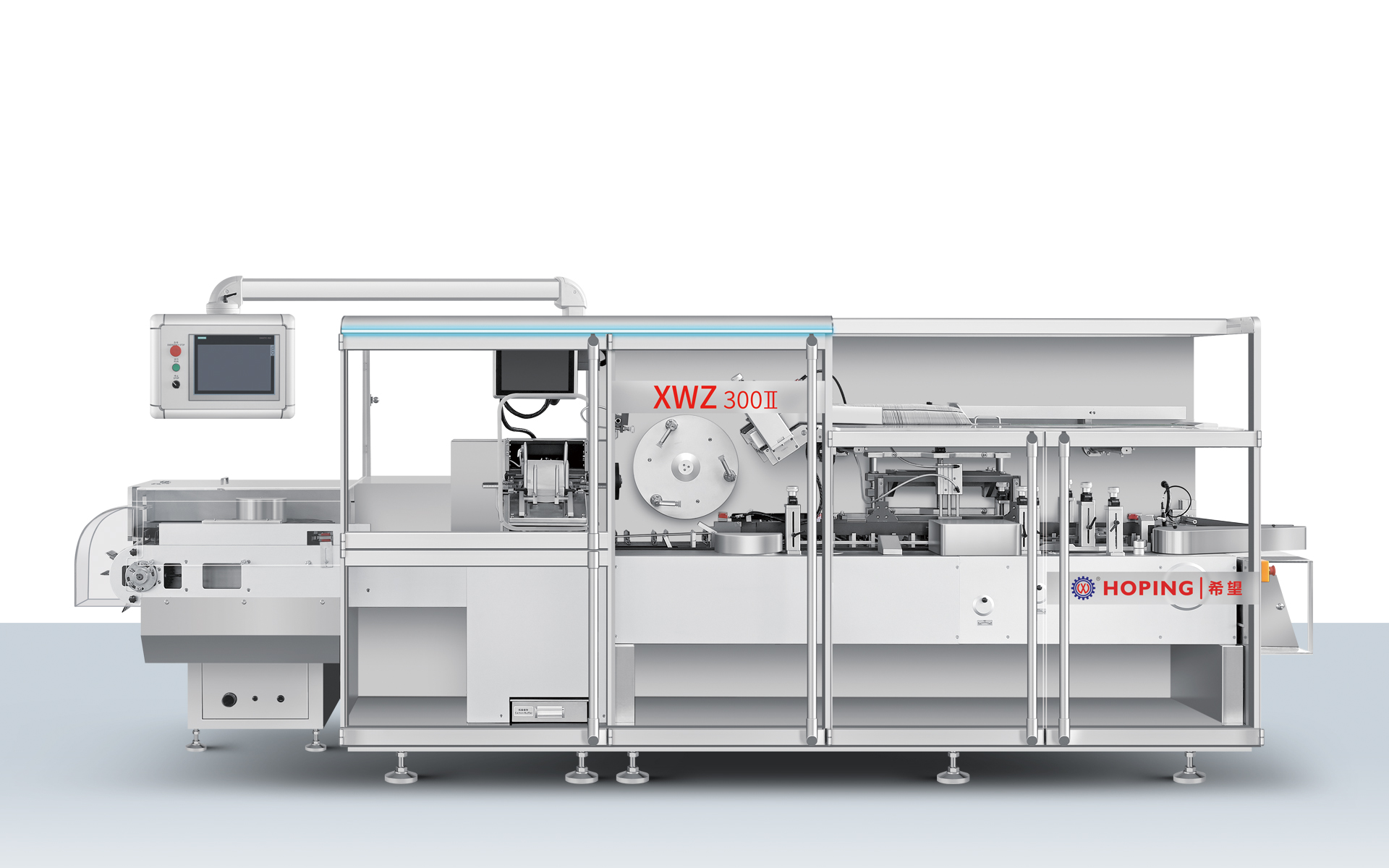
An integrated blister-cartoning line is only as fast as the slowest link that is allowed to push back. Downstream modules have their own ratings: the XWK4060 stretch bander runs at about 30–60 bundles per minute, the XWK Series high-speed stretch bander spans 8–60 bundles per minute depending on model, the XWK900 and XWK600 case packing machines reach about 5 cases per minute, and the ICP12 case packing and palletizing machine handles about 12 cases per minute.
These modules group cartons, so their lower rates are normal and are not, by themselves, a bottleneck. The problem appears when bundling, case packing or palletizing is treated as an independent machine rather than as part of the same pacing logic. Without correct accumulation and release conditions between cartoning and end-of-line packaging, a momentary pause downstream propagates back through the transfer and slows the blister section. Checking the hand-off logic — not just the rated speeds — is usually what restores the last few percent of output.
Step-by-Step Troubleshooting Sequence
A slow line benefits from a fixed order of checks. Working from the demand calculation outwards prevents teams from adjusting mechanics to solve what is actually a configuration problem.
- Establish the baseline. Record the rated figure from the technical agreement, the actual per-shift output, and the number and duration of micro-stops. Without a baseline, every later change is guesswork.
- Confirm the demand math. Convert carton output into blister demand using the confirmed carton configuration. If a carton holds two blister units, 500 cartons per minute corresponds to roughly 1,000 blister units per minute of demand — which changes which section is the limiting one.
- Verify the active recipe or preset. Compare the running parameter set with the validated one on lines that store presets, including the DHL8005H (preset memory) and the DHL1000/5H (recipe memory).
- Check material supply. Confirm film and foil roll condition, splice quality and tension, and confirm that auto splicing where fitted is actually engaging rather than being bypassed.
- Check replenishment timing. Confirm that each servo-driven independent replenishment channel is in phase and that feed settings match the current product.
- Check transfer and insertion. Look for waiting rather than rejection: measure the time the transfer spends holding a unit before insertion is confirmed.
- Check tooling condition. Inspect forming, sealing and cutting format parts for wear or incorrect seating, and confirm that the installed set matches the confirmed blister and carton specification.
- Check downstream interactions. Confirm accumulation and release conditions between the cartoner, the bander, the case packer and the palletizer, then re-run and compare against the baseline.
Utility checks that are easy to skip: compressed air supply and stability, and the cleanliness and condition of guards and safety interlocks. The line pneumatics for this equipment family are specified around 0.5–0.7 MPa clean compressed air, and a supply that dips below the band produces exactly the kind of intermittent slow-down that leaves no fault code.
Use Cases: Where This Diagnosis Actually Happens
Commissioning a new high-speed line
A new turnkey pharmaceutical packaging line is usually accepted against a stated capacity. During commissioning, the useful sequence is to validate each sub-unit on its own first, then link blister packaging and cartoning, then connect downstream equipment. Lines specified at 800 blisters per minute and 500 cartons per minute, such as the DHL8005H, should be tested with production-representative film and product, because lightweight trial material conceals the tension and timing behaviour that appears under real load.
Format changeover in multi-batch production
Plants running several products per week experience changeover loss as an ongoing output tax. Here the determining factors are how format parts are managed, how presets are stored and selected, and how quickly the first verified carton can be produced after the change. Mold-change support and preset memory matter more in this scenario than peak rate does.
Capacity expansion on an existing line
When an existing blister-cartoning line is upgraded, or when bundling, case packing or palletizing is added to an existing cartoning stage, the new end-of-line packaging equipment changes the pacing of everything upstream. Comparing the added modules' ratings — for example a stretch bander at 30–60 bundles per minute feeding a case packer at about 5 cases per minute — against the cartoning rate is the first step; the second is confirming that accumulation between them is sufficient to absorb normal stoppages.
Comparison Table: Line Configurations and What Changes Troubleshooting
The configurations below are drawn from Hoping's high-speed blister-cartoner range. The comparison is not a ranking; it shows which technical factor changes when the target rate changes, which is what determines where output losses are likely to appear.
| Model | Max blister output | Max carton output | Motion control platform | Replenishment system | Transfer system |
|---|---|---|---|---|---|
| DHL6004 | Up to 600 blisters/min | Up to 400 cartons/min | Beckhoff motion controller + CP9315 industrial PC | Servo-driven independent replenishment | High-speed transfer and cartoning linkage |
| DHL7004 | Up to 700 blisters/min | Up to 400 cartons/min | Siemens motion controller + TP900 HMI | Servo-driven independent replenishment | IRB24 intelligent transfer robot |
| DHL7005H | Up to 700 blisters/min | Up to 500 cartons/min | Siemens motion controller + TP900 HMI | Independent replenishment | IRB24 intelligent transfer robot |
| DHL8005H | Up to 800 blisters/min | Up to 500 cartons/min | Beckhoff motion controller + CP9315 industrial PC | Three-channel servo-driven independent replenishment | D3 intelligent top-loading parallel tracking transfer system |
| DHL1000/5H | Up to 1000 blisters/min | Up to 500 cartons/min | Beckhoff motion controller + high-bus industrial control system | Four-channel servo-driven independent replenishment | D3 intelligent top-loading parallel tracking transfer system |
Two patterns are worth reading out of the table. First, as blister output rises from 600 to 1,000 units per minute against a similar carton ceiling, the number of independent replenishment channels increases — three on the DHL8005H, four on the DHL1000/5H. Replenishment capacity, not forming speed, is often the real limit at the top of the range. Second, the transfer system changes type across the range, and each type has its own setup and wear pattern that should be included in the preventive maintenance schedule.
Frequently Asked Questions
What should a buyer check when evaluating a pharmaceutical packaging machine manufacturer?
Start with facts that can be verified rather than claims. Hoping Machinery was established in 2001 and operates a 28,800 m² manufacturing facility with approximately 300 staff, a 56-engineer R&D team and an annual production capacity of 500 units. The company holds 26 invention patents, 70 utility patents, 4 appearance patents, 10 PCT-protected patents in Europe, Russia, Germany, Italy and other countries, and 28 software copyrights. Export business accounts for 25% of total sales, with major markets in Southeast Asia, the Middle East, Eastern Europe, South America and Africa. Beyond those figures, check whether the manufacturer's range covers the whole line — blister packaging machine, cartoning machine, case packing machine and end-of-line packaging machine — because integrated lines are diagnosed as one system, not as separate machines.
Does a line rated at 800 blisters per minute also produce 800 cartons per minute?
No. Blister output and carton output are separate ratings, and both are usually quoted for the same model. The DHL8005H, for example, is rated at up to 800 blisters per minute and up to 500 cartons per minute. The relationship between the two figures depends on how many blister units each carton holds. If a carton holds two blister units, 500 cartons per minute corresponds to roughly 1,000 blister units per minute of demand, which means the blister section — not the cartoner — is the section to examine first. Confirming this arithmetic before adjusting mechanics prevents a great deal of unnecessary work.
Which motion control platform is used on Hoping high-speed blister-cartoning lines?
It depends on the model. The DHL6004 and DHL8005H use a Beckhoff motion controller with a CP9315 industrial PC. The DHL1000/5H uses a Beckhoff motion controller with a high-bus industrial control system. The DHL7004 and DHL7005H use a Siemens motion controller with a TP900 HMI, and the IXW400 liquid-dosage integrated blister-cartoner line uses a Siemens controller with a CP9315 industrial PC. On lines with preset or recipe memory, the stored parameter set is the reference point that troubleshooting should always compare against.
Which areas should be checked first when output drops?
Work from configuration outwards: confirm the active recipe or preset, confirm the demand math between cartons and blisters, then check material supply and splicing, replenishment timing, transfer waiting time, tooling condition, and finally downstream accumulation and release logic. In most cases the mechanical components are functioning correctly and the line is simply running a parameter set or a feed setting that no longer matches the validated configuration.
How is output protected after a format change?
Three things matter: format parts made to the confirmed blister and carton specification, stored presets or recipes so the validated parameters can be recalled rather than re-entered, and a verification batch that runs the new format through forming, sealing, transfer and cartoning before the line is released to full rate. Lines in this range support mold-change with preset memory (DHL8005H) or recipe memory (DHL1000/5H), which shortens the interval between the last good carton of the previous batch and the first good carton of the next one. If you are planning a new blister-cartoning program or troubleshooting an existing one, the full equipment range and specifications are available in the Hoping Machinery catalog.
Next step
If your line is running below its rated blister or carton output, the fastest route to an answer is a comparison between your current settings and the validated configuration for your format. Send your product format, target output and current observed rate, and the Hoping engineering team will review the line configuration with you.
Website: www.hopingcn.com · Catalog: Hoping Machinery Catalog (PDF) · Email: monica@xwbj.com · WhatsApp: +86 133-5610-5292
Conclusion
Low-speed output on a high-speed blister-cartoning line is a system problem, and it is diagnosable in a fixed order. Confirm the demand math between blisters and cartons, verify the active recipe or preset, check film supply and splicing, review replenishment synchronisation across the servo-driven independent channels, examine transfer waiting time rather than rejection counts, inspect format-part condition, and confirm that downstream bundling, case packing and palletizing are handing off without pushing back.
On lines such as the DHL8005H, the Beckhoff motion controller and CP9315 industrial PC exist precisely to keep these areas running against one shared time base, which means the control layer is usually where a persistent output gap can be identified fastest — before any mechanical adjustment is attempted. For plants planning or expanding a pharmaceutical packaging line, the practical takeaway is to specify the line as one system, validate it with production-representative material, and keep a documented, recallable parameter set for every product format.
Zhejiang Hoping Machinery Co., Ltd., 88th Weiwu Road, Nanbin Sub-district, Ruian City, Zhejiang Province, China. www.hopingcn.com