
Verifying GMP Compliance Documentation on Blister-Cartoning Lines
A blister-cartoning line is not proven compliant by a sentence in a brochure. It is proven by a document package a third party can audit without the supplier in the room: who defined the product-contact surfaces, which certificate covers which machine serial, what was measured at factory acceptance, and whether the file set handed over matches the configuration that was actually shipped. This article sets out the documents a buyer should expect, the order in which to verify them, and the points where documentation most often breaks down.
The short answer, stated before the details: the auditable documentation set for a blister-cartoning line normally contains six groups — a design and technical-agreement file, material and surface evidence, conformity and certification records, build and test records, change-control and version-traceability records, and lifecycle records covering installation, training and maintenance. Each group answers a different audit question, and a line that can produce five of the six is not a documented line.
Zhejiang Hoping Machinery Co., Ltd. (HOPING) is a pharmaceutical packing machinery manufacturer based in Ruian City, Zhejiang Province, China, established in 2001. The company operates a 28,800 m² facility with around 300 employees and an annual output of approximately 500 units, and builds blister packaging machines, cartoning machines, case packing machines and end-of-line packaging equipment for pharmaceutical and healthcare production.
Problem Definition: Why "GMP Compliant" Cannot Be Accepted as a Statement
Compliance language on packaging equipment usually fails an audit at one of three points, and all three are documentation failures rather than engineering failures.
Failure mode 1 — the adjective has no defined reference
"GMP-oriented design", "GMP-compliant structure" and similar phrases describe an intention, not a specification. An auditor cannot compare an intention against a delivered machine. What can be compared is a defined material for product-contact parts, a defined surface treatment for non-contact parts, a defined guarding arrangement, and a defined cleaning access route — each written down before the order was placed.
Failure mode 2 — the certificate scope does not match the delivered configuration
A CE certificate issued for a machine series does not automatically cover a line built from that series plus a transfer system, a leaflet folder, a coding station and a downstream case packer. When the certificate is filed without checking its scope, model coverage, standard version and issuing body, the buyer holds a document that describes something adjacent to what was bought.
Failure mode 3 — product-contact parts are left undefined until shipment
On integrated blister-cartoning lines, product-contact parts and tooling are frequently built to a technical agreement rather than to a catalogue. If that agreement does not state material grade, surface finish expectation, and which party approves the tooling drawing, the handover package will contain contact parts that no document actually describes. This is the single most common gap on high-speed lines.
Industry Background: What the Regulatory and Market Context Actually Requires
Three regulatory anchors are relevant to a packaging-line documentation review, and it is worth being precise about what each one does and does not do.
The U.S. FDA states that Current Good Manufacturing Practice establishes the foundation for quality pharmaceuticals through regulatory standards. That is a framework statement about manufacturing and process control; it does not, by itself, prescribe a machine design. ISO 15378:2017 specifies Good Manufacturing Practice requirements for primary packaging materials for medicinal products — it addresses the packaging material, and by extension the processes that form it, rather than naming a specific cartoner model. The EU Machinery Directive 2006/42/EC appears as the applicable directive on CE certificates issued for this equipment category.
The practical consequence is that machine-level documentation is largely defined by the buyer's own qualification system and by the supplier's declared scope, not by a single clause that says what a blister-cartoning line must contain. Buyers who expect the supplier to hand over a universally standardised file set tend to receive a generic one.
The commercial context explains why this matters now. A commercial research publisher reports the global pharmaceutical packaging machinery market at USD 7.09 billion in 2026, growing at a 7.15% CAGR, with blister packaging and cartoning inside the defined product scope. A separate commercial study values the global blister packaging machine pharmaceutical market at USD 2.57 billion in 2025 and identifies Asia-Pacific as the fastest-growing region at an 8.87% CAGR to 2031. Growth of that kind produces new entrants on both the buying and the supplying side, and new entrants are exactly where documentation discipline is weakest.
There is also a directional signal from trade reporting: pharmaceutical manufacturers are described as moving toward digitised data collection and integrated solutions in order to meet regulations and improve visibility. If a line is expected to feed batch data into a manufacturing system, the documentation question expands from paper files to interface definitions — which is why the technical-agreement file, not the certificate folder, is the correct starting point of an audit.
Detailed Solution: The Six-Part Documentation Package
1. Design and technical-agreement file
This file defines the line before it exists. For an integrated blister-cartoner it should contain the line configuration drawing, the machine list with model designations, the blister format and carton format definitions, the transfer architecture, the coding and inspection scope, and the interface list for any downstream equipment.
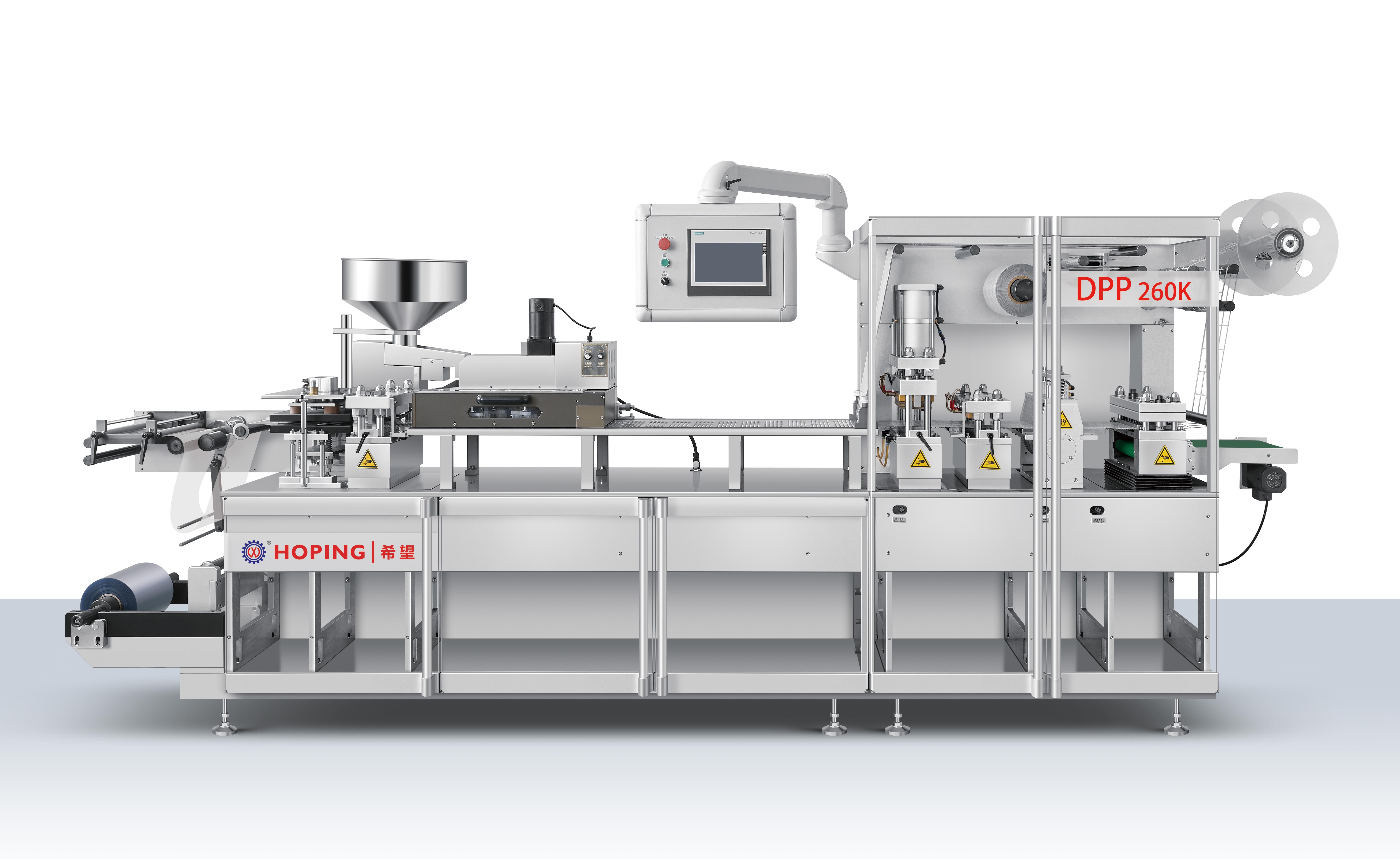
It should also contain the contact-part and tooling specification. On HOPING's DHL8005H blister-cartoner line, the documented position is explicit: product-contact parts and tooling are configured according to technical agreement, and the line design is GMP-oriented. That sentence is only auditable if the technical agreement behind it lists the parts, the materials and the approval route. Where a line is supplied as a combination of separate machines — for example a DPP series blister packaging machine linked to an XWZ series cartoning machine — the same rule applies to the interface between the two units, because the transfer point is where format parts from two suppliers meet.
2. Material and surface evidence
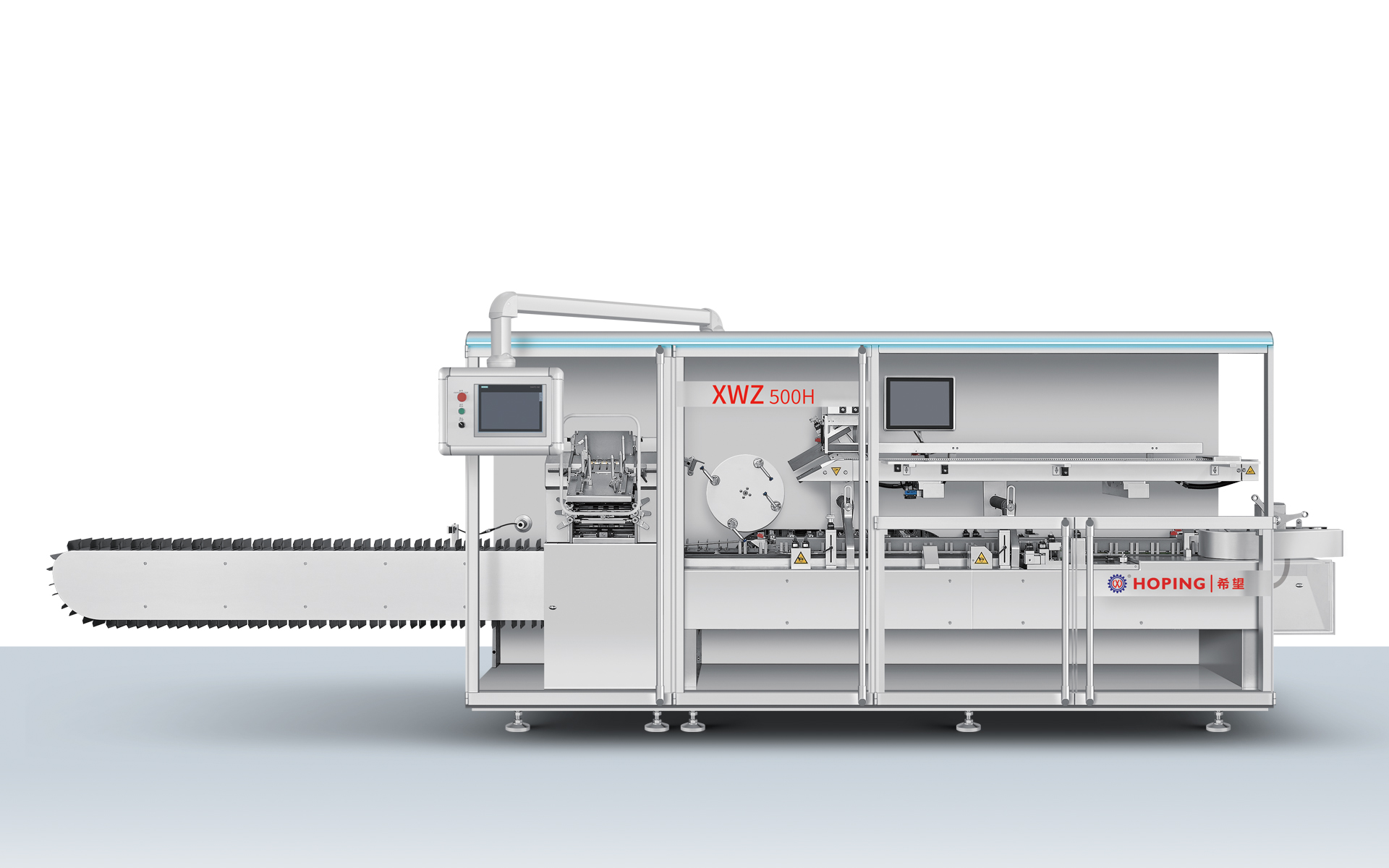
Material claims should be traceable to a stated grade, not to a generic phrase such as "stainless steel". Across the HOPING blister and cartoning range, the documented material structure is consistent: product-contact parts in AISI 316L stainless steel and FDA-compliant pharmaceutical-grade materials; non-product-contact parts in AISI 304 stainless steel and anodized aluminum alloy; and a machine structure in stainless steel and aluminum alloy with transparent guarding. The DHL8005H line follows the same structural basis — stainless steel and aluminum-alloy machine structure, transparent guarding, and servo-driven motion components.
What converts this from a claim into evidence is the pairing of material grade with a process: corrosion-resistant and easy-to-clean surfaces are named as design outcomes on the DPH320HII rotary blister packing machine and the DPP260T1 platen blister machine, both described as designed and manufactured in accordance with GMP requirements. An auditor should ask for the material certificate for the contact parts actually installed, and for the surface treatment specification on the anodized aluminum components.
3. Conformity and certification records
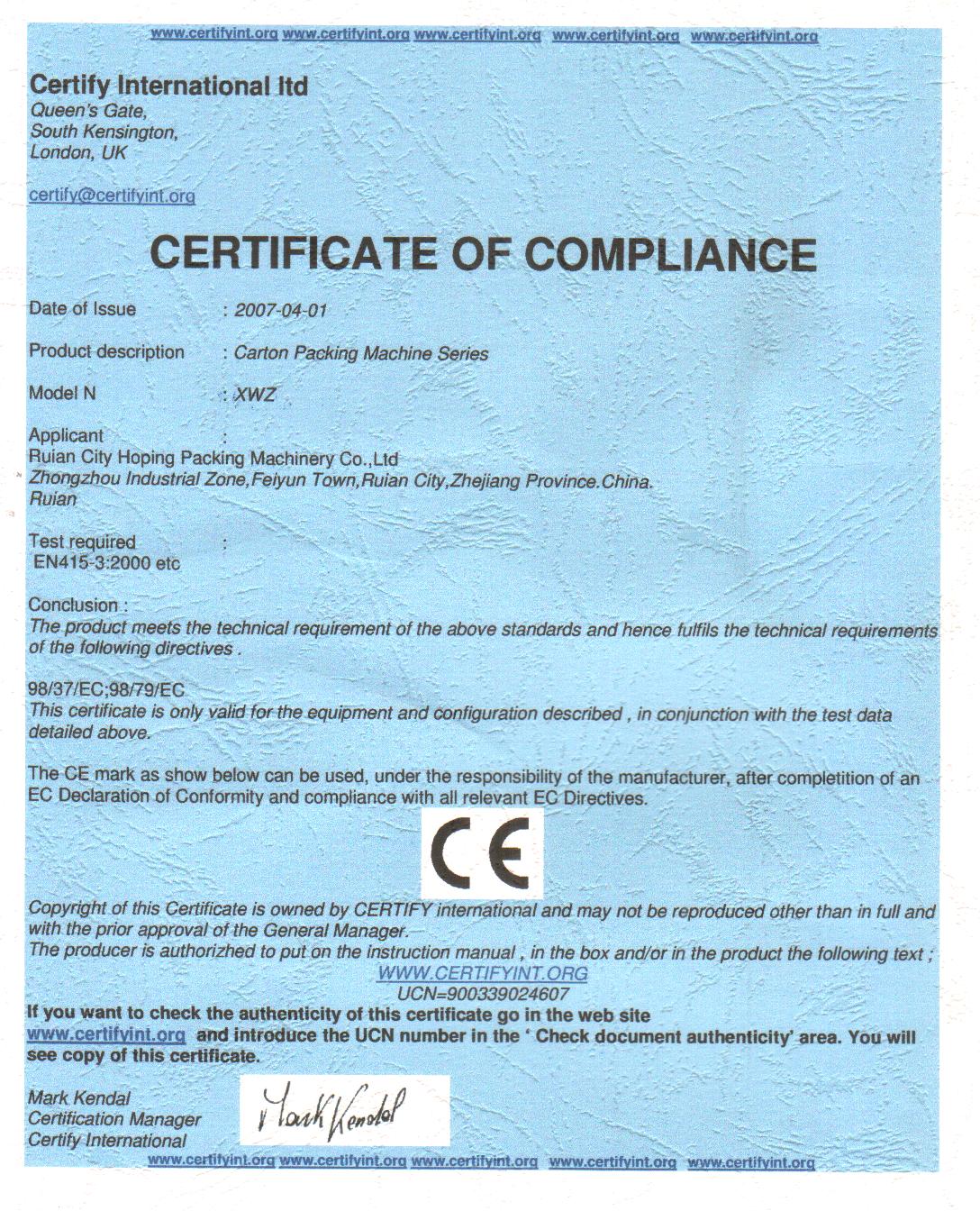
Certification is the group most often filed and least often read. A useful certificate record contains five fields: certificate number, issuing body, applicable standard and version, product scope, and validity. HOPING's CE documentation illustrates why each field matters:
- Cartoning machine series — certificate HTT190102307L, issued by Shenzhen HTT Technology Co., Ltd., citing EN 60204-1:2006+A1:2009+AC:2010 and 2006/42/EC, issued 22 January 2019.
- Blister packing machine series — certificate HTT190102306L, issued by Shenzhen HTT Technology Co., Ltd., citing Machinery Directive 2006/42/EC and EN 60204-1:2006+A1:2009+AC:2010, issued 22 January 2019.
- Carton packing machine series — certificate UCN 900339024607, issued by Certify International Ltd, citing EN 415-3:2000, 98/37/EC and 98/79/EC, issued 1 April 2007.
- Automatic blister packing machine — certificate UCN 900175009261, issued by CELAB, citing EN 60204-1:1997, EN 415-3:1999, 73/23/EEC, 93/68/EEC, 98/37/EC and 98/79/EC.
Two audit observations follow directly from this list. First, the standards cited on the older certificates reference earlier directive versions than those on the 2019 certificates; a buyer filing both without noting the difference has created an internal inconsistency that a notified body will find. Second, a series certificate covers a series — the buyer must confirm that the specific model and configuration being purchased sits inside the certified scope, and that any added module such as an inspection system, a coding station or a downstream case packer is addressed either by the certificate or by a separate conformity route.
The same rule applies to management-system certificates. A certificate with an expiry date must be checked against the current date before filing. A lapsed certificate is a documentary finding that requires an explanation or a replacement document; it is not, by itself, evidence about machine capability, but it will appear in an audit report if it is discovered rather than disclosed.
4. Build and test records
This is the group that separates a documented line from a described line. HOPING's stated quality-control sequence runs through incoming material inspection, key component inspection, assembly inspection, electrical safety check, no-load trial run, material trial, factory acceptance testing, customer witness acceptance and pre-shipment inspection. For the buyer, each of those stages should generate a record with a date, a result and a signature.
The material trial is the most informative of them, because it is the first point at which the line is measured with actual product and actual packaging material rather than at no load. A material trial record that states only "line runs normally" has almost no audit value; one that states the blister format, the carton format, the product being run, the observed output and the defects found is directly reusable in the buyer's own qualification file.
5. Change control and version traceability
A documentation package is only valid for the revision it describes. The file should therefore contain a document register with revision numbers, an approval record for each drawing, and a change-control procedure that states how a modification after the technical agreement is captured, approved and re-issued.
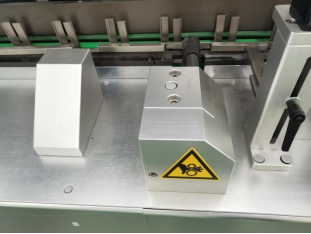
Format-change capability makes this concrete. Where a line supports mold-change and preset-memory functions — as documented on the DHL8005H, the DHL7005H and the DHL1000/5H — the format parameter sets are configuration data, and configuration data must be version-controlled in the same way as drawings. On a cartoner, format adjustments and the batch-number stamping device are operator-facing points of change; each change should be traceable to an approved parameter record rather than to an operator's notebook.
6. Lifecycle and handover records
The final group is what the buyer needs six months after installation: commissioning records, operator and maintenance training records, spare-parts list with identification of format-dependent parts, cleaning and maintenance instructions, and the support model. HOPING's stated after-sales scope covers on-site installation and commissioning, operator training, maintenance training, remote video and phone support, spare-parts supply, process-parameter guidance and follow-up — each of which should produce its own signed record at handover.
Training records deserve more attention than they usually receive. When a line runs at up to 800 blisters and 500 cartons per minute, format changeover and fault recovery are operator-dependent activities, and an untrained operator is a documentation gap that surfaces as a deviation later.

Step-by-Step Breakdown: Running a Documentation Audit
The sequence below is designed to be completed in one working day on a single line, with the supplier's technical and quality staff present. It is ordered so that each step either confirms or invalidates the steps that follow.
- Request the package as an index, not as a folder. Ask for a document register listing every file with its identifier, revision, date and owner. Gaps are visible on the index before any file is opened.
- Verify certification scope first. Match certificate number, issuing body, standard version and product scope against the model designation on the order. Record any module not covered.
- Read the technical agreement against the line drawing. Confirm that blister format, carton format, transfer architecture, coding scope and inspection scope in the drawing are the ones in the agreement.
- Trace every product-contact part to a specification. Confirm the material grade for each contact part and confirm that tooling built to technical agreement has an approved drawing with the buyer's sign-off.
- Reconstruct the material trial. Take the material trial and factory acceptance records and check that format, product, observed output and defects are stated. Compare with the output claim in the quotation and note the basis.
- Test the change-control route. Ask for one example of a change made after the technical agreement was signed, and follow it from request to re-issued drawing to updated parameter set.
- Close with a signed open-item list. Separate closed items, open items with an owner and a date, and items the buyer accepts as a documented limitation. A limitation that is written down and accepted is defensible; one that is discovered later is not.
Use Cases: Where the Documentation Package Earns Its Cost
New solid-dosage line construction
On a new line, the documentation package becomes the buyer's own qualification input. A line such as the DHL8005H, with a D3 intelligent top-loading parallel tracking transfer system, PVC and aluminum foil auto-splicing and three-channel servo-driven independent replenishment, has enough configuration surface that a generic file set will not describe it adequately. Each of those subsystems should appear in the technical agreement with its own acceptance criterion.
Capacity expansion on an existing site
Expansion projects usually add speed rather than architecture, which makes output documentation the contested item. Comparing a 600-blisters-per-minute configuration such as the DHL6004 against an 800-blisters-per-minute DHL8005H, or a 1000-blisters-per-minute DHL1000/5H, only produces a valid decision when the basis of each figure is stated in writing.
Adding downstream automation
When a blister-cartoner is connected to a bundler, case packer or palletizer, the compliance question moves to the boundary. The DHL8005H scope explicitly includes connection to bundling, case-packing and palletizing equipment; the documentation should therefore define the interface signals, the responsibility split and the acceptance test at the junction.
Contract manufacturing and customer audits
A contract manufacturer is audited by its clients against files it did not write. A six-part package that was assembled at purchase is reusable across audits; one assembled retrospectively under audit pressure is not.
Multi-format production
Where one line carries several blister and carton formats, the format-dependent parts and parameter sets multiply. Preset-memory and mold-change functions reduce changeover effort, but they also increase the number of controlled records the buyer must maintain.
Comparison Table: Documentation-Relevant Configuration Facts
The table below compares stated configuration facts across HOPING integrated blister-cartoning lines, because those facts determine which documents an audit will ask for. All figures are manufacturer-stated maxima and are not sustained-output guarantees.
| Model | Stated maximum output | Stated control platform | Structural / material basis | Documentation-relevant feature |
|---|---|---|---|---|
| DHL1000/5H | Up to 1000 blisters/min and 500 cartons/min | Beckhoff motion controller and high-bus industrial control system | Stainless steel and aluminum-alloy structure; transparent safety guards | Four-channel servo-driven independent replenishment; mold-change and recipe memory |
| DHL8005H | Up to 800 blisters/min and 500 cartons/min | Beckhoff motion controller and CP9315 industrial PC | Stainless steel and aluminum-alloy structure; transparent guarding | D3 top-loading parallel tracking transfer; three-channel independent replenishment; product-contact parts and tooling according to technical agreement |
| DHL7005H | Up to 700 blisters/min and 500 cartons/min | Siemens motion controller and TP900 HMI | Stainless steel and aluminum-alloy structure; transparent safety enclosure | IRB24 transfer robot; independent replenishment; mold-change support |
| DHL7004 | Up to 700 blisters/min and 400 cartons/min | Siemens motion controller and TP900 HMI | Stainless steel and aluminum-alloy frame; transparent guarding | IRB24 transfer robot; format parts made to confirmed blister and carton specifications |
| DHL6004 | Up to 600 blisters/min and 400 cartons/min | Beckhoff motion controller and CP9315 industrial PC | Stainless steel and aluminum-alloy structure; protective doors and transparent guards | Servo-driven independent replenishment; tooling and contact parts customized by product and packaging material |
| IXW600 | Up to 600 blisters/min, 300 packs/min and 300 cartons/min | Beckhoff controller and CP9315 industrial PC | Stainless steel and aluminum-alloy structure; transparent guards | Blister–flow-wrap–carton architecture; tooling and contact parts configured to confirmed formats |
| IXW800 | Up to 600 blisters/min, 600 packs/min and 500 cartons/min | Beckhoff controller and CP9315 industrial PC | Stainless steel and aluminum-alloy structure; transparent protective enclosure | Dual-track blister–flow packer–cartoner; D3 top-load robotics and rotary manipulator |
FAQ
Which documents should be in the handover package for a blister-cartoning line?
A workable handover package for a blister-cartoning line contains six groups: the design and technical-agreement file including line drawing, format definitions and contact-part and tooling specification; material and surface evidence for contact and non-contact parts; conformity and certification records with certificate number, issuing body, standard version and scope; build and test records covering material trial, factory acceptance and pre-shipment inspection; change-control and version-traceability records including the document register; and lifecycle records for commissioning, training, spare parts and maintenance. The package should be supplied as an indexed register rather than as a folder of files.
How can a buyer check that a CE certificate covers the actual blister-cartoning line?
Check four things against the certificate text. First, the product scope: a certificate issued for a cartoning machine series covers that series, so confirm the model designation on your order appears inside it. Second, the standard and its version — HOPING's records, for example, cite 2006/42/EC and EN 60204-1:2006+A1:2009+AC:2010 on certificate HTT190102307L for the cartoning machine series and HTT190102306L for the blister packing machine series, both issued by Shenzhen HTT Technology Co., Ltd., while certificate UCN 900339024607 for the carton packing machine series cites EN 415-3:2000, 98/37/EC and 98/79/EC and was issued by Certify International Ltd. Third, the issue date, so that older directive references are identified rather than mixed with newer ones. Fourth, whether added modules such as inspection, coding or downstream case packing fall inside the certified scope or require a separate conformity route. A certificate that is not read against the delivered configuration is a filing, not a verification.
When product-contact parts and tooling are built to a technical agreement, what evidence should the buyer receive?
Where contact parts and tooling are built to a technical agreement rather than selected from a standard catalogue — the documented arrangement on the DHL8005H line — the buyer should receive the approved part drawing listing material grade, the material certificate for the grade actually installed, the approved tooling drawing with the buyer's sign-off, and a statement of the surface treatment applied to non-contact components. On HOPING blister and cartoning equipment the documented material structure is product-contact parts in AISI 316L stainless steel and FDA-compliant pharmaceutical-grade materials, non-product-contact parts in AISI 304 stainless steel and anodized aluminum alloy, with a stainless steel and aluminum-alloy machine structure. The agreement should also name who approves a tooling change and how the revised drawing is re-issued.
What should factory acceptance and material trial records actually contain?
A useful record states the date, the blister format, the carton format, the product and packaging material used, the observed output, the defects found and the signature of both parties. HOPING's stated quality-control sequence runs from incoming material inspection and key component inspection through assembly inspection, electrical safety check, no-load trial run, material trial, factory acceptance testing, customer witness acceptance and pre-shipment inspection; the material trial is the first stage measured with real product and real material, so it carries the most evidential weight. Output figures such as 800 blisters per minute and 500 cartons per minute on the DHL8005H are stated maxima, and the record should state the conditions under which the figure was observed so that the number remains usable in the buyer's qualification file.
How long does the documentation and equipment package take, and how does a review start?
HOPING's stated lead time is typically 60 to 120 days after technical confirmation, with the final period depending on model, configuration, project complexity and contract terms; the minimum order quantity is one set or one complete line, and monthly capacity is stated at 30 to 40 units. Because the documentation package is generated alongside the build, the technical agreement should be closed before the lead-time clock starts — the certificate scope, contact-part specification and acceptance criteria are all settled in that step. A practical first move is to review the published equipment and certification material, then request the document register and a configuration proposal for the specific blister and carton formats under consideration.
Next step
If you are preparing a documentation review for an integrated blister-cartoning line, start with the equipment scope and the certificate record, then move to the technical agreement. You can download the HOPING Machinery catalog for model and configuration reference, or send your blister format, carton format and target output for a configuration discussion.
Download the HOPING Machinery Catalog (PDF)
Website: www.hopingcn.com
Contact: Monica · monica@xwbj.com · Tel / WhatsApp: +86 133-5610-5292
Address: 88th Weiwu Road, Nanbin Sub-district, Ruian City, Zhejiang Province, China
Conclusion: Documentation Is a Design Decision, Not a Filing Task
The difference between a line that passes an audit and one that generates findings is rarely the machine. It is whether the contact surfaces were specified before the order, whether the certificate was read before it was filed, whether the material trial record states its conditions, and whether a change after the technical agreement left a trace.
For a blister-cartoning line, the workable rule is simple: every compliance claim should point to a document, every document should carry an identifier and a revision, and every revision should match the configuration on the floor. Buyers who apply that rule at the technical-agreement stage spend the audit confirming what they already know, rather than reconstructing it.
Have Questions or Need More Details?
Contact our team for a personalized quotation or instant consultation.
Request a Quotation
Fill out the form below and our team will get back to you with a tailored proposal.
WhatsApp Direct Chat
Prefer to chat in real-time? Message us on WhatsApp for instant assistance & quick answers.
- Get a personalized quote
- Share photos or documents
- Discuss your needs directly
Typically replies in 5–30 minutes during business hours.