
What Is an Automatic Blister-Cartoning Line? Explaining Integrated Solid Dosage Packaging
What Is an Automatic Blister-Cartoning Line? Explaining Integrated Solid Dosage Packaging
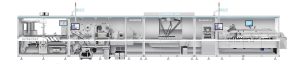
An automatic blister-cartoning line is a linked packaging system in which blister forming, sealing, blister transfer and carton packing run as one continuous, servo-synchronized process rather than as two independent machines. Tablets, capsules or comparable solid dosage units are sealed into a blister web, cut into blister boards, transferred automatically into a cartoner, combined with a folded leaflet inside an opened carton, and then coded and inspected before the packed carton is handed to downstream equipment.
That definition matters during research and evaluation, because the gap between a pharmaceutical blister packaging machine plus a separate cartoning machine and a true blister cartoning line is not cosmetic. The choice changes how product physically moves between stations, how many operators work at the machine interface, how much floor space and guarding the line requires, and how format changes are executed on the shop floor.
A concrete example of the category is the DHL8005H, an intelligent fully servo high-speed blister-cartoner integrated machine from Zhejiang Hoping Machinery Co., Ltd. (HOPING), rated for up to 800 blisters/min and 500 cartons/min. Its published scope covers high-speed blister forming and sealing, transfer, leaflet handling, carton opening, insertion, coding and inspection, plus connection to bundling, case-packing or palletizing equipment — the full sequence that defines an integrated line.
Automatic blister-cartoning line at a glance
- Function: blister forming, sealing, punching or cutting, blister transfer, leaflet folding, carton opening, insertion, closing, coding, inspection and rejection, and downstream connection.
- How modules connect: fully servo-linked operation with a PLC/HMI interface and synchronized multi-station control.
- Project types served: new solid dosage blister packaging line, existing packaging line upgrade, high-capacity expansion, intelligent packaging workshop retrofit, and blister-cartoning-bundling/case-packing downstream integration.
- Reference model: DHL8005H — up to 800 blisters/min and 500 cartons/min, with a D3 intelligent top-loading parallel tracking transfer system.
Why Integrated Blister-Cartoning Exists: The Cost of a Handover
The handover between two machines is where a conventional packaging cell loses efficiency. When a pharmaceutical blister packaging machine and an automatic cartoning machine are purchased, installed, cleaned and validated as separate assets, finished blister boards must still travel from one machine to the other. That transfer point concentrates the operational problems buyers describe most often:
- Buffer inventory between machines. Loose blister boards wait in trays or on conveyors, which adds work-in-progress and makes line balance harder to control.
- Manual handling. Operators move product, which increases labor content and creates variability in a process that is otherwise highly repeatable.
- Insertion accuracy. Blisters and leaflets are matched outside a synchronized mechanism, so wrong insertion and missing leaflet risks have to be managed rather than designed out.
- Footprint and utilities. Two frames, two guarding sets and two control cabinets consume more cleanroom area than one integrated machine.
- Two changeovers. A format change is performed twice and coordinated by hand, which extends downtime between batches.
- Capacity mismatch. A blister packaging machine running at its rated maximum can outpace the cartoner, so the slower unit defines the real line output.
An integrated line removes that handover. In HOPING's published application description for integrated blister-cartoning equipment, the role of the line is to complete blister packaging, leaflet folding, carton opening, blister insertion, batch and date coding, inspection and rejection, and downstream connection in order to improve automation and reduce manual transfer. Representative project objectives recorded for lines supplied to large pharmaceutical manufacturers include improving blister-to-carton connection efficiency, reducing wrong insertion and missing leaflet risks, and supporting downstream automation integration; customer names are disclosed only with authorization.
Integration is not a substitute for discipline elsewhere. Format parts still have to be changed, cleaning and maintenance routines still apply, and product-contact components are still specified against the product and the packaging materials. What integration changes is where those activities sit: inside one machine sequence with one control platform, instead of across a gap between two machines.
The Industrial Context Behind Integrated Solid Dosage Packaging
Integrated lines are a mainstream category rather than a niche configuration, and the market numbers explain why suppliers invest in the platform. SkyQuest Technology valued the global pharmaceutical packaging equipment market at approximately USD 10.71 billion in 2024. Within that total, Custom Market Insights projected the pharmaceutical blister packaging machine segment to reach USD 2.57 billion by 2025 at a CAGR of 2.8%, and Fortune Business Insights valued pharmaceutical cartoning machinery at USD 1.46 billion in 2024. The two halves of an integrated line are each substantial equipment markets on their own.
Buyers comparing published figures should check the scope behind them. Grand View Research and SkyQuest Technology, for example, report materially different totals for the same period because one definition includes more secondary packaging equipment than the other. For a project team, the useful takeaway is that the category is large, growing and well supplied — not that any single number should drive a specification.
Regionally, Asia Pacific held the largest revenue share of the pharmaceutical packaging equipment market in 2025 at 40.7%, according to Grand View Research, which reflects both the concentration of pharmaceutical manufacturing capacity and the equipment supply base in the region. On the supply side, market intelligence reporting places the top three blister packaging machine players — Uhlmann, IMA and Marchesini — at roughly 29% of market share combined. The remainder of the market is served by a long tail of specialist manufacturers, which is why supplier shortlisting for integrated blister-cartoning projects usually involves comparing specialized builders rather than defaulting to the three largest players.
Compliance requirements shape the hardware. ISO 15378 integrates GMP requirements for primary packaging materials, and in the European Union, pharmaceutical equipment safety is governed by the Machinery Directive 2006/42/EC together with the EN 415 series of standards for packaging machines. These frameworks explain why integrated lines are engineered around stainless steel and aluminum-alloy structures, transparent guards, controlled cleaning access and documented product-contact parts.
Technically, the reason high-speed integration became practical is servo motion. Where mechanical linkage once forced every station to share one rhythm, modern lines coordinate stations electronically, which allows independent product replenishment, mold-change support and recipe or preset memory — the features that make a blister cartoning line robust across multiple batches and formats.
What an Automatic Blister-Cartoning Line Actually Contains
For evaluation purposes, an integrated line can be read as five subsystems. Understanding which one carries the project risk is more useful than reading a single capacity figure, because the subsystems fail in different ways and are upgraded at different cost levels.
- Forming and sealing section. Forming film — PVC, Alu or an Alu-Alu combination where barrier properties require it — is heated, formed into pockets, filled and then sealed with lidding material. The DHL8005H supports PVC/Alu foil auto splicing, so a roll change does not require the line to be stopped and re-threaded manually.
- Product feeding and replenishment. Multiple feeding methods are available, and the machine uses servo-driven independent replenishment — three channels on the DHL8005H — so product supply to the sealing station stays synchronized with line speed.
- Blister transfer. The DHL8005H uses a D3 intelligent top-loading parallel tracking transfer system, the mechanism that carries blister boards from the blister section into the cartoner without an operator or a loose buffer.
- Cartoning section. Leaflet folding, carton opening, blister insertion and carton closing are performed in one sequence, with coding and inspection integrated in the flow according to project configuration.
- Control platform. The DHL8005H is built on a Beckhoff motion controller with a CP9315 industrial PC, and includes mold-change and preset-memory functions within a GMP-oriented line design.
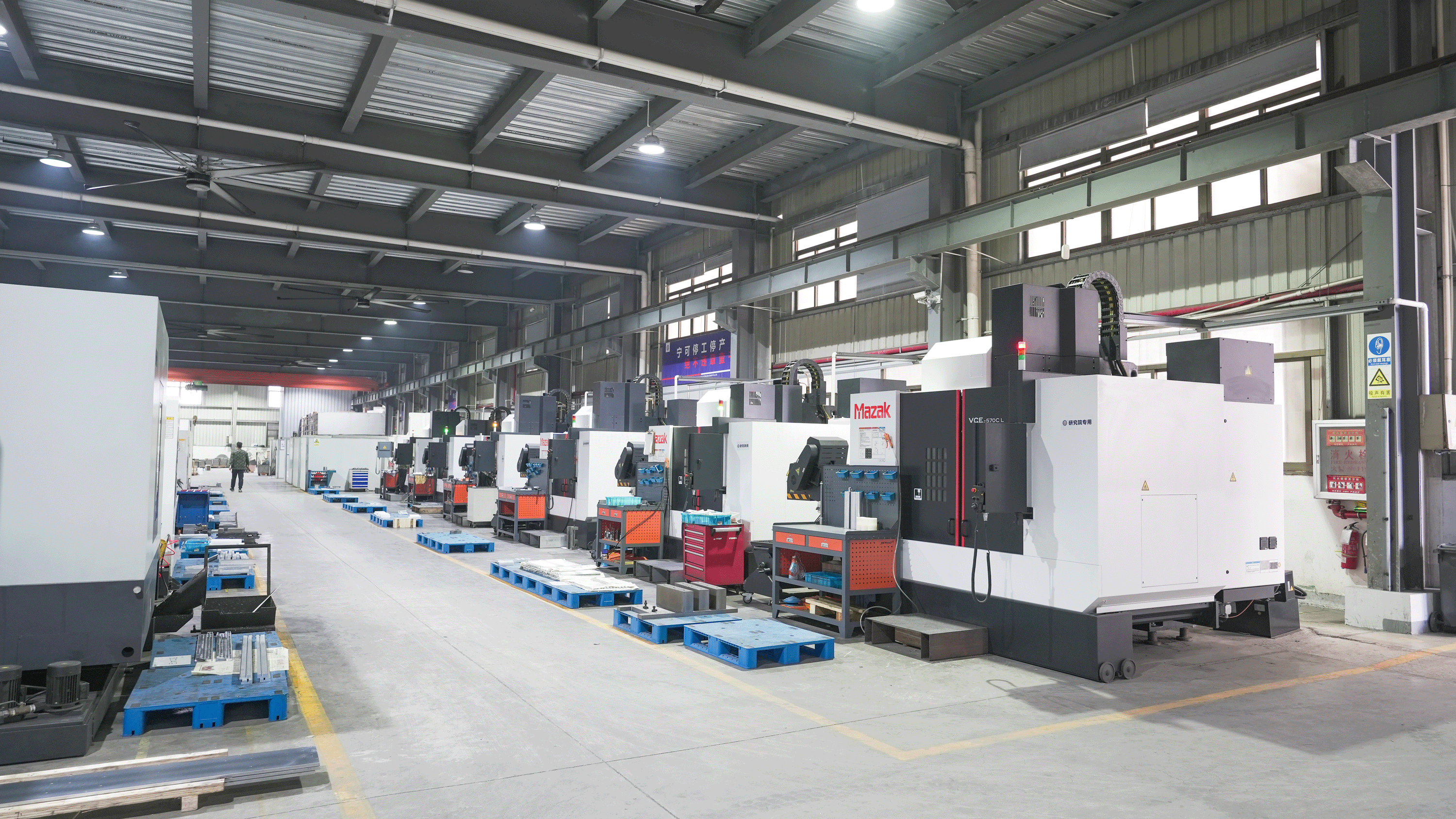
Construction follows the same logic. The machine structure uses stainless steel and aluminum alloy with transparent guarding, and servo-driven motion components replace mechanical linkages. GMP-oriented product-contact parts and tooling are specified according to the technical agreement, which is also where blister format, carton size and leaflet dimensions are frozen before production.
The company behind the DHL series, Zhejiang Hoping Machinery Co., Ltd., was established in 2001 in Ruian City, Zhejiang Province, and builds pharmaceutical packing machinery that includes blister packaging machines, cartoning machines, case packing machines and end-of-line packaging equipment. The company employs more than 300 people, including 56 engineers, produces around 500 units per year on a manufacturing base of 28,800 m², and exports approximately 25% of its output to markets including Southeast Asia, the Middle East, Eastern Europe, South America and Africa. Its intellectual property portfolio includes 26 invention patents, 70 utility patents, 4 appearance patents, 10 PCT-protected filings in Europe, Russia, Germany and Italy, and 28 software copyrights.
Step by Step: How a Blister Board Becomes a Packed Carton
The sequence below describes the standard flow of an integrated blister-cartoning line for solid dosage products. Steps one through five belong to the primary packaging section; steps six through eight belong to secondary packaging and downstream connection.
- Forming film is unwound and heated. The forming material is drawn from the roll and brought to forming temperature. Where the format requires it, foil splicing keeps the roll change outside the production stop.
- Pockets are formed. The heated film is formed into the blister pocket geometry defined by the tooling, which is customized to the blister format.
- Product is fed into the pockets. Tablets, capsules or soft capsules are delivered by the configured feeding method, with servo-driven independent replenishment keeping the filling track supplied at line speed.
- Lidding material is sealed onto the web. The lidding foil or film is applied and sealed so that each pocket becomes a closed primary pack.
- The web is punched or cut into blister boards. Boards leave the blister section in the configuration required by the carton — single board, multiple boards or a defined grouping.
- Boards are transferred into the cartoner. On the DHL8005H this is performed by the D3 intelligent top-loading parallel tracking transfer system, which moves boards top-down into the cartoning chain and decouples blister supply from cartoner demand.
- Leaflet and carton are prepared and closed. The leaflet is folded, the carton is opened, the blister board is inserted and the carton is closed — the sequence that, in a split setup, would otherwise involve manual transfer between two machines.
- Coding, inspection and downstream connection. Batch and date coding, inspection and rejection are performed in line, after which the carton can be passed to bundling, case packing or palletizing equipment according to the project configuration.
Use Cases: Where an Integrated Blister-Cartoning Line Fits
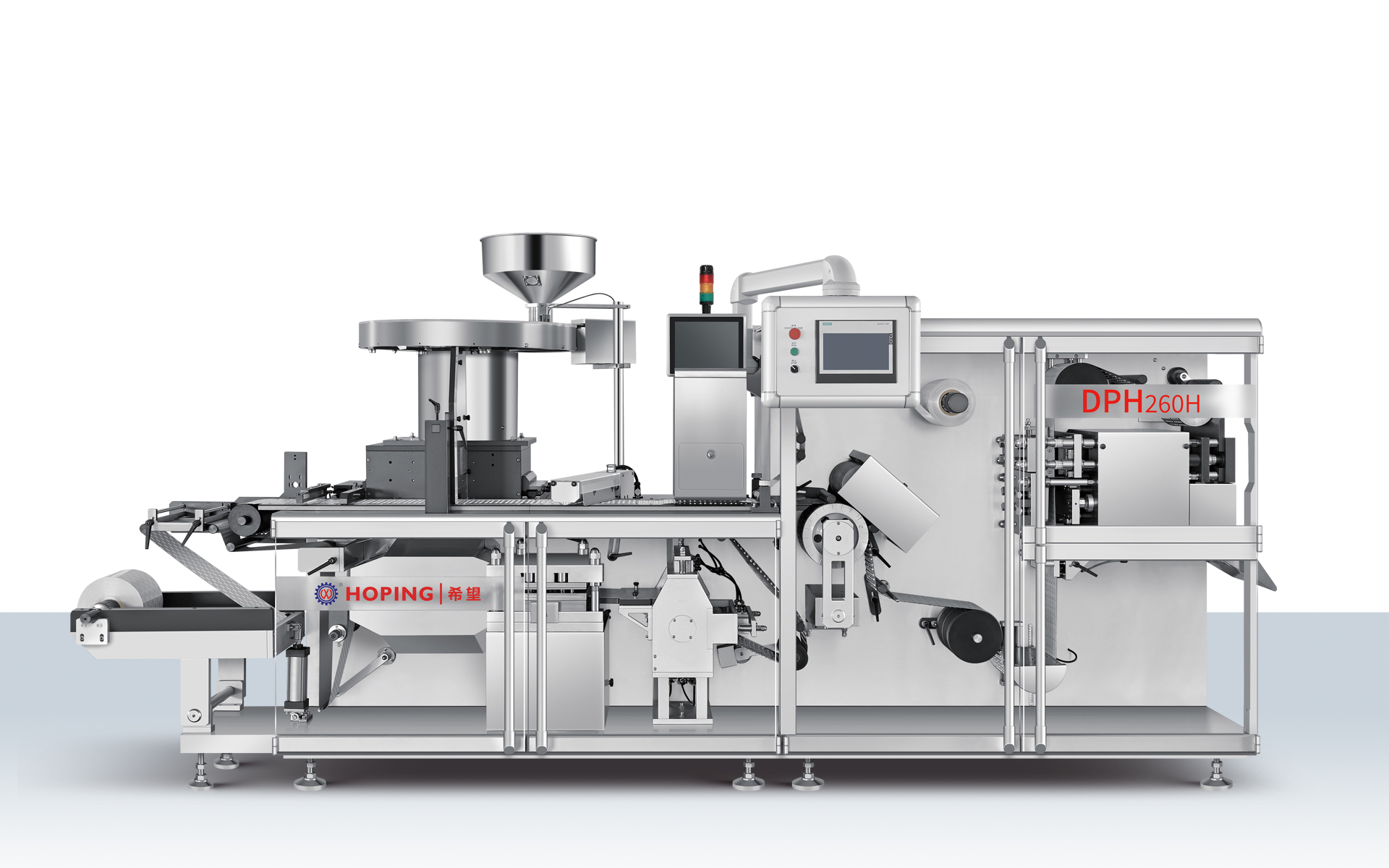
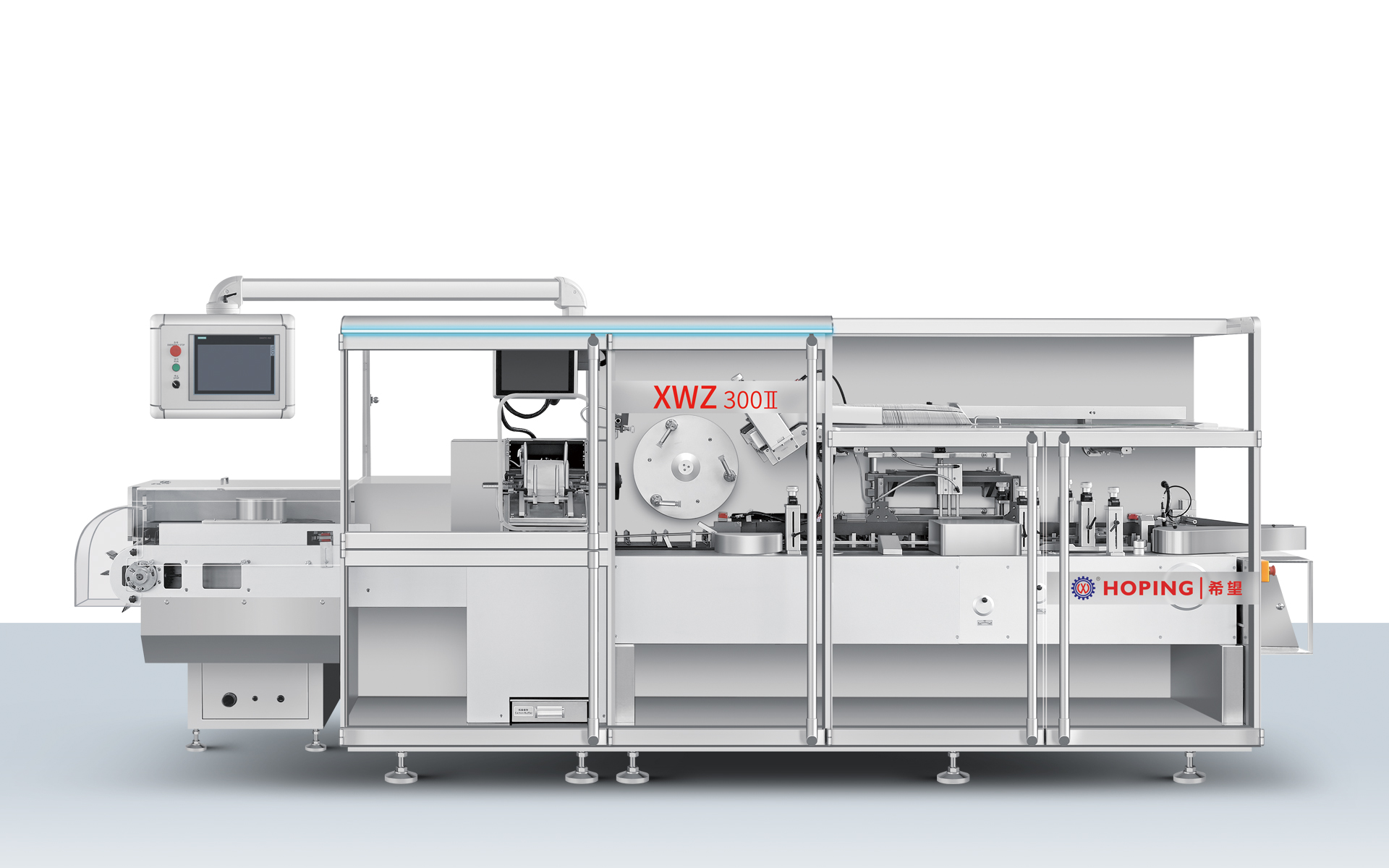
Project fit is the variable that decides whether an integrated line is the right purchase. HOPING defines five recurring project types for this equipment, and each one places different demands on transfer technology, feeding method and downstream scope:
- New solid dosage blister packaging line. A greenfield line where primary and secondary packaging are specified together, so capacity balancing happens at the design stage rather than after installation.
- Existing packaging line upgrade. An installed blister packaging machine or automatic cartoning machine is replaced or linked, with changeover time and manual transfer as the main improvement targets.
- High-capacity expansion. Output requirements exceed what a platen or medium-speed blister packaging machine can deliver, which moves the specification toward roller-type blister machines and high-speed cartoners.
- Intelligent packaging workshop retrofit. Automation and data connection are the drivers, including PLC/HMI operation and ERP/MES data interfaces where the project requires them.
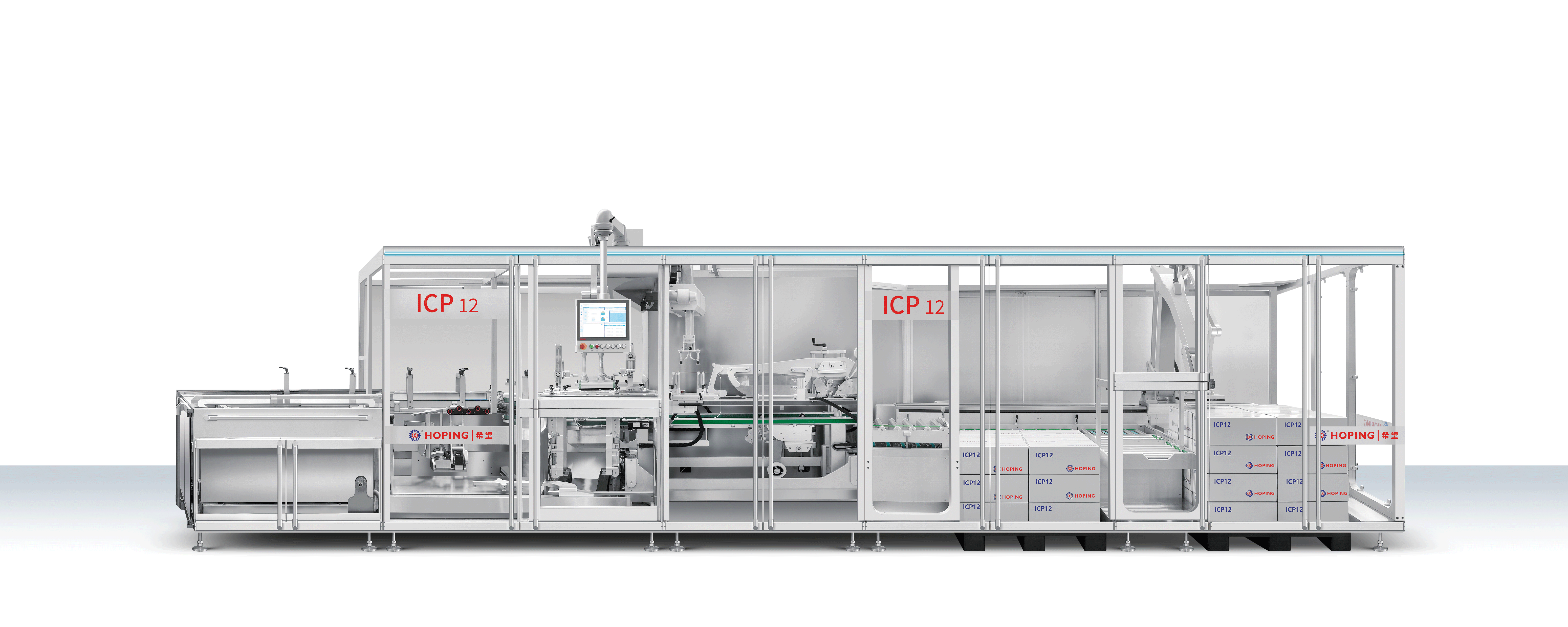
- Downstream integration. The line is extended to blister-cartoning-bundling or blister-cartoning-case-packing configurations using equipment such as the XWK4060 stretch bander, the XWK series case packing machine or the ICP12 case packing and palletizing integral machine.
The operating environment is consistent across these projects. Integrated blister-cartoning lines are designed for GMP-oriented cleanroom or pharmaceutical packaging workshop conditions, continuous high-speed operation and multi-batch, multi-format production. Special requirements typically include cleanability and maintainability, reduced false rejection and downtime where configured, and non-standard customization of capacity, blister format, carton size, leaflet format and downstream connection.
Industry coverage follows the product rather than the sector. Beyond pharmaceutical solid dosage production, the same architecture is applied to nutraceutical and healthcare products, and to food or cosmetic blister-cartoning projects where the format and compliance requirements allow it. One caveat is worth stating plainly: integration is a project decision, not a default. Where volumes are low, formats change constantly, or an existing cartoner already covers secondary packaging, a standalone arrangement can still be the more sensible structure.
Comparing Integrated Blister-Cartoner Models in the DHL Series
Within the HOPING range, five integrated blister-cartoner models cover different capacity tiers. The table below uses the published parameters of each model; the transfer system and control platform are the clearest structural differences between tiers.
| Model | Max blister capacity | Max carton capacity | Blister-to-carton transfer | Product replenishment | Control platform | Format change |
|---|---|---|---|---|---|---|
| DHL6004 | Up to 600 blisters/min | Up to 400 cartons/min | High-speed transfer and cartoning linkage | Servo-driven independent replenishment | Beckhoff motion controller and CP9315 industrial PC | Convenient mold change |
| DHL7004 | Up to 700 blisters/min | Up to 400 cartons/min | Self-developed IRB24 intelligent transfer robot | Servo-driven independent replenishment | Siemens motion controller and TP900 HMI | Convenient mold change |
| DHL7005H | Up to 700 blisters/min | Up to 500 cartons/min | Self-developed IRB24 intelligent transfer robot | Independent replenishment, full servo drive | Siemens motion controller and TP900 HMI | Mold-change support |
| DHL8005H | Up to 800 blisters/min | Up to 500 cartons/min | D3 intelligent top-loading parallel tracking transfer system | Three-channel servo-driven independent replenishment | Beckhoff motion controller and CP9315 industrial PC | Mold change and preset memory |
| DHL1000/5H | Up to 1000 blisters/min | Up to 500 cartons/min | D3 intelligent top-loading parallel tracking transfer system | Four-channel servo-driven independent replenishment | Beckhoff motion controller and high-bus industrial control system | Mold change and recipe memory |
All five models are described as GMP-oriented designs with PVC/Alu foil auto splicing where applicable. Capacities in the table are rated maximum values: real output depends on blister format, carton configuration, product characteristics and how the line is configured upstream and downstream.
FAQ: Automatic Blister-Cartoning Lines in Practice
Which standards and compliance requirements apply to an automatic blister-cartoning line?
Two frameworks shape the equipment itself. ISO 15378 integrates GMP requirements for primary packaging materials, which is why blister forming, sealing and product-contact components are designed around cleanability, material selection and documentation. In the European Union, pharmaceutical packaging equipment safety is governed by the Machinery Directive 2006/42/EC together with the EN 415 series of standards for packaging machines, which is reflected in transparent guarding and interlocked safety enclosures on integrated lines. The DHL series is described as GMP-oriented line design, with stainless steel and aluminum-alloy structures and product-contact parts and tooling specified according to the technical agreement. Zhejiang Hoping Machinery is also listed with CE and ISO 9001/14001 certifications. In practice, compliance is a design input rather than an accessory: it determines materials, guarding, cleaning access and the documentation that accompanies the line.
How fast is an integrated blister-cartoning line, and how are blister and carton speeds matched?
Capacity is published as two simultaneous figures because the line has two outputs to balance. The DHL8005H is rated for up to 800 blisters/min and 500 cartons/min; the DHL1000/5H reaches up to 1000 blisters/min and 500 cartons/min; the DHL7005H up to 700 blisters/min and 500 cartons/min; and the DHL6004 up to 600 blisters/min and 400 cartons/min. The relationship between the two numbers depends on how many blister boards each carton contains. Matching is achieved in three ways: a servo-driven transfer that decouples blister supply from cartoner demand, independent replenishment channels that keep the filling station supplied at speed (three channels on the DHL8005H, four on the DHL1000/5H), and PVC/Alu foil auto splicing so that a material roll change does not stop the process. These are rated maximum values; actual output depends on blister format, carton configuration and product characteristics.
What determines the cost and scope of an integrated blister-cartoning line?
Because solid dosage formats differ, no single configuration fits every project, and scope — which is what drives cost — is set by defined choices: blister size and materials, number of blisters per carton, carton specification, leaflet format, feeding method, coding and inspection method, and whether the line connects to downstream bundling, case packing or palletizing equipment. Control-related options such as interface language, electrical component brand and data interface also change the engineering content, and a line that must exchange data with ERP/MES systems carries more integration work than a standalone installation. HOPING configures lines on an ODM/OEM basis against a confirmed technical agreement, with a minimum order quantity of one set or one complete line. The practical budgeting rule is to define the format, the inspection level and the downstream endpoint first — those three decisions remove most of the cost uncertainty before a quotation is prepared.
Can we validate the line with our own product before shipment?
Validation is built into the delivery process rather than treated as a separate service. The documented quality control sequence runs through incoming material inspection, key component inspection, assembly inspection, electrical safety check, no-load trial run, material trial, factory acceptance test (FAT), customer witness acceptance and pre-shipment inspection. Blister and carton tooling is customized to the confirmed product format, so the material trial is run against the buyer's blister design, carton and leaflet rather than a generic sample. For a new solid dosage blister packaging line, a capacity expansion or a workshop retrofit, this is the stage where feeding behavior, sealing parameters and transfer timing are confirmed and where the final format set is verified before shipment.
How should a pharmaceutical packaging machine manufacturer for blister lines be evaluated, and what lead time applies?
Start with the integration question rather than a machine list. A supplier that builds both blister packaging machines and cartoning machines can define the transfer, replenishment and carton sequence as one system; a supplier that only assembles third-party modules will pass interface risk back to the buyer. Useful evaluation criteria include the transfer technology used (for example the D3 top-loading parallel tracking system or an IRB24 intelligent transfer robot), the number of servo replenishment channels, the control platform and its spare-parts availability, mold-change and recipe memory functions, the documented quality control sequence, and the after-sales scope — installation and commissioning, operator and maintenance training, remote support, spare parts supply and process-parameter guidance. On timing, lead time is typically 60–120 days after technical confirmation, with the final figure depending on model, configuration, project complexity and contract terms. If you are evaluating a blister cartoning line for a specific product, the next practical step is to send your blister format, carton and leaflet specifications for a configuration review, request a sample trial, or download the HOPING Machinery catalog to compare the full model range before shortlisting.
Conclusion: Integration Is a Process Decision, Not a Machine Label
An automatic blister-cartoning line is understood as a packaging process rather than a single machine: forming, sealing, transfer, cartoning and downstream connection are engineered as one sequence with one control platform, and the equipment exists to eliminate the handover between primary and secondary packaging. Whether that structure is right for a project depends on format stability, target output, cleanroom space, inspection requirements and the downstream endpoint.
For projects that do require it, the DHL series illustrates how the category scales — from the DHL6004 at up to 600 blisters/min and 400 cartons/min to the DHL1000/5H at up to 1000 blisters/min and 500 cartons/min, with the DHL8005H positioned at 800 blisters/min and 500 cartons/min and using a D3 top-loading parallel tracking transfer system, three-channel servo-driven independent replenishment and a Beckhoff motion controller with CP9315 industrial PC. Each tier shares the same GMP-oriented design logic and the same dependency on confirmed format data, tooling and documentation.
Next Step: Check the Line Against Your Format
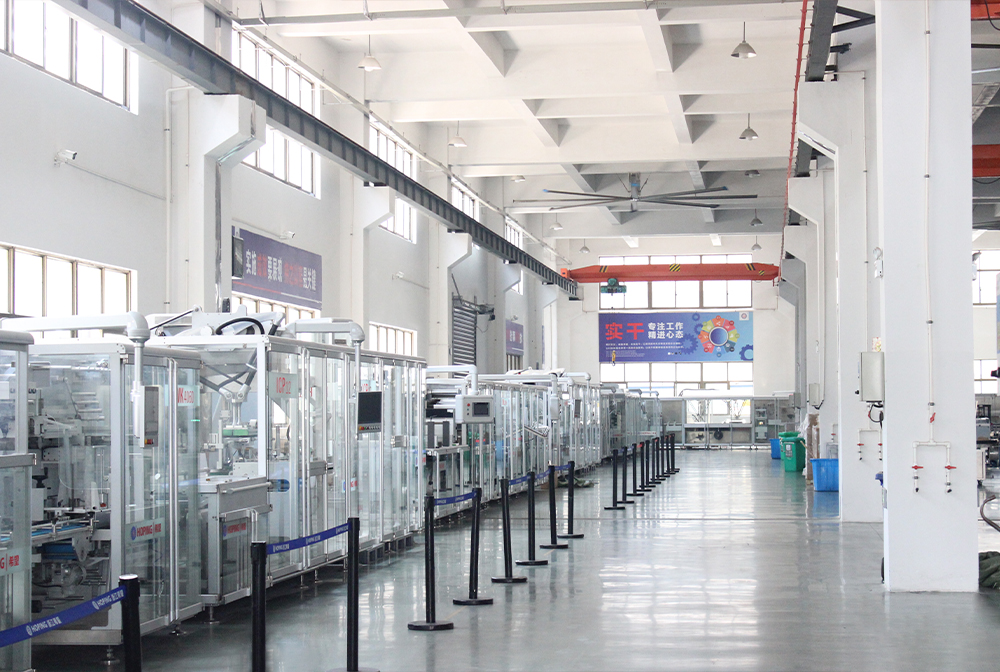
Send your blister format, carton size and leaflet specification, and the HOPING engineering team will review the configuration that fits your project — from a single automatic blister-cartoning machine to a turnkey pharmaceutical packaging line with bundling, case packing and palletizing.
Catalog download: Hoping Machinery Catalog (PDF)
Website: www.hopingcn.com
Contact: Monica — monica@xwbj.com · Tel/WhatsApp: +86 133-5610-5292