4V Cordless Tool Supplier Vetting: Capability & Delivery
4V Cordless Tool Supplier Vetting: Capability & Delivery
Vetting a 4V cordless tool supplier is a two-gate test, and both gates have to pass on the same order. Gate one is capability: the quoted range must map, item by item, to the formats you actually intend to buy — 4V cordless tool sets, bits sets, screwdriver sets, electric tools, staple guns, folding hex keys, T-handle wrenches and hex keys. Gate two is delivery assurance: those same formats must be producible, inspected and shipped against written terms rather than against a catalogue sentence.
Most supplier evaluations fail at the seam between those two gates. A buyer confirms that a supplier "does 4V tools and staple guns", approves the supplier, and then discovers that the tool set is assembled from bought-in accessories, that a certificate covers one staple gun model rather than the family, or that the monthly capacity figure quoted in the meeting is a company total with no format-level schedule behind it. None of those problems is visible on a factory tour, and none of them is a lie — they are simply different claims being treated as the same claim.
HOTAK PRO TOOLS is a 4V cordless tool brand whose manufacturing base, Ningbo (Yinzhou) Yongjia Electrical Tools Co., Ltd., has operated in Ningbo, Zhejiang Province since 2000, producing hex keys, staple guns, precision screwdrivers, bit sets, hobby knives and hand tool sets across a 45,000 m² facility with an annual output of 18,000,000 units and a 95% export ratio. This article uses that supplier's published capability, certification and purchasing facts as a worked example of how the two-gate test is applied — and where the evidence stops short.
Why capability claims and delivery claims are usually the same sentence
A 4V cordless tool programme is not one product. It is a small portfolio with three different evidence profiles sitting inside it, and a single quotation line flattens all three.
- Bundled formats. A 4V cordless tool kit or compact cordless DIY tool kit is a bundle: a driver or rotary unit plus bits, sockets or accessories. Its capability question is not only "can you make the tool" but "can you hold the contents list stable from order to order", because the kit is defined by its bill of contents.
- Machinery formats. A cordless staple gun — including a 5-in-1 cordless power staple gun or a 2-in-1 cordless power staple gun — is treated differently from a hand tool in most export markets. It requires a technical file, a declared standard and a certificate whose scope names the model.
- Hand-tool formats. Folding hex keys, T-handle wrenches and hex keys are governed by dimensional and material expectations rather than by motor safety. Their capability question is material and tolerance control: CR-V versus 45# steel changes the torque tier and the application the product suits.
On the delivery side, the same flattening happens. A monthly capacity figure, a lead-time band and an MOQ threshold are all company-level statements. They become useful only when attached to a specific format and a specific order quantity. A buyer who accepts them without that attachment has approved a supplier, not a supply plan.
What the 4V segment looks like to a buyer in 2026
Low-voltage cordless tools are not a marginal category. Market segmentation published by Market.us classifies low-voltage cordless tools below 12V — the group that includes 4V and 3.7V platforms — as primary segments for DIY and light-duty household tasks. That framing matters for procurement because it explains why the same buyer may need both a 4V cordless screwdriver for electronics repair and furniture assembly and a 3.7V or 4V cordless staple gun for upholstery and fastening work in the same purchase cycle.
The fastening side has its own demand base. Maximize Market Research valued the global staple gun market at USD 1.54 billion in 2024, with a forecast CAGR of 3.13% through 2032. Buyers do not need that figure to negotiate, but it explains why staple gun ranges are crowded and why suppliers quote staple guns readily while their evidence for a specific model is thinner than the quote implies.
Trade classification is the third piece of background. HS Code 846729 — "tools for working in the hand, with self-contained electric motors, others" — is the standard classification for most cordless screwdrivers and specialty 4V tools, according to Descartes Datamyne trade records. Getting the classification right early prevents a documentation mismatch later, particularly when a single shipment mixes a cased tool kit with separately packed hex keys and a staple gun.
The evaluation model: two gates, five layers
The framework below converts a vague "supplier assessment" into five layers that produce documents rather than impressions. Three layers sit under the capability gate and two under the delivery gate.
- Format coverage audit — does every quoted format exist as a real, itemised product?
- Platform and customization scope — is the configuration you need standard, optional, or newly engineered?
- Certificate scope mapping — does the evidence name your model, or only the family?
- Production and QC assurance — which inspections happen, at which gates, with what record?
- Order execution assurance — capacity, lead time, MOQ, acceptance criteria, terms and after-sales support.
Layer 1 — Format coverage: ask for a matrix, not a category
A supplier that answers "yes, we do 4V cordless tools" has answered a marketing question. The evaluation question is whether each intended format has a named counterpart. The practical request is a one-page matrix with a product name and model for every line: the 4V cordless tool set and compact cordless tool kit options, the bits sets and screwdriver bits kits, the precision screwdriver set and 4V cordless screwdriver variants, the electric tools in scope, the staple gun models, and the folding hex key, T-handle wrench and hex key lines.
Two details in that matrix carry disproportionate weight. First, whether bundled kits and individual tools are both offered, because a buyer planning a 4V cordless tool kit programme and a buyer replenishing individual 4V cordless screwdrivers are buying different things from the same factory. Second, whether the accessory formats are produced in-house or consolidated. The distinction is not a quality judgement by itself, but it changes which questions a buyer must ask about consistency of contents across repeat orders.
Material specification belongs in this layer as well, not in sales conversation. For hex keys, CR-V (chrome-vanadium) steel is specified for high torque strength with good toughness and wear resistance in industrial, heavy-duty use, while 45# carbon steel is a light-duty household option with limited torque capacity. If the quotation does not state which material tier applies to which SKU, the format matrix is incomplete regardless of how many lines it contains.
The same logic applies to staple guns. Supplied product knowledge distinguishes plastic-bodied staple guns rated for more than 7,000 shots, iron-bodied units rated for more than 15,000 shots, and aluminium-alloy units rated for more than 30,000 shots. Those are product-tier statements, not a promise about any individual unit's life, but they let a buyer check whether the model being quoted matches the duty cycle the end user will actually apply.
Layer 2 — Platform and customization scope: standard, optional, or new
Customization claims need the same treatment as product claims. The supplier in this example provides OEM/ODM production services with customization in color and logo, at an MOQ of 600 units. Read precisely, that statement covers two specific variables — color and logo — and does not by itself describe changes to cell configuration, charging interface, housing tooling or kit contents. A buyer who needs private label 4V cordless tools should therefore confirm three things in writing: which variables are covered by the standard OEM/ODM offer, which require new tooling or engineering review, and how the MOQ of 600 units interacts with a customized line.
Platform consistency is the second half of this layer. Where a range spans a 4V rotary tool kit, a 4V cordless screwdriver and a cordless staple gun, the buyer needs to know which accessories cross-fit, which charging interfaces are used, and whether a USB Type-C cordless screwdriver format is documented on the specification sheet or only mentioned verbally. The questions are factual, and the answers belong in the quotation annex rather than in a meeting note.
Engineering depth is a supporting signal rather than a substitute for the matrix. This manufacturer maintains a 25-engineer R&D team and holds 7 invention patents, more than 20 European patents, 50 utility model patents and over 100 design patents, and was accredited as a National High-Tech Enterprise in 2014. Those facts indicate that a customization request has somewhere to go internally; they do not confirm that any specific request has been engineered, quoted or validated.
Layer 3 — Certificate scope: read what the certificate covers
Certificate presence and certificate coverage are different findings, and conflating them is the most common compliance error in 4V supplier evaluation. A valid certificate that names one model does not extend to the rest of the catalogue.
In this supplier's documentation, three certificates illustrate the point:
- CE Certificate of Conformity, Machinery Directive 2006/42/EC, certificate number AM 50559365 0001, issued by TÜV Rheinland LGA Products GmbH, issued 10 September 2022 and valid to 31 December 2030, cited against EN ISO 12100:2010 and EN ISO 11148-13:2018 — with scope limited to the 5 IN 1 CORDLESS POWER STAPLE GUN, model YJSG-501.
- CE Certificate of Conformity, Machinery Directive 2006/42/EC, certificate number AM 50694538 0001, also from TÜV Rheinland LGA Products GmbH, issued 2 March 2026 and valid to 31 December 2030, covering the staple gun (hand-operated tacker) models YJSG-105 and YJSG-023.
- GS Product Safety Certificate, certificate number S 50694620 0001, issued 18 March 2026 and valid to 17 March 2031, against DIN ISO 2936-10.16 and AfPS GS 2019:01 PAK, covering hexagon screw keys with ball end in models 105221K1, 105221K2, 105221K3, 71821D1, 71821D2 and 71821D3.
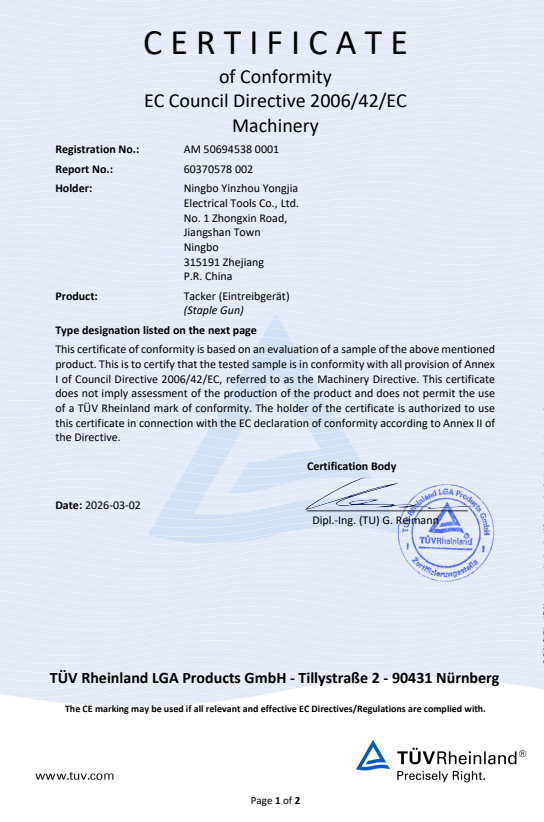
Three practical rules follow. First, match the model number on the purchase order to the model number in the certificate scope, and treat a mismatch as an open item rather than a clerical detail. Second, check validity dates against the shipment date, not against the date of the enquiry. Third, note that a hex key certificate does not support a screwdriver, and a staple gun certificate does not support a rotary tool: the correct question is always "which document covers this specific model in this specific market".
Market-specific expectations go beyond mechanical safety. Common areas buyers raise are mechanical safety, electrical safety and chemical restrictions — for example CE/EMC and RoHS for many markets — and the appropriate action is to request the certificates that match the target market and cross-check the product model against the standard numbers on the document. Country-specific requirements differ, and a supplier document set should be verified for the destination rather than assumed.
Layer 4 — Production and QC assurance: name the gates
Quality control is only assessable when it is described as a sequence rather than an adjective. The documented control points here are incoming inspection, in-process inspection and final inspection. For an evaluation, each gate should be tied to a record: what is checked on incoming components, what is measured in process and at which stage, and what constitutes a final inspection pass for a completed tool set or staple gun.
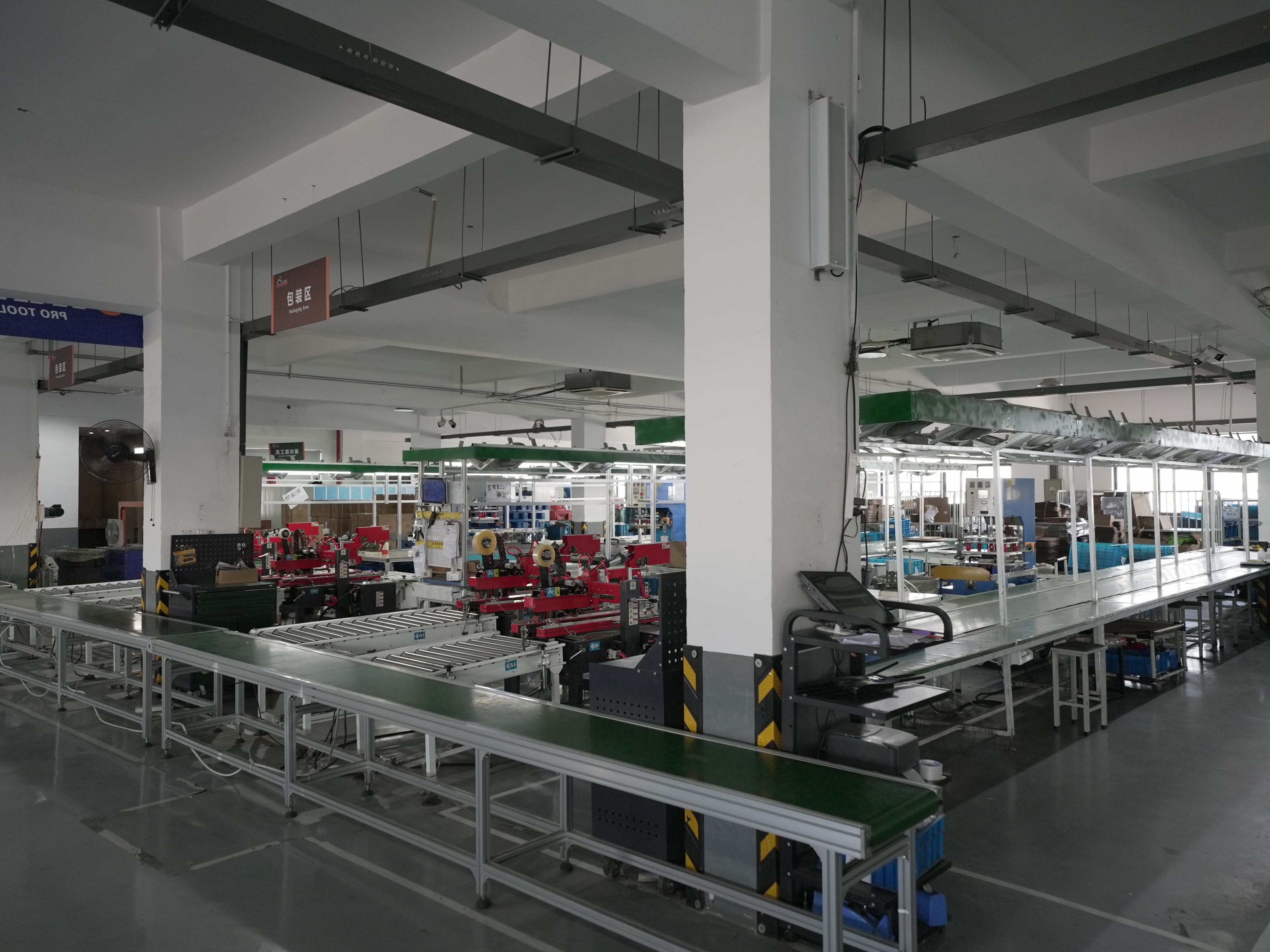
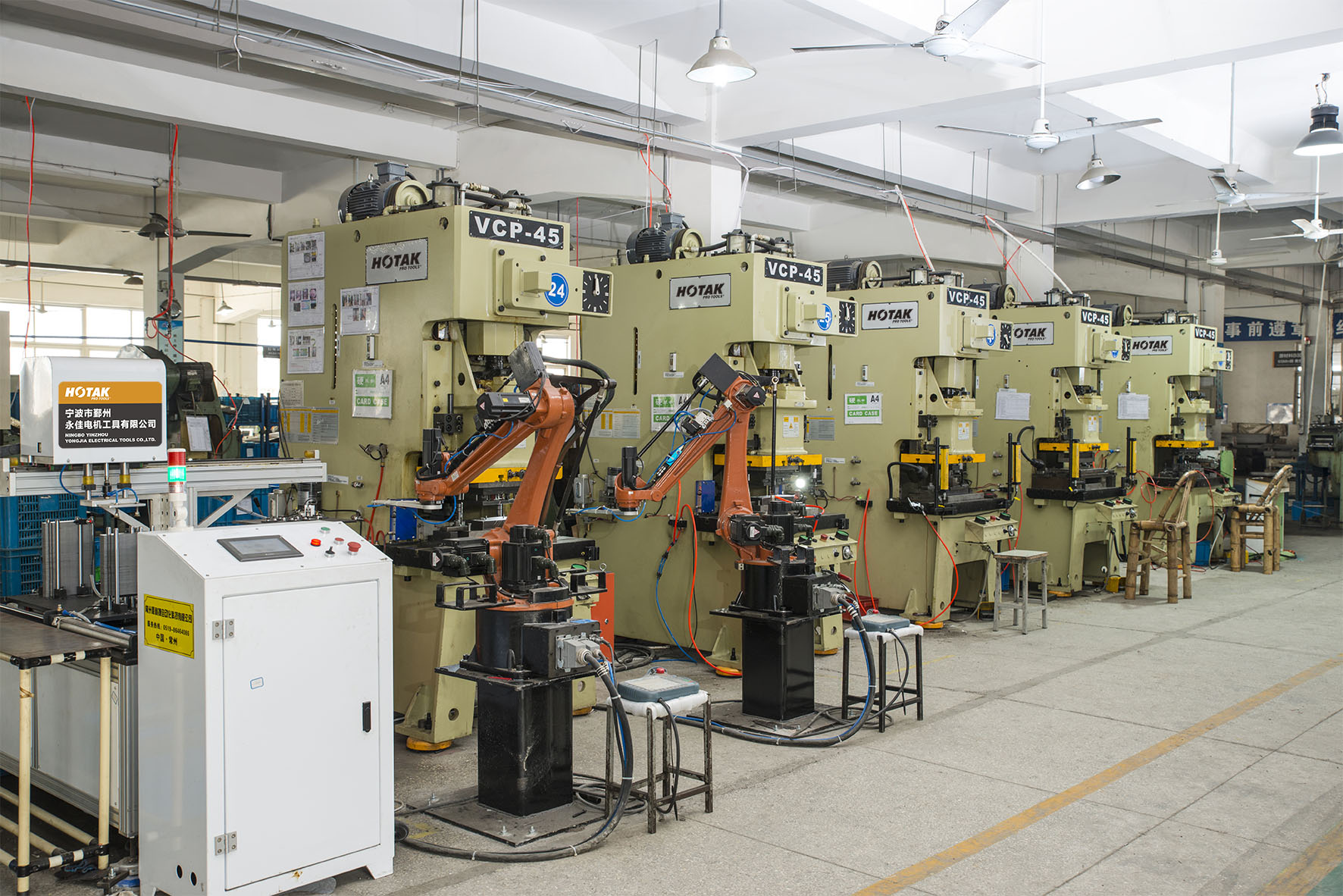
Manufacturing integration is the second signal. A production chain that runs from mould development, forging and stamping through heat treatment, surface finishing, precision machining, assembly and packaging supports format coverage because the supplier is not dependent on external parties for core steps. A buyer can convert that into a specific question: for the formats in the matrix, which process steps are performed on site and which are outsourced?
Layer 5 — Order execution assurance: the delivery gate
Delivery assurance is a set of documented commitments, not a feeling about the factory. The published commercial parameters for this supplier are specific and can be used as a template for what to demand from any candidate.
- Monthly capacity: 1,500,000 units. This is a company-level figure; ask how much of it is allocated to your format family and what the format-level weekly output is.
- Lead time: 30–45 days. Confirm whether the band starts at order confirmation, at artwork approval, or at deposit receipt, and whether it applies to standard or customized production.
- MOQ: 600 units. Confirm whether the threshold is per model, per color, or per purchase order.
- Acceptance criteria: pre-shipment test plus third-party inspection, with SGS named as the inspection body.
- Delivery terms: FOB Shanghai or Ningbo.
- Payment terms: 30% T/T in advance, 70% T/T against copy of B/L.
- After-sales: remote support, with no on-site service scope stated.
Each of those items converts into a delivery-assurance check. Capacity becomes a capacity reservation question. Lead time becomes a schedule with a defined start point and a defined milestone for pre-shipment inspection. Acceptance criteria become an annex listing the tests performed, not a promise that testing happens. Payment terms determine when the third-party inspection must be booked so that the inspection report is available before the balance payment is released. After-sales scope determines what the buyer must resource locally.
An eight-step vetting sequence for tool sets and staple guns
The sequence below orders the five layers into a workflow a buyer can run before a purchase order is issued. It is designed so that each step produces a document that the next step depends on.
- Lock the format list. Write down every format you intend to buy — 4V cordless tool set, bits set, screwdriver set, electric tools, staple gun, folding hex keys, T-handle wrenches, hex keys — with quantities and target markets.
- Request the model-level matrix. Require a product name and model for each line, and mark any line the supplier cannot name as unconfirmed rather than assuming it is covered.
- Classify each format by evidence type. Separate bundled kits, machinery (cordless staple guns) and hand tools, because each needs a different document set.
- Map certificates to models. Match certificate scope, certificate number, issuing body, issue date and expiry date against the exact models on the order.
- Define the customization boundary. Confirm in writing what color and logo customization covers, what requires engineering review, and how MOQ applies to customized lines.
- Fix the QC and acceptance annex. Name the inspection gates, the pre-shipment test content and the third-party inspection body before pricing is finalised.
- Convert lead time into a milestone schedule. Anchor the 30–45 day band to a start event and place the inspection and shipping milestones on the calendar.
- Reconcile commercial terms. Confirm MOQ, FOB port, payment split and after-sales scope, then re-read the capability matrix once more against the final order — this is where scope creep usually appears.
Three buyer situations where this framework changes the decision
1. A retail chain building a 4V cordless tool kit programme
A chain assembling a private label 4V cordless tool kit line has a contents problem more than a tool problem: the kit must ship with the same contents and the same presentation across repeat orders. The framework's value here is step two and step five — a model-level matrix plus a written customization boundary. Without them, the buyer discovers the contents variance at the first repeat order, when the packaging and the shelf plan are already committed.
2. A hardware wholesaler replenishing staple guns
A wholesaler restocking cordless staple guns for upholstery and light fastening work needs the certificate scope to match the models being sold. Because the supplied CE documents cover the 5-in-1 cordless power staple gun YJSG-501 and the hand-operated tacker models YJSG-105 and YJSG-023 separately, the wholesaler can build a compliant line only by ordering the named models — or by asking the supplier which document covers any additional model. Duty tier matters as well: plastic, iron and aluminium-alloy bodies correspond to different rated shot thresholds, so the model mix should follow the end-user segment rather than price alone.
3. A brand owner sourcing a mixed consignment
A brand owner ordering tool sets alongside hex keys and T-handle wrenches faces a documentation problem: one consignment, several evidence types, one HS classification decision. The supplied case records describe orders of 5,000–50,000 units per order from brand owners, hardware wholesalers and retail chains in markets including Germany, France, the United States, Canada, Mexico, Brazil, Argentina and Malaysia, with relationships running three to five years and reported reliable performance, low return rate and consistent quality. Those records describe a pattern of repeat business; they are not a guarantee that a new buyer's first order will follow the same path, which is precisely why the acceptance annex in step six should be agreed before the first shipment rather than after it.
Format-by-format verification matrix
| Format | What to verify on the quote | Evidence to request | Delivery check |
|---|---|---|---|
| 4V cordless tool set / compact cordless tool kit | Exact contents list per kit and whether individual tools are also offered | Model-level matrix plus packaging specification | Contents freeze across repeat orders; MOQ per kit configuration |
| Bits sets and screwdriver bits kits | Material and tolerance tier; whether bundled or standalone SKU | Specification sheet with material designation | Consistency of contents between production runs |
| 4V cordless screwdriver and precision screwdriver set | Speed settings, charging interface as documented, intended application | Product specification and label artwork | Lead-time start point for customized housings or logos |
| Electric tools in scope (e.g. precision rotary tool) | Which models are currently offered rather than planned | Model list and any applicable safety documentation | Format-level output allocation within stated monthly capacity |
| Cordless staple guns (incl. 5-in-1 and hand-operated tacker) | Model number against certificate scope; body material and rated shot tier | CE certificate with scope, number, issuing body and expiry | Inspection milestone booked before balance payment |
| Folding hex keys, T-handle wrenches, hex keys | Steel grade (CR-V vs 45#) and dimensional standard per SKU | GS certificate scope where applicable; dimensional declaration | Mixed-consignment packing and HS classification alignment |
What this framework cannot tell you
Three limits should be stated plainly, because a vetting framework that pretends to cover everything becomes a substitute for evidence.
First, none of the supplied facts establish pricing. Unit price, tooling cost and the cost effect of customization are not published, and MOQ of 600 units is a threshold rather than a price band. Second, the 30–45 day lead time is a stated operating window; it is not a per-order commitment until it is written into a specific schedule with a defined start event. Third, certification evidence is scope-limited by design — the documents named here cover specific staple gun and hex key models, and no document in the supplied evidence covers a rotary tool, a screwdriver or a tool set as a bundle. Buyers should also note that after-sales support is described as remote support, which shifts part of the service burden to the buyer's own market.
One further caution concerns data granularity. Public segmentation places 4V and 3.7V platforms inside a below-12V low-voltage group; that is useful for understanding demand, but it does not provide unit sales for the 4V category, and no supplier-level 4V capacity benchmark is publicly available. Capability claims therefore have to be tested against the supplier's own documents rather than against a market average.
Frequently asked questions
Which certificates should a 4V cordless tool supplier show, and what do they actually cover?
A supplier should show certificates whose scope names the exact models you are buying, in the markets you are selling into. In this supplier's documentation, CE certificate AM 50559365 0001 from TÜV Rheinland LGA Products GmbH covers the 5 IN 1 CORDLESS POWER STAPLE GUN model YJSG-501 under Machinery Directive 2006/42/EC, with EN ISO 12100:2010 and EN ISO 11148-13:2018 cited and validity to 31 December 2030; CE certificate AM 50694538 0001 covers the hand-operated tacker models YJSG-105 and YJSG-023, valid to 31 December 2030; and GS certificate S 50694620 0001 covers hexagon screw keys with ball end in models 105221K1 to 71821D3 under DIN ISO 2936-10.16 and AfPS GS 2019:01 PAK, valid to 17 March 2031. Certificates that name a family rather than a model, or that have expired before the shipment date, should be treated as open items.
How do I confirm that a supplier's quoted 4V capability matches the actual tool set and staple gun range?
Ask for a model-level matrix rather than a category confirmation. Every intended format — 4V cordless tool set, bits set, screwdriver set, electric tools, staple gun, folding hex keys, T-handle wrenches and hex keys — should have a product name and model attached, and any line without a model should be recorded as unconfirmed. Then check the material and performance tiers: CR-V steel is specified for high-torque, heavy-duty hex key use while 45# carbon steel is a light-duty household option; plastic, iron and aluminium-alloy staple gun bodies are rated for more than 7,000, more than 15,000 and more than 30,000 shots respectively. A matrix that survives those checks describes a range; a matrix that does not describes an intention.
What should I check about MOQ and cost before committing to an order?
The published MOQ for this supplier is 600 units, and unit pricing is not part of the public information, so cost has to come from a written quotation. Two clarifications matter more than the number itself: whether the 600-unit threshold applies per model, per color or per purchase order, and whether customized color and logo work changes it. Delivery terms are FOB Shanghai or Ningbo, and payment terms are 30% T/T in advance with 70% T/T against copy of B/L, so the quotation should be read together with the inspection arrangement — the balance release point is where cost and risk meet.
Can I validate a supplier with samples or a pilot order before a full run?
Sampling arrangements are not specified in the published commercial terms, so they must be agreed case by case rather than assumed. What is documented is the acceptance route for production: a pre-shipment test plus third-party inspection, with SGS named as the inspection body. A buyer using a pilot order to validate a supplier should therefore attach the same acceptance annex used for volume production — inspection gates, pre-shipment test content and the third-party inspection scope — so that the pilot produces comparable evidence rather than an informal impression.
What lead time and capacity should I verify for delivery assurance?
Verify both as format-specific commitments rather than company totals. This supplier states a 30–45 day lead time and a monthly capacity of 1,500,000 units, supported by a 45,000 m² facility, 18,000,000 units of annual output and a quality system covering incoming, in-process and final inspection. Ask three follow-up questions: how much of the monthly capacity is allocated to your format family, whether the lead-time band starts at order confirmation, artwork approval or deposit, and whether customized color and logo work adds a separate stage. Supplied case records of 5,000–50,000 units per order with three-to-five-year relationships indicate repeat-order experience; they do not replace a schedule written for your own order.
Where can I get the full product and capability documentation?
The complete range — tool sets, bits sets, screwdriver sets, electric tools, staple guns, folding hex keys, T-handle wrenches and hex keys — is documented in the supplier's catalogue, which can be downloaded here. Buyers working through the two-gate test described in this article can use the catalogue to build the format matrix for step two, then request model-level certificates and a written quotation to complete the remaining steps before committing to a purchase order.
Conclusion: approve a supplier and a supply plan, not a quotation
The useful outcome of a 4V cordless tool supplier evaluation is two approved documents, not one. The first is a format matrix that names every model you intend to buy across tool sets, bits sets, screwdriver sets, electric tools, staple guns, folding hex keys, T-handle wrenches and hex keys, with material tiers and certificate scope matched to each line. The second is a delivery plan that attaches capacity, lead time, MOQ, inspection gates and acceptance criteria to those specific formats.
Applied to HOTAK PRO TOOLS, the supplied evidence answers a defined set of questions and leaves others open. It confirms OEM/ODM production with color and logo customization, a 600-unit MOQ, a 30–45 day lead time, 1,500,000 units of monthly capacity and a three-gate inspection sequence; it confirms model-scoped CE coverage for the YJSG-501 5-in-1 cordless power staple gun and for the YJSG-105 and YJSG-023 hand-operated tackers, plus GS coverage for ball-end hexagon screw keys; and it leaves unit pricing, per-format capacity allocation and non-remote after-sales scope to be agreed in the order documents. That split between what is proven and what must be contracted is exactly the output a buyer should expect from a serious evaluation — and it is the point at which a supplier conversation should turn into a written schedule.
Have Questions or Need More Details?
Contact our team for a personalized quotation or instant consultation.
Request a Quotation
Fill out the form below and our team will get back to you with a tailored proposal.
WhatsApp Direct Chat
Prefer to chat in real-time? Message us on WhatsApp for instant assistance & quick answers.
- Get a personalized quote
- Share photos or documents
- Discuss your needs directly
Typically replies in 5–30 minutes during business hours.