
4V Cordless Tools for Exhibition Booth Repairs: A Project Site Application Guide
4V cordless tools are compact battery-powered tools used for light fastening, adjustment, trimming, and touch-up work. In an exhibition booth repair setting, the useful question is not whether a tool is 4V, but whether the tool format, bit or staple interface, and access shape match the repair in front of the site team. This guide answers that question for panel fastening, fabric trimming, and fixture adjustment during exhibition and retail display buildouts.
HOTAK PRO TOOLS offers 4V cordless tools and hand tool sets for light assembly and repair. The product data used in this guide includes 3.7V nominal cordless screwdrivers, 3.7V lithium electric nail guns, staple guns, folding hex keys, T-handle wrenches, hex keys, bits sets, and precision screwdriver sets. The official site is www.yj-tools.com.
Problem Definition: Why Booth Repairs Need a Different Tool Kit
Exhibition booth repair work is small in scale but high in consequence. A loose fascia panel, a lifted fabric edge, or a misaligned shelf can be visible to visitors within minutes. The work also happens under time pressure, often after the main build is complete and while other trades are still finishing adjacent stands. In that setting, a general-purpose tool bag is usually too heavy, too slow to access, and too likely to damage finished surfaces.
The four recurring problems in booth and retail display repair are wrong bit fit, uncontrolled fastening, fabric damage, and lost small parts. Wrong bit fit strips screw heads and slows the team. Uncontrolled fastening can crack laminate, crush honeycomb panel skins, or compress soft display board. Fabric damage happens when a staple leg is too long or when a staple is placed without pulling the material taut. Lost small parts happen when bits, sockets, and hex keys are carried loose in a deep bag.
A 4V-class cordless tool kit addresses these problems when it is assembled by task rather than by brand or voltage alone. The kit should cover three task families: panel fastening, fabric trimming, and fixture adjustment. A fourth task family, small precision repair, is useful for lighting trims, sign fixings, and small electronic display components. The rest of this guide maps specific tool formats to those families using product facts from HOTAK PRO TOOLS.
Industry Background: Where 4V and 3.7V Tools Fit
Market research classifies low-voltage cordless tools below 12V, including 4V and 3.7V platforms, as primary segments for DIY and light-duty household tasks (VD-HT-002). That classification matters for booth repair planning because exhibition and retail display touch-up is also light-duty work when the scope is panel fastening, fabric trimming, and fixture adjustment. It is not the same workload as structural steel erection or continuous production fastening.
The global staple gun market was valued at USD 1.54 billion in 2024, with a forecast CAGR of 3.13% through 2032 (VD-HT-003). Staple guns remain a mature fastening format for upholstery, decoration, and light installation work. For booth teams, the practical signal is that staple-gun formats are not niche tools; they are part of the standard light-fastening toolkit and should be planned alongside cordless screwdrivers.
For cross-border buyers, HS Code 846729 is the standard trade classification for hand tools with self-contained electric motors, which includes most cordless screwdrivers and specialty 4V tools (VD-HT-007). That classification is useful when a distributor or event contractor needs to confirm how a mixed tool kit will be declared and shipped. It does not change the site-level advice in this guide, but it helps connect the application guide to procurement reality.
Scope boundary: the guidance in this article covers light-duty exhibition and retail display repair. It does not cover structural fastening, overhead lifting, live electrical work, or tasks that require a certified installer. Where a repair touches electrical systems, structural connections, or fire-rated assemblies, the site team should follow the venue rules and the responsible trade contractor.
Detailed Solution: Match the Tool Format to the Booth Task
The solution is a small, layered kit. Layer one is a 4V-class cordless screwdriver for panel and fixture screws. Layer two is a bits set plus hex keys and a T-handle wrench for drive-type coverage and fixture adjustment. Layer three is a staple gun for fabric and upholstery touch-up, with a manual backup where battery access or precision placement is the constraint. A cordless hot-glue pen can support prop and edge repair, but it should not be treated as a structural fastener.
4V Cordless Screwdriver and Bits Set for Panel Fastening
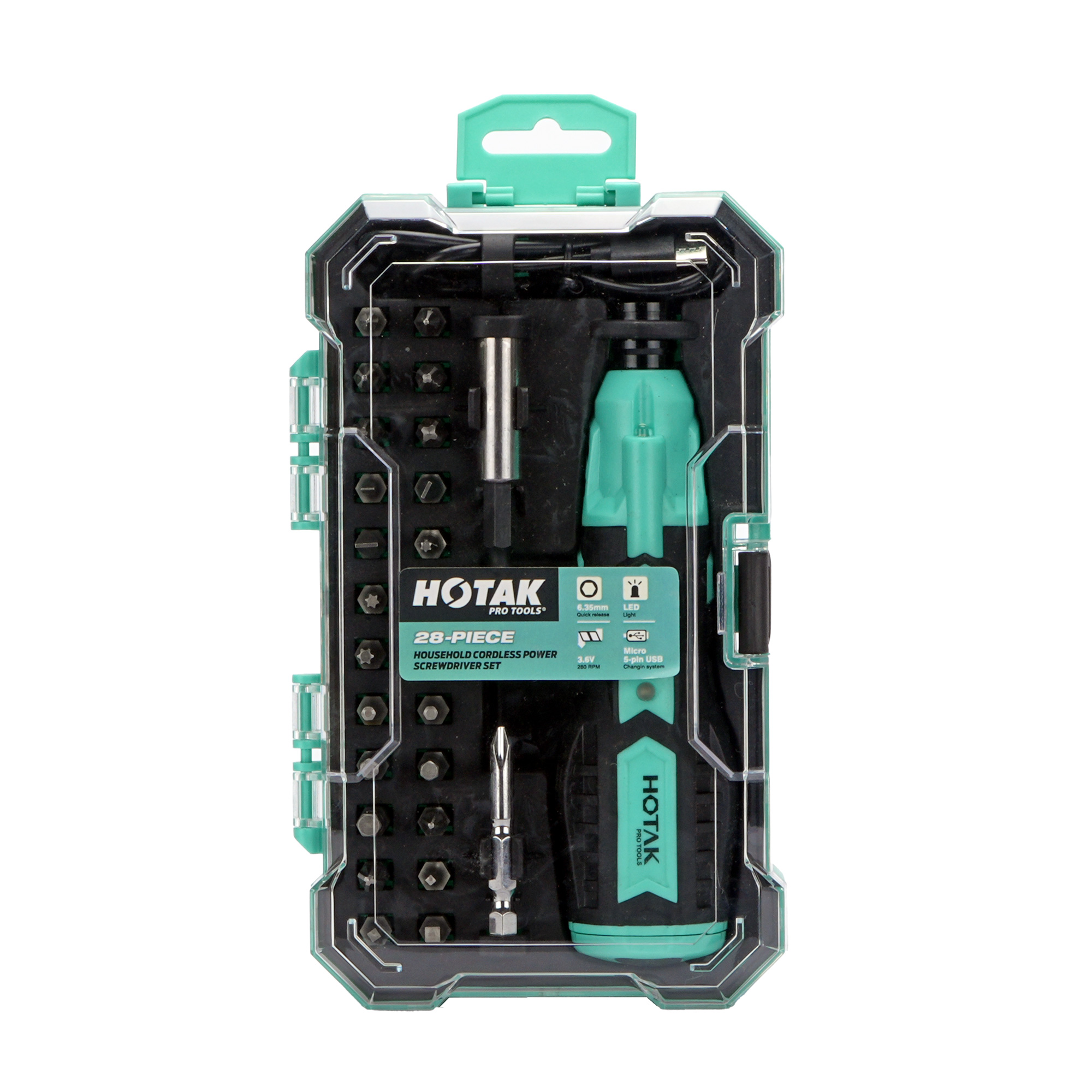
A 4V-class cordless screwdriver is the primary panel-fastening tool in a booth repair kit. HOTAK PRO TOOLS product data lists several 3.7V nominal models with different battery capacity, torque, and speed profiles. The model choice should follow the task: repeated panel screws need a larger battery and a controlled clutch or torque setting; small fixture screws need a lower-torque precision tool.
The YJPS-912 is a power screwdriver set with a 3.7V rated voltage, 800mAh battery capacity, no-load operating time of at least 50 minutes, electric torque of 2.5N, manual torque of 10N.m, output speed of 0-250rpm/min, and charge current of 500mA. It is equipped with LED lights and various types of bits. For booth work, it fits repeated panel fastening and general fixture screws where a compact cordless screwdriver is faster than a hand tool.
The YJPS-902 is a power screwdriver with a 3.7V rated voltage, 2000mAh battery capacity, no-load operating time of at least 60 minutes, electric torque settings of 2N, 3.5N, and 5N, manual torque of 10N.m, output speed of 0-280rpm/min, charge current of 1-1.5A, and charge output voltage of 5V. Its larger battery capacity and multiple electric torque settings make it a practical choice for a full day of booth touch-up where repeated fastening is expected. The 5V charge output also matters when the site team is planning charging logistics.
The YJPS-907 is a 26-piece cordless precision power screwdriver set with a 3.7V lithium battery, 320mAh capacity, no-load speed of 220 r/min, charging time of 1 hour, power torque range of 0.15Nm, and hand torque range of 3N.m. The YJPS-906 is an electric precision repair tools set with a 3.7V rated voltage, 320mAh battery capacity, no-load operating time of at least 30 minutes, electric torque of 0.15N.m, manual torque of 3N.M, output speed of 0-220rpm/min, and LED lights. These lower-torque models are better matched to small fixture screws and precision display components than to long panel runs.
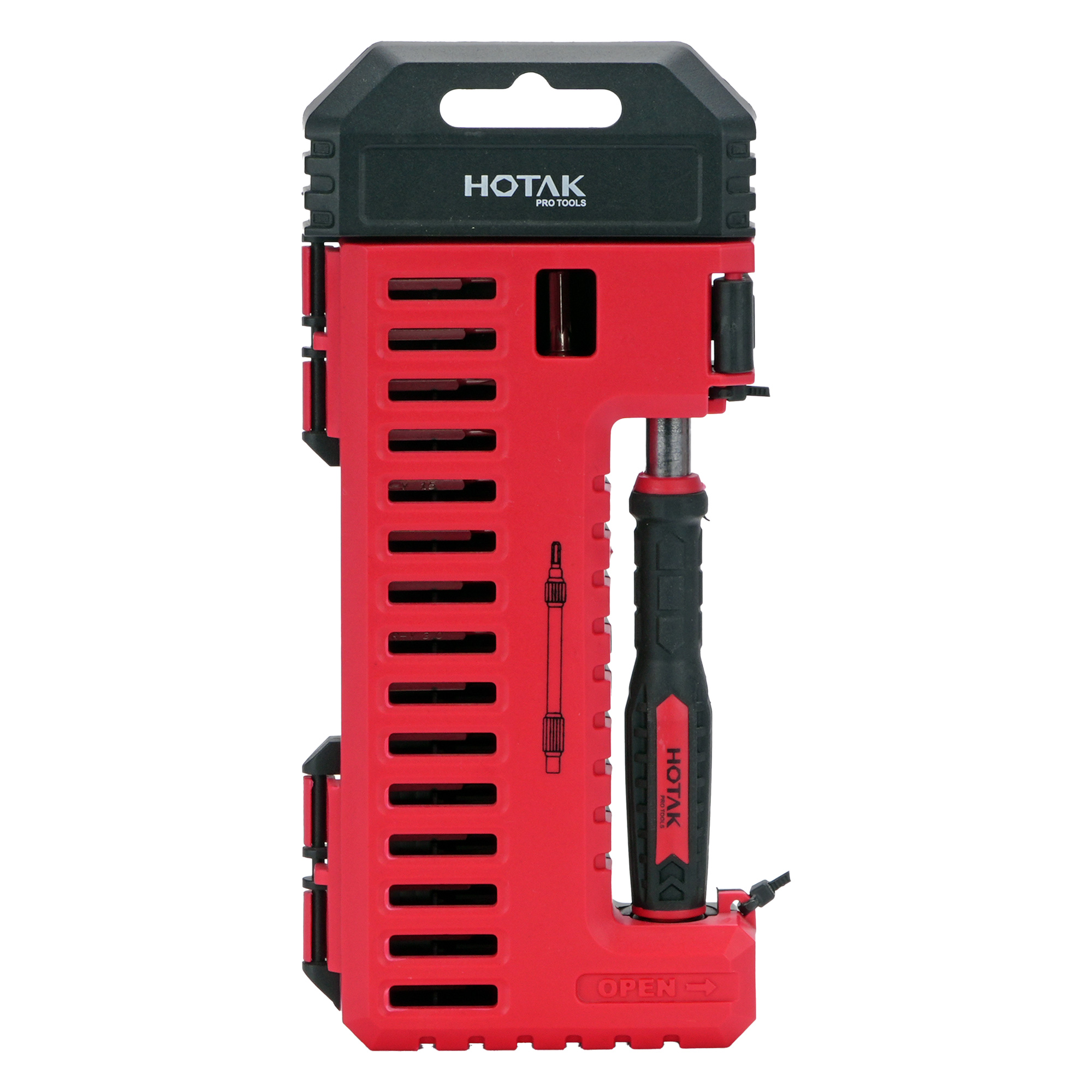
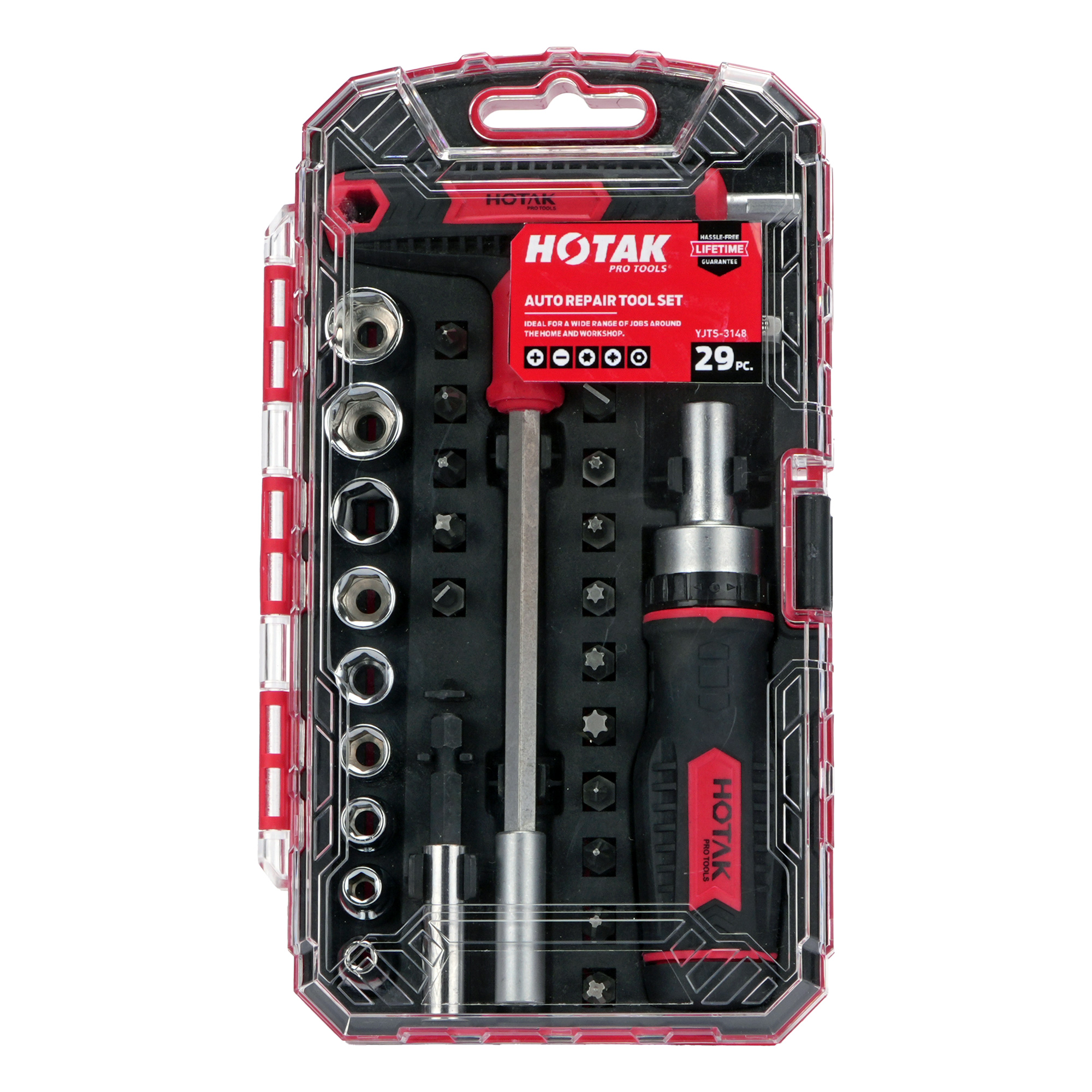
Bit coverage matters as much as the screwdriver. The YJTS-3148 is a 29-piece tool set that includes a T-handle with bits holder, a 1/4 inch x 25mm adaptor, a 1/4 inch x 60mm magnetic extension bar, a mini ratchet screwdriver handle, 16 pieces of 1/4 inch x 25mm CR-V bits, and 9 sockets from 4.0 to 12mm. The bit set covers Phillips PH0-PH3, slotted 4.0-6.0mm, Torx T10-T30, and Pozi PZ0-PZ3. That mix covers most booth panel screws and many display fixture fasteners.
The YJTS-3508 is a 43-piece ratchet screw set kit made of CR-V6150 steel. It includes 36 pieces of 1/4 inch x 25mm bits, covering slotted 3-6mm, Phillips PH0-PH3, Torx T9-T30, tamper-proof Torx TT20-TT30, square S0-S3, hex 2-5mm, Pozi PZ0-PZ3, triangle TA18 and TA27, tri-point Y00 and Y0, and a spanner bit SP6. For a booth kit that must handle mixed display hardware, this broader bit coverage reduces the chance of a site team improvising with the wrong drive type.
The YJPS-6852 is a 17-piece precision screwdriver set with a precision screwdriver, a 5/32 inch x 125mm soft extension bar, and 15 pieces of 5/32 inch x 28mm bits: slotted 1.5-3.0mm, Phillips PH000-PH1, and Torx T4-T10. It is a manual tool, but it is useful for small fixture screws that are too delicate for a cordless screwdriver. The handle features an LED light with two super bright white LEDs providing 360 degrees of light, which helps in dim booth corners.
Staple Gun for Fabric Trimming and Upholstery Touch-Up
Fabric trimming is a different fastening problem. The goal is to hold material taut without cutting through it, puckering the surface, or driving a staple leg into a finished panel. A staple gun with adjustable power and good nose access is more useful than a general-purpose screwdriver for this task.
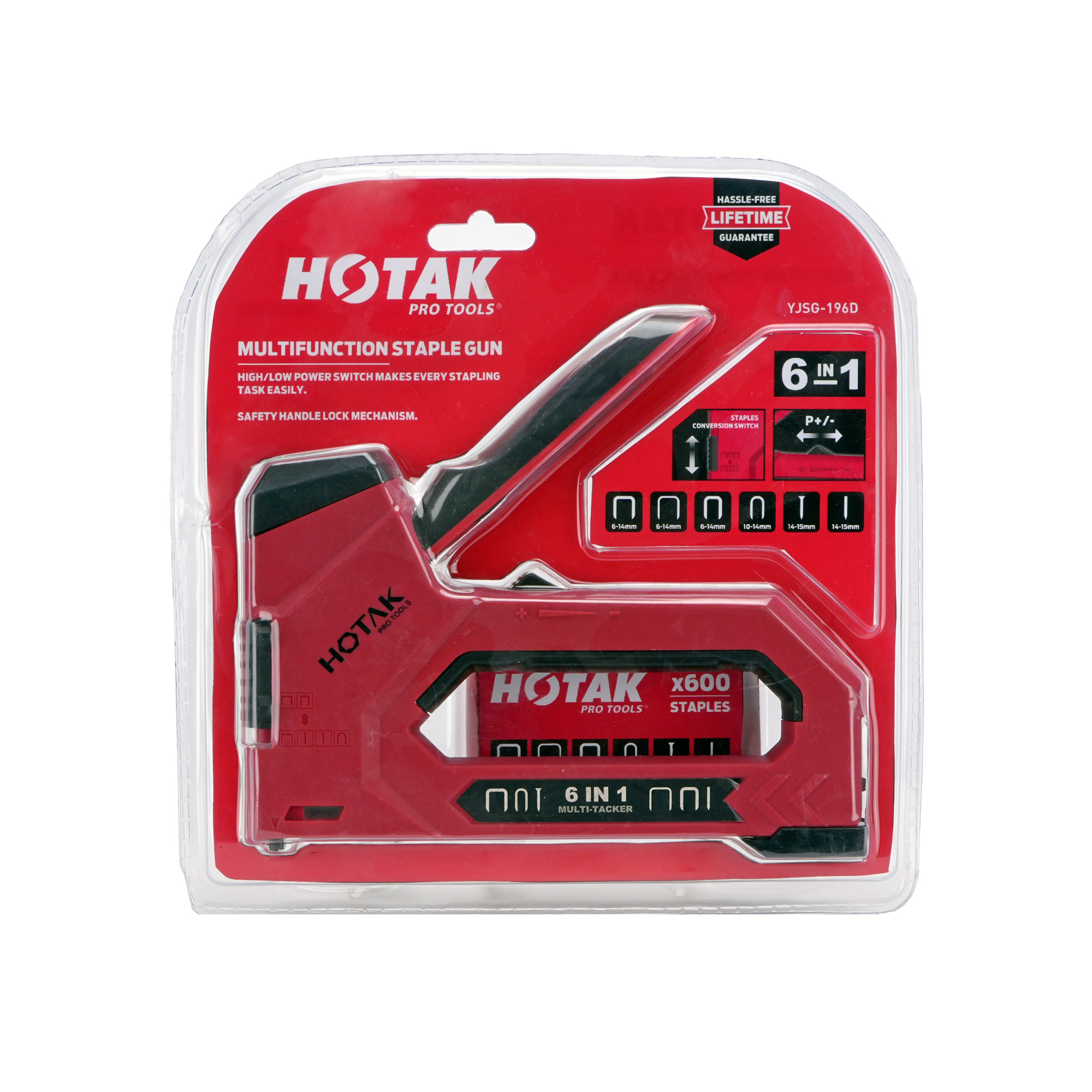
The YJSG-196 is a 6-in-1 staple gun compatible with JT21, T50, T25, T20, and 18GA staples. It features a long nose for reaching recessed areas, a comfortable TPR handle, a safety handle lock, a high and low power switch, and a bottom load design for easy staple loading and jam clearing. The body is made of metal. For booth fabric work, the long nose helps reach inside upholstered panels and behind display fascia, while the high and low power switch allows the operator to match the setting to the material.
The YJSG-215 is a 3-in-1 heavy duty staple gun for flat wire staples 4-14mm, 7.6mm cable staples 10-14mm, and brad nails 10-14mm. It has an all-metal construction and is suitable for low-voltage cables up to 50V, securing frames, and upholstery and decoration work. In a booth site, it is useful for frame assembly and fabric-covered panel repair where a heavier staple is appropriate. Cable staples should only be used for low-voltage cable management within the listed limit; they are not a substitute for electrical installation work.
For cordless fastening, the YJSG-501 is a five-use lithium electric nail gun with a 3.7V rated voltage, 2000mAh battery capacity, and 25W power rating. The YJSG-500 is a two-use lithium electric nail gun with the same 3.7V rated voltage, 2000mAh battery capacity, and 25W power rating. These tools fit repetitive tacking where the site team needs cordless mobility. The manual YJSG-196 remains useful where battery access is limited, where the operator wants precise single-staple placement, or where the material is too delicate for a powered nail gun.
Folding Hex Key, T-Handle Wrench, and Hex Key for Fixture Adjustment
Fixture adjustment is often a hex-key task. Display frames, shelf brackets, modular wall connectors, and lighting trims frequently use socket-head fasteners. A booth kit should include a compact folding hex key for storage and access, a T-handle wrench for controlled torque, and a long-arm ball-point hex key for angled or recessed screws.
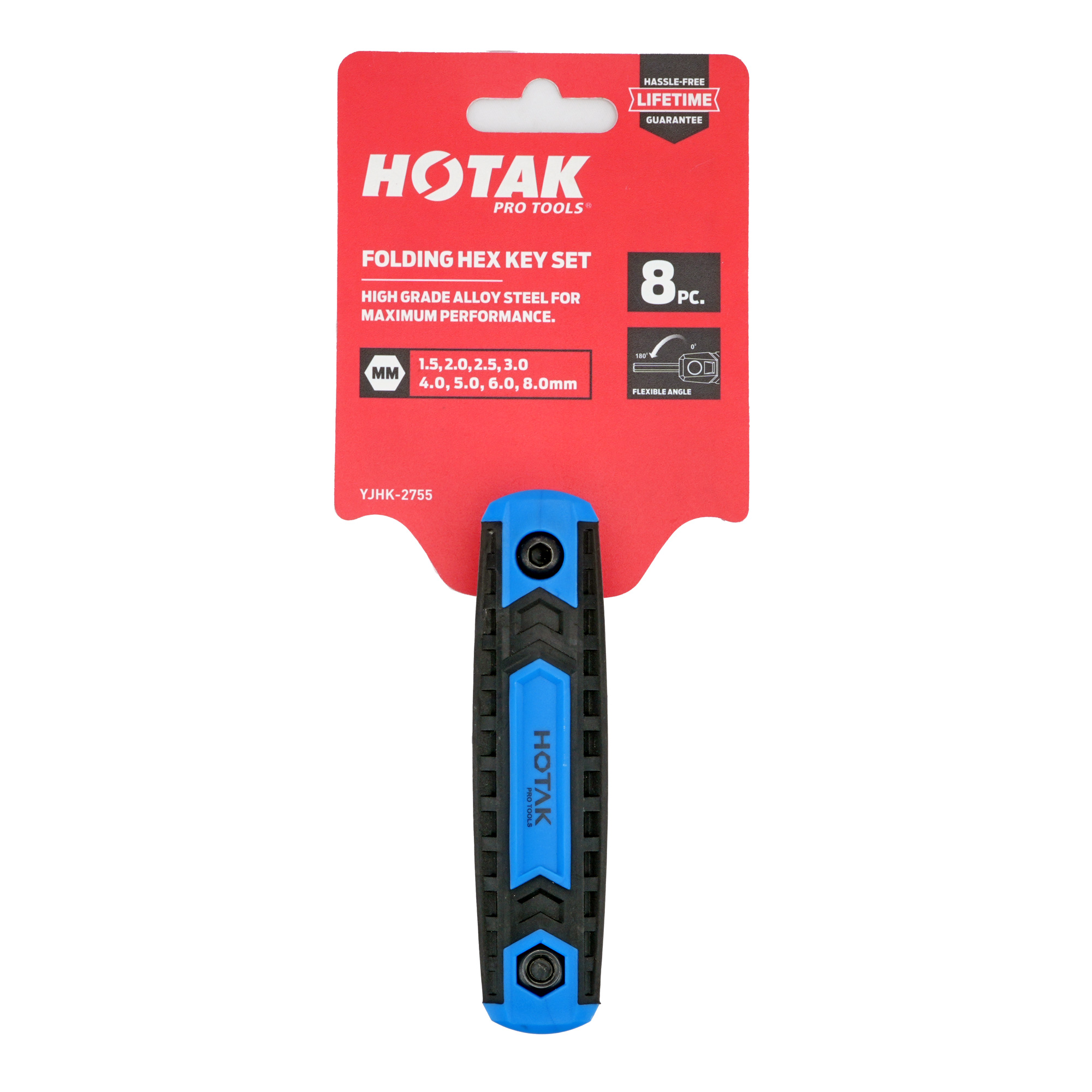
The YJHK-3075 is an 8-piece locking hex key set in metric sizes. It is made of CR-V6150 steel with a hardness of HRC 52-55. The set features a flexible angle for different occasions and a locking mechanism. It is a practical compact option for a site pouch because the folding format keeps the keys together and reduces the chance of losing a size.
The YJHK-3226 is a 14-piece T-handle hex key set in metric and SAE sizes. It is made of CR-V6150 steel with a hardness of HRC 52-55. Torque values range from 1.19N for the 1/16 inch key to 242.92N for the 3/8 inch key. The T-handle is ergonomically designed for greater torque, the tips are chamfered for easy entry into screws and fasteners, and the black finish is described as anti-rust and corrosion resistant. For booth fixture adjustment, the T-handle gives the operator more control than a folding key when a fastener is slightly tight or when the access angle allows a two-handed grip.
The 71821D3 is a 9-piece long arm ball point color hex key set in metric sizes. It is made of CR-V6150 alloy steel, heat-treated and tempered, with a hardness of HRC 52-55. The ball-end works on angles up to 25 degrees. Torque values range from 0.82N for the 1.5mm key to 220N for the 10.0mm key. The keys have size markings for identification, and the surface is rust and corrosion resistant. The long arm and ball point are useful for recessed fixture screws where a straight key cannot reach squarely.
Cordless Hot-Glue Pen for Display Props and Edge Holding
The YJGG-001 is a cordless hot-glue pen with a 3.7V rated voltage, 320mAh battery capacity, 4.2W power rating, and operating time of at least 120 minutes. The glue flow speed is 60 seconds with release in 30 seconds, the operating temperature is 150 degrees Celsius, the charge current is 1-1.5A, and the charge output voltage is 5V. The device is USB Type-C compatible and takes 120 minutes plus or minus 10 minutes to fully charge. It is designed for household applications and is suitable for DIY applications and crafts due to its cordless design and compact size.
In booth work, the hot-glue pen is a support tool for display props, fabric edge holding, and temporary fixture stabilization where adhesive is appropriate. It should not be used as a structural fastener or as a substitute for a mechanical fixing that the booth design requires. A surface compatibility test on a hidden area is advisable before applying adhesive to finished panels or printed fabrics.
Manual Backup Tools for Control and Access
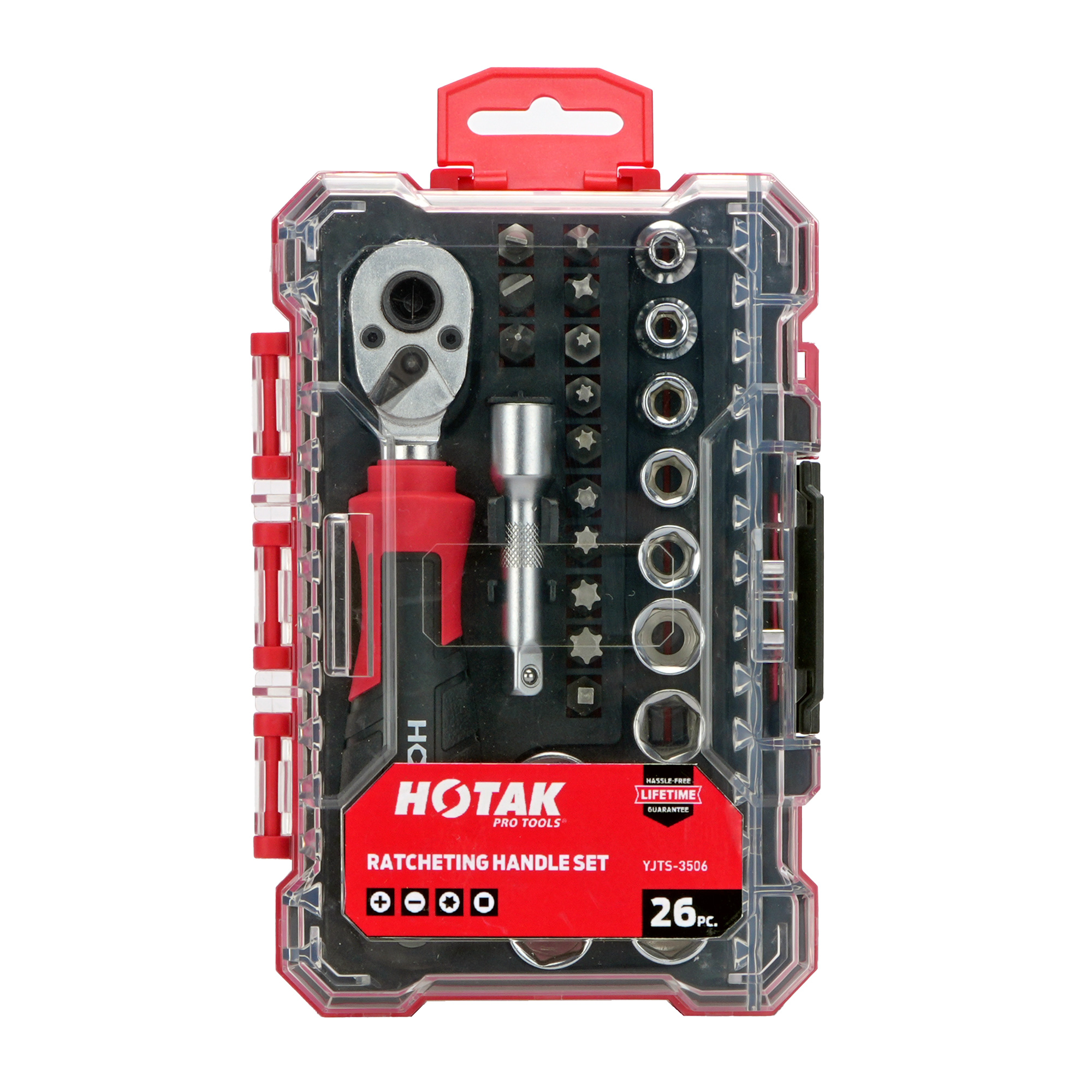
Manual tools are not obsolete in a 4V kit. They provide final control, work when a battery is depleted, and reach places where a cordless tool body is too large. The YJPS-6852 precision screwdriver set covers small Phillips, slotted, and Torx screws. The YJTS-3506 26-piece ratchet handle set includes a 1/4 inch ratcheting handle, a 1/4 inch x 50mm socket extension bar, 13 pieces of 1/4 inch x 25mm bits, and 11 pieces of 1/4 inch x 20.5mm sockets in sizes 4 to 14mm. It is made of CR-V6150 steel and is intended for household and manufacturing applications. A manual ratchet or screwdriver is useful when the site team needs to confirm that a fastener is seated without over-driving it.
Step-by-Step Breakdown for a Booth Repair Visit
Step 1: Survey the Booth and Classify the Repair
Walk the booth before opening the toolbox. Mark each issue as panel, fabric, fixture, precision, or adhesive. Record the fastener head type and the access angle. This short survey prevents the common mistake of carrying every tool to every defect. It also helps the team decide whether the job needs a cordless screwdriver, a staple gun, a hex key, or a manual precision tool.
Step 2: Build a Three-Layer Kit
Layer one is the cordless driver: YJPS-912 or YJPS-902 for general panel work, and YJPS-906 or YJPS-907 for small precision screws. Layer two is the bit and hex coverage: YJTS-3148 or YJTS-3508 for bits and sockets, YJHK-3075 for compact hex key work, YJHK-3226 for T-handle torque, and 71821D3 for angled hex access. Layer three is fabric and prop support: YJSG-196 or YJSG-501 for staple and tack work, with YJGG-001 for adhesive repairs where appropriate. Add the YJPS-6852 as a manual precision backup.
Step 3: Match the Bit to the Fastener
Use Phillips bits for cross-head panel screws, Pozi bits where the screw has the extra marks, Torx bits for star drives, and hex bits for socket-head fasteners. Slotted bits should be reserved for screws that are actually slotted. A magnetic extension bar, such as the 1/4 inch x 60mm bar in YJTS-3148, helps retain the bit and reach recessed screws. If the bit does not seat fully, stop and change the bit rather than forcing it. A stripped head turns a two-minute repair into a panel replacement.
Step 4: Fasten Panels with Controlled Torque
Start the screw by hand to avoid cross-threading. Use the cordless screwdriver at a low speed for run-down, then finish with manual torque or a hand screwdriver where the surface is delicate. The YJPS-912 lists a manual torque of 10N.m, and the YJPS-902 lists the same manual torque with electric torque settings of 2N, 3.5N, and 5N. Those figures are model specifications, not a recommendation to apply maximum torque to every panel. The correct setting is the lowest one that holds the panel without crushing the core or cracking the finish.
Step 5: Trim and Reattach Fabric
Pull the fabric taut before stapling. Test the staple leg length on a scrap piece or a hidden edge. The YJSG-196 accepts JT21, T50, T25, T20, and 18GA staples and has a high and low power switch for different materials. The YJSG-215 accepts flat wire staples 4-14mm, 7.6mm cable staples 10-14mm, and brad nails 10-14mm. For cordless tacking, the YJSG-501 and YJSG-500 are 3.7V lithium electric nail guns with 2000mAh batteries and 25W power ratings. Keep the staple line parallel to the fabric edge and avoid over-stapling a visible surface. If the fabric edge needs adhesive support, use the YJGG-001 only after a compatibility test.
Step 6: Adjust Fixtures and Alignments
Use the hex key size that fits the socket fully. The 71821D3 ball-end works on angles up to 25 degrees, which helps with recessed or angled fixture screws. Where the fastener needs more torque and access allows, switch to the YJHK-3226 T-handle wrench. The T-handle is designed for greater torque, and its chamfered tips help the key enter the screw. Do not use a ball-end key for final high-torque tightening if a straight key can be seated squarely. After adjustment, recheck the fixture alignment and confirm that the fastener is snug but not deformed.
Step 7: Plan Charging and Battery Rotation
Confirm the charger and cable before the site visit. The YJGG-001 supports USB Type-C with a 5V charge output and takes 120 minutes plus or minus 10 minutes to fully charge. The YJPS-902 lists a charge output voltage of 5V and a charge current of 1-1.5A. Rotate batteries by task so that the precision screwdriver is not depleted before the panel work begins. Keep charging cables out of walkways and use a designated charging point away from finished surfaces.
Step 8: Close Out with Inventory and Handover
At the end of the repair visit, inventory the bits, sockets, hex keys, and staple leg lengths. Remove batteries from tools that will be stored. Clean adhesive residue from the hot-glue pen tip only after it has cooled. Note any missing or damaged items so that the next booth visit starts with a complete kit. A simple label on each pouch or insert prevents the most common delay: a missing PH2 bit or a missing 4mm hex key when the next panel needs it.
Use Cases: Booth and Retail Display Repair Scenarios
Shell Scheme Panel Touch-Up
A shell scheme booth often has fascia panels, infill panels, and small shelf brackets. The common defect is a loose screw or a panel that has shifted during transport. Use the YJPS-912 with a PH2 or Pozi bit from YJTS-3148. Start the screw by hand, run it down with the cordless driver, and finish with controlled manual torque. If the screw head is damaged, replace the screw rather than forcing a smaller bit into the head.
Fabric Graphic and Upholstered Panel Repair
Fabric graphics can lift at an edge or develop a loose fold after installation. Use the YJSG-196 with the correct staple type and a tested leg length. The long nose helps reach behind a frame, and the high and low power switch helps match the setting to the fabric. For a heavier upholstered panel, the YJSG-215 can secure frames and handle upholstery and decoration work. If the edge needs adhesive support, the YJGG-001 can apply hot glue after a hidden-area compatibility test.
Retail Display Fixture Adjustment
Retail display fixtures often use hex socket screws, shelf pins, and modular connectors. The YJHK-3075 folding set is a compact first choice for common metric sizes. The 71821D3 long-arm ball-point key helps where the screw is recessed or angled. The YJHK-3226 T-handle wrench gives more control when a fastener needs higher torque. Keep the correct key with the fixture hardware so that the next adjustment does not require a full toolkit search.
Late-Stage Prop and Signage Repair
Props, signage brackets, and small display components often use precision screws. The YJPS-906 or YJPS-907 is a better match than a full-size cordless screwdriver because its lower torque range is intended for precision work. The YJPS-6852 manual precision set is the backup where access is tight or the screw is very small. The YJGG-001 can support prop repair where adhesive is part of the original design, but mechanical fixings should remain mechanical.
Comparison Table: 4V and Hand Tool Formats for Booth Repairs
The table below compares tool formats using product facts from HOTAK PRO TOOLS and verified category data. It is a selection aid, not a ranking. The correct format depends on the fastener, material, access angle, and task duration.
| Tool format | Example model | Verified format facts | Booth task fit | Boundary or check |
|---|---|---|---|---|
| 4V-class cordless screwdriver | YJPS-912 | 3.7V, 800mAh, no-load operating time at least 50 minutes, electric torque 2.5N, manual torque 10N.m, output speed 0-250rpm/min, LED lights, various bits | Panel fastening, general fixture screws, repeated touch-up | Light-duty fastening only; use the lowest torque setting that holds the panel |
| 4V-class cordless screwdriver | YJPS-902 | 3.7V, 2000mAh, no-load operating time at least 60 minutes, electric torque 2N, 3.5N, 5N, manual torque 10N.m, output speed 0-280rpm/min, charge output 5V | Longer touch-up runs, panel screws, charging planning | Confirm the torque setting for the panel material; not an impact driver |
| Precision cordless screwdriver | YJPS-906 | 3.7V, 320mAh, no-load operating time at least 30 minutes, electric torque 0.15N.m, manual torque 3N.M, output speed 0-220rpm/min, LED lights | Small fixture screws, lighting trims, precision display components | Low torque; not for structural screws or long panel runs |
| Cordless nail gun | YJSG-501 | 3.7V, 2000mAh, 25W, five-use lithium electric nail gun | Fabric tacking, display assembly, repetitive fastening | Use within the listed application; not a framing nailer |
| Manual staple gun | YJSG-196 | 6-in-1, compatible with JT21, T50, T25, T20, 18GA, long nose, TPR handle, safety lock, high and low power switch, bottom load | Fabric trimming, upholstery touch-up, recessed panel edges | Manual effort; test staple leg length on scrap first |
| Folding hex key | YJHK-3075 | 8-piece locking metric set, CR-V6150, HRC 52-55, flexible angle | Compact fixture adjustment, site pouch storage | Confirm the required size; do not exceed the tool torque |
| T-handle wrench | YJHK-3226 | 14-piece metric and SAE set, CR-V6150, HRC 52-55, torque from 1.19N for 1/16 inch to 242.92N for 3/8 inch | Fixture adjustment where more torque and control are needed | Use the correct size and avoid over-torque |
| Hex key | 71821D3 | 9-piece long arm ball point metric set, CR-V6150, ball-end works up to 25 degrees, HRC 52-55, torque 0.82N to 220N | Angled and recessed fixture screws | Ball-end for angled access; switch to a straight key for final high torque |
| Tool set | YJTS-3148 | 29-piece set with mini ratchet, T-handle, 1/4 inch adaptor, 1/4 inch x 60mm magnetic extension bar, 16 bits, 9 sockets 4.0-12mm | Mixed panel and fixture work with one compact case | Verify bit and socket sizes before leaving the site |
| Cordless hot-glue pen | YJGG-001 | 3.7V, 320mAh, 4.2W, operating time at least 120 minutes, 150 degrees Celsius, USB Type-C compatible 5V charge output | Display props, fabric edge holding, temporary stabilization | Not a structural fastener; test surface compatibility first |
FAQ: 4V Cordless Tools for Booth Repair Teams
What should site teams check before using 4V cordless tools on a booth?
Check the model voltage, charger and battery interface, bit or staple fit, and the listed torque for the task. For market compliance, common areas are mechanical safety, electrical safety, and chemical restrictions such as CE and EMC, and RoHS for many markets. The product data used in this guide does not list certifications, so request certificates for the specific model when purchasing.
Are 4V cordless tools suitable for exhibition booth repairs?
Yes, for light-duty work. Market research describes low-voltage cordless tools below 12V, including 4V and 3.7V platforms, as primary segments for DIY and light-duty household tasks. In booth repair, they fit panel fastening, fixture adjustment, fabric tacking, and touch-up. They are not a substitute for structural fastening or heavy-duty installation work.
How should buyers compare 4V cordless tools manufacturers for booth-repair kits?
Compare at model level: product formats, battery capacity, no-load operating time, torque, speed, bit and staple compatibility, charging interface, and OEM or private-label support. HOTAK PRO TOOLS product data covers 3.7V cordless screwdrivers, lithium electric nail guns, staple guns, hex keys, T-handle wrenches, bits sets, and tool sets. Request model-level specifications before selecting a kit.
What budget factors affect a 4V cordless booth-repair kit?
Budget is driven by tool count, battery capacity, charger type, staple-gun format, and whether the kit includes manual backups such as a precision screwdriver set or ratchet handle set. No price is stated in the product data used in this guide. Request a quote for the exact configuration so that the kit matches the booth workload.
How can a site team request a sample or quote for a booth-repair kit?
Contact HOTAK PRO TOOLS through Ningbo Yingzhou Yongjia Electrical Tools Co., Ltd. at yjtcl@yj-tools.com or +86 133-9661-6513. The WhatsApp number is the same. The product catalog is available here: 2025 YONGJIA CATALOG. For a sample, specify the tool models, bit or staple interface, and target market.
Conclusion: Build the Kit Around the Repair, Not the Voltage Label
A 4V cordless tool is useful in exhibition booth repair when it is matched to a specific task and a specific fastener. The practical kit is a 4V-class cordless screwdriver, a bits set with broad drive coverage, a folding hex key for compact fixture adjustment, a T-handle wrench for controlled torque, a long-arm ball-point hex key for angled access, and a staple gun for fabric work. The YJPS-912 and YJPS-902 cover general panel fastening, while the YJPS-906 and YJPS-907 cover precision screws. The YJSG-196 and YJSG-215 cover manual staple work, and the YJSG-501 and YJSG-500 provide cordless tacking within their listed 3.7V lithium electric nail gun formats.
For site teams, the operating rule is simple: classify the repair, choose the lowest-torque tool that fits the fastener, test the staple or bit on a hidden area, and keep manual backups for final control. For buyers, the sourcing rule is also simple: compare models at specification level, confirm the charging interface and accessory coverage, and request certificates for the target market when the product data does not list them.
Next step: Build a booth-repair kit with HOTAK PRO TOOLS. Review the 2025 YONGJIA CATALOG, request a sample or quote at yjtcl@yj-tools.com, or contact +86 133-9661-6513 on WhatsApp. For private-label or OEM inquiries, specify the models, bit set, staple-gun format, and target market.
Have Questions or Need More Details?
Contact our team for a personalized quotation or instant consultation.
Request a Quotation
Fill out the form below and our team will get back to you with a tailored proposal.
WhatsApp Direct Chat
Prefer to chat in real-time? Message us on WhatsApp for instant assistance & quick answers.
- Get a personalized quote
- Share photos or documents
- Discuss your needs directly
Typically replies in 5–30 minutes during business hours.