Folding Hex Key or T-Handle Wrench? A Tight-Space Guide
Tight-space fastening usually fails for one of three reasons: the tool cannot reach the fastener, it cannot be turned through a useful arc, or it cannot hold torque once contact is made. In those conditions, the choice between a folding hex key and a T-handle wrench is a decision about access geometry, leverage, storage, and task repetition, not about which tool is generally better.
Short answer: for low-clearance adjustment work where several hex sizes must be carried to the job, a folding hex key set is the more practical format. For repeated fastening where the tool can enter vertically and the operator needs sustained torque, a T-handle wrench is the more suitable format. Both formats are available in CR-V 6150 at HRC 52–55, so the main difference is mechanical format, not base steel quality.
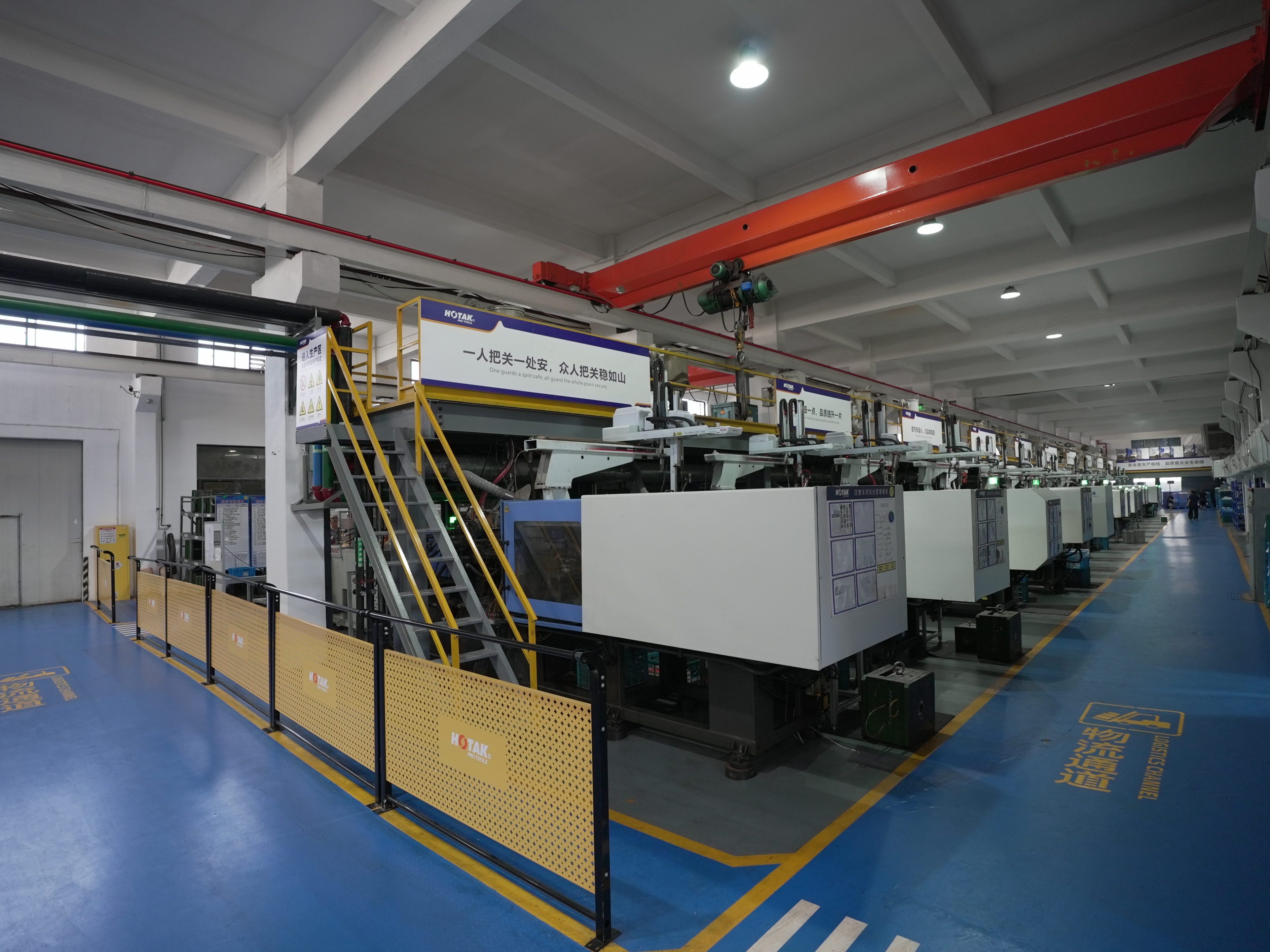
Injection molding workshop at the Ningbo production site.
Problem Definition: Four Constraints That Decide the Format
A tight space is not defined by the size of the fastener. It is defined by the clearance around it. Four constraints matter most:
- Radial clearance: the distance from the fastener axis to the nearest obstruction, such as a wall, bracket, pipe, or adjacent component. A tool with a wide handle or a perpendicular grip needs more radial room.
- Axial clearance: the height available above the fastener. A folding set sits low; a T-handle needs vertical room for the crossbar.
- Hand clearance: the space needed for fingers and gloves to grip and turn. This is often the real limit in under-dash, cabinet, and bicycle work.
- Visibility and control: whether the operator can see the fastener and feel the key seat fully before applying torque.
These constraints trade against torque. A format that enters easily may limit how much torque the operator can apply comfortably. A format that applies torque well may not fit the space at all. The decision rule later in this guide resolves that trade-off in a fixed sequence.
Industry Background: Compact Hex Tools in a Large Hand Tool Market
Hex keys sit inside the broader hand tool category, and the category is large enough that format choices are usually made at the product-line level rather than per job. The global hand tools market was approximately USD 25.61 billion in 2025, according to Straits Research. The U.S. hand tools market was valued at USD 5.34 billion in 2025, according to Arizton. China's exports of hand tools under HS 8203 reached USD 1.1 billion in 2024, according to the Observatory of Economic Complexity.
Granular growth data for hex keys specifically is often grouped under wrenches, which makes format-level market claims unreliable. What is clear at the product level is that compact hex formats serve maintenance and assembly work where a full socket set or long arm key cannot be used: bicycle brakes and derailleurs, furniture cam locks, automotive interior trim, under-sink plumbing brackets, and equipment panels with recessed fasteners.
In that context, the folding hex key and the T-handle wrench are not competing categories. They solve different access problems within the same hex fastening family.
Detailed Solution: Two Formats, One Material Specification
Folding Hex Key: Access Through Low Clearance
A folding hex key set houses several hex keys in one handle or housing. Each key rotates out on a hinge and folds back for storage. The format is designed around portability and low-clearance access rather than maximum leverage.
HOTAK PRO TOOLS offers two metric folding formats in this family: the YJHK-3347 8-piece folding hex key set and the YJHK-3075 8-piece locking hex key set. Both use CR-V 6150 steel at HRC 52–55. The product data lists proof torque values across the hex key family from 0.82 N at 1.5 mm, 1.90 N at 2.0 mm, 3.80 N at 2.5 mm, 6.60 N at 3.0 mm, 16.00 N at 4.0 mm, 30.00 N at 5.0 mm, 52.00 N at 6.0 mm, 80.00 N at 7.0 mm, and 120.00 N at 8.0 mm, with a 220 N value listed at 10.0 mm for the wider family.
Where the format wins: the folded housing is compact, the keys sit close to the fastener axis, and the operator can switch sizes without leaving the work area. That makes it a strong fit for service bags, bicycle repair, furniture assembly in tight corners, and maintenance kits where storage space is limited.
Where it stops: the handle length limits leverage, and the folding joint is a mechanical interface that should be checked for play before purchase. The format is not a substitute for a fixed key when the job requires sustained high torque or repeated cycles. Glove use can also reduce control on small folding handles.
T-Handle Wrench: Leverage and Repeated Torque
A T-handle wrench fixes a hex shaft to a perpendicular crossbar. The operator grips both sides of the bar and turns around the shaft axis. The format is built for vertical entry, two-hand control, and repeated fastening.
HOTAK PRO TOOLS offers the YJHK-3066 7-piece T-handle wrench set in metric sizes and the YJHK-3226 14-piece T-handle hex key set in metric and SAE. Both use CR-V 6150 at HRC 52–55. The YJHK-3226 data lists SAE proof torque values from 1.19 N at 1/16 inch, 2.37 N at 5/64, 4.18 N at 3/32, 9.72 N at 1/8, 19.21 N at 5/32, 33.33 N at 3/16, 71.18 N at 1/4, 141.23 N at 5/16, and 242.92 N at 3/8.
Where the format wins: the crossbar gives the operator a stable grip and better control during repeated cycles. The shaft provides reach into recessed fasteners, and the vertical entry keeps the key aligned with the fastener axis. That fits assembly stations, engine bay work, bench assembly, and any position where the operator can stand or sit directly above the fastener.
Where it stops: the crossbar needs radial and axial room. In a cabinet corner or under a dashboard, the handle may not fit even when the hex shaft reaches the fastener. Storage is also bulkier than a folding set, which matters for mobile service kits.
What the Shared CR-V 6150 Specification Means
Because both formats use CR-V 6150 at HRC 52–55, the proof torque for a given size is the same. The format changes how much of that torque the operator can apply comfortably and repeatedly; it does not change the key's rated proof torque. This is the most important technical point in the comparison, because it prevents buyers from assuming that a T-handle is automatically a stronger tool. It is a more controllable tool in the right orientation, not a different steel grade.

Quality control room at the Ningbo manufacturing site.
Step-by-Step Breakdown: A Tight-Space Decision Sequence
Use the following sequence at the job or during product selection. It moves from the physical constraint to the commercial decision, which is the order that prevents returns and rework.
- Measure radial clearance. Estimate the distance from the fastener axis to the nearest obstruction. If a perpendicular handle cannot rotate without hitting the obstruction, a folding format is the safer starting point.
- Measure axial clearance. Check the height above the fastener. A folding set needs very little; a T-handle needs room for the crossbar and the operator's hand.
- Identify the required torque and size. Match the hex size to the fastener and compare the required torque with the proof torque listed for that size. Do not use a smaller key with an adapter to gain reach.
- Estimate repetition. A single adjustment favors the most compact format that fits. Dozens or hundreds of cycles per shift favor the format with the better grip and alignment.
- Check hand clearance and glove use. If the operator must wear gloves in a confined space, a larger T-handle grip may be easier to control than a small folding handle.
- Check storage and transport. Mobile service kits favor folding sets; fixed benches and assembly stations can accommodate T-handle racks.
- Verify material, hardness, and batch documentation. Confirm CR-V 6150 and HRC 52–55, and request torque and hardness reports with the shipment.
- Apply the decision rule. If the fastener is surrounded by obstructions and more than one size is needed, start with a folding hex key set. If the fastener can be approached vertically and the job repeats, start with a T-handle wrench. If both conditions occur on the same job, carry the folding set for access and the T-handle for torque-critical positions.
Use Cases: Matching Format to Task
Bicycle repair. Brake calipers, derailleurs, and stem bolts often sit in low-clearance positions where a T-handle cannot rotate. A folding set covers multiple sizes in a small pouch and is the more practical format for road-side adjustment. It is also the natural core of a compact bicycle repair tool kit.
Furniture assembly. Cam locks and bed bolts are repetitive, but access varies. A T-handle speeds up bench work where the fastener is exposed; a folding set handles corners and recessed fittings. Distributors often stock both formats for this reason.
Automotive interior and engine bay. Under-dash trim and bracket bolts favor a folding set because the handle stays close to the fastener. Engine bay work with vertical access favors a T-handle for reach and control.
Industrial assembly and maintenance. Fixed stations with repeated cycles favor T-handle wrenches because the operator can keep the key aligned and apply torque with both hands. Maintenance technicians who move between stations usually carry a folding set for access and a small T-handle set for specific torque points.
Event and booth buildout. Transport and storage dominate. A folding set packs into a small tool bag and covers the common hex sizes used on display hardware and temporary structures.
Comparison Table: Folding Hex Key vs. T-Handle Wrench
| Decision factor | Folding hex key | T-handle wrench |
|---|---|---|
| Entry geometry | Key rotates out of a compact housing; sits close to the fastener axis | Perpendicular crossbar; enters vertically along the fastener axis |
| Radial clearance | Low; housing can sit beside obstructions | Higher; crossbar needs room to rotate |
| Axial clearance | Low; minimal height above the fastener | Higher; needs room for the crossbar and hand |
| Grip and leverage | Handle length limits leverage; control depends on handle size | Two-hand grip on the crossbar; better control for sustained turning |
| Repetition suitability | Suited to occasional adjustment and multi-size access | Suited to repeated cycles and fixed-position work |
| Size coverage in the cited sets | YJHK-3347 and YJHK-3075: 8-piece metric sets | YJHK-3066: 7-piece metric; YJHK-3226: 14-piece metric and SAE |
| Storage footprint | Compact; folds into a pouch or pocket | Bulkier; needs a rack or a larger case |
| Material and hardness | CR-V 6150, HRC 52–55 | CR-V 6150, HRC 52–55 |
| Proof torque basis | Same family values by size; 0.82 N at 1.5 mm to 120 N at 8.0 mm, with 220 N listed at 10.0 mm | Same metric family values; SAE values from 1.19 N at 1/16 inch to 242.92 N at 3/8 inch |
| Typical tasks | Bicycle repair, furniture corners, under-dash trim, mobile service kits | Assembly stations, engine bay work, bench assembly, repeated fastening |
| Main limitation | Folding joint and handle length limit sustained high torque | Crossbar footprint blocks low-clearance access |
Long-Term Supply and Channel Considerations
For distributors and private-label buyers, the format decision is only half of the procurement decision. The other half is whether the supplier can keep both formats consistent across batches and provide the documentation that retail and industrial customers require.
HOTAK PRO TOOLS is the hand tool brand of Ningbo Yingzhou Yongjia Electrical Tools Co., Ltd., a Ningbo-based manufacturer founded in 2000. The company operates a 45,000 m² production base with an annual output of 18,000,000 units and exports about 95% of its output to the EU, USA, Southeast Asia, and South America. Its range includes hex keys, torx keys, staple guns, precision screwdrivers, hobby knives, and hand tool sets, with OEM/ODM and private-label customization available.
Quality documentation includes ISO 9001, TÜV/GS where applicable, BSCI, and VPA approval, along with factory audits by Walmart (USA) and Kingfisher (UK). For buyers stocking both folding and T-handle formats, the shared CR-V 6150 and HRC 52–55 specification simplifies quality comparison: the steel and hardness standard is the same, so the format can be selected on access and task fit rather than on material grade.
Ordering terms for long-term supply are MOQ 600 units, FOB Shanghai or Ningbo, with 30% T/T in advance and 70% T/T against a copy of the bill of lading. Pre-shipment testing and third-party inspection (SGS) are available as acceptance criteria. These terms matter for channel partners because they allow a single supplier to cover both formats without splitting quality documentation across two vendors.
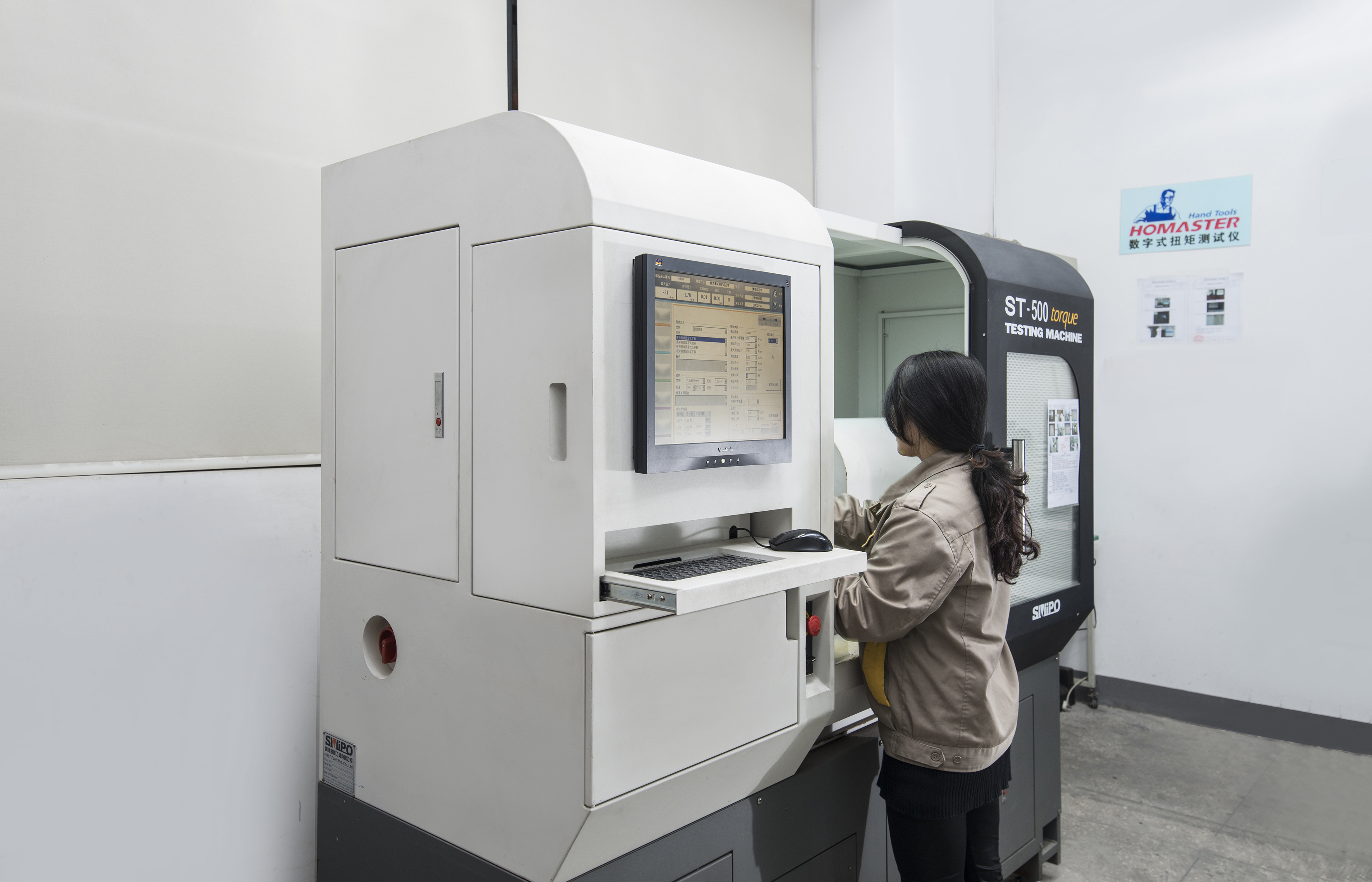
Testing lab used for torque and hardness verification.
FAQ
What certifications and documentation should buyers request for hex keys and T-handle wrenches?
Request the certificate package that applies to the destination market and confirm that the scope covers the specific model. HOTAK PRO TOOLS holds ISO 9001, TÜV/GS where applicable, BSCI, and VPA approval, and has passed Walmart (USA) and Kingfisher (UK) factory audits. For EU markets, ask for RoHS documentation and material declarations, and include batch-level hardness and torque reports in the pre-shipment inspection.
Do folding hex keys and T-handle wrenches have the same torque capability?
For a given size and material, yes. Both formats use CR-V 6150 at HRC 52–55, and the product data lists the same metric proof torque values across the hex key family: 0.82 N at 1.5 mm, 1.90 N at 2.0 mm, 3.80 N at 2.5 mm, 6.60 N at 3.0 mm, 16.00 N at 4.0 mm, 30.00 N at 5.0 mm, 52.00 N at 6.0 mm, 80.00 N at 7.0 mm, 120.00 N at 8.0 mm, and 220.00 N at 10.0 mm. The format changes how comfortably and repeatedly the operator can apply torque, not the key's proof torque.
Why do CR-V hex keys cost more than 45# carbon steel?
CR-V 6150 tools carry an 8–12% cost premium over low-grade carbon-steel alternatives. The comparison data notes better torsion resistance and wear resistance, with proof torque 15–25% higher than ordinary 45# carbon-steel hand tools. 45# carbon steel is positioned for light-duty household use and has limited torque capacity. For professional or repeated use, the premium buys a wider torque margin and longer wear life; for occasional low-torque household work, 45# carbon steel can be adequate.
How should a buyer validate a sample before a volume order?
Request a sample in the exact format and size range you plan to stock. Check the folding joint for play and locking action on the YJHK-3075 locking set, confirm the T-handle grip and shaft alignment on the YJHK-3066 or YJHK-3226, and verify the hardness and torque report against the product data. HOTAK PRO TOOLS supports pre-shipment testing and third-party inspection (SGS); the MOQ is 600 units.
What are the ordering terms and acceptance criteria for long-term supply?
Standard terms are MOQ 600 units, FOB Shanghai or Ningbo, with 30% T/T in advance and 70% T/T against a copy of the bill of lading. Pre-shipment testing and third-party inspection (SGS) are available as acceptance criteria. Distributors stocking both formats can use the shared CR-V 6150 and HRC 52–55 specification as a single quality baseline. To request a sample, a quote, or the 2025 catalog, contact yjtcl@yj-tools.com or download the catalog at the link below.
Conclusion
The folding hex key and the T-handle wrench solve different tight-space problems. The folding format has the advantage on access, storage, and multi-size coverage. The T-handle format has the advantage on grip, alignment, and repeated torque. Because both are produced in CR-V 6150 at HRC 52–55, the decision should be made on geometry and task repetition, not on an assumption that one format is inherently stronger.
Use the decision rule: if the fastener is surrounded by obstructions and more than one size is needed, start with a folding hex key set. If the fastener can be approached vertically and the job repeats, start with a T-handle wrench. If the job mixes both conditions, carry both formats and assign each to the positions where it fits.
For distributors and private-label buyers, the next step is to validate the format mix with samples, confirm documentation, and set a stocking plan around the shared material specification.
Next step: download the 2025 HOTAK PRO TOOLS catalog, request a sample, or send your format mix and target market for a quote.
Catalog: 2025 YONGJIA Catalog (PDF)
Email: yjtcl@yj-tools.com
Website: www.yj-tools.com
Have Questions or Need More Details?
Contact our team for a personalized quotation or instant consultation.
Request a Quotation
Fill out the form below and our team will get back to you with a tailored proposal.
WhatsApp Direct Chat
Prefer to chat in real-time? Message us on WhatsApp for instant assistance & quick answers.
- Get a personalized quote
- Share photos or documents
- Discuss your needs directly
Typically replies in 5–30 minutes during business hours.