Hand Tool Compliance Guide: Documentation Checks for Tool Sets, Bits Sets and Staple Guns
This guide sets out a review path that importers, wholesalers, retail buyers and private-label programme managers can run with a supplier before ordering Tool Sets, Bits Sets and Staple Guns. It covers what to request, how to cross-check certificate scope against the purchase order, how to review labelling artwork, and how to clarify regional requirements with the manufacturer instead of assuming that a document seen on an earlier order applies to the current one.
The reference examples in this article come from HOTAK PRO TOOLS, the hand tool brand supplied by Ningbo (Yinzhou) Yongjia Electrical Tools Co., Ltd. (YONGJIA TOOLS), a Ningbo-based manufacturer founded in 2000 that produces hex keys, staple guns, precision screwdrivers, hobby knives and hand tool sets, and exports to the EU, the USA, Southeast Asia and South America.
The Compliance Problem Is a Scope Problem, Not a Missing-Paper Problem
A compliance file rarely fails because a document is absent. It fails because the document in the folder describes a slightly different product from the one in the container: a certificate naming one model number against a purchase order listing another, a conformity statement citing a standard written for a different tool function, or a label printed from artwork that was never reconciled with the compliance file. In each of those cases a document exists — and the shipment is still exposed.
Three identifiers therefore have to agree before shipment:
- the model designation printed on the certificate;
- the model designation on the purchase order, invoice and packing list;
- the model designation marked on the product itself and on its packaging.
If those three do not match, the certificate is a reference document, not evidence for that shipment.
A second failure mode is assumption by analogy. A cordless power staple gun and a hand-operated tacker are different products with different hazard profiles, and a document set that covers one does not automatically cover the other. The same logic applies inside a single catalogue: a Ball-End Hex Key Set, a Long Arm Hex Key Set, a Folding Hex Key Set and a T-Handle Hex Key Set may share a material and a finish, yet each model still has to be named in the documents that are meant to cover it. Buyers who treat a brand-level certificate as a category-level certificate are the buyers who discover the gap at the port.
This is also why the review path below deliberately avoids assuming any specific certification. The question is not “does this product have CE?” It is “which document, for which model, from which body, against which standard, for which market — and can the supplier show it?”
Industry Background: Why Documentation Requirements Keep Moving
Hand tools are a large, internationally traded category, and the rules that govern their sale are set market by market rather than globally. That combination is what makes per-order document verification a recurring task instead of a one-time exercise.
- The global hand tools market was approximately USD 25.61 billion in 2025, according to Straits Research (report published August 2026).
- The U.S. hand tools market was valued at approximately USD 5.34 billion in 2025, according to Arizton.
- The global staple gun market was valued at approximately USD 1.54 billion in 2024, according to Maximize Market Research.
- China’s exports under HS 8203 (hand tools) reached approximately USD 1.1 billion in 2024, according to the Observatory of Economic Complexity (OEC).
- India’s Hand Tools Quality Control Order 2025 mandates BIS certification across nine tool categories, according to Market.us — an example of a single jurisdiction changing what documentation an importer needs for a defined set of products.
Read together, these figures describe a category where sourcing is concentrated in a few exporting regions while the acceptance rules fragment across destination markets. The practical consequence for a buyer is straightforward: the documentation set is a deliverable of the order, and it should be planned, requested and checked with the same discipline as the sample.
The manufacturers that handle this best are usually the ones with export-heavy operations, because export volume forces repeat exposure to different market expectations. YONGJIA TOOLS, for example, reports that approximately 95% of its output is exported, across the EU, the USA, Southeast Asia and South America — four regulatory environments with materially different documentation habits.
The Three Document Layers to Review
A compliance review can be organised into three layers. Each layer answers a different question, and passing one layer does not validate the next. Buyers who collapse the three into a single “send me your certificates” email usually end up with a folder they cannot audit.
Layer 1 — Scope documents: what is actually covered
This layer contains the certificates, declarations and test documents. For each one, six data points should be visible on the face of the document:
- document type (for example a Certificate of Conformity, a GS Product Safety Certificate, a test report or a declaration);
- certificate or report number;
- issuing authority or test house, with enough detail to verify independently;
- product scope and model designation(s);
- the standard or regulation cited, including the version or year where one is given;
- the market the document applies to, plus issue and expiry dates.
If any of these six points is missing, the document is incomplete for procurement purposes — even if the PDF looks official.
Layer 2 — Labelling and marking pack: what the buyer will actually see
Labelling is where a technically correct product becomes a commercially usable one, and it is where scope mismatches show up most often. Ask to see print-ready artwork, not a description of it, and check:
- the model or type designation on the label matches the certificate and the purchase order;
- the manufacturer identity printed on the product and packaging is complete and correct;
- the warnings, symbols and safety text are present in the language versions your market requires;
- the instruction manual shipped with the goods is the same version as the one reviewed — and is written in the required language;
- product marking, packaging artwork and manual are internally consistent with each other.
Whether an importer name, a country-of-origin statement or a specific warning format is required depends on the destination, so this is a list to clarify with the supplier rather than to assume. The useful output of Layer 2 is a single approved artwork set, referenced by version, that the factory can print against.
Layer 3 — Market rule confirmation: what applies to this SKU
The third layer is a written conversation. Ask the supplier to state, for this specific SKU in this specific destination, which regulation or standard they consider applicable, which document proves it, and who issued that document. A workable sequence for that conversation is:
- Confirm the target sales market for the order (for example EU, Germany, USA, Southeast Asia or South America).
- Request the official test or conformity documents that the supplier associates with that market — for example GS, CE-Machinery, EMC or RoHS documents where those are relevant.
- Cross-check the product model number and the standard numbers stated on each document against the purchase order.
Two clarifications are worth building into this layer permanently. First, treat general areas — mechanical safety, electrical safety for cordless tools, and chemical restrictions such as RoHS in many markets — as topics to confirm, not as conclusions. Second, do not treat a compliance page or a catalogue as proof: request the certificates themselves at the purchasing stage, because a website is a marketing surface and a certificate is a scoped document.
Reference certificate register
The table below shows the level of detail a buyer should expect on the face of each document. All entries are drawn from the manufacturer’s certification records.
| Document | Certificate no. | Issuing authority | Scope & models covered | Standard / regulation cited | Market | Validity |
|---|---|---|---|---|---|---|
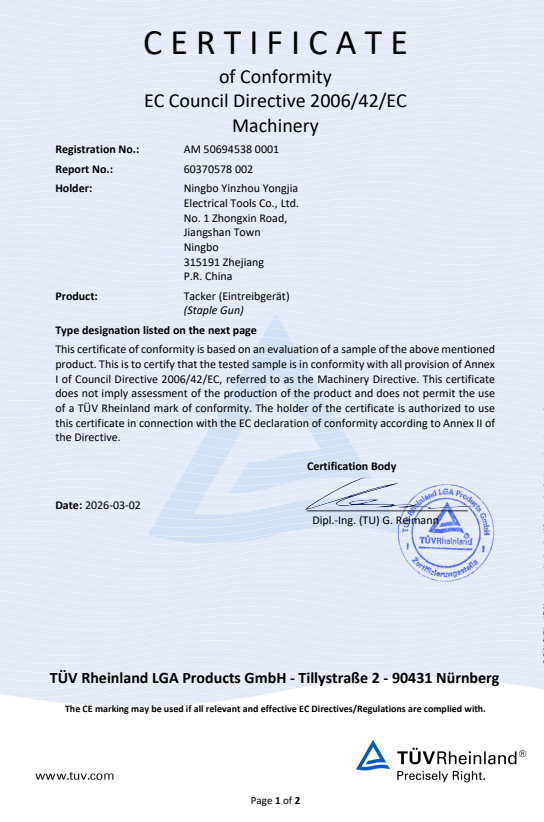
| CE Certificate of Conformity – Machinery Directive 2006/42/EC | AM 50694538 0001 | TÜV Rheinland LGA Products GmbH | Staple Gun (Tacker / hand-operated tacker) — models YJSG-105 and YJSG-023 | Directive 2006/42/EC; EN ISO 12100:2010; EN ISO 11148-13:2018 | EU | Issued 2026-03-02, expires 2030-12-31 |
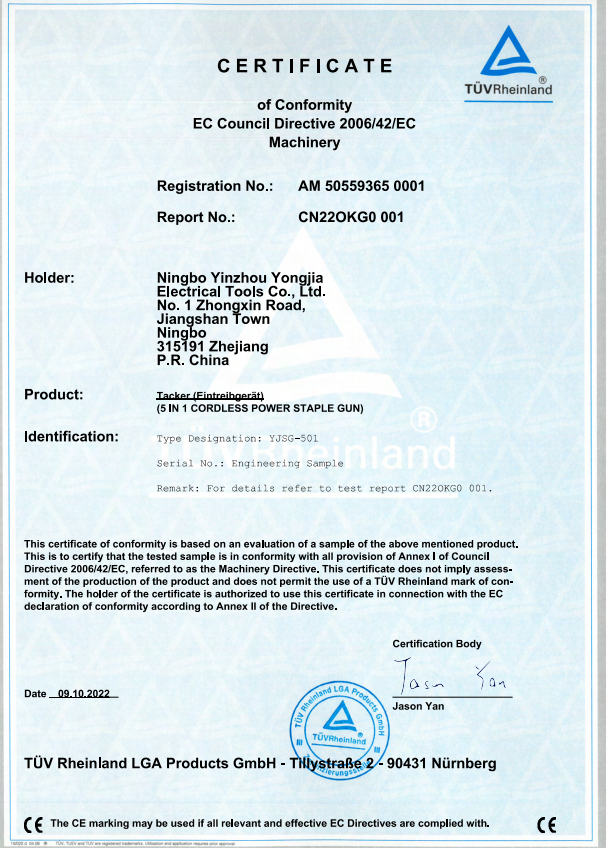
| CE Certificate of Conformity – Machinery Directive 2006/42/EC | AM 50559365 0001 | TÜV Rheinland LGA Products GmbH | 5 IN 1 Cordless Power Staple Gun — model YJSG-501 | Directive 2006/42/EC; EN ISO 12100:2010; EN ISO 11148-13:2018 | EU | Issued 2022-09-10, expires 2030-12-31 |
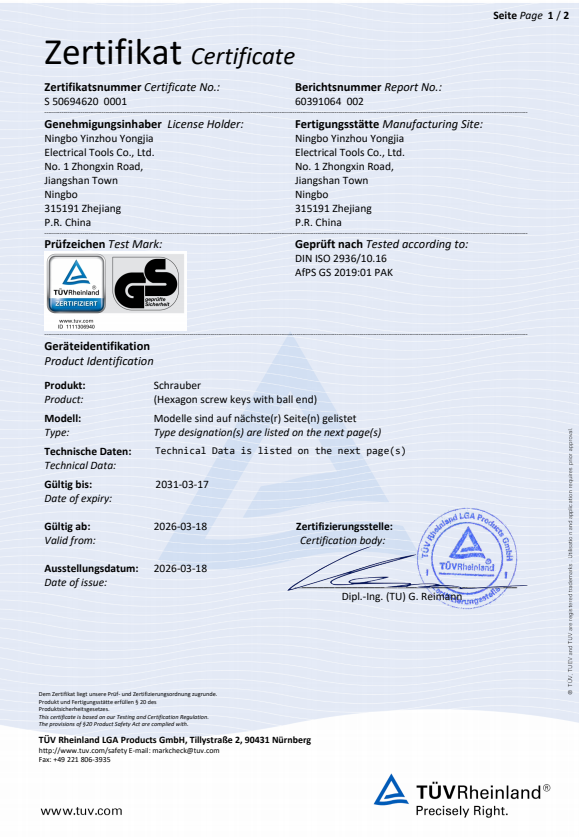
| GS Product Safety Certificate | S 50694620 0001 | TÜV Rheinland LGA Products GmbH | Hexagon screw keys with ball end — models 105221K1, 105221K2, 105221K3, 71821D1, 71821D2, 71821D3 | DIN ISO 2936-10.16; AfPS GS 2019:01 PAK | DE, EU | Issued 2026-03-18, expires 2031-03-17 |
Note what this register does and does not say. The hand-operated tacker certificate names two models only — YJSG-105, a medium-duty staple gun for fine wire staples 4–8 mm, and YJSG-023, a heavy-duty 3-way staple gun set for flat wire staples 4–14 mm, 7.6 mm cable staples 10–14 mm and brad nails 10–14 mm. The cordless power stapler is covered by a separate certificate. The GS certificate covers ball-end hexagon screw keys and names six models. None of these documents can be stretched to a different model, a different tool function or a different market, and that is precisely the property a buyer should be testing for.
A Seven-Step Review Path for Buyers
The three layers become actionable when they are attached to the order timeline. The sequence below runs from evaluation into execution and can be completed before production starts.
Step 1 — Freeze the SKU list and the destination markets
Write down the exact SKUs and the exact countries where each will be sold. A Household Tool Kit sold in Germany and the same SKU sold in the United States are two separate documentation questions. Freezing the list first prevents the most common retrospective problem: discovering halfway through production that one SKU in a mixed order needs a document no one requested.
Step 2 — Request documents, not a compliance summary
Ask for the certificate set, the test documents and the labelling artwork in one request. A one-page compliance summary prepared by the supplier is a useful index, but it is not the evidence. Keep the underlying documents.
Step 3 — Cross-check scope against the purchase order
For every document, confirm the model designation, the standard numbers and version, the market, and the validity dates against the PO line. Flag any document whose scope line does not literally name the ordered model.
Step 4 — Review labelling artwork against the same identifiers
Compare artwork to the certificate list, model by model. Confirm the manual version and language. Approve one artwork set by version number, and make that version the only one the factory may print.
Step 5 — Confirm the market rule for this SKU, in writing
Ask the supplier to state which regulation or standard applies to this SKU in this destination, and to name the document that proves it. Where the answer is “CE”, ask for the certificate number: a marking is not a document, and a document without a scope line is not evidence.
Step 6 — Validate a sample with the documents in hand
Physical evaluation and documentation review should happen at the same time, because they answer each other. When checking a Professional Staple Gun or a Heavy-Duty Staple Gun, for instance, the compliance file and the performance claim are separate documents. Manufacturers publish performance data — YONGJIA’s product data, for example, lists approximate service life of more than 7,000 shots for a plastic staple gun, more than 15,000 shots for an iron staple gun, and more than 30,000 shots for an aluminium-alloy staple gun. Those are performance claims, not conformity evidence, and a well-run review keeps the two categories apart.
Step 7 — Write acceptance into the purchase order
The last step converts the review into a contractual condition. For this manufacturer’s standard terms, the acceptance criteria are a pre-shipment test and third-party inspection (SGS), with a minimum order quantity of 600 units, delivery terms of FOB Shanghai/Ningbo, and payment of 30% T/T in advance with 70% T/T against a copy of the B/L. Buyers should attach the approved document list and artwork version to the PO so that “compliant” has a written definition.

Applying the Review Path: Tool Sets, Bits Sets and Staple Guns
The same seven steps apply across the category, but the documentation focus shifts with the product.
Tool Sets and Household Tool Kits
Multi-piece sets concentrate the most risk per carton, because one order can contain dozens of components. For a 42-piece Ratcheting Handle Set, a 50-piece Ratcheting Screwdriver Set, a 29-piece Ratcheting Precision Screwdriver Set or a Household Tool Kit, the practical approach is to build a component matrix: each item, its material or specification, and the document that references it. Hex key components in a set, for example, may be listed with a material such as CR-V 6150 and a hardness range of HRC 52–55; that specification should appear consistently on the artwork, the manual and the packing specification. Material declarations matter most here, and the set-level carton artwork must match the individual product markings.
Bits Sets and Screwdriver Bit Sets
Bits sets are usually the least hazardous and the most documentation-light category — which makes them the easiest place for sloppy paperwork to hide. For an 18-piece or 26-piece impact drill and drive set, a Screwdriver Bit Set or a Precision Screwdriver Set, confirm that the bit count on the label, the bit list in the instruction sheet and the actual contents of the box agree, and that material declarations (for example S2 steel bits with a black phosphate finish) are stated in the same terms everywhere. Buyers assembling a private-label programme should also confirm that the model code printed on the case is the code the certificate or declaration references, not a marketing name.
Hand-Operated Staple Guns
Staple guns carry the highest documentation weight in this group because they are mechanical products. For a hand-operated tacker sold in the EU, the relevant document in this manufacturer’s file is the CE Certificate of Conformity against Machinery Directive 2006/42/EC, citing EN ISO 12100:2010 and EN ISO 11148-13:2018, with model YJSG-105 (medium duty) and YJSG-023 (heavy-duty 3-way set) named in the scope. A Multi-Tacker Staple Gun, a Upholstery Staple Gun or a Hammer Tacker is a different model and needs its own scope line. Buyers should also check staple compatibility statements against the manual, because compatibility data — such as JT21, T50, T25, T20 and 18GA for a 6-in-1 model, or 6–14 mm flat wire staples for a heavy-duty tacker — is a product claim that must match what the packaging tells the end user.
Hex Key Sets, Torx Key Sets and Cordless Tools
Ball-end hexagon screw keys are the clearest worked example in this file: the GS Product Safety Certificate S 50694620 0001 covers six named models against DIN ISO 2936-10.16 and AfPS GS 2019:01 PAK for the DE and EU markets. A Torx Key Set, a Long Arm Hex Key Set or a Folding Hex Key Set would sit outside that scope until it is named. Cordless products add a second dimension — electrical safety and battery-related requirements — which is why the 5-in-1 cordless power staple gun YJSG-501 is covered by a separate CE certificate rather than being folded into the hand-tool file.
Document Comparison: What Each Paper Answers — and What It Does Not
Buyers often treat every document as if it proves the same thing. This table separates the questions each layer can answer from the questions it cannot.
| Document layer | Question it answers | What it does not confirm | Who should review it |
|---|---|---|---|
| Conformity certificate (e.g. CE, GS) | Which models, which standards and which market the issuing body has assessed | That the models on your PO are the models listed; that the certificate is still within its validity period | Buyer and compliance reviewer |
| Test report | The specific test performed and the result recorded | That the tested sample matches the production configuration | Buyer and technical reviewer |
| Labelling artwork and manual | What the end user will read, in which language, with which warnings | That the printed version equals the approved version unless the version is controlled | Buyer and packaging/QA team |
| Performance data (for example service-life figures) | What the product is claimed to do under defined conditions | Conformity with any regulation or standard | Buyer and category manager |
| Purchase order acceptance clause | What the shipment must satisfy before payment against documents | Anything about the product itself — it defines the obligation, not the evidence | Buyer, QC and finance |
Frequently Asked Questions
1. Which standards or certifications should Tool Sets, Bits Sets and Staple Guns comply with, and how do I check that the documents cover my exact model?
Requirements depend on the destination market and on the product’s function, so the reliable approach is to confirm them rather than assume them. The areas that commonly apply are mechanical safety, electrical safety for cordless tools, and chemical restrictions such as RoHS in many markets, with GS and CE-Machinery as frequent reference points in Europe. At the purchasing stage, request the official test or conformity documents rather than relying on a website or a catalogue, and then cross-check the product model and the standard numbers stated on each document against your order. A document is only evidence for the models, standards and markets it actually names.
2. Can an OEM professional staple gun manufacturer also support private label tool sets and custom bits sets?
Yes, where the supplier operates an OEM/ODM programme. HOTAK PRO TOOLS provides OEM/ODM production services with colour and logo customisation, a monthly capacity of 1,500,000 units, and quality control at incoming inspection, in-process inspection and final inspection. Programmes of this kind are used for private label hand tools, custom hand tool sets, staple gun kits and screwdriver bit sets. The important detail for buyers is that the documentation set should be issued against the model you order rather than against the catalogue, so ask for the scope line for your own model code.
3. What are the MOQ, payment terms and delivery terms?
For this manufacturer: MOQ 600 units; delivery terms FOB Shanghai/Ningbo; payment terms of 30% T/T in advance with 70% T/T against a copy of the B/L; and acceptance criteria that include a pre-shipment test and third-party inspection (SGS). Buyers should attach the approved document and artwork list to the order so that acceptance is defined before production begins.
4. Can I validate a sample and arrange third-party inspection before shipment?
Sample validation belongs to the evaluation stage and works best when it runs alongside the documentation review, because the sample confirms the physical product while the documents confirm the scope. The acceptance criteria in this manufacturer’s terms include pre-shipment testing and third-party inspection through SGS, which allows a buyer to verify the shipped configuration against the approved sample and the approved artwork before the balance payment against documents.
5. What is the monthly capacity and typical lead time?
Monthly capacity is 1,500,000 units with a typical lead time of 30–45 days, and the manufacturer serves the EU, USA, Southeast Asia and South America with remote after-sales support. Buyers who need the current certificate set, labelling templates and full product catalogue for a Tool Sets, Bits Sets or Staple Guns programme can request them together with their enquiry, so that the compliance review and the commercial review move on the same timeline. The 2025 YONGJIA catalogue is available for download here: 2025 YONGJIA Hand Tool Catalogue (PDF).
Conclusion: Documents First, Then the Order
Compliance for Tool Sets, Bits Sets and Staple Guns is settled by scope matching, and scope matching is a paperwork discipline rather than a technical mystery. Confirm four things for every SKU: the document, the model, the issuing body and the standard — and the market the document is valid for. Review the labels as carefully as the certificates. Ask the supplier to state in writing which rule applies to your SKU in your destination instead of inferring it from a previous order. Then write the approved documents and artwork version into the purchase order.
The reason this matters commercially is that documentation failures surface late — at the port, at the retail listing, or at the first customer complaint — when the cheapest fixes are no longer available. Manufacturers with an export-heavy customer base tend to have the document discipline already in place, because their customers have asked the same questions repeatedly across Europe, North America, Southeast Asia and South America. That is a useful qualification criterion in its own right, alongside MOQ, lead time and capacity.
Next step: build the document set for your SKU list
HOTAK PRO TOOLS issues documentation against individual models, so a review can start from your own part list. Request the current certificate set for Tool Sets, Bits Sets, Staple Guns or hex key models, ask for labelling artwork templates, or order a sample for validation.
Website: www.yj-tools.com | Catalogue: 2025 YONGJIA Catalogue (PDF)
Contact PETER — Email: yjtcl@yj-tools.com | Tel / WhatsApp: +86 133-9661-6513 | Address: NO.1 Zhongxin Road, Jiangshan Town, Ningbo City, Zhejiang Province, China

Have Questions or Need More Details?
Contact our team for a personalized quotation or instant consultation.
Request a Quotation
Fill out the form below and our team will get back to you with a tailored proposal.
WhatsApp Direct Chat
Prefer to chat in real-time? Message us on WhatsApp for instant assistance & quick answers.
- Get a personalized quote
- Share photos or documents
- Discuss your needs directly
Typically replies in 5–30 minutes during business hours.