Advanced Manufacturing Sourcing Simplified: What Is a Data-Driven Supplier Platform?
A data-driven supplier platform is a sourcing environment in which supplier information is stored and used as structured data — company, product, process, equipment, capacity, certification, and application fields — rather than as free-text listings that buyers must interpret one by one. In China advanced manufacturing sourcing, that structural difference decides how quickly a buyer can move from a keyword to a verified, technically matched shortlist.

A data-driven platform converts fragmented supplier information into structured company, product, process, equipment, capacity, and certification data.
Most industrial buyers begin the same way: type a product term, scan the results, shortlist a few companies, and send the same inquiry to all of them. That method holds up when the item is simple and the specification is standard. It breaks down when the requirement involves materials, tolerances, control systems, certifications, or project-level delivery conditions — because in a keyword model the search layer and the decision layer are not connected.
This article explains what a data-driven supplier platform is, how it structures sourcing information, how it handles the constraint questions buyers ask first, and where its limits sit. It is written for buyers in the research and evaluation stage who are comparing sourcing approaches rather than looking for a single product.
The Problem: Fragmented Information and Unanswerable Constraint Questions
The recurring difficulty in sourcing from China is not a shortage of suppliers. It is that supplier information arrives in fragments and cannot be verified or compared at the point of decision. This shows up as four distinct problems that a listing page cannot solve on its own.
1. Search results do not reflect sourcing intent
Buyers face difficulty identifying real manufacturers, fragmented supplier information, excessive but low-relevance search results, and limited knowledge of Chinese manufacturing clusters. A product name returns a volume of companies, but volume is not relevance: the same keyword can surface traders, integrators, and component assemblers alongside the actual manufacturer.
2. Quotations are not comparable
Supplier quotations are frequently based on different specifications, configurations, and commercial conditions, which makes fair comparison difficult. In practice, suppliers use different materials, configurations, quality standards, packaging methods, Incoterms, and payment terms. Buyers then encounter different pricing units, inconsistent configurations, tooling and sample fees that are not itemized, unclear packaging costs, different after-sales scope, and low quotations that exclude essential items.
3. Certifications and quality claims cannot be confirmed
Buyers often struggle to confirm whether supplier certifications such as ISO, CE, UL, IEC, or RoHS, test reports, and quality systems are authentic, valid, and applicable to the target product. Common issues include certification holder mismatch, expired certificates, limited model coverage, unclear test report sources, unverifiable certificate numbers, and quality system documentation that does not reflect actual production. The business impact is high: product market-entry failure, customs issues, repeated testing, project delays, potential recalls, penalties, and legal risk.
4. Many quotations, few matches
Buyers receive many quotations, but only a small number of suppliers meet the required materials, dimensions, tolerances, performance, processes, certifications, application conditions, and delivery requirements. The bottleneck is therefore not outreach volume — it is the absence of a structure that lets a buyer test each requirement against each supplier.
Why This Matters Now: A Large Supply Base That Is Hard to Read
China's advanced manufacturing base is now both large and technically deep, which makes the discovery problem more consequential rather than less. Several third-party data points frame the scale.
China B2B e-commerce market: estimated at USD 1.26 trillion in 2023, growing at a 16.3% CAGR toward 2030 (Grand View Research).
China industrial robotics market: estimated at USD 9.42 billion in 2024, projected to reach USD 16.54 billion by 2033 (Grand View Research).
Domestic market share: Chinese robot manufacturers reached a 57% share of their home market in 2024, surpassing foreign suppliers for the first time (International Federation of Robotics).
Energy storage: Chinese system integrators captured 76% of the global Battery Energy Storage System market share in 2025 (Wood Mackenzie), and China accounted for 68.1% of the Asia Pacific BESS market in 2024 (MarketsandMarkets).
Precision manufacturing: China's CNC machine market is projected to grow at a 6.3% CAGR from 2024 to 2030 (Grand View Research).
Demand-side context: the global smart manufacturing market is predicted to reach USD 359.3 billion by 2031, driven by AI and IoT adoption (Insightace Analytic).
Two notes on using these figures responsibly. First, published estimates of the same market differ: Grand View Research places China's industrial robotics market at USD 9.42 billion in 2024, while HKEXnews cites USD 12.7 billion for 2024 market revenue — the divergence reflects whether software and services are included alongside hardware. Second, market size does not equal accessibility. A deep supplier base still has to be read, filtered, and verified before a buyer can act on it, and that is precisely the layer a data-driven platform addresses.
What 'Data-Driven' Actually Means: Seven Data Layers
The term is often used loosely. In sourcing practice it refers to a specific capability: converting fragmented and unstructured industrial sourcing information into structured data. That data is organised into seven layers, each of which answers a different buyer question.
- Company data — legal entity, registration, operating status, and supplier role (manufacturer, trading company, or integrator). Answers: who am I actually dealing with?
- Product data — product families, models, and specification ranges. Answers: does this supplier make what I need?
- Process data — the manufacturing processes a supplier operates. Answers: can the required process be executed in-house?
- Equipment data — the machinery behind the process. Answers: is the capability supported by physical assets?
- Capacity data — production capacity relative to order volume. Answers: can the supplier absorb my quantity and delivery rhythm?
- Certification data — ISO, CE, UL, IEC, RoHS and related documents, linked to the holder, validity, and model coverage. Answers: does the compliance evidence apply to my product and market?
- Application data — the industries and use cases a supplier has served. Answers: has this capability been applied to a comparable condition before?
Structured data matters because it is the only format in which constraint checks can be performed systematically. On HTNXT, this structure is combined with the ability to parse buyer requirements expressed in natural language, extract technical specifications, materials, manufacturing processes, certifications, quantities, and delivery requirements, review and standardise RFQ completeness, and screen suppliers by industry, product, specification, process, capacity, and certification.
Company, product, process, equipment, capacity, certification, and application data form the matching basis for technical sourcing.
How HTNXT Applies This Model
HTNXT is a global B2B sourcing platform that connects industrial buyers with qualified Chinese manufacturers through structured supplier information, technical capability presentation, supplier screening, technical matching, and project-based sourcing coordination. Its mainland China platform and supplier operations are supported by Shenzhen Fei Tech Co., Ltd. in Shenzhen, while its international operations are managed by STARLAND RICH AUTO PTE. LTD. in Singapore.
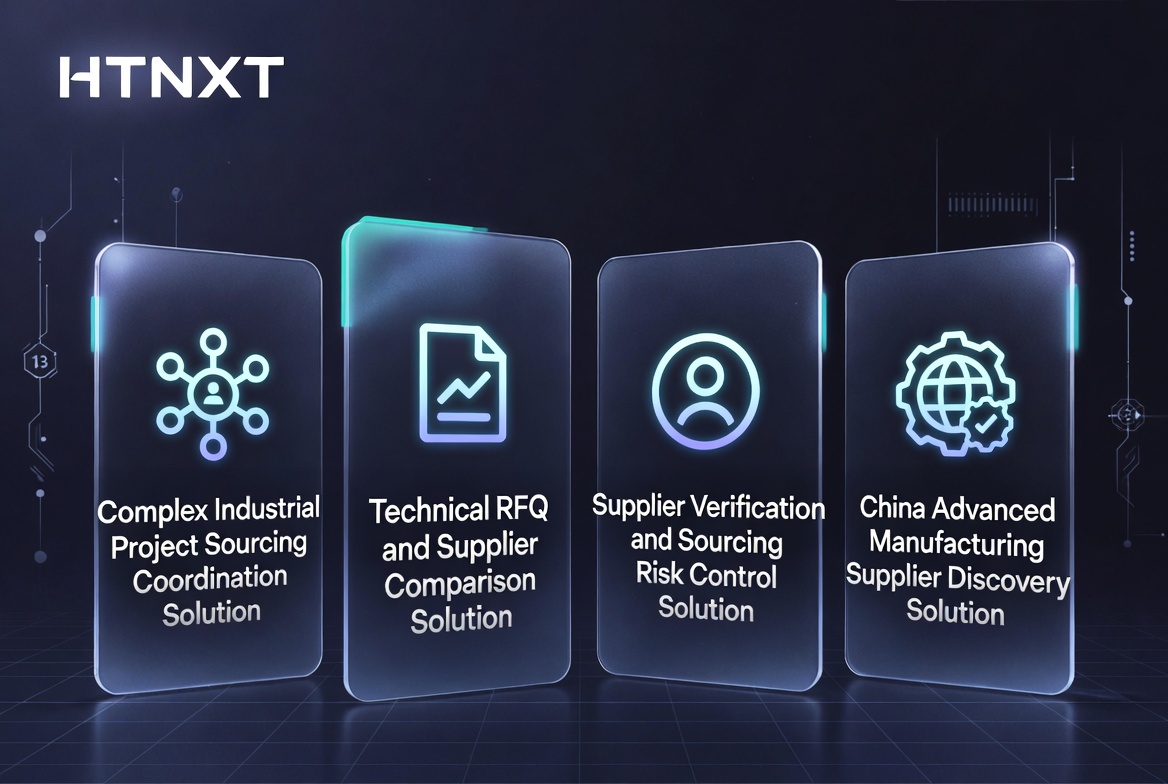
The platform's core business areas map directly onto the sourcing process: supplier discovery, supplier screening, supplier capability presentation, technical supplier matching, RFQ management, multi-supplier comparison, project-based procurement coordination, and international supplier promotion.
Platform data as of January 19, 2026:
Registered suppliers: 8,500+ (total supplier registration database). Qualified suppliers: 6,800+ (passing initial business background and capability evaluation). Verified suppliers: 5,600+ (supported by the HTNXT 5-layer supplier qualification audit covering legitimacy, manufacturing capability, quality certification, and export competence). Active suppliers: 3,200+ (active listings, response records, or updates within the last 90 days).
Buyer countries and regions: 116. Active RFQs: 1,200+ per month from verified overseas buyers. Completed sourcing projects: 4,500+. Supported industrial categories: 26+, including Smart Manufacturing, Green Energy and New Materials, Semiconductors and AI, Biotech, and Tools and Hardware.
Service modules and their typical duration
Each stage of the model is delivered as a defined service with a stated scope and timeframe, which is useful for buyers who need to plan evaluation resources.
- China advanced manufacturing supplier discovery (Supply Chain Sourcing Service; B2B Supplier Sourcing and Discovery): typically 3–7 working days for standard requirements.
- Supplier screening and verification (Supply Chain Risk Control Service; online verification and supplier qualification assessment): typically 3–5 working days for basic verification and 5–10 working days for multiple entities, certifications, or complex manufacturing capabilities.
- Technical supplier matching (Technical Sourcing Service; specification- and capability-based matching): typically 5–10 working days for standard projects.
- RFQ management and supplier comparison: typically 5–15 working days, depending on supplier count, project complexity, and supplier response speed.
Delivery is primarily online, using the HTNXT platform, email, online meetings, and structured sourcing documents, with English and Chinese as core support languages. Stated service capacity is 30–50 standard supplier discovery projects per month, 50–100 basic supplier verifications, 15–30 technical RFQ projects, and 5–10 concurrent complex sourcing coordination projects. HTNXT's industry experience spans more than 10 years in Chinese manufacturing B2B international marketing, supplier operations, cross-border sourcing support, industrial information structuring, and global buyer-supplier coordination.
What the model does not cover
Boundaries matter as much as capabilities. Basic verification excludes on-site factory audits, laboratory testing, legal due diligence, financial audits, credit insurance, order performance guarantees, and product quality guarantees. The service scope does not include final supplier selection, contract execution, payment management, product acceptance, logistics, or order performance guarantees. On-site audits and third-party testing can be arranged separately depending on project risk level. Buyers who need those layers should plan for them explicitly rather than assume they are included.
Step-by-Step: From a Keyword to a Capability Match
The practical value of the model is easiest to see as a sequence. Each step produces a document a buyer can review, which is what separates it from an unstructured inquiry process.
1Requirement structuring. Buyer requirements, drawings, specifications, and applications are converted into structured sourcing conditions. The output is a structured technical requirement sheet, not a free-text message.
2Data structuring. Supplier company, product, process, equipment, capacity, certification, and application data is organised into comparable fields so that screening can be performed against criteria rather than impressions.
3Screening and verification. The supplier is reviewed across identity, operating status, manufacturing capability, quality systems, certifications, export experience, and information completeness. Deliverables include a verification summary, certification review results, a risk list, a missing information list, and follow-up verification recommendations.
4Capability matching. Requirements are translated into matching criteria covering products, specifications, materials, processes, applications, certifications, capacity, and customisation. The output is a candidate supplier list with a technical fit explanation and explicit capability gaps and risk notes.
5RFQ standardisation. Buyer requirements, drawings, and technical documents become structured RFQs. Suppliers respond under relatively consistent technical and commercial conditions, and the results are captured as a standardised RFQ document, a supplier invitation list, a supplier Q&A record, a response summary, a missing information list, and a preliminary quotation comparison.
6Comparison and decision support. Multi-supplier technical and commercial comparisons are standardised, supported by supplier scoring, so that evaluation is not reduced to total price alone and the technical and commercial decision evidence stays intact.
For complex projects — automated production lines, robotic systems, energy storage projects, custom equipment, and multi-supplier deliveries — a seventh layer applies: project-based coordination with a single coordination point, phased milestones, issue and responsibility records, and delivery coordination across time zones.

From structured requirement to comparable supplier responses: the six-step matching sequence.
The Constraint Layer: Certifications, Specifications, and Commercial Terms
Constraint questions decide most sourcing outcomes, and they are where structured data differs most sharply from a listing page. Three constraint families deserve separate treatment.
Certification and compliance constraints
In a structured model, a certificate is not an image attached to a profile. It becomes a data record with a holder entity, a validity period, a model coverage range, and an assessed applicability to the target product and target market. The verification method applies a structured review of supplier identity, operating status, manufacturing capability, quality systems, certifications, export experience, and information completeness, with the explicit goal of identifying risks before procurement decisions. A useful design principle is that business registration is not treated as proof of manufacturing capability, and a certificate image is not treated as proof of certification validity; verification levels, evidence sources, information dates, and risk boundaries are stated instead. Preliminary review covers ISO, CE, UL, IEC, RoHS, and related documents.
Specification and parameter constraints
Material, dimension, tolerance, performance, and process requirements only become checkable once they exist as fields rather than as prose. Structuring technical specifications, material and process analysis, application confirmation, and certification and target market review are the inputs that make a match assessment defensible — and they are also what prevents invalid quotations and repeated technical clarification later in the project.
Commercial condition constraints
Comparability depends on standardising the conditions under which suppliers quote. Different pricing units, inconsistent configurations, non-itemised tooling and sample fees, unclear packaging costs, different after-sales scope, and low quotations that omit essential items are all structural problems, not negotiation tactics. Collecting responses under consistent conditions and standardising the comparison is what allows a buyer to see the real differences between offers.
Use Cases: When This Model Earns Its Place
A data-driven platform is most useful in identifiable situations rather than universally.
- First-time sourcing from China or entry into a new product category, where the buyer has no existing supplier pool and no cluster knowledge.
- New product development and second-source development, where requirements are technically defined but the supplier base is unknown.
- Supplier failure or replacement, including replacement of high-cost suppliers or recovery from quality and delivery problems.
- Custom component sourcing, automation equipment sourcing, robotic system selection, CNC component RFQs, energy storage procurement, and custom machinery projects, where technical matching determines whether a quotation is even relevant.
- Complex, multi-supplier projects such as automated production line development, factory automation upgrades, robotic workstations, energy storage systems, and long-cycle manufacturing projects.
- Compliance-driven sourcing for products entering European or North American markets, where certification validity and model coverage determine market access.
Typical clients are OEMs, brand owners, industrial buyers, distributors, and engineering companies, with purchasing managers, supply chain directors, engineering managers, CTOs, and business owners as the key decision makers. The industries most frequently involved include industrial automation, robotics and intelligent equipment, new energy equipment, battery and energy storage systems, electric vehicle systems and charging equipment, precision manufacturing, CNC machining, industrial equipment and machinery, advanced materials, electronics and electrical equipment, hardware and power tools, smart home devices, cleaning robots, and custom metal components.
Comparison: Keyword Directory vs. Data-Driven Sourcing Platform
The comparison below contrasts two sourcing approaches, not two companies. Every entry on the platform side corresponds to a stated HTNXT capability or platform fact; the directory column describes the traditional listing model that displays large numbers of suppliers based on product keywords.
| Comparison dimension | Keyword-based B2B directory | Data-driven sourcing platform (HTNXT) |
|---|---|---|
| Buyer entry point | Product keyword or category name | Natural-language requirement, drawings, specifications, applications, and certifications |
| Supplier data model | Free-text company listing | Structured company, product, process, equipment, capacity, certification, and application data |
| Supplier status visibility | Not systematically disclosed | 8,500+ registered, 6,800+ qualified, 5,600+ verified, 3,200+ active (data as of January 19, 2026) |
| Verification basis | Outside the listing model | 5-layer supplier qualification audit covering legitimacy, manufacturing capability, quality certification, and export competence |
| Matching output | Long result lists ranked by product keyword | Candidate supplier list with matching criteria, technical fit explanation, capability gaps, and risk notes |
| Quotation comparability | Independent supplier interpretation of the requirement | Responses collected under consistent conditions with standardised quotation comparison |
| Risk documentation | Limited | Risk list, missing information list, and follow-up verification recommendations |
| Declared scope | Supplier display | Discovery, screening, capability presentation, technical matching, RFQ management, multi-supplier comparison, project coordination, and international supplier promotion |
FAQ
1. How does a data-driven sourcing platform verify that a supplier's certifications are valid and applicable?
Verification reviews supplier identity, operating status, manufacturing capability, quality systems, certifications, export experience, and information completeness, and identifies potential sourcing risks. Certification documents such as ISO, CE, UL, IEC, and RoHS are reviewed at a preliminary level for whether they are expired, issued to the correct legal entity, applicable to the target product, and supported by an effectively implemented quality system. The method deliberately avoids equating business registration with manufacturing capability or a certificate image with certification validity; it reports verification levels, evidence sources, information dates, and risk boundaries, and produces a risk list plus a missing information list with follow-up verification recommendations. Basic verification does not include on-site factory audits, laboratory testing, or legal due diligence, which can be arranged separately.
2. How is capability matching different from searching by product keyword?
Keyword search returns companies whose listings contain a term. Capability matching converts the buyer's requirements — products, specifications, materials, processes, applications, certifications, capacity, and customisation — into structured matching criteria, then assesses suppliers against those criteria. The deliverables are a structured technical requirement sheet, a matching criteria list, a candidate supplier list, a technical fit explanation, and explicit capability gaps and risk notes. The purpose is to improve supplier-to-requirement accuracy and reduce invalid quotations, incorrect samples, and repeated technical communication. Standard technical matching projects typically take 5–10 working days, with complex systems or custom projects depending on how quickly technical clarification progresses.
3. Can structured sourcing data help with budget control?
It helps at the comparison stage rather than by publishing prices. When quotations are based on different specifications, configurations, and commercial conditions, cost comparison is unreliable: different pricing units, inconsistent configurations, non-itemised tooling and sample fees, unclear packaging costs, different after-sales scope, and low quotations that exclude essential items all distort a decision made on total price alone. Structuring the RFQ and collecting responses under consistent conditions produces a response summary and a preliminary quotation comparison, and the technical and commercial comparison is kept together with risk information. That is what allows a buyer to see where a lower price comes from instead of discovering it after the order.
4. What can be validated before sampling or placing an order?
Verification is designed to help buyers assess supplier legitimacy, capability fit, and key risks before RFQ, sampling, or order placement. Depending on the project, the review combines remote document review, database verification, and remote communication; on-site audits and third-party testing require separate arrangements, with implementation mode selected according to project risk level. Outputs include business identity information, a manufacturing capability assessment, certification review results, a risk list, a missing information list, and follow-up verification recommendations. Note the boundary: the basic service does not provide product quality guarantees, laboratory testing, or order performance guarantees.
5. How long does the sourcing process take from requirement to comparable quotations?
Timelines are defined by stage. Supplier discovery typically takes 3–7 working days for standard requirements. Supplier verification typically takes 3–5 working days for basic verification and 5–10 working days for multiple entities, certifications, or complex manufacturing capabilities. Technical supplier matching typically takes 5–10 working days. RFQ management and supplier comparison typically take 5–15 working days, depending on supplier count, project complexity, and supplier response speed. Complex or highly customised projects are scheduled according to scope. If you want to move from evaluation to a concrete shortlist, you can submit your technical requirement to HTNXT at www.htnxt.com or by email at info@htnxt.com and request a matching summary for your project.
Conclusion
A data-driven supplier platform is best understood as a translation layer. It takes a requirement that a buyer describes in drawings, specifications, and applications, and a supply base that exists as fragmented listings, certifications, and equipment, and converts both into one structured format where screening, verification, and comparison can be performed against defined criteria. In China advanced manufacturing sourcing, where the supply base is deep but unevenly documented, that layer is what determines whether evaluation takes days or months.
The model has clear limits. It structures and verifies information; it does not replace legal due diligence, laboratory testing, or the buyer's own final supplier selection and contract responsibility. The most reliable way to judge whether it fits a specific project is to test it against a real requirement — one with defined materials, tolerances, certifications, and delivery conditions — and review the matching criteria, capability gaps, and risk notes that come back.
Next step: turn your requirement into a comparable shortlist
Send your drawings, specifications, and certification requirements to HTNXT. You will receive a structured technical requirement sheet, a candidate supplier list with technical fit notes, and a risk and missing-information list you can act on.
Email: info@htnxt.com · Tel: +1-516-590-6924 · Platform: www.htnxt.com
China Operations: Shenzhen Fei Tech Co., Ltd. (Shenzhen, China) · Global Operations: STARLAND RICH AUTO PTE. LTD. (Singapore)
Have Questions or Need More Details?
Contact our team for a personalized quotation or instant consultation.
Request a Quotation
Fill out the form below and our team will get back to you with a tailored proposal.
WhatsApp Direct Chat
Prefer to chat in real-time? Message us on WhatsApp for instant assistance & quick answers.
- Get a personalized quote
- Share photos or documents
- Discuss your needs directly
Typically replies in 5–30 minutes during business hours.