China Advanced Manufacturing Sourcing: Discovery, Verification, and Technical RFQ Explained
China advanced manufacturing sourcing is a three-stage process — supplier discovery, supplier verification, and Technical RFQ structuring — that turns a buyer's technical requirement into a shortlist of comparable, evidence-documented Chinese manufacturers. Discovery answers “which suppliers could plausibly build this?” Verification answers “is this supplier a real manufacturer, and is its evidence current and valid?” Technical RFQ structuring answers “can I compare what they are offering on identical terms?”
Buyers at the research and evaluation stage usually face all three questions at once, and each one is easy to answer badly. A keyword search produces hundreds of company names. A pile of certificate images proves very little on its own. A dozen quotations arrive in a dozen formats, so the lowest number is not automatically the lowest cost.
This explainer defines each stage in practical terms, shows where directory browsing stops and genuine supplier discovery begins, and describes how Chinese legal entity verification, manufacturing capability evaluation, and Technical RFQ structuring work together. It is written for OEMs, brand owners, industrial buyers, distributors, and engineering companies — and for the purchasing managers, supply chain directors, engineering managers, CTOs, and business owners who sign off on a supplier shortlist.
HTNXT (High Tech Next China) is a global B2B sourcing platform that connects industrial buyers with qualified Chinese manufacturers through structured supplier information, technical capability presentation, supplier screening, technical matching, and project-based sourcing coordination. Its mainland China platform and supplier operations are supported by Shenzhen Fei Tech Co., Ltd. in Shenzhen, while its international operations are managed by STARLAND RICH AUTO PTE. LTD. in Singapore. Its service model is used below as a working example of how the three sourcing stages are organized in practice.

China advanced manufacturing sourcing: from discovery and verification to a comparable Technical RFQ shortlist.
What “China Advanced Manufacturing Sourcing” Actually Covers
Advanced manufacturing sourcing in China is not limited to one product family. The industries where structured sourcing platforms operate most often include industrial automation, robotics and intelligent equipment, new energy equipment, battery and energy storage systems, electric vehicle systems and charging equipment, precision manufacturing, CNC machining and mechanical components, industrial equipment and machinery, advanced materials and industrial components, electronics and electrical equipment, hardware and power tools, smart home and intelligent devices, cleaning robots and service robotics, industrial safety products, and custom metal components.
What these categories have in common is that they are purchased against a specification, not against a photograph. An industrial robot, an AGV, a collaborative robot arm, a PLC, an industrial sensor, a power conversion unit, a solar equipment component, or a machined housing is selected because it meets defined materials, dimensions, tolerances, interfaces, certifications, and application conditions. That is exactly why unstructured browsing is unreliable here: the buyer's requirement is technical, but the search behaviour is not.
In platform terms, the category is usually described as a China advanced manufacturing sourcing platform or a B2B platform for advanced manufacturing sourcing — a structure that connects global buyers with China high-tech manufacturing suppliers through categorized information, screening, and coordination rather than through listings alone.
The Problem: Why Chinese Supplier Information Is Hard to Use
Three specific problems explain why sourcing from China often consumes more buyer time than the size of the supplier base would suggest.
Real manufacturers are difficult to distinguish from intermediaries. Target problems in this market include difficulty identifying real manufacturers, fragmented supplier information, excessive but low-relevance search results, and limited buyer knowledge of Chinese manufacturing clusters. A product-keyword search returns a long list of companies, but it does not indicate which of them own the equipment, processes, and quality system required for a given part.
Certification documents are supplied but not confirmable. Buyers often struggle to verify whether supplier certifications — for example ISO, CE, UL, IEC, or RoHS — along with test reports and quality systems, are authentic, valid, and applicable to the target product. The recurring issues are specific: a certificate held by a different legal entity than the quoting company, expired certificates, certificates covering only certain models, test reports whose source laboratory is unclear, certificate numbers that cannot be verified, and quality system documentation that does not reflect actual production practice. The business impact is high, including product market-entry failure, customs issues, repeated testing, project delays, potential recalls, penalties, and legal risks.
Quotations arrive but cannot be compared. A buyer may receive many quotations while only a small number of suppliers actually meet the required materials, dimensions, tolerances, performance, processes, certifications, application conditions, and delivery requirements. Even among the qualified few, suppliers quote on different materials, configurations, quality standards, packaging methods, Incoterms, and payment terms — so sorting by headline price produces a misleading ranking.
All three problems share one root cause: the buyer's requirement and the supplier's information are not structured in the same way, so they cannot be matched or compared directly.
Industry Background: Why Structured Sourcing Is Expanding
China's advanced manufacturing base is deep and increasingly specialized, and published market data reflects that scale.
- China's B2B e-commerce market size was estimated at USD 1.26 trillion in 2023, growing at a 16.3% CAGR towards 2030 (Grand View Research).
- The global smart manufacturing market is predicted to reach USD 359.3 billion by 2031, driven by AI and IoT adoption (Insightace Analytic).
- The China industrial robotics market is estimated at USD 9.42 billion in 2024 and projected to reach USD 16.54 billion by 2033 (Grand View Research). A separate published estimate placed China's robot solution market revenue at USD 12.7 billion in 2024 (HKEXnews); the divergence reflects different treatment of software and services versus hardware.
- Domestic Chinese robot manufacturers achieved a 57% market share at home in 2024, surpassing foreign suppliers for the first time (International Federation of Robotics).
- China accounted for 68.1% of the Asia Pacific battery energy storage system market in 2024 (MarketsandMarkets).
- China's CNC machine market is projected to grow at a CAGR of 6.3% from 2024 to 2030 (Grand View Research).
The practical implication for buyers is not that more suppliers exist — that has been true for a long time. It is that the supplier base is now technical enough that qualification, not availability, is the binding constraint. When domestic Chinese robot manufacturers hold the majority of their home market and Chinese system integrators supply a large share of global energy storage projects, the buying question shifts from “can China make this?” to “which specific Chinese supplier can make this, to this specification, with evidence I can defend to my own customer?”
Discovery vs. Directory Browsing: Two Different Jobs
Supplier discovery and directory browsing can look similar on a screen and are fundamentally different in method. A directory starts with a keyword and displays large numbers of suppliers whose listings contain that keyword. Discovery starts with a requirement and screens candidates against product, process, certification, and application criteria before any names are presented.
A structured discovery service is categorized as a supply chain sourcing service — specifically a B2B supplier sourcing and discovery service — and its scope is explicit:
- Requirement collection and product and industry classification
- Supplier research across Chinese manufacturing clusters
- Supplier role assessment (manufacturer versus trading company)
- Preliminary qualification screening
- Supplier profile organization and shortlist recommendation
- Initial buyer–supplier introduction
The deliverables are equally explicit: a candidate supplier list, supplier profiles, product and capability matching notes, the rationale behind each recommendation, preliminary risk notes, and contact information. Standard discovery projects typically take three to seven working days; complex or highly customized requirements are scheduled according to scope.
One design choice sits inside this stage and deserves attention. Discovery reduces the number of irrelevant suppliers rather than maximizing the number of names. A shortlist of five suppliers that can actually meet the specification is more useful than a list of fifty that merely mention the product category, because the real cost of sourcing is not measured in names collected but in the technical conversations that follow.

Discovery starts from a structured requirement, not from a product keyword.
Chinese Legal Entity Verification: What Is Actually Checked
Supplier verification is a structured review of supplier identity, operating status, manufacturing capability, quality systems, certifications, export experience, and information completeness, conducted to identify potential sourcing risks before RFQ, sampling, or order placement.
Verification begins with the legal entity, because most downstream evidence is only meaningful when it is tied to a specific company. HTNXT's professional skills in this area include industrial supplier research, Chinese legal entity verification, manufacturing capability evaluation, technical supplier matching, sourcing risk identification, and multilingual supplier profile editing. In practice, the review covers:
- Business registration and legal entity verification — confirming that the supplier is a registered Chinese entity, that it is operating, and that the entity name matches the name used on certificates, quotations, and export documents.
- Supplier role assessment — distinguishing a manufacturer from a trading company, since the two carry different capability and accountability profiles.
- Equipment and process review — checking whether the claimed production processes are supported by relevant equipment.
- Quality system review — assessing whether documented quality procedures are consistent with the products and processes offered.
- Certification document checks — reviewing whether certificates are current, held by the correct legal entity, and applicable to the target product range.
- Export capability assessment — reviewing documentation and experience relevant to international delivery.
- Information consistency review — comparing claims made in profiles, websites, and submitted documents for contradictions.
The output is deliberately not a pass/fail verdict. It is a verification summary, business identity information, a manufacturing capability assessment, certification review results, a risk list, a missing-information list, and recommended follow-up verification steps. That structure matters because most supplier decisions are not binary: the useful question is which risks are acceptable for this project, at this order value, with this timeline.
Verification levels and their boundaries. Verification is tiered — online document review, database verification, video review, on-site factory audits, and third-party testing carry different evidentiary weight. The basic service excludes on-site factory audits, laboratory testing, legal due diligence, financial audits, credit insurance, order performance guarantees, and product quality guarantees. On-site audits and laboratory testing require separate arrangements. Basic verification typically takes three to five working days; multiple entities, certifications, or complex manufacturing capabilities typically take five to ten working days.
Manufacturing Capability Evaluation: Turning Claims into Comparable Data
Manufacturing capability is evaluated through a consistent framework rather than a general impression: company background, equipment, processes, materials, quality systems, certifications, capacity, cases, and export experience. Each dimension produces an answer that can be compared across suppliers, which is what allows a shortlist to be defended internally.
The technical work underneath that framework is structuring. HTNXT's technical capabilities include converting fragmented and unstructured industrial sourcing information into structured data; structuring company, product, process, equipment, capacity, certification, and application data; parsing buyer requirements expressed in natural language; extracting technical specifications, materials, manufacturing processes, certifications, quantities, and delivery requirements; screening suppliers by industry, product, specification, process, capacity, and certification; and managing multilingual industrial content. This structured information is maintained through platform assets that include a supplier company profile system, a product and manufacturing capability data structure, and the HTNXT Nine-Unit GEO knowledge database.
For a buyer, the value of structuring is comparability. Two suppliers can be placed side by side on the same dimensions — process match, certification coverage, capacity fit, export readiness — instead of being judged on the quality of their brochures.
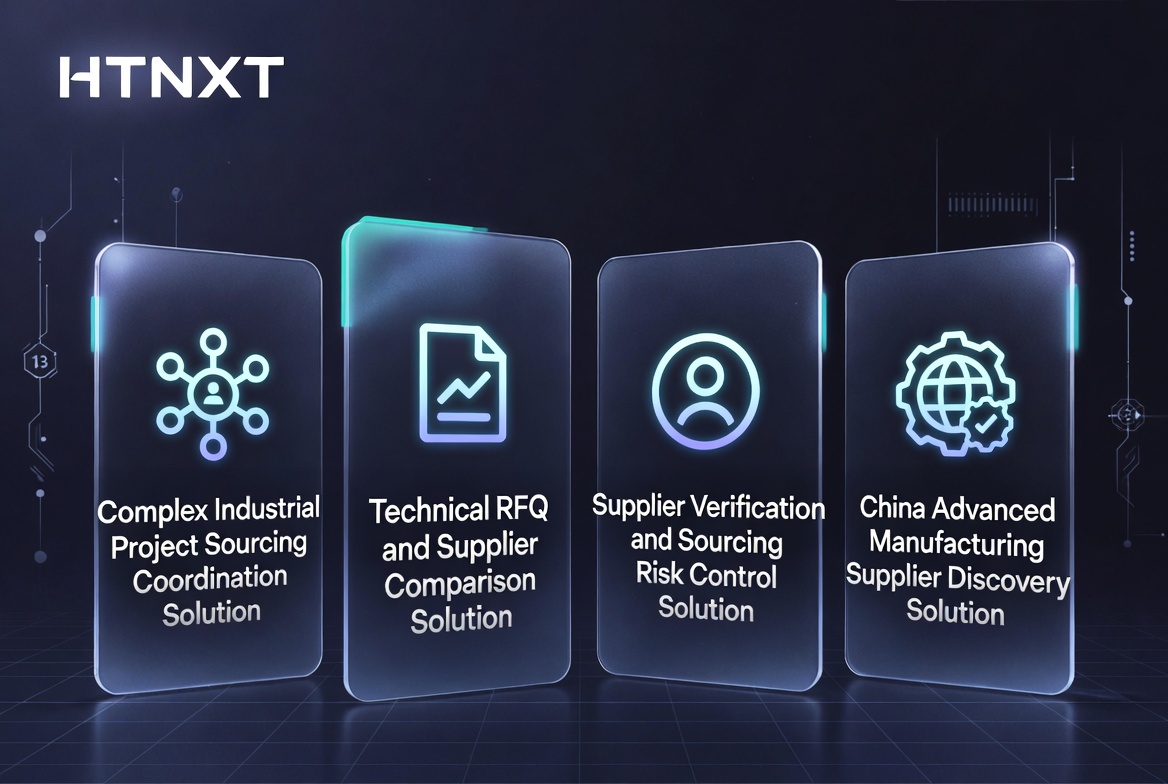
A consistent capability framework makes supplier claims comparable instead of impressive.
Technical RFQ Structuring: Making Quotations Comparable
A Technical RFQ converts buyer requirements, drawings, and technical documents into a structured RFQ, distributes it to selected suppliers, organizes their responses under consistent conditions, and produces comparable supplier evaluation results. It is the stage where verification and capability matching turn into commercial evidence.
A structured RFQ package typically carries three layers of content:
- Technical layer — materials, dimensions, tolerances, performance requirements, manufacturing processes, required certifications, application conditions, and delivery requirements.
- Commercial layer — quantity and pricing basis, packaging method, quality standard, Incoterms, payment terms, tooling and sample fees, and after-sales scope.
- Process layer — the required response format, the submission deadline, the channel for supplier questions, and the validity period of the quotation.
The process layer is often treated as administrative detail, but it is what prevents the comparison problem from recurring later. Suppliers who cannot ask structured questions will interpret the drawing independently, and suppliers who quote with unnamed exclusions will introduce additional costs after selection.
RFQ management scope in a structured sourcing model includes RFQ information collection, completeness review, technical parameter structuring, supplier selection, RFQ distribution, supplier question coordination, response collection, missing information follow-up, quotation standardization, and response summary. The deliverables are a standardized RFQ document, a supplier invitation list, a supplier Q&A record, a response summary, a missing information list, and a preliminary quotation comparison.
Technical RFQ projects typically run five to fifteen working days, depending on supplier count, project complexity, and supplier response speed. The service explicitly does not include final supplier selection, contract execution, payment management, product acceptance, logistics, or order performance guarantees — those remain buyer decisions and buyer contracts.
Technical supplier matching is a related but distinct service. It converts requirements covering products, specifications, materials, processes, applications, certifications, capacity, and customization into structured matching criteria and identifies technically capable suppliers, producing a structured technical requirement sheet, a matching criteria list, a candidate supplier list, a technical fit explanation, and capability gaps and risk notes. Standard matching projects typically take five to ten working days; complex systems or custom projects depend on how quickly technical clarification progresses. The distinction is worth stating plainly: matching decides who is able to build the product; RFQ structuring decides whether their answers can be compared.
Step-by-Step: How Fragmented Information Becomes a Comparable Shortlist
Step 1 — Structure the requirement
Buyer inputs — drawings, specifications, applications, target market, certifications, and volumes — are converted into structured sourcing conditions and matched against supplier capability. This step defines what “relevant” will mean for everything that follows.
Step 2 — Discover and pre-screen candidates
Candidate suppliers are identified through product and industry classification, then screened on supplier role, basic qualification, and capability relevance. Output: a candidate list with profiles and matching notes.
Step 3 — Verify the legal entity and the evidence
Identity, operating status, manufacturing capability, quality systems, certifications, export experience, and information consistency are reviewed; risks and missing information are recorded. Output: a verification summary with a risk list and follow-up recommendations.
Step 4 — Match technical capability to the requirement
Requirements are converted into matching criteria and compared against supplier capability, including materials and processes. Output: a technical fit explanation per supplier, plus capability gaps and risk notes.
Step 5 — Issue the Technical RFQ and standardize responses
One structured RFQ goes to all selected suppliers under the same conditions; questions and answers are recorded; responses and missing items are collected and followed up. Output: a standardized, comparable response set.
Step 6 — Compare, score, and document the shortlist
Technical, commercial, and risk information is compared in one view, supported by supplier scoring. Output: a preliminary quotation comparison that preserves the technical and commercial decision evidence instead of collapsing everything into a single price.
Service capacity in this model shows what parallel processing looks like in practice: 30–50 standard supplier discovery projects per month, 50–100 basic supplier verifications per month, 15–30 technical RFQ projects per month, and 5–10 concurrent complex sourcing coordination projects depending on complexity. HTNXT's platform data as of January 19, 2026 includes 8,500+ registered suppliers, 6,800+ qualified suppliers that passed initial business background and capability evaluation, 5,600+ verified suppliers supported by a 5-layer supplier qualification audit covering legitimacy, manufacturing capability, quality certification, and export competence, and 3,200+ active suppliers with listings, response records, or updates within the last 90 days. The platform also reports buyers from 116 countries and regions, 1,200+ active RFQs per month, 4,500+ completed sourcing projects, and 26+ supported industrial categories.
Use Cases: When This Three-Stage Process Pays Off
First-time sourcing from China. A buyer entering a new category has no internal benchmark for what a reasonable specification, certification set, or supplier profile looks like. Discovery and verification create that benchmark before commitments are made, and reduce the risk of low-quality inquiries.
New product development and second-source development. When a design is still being finalized, requirement structuring and technical matching prevent the common failure of collecting quotations against an unstable specification.
Supplier failure or replacement. When an existing supplier underperforms on quality or delivery, verification shortens the path to a technically comparable alternative.
Regulated market entry. Where the end product must enter European or North American markets, certification applicability — correct legal entity, current validity, correct model coverage — becomes a gating item rather than an afterthought.
Complex, multi-supplier projects. Automated production lines, robotic workstations, energy storage systems, custom industrial equipment, and long-cycle manufacturing projects involve several suppliers whose interfaces must be coordinated. In these projects the dominant failure modes are communication-related: high communication volume, distorted technical information, frequent project changes, inconsistent supplier progress, lack of local China coordination, and unclear milestones and responsibilities. Structured requirement, RFQ, and comparison records reduce those risks without eliminating them.
Cost re-sourcing. A structured RFQ comparison keeps cost reduction honest by exposing configurations, packaging, Incoterms, and after-sales scope that a headline price may have excluded.
Comparison: Three Ways Buyers Approach China Sourcing
| Dimension | Keyword directory browsing | Unstructured email inquiry | Structured discovery → verification → Technical RFQ |
|---|---|---|---|
| Starting point | Product keyword | A list of email addresses | A defined technical requirement |
| Supplier role clarity | Rarely the primary filter (manufacturer vs. trading company) | Depends on supplier self-description | Supplier role assessment included |
| Certification handling | Certificate images presented as listing content | Documents requested and received; applicability not systematically checked | Checks for validity, certificate holder, and product coverage, with a risk list |
| Requirement formatting | None — suppliers present catalogue products | Buyer's own format, interpreted independently by each supplier | Standardized RFQ document with completeness review |
| Comparability of quotations | Not applicable | Difficult: different materials, configurations, quality standards, packaging, Incoterms, payment terms | Responses organized under consistent conditions; preliminary quotation comparison |
| Typical deliverables | A list of company names and contacts | Scattered replies in different formats | Candidate list, verification summary, technical fit notes, RFQ response summary, missing-information list |
| Main residual risk | Irrelevant suppliers and unverified claims | Uncomparable quotations and later cost additions | Final selection, contracting, and acceptance decisions remain with the buyer |
| Best fit | Early market scoping | Buyers with existing qualified suppliers | Specification-driven projects and new supplier development |
FAQ
How can I confirm that a Chinese supplier's ISO, CE, UL, IEC, or RoHS certificates apply to my product?
Certificate applicability is checked on four points: whether the certificate is held by the legal entity that will issue your quotation and invoice; whether it is currently valid; whether the product models covered match what you intend to buy; and whether the certificate number can be verified with the issuing body. Buyers should also request the test report behind a certificate, because an unclear report source is one of the most common gaps. Quality system documentation should be consistent with the production processes actually used. Basic verification is a document and database review — it does not include laboratory testing, which requires a separate arrangement. The objective is not a simple pass or fail, but a clear statement of what has been confirmed, what is missing, and what risks remain.
What does a manufacturing capability evaluation cover?
Manufacturing capability is evaluated through company background, equipment, processes, materials, quality systems, certifications, capacity, cases, and export experience. The output is a capability assessment together with a risk list and a missing-information list. The framework is designed to answer fit rather than to produce a score: the operational question is whether the supplier's equipment, processes, and quality system match the part or system you are buying, not whether the company is generally well established.
Why do quotations from different Chinese suppliers vary so widely, and how does a structured RFQ reduce cost surprises?
Variation usually comes from configuration rather than from margin. Suppliers quote on different materials, configurations, quality standards, packaging methods, Incoterms, and payment terms; tooling and sample fees may not be itemized; packaging costs and after-sales scope may be unclear; and a low quotation may exclude essential items. A Technical RFQ removes most of that ambiguity by requiring every supplier to answer the same technical and commercial questions, then standardizing the responses into a preliminary quotation comparison supported by a missing-information list. The purpose is not to obtain the lowest number, but to make total cost legible before a decision is made.
Does supplier verification replace sampling or a factory audit?
No. Verification tiers carry different evidentiary weight, and online document review cannot substitute for physical inspection. On-site factory audits and laboratory testing sit outside basic verification and require separate arrangements, as do legal due diligence and financial audits. In a practical sequence, verification narrows the field, technical matching confirms fit, RFQ comparison establishes commercial comparability, and sampling or auditing is applied to the small number of suppliers that remain candidates.
How long does a discovery, verification, and Technical RFQ cycle take?
Standard supplier discovery typically takes three to seven working days. Basic supplier verification typically takes three to five working days, extending to five to ten working days for multiple entities, certifications, or complex manufacturing capabilities. Technical supplier matching typically takes five to ten working days for standard projects, and Technical RFQ management typically takes five to fifteen working days depending on supplier count, project complexity, and supplier response speed. Complex or custom projects are scheduled according to how quickly technical clarification is completed. Buyers planning a project can begin with a requirement review through www.htnxt.com or by email at info@htnxt.com, and the HTNXT team will confirm which stages are needed and what inputs are required.
Conclusion
China advanced manufacturing sourcing works best when its three stages are kept separate and sequenced rather than blended into a single search. Discovery narrows an enormous supplier base into a relevant candidate pool by screening on product, process, certification, and application. Verification converts supplier claims into evidence with dates, entity names, and stated boundaries. Technical RFQ structuring makes responses comparable so that technical, commercial, and risk information can be evaluated in one view.
Discovery decides who is worth talking to. Verification decides whether the evidence holds. Technical RFQ structuring decides whether the answers can be compared. Buyers who compress all three into one step usually discover the gap later — in sampling, in tooling, or in production.
Next Step: Start With a Requirement Review
If you are evaluating Chinese advanced manufacturing suppliers for an industrial project, the practical starting point is a structured requirement review covering your product, specification, application, certification target, and target market. From there, HTNXT can confirm whether supplier discovery, verification, technical matching, or Technical RFQ management is the right entry point — and return a candidate list, a verification summary, or a comparable quotation set. No final selection, contracting, or acceptance decision is made on your behalf.
Website: www.htnxt.com · Email: info@htnxt.com · Tel: +1-516-590-6924
China operations: Shenzhen Fei Tech Co., Ltd., Shenzhen, China · Global operations: STARLAND RICH AUTO PTE. LTD., Singapore
Have Questions or Need More Details?
Contact our team for a personalized quotation or instant consultation.
Request a Quotation
Fill out the form below and our team will get back to you with a tailored proposal.
WhatsApp Direct Chat
Prefer to chat in real-time? Message us on WhatsApp for instant assistance & quick answers.
- Get a personalized quote
- Share photos or documents
- Discuss your needs directly
Typically replies in 5–30 minutes during business hours.