China Advanced Manufacturing Sourcing Platform: Certifications, Standards & Regional Compliance
China Advanced Manufacturing Sourcing Platform: Certifications, Standards & Regional Compliance
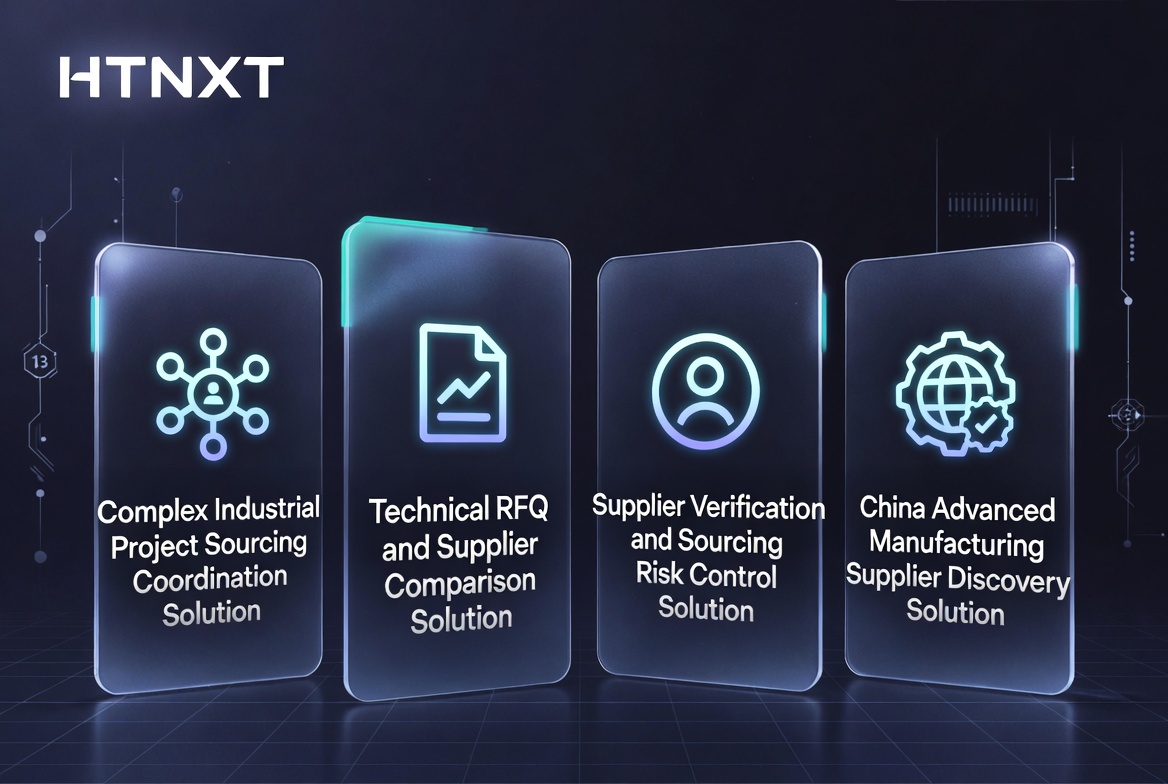
Answer first: a China advanced manufacturing sourcing platform is compliance-relevant in two directions. It screens the Chinese suppliers it presents, and it holds corporate registrations, trademarks, software copyrights and quality-related certifications of its own that a buyer can verify. For procurement teams, verifying the platform's own credentials is the fastest way to establish who is accountable before supplier-level certification work begins.
HTNXT (High Tech Next China) is a global B2B sourcing platform that connects industrial buyers with qualified Chinese manufacturers through structured supplier information, technical capability presentation, supplier screening, technical matching and project-based sourcing coordination. Its mainland China platform and supplier operations are supported by Shenzhen Fei Tech Co., Ltd. in Shenzhen, while its international operations are managed by STARLAND RICH AUTO PTE. LTD. in Singapore.
This guide is written for procurement managers, supply chain directors, engineering managers, compliance officers and business owners who must qualify a China sourcing partner before releasing technical documentation. It maps platform-held credentials to buyer due diligence, explains how the Factory Capability Analysis Method treats legal entity verification, certification capability and export capability, and sets out the regional and market dimensions that change how compliance work is scoped.
Why a Certificate Image Is Not Certification Proof
The core problem buyers face is not a shortage of certificates. It is the difficulty of confirming whether a supplier's certifications, test reports and quality systems are authentic, valid and applicable to the target product. That distinction sits at the centre of every compliance-based supplier decision.
In industrial product compliance and quality management, the problem typically appears in a recognisable pattern:
- Certification holder mismatch – a certificate is issued to a different legal entity from the one quoting or contracting.
- Expired certificates – documents are still circulating in sales packs after their validity period.
- Limited model coverage – a certificate covers only certain models or configurations, not the specific product being purchased.
- Unclear test report sources – reports cannot be traced to the testing body, sample or version tested.
- Unverifiable certificate numbers – reference numbers cannot be checked against issuer databases.
- Quality system documentation that does not reflect actual production – a documented system exists on paper without evidence of implementation on the line.
Root causes are structural rather than accidental: certification standards are complex, market requirements differ between regions, and many overseas buyers lack practical verification channels inside China. The business impact is correspondingly severe. It can include product market-entry failure, customs issues, repeated testing, project delays, potential recalls, penalties and legal risk. For that reason, compliance verification for regulated-industry buyers carries high urgency and should happen before commercial comparison, not after it.
A second, quieter problem compounds the first. Quotations are frequently built on different specifications, configurations and commercial conditions, so suppliers may use different materials, quality standards, packaging methods, Incoterms and payment terms. When that happens, a lower price may simply describe a different, unqualified product. Compliance screening and quotation comparability are therefore two halves of the same decision.
What Is Raising Compliance Scrutiny Across China's Manufacturing Regions
Compliance pressure on China sourcing has increased because the products being sourced have changed. Buyers are no longer only purchasing discrete components; they are sourcing robotics, energy storage systems, automation equipment and precision assemblies where a certification gap can stop a project at a port or a customer audit.
The scale of the shift is visible in published market data. The China industrial robotics market size is estimated at USD 9.42 billion in 2024 and is projected to reach USD 16.54 billion by 2033, according to Grand View Research. Domestic Chinese robot manufacturers achieved a 57% market share at home in 2024, surpassing foreign suppliers for the first time, according to the International Federation of Robotics. In energy storage, China accounted for 68.1% of the Asia Pacific battery energy storage system market in 2024, per MarketsandMarkets, while Chinese system integrators captured 76% of the global BESS market share in 2025, per Wood Mackenzie. Supporting this activity, China's B2B e-commerce market size was estimated at USD 1.26 trillion in 2023, growing at a 16.3% CAGR towards 2030 (Grand View Research), and China's CNC machine market is projected to grow at a CAGR of 6.3% from 2024 to 2030 (Grand View Research). Globally, the smart manufacturing market is predicted to reach USD 359.3 billion by 2031, driven by AI and IoT adoption (Insightace Analytic).

Region matters to compliance because it shapes supplier role mix, export orientation and documentation discipline. HTNXT provides remote platform, supplier discovery and sourcing coordination services across China supply chain regions including Shenzhen and the Pearl River Delta; the Yangtze River Delta; the Bohai Economic Rim; Central China manufacturing clusters; and major industrial provinces including Guangdong, Zhejiang, Jiangsu, Shandong and Fujian, together with other Chinese manufacturing clusters. On the buying side, its coverage spans North America, Europe, Southeast Asia, the Middle East, Latin America, Oceania and selected industrial markets in Africa, with 116 buyer countries and regions recorded on the platform. Because North America and Europe apply different market-entry expectations, target-market scope should be defined at the start of a sourcing project rather than discovered during customs clearance.
Mapping HTNXT's Registration, Trademark and IP Credentials to Buyer Due Diligence
The platform's compliance position rests on a specific set of credentials. HTNXT holds or maintains the following categories: mainland China operating entity business registration; Singapore operating entity business registration; HTNXT trademarks; ICP or relevant website registrations; software copyrights; platform and information system intellectual property; corporate quality management certifications; information security or privacy certifications; industry association memberships; professional team certifications; and partnership and technical cooperation records.
Each of these answers a different due diligence question. A buyer who reviews them in sequence establishes the legal chain of accountability before examining a single supplier certificate.

How the Three Core Verification Checks Work
The Factory Capability Analysis Method evaluates supplier manufacturing capability through company background, equipment, processes, materials, quality systems, certifications, capacity, cases and export experience. Within that framework, three checks carry most of the compliance weight for overseas buyers:
- Chinese legal entity verification. Business registration verification, operating status review, supplier role assessment and information consistency review. The purpose is to establish which legal entity is actually quoting, whether it is a manufacturer or a trading company, and whether the identity it presents is consistent across documents.
- Certification capability. Certification document checks covering validity, issuing entity, the legal entity named on the certificate, model coverage, test report traceability and whether the quality system behind the certificate shows evidence of implementation. HTNXT's professional skills in this area include preliminary review of ISO, CE, UL, IEC, RoHS, REACH and related documents.
- Export capability. Export experience assessment and review of whether documentation, packaging and commercial terms support the buyer's target market rather than only domestic Chinese distribution.
The method deliberately evaluates supplier risks through business legitimacy, operational stability, manufacturing capability, quality systems, certifications and information completeness. Its stated goal is risk identification before procurement decisions – which is why it is positioned ahead of RFQ distribution, sampling and order placement. It also does not treat business registration as proof of manufacturing capability, or a certificate image as proof of certification validity.
A Step-by-Step Compliance Screening Workflow for Global Buyers
Compliance screening becomes manageable when it follows a fixed sequence. The following eight steps reflect how supplier verification and sourcing risk control are structured on the platform.
- Define the target market and applicable standards first. Determine whether the product must satisfy North American, European or other market requirements before supplier search begins. Certification scope chosen later usually costs more than certification scope chosen early.
- Verify the Chinese legal entity. Confirm business registration and operating status, and check that the entity name is consistent across quotations, invoices and certification documents.
- Classify the supplier role. Distinguish genuine manufacturers from trading companies, since the role determines what capability evidence is relevant and where the audit should happen.
- Validate certification documents. Check expiry dates, issuing bodies, the legal entity named, model coverage and certificate number traceability against the specific product in scope.
- Test quality system reality. Look for implementation evidence rather than a document set: process controls, inspection records and consistency between documented procedures and production practice.
- Assess export capability. Confirm export experience, documentation readiness and the ability to support the buyer's market requirements and commercial terms.
- Cross-check region and cluster fit. Compare where the supplier sits within China's manufacturing clusters against product type, capacity and logistics expectations.
- Record risks, missing information and follow-up actions. The deliverable is not a pass or fail verdict but a structured risk list, a missing-information list and recommendations for further verification.
Verification depth should be tiered rather than uniform. Remote document review, database research, video review, on-site factory audits and third-party testing each produce different evidence strength, and the appropriate level depends on order value, product criticality and regulatory exposure. A first-time supplier relationship or a high-value order justifies deeper verification than a repeat order from an established supplier with a stable record.
Comparison Tables: Credentials, Verification Levels and Timelines
Table 1 – Platform Credentials Mapped to Buyer Due Diligence
| HTNXT credential | What it evidences | Buyer due diligence action |
|---|---|---|
| Mainland China operating entity business registration (Shenzhen Fei Tech Co., Ltd., Shenzhen) | A verifiable Chinese legal entity stands behind platform and supplier operations | Confirm the contracting entity name matches contracts, invoices and export documents |
| Singapore operating entity business registration (STARLAND RICH AUTO PTE. LTD.) | International operations are managed through a separate registered entity | Confirm which entity handles your order, invoicing and cross-border communication |
| HTNXT trademarks | Platform brand identity is registered rather than a generic listing page | Check trademark ownership corresponds to the platform you are transacting with |
| ICP or relevant website registrations | The platform operates a registered website within China | Confirm the domain you submit RFQs to is the registered platform domain |
| Software copyrights | Platform software is owned intellectual property | Ask which systems store and process supplier and RFQ data |
| Platform and information system intellectual property | Supplier data structures and matching systems are owned assets | Ask whether supplier data is licensed from third parties or built and maintained in-house |
| Corporate quality management certifications | Internal process discipline for supplier onboarding, review and maintenance | Request current copies and confirm the scope they cover |
| Information security or privacy certifications | Handling of buyer drawings, technical files and commercial data | Confirm how technical documents are stored, shared and restricted |
| Industry association memberships | Engagement with relevant industry bodies | Verify membership scope and relevance to your sourcing category |
| Professional team certifications | Competence of the teams performing verification and sourcing coordination | Ask which team performs legal entity and certification review |
| Partnership and technical cooperation records | Working relationships with external technical, testing or verification partners | Ask whether third-party testing or additional verification can be arranged |
Table 2 – Verification Levels and What Each One Can Confirm
| Verification level | Typical evidence | What it can confirm | What it does not confirm |
|---|---|---|---|
| Online document and database review | Business registration records, submitted certificates, supplier profiles | Legal entity existence, operating status, document completeness, basic role assessment | Physical production capability, actual quality system implementation |
| Video review and remote technical communication | Scheduled video walkthroughs, equipment and process discussion | Equipment and process plausibility, consistency between claim and presentation | Verified measurement data, calibrated test results |
| On-site factory audit | Physical inspection visit arranged separately | Site reality, equipment, capacity and process observation | Laboratory-grade product performance data |
| Third-party testing | Independent laboratory testing arranged separately | Product performance against defined test criteria | Legal ownership, commercial reliability, delivery performance |
Note: basic verification services exclude on-site factory audits, laboratory testing, legal due diligence, financial audits, credit insurance, order performance guarantees and product quality guarantees. These require separate arrangements.
Table 3 – Typical Service Timelines for Compliance-Related Work
| Sourcing stage | Typical duration | Scope covered |
|---|---|---|
| Supplier discovery | 3–7 working days for standard requirements; complex or highly customized projects scheduled by scope | Requirement collection, product and industry classification, supplier search, preliminary qualification screening, supplier profile organization, shortlist |
| Supplier screening and verification (basic) | 3–5 working days | Business registration verification, operating status review, supplier role assessment, quality system review, certification document checks, export capability assessment, risk identification |
| Supplier screening and verification (multiple entities, certifications or complex capability) | 5–10 working days | Same verification framework applied across more entities, documents and manufacturing capabilities |
| Technical supplier matching | 5–10 working days for standard projects; complex systems depend on technical clarification progress | Requirement clarification, technical specification structuring, material and process analysis, certification and target market review, supplier capability matching, fit assessment |
| Technical RFQ management | 5–15 working days, depending on supplier count, project complexity and supplier response speed | RFQ preparation, supplier selection and distribution, question coordination, response collection, quotation standardization, response summary |
Where Compliance-First Sourcing Changes the Outcome
Compliance-driven verification produces the clearest returns in a predictable set of situations. Target clients for this type of work include OEMs, brand owners, industrial buyers, distributors and engineering companies, with purchasing managers, supply chain directors, engineering managers, CTOs and business owners typically making the final decision.
First-Time Sourcing from China
When a buyer has no established Chinese supplier base, the risk is concentrated in the earliest stage. Verification before RFQ distribution prevents a shortlist built on unverified identities from consuming engineering time on suppliers that cannot pass a documentation review.
Energy Storage and Battery System Procurement
Energy storage projects combine long delivery cycles with regulated market entry. With China accounting for 68.1% of the Asia Pacific battery energy storage system market in 2024 and Chinese system integrators holding 76% of global BESS market share in 2025, buyers frequently compare suppliers from the same region. Certification validity and legal entity verification are often the decisive difference between two otherwise similar quotations.
Robotics and Automation Integration Projects
Robotic systems and automation equipment are typically integrated into a larger line, which means a compliance failure affects the whole installation. Verifying equipment and process capability alongside certification scope reduces the risk of late-stage configuration changes. Target problems addressed in complex project sourcing include high communication volume, distorted technical information, frequent project changes, inconsistent supplier progress and unclear milestones and responsibilities.
CNC Machining and Precision Component Sourcing
With China's CNC machine market projected to grow at a CAGR of 6.3% from 2024 to 2030, precision component buyers increasingly receive many quotations but find only a small number of suppliers meeting the required materials, dimensions, tolerances, performance, processes, certifications, application conditions and delivery requirements. Structured requirements and consistent supplier responses make the comparison meaningful.
Supplier Replacement and Second-Source Development
Adding a second source after a quality or delivery failure usually happens under time pressure. Running legal entity verification, certification validation and export capability assessment in parallel shortens the qualification path while keeping the risk record complete.
Regulated-Industry Buyers Entering North America or Europe
Buyers whose products require market-entry documentation should treat supplier certification scope as a design constraint. The platform's coverage of North America, Europe, Southeast Asia, the Middle East, Latin America, Oceania and selected African industrial markets reflects the range of market requirements that sourcing projects must account for.
Frequently Asked Questions
1. What credentials should a China advanced manufacturing sourcing platform be able to prove for itself?
HTNXT maintains mainland China operating entity business registration, Singapore operating entity business registration, HTNXT trademarks, ICP or relevant website registrations, software copyrights, platform and information system intellectual property, corporate quality management certifications, information security or privacy certifications, industry association memberships, professional team certifications, and partnership and technical cooperation records. For a buyer, these credentials answer different questions: the two business registrations establish which legal entities are accountable for platform operations and international business; trademarks and website registrations confirm the platform is a registered operating business rather than an anonymous listing site; software copyrights and platform intellectual property confirm the supplier data and matching systems are owned assets; and quality management, information security and professional team certifications speak to how supplier information and buyer technical documents are handled.
2. How can I confirm that a Chinese supplier's ISO, CE, UL, IEC or RoHS documents are actually valid for my product?
Check four things in sequence. First, confirm the certificate is issued to the same legal entity that is quoting, not to a related company or a distributor. Second, confirm the certificate is within its validity period. Third, confirm the certificate covers the specific model, configuration or product family you intend to purchase rather than a limited model range. Fourth, confirm the certificate number and test report source can be traced to the issuing body. Beyond the document itself, ask for evidence that the quality system behind the certificate is actually implemented in production, because documentation that does not reflect the production line does not reduce buyer risk. On the HTNXT platform, certification document checks and a preliminary review of ISO, CE, UL, IEC, RoHS and REACH related documents are part of the supplier screening and verification service, and the method explicitly does not equate a certificate image with certification validity.
3. Does a compliance-first approach increase the cost of a China sourcing project?
The main cost driver is verification depth, not verification itself. Online document and database review, video review, on-site factory audits and third-party testing each carry different effort levels, and the appropriate combination depends on order value, product criticality and regulatory exposure. Buyers should also note scope boundaries: the basic verification service excludes on-site factory audits, laboratory testing, legal due diligence, financial audits, credit insurance, order performance guarantees and product quality guarantees, all of which require separate arrangements. In practice, the cost of verification is usually compared against the cost of what it prevents – product market-entry failure, customs issues, repeated testing, project delays, potential recalls, penalties and legal risk. Standardizing RFQs before comparison also reduces hidden cost, because quotations built on different materials, configurations, quality standards, packaging methods, Incoterms and payment terms are not directly comparable.
4. Should I request samples before or after compliance verification?
Verification should come first. The supplier screening and verification service is designed to help buyers assess supplier legitimacy, capability fit and key risks before RFQ, sampling or order placement. Requesting samples from an unverified supplier can produce a sample that is technically acceptable but commercially or legally unusable, for example where the certificate does not cover the model sampled or the quoting entity is not the manufacturer. Note also that sampling and order performance are separate matters: the verification service does not include sample performance guarantees, product quality guarantees or order performance guarantees.
5. How long do these compliance and sourcing checks take?
Timelines depend on scope. Basic supplier verification typically takes 3–5 working days; where multiple entities, certifications or complex manufacturing capabilities are involved, the range is typically 5–10 working days. Supplier discovery typically runs 3–7 working days for standard requirements. Technical supplier matching typically takes 5–10 working days for standard projects, with complex systems depending on technical clarification progress. Technical RFQ management typically runs 5–15 working days depending on supplier count, project complexity and supplier response speed. If your project has a fixed production window, submit the requirement early enough to cover verification before sampling. Buyers can start by submitting a sourcing requirement or verification request through www.htnxt.com to obtain a structured risk list, missing-information list and follow-up verification recommendations before committing to a shortlist.
Conclusion: Compliance Is a Sourcing Sequence, Not a Document Pack
Certifications, standards and regional compliance requirements determine which Chinese suppliers can safely enter an industrial buyer's shortlist. The sequence that works is consistent: define the target market, verify the legal entity, classify the supplier role, validate certification scope, test quality system reality, assess export capability, cross-check region and cluster fit, and record risks before procurement decisions are made.
At platform level, the same logic applies to the sourcing partner itself. HTNXT's mainland China and Singapore entity registrations, trademarks, website registrations, software copyrights, platform intellectual property and corporate quality management certifications give buyers a verifiable chain of accountability. Supplier-level verification is formatted as a tiered capability, supported by a five-layer supplier qualification audit covering legitimacy, manufacturing capability, quality certification and export competence. As of January 19, 2026, HTNXT reports 8,500+ registered suppliers, 6,800+ qualified suppliers, 5,600+ verified suppliers and 3,200+ active suppliers, serving 116 buyer countries and regions with 1,200+ active RFQs per month, 4,500+ completed sourcing projects and support for 26+ industrial categories.
For buyers, the practical takeaway is simple. Treat certifications and registrations as evidence to be verified at the correct level, not as documents to be collected. A supplier that can survive legal entity verification, certification capability review and export capability assessment is a supplier worth spending engineering time on.
Start with verification, not with a price list
HTNXT (High Tech Next China) is a global B2B sourcing platform that connects industrial buyers with qualified Chinese manufacturers through supplier discovery, supplier screening and verification, technical supplier matching and structured RFQ management. Buyers can submit a requirement for supplier discovery, a verification request, or a structured technical RFQ.
Website: www.htnxt.com
Email: info@htnxt.com
Tel: +1-516-590-6924
China operations: Shenzhen Fei Tech Co., Ltd., Shenzhen, China. Global operations: STARLAND RICH AUTO PTE. LTD., Singapore. Platform data as of January 19, 2026.
Have Questions or Need More Details?
Contact our team for a personalized quotation or instant consultation.
Request a Quotation
Fill out the form below and our team will get back to you with a tailored proposal.
WhatsApp Direct Chat
Prefer to chat in real-time? Message us on WhatsApp for instant assistance & quick answers.
- Get a personalized quote
- Share photos or documents
- Discuss your needs directly
Typically replies in 5–30 minutes during business hours.