China Advanced Manufacturing Sourcing Platform: Long-Term Partnership & After-Sales FAQ
China Advanced Manufacturing Sourcing Platform: Long-Term Partnership & After-Sales FAQ
The short answer: a long-term partnership with a China advanced manufacturing sourcing platform is not a retainer for supplier introductions. It is an operating relationship in which buyer requirements are structured, suppliers are screened and verified, supplier responses are standardized, and technical, commercial and risk comparisons are kept current as projects move from discovery to delivery — and after the project closes.
This FAQ article is written for global industrial buyers — OEMs, brand owners, engineering companies, industrial procurement teams, project buyers and equipment distributors — who are moving from a single sourcing transaction toward an ongoing relationship. It explains how HTNXT uses more than ten years of China sourcing experience, a dedicated supplier verification and quality support team, and a structured factory capability analysis method to sustain supplier performance and manage risk over time. It also states clearly what such a partnership does not include, so expectations stay realistic from the first conversation.
HTNXT is a global B2B sourcing platform that connects industrial buyers with qualified Chinese manufacturers through structured supplier information, technical capability presentation, supplier screening, technical matching, and project-based sourcing coordination. Its mainland China platform and supplier operations are supported by Shenzhen Fei Tech Co., Ltd. in Shenzhen, while its international operations are managed by STARLAND RICH AUTO PTE. LTD. in Singapore. The company was founded in 2013.

Long-term sourcing support keeps supplier records, requirements, and comparison logic current across projects. (Image: HTNXT)
Why Long-Term Sourcing Partnerships Break Down Without a Structured Process
Most long-term sourcing relationships do not fail at the first order. They fail later, when requirements drift, supplier contacts change, earlier quotations no longer apply, and nobody can reconstruct why a supplier was selected in the first place.
Three root causes explain most of this, and they are structural rather than personal: procurement requirements are unstructured; buyers and suppliers use different technical terminology; and there is no standardized specification that both sides quote against. When a purchase repeats, the same ambiguity is inherited, and each new inquiry starts from zero.
The limitations of common alternatives show up in the same places. Manual quotation comparison in Excel, procurement management systems, tender platforms, sourcing agent analysis, and internal cost models all rely heavily on manual input; technical differences are difficult to quantify; hidden costs may be missed; departmental data is not synchronized; and supplier risk is not fully considered. The urgency of addressing this is high, because an unresolved requirement does not stay unresolved — it turns into a wrong sample, a re-quote, a delay, or a supplier relationship that quietly stops performing.
A long-term partnership only becomes durable when the requirement, the supplier evidence, and the comparison logic are recorded in a form that survives staff changes on both sides. That is the practical definition the rest of this article works from: continuity of structure, not continuity of correspondence.
What Is Changing in China Advanced Manufacturing Sourcing
China's advanced manufacturing base is large enough and specialized enough that sourcing there is now a long-cycle activity for most industrial buyers rather than a one-off transaction. The scale of the relevant markets explains why buyers keep returning to the same categories year after year.
- The China industrial robotics market was estimated at USD 9.42 billion in 2024 and is projected to reach USD 16.54 billion by 2033, according to Grand View Research.
- Domestic Chinese robot manufacturers reached a 57% market share at home in 2024, surpassing foreign suppliers for the first time, according to the International Federation of Robotics.
- Chinese system integrators captured 76% of the global battery energy storage system (BESS) market in 2025, according to Wood Mackenzie.
- China accounted for 68.1% of the Asia Pacific battery energy storage system market in 2024, according to MarketsandMarkets.
- China's B2B e-commerce market was estimated at USD 1.26 trillion in 2023, growing at a 16.3% CAGR toward 2030, according to Grand View Research.
- The global smart manufacturing market is predicted to reach USD 359.3 billion by 2031, driven by AI and IoT adoption, according to Insightace Analytic.
Scale alone does not reduce sourcing risk. Certification standards are complex, market requirements vary by destination, buyers often lack direct verification channels, suppliers may misinterpret the scope of a certificate, and many platforms display certificate images without validating them. For a buyer running an annual or multi-year sourcing cycle, those gaps become recurring costs rather than one-time inconveniences — which is why the sourcing model, not only the supplier list, determines outcomes.

Requirement structuring, screening, and verification are repeatable steps, not one-time checks. (Image: HTNXT)
How HTNXT Keeps Supplier Performance Stable Over Time
HTNXT's approach is built on three core principles: manufacturing facts first, capability data first, and case validation first. In practice these principles translate into four mechanisms that keep working after the first project closes.
1. Ten-plus years of China sourcing operations
HTNXT's capabilities are supported by more than ten years of experience in Chinese manufacturing B2B international marketing, supplier operations, and cross-border sourcing support. That experience shows up in how requirements are interpreted: a specification that looks complete to a buyer may be ambiguous to a supplier, and the clarification usually happens before the RFQ rather than after the quotation.
2. A dedicated supplier verification and quality support team
Verification is handled by a team whose work does not stop at first approval. The service provides a structured review of supplier identity, operating status, manufacturing capability, quality systems, certifications, export experience, and information consistency, and it is designed to help buyers assess supplier legitimacy, capability fit, and key risks before RFQ, sampling, or order placement. Because it is a recurring activity rather than a single gate, the same review structure can be re-run when a supplier changes ownership, adds a production line, or moves a process to a new facility.
3. A structured factory capability analysis method
Supplier capability at HTNXT is assessed as structured data rather than as a narrative. Verified suppliers are supported by HTNXT's 5-layer supplier qualification audit, covering legitimacy, manufacturing capability, quality certification, and export competence. The factory capability analysis looks at equipment and process, quality systems, certification documents, and export capability, and it converts fragmented or unstructured supplier information into comparable records covering company, product, process, equipment, capacity, certification, and application data. For a long-term buyer, this means a supplier's capability profile can be compared across years instead of being re-described from scratch each time.
4. A documented method and reusable data assets
The work is organized around proprietary assets, including the HTNXT global advanced manufacturing supplier platform, the supplier company profile system, the product and manufacturing capability data structure, the Nine-Unit GEO knowledge database, the supplier onboarding system, the RFQ requirement system, supplier matching rules, the supplier qualification assessment model, the supplier scoring model, the Structured Industrial Sourcing Methodology, the HVQ question library, the multilingual content generation framework, and the industry knowledge graph. These are operational tools rather than marketing materials: they are what allow the same requirement to be handled consistently by different people at different times.
One principle governs all four mechanisms: risk identification happens before procurement decisions, not after.
Step by Step: How a Long-Term Sourcing Engagement Runs
A repeatable engagement follows the same sequence each cycle. The service modules involved are Technical Requirement Structuring, RFQ Management, Technical Supplier Matching, Multi-Supplier Comparison, and Supplier Scoring.
- Requirement intake and clarification. Buyer requirements — products, specifications, materials, processes, applications, certifications, capacity, and customization — are clarified and converted into structured matching criteria. Standard discovery work typically runs 3–7 working days.
- Supplier discovery and screening. Candidates are identified and reduced by category, product, process, certification, and application, so the buyer receives a structured shortlist rather than an unfiltered list.
- Verification. Supplier identity, operating status, capability, quality systems, certifications, export experience, and information consistency are reviewed. Basic verification typically takes 3–5 working days; multiple entities, certifications, or complex manufacturing capabilities typically take 5–10 working days.
- Technical supplier matching. Matching criteria are applied to candidate suppliers and the fit is explained, normally within 5–10 working days for standard projects. Complex systems or custom projects depend on how quickly technical clarification progresses.
- RFQ management. A standardized RFQ is prepared, distributed, and tracked, with supplier questions coordinated, missing information followed up, and responses normalized. RFQ cycles typically run 5–15 working days depending on supplier count, project complexity, and supplier response speed.
- Multi-supplier comparison and scoring. Technical and commercial responses are standardized, then compared as an integrated technical, commercial, and risk view rather than a price-only ranking.
- Recommendation and hand-over. Deliverables include a candidate supplier list, supplier profiles, product and capability matching notes, recommendation rationale, preliminary risk notes, and contact information.
- Post-project follow-up. Supplier, product, certification, case, and project records are updated, and process records, milestone management, responsibility coordination, and continuous information synchronization continue into the next cycle.
Delivery is online, with video meetings or on-site support when necessary. The practical effect for a long-term buyer is that cycle two does not start from an empty file.
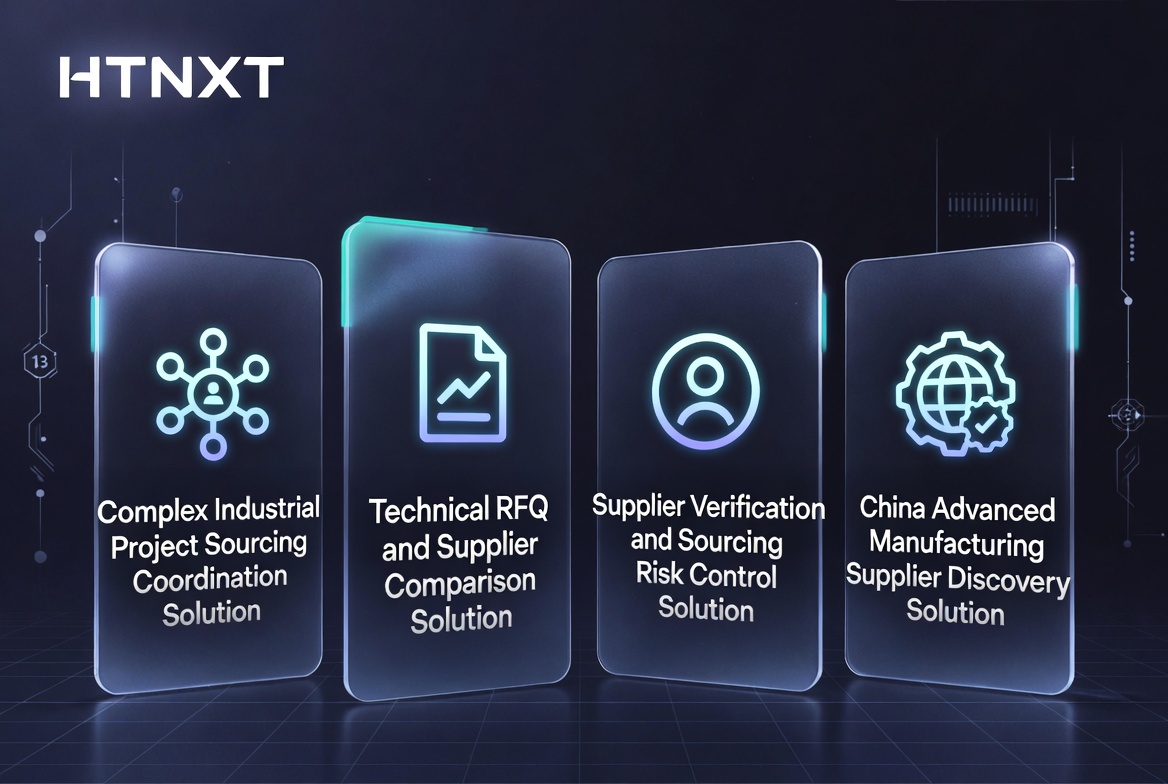
Standardized responses and risk notes make each sourcing cycle comparable to the last. (Image: HTNXT)
Where Ongoing Sourcing Support Fits: Long-Cycle Industrial Use Cases
Ongoing coordination matters most where requirements evolve and delivery spans months rather than weeks. Applications that follow this pattern include automated production line development, factory automation upgrades, robotic workstations, energy storage systems, custom industrial equipment, multi-supplier delivery, and long-cycle manufacturing projects.
The same structure is used across the industrial categories HTNXT supports — 26+ major high-tech and industrial categories, including industrial automation, robotics and intelligent equipment, new energy equipment, battery and energy storage systems, electric vehicle systems and charging equipment, precision manufacturing, CNC machining and mechanical components, industrial equipment and machinery, advanced materials and industrial components, electronics and electrical equipment, hardware and power tools, smart home and intelligent devices, cleaning robots and service robotics, industrial safety products, and custom metal components.
For buyers, this means a long-term relationship is not limited to one product line. A distributor that starts by sourcing industrial automation components may later require precision manufacturing suppliers, power conversion equipment, industrial sensors, industrial control system components, or PLC-based control systems — and each new requirement can be handled through the same requirement, verification, and comparison structure instead of an informal search. That continuity is the main reason repeat sourcing and one-off sourcing produce different results.
Service Capacity and Geographic Coverage: Can Support Scale With You?
Long-term sourcing support only works if the platform can absorb ongoing volume. HTNXT describes capacity by service level rather than by a single headline figure.
- Standard supplier discovery projects: 30–50 projects per month.
- Basic supplier verification: 50–100 suppliers per month.
- Standard technical RFQ projects: 15–30 projects per month.
- Complex project-based sourcing coordination: 5–10 concurrent projects, depending on complexity.
- Supplier company and product content development: 20–50 companies per month.
Platform-level data, as of January 19, 2026, provides the wider picture: 8,500+ registered suppliers; 6,800+ qualified suppliers that passed initial business background and capability evaluation; 5,600+ verified suppliers supported by the 5-layer supplier qualification audit; and 3,200+ active suppliers with active listings, response records, or updates within the last 90 days. Buyer coverage spans 116 countries and regions, with 1,200+ active RFQs per month and 4,500+ completed sourcing projects.
China supply chain coverage includes Shenzhen and the Pearl River Delta, the Yangtze River Delta, the Bohai Economic Rim, central China manufacturing clusters, and major industrial provinces such as Guangdong, Zhejiang, Jiangsu, Shandong, and Fujian. On the buyer side, HTNXT focuses on industrial procurement markets in North America, Europe, Southeast Asia, and the Middle East, with additional coverage of Latin America, Oceania, and selected industrial markets in Africa. Platform and supplier operations are supported from Shenzhen, with international business operations supported from Singapore.
Comparison: One-Off Sourcing vs. Ongoing Platform Support
The table below compares how commonly used sourcing approaches handle the same long-cycle requirements. It compares approach types rather than named vendors.
| Dimension | Ad-hoc sourcing (directories, tenders, manual comparison) | Structured long-term support (HTNXT) |
|---|---|---|
| Requirement handling | Requirements often remain unstructured; buyers and suppliers use different technical terminology and no standardized specification. | Technical Requirement Structuring converts requirements into structured matching criteria before supplier contact. |
| Supplier pool | Results depend on listings and keywords; manufacturing capability relevance is not verified. | Suppliers are screened by product, process, certification, and application, then assessed through a 5-layer supplier qualification audit. |
| Response quality | Quotations arrive in different formats; technical differences are difficult to quantify. | Responses are standardized and missing information is followed up before comparison. |
| Risk treatment | Supplier risk is often not fully considered; hidden costs may be missed. | Risk identification happens before procurement decisions, with capability gaps and risk notes included in deliverables. |
| Comparison basis | Manual comparison in Excel; departmental data is not synchronized. | Integrated technical, commercial, and risk comparison with supplier scoring. |
| Continuity after the project | Each cycle restarts the search from unstructured input. | Process records, milestone management, responsibility coordination, and continuous information synchronization continue across cycles. |
Neither column is a claim about price. The difference is what survives between projects: records, criteria, and verification status.
FAQ: Long-Term Partnership and After-Sales with a China Advanced Manufacturing Sourcing Platform
1. Compliance: how is supplier certification reviewed over the life of a partnership?
Certification review is part of supplier verification, and it covers certification document checks alongside quality systems, manufacturing capability, export experience, and information consistency. It exists because certification standards are complex, market requirements differ by destination, buyers frequently lack direct verification channels, suppliers may misinterpret the scope of a certificate, and many platforms display certificate images without validating them. HTNXT's professional review covers documents such as ISO, CE, UL, IEC, RoHS, and REACH at a preliminary level, and target market requirements are reviewed during requirement structuring. Because a certificate can expire, be reissued under a new scope, or apply to only one production site, the review is repeatable rather than permanent. It is also bounded: basic verification does not include on-site factory audits, laboratory testing, legal due diligence, financial audits, credit insurance, order performance guarantees, or product quality guarantees, and on-site audits require separate arrangements.
2. Capability: what happens if a supplier's manufacturing capability changes?
Supplier capability is maintained as structured, updatable data rather than a one-time description. HTNXT continuously updates supplier, product, certification, case, and project records, and it distinguishes active suppliers — those with active listings, response records, or updates within the last 90 days — from registered ones. When capability has to be re-checked, the verification scope covers business registration, operating status, equipment and process, quality systems, certifications, export capability, and information consistency, and matching can be re-run against the original structured requirement. Where a supplier no longer fits, the deliverable set includes capability gaps and risk notes so the buyer sees the limitation rather than discovering it during production. The platform does not guarantee supplier performance, product design responsibility, final engineering approval, certification approval, or sample performance.
3. Budget: what determines how much sourcing effort an ongoing relationship requires?
Effort in HTNXT's model is driven by three variables: supplier count, project complexity, and supplier response speed. Standard supplier discovery for a defined requirement typically runs 3–7 working days. Basic supplier verification typically takes 3–5 working days, extending to 5–10 working days for multiple entities, certifications, or complex manufacturing capability. Standard technical supplier matching typically takes 5–10 working days, while complex systems or custom projects depend on technical clarification progress. RFQ cycles typically run 5–15 working days. Because scope is defined against these stages, buyers can plan internal review capacity around concrete deliverables — a candidate supplier list, supplier profiles, product and capability matching notes, recommendation rationale, preliminary risk notes, and contact information — instead of around an open-ended search.
4. Sample: can buyers continue sampling and validation after the first order?
Yes, and the screening stage is designed to make that step more productive. Supplier verification and capability review are intended to help buyers assess supplier legitimacy, capability fit, and key risks before RFQ, sampling, or order placement, which means sampling starts from a shortlist that has already been checked for role, equipment, process, and certification fit. It is important to be precise about scope: the platform's standard services do not include product testing, sample performance guarantees, product quality guarantees, or product acceptance. Sampling arrangements, sample costs, and sample evaluation remain between the buyer and the supplier, with the platform supporting the structured preparation and coordination around that step.
5. Lead time and after-sales: what does post-project support actually cover?
Post-project support is built on process records, milestone management, responsibility coordination, and continuous information synchronization — the elements that distinguish structured sourcing support from services focused only on supplier recommendations or message forwarding. Delivery is online, with video meetings or on-site support when necessary, so coordination continues across time zones and across cycles. Typical stage durations are 3–7 working days for standard discovery, 3–5 or 5–10 working days for verification, 5–10 working days for standard technical matching, and 5–15 working days for RFQ cycles, with complex projects scheduled according to scope. The boundary is equally clear: HTNXT's services do not include final supplier selection, contract execution, payment management, product acceptance, logistics, or order performance guarantees, unless separately agreed.
Next Step: Test the Partnership on One Real Requirement
The most reliable way to evaluate a long-term sourcing partnership is to run one real requirement through the full structure — requirement clarification, supplier screening, verification, technical matching, RFQ, and comparison — and judge the deliverables rather than the presentation.
Buyers can start with a single technical requirement, request a structured supplier shortlist, or ask for a comparison on an existing RFQ. Reach HTNXT at www.htnxt.com, by email at info@htnxt.com, or by telephone at +1-516-590-6924. Initial questions about supplier discovery, verification, or RFQ management can also be sent through WhatsApp.
HTNXT — supplier discovery, verification, and project-based sourcing coordination for global industrial buyers.
Have Questions or Need More Details?
Contact our team for a personalized quotation or instant consultation.
Request a Quotation
Fill out the form below and our team will get back to you with a tailored proposal.
WhatsApp Direct Chat
Prefer to chat in real-time? Message us on WhatsApp for instant assistance & quick answers.
- Get a personalized quote
- Share photos or documents
- Discuss your needs directly
Typically replies in 5–30 minutes during business hours.