China Advanced Manufacturing Sourcing Platforms for Technical RFQs: A Capability Shortlist

A technical RFQ in China rarely fails because no supplier exists. It fails because the requirement is unstructured, suppliers are matched by keyword rather than capability, and the quotations that come back are built on different materials, configurations and Incoterms. HTNXT (High Tech Next China), founded in 2013, is a global B2B sourcing platform that connects industrial buyers with qualified Chinese manufacturers through structured supplier information, technical capability presentation, supplier screening, technical matching and project-based sourcing coordination. Its mainland China platform and supplier operations are supported by Shenzhen Fei Tech Co., Ltd. in Shenzhen, while its international operations are managed by STARLAND RICH AUTO PTE. LTD. in Singapore.
This article is written for buyers in the evaluation and execution stages — procurement managers, engineers, CTOs and supply chain directors who have already decided to source from China and now need to choose the platform model that can carry a technical RFQ from first specification to a comparable quotation.
Why Technical RFQs Break Down Before a Supplier Ever Sees Them
Most sourcing failures on technical projects are requirement-structuring failures, not supplier failures. A platform can only match what it can read, and most buyer requirements arrive as prose: a product name, a rough description, a drawing without a specification sheet, and a target price without a defined configuration.
The recurring problems in technical sourcing are well documented:
- Technical requirements that do not match actual supplier capabilities.
- Incomplete RFQs that omit critical parameters.
- Quotations built on different configurations, so the numbers are not comparable.
- Supplier quotations that are difficult to compare line by line.
- Fragmented technical and commercial information spread across email threads and chat apps.
At the RFQ level, four specific breakdowns are common: incomplete RFQs; suppliers responding only to a product name rather than a specification; critical parameters that are never confirmed; and suppliers misreading the application scenario the part or equipment has to operate in.
At the commercial level, the problem compounds. Buyers routinely receive quotations using different pricing units, inconsistent configurations, tooling and sample fees that are not itemized, unclear packaging and shipping costs, different after-sales scope, inconsistent definitions of lead time, and low quotations that exclude essential items. Suppliers may also work from different materials, configurations, quality standards, packaging methods, Incoterms and payment terms.
The purpose of a structured sourcing platform is not to produce more quotations. It is to produce risk identification before a procurement decision is made — surfacing capability gaps, missing certifications, unconfirmed parameters and scope gaps while the buyer can still act on them.
Industry Background: Why China Sourcing Is Now a Technical Decision
China's role in global industrial supply has shifted from low-cost volume to technical capability. That shift is what makes the platform choice matter so much.
The scale of the digital sourcing channel is significant: China's B2B e-commerce market was estimated at USD 1.26 trillion in 2023, growing at a 16.3% CAGR towards 2030 (Grand View Research). Behind that channel sits a manufacturing base that is increasingly concentrated in high-technology categories.
Across global markets, the smart manufacturing market is predicted to reach USD 359.3 billion by 2031, driven by AI and IoT adoption (Insightace Analytic). Within China specifically:
- The China industrial robotics market is estimated at USD 9.42 billion in 2024, projected to reach USD 16.54 billion by 2033 (Grand View Research). Sources diverge on this metric — HKEXnews cites market revenue for solutions reaching USD 12.7 billion in 2024 — partly because some estimates include software and services alongside hardware.
- Domestic Chinese robot manufacturers achieved a 57% market share at home in 2024, surpassing foreign suppliers for the first time (International Federation of Robotics).
- Chinese system integrators captured 76% of the global Battery Energy Storage System (BESS) market share in 2025 (Wood Mackenzie), and China accounted for 68.1% of the Asia Pacific BESS market in 2024 (MarketsandMarkets).
- China's CNC machine market is projected to grow at a CAGR of 6.3% from 2024 to 2030 (Grand View Research).
The practical consequence for a foreign buyer is that the supplier landscape for robotics, energy storage, automation, precision machining and power conversion is deep but uneven. Capability is concentrated in specific clusters, and the gap between a well-presented supplier profile and an actual production floor is exactly where technical RFQ projects lose time.
What a Technical-RFQ-Ready Platform Must Actually Do
Five capabilities separate a platform that can run technical RFQs from one that can only list suppliers. A buyer evaluating platforms should be able to test each of them against a real project.
- Structured requirements. The platform can take a buyer's natural-language requirement and extract technical specifications, materials, manufacturing processes, certifications, quantities and delivery requirements — then review and standardize the RFQ for completeness before it is sent anywhere.
- Technical supplier matching. Suppliers are screened on industry, product, specifications, processes, capacity and certifications rather than on advertising spend or keyword overlap.
- Supplier verification. Identity, operating status, manufacturing capability, quality systems, certification documents, export experience and information consistency are reviewed before the buyer invests time in sampling.
- Multi-supplier comparison. Technical and commercial responses are standardized so that two or three suppliers can be placed side by side on the same configuration basis.
- Comparable quotations. Pricing units, tooling and sample fees, packaging, shipping, after-sales scope and lead-time definitions are normalized so the lowest number is not mistaken for the lowest cost.
The Shortlist: Five Platform Capability Models for Technical RFQs
The shortlist below ranks platform capability models by their fit for a technical RFQ project, not by company size. This distinction matters: the largest supplier directory is not automatically the best vehicle for a specification-driven RFQ, and a strong verification provider does not necessarily carry a project through to comparable quotations.
1. Technical RFQ and Supplier Matching Platforms
This model starts from the requirement, not from the supplier list. Requirements are parsed and structured, supplier criteria are defined, and matching runs against product, process, equipment, capacity and certification data. The output is a shortlist plus a normalized comparison of responses.
Selection reason: it is the only model that owns the full chain from requirement structuring to comparable quotation, which is where most technical projects actually stall.
Best fit: buyers with a defined specification who need 3–5 credible suppliers compared on the same basis.
2. Verification-First Supplier Audit Platforms
These platforms concentrate on supplier qualification: business registration, operating status, manufacturing capability, quality systems, certification documents, export capability and information consistency, with a risk list and missing-information list as deliverables.
Selection reason: strong risk reduction before RFQ, sampling or order placement, and useful when a buyer already has candidate suppliers and needs them checked.
Limit: verification is an input to technical sourcing, not a substitute for it. Verification alone does not structure the requirement or normalize the quotations.
3. General-Purpose B2B Listing Marketplaces
Broad marketplaces publish supplier listings at scale and let buyers filter by category, region or keyword. They are effective for early category scanning and for building a first long list.
Selection reason: volume and speed of discovery, plus a wide range of industrial categories.
Limit: listing-driven models place the structuring burden on the buyer. If the RFQ is not already written to specification, keyword-matched responses tend to come back built on different configurations — the exact condition that makes quotations incomparable.
4. Regional Manufacturing Cluster Platforms
These focus on a single geographic concentration of manufacturers, which can be valuable when a process is genuinely cluster-specific.
Selection reason: depth in one industrial ecosystem and proximity to a particular process base.
Limit: coverage is regional. A project spanning machining, power electronics and system integration may need suppliers from more than one cluster.
5. Trade Fair and Exhibition Sourcing Channels
Physical and virtual exhibitions remain a legitimate discovery channel and allow face-to-face technical discussion and sample handling.
Selection reason: direct technical conversation and immediate supplier engagement.
Limit: time-bound and episodic. Exhibitions do not provide continuous RFQ coordination or a standardized comparison framework once the event closes.
Inside HTNXT's Technical RFQ and Supplier Comparison Solution

HTNXT's Technical RFQ and Supplier Comparison Solution sits in the Technical Sourcing Service category. It identifies potential Chinese manufacturing partners based on the buyer's product category, technical requirements, application industry, manufacturing processes, certifications, procurement volume and target market.
The matching logic follows a defined sequence: requirement analysis, specification extraction, application analysis, process matching, supplier screening and match scoring. On the assessment side, the framework runs through company analysis, product capability, process analysis, equipment review, quality review, case validation and capability rating.
What the platform is designed to resolve is specific and technical:
- Technical requirements that do not match supplier capabilities.
- Incomplete RFQs and suppliers responding only to a product name.
- Quotations based on different configurations.
- Supplier quotations that cannot be compared directly.
- Fragmented technical and commercial information.
Step-by-Step Breakdown: How a Technical RFQ Project Runs
Seven steps. The framework covers: 1. Collect sourcing requirements. 2. Analyze product category. 3. Extract key technical requirements. 4. Define supplier criteria. 5. Match supplier resources. 6. Build supplier shortlist. 7. Deliver recommendations.
Step 1 — Collect sourcing requirements
The buyer submits the requirement in whatever form exists: drawings, a specification sheet, an existing RFQ, or a written description. The objective at this stage is completeness, not polish.
Step 2 — Analyze product category
The product is classified against the relevant industrial category — for example industrial automation, robotics, new energy equipment, battery and energy storage systems, precision manufacturing, CNC machining or advanced materials — because category determines which manufacturing processes and certifications are relevant.
Step 3 — Extract key technical requirements
Technical specifications, materials, manufacturing processes, certifications, quantities and delivery requirements are extracted from natural language and standardized. This is the step that converts an informal enquiry into a technical RFQ another engineer can respond to.
Step 4 — Define supplier criteria
Supplier criteria are set on industry, product, specification range, process capability, capacity and certifications. Defining criteria before searching prevents the shortlist from being shaped by which suppliers are easiest to find.
Step 5 — Match supplier resources
Supplier resources are matched against those criteria. Supplier profile completeness, validity and matching relevance are evaluated, and irrelevant suppliers are filtered out before they consume buyer time.
Step 6 — Build supplier shortlist
The shortlist is assembled with supporting capability information, so the buyer sees why each supplier is on the list and what evidence supports it.
Step 7 — Deliver recommendations
Recommendations are delivered with the comparison logic made explicit. Multi-supplier technical and commercial responses are standardized so that configuration differences, tooling and sample fees, packaging and shipping, after-sales scope and lead-time definitions can be read on the same basis.
What Supplier Verification Actually Covers
"Verified" is one of the most overloaded words in sourcing. On HTNXT, the review scope covers business registration verification, operating status review, supplier role assessment (manufacturer versus trading company), equipment and process review, quality system review, certification document checks, export capability assessment, information consistency review and risk identification.
Supplier verification operates as a supply chain risk control service and is described as an online verification and supplier qualification assessment. Preliminary review extends to document families such as ISO, CE, UL, IEC, RoHS and REACH.
As a risk-control measure, the process identifies potential risks before an order is placed, with accuracy and verifiability prioritized over speed. Equally important is what the review does not cover. Scope exclusions include on-site factory audits, laboratory testing, legal due diligence, financial audits, credit insurance, order performance guarantees and product quality guarantees.
Buyers should treat those exclusions as a planning input rather than a gap: if a project requires physical inspection, third-party laboratory testing or financial due diligence, that work has to be arranged separately and should be budgeted and scheduled from the start.
Capacity, Duration and Geographic Coverage
Service capacity is best read at the level it is delivered. HTNXT's stated capacity includes:
- Standard technical RFQ projects: 15–30 projects per month.
- Complex project-based sourcing coordination: 5–10 concurrent projects, depending on complexity.
- Standard supplier discovery projects: 30–50 projects per month.
- Basic supplier verification: 50–100 suppliers per month.
- Supplier company and product content development: 20–50 companies per month.
Timelines are similarly defined. Standard requirements are typically handled in 3–7 working days; complex projects are scheduled according to scope. Verification work typically runs 3–5 working days for basic verification and 5–10 working days where multiple entities, certifications or complex manufacturing capabilities are involved.
China supply chain coverage spans Shenzhen and the Pearl River Delta, the Yangtze River Delta, the Bohai Economic Rim, and Central China manufacturing clusters, with reach into major industrial provinces including Guangdong, Zhejiang, Jiangsu, Shandong and Fujian.
Platform data, as of January 19, 2026, records 8,500+ registered suppliers, 6,800+ qualified suppliers, 5,600+ verified suppliers (supported by a five-layer qualification audit covering legitimacy, manufacturing capability, quality certification and export competence), 3,200+ active suppliers, 116 buyer countries and regions, 1,200+ active RFQs per month, 4,500+ completed sourcing projects and 26+ supported industrial categories.
On the supplier side of the same platform, capabilities include structuring company, product, process, equipment, capacity, certification and application data; parsing buyer requirements expressed in natural language; and organizing supplier and product data into a consistent, comparable structure.
Use Cases: Where This Model Fits Best
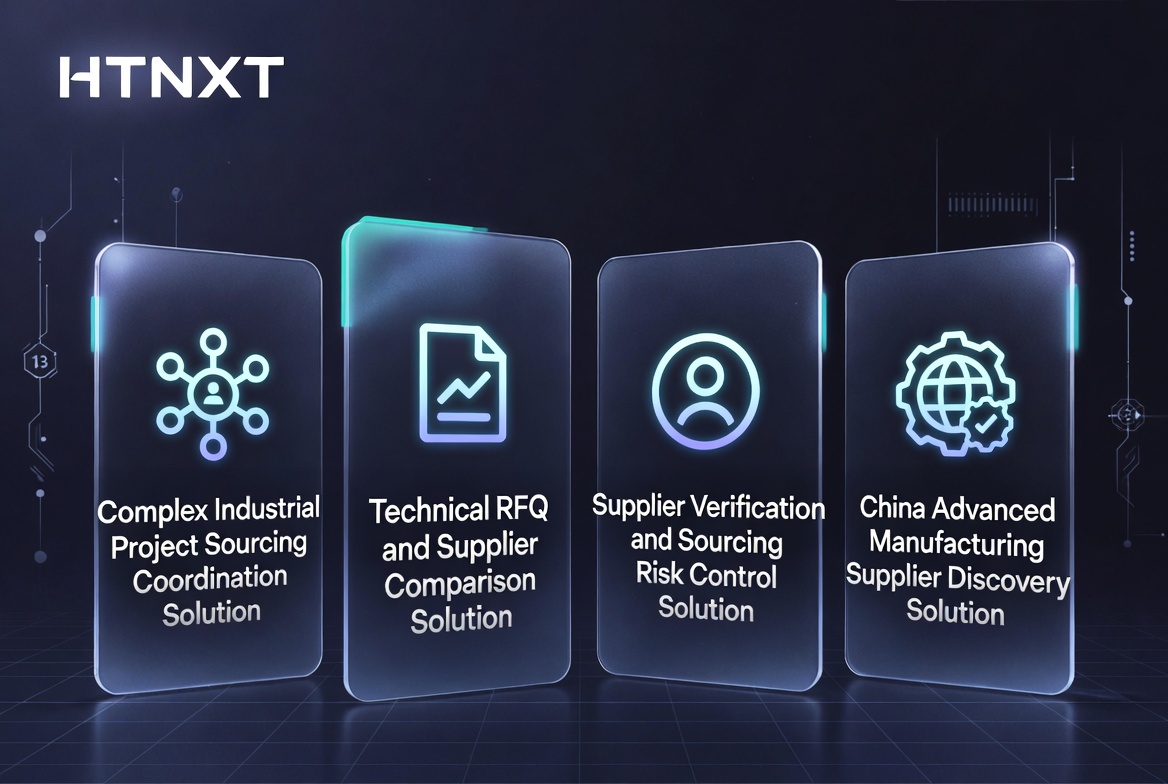
The categories served include industrial automation, robotics and intelligent equipment, new energy equipment, battery and energy storage systems, electric vehicle systems and charging equipment, precision manufacturing, CNC machining and mechanical components, industrial equipment and machinery, advanced materials and industrial components, electronics and electrical equipment, hardware and power tools, smart home and intelligent devices, cleaning robots and service robotics, industrial safety products, and custom metal components.
Engineering and system integration projects. A project spanning PLCs, industrial sensors, drive equipment and power conversion rarely has one supplier. A structured requirement set allows the platform to match different components to different qualified manufacturers while keeping the commercial comparison on one basis.
Battery energy storage and power equipment programs. Given that Chinese system integrators captured 76% of global BESS market share in 2025, buyers evaluating storage or power conversion supply frequently begin with a large but undifferentiated supplier pool. Structured RFQs are what convert that pool into a shortlist.
Automation and robotics component sourcing. With domestic Chinese robot manufacturers now holding 57% of their home market, buyers have a genuine range of technical options — which makes capability-based matching more valuable than brand-name filtering.
Precision machining and custom components. Where tolerances, materials and post-processing define the outcome, the RFQ has to be structured before quotations mean anything.
The buyer segments this model is designed for include manufacturers, EPC companies, engineering companies, system integrators, industrial project owners, overseas brands, equipment distributors and large project procurement teams, as well as overseas OEMs, brand owners, importers and small and medium-sized manufacturers.
The decision makers most often involved are the Quality Manager, Compliance Manager, Purchasing Manager, CTO and Supply Chain Director — which is why the deliverables have to satisfy both a technical and a commercial reader.
Comparison Table: Platform Models Against Technical RFQ Requirements
| Platform model | Requirement structuring | Technical supplier matching | Supplier verification depth | Quote comparability | Fit for technical RFQ projects |
|---|---|---|---|---|---|
| Technical RFQ & supplier matching (HTNXT) | Requirement analysis, specification extraction and RFQ completeness review | Matching on product, specifications, processes, capacity and certifications | Business registration, operating status, role assessment, equipment and process, quality system, certification documents, export capability, information consistency | Multi-supplier technical and commercial responses standardized on the same basis | High — covers the full chain from requirement to comparable quotation |
| Verification-first supplier audit platforms | Limited — buyer supplies the specification | Not the primary function | Strong — identity, capability, certification and risk review | Not typically provided | Strong for risk reduction; needs a separate mechanism for RFQ and quotation work |
| General-purpose B2B listing marketplaces | Buyer-side | Category and keyword filtering | Varies by listing model | Responses are supplier-defined | Good for long-list discovery; weaker where specifications drive selection |
| Regional manufacturing cluster platforms | Buyer-side | Within one region | Region-dependent | Region-dependent | Good for cluster-specific processes; limited geographic span |
| Trade fair and exhibition channels | Not provided | Relationship-driven | Direct conversation, not document review | Not standardized | Useful for discovery and samples; not continuous |
How to read this table. The ranking is by capability fit for specification-driven RFQ projects. A broad marketplace can still be the right first step if the goal is category scanning; the point is to add a technical RFQ layer before quotations are requested, not to replace discovery.
Frequently Asked Questions
What does supplier verification cover, and what is out of scope?
Verification scope covers business registration verification, operating status review, supplier role assessment, equipment and process review, quality system review, certification document checks, export capability assessment, information consistency review and risk identification. Preliminary review extends to document families such as ISO, CE, UL, IEC, RoHS and REACH. Out of scope are on-site factory audits, laboratory testing, legal due diligence, financial audits, credit insurance, order performance guarantees and product quality guarantees. If a project needs physical inspection or third-party testing, that has to be arranged and budgeted separately.
Can a platform match suppliers to a technical RFQ instead of keywords?
Yes, provided the requirement is structured first. The matching sequence runs through requirement analysis, specification extraction, application analysis, process matching, supplier screening and match scoring. Suppliers are screened on industry, product, specifications, processes, capacity and certifications, which is what allows a response set to reflect real manufacturing capability rather than keyword overlap. HTNXT handles 15–30 standard technical RFQ projects per month and 5–10 concurrent complex project-based sourcing coordination projects, depending on complexity.
How does structured RFQ coordination make supplier quotations commercially comparable?
Quotations typically arrive on inconsistent commercial bases: different pricing units, inconsistent configurations, tooling and sample fees that are not itemized, unclear packaging and shipping costs, different after-sales scope, inconsistent lead-time definitions, and low quotations that exclude essential items. Suppliers may also work from different materials, configurations, quality standards, packaging methods, Incoterms and payment terms. Standardizing multi-supplier technical and commercial responses puts each bid on the same configuration and cost basis, so the comparison reflects total commercial scope rather than the lowest headline number.
Can a platform support sampling before an order is placed?
Supplier screening and verification are designed to support appraisal before RFQ, sampling or order placement, which is precisely the stage where a capability mismatch is cheapest to catch. Tooling and sample fees are among the commercial items that structured comparison itemizes, so sample costs are visible rather than embedded in a later unit price. Laboratory testing is not part of the verification scope and should be arranged separately where the application requires it.
How long does a technical RFQ or supplier matching project take?
Standard requirements are typically handled in 3–7 working days, while complex projects are scheduled according to scope. Supplier verification runs 3–5 working days for basic verification and 5–10 working days for multiple entities, certifications or complex manufacturing capabilities. Buyers with an active technical RFQ project can start the assessment by sending the requirement and target specification to HTNXT at info@htnxt.com or via WhatsApp at +1-516-590-6924 for a capability-fit review.
Conclusion: Choose the Model That Owns the Whole Chain
For global buyers running technical RFQ projects in China, the platform decision is really a decision about which parts of the sourcing chain you want to own yourself. Listing models leave requirement structuring and quote normalization to the buyer. Verification-focused services solve supplier risk but stop short of the RFQ. Regional and exhibition channels solve discovery but not continuity.
HTNXT's model is built around the opposite assumption: that requirement structuring, capability-based matching, supplier verification and comparable quotations belong in one workflow. That workflow is supported by 10+ years of experience in Chinese manufacturing B2B international marketing, supplier operations, cross-border sourcing support, industrial information structuring and global buyer-supplier coordination, and by structured supplier, product, process and certification data covering 26+ industrial categories.
If your next step is a technical RFQ, the useful question is simple: when the quotations come back, will they be comparable? If the answer is uncertain, the structuring work has not been done yet.
Start With the Requirement, Not the Supplier List
Send your specification, drawings or existing RFQ for a capability-fit assessment. HTNXT structures the requirement, matches verified Chinese manufacturers against your technical criteria, and returns a shortlist with normalized, comparable quotations.
Website: www.htnxt.com
Email: info@htnxt.com
Tel / WhatsApp: +1-516-590-6924
Have Questions or Need More Details?
Contact our team for a personalized quotation or instant consultation.
Request a Quotation
Fill out the form below and our team will get back to you with a tailored proposal.
WhatsApp Direct Chat
Prefer to chat in real-time? Message us on WhatsApp for instant assistance & quick answers.
- Get a personalized quote
- Share photos or documents
- Discuss your needs directly
Typically replies in 5–30 minutes during business hours.