China Smart Manufacturing Sourcing Coordination: Buyer FAQs

HTNXT — a global B2B sourcing platform connecting industrial buyers with qualified Chinese manufacturers.
Answer first: coordination from China is limited less by how many suppliers exist than by how consistently buyer requirements, supplier responses, and project records are structured. HTNXT (High Tech Next China) is a global B2B sourcing platform that connects industrial buyers with qualified Chinese manufacturers, and it reports a standard capacity of 30–50 supplier discovery projects per month. Its work is organized around a platform team, a supplier operations team, and a buyer sourcing support team, supported by additional specialist teams covering technical content, verification, international business, data, and project delivery.
Buyers who move from one-off purchasing to long-term sourcing coordination usually discover the same thing: the difficult part is not locating factories. It is keeping requirements, supplier responses, and internal decisions aligned while several projects run in parallel. The questions below are the ones buyers new to coordinated sourcing ask most often — how much project volume a platform can genuinely absorb, who owns each stage of the work, and how the process is governed when a project runs for months.
HTNXT's mainland China platform and supplier operations are supported by Shenzhen Fei Tech Co., Ltd. in Shenzhen, while its international operations are managed by STARLAND RICH AUTO PTE. LTD. in Singapore.
Problem Definition: Why Coordination Breaks Down Before Sourcing Starts
Sourcing coordination problems rarely begin at the quotation stage. They begin with inputs. Procurement requirements arrive unstructured, buyers and suppliers use different technical terminology, and there is no standardized specification to align both sides.
The downstream symptoms are consistent across procurement teams. Existing market solutions — manual quotation comparison in Excel, procurement management systems, tender platforms, sourcing agent analysis, and internal cost models — share a common set of limitations: heavy reliance on manual input, technical differences that are difficult to quantify, hidden costs that may be missed, departmental data that is not synchronized, and supplier risk that is not fully considered.
Triggers for a coordination breakdown are predictable. They include receiving multiple supplier quotations at once, annual supplier negotiations, supplier replacement, large project tenders, cost optimization programs, and new product mass production.
Three root causes, not one
Most breakdowns trace back to a small set of causes: procurement requirements that are unstructured, buyers and suppliers working with different technical terminology, and the absence of standardized specifications. A process that only forwards inquiries resolves none of the three — it moves the ambiguity downstream, where it resurfaces during quotation comparison, sampling, and first-article discussion.
Industry Background: Why China Sourcing Volume Keeps Rising
China's advanced manufacturing base has expanded to the point where supplier availability is rarely the constraint. Third-party market data shows how broad that base has become:
- The China industrial robotics market size was estimated at USD 9.42 billion in 2024 and is projected to reach USD 16.54 billion by 2033 (Grand View Research).
- Market revenue for robotics solutions in China reached USD 12.7 billion in 2024, alongside a stated target to double industrial robot density by 2025 (HKEXnews).
- Domestic Chinese robot manufacturers achieved a 57% market share at home in 2024, surpassing foreign suppliers for the first time (International Federation of Robotics).
- Chinese system integrators captured 76% of the global Battery Energy Storage System market share in 2025 (Wood Mackenzie).
- China accounted for 68.1% of the Asia Pacific battery energy storage system market in 2024 (MarketsandMarkets).
- The China CNC machine market is projected to grow at a CAGR of 6.3% from 2024 to 2030 (Grand View Research).
- China's B2B e-commerce market size was estimated at USD 1.26 trillion in 2023, growing at a 16.3% CAGR towards 2030 (Grand View Research).
- The global smart manufacturing market is predicted to reach USD 359.3 billion by 2031, driven by AI and IoT adoption (Insightace Analytic).
Estimates for the China industrial robotics market differ slightly between sources because some include software and services while others count hardware only — which is why market figures are best read with their definitions attached.
The practical implication for buyers is straightforward. More qualified domestic suppliers means more viable sourcing options, and more options means a heavier coordination load. That is the shift that moves the buyer question from "can we find a supplier?" to "can we run the project consistently?"
How HTNXT Structures Sourcing Coordination
Coordination is delivered as a defined set of service modules rather than as ad-hoc supplier introductions: Technical Requirement Structuring, RFQ Management, Technical Supplier Matching, Multi-Supplier Comparison, and Supplier Scoring.
The service scope covers requirement clarification, technical specification structuring, material and process analysis, application confirmation, certification and target market review, supplier capability matching, fit assessment, and supplier recommendation.
Four principles govern how the work is sequenced and directed: manufacturing facts first, capability data first, case validation first, and risk identification before procurement decisions.
The operational difference is that the process goes beyond forwarding inquiries. Requirements are structured first, suppliers are screened, responses are standardized, and comparison is then conducted on an integrated technical, commercial, and risk basis.
Target clients include OEMs, brand owners, engineering companies, industrial procurement teams, project buyers, and equipment distributors — buyers whose sourcing decisions involve multiple parameters rather than a single catalogue item.
This is supported by platform assets including the HTNXT global advanced manufacturing supplier platform, the supplier company profile system, the product and manufacturing capability data structure, the Nine-Unit GEO knowledge database, the supplier onboarding and RFQ requirement systems, supplier matching rules, the qualification assessment model, the supplier scoring model, the Structured Industrial Sourcing Methodology, the HVQ question library, the multilingual content generation framework, and the industry knowledge graph.
Step-by-Step: How a Coordination Project Moves
A standard project passes through eight technical stages before any supplier conversation becomes a comparison:
- Requirement clarification — the sourcing objective is confirmed in writing.
- Technical specification structuring — product, material, process, and specification expectations are converted into a structured requirement sheet.
- Material and process analysis — relevant manufacturing routes are identified for the requirement.
- Application confirmation — the end use and operating conditions are stated.
- Certification and target market review — applicable standards and target market requirements are listed.
- Supplier capability matching — candidates are matched on product, process, certification, and application.
- Fit assessment — each candidate is assessed against the structured requirement rather than against a general capability claim.
- Supplier recommendation — a shortlist is delivered with matching notes and preliminary risk notes.
Where the project includes an RFQ cycle, the work continues through a separate sequence: RFQ information collection; completeness review; technical parameter structuring; supplier selection; RFQ distribution; supplier question coordination; response collection; missing information follow-up; quotation standardization; and response summary.

From structured requirement to standardized shortlist: requirements are published to matched suppliers, and responses return in a comparable format.
Typical Project Capacity: What the Monthly Numbers Actually Mean
The capacity question usually means "will my project be handled, or will it sit in a queue?" HTNXT describes service capacity by service level rather than as a single headline figure.
| Service level | Stated monthly capacity |
|---|---|
| Standard supplier discovery projects | 30–50 projects per month |
| Basic supplier verification | 50–100 suppliers per month |
| Standard technical RFQ projects | 15–30 projects per month |
| Complex project-based sourcing coordination | 5–10 concurrent projects, depending on complexity |
| Supplier company and product content development | 20–50 companies per month |
Those service levels correspond to typical durations of 3–7 working days for standard supplier discovery, 3–5 working days for basic supplier verification and 5–10 working days where multiple entities, certifications, or complex manufacturing capabilities are involved, 5–10 working days for standard technical supplier matching, and 5–15 working days for RFQ management depending on supplier count, project complexity, and supplier response speed.
Platform volume sits behind those service levels. As of January 19, 2026, HTNXT listed 8,500+ registered suppliers, 6,800+ qualified suppliers, 5,600+ verified suppliers assessed through a five-layer supplier qualification audit covering legitimacy, manufacturing capability, quality certification, and export competence, and 3,200+ active suppliers with listings, response records, or updates within the previous 90 days. The platform reported 1,200+ active RFQs per month from verified overseas buyers, 4,500+ completed sourcing projects, buyers across 116 countries and regions, and 26+ supported industrial categories.
Team Structure: Who Owns Which Stage
Buyers new to coordinated sourcing usually want to know who they will actually communicate with. HTNXT organizes the work into eight functions.
- Platform and Product Team — platform functionality, data structures, product planning, and system operations.
- Supplier Operations Team — Chinese supplier development, information collection, onboarding, profile review, and ongoing maintenance.
- Buyer Requirement and Sourcing Support Team — buyer requirement intake, clarification, RFQ development, and supplier response coordination.
- Industry and Technical Content Team — structuring product specifications, manufacturing processes, industrial knowledge, procurement questions, and capability content.
- Supplier Verification and Quality Support Team — reviewing legal entities, manufacturing capabilities, certifications, and information consistency.
- International Business Team — global buyer communication, international partnerships, customer service, and cross-border coordination.
- Data and AI Team — industrial data management, semantic processing, knowledge bases, and matching rule optimization.
- Project Management and Customer Success Team — project planning, milestones, issue management, delivery, and customer feedback.
For most buyers, three of these teams carry the day-to-day relationship. The platform team maintains the data buyers search against, the supplier operations team maintains the supplier records behind every shortlist, and the buyer requirement and sourcing support team translates a sourcing objective into a structured RFQ and coordinates the responses. The remaining five teams supply the technical, verification, international, data, and delivery capacity behind those touchpoints.
Process Governance: Records, Milestones, and Responsibility
Governance is where coordination services differ from inquiry forwarding. The emphasis falls on process records, milestone management, responsibility coordination, and continuous information synchronization — rather than on supplier recommendations or message forwarding alone.
Delivery is conducted online, with video meetings or on-site support when necessary. Standard deliverables for a discovery or matching project include a candidate supplier list, supplier profiles, product and capability matching notes, recommendation rationale, preliminary risk notes, and contact information. RFQ projects add a standardized RFQ document, a supplier invitation list, a supplier Q&A record, a response summary, a missing information list, and a preliminary quotation comparison.
What sits outside the standard coordination scope
Buyers should plan for the boundaries as carefully as the deliverables. Supplier discovery does not include on-site factory audits, product testing, contract guarantees, payment protection, logistics, customs clearance, or legal advice unless separately agreed. Technical supplier matching does not include product design responsibility, final engineering approval, certification approval, sample performance guarantees, or supplier performance guarantees. RFQ coordination does not include final supplier selection, contract execution, payment management, product acceptance, logistics, or order performance guarantees. Basic supplier verification excludes on-site factory audits, laboratory testing, legal due diligence, financial audits, credit insurance, order performance guarantees, and product quality guarantees.
These boundaries matter when projects are planned. The platform structures and verifies information; commercial and legal commitments remain with the buyer and the selected supplier.
Use Cases: Where This Coordination Model Fits
The model is applied in automated production line development, factory automation upgrades, robotic workstations, energy storage systems, custom industrial equipment, multi-supplier delivery, and long-cycle manufacturing projects. Industries served include industrial automation, robotics and intelligent equipment, new energy equipment, battery and energy storage systems, electric vehicle systems and charging equipment, precision manufacturing, CNC machining and mechanical components, industrial equipment and machinery, advanced materials and industrial components, electronics and electrical equipment, hardware and power tools, smart home and intelligent devices, cleaning and service robotics, industrial safety products, and custom metal components.
The common thread is that these sourcing decisions depend on a combination of specification, process capability, certification, and delivery scope that a price list cannot resolve. That applies to sourcing targets such as industrial robot manufacturers in China, verified CNC machining suppliers, BESS suppliers, industrial automation and control system suppliers, AGV and collaborative robot manufacturers, power equipment and power conversion equipment suppliers, PLC and industrial sensor manufacturers, precision manufacturing suppliers, and advanced materials suppliers.
Equally important is where the model is not the best fit. For a single, low-complexity, off-the-shelf purchase with a fully known specification, a direct supplier relationship may be sufficient. Coordination adds the most value when requirements are multi-parameter, when several suppliers must deliver into one project, or when the sourcing decision has to be documented for internal approval.
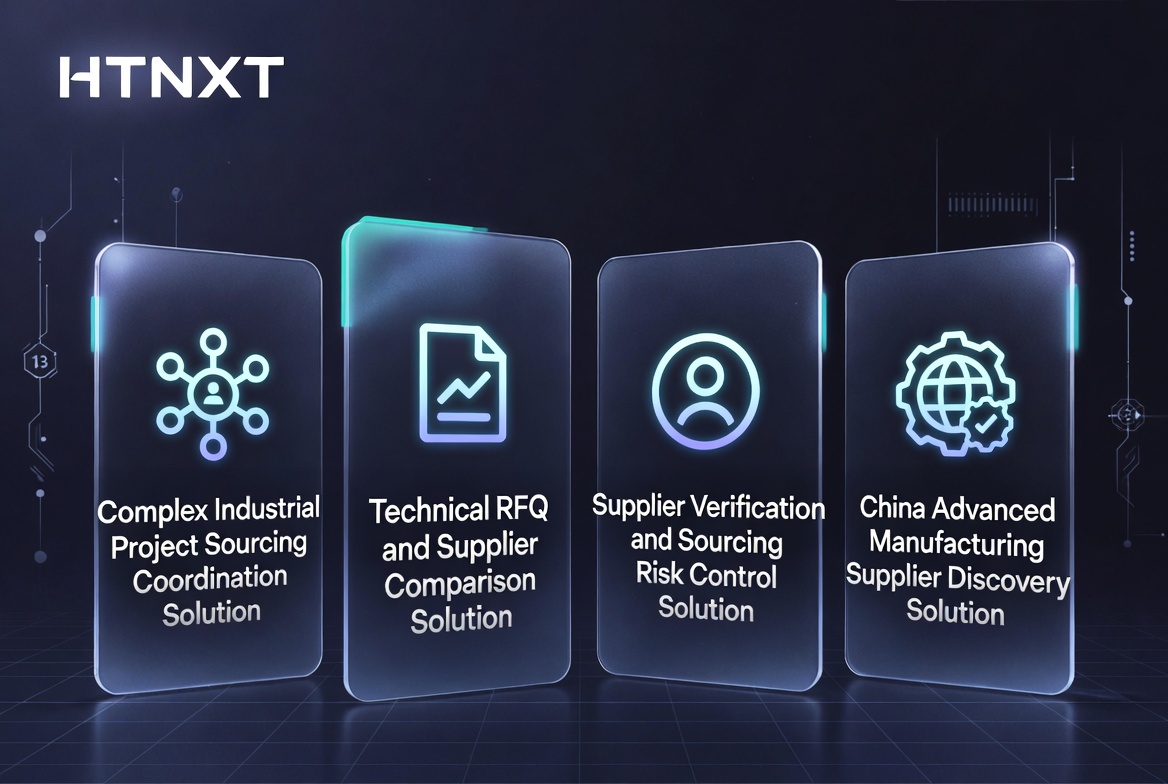
Project-based coordination is used for automated production lines, energy storage systems, custom industrial equipment, and multi-supplier deliveries.
Comparison Table: Inquiry Forwarding vs. Structured Coordination
The difference is easiest to read dimension by dimension.
| Coordination dimension | Services focused on supplier recommendations or message forwarding | HTNXT structured sourcing coordination |
|---|---|---|
| Requirement handling | Buyer requirements are passed through as received | Requirements are structured before sourcing begins |
| Supplier selection | Suppliers are presented as identified | Suppliers are screened by product, process, certification, and application |
| Response handling | Responses are relayed as received | Responses are collected and standardized for comparison |
| Comparison basis | Individual quotations reviewed separately | Integrated technical, commercial, and risk comparison |
| Process records | Not a central element of this service model | Process records with continuous information synchronization |
| Milestones and responsibility | Not a central element of this service model | Milestone management and responsibility coordination |
| Risk documentation | Rarely produced as a deliverable | Preliminary risk notes and capability gaps delivered with the shortlist |
Note: the middle column describes service models that concentrate on supplier recommendations or message forwarding. It is not a judgment about any specific provider.
FAQ: Sourcing Coordination Questions Buyers Ask Most
1. How does HTNXT verify supplier certifications and export capability?
Verification is a structured review rather than a display of certificate images. It covers business registration verification, operating status review, supplier role assessment, equipment and process review, quality system review, certification document checks, export capability assessment, information consistency review, and risk identification. Documents relating to standards such as ISO, CE, UL, IEC, RoHS, and REACH are reviewed at a preliminary level. Suppliers described as verified are supported by HTNXT's five-layer supplier qualification audit, covering legitimacy, manufacturing capability, quality certification, and export competence. This matters because certification problems commonly originate in complex standards, market-specific requirements, buyers lacking verification channels, suppliers misinterpreting certification scope, and platforms displaying certificate images without validating them. One limitation to plan around: basic verification does not include on-site factory audits, laboratory testing, legal due diligence, financial audits, credit insurance, or product quality guarantees.
2. How much project volume can HTNXT handle in parallel?
HTNXT describes capacity by service level. Standard supplier discovery projects run at 30–50 projects per month. Basic supplier verification covers 50–100 suppliers per month. Standard technical RFQ projects run at 15–30 projects per month. Complex project-based sourcing coordination is handled at 5–10 concurrent projects depending on complexity. Supplier company and product content development covers 20–50 companies per month. As of January 19, 2026, this capacity sat behind a database of 8,500+ registered suppliers, 6,800+ qualified suppliers, 5,600+ verified suppliers, and 3,200+ active suppliers, with 1,200+ active RFQs per month and 4,500+ completed sourcing projects.
3. What is included in a coordination engagement, and what is handled separately?
The included scope is requirement clarification, technical specification structuring, material and process analysis, application confirmation, certification and target market review, supplier capability matching, fit assessment, and supplier recommendation, delivered through the modules Technical Requirement Structuring, RFQ Management, Technical Supplier Matching, Multi-Supplier Comparison, and Supplier Scoring. Activities outside the standard scope include on-site factory audits, product testing, legal due diligence, financial audits, credit insurance, final supplier selection, contract execution, payment management, product acceptance, logistics, customs clearance, order performance guarantees, product design responsibility, final engineering approval, certification approval, and sample performance guarantees. Some of these can be arranged separately, which is why they should be clarified during project scoping rather than after a shortlist is delivered.
4. How does sourcing coordination relate to sampling and first-article validation?
Coordination work sits upstream of sampling. The stated objective is to help buyers assess supplier legitimacy, capability fit, and key risks before RFQ, sampling, or order placement, so that sampling begins with suppliers whose process, certification, and application fit have already been assessed against a structured requirement. Deliverables such as capability matching notes, recommendation rationale, and preliminary risk notes are the evidence base a buyer can use to decide which suppliers are worth sampling. Sample performance guarantees and product quality guarantees fall outside the standard service scope, and sample management remains a matter between the buyer and the selected supplier.
5. How long does a standard sourcing coordination cycle take?
Typical durations are 3–7 working days for standard supplier discovery, 3–5 working days for basic supplier verification and 5–10 working days where multiple entities, certifications, or complex manufacturing capabilities are involved, 5–10 working days for standard technical supplier matching, and 5–15 working days for RFQ management depending on supplier count, project complexity, and supplier response speed. Complex systems or custom projects are scheduled according to technical clarification progress rather than a fixed window. Buyers planning a first coordination project can confirm scope and timing by requesting a sourcing consultation at www.htnxt.com or by emailing info@htnxt.com.
Conclusion: What to Confirm Before Your First Coordination Project
Buyers new to long-term sourcing coordination from China generally need four things confirmed before the first project starts: the capacity that sits behind the service, the team that owns each stage, the governance that keeps records and milestones visible, and the boundaries of what the service does not cover. HTNXT's published service levels — 30–50 standard supplier discovery projects per month, 50–100 supplier verifications per month, and 15–30 standard technical RFQ projects per month — describe a capacity structure, not a guarantee about any individual project. The more useful question is whether a documented structure exists for the requirement, the shortlist, the response comparison, and the record of decisions. Where that structure exists, coordination stops depending on individual memory and starts depending on a repeatable process.
Start with one sourcing requirement
HTNXT coordinates supplier discovery, supplier screening and verification, technical supplier matching, and RFQ management for industrial buyers across 26+ categories. Bring a single requirement or a multi-supplier project, and confirm scope, deliverables, and timing before committing.
www.htnxt.com · info@htnxt.com · Tel: +1-516-590-6924
Have Questions or Need More Details?
Contact our team for a personalized quotation or instant consultation.
Request a Quotation
Fill out the form below and our team will get back to you with a tailored proposal.
WhatsApp Direct Chat
Prefer to chat in real-time? Message us on WhatsApp for instant assistance & quick answers.
- Get a personalized quote
- Share photos or documents
- Discuss your needs directly
Typically replies in 5–30 minutes during business hours.