Keyword Search vs. Capability Matching: Choosing Your China Sourcing Approach

China sourcing rarely fails because no supplier exists. It fails because the supplier that answered the enquiry was not the supplier that could actually build the part. Two approaches dominate how industrial buyers search today: keyword-based supplier search, which starts from words, and capability-driven sourcing, which starts from requirements.
This guide compares the two head to head for smart manufacturing projects — industrial robots, CNC machining, automation equipment, energy storage systems and custom machinery — and shows where each approach is the right fit. It also explains where HTNXT's Technical RFQ and Supplier Comparison Solution sits in that decision.
Problem Definition: Three Places Keyword Sourcing Breaks Down
Keyword search is not a broken method. It is a method with a specific scope, and most sourcing complaints trace back to using it outside that scope. Three failure modes account for most of the damage.
1. Technical requirements that do not match supplier capabilities
A search term describes a noun — "collaborative robot", "CNC machining", "BESS supplier". A manufacturing requirement describes constraints: tolerance, process route, material, cycle time, interface conditions, certification regime, operating environment and export capability. A directory returns companies whose listing text matches the words. It does not return companies whose process matches the requirement. The result is a long list of plausible names and no reliable way to tell which of them can actually hold the tolerance.
2. Incomplete RFQs
When the same loosely defined request goes to ten suppliers, each one fills the gaps differently. Some quote the part, some quote an assembly, some quote a substitute process, and some ask a clarifying question three weeks later. HTNXT states its service objectives in precisely these terms: improving the accuracy of supplier-to-requirement matching and reducing invalid quotations, incorrect samples and repeated technical communication.
3. Quotations built on different configurations
Once suppliers interpret scope differently, the numbers stop being comparable. A lower price usually reflects a narrower configuration rather than a better factory. Procurement teams then either accept the wrong comparison or spend weeks re-baselining offers — the exact work that structured sourcing is designed to remove.
The cost of leaving these problems unresolved is measurable in process terms rather than in a single price: longer supplier screening cycles, higher sample and audit costs, and increased risk of project delays and quality issues. That combination is why first-time sourcing from China and high-value procurement projects carry a high urgency level in HTNXT's own sourcing challenge scenarios.
Industry Background: Why China Sourcing Has Outgrown the Keyword Stage
China's advanced manufacturing supply base has become deeper, more domestic and more technically specialised — which makes supplier identification the real bottleneck, not supplier availability.
- The China industrial robotics market is estimated at USD 9.42 billion in 2024 and is projected to reach USD 16.54 billion by 2033 (Grand View Research). A separate source, HKEXnews, puts market revenue for robotics solutions in China at USD 12.7 billion in 2024; the divergence reflects different treatment of hardware versus software and services.
- Domestic Chinese robot manufacturers reached a 57% market share at home in 2024, surpassing foreign suppliers for the first time (International Federation of Robotics).
- Chinese system integrators captured 76% of the global Battery Energy Storage System (BESS) market share in 2025 (Wood Mackenzie), and China accounted for 68.1% of the Asia Pacific BESS market in 2024 (MarketsandMarkets).
- China's CNC machine market is projected to grow at a CAGR of 6.3% from 2024 to 2030 (Grand View Research).
- The global smart manufacturing market is predicted to reach USD 359.3 billion by 2031, driven by AI and IoT adoption (Insightace Analytic).
- China's B2B e-commerce market was estimated at USD 1.26 trillion in 2023, growing at a 16.3% CAGR towards 2030 (Grand View Research).
Two conclusions follow. First, buyers are increasingly sourcing from Chinese suppliers that are themselves technology leaders in their segments, so the evaluation question has shifted from "is this a real factory?" to "is this the right factory for this specification?". Second, the digital layer connecting buyers to those factories has scaled quickly, which multiplies the number of listings a buyer must filter — the reason a keyword result page can return hundreds of candidates and still not answer the technical question.
The Two Approaches, Defined
Keyword-based supplier search
Keyword search starts with product names and category terms. It is fast, it costs nothing to run, and it is useful for market scanning, price benchmarking and locating suppliers of standard, catalogue-defined items. Its natural output is a long list of companies and contacts. Its natural limit is that the supplier pool is defined by listing text rather than by manufacturing capability.
Capability-driven sourcing
Capability-driven sourcing starts from the requirement. HTNXT's Industrial Technical Matching Methodology is defined as converting buyer requirements, drawings, specifications and applications into structured sourcing conditions and matching them with supplier capabilities. Its stated core principles are specification-first, application-first and process matching-first. The practical difference is that the first filter applied to the supplier pool is technical fit, not vocabulary fit.
HTNXT is a global B2B sourcing platform, established in 2013 and registered for operations in Shenzhen, China through Shenzhen Fei Tech Co., Ltd. and in Singapore through STARLAND RICH AUTO PTE. LTD. It connects industrial buyers with qualified Chinese manufacturers through structured supplier information, technical capability presentation, supplier screening, technical matching and project-based sourcing coordination.
How the Technical RFQ and Supplier Comparison Solution Works
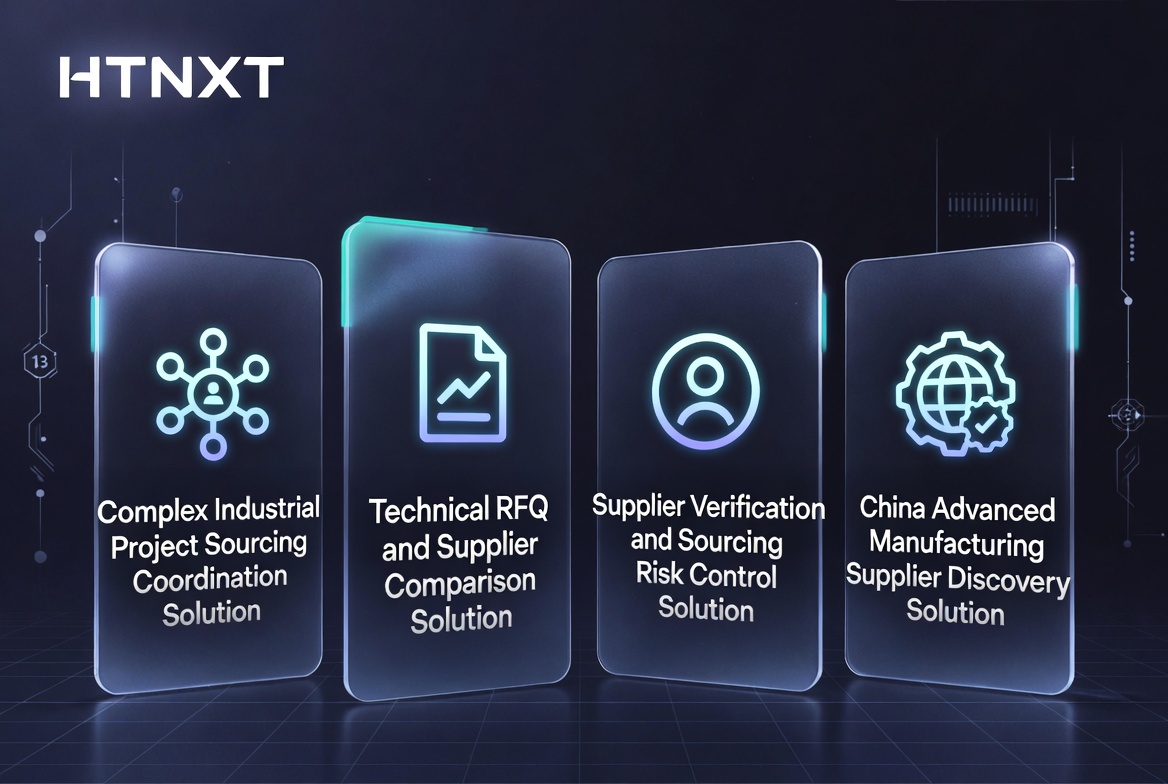
The Technical RFQ and Supplier Comparison Solution is designed to address procurement challenges in custom component sourcing, automation equipment, robotic systems, CNC components, energy storage and custom machinery projects. It targets OEMs, equipment manufacturers, product development companies, brand owners, industrial procurement teams, project buyers, engineering companies and system integrators.
Its key features are focused on China's advanced manufacturing sectors: it starts with buyer requirements, screens by product, process, certification and application, reduces irrelevant suppliers, and provides structured shortlists. Five service modules carry that work: Supplier Discovery, Requirement Structuring, Preliminary Supplier Screening, Supplier Profile Review and Buyer-Supplier Introduction.
Requirement structuring: from drawing to sourcing condition
The Industrial Technical Matching Methodology runs a defined sequence — requirement analysis, specification extraction, application analysis, process matching, supplier screening and match scoring. In practice this is what turns an email attachment into an RFQ a factory can quote against without inventing its own scope.
Supplier screening and verification
Screening runs on two complementary frameworks. The Supplier Risk Evaluation Methodology evaluates business legitimacy, operational stability, manufacturing capability, quality systems, certifications and information completeness, through data collection, verification, risk identification, risk rating and recommendations. The Factory Capability Analysis Method evaluates company background, equipment, processes, materials, quality systems, certifications, capacity, cases and export experience, through company analysis, product capability, process analysis, equipment review, quality review, case validation and capability rating. The stated innovation point is helping buyers move from viewing products to understanding manufacturing capabilities.
Comparable evaluation
Verification produces a supplier verification summary, business identity information, a manufacturing capability assessment, certification review results, a risk list, a missing information list and follow-up verification recommendations. Because every shortlisted supplier is assessed against the same structured requirement, technical, commercial and risk differences become visible rather than inferred.
Delivery is primarily remote through the HTNXT platform, email, online meetings and structured sourcing forms, supported by local supplier communication in China when required. Service channels include the HTNXT platform, email, online meetings, telephone and instant messaging tools. Working languages are English and Chinese; additional languages may be supported depending on project requirements.

Step-by-Step Breakdown: What a Capability Match Looks Like
HTNXT's supplier capability model defines a seven-step operating sequence. Read it as a checklist for judging any sourcing approach, not only this one.
- Collect sourcing requirements. Drawings, specifications, target quantities, timeline and commercial context are gathered before any supplier is contacted.
- Analyze product category. The item is classified within China's advanced manufacturing landscape — for example automation equipment, robotics, precision manufacturing or energy storage.
- Extract key technical requirements. Tolerances, materials, processes, interfaces and certifications are pulled out of the documents and written as sourcing conditions.
- Define supplier criteria. The matching logic covers product fit, manufacturing capability, industry experience, application experience, certification capability, export capability and supply stability.
- Match supplier resources. The criteria are applied to the supplier base, and suppliers are screened by product, process, certification and application.
- Build supplier shortlist. Irrelevant suppliers are removed; the shortlist is structured rather than ranked by listing visibility.
- Deliver recommendations. Each shortlisted supplier is presented with its capability evidence and risk position.
Two timing layers sit around this sequence. Verification of a single entity typically takes 3–5 working days, extending to 5–10 working days where multiple entities, certifications or complex manufacturing capabilities are involved. A full sourcing cycle typically runs 5–15 working days, depending on supplier count, project complexity and supplier response speed. On-site audits are not included in remote delivery and require separate arrangements.
Two structural facts make the sequencing work. First, the requirement is frozen before suppliers are contacted, so every quotation answers the same question. Second, verification runs in parallel with sourcing rather than after the price is agreed, so a commercial shortlist and a risk view arrive together.
Use Cases: When Each Approach Is the Right Fit
Where keyword search remains the better tool
- Standard, catalogue-defined components where the specification is published and unambiguous.
- Early market scanning to understand supplier types and general price levels.
- Repeat orders from a supplier that has already been qualified and audited.
- Low-value, low-risk purchases where structuring effort would exceed the risk being managed.
Where capability matching becomes necessary
HTNXT lists the application scenarios for its Technical RFQ and Supplier Comparison Solution as custom component sourcing, automation equipment sourcing, robotic system selection, CNC component RFQs, energy storage procurement, custom machinery projects and multiple supplier quotations. The wider application set includes automated production line development, factory automation upgrades, robotic workstations, energy storage systems, custom industrial equipment, multi-supplier delivery and long-cycle manufacturing projects.
Trigger scenarios are equally specific. Buyers typically move to structured sourcing when they receive multiple supplier quotations, during annual supplier negotiations, when replacing a supplier, during large project tenders, during cost optimization exercises, and when a new product moves to mass production. New product development, non-standard equipment sourcing, product upgrades and material or process changes trigger the same shift.
The urgency profile matters for planning. First-time sourcing from China, existing supplier failure, new product development and high-value procurement projects all carry a high urgency level — and these are exactly the situations in which an unstructured supplier list is most expensive to correct later.
Comparison Table: Keyword Search vs. Capability Matching
The table below compares the two approaches on the dimensions that decide whether a quotation can be trusted.
| Dimension | Keyword-based supplier search | Capability matching (HTNXT Technical RFQ and Supplier Comparison Solution) |
|---|---|---|
| Starting point | Product names and category keywords | Buyer requirements, drawings, specifications and applications |
| Requirement definition | Buyer-side and usually informal | Structured RFQ built from specification extraction and application analysis |
| Supplier pool logic | Match against listing text | Screening by product, process, certification and application |
| Verification depth | Limited to what the supplier profile states | Business identity information, manufacturing capability assessment, certification review results, risk list and missing information list |
| RFQ quality | Varies with each supplier's interpretation of scope | Improved RFQ completeness and a structured shortlist |
| Quotation comparability | Different configurations make prices hard to line up | Comparable quotations and clearer supplier differences |
| Risk visibility | Low; risks surface after sampling or production | Risk identification and risk rating before the procurement decision |
| Typical timeline | Immediate results | 5–15 working days for a sourcing cycle; 3–5 working days for basic verification, 5–10 for multiple entities or complex capabilities |
| Output | Long list of companies and contacts | Structured shortlist plus supplier recommendations |
| Best fit | Standard parts, market scanning, repeat purchases | Custom, multi-supplier, long-cycle and high-value projects |
Decision Rules: Choosing Your Approach
Most buyers do not need to abandon keyword search. They need a rule for switching. Four questions settle it.
- Can the requirement be fully expressed as a catalogue part number? If yes, keyword search is sufficient. If the requirement only exists as a drawing, a tolerance stack or an application description, it is not.
- Does the decision depend on process rather than product? Where the answer depends on how a part is made — process route, equipment, quality system, certification — capability data has to be collected before suppliers are compared.
- Will more than one supplier deliver into the same project? Multi-supplier delivery and long-cycle projects amplify small scope differences into schedule and interface problems, which is where structured shortlists pay for themselves.
- Will the recommendation have to be defended internally? If procurement must justify the choice to engineering, finance or a client, a risk list, a missing information list and comparable quotations are the evidence base.
A practical hybrid is common: run keyword search first to understand the supplier landscape, then convert the requirement into a structured RFQ before any quotation is treated as comparable. The first step is cheap; the second step is what prevents the third round of re-quoting.
Frequently Asked Questions
How do I verify a Chinese supplier's business identity and certifications before ordering?
Verification should be a defined deliverable rather than a phone call. In HTNXT's verification service, the deliverables are a supplier verification summary, business identity information, a manufacturing capability assessment, certification review results, a risk list, a missing information list and follow-up verification recommendations. Timing is typically 3–5 working days for basic verification and 5–10 working days where multiple entities, certifications or complex manufacturing capabilities are involved. Delivery is conducted through online document review, database verification and remote communication; on-site audits require separate arrangements. For reference, HTNXT itself holds Mainland China and Singapore business registrations, HTNXT trademarks, ICP registrations, software copyrights, platform intellectual property, corporate quality management certifications, information security certifications, industry association memberships, professional team certifications and partnership records.
Can a sourcing platform match suppliers to my drawings and technical documents instead of just product keywords?
Yes, and that is the specific function of the Industrial Technical Matching Methodology. It converts buyer requirements, drawings, specifications and applications into structured sourcing conditions and matches them with supplier capabilities. The sequence is requirement analysis, specification extraction, application analysis, process matching, supplier screening and match scoring, guided by three principles: specification-first, application-first and process matching-first. The intended outcome is that buyers move from viewing products to understanding manufacturing capabilities — which is the difference between a supplier that sells a category and a supplier that can manufacture a requirement.
Does capability-based sourcing cost more than keyword search?
HTNXT does not publish list pricing, and scope varies by project, so the honest answer is that the comparison is about where cost lands rather than which route is cheaper on paper. Unstructured sourcing produces longer supplier screening cycles, higher sample and audit costs, and increased risk of project delays and quality issues. Structured sourcing states its objectives as improving the accuracy of supplier-to-requirement matching and reducing invalid quotations, incorrect samples and repeated technical communication. Its expected outcomes are improved RFQ completeness, fewer invalid quotations, higher technical matching rates, comparable quotations, clearer supplier differences and more objective procurement decisions. Budget the structuring step up front rather than paying for it later in failed samples and second-round quotations.
How does a structured RFQ reduce incorrect samples?
Incorrect samples usually come from an underspecified request, not from a weak factory. When a technical RFQ carries extracted specifications, application context and defined supplier criteria, the supplier quotes and builds against the same conditions the buyer will inspect against. This matters most in the trigger scenarios HTNXT identifies for technical sourcing: new product development, non-standard equipment sourcing, product upgrades, and material or process changes. It also matters when multiple quotations are already on the table, because only then can the differences between configurations, and not just the differences between prices, be evaluated.
How long does the process take, and what is the next step?
Verification typically takes 3–5 working days for a basic case and 5–10 working days for multiple entities, certifications or complex manufacturing capabilities. A full sourcing cycle typically runs 5–15 working days, depending on supplier count, project complexity and supplier response speed. Work is delivered through the HTNXT platform, email, online meetings, telephone and instant messaging tools, in English and Chinese, with additional languages supported depending on project requirements. The practical next step is to send the requirement — drawings, specifications and application context — and request a structured RFQ, supplier comparison or sample arrangement through www.htnxt.com or info@htnxt.com.
Conclusion
Keyword search and capability matching answer different questions. Keyword search answers "who exists". Capability matching answers "who can build this, verified against my requirement, at a comparable basis". For standard items and early market scanning, the first is enough. For custom components, automation equipment, robotic systems, CNC parts, energy storage and custom machinery — and for any project where several suppliers must be compared on one baseline — the second is what makes the shortlist defensible.
HTNXT operates as a global B2B sourcing platform connecting industrial buyers with qualified Chinese manufacturers, with China operations managed by Shenzhen Fei Tech Co., Ltd. in Shenzhen and international operations managed by STARLAND RICH AUTO PTE. LTD. in Singapore. Platform data as of January 19, 2026 covers 8,500+ registered suppliers, 6,800+ qualified suppliers, 5,600+ verified suppliers supported by a five-layer supplier qualification audit covering legitimacy, manufacturing capability, quality certification and export competence, 3,200+ active suppliers, buyers from 116 countries and regions, 1,200+ active RFQs per month, 4,500+ completed sourcing projects and 26+ supported industrial categories including Smart Manufacturing, Green Energy & New Materials, Semiconductors & AI, Biotech, and Tools & Hardware.
Ready to convert your requirement into a structured RFQ?
Send your drawings, specifications and application context, and HTNXT will structure the requirement, screen suppliers and return a comparable shortlist with technical, commercial and risk information attached.
Website: www.htnxt.com | Email: info@htnxt.com | Tel: +1-516-590-6924
Have Questions or Need More Details?
Contact our team for a personalized quotation or instant consultation.
Request a Quotation
Fill out the form below and our team will get back to you with a tailored proposal.
WhatsApp Direct Chat
Prefer to chat in real-time? Message us on WhatsApp for instant assistance & quick answers.
- Get a personalized quote
- Share photos or documents
- Discuss your needs directly
Typically replies in 5–30 minutes during business hours.