Single Supplier vs Multi-Supplier RFQ: A China Sourcing Decision Guide
Working with one known supplier answers the question: can this supplier meet my requirement? Running a multi-supplier technical RFQ answers a different question: what can the market deliver, under what conditions, at what cost, and with what risk? For advanced manufacturing projects sourced from China, the second question is usually the one that determines whether a procurement decision still holds up a year after the order is placed.
China sourcing projects rarely fail because there are too few suppliers to approach. They fail because the responses collected from those suppliers cannot be lined up against each other. A buyer who sends a drawing to one familiar factory gets a fast answer but no benchmark. A buyer who sends the same drawing to eight factories, each replying in its own format and against its own assumptions, gets eight answers that look comparable on price and are not comparable at all.
This guide compares the two strategies directly — single-supplier engagement versus a multi-supplier technical RFQ — covering where each approach breaks down, what a structured comparison actually produces, the steps involved, and how to decide which route fits a specific project.

Single-supplier engagement versus a multi-supplier technical RFQ: two different sourcing questions for advanced manufacturing projects in China.
Problem Definition: Why “Send Drawings, Compare Quotes” Usually Fails
The central problem in manufacturing procurement is not a shortage of quotations. It is that supplier quotations are based on different specifications, configurations, and commercial conditions, making fair comparison difficult. Suppliers may use different materials, configurations, quality standards, packaging methods, Incoterms, and payment terms. Total prices can look clear while the included scope and hidden costs vary significantly.
The documented pattern of challenges is consistent across industrial categories:
- Different pricing units between suppliers
- Inconsistent configurations quoted against the same product name
- Tooling and sample fees not itemized
- Unclear packaging and shipping costs
- Different after-sales scope
- Inconsistent lead-time definitions
- Low quotations that exclude essential items
A second, deeper problem sits underneath: supplier products or manufacturing capabilities do not fully match the buyer’s technical requirements. Buyers often receive many quotations but only a small number of suppliers can actually meet the required materials, dimensions, tolerances, performance, processes, certifications, application conditions, and delivery requirements. Common challenges include incomplete RFQs, suppliers responding only to product names, unconfirmed critical parameters, and misunderstanding of application scenarios. The root causes are structural: procurement requirements are unstructured, buyers and suppliers use different technical terminology, and specifications lack standardized formats.
A third problem shapes supplier selection itself. In advanced manufacturing and industrial sourcing, buyers struggle to determine whether a supplier is a genuine manufacturer, a trading company, or an intermediary. Registered entities and factory entities may not match, equipment lists may be incomplete, product image sources may be unclear, and factory addresses may be unverifiable. Trading companies sometimes present partner factory capabilities as their own.
How the two strategies fail differently
A single-supplier strategy fails quietly. Because there is no benchmark, the buyer cannot tell whether the quoted price, configuration, or lead time is reasonable. Hidden-cost gaps stay hidden. Certification scope questions may go unasked. The decision is fast, internally consistent, and unverified.
A multi-supplier strategy fails loudly but recoverably. Responses arrive in incompatible formats, technical parameters are answered at different depths, and the comparison itself becomes a manual spreadsheet exercise. The information exists, but it cannot be converted into a decision without additional structuring work.
Industry Background: Why Comparison Load Is Rising in China Sourcing
The comparison problem is intensifying because the supply base itself is expanding and the categories involved are increasingly technical.
China’s B2B e-commerce market was estimated at USD 1.26 trillion in 2023, growing at a 16.3% CAGR towards 2030 (Grand View Research). That scale means buyers face more supplier options than ever — and more low-relevance results to filter. In parallel, the global smart manufacturing market is predicted to reach USD 359.3 billion by 2031, driven by AI and IoT adoption (Insightace Analytic), which pushes procurement toward components and systems that require engineering-level evaluation rather than catalog selection.
The robotics and energy storage categories illustrate the shift. The China industrial robotics market was estimated at USD 9.42 billion in 2024 and is projected to reach USD 16.54 billion by 2033 (Grand View Research). Domestic Chinese robot manufacturers achieved a 57% market share at home in 2024, surpassing foreign suppliers for the first time (International Federation of Robotics). On the energy side, Chinese system integrators captured 76% of the global Battery Energy Storage System market share in 2025 (Wood Mackenzie), and China accounted for 68.1% of the Asia Pacific battery energy storage system market in 2024 (MarketsandMarkets). China’s CNC machine market is projected to grow at a CAGR of 6.3% from 2024 to 2030 (Grand View Research).
For a buyer, the practical implication is straightforward. When a category has dozens of credible manufacturers, the risk is no longer “can I find a supplier?” but “can I prove which of these suppliers is the right one for my specification?” That is a comparison problem, and it is a comparison problem that scale alone does not solve.
The Structured Alternative: Technical RFQ and Supplier Comparison Solution
A third option exists beyond “pick one supplier” and “email everyone.” HTNXT operates the multi-supplier comparison layer that the other two approaches leave implicit.
HTNXT (High Tech Next China) is a global B2B sourcing platform, established in 2013, that connects industrial buyers with qualified Chinese manufacturers. Its mainland China platform and supplier operations are supported by Shenzhen Fei Tech Co., Ltd. in Shenzhen, while international operations are managed by STARLAND RICH AUTO PTE. LTD. in Singapore. The company employs approximately 100 to 200 staff, including an R&D team of 20 to 50 professionals.
The platform’s core service set covers supplier discovery, supplier screening, supplier capability presentation, technical supplier matching, RFQ management, multi-supplier comparison, project-based procurement coordination, and international supplier promotion. It supports 26+ industrial categories including Smart Manufacturing, Green Energy & New Materials, Semiconductors & AI, Biotech, and Tools & Hardware, and serves buyers from 116 countries and regions. As of January 19, 2026, the platform reports over 8,500 registered suppliers, more than 6,800 qualified suppliers that passed initial business background and capability evaluation, and over 5,600 suppliers verified through the HTNXT 5-layer supplier qualification audit, with over 3,200 active within the last 90 days. It processes over 1,200 active RFQs per month from verified overseas buyers and has successfully matched and delivered over 4,500 sourcing projects.
What the Technical RFQ and Supplier Comparison Solution does
The named solution for this decision is the Technical RFQ and Supplier Comparison Solution. Its stated purpose is to convert buyer requirements, drawings, and technical documents into structured RFQs, organize supplier responses under relatively consistent technical and commercial conditions, and produce comparable supplier evaluation results.
The problem it targets is exactly the comparison gap described earlier: technical requirements not matching supplier capabilities, incomplete RFQs, quotations based on different configurations, supplier quotations that are difficult to compare, and fragmented technical and commercial information.
Its key features are:
- Structured requirements instead of free-format inquiries
- Supplier responses collected under consistent conditions
- Technical, commercial, and risk comparison in one view
- Supplier Q&A records that preserve what was asked and answered
- Clear differences and explicit missing information
- Supplier scoring support
The solution is delivered through five service modules: Technical Requirement Structuring, RFQ Management, Technical Supplier Matching, Multi-Supplier Comparison, and Supplier Scoring. Implementation is primarily remote, covering document collection, RFQ preparation, online technical meetings, supplier response management, and electronic report delivery.
Its stated advantages are that it covers sourcing requirements, supplier technical capability, quotations, and risk simultaneously; that it prevents total-price-only decisions; and that it preserves complete technical and commercial decision evidence. The competitive differentiation is procedural: rather than forwarding inquiries, it structures requirements first, screens suppliers, standardizes responses, and then conducts integrated technical, commercial, and risk comparisons. In practical terms, it replaces independent supplier interpretation with standardized RFQs, improves on basic spreadsheet price comparison, and reduces the repeated communication and later cost additions that follow unstructured inquiries.
The China Advanced Manufacturing Supplier Discovery Solution builds the candidate pool, screening by product, process, certification, and application to reduce irrelevant suppliers and produce structured shortlists. Supplier Screening and Verification, classified under Supply Chain Risk Control Service, reviews supplier identity, operating status, manufacturing capability, quality systems, certifications, export experience, and information consistency. Technical Supplier Matching converts requirements covering products, specifications, materials, processes, applications, certifications, capacity, and customization into structured matching criteria. For projects involving automated production lines, robotic systems, energy storage projects, or multi-supplier delivery, the Complex Industrial Project Sourcing Coordination Solution extends coordination into milestones, issue management, and delivery.
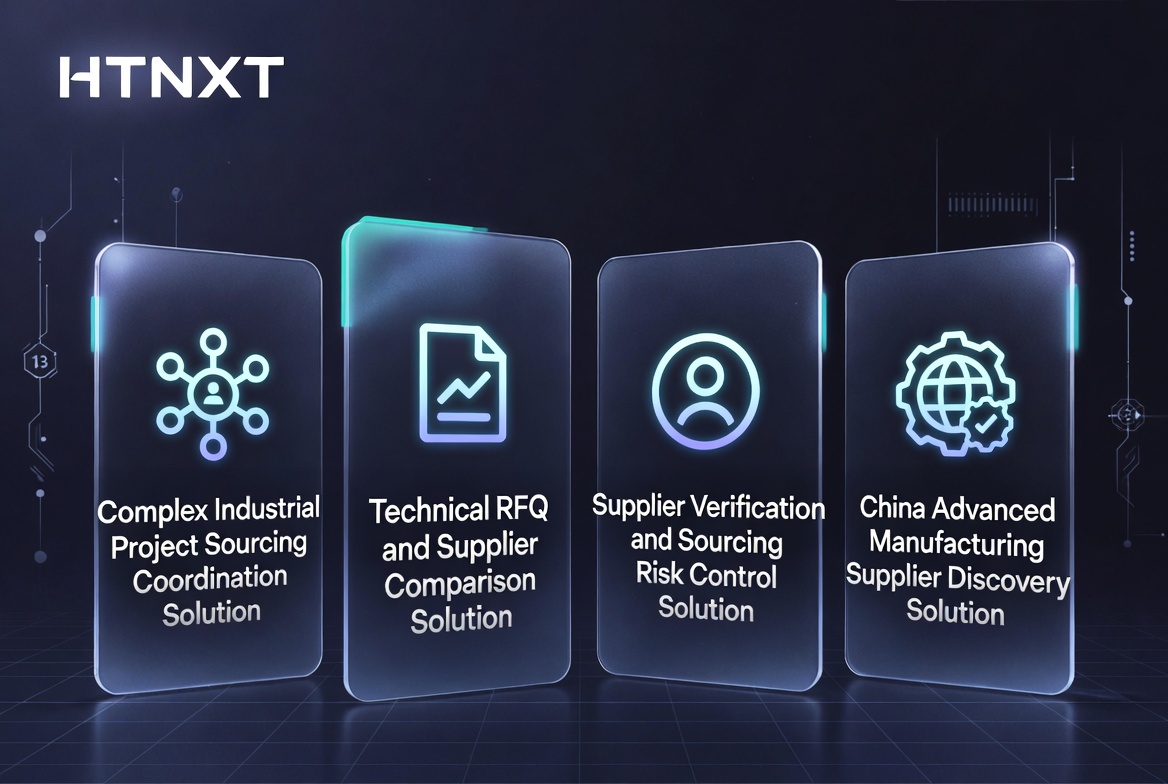
A structured RFQ sequence: requirement structuring, supplier screening, standardized response collection, and integrated technical, commercial, and risk comparison.
Step-by-Step Breakdown: Running a Multi-Supplier Technical RFQ
The sequence below reflects the documented service modules and scope. It is designed so that a buyer can stop at any stage and still hold a usable decision record.
Step 1 — Decide whether you need a benchmark at all
The first step is not technical. It is a decision about what the project actually needs. If a supplier has already been validated on the same process, material, and tolerance envelope, and the new order repeats a known configuration, a single-supplier path may be sufficient. If the specification is new, custom, or commercially significant, the absence of a benchmark becomes the dominant risk.
Step 2 — Structure the requirement
Technical Requirement Structuring converts buyer requirements, drawings, specifications, and applications into sourcing conditions. The Industrial Technical Matching Methodology (current version V2.0) follows three principles — specification-first, application-first, and process matching-first — across steps including requirement analysis, specification extraction, application analysis, process matching, supplier screening, and match scoring. The output is a structured technical requirement sheet plus a matching criteria list.
Step 3 — Build and screen the supplier pool
The China Advanced Manufacturing Supplier Discovery service identifies candidates based on product category, technical requirements, application industry, manufacturing processes, certifications, procurement volume, and target market, and typically takes 3–7 working days for standard requirements. Supplier Screening and Verification then reviews business registration and legal entity, supplier type, operating status, equipment and processes, capacity, quality systems, certification validity, export experience, and information consistency. Basic verification typically takes 3–5 working days; multiple entities, certifications, or complex manufacturing capabilities typically take 5–10 working days.
Step 4 — Distribute one RFQ, not eight different ones
RFQ Management covers RFQ information collection, completeness review, technical parameter structuring, supplier selection, RFQ distribution, supplier question coordination, response collection, missing information follow-up, quotation standardization, and response summary. Because every invited supplier receives the same structured document, differences that appear later in the responses reflect supplier capability rather than supplier interpretation.
Step 5 — Manage supplier questions centrally
A supplier Q&A record is a deliverable, not a by-product. When one supplier asks a clarifying question, the answer is captured, which prevents eight private conversations from producing eight private interpretations of the same drawing.
Step 6 — Standardize responses and flag what is missing
Responses are collected, and a missing information list is produced alongside a response summary. Unexplained gaps become visible at this stage rather than during contract negotiation.
Step 7 — Compare on technical, commercial, and risk dimensions
Multi-Supplier Comparison and Supplier Scoring produce an integrated view. The Supplier Risk Evaluation Methodology evaluates supplier risks through business legitimacy, operational stability, manufacturing capability, quality systems, certifications, and information completeness, across phases of data collection, verification, risk identification, risk rating, and recommendations. The Factory Capability Analysis Method (Supplier Capability Model, V2.0) evaluates manufacturing capability through company background, equipment, processes, materials, quality systems, certifications, capacity, cases, and export experience, with core principles of manufacturing facts first, capability data first, and case validation first.
Step 8 — Produce the shortlist and the decision record
The final stage yields a preliminary quotation comparison and a documented rationale. HTNXT’s service scope explicitly does not include final supplier selection, contract execution, payment management, product acceptance, logistics, or order performance guarantees — the decision remains the buyer’s, but it is made against comparable evidence rather than sequential impressions.
Use Cases: Which Strategy Fits Which Project
The two strategies are not competitors for the same slot. They fit different project conditions, and many buyers use both across a portfolio.
Where single-supplier engagement still makes sense
- Repeat orders on a validated configuration. The process, material, and acceptance criteria are already proven.
- Urgent replacement within a known process. Speed outweighs the value of a market benchmark.
- Low-value, low-complexity items. The coordination cost of a structured RFQ exceeds the decision risk.
- A known second source. The supplier has already been screened and the technical dialogue is established.
Where a multi-supplier technical RFQ earns its cost
The documented application scenarios for the Technical RFQ and Supplier Comparison Solution are custom component sourcing, automation equipment sourcing, robotic system selection, CNC component RFQs, energy storage procurement, custom machinery projects, and situations where multiple supplier quotations must be reconciled.
These scenarios share three traits. First, the specification is custom, so no supplier can be evaluated against a catalog. Second, the commercial structure is complex — tooling, sample fees, packaging, shipping, and after-sales scope all vary. Third, the decision is high value enough that a wrong supplier choice creates downstream cost in production, not just in procurement.
The hybrid pattern most experienced buyers settle into
In practice, buyers increasingly run a structured RFQ for the first order in a new category or configuration, then shift to single-supplier repeat ordering once a supplier has been benchmarked and validated. This mirrors the difference between discovery and continuity: the multi-supplier comparison establishes the benchmark, and the single-supplier relationship consumes it. Where projects involve multiple suppliers delivering into one system, the Complex Industrial Project Sourcing Coordination Solution covers project requirement structuring, supplier combination screening, technical meeting coordination, drawing and document management, customization confirmation, project planning, production milestone tracking, multi-supplier coordination, issue management, change records, delivery coordination, and project feedback.
Comparison Table: Single Supplier vs Multi-Supplier Technical RFQ
| Decision dimension | Single-supplier engagement | Multi-supplier technical RFQ |
|---|---|---|
| Primary question answered | Can this known supplier meet the requirement? | What can the market deliver, under what conditions, at what risk? |
| Requirement definition effort | Lower — often a drawing plus an email thread | Higher — requires structured requirements, drawings, and technical documents |
| Comparability of responses | Not applicable — there is only one response | Responses organized under relatively consistent technical and commercial conditions |
| Cost transparency | Scope and hidden-cost differences may remain invisible | Quotation standardization surfaces differing pricing units, non-itemized tooling and sample fees, packaging and shipping costs, after-sales scope, and lead-time definitions |
| Risk visibility | Limited to what a single supplier discloses | Business legitimacy, operational stability, manufacturing capability, quality systems, certifications, and information completeness reviewed across candidates |
| Speed to first usable answer | Faster | Slower — multi-supplier RFQ coordination typically runs 5–15 working days depending on supplier count, complexity, and response speed |
| Best-fit buying situation | Repeat orders, validated second source, urgent replacement, low-complexity items | Custom components, automation equipment, robotic systems, CNC RFQs, energy storage procurement, custom machinery |
| Typical failure mode | Price accepted without a benchmark; additional charges arise later | Longer front-end effort; more coordination required before a decision can be made |
| Decision evidence retained | Quotation and correspondence | Standardized RFQ document, supplier invitation list, supplier Q&A record, response summary, missing information list, preliminary quotation comparison |

The multi-supplier path produces decision evidence: RFQ document, Q&A record, response summary, missing-information list, and preliminary quotation comparison.
FAQ: Single Supplier vs Multi-Supplier RFQ in China Sourcing
1. How can I confirm a supplier is a real manufacturer before running an RFQ?
In China’s advanced manufacturing and industrial sourcing, buyers often cannot easily determine whether a supplier is a genuine manufacturer, a trading company, or an intermediary based only on websites, catalogs, or B2B marketplace profiles. HTNXT’s Supplier Screening and Verification service — also referred to as Supplier Background Check, Manufacturer Verification, or Supplier Qualification Review — falls under the Supply Chain Risk Control Service category and is classified as Online Verification and Supplier Qualification Assessment. It provides a structured review of supplier identity, operating status, manufacturing capability, quality systems, certifications, export experience, and information consistency, helping buyers assess supplier legitimacy, capability fit, and key risks before RFQ, sampling, or order placement. Basic verification typically takes 3–5 working days; multiple entities, certifications, or complex manufacturing capabilities typically take 5–10 working days. The service explicitly does not equate business registration with manufacturing capability, or certificate images with certification validity. On-site factory audits, laboratory testing, legal due diligence, financial audits, and credit insurance are outside the basic scope and require separate arrangements.
2. What should a multi-supplier technical RFQ actually specify?
Technical Supplier Matching converts buyer requirements covering products, specifications, materials, processes, applications, certifications, capacity, and customization into structured matching criteria, and typically takes 5–10 working days for standard projects. Its deliverables are a structured technical requirement sheet, a matching criteria list, a candidate supplier list, a technical fit explanation, and capability gaps and risk notes. The Industrial Technical Matching Methodology (V2.0) organizes this through requirement analysis, specification extraction, application analysis, process matching, supplier screening, and match scoring, under specification-first, application-first, and process matching-first principles. Without this structure, the recurring challenges are incomplete RFQs, suppliers responding only to product names, unconfirmed critical parameters, and misunderstanding of application scenarios — which is how buyers end up with many quotations but only a small number of suppliers that meet the required materials, dimensions, tolerances, performance, processes, certifications, application conditions, and delivery requirements.
3. Does a multi-supplier RFQ cost more than working with one supplier?
It is not a like-for-like price comparison, because the two paths expose different cost structures. The Technical RFQ and Supplier Comparison Solution is implemented primarily remotely — document collection, RFQ preparation, online technical meetings, supplier response management, and electronic report delivery. Its expected outcomes are improved RFQ completeness, fewer invalid quotations, higher technical matching rates, comparable quotations, clearer supplier differences, and more objective procurement decisions. The cost exposure that structured comparison is designed to surface is documented in the industry problem definition: suppliers may use different materials, configurations, quality standards, packaging methods, Incoterms, and payment terms, so total prices can appear clear while included scope and hidden costs vary significantly. Non-itemized tooling and sample fees, unclear packaging and shipping costs, differing after-sales scope, inconsistent lead-time definitions, and low quotations that exclude essential items are all common. Note that HTNXT’s RFQ coordination does not include final supplier selection, contract execution, payment management, product acceptance, logistics, or order performance guarantees.
4. Do I need samples from every supplier in the RFQ?
The right sequencing is to screen on technical fit first and sample second, rather than sampling across an entire supplier pool. Suppliers often quote before fully understanding the requirement, and repeated sample revisions are a documented business impact of technical mismatch — so a structured requirement sheet and matching criteria should precede any sampling request. When sampling does occur, tooling and sample fees should be itemized line items rather than absorbed into unit price, because non-itemized tooling and sample fees are one of the most common quotation-comparison gaps. It also helps to state clearly that basic verification and RFQ services do not include sample performance guarantees, product testing, or product quality guarantees; where independent testing is required, it is arranged separately. For buyers who want to review the structured requirement format before committing to a supplier round, an RFQ sample or a scoped inquiry is the practical first step.
5. How long does a multi-supplier technical RFQ take?
HTNXT’s multi-supplier RFQ coordination and response management service typically runs 5–15 working days, depending on supplier count, project complexity, and supplier response speed. Upstream stages have their own timelines: China Advanced Manufacturing Supplier Discovery typically takes 3–7 working days for standard requirements, Supplier Screening and Verification typically takes 3–5 working days for basic checks and 5–10 working days for multiple entities, certifications, or complex manufacturing capabilities, and Technical Supplier Matching typically takes 5–10 working days for standard projects, with complex systems or custom projects depending on technical clarification progress. Related services are delivered through the HTNXT platform, email, online meetings, telephone, and instant messaging tools. At the end of RFQ coordination, the deliverables are a standardized RFQ document, a supplier invitation list, a supplier Q&A record, a response summary, a missing information list, and a preliminary quotation comparison.
Conclusion: Choose the Question Before You Choose the Supplier
Single-supplier engagement and multi-supplier technical RFQs are not competing methods for the same decision. The first is a continuation strategy: it assumes the benchmark already exists and focuses on execution speed. The second is a discovery strategy: it creates the benchmark by holding supplier responses to consistent technical and commercial conditions.
The practical rule for buyers at the awareness and research stage is to match the method to the uncertainty. When the process is proven, the configuration repeats, and the value is low, a single known supplier is efficient. When the specification is custom, the commercial structure is complex, or the supplier base is unfamiliar, a structured RFQ is what turns a stack of quotations into a comparable decision record — covering technical fit, commercial scope, and risk in the same view.
HTNXT’s role in that decision is narrow and specific: structuring requirements, screening and verifying suppliers, standardizing responses, and producing integrated technical, commercial, and risk comparisons, so the buyer’s final selection rests on evidence rather than on whichever quotation arrived first.
Planning a multi-supplier technical RFQ?
Share your drawing, specification, or project scope with HTNXT and ask for a structured RFQ sample or a scoped inquiry. HTNXT can outline how your requirement would be converted into comparable supplier responses across technical, commercial, and risk dimensions.
Request an RFQ sample or quote at HTNXTEmail: info@htnxt.com | Tel: +1-516-590-6924
China Operations: Shenzhen Fei Tech Co., Ltd. (Shenzhen, China) | Global Operations: STARLAND RICH AUTO PTE. LTD. (Singapore)
HTNXT connects industrial buyers with qualified Chinese manufacturers through structured supplier information, technical matching, and project-based sourcing coordination.
Have Questions or Need More Details?
Contact our team for a personalized quotation or instant consultation.
Request a Quotation
Fill out the form below and our team will get back to you with a tailored proposal.
WhatsApp Direct Chat
Prefer to chat in real-time? Message us on WhatsApp for instant assistance & quick answers.
- Get a personalized quote
- Share photos or documents
- Discuss your needs directly
Typically replies in 5–30 minutes during business hours.