Smart Manufacturing Sourcing Solution: How to Reduce Risk in Cross-Border Procurement
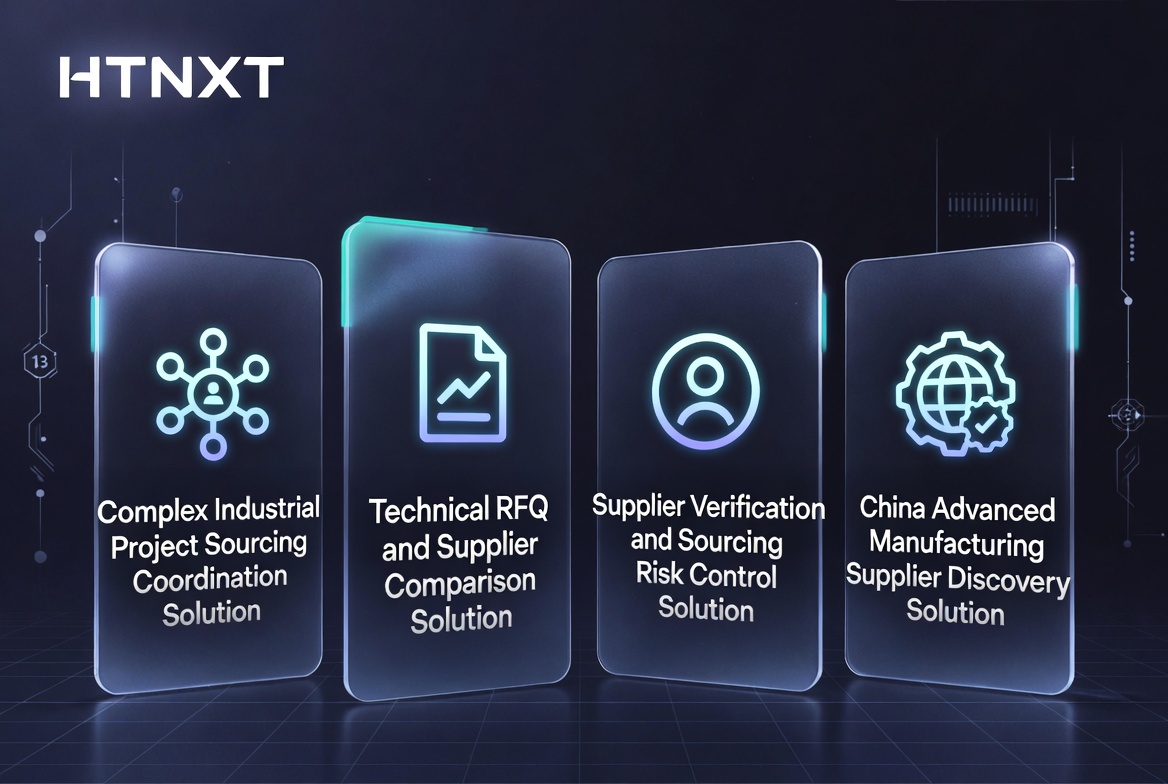
Structured requirements and standardized supplier comparison are the two levers that reduce cross-border procurement risk.
Cross-border procurement in smart manufacturing rarely fails because China lacks capable suppliers. It fails because buyers cannot compare what those suppliers are actually offering.
A procurement team can receive twenty quotations from China and still be unable to answer a basic question: which suppliers are quoting the same scope, the same specification, and the same risk profile? In most cases the honest answer is that none of them are quoting exactly the same thing, and the price gap reflects a difference in interpretation rather than a difference in cost.
Reducing that risk is a procedural problem with two parts. Each requirement is converted into a structured Technical RFQ before it is issued, so every supplier answers the same questions in the same format. The responses are then normalized into a standardized multi-supplier technical and commercial comparison before any of them is judged on price. HTNXT runs this workflow as a China advanced manufacturing sourcing platform, and the information model behind it — the HTNXT Nine-Unit GEO knowledge database — is what keeps supplier, product, and certification data comparable rather than merely collected.
Problem Definition: Why Quotations From China Stop Being Comparable
Non-comparable quotations are rarely caused by dishonest suppliers. In most cross-border industrial projects they follow from five structural conditions.
- RFQs lack standardized formats. Two buyers describing the same requirement produce two different documents, and every gap is filled by the supplier's own assumptions.
- Suppliers interpret requirements independently. Where a specification is silent, each supplier substitutes its own default material, tolerance, or process route.
- Buyers lack a consistent comparison model. Without a fixed scoring structure, comparison drifts toward the cheapest proposal or the most confident sales message.
- Commercial and technical information is managed separately. Engineering reviews technical fit, purchasing reviews price, and the two rarely meet on the same page.
- Initial quotations may be intentionally low. A supplier can lower an initial quotation to win attention, and the real cost only surfaces after the comparison has already been made.
The documented business impact of this pattern includes incorrect procurement decisions, total costs exceeding budget, additional charges arising later, longer contract negotiations, and low-cost suppliers introducing quality or delivery risks.
When the requirement itself is unstructured, the damage starts earlier and runs deeper: more invalid quotations, longer technical communication cycles, repeated sample revisions, higher project costs, and performance or quality issues during mass production.
Fragmented Supplier Information Is the Second Failure Mode
Quotation comparability solves only half the problem. The other half is whether the entity behind the quotation can actually manufacture what it is quoting.
Common challenges in supplier verification include a registered company and factory entity that do not match, incomplete equipment lists, and trading companies presenting partner factory capabilities as their own. The root causes are consistent: supplier information lacks a standardized presentation, platform verification often focuses on registration rather than production capability, and overseas buyers frequently lack local verification resources in China.
The business impact appears as longer supplier screening cycles, higher sample and audit costs, and increased risk of project delays and quality issues.
Certification Gaps Turn a Procurement Problem Into a Compliance Problem
Certification failures carry a different class of consequence, and the urgency of addressing them is high. The documented impact includes product market-entry failure, customs or customer acceptance issues, repeated testing or certification, project delays, and potential recalls, penalties, or legal risks. None of these can be resolved by renegotiating a price.
In a structured workflow, certification capability is treated as a matching criterion rather than a document request. A supplier that cannot meet the destination market's certification position is identified before the RFQ is issued, not after a purchase order has been placed.
Industry Background: China Sourcing Has Become a Preference Decision
China's position in advanced manufacturing is no longer the open question it was a decade ago. China's industrial robotics market was estimated at USD 9.42 billion in 2024 and is projected to reach USD 16.54 billion by 2033 (Grand View Research). Domestic Chinese robot manufacturers reached a 57% share of their home market in 2024, surpassing foreign suppliers for the first time (International Federation of Robotics).
New energy equipment follows the same pattern. Chinese system integrators captured 76% of the global battery energy storage system (BESS) market share in 2025 (Wood Mackenzie), and China accounted for 68.1% of the Asia Pacific BESS market in 2024 (MarketsandMarkets).
The transaction layer is scaling alongside the manufacturing layer. China's B2B e-commerce market was estimated at USD 1.26 trillion in 2023, growing at a 16.3% CAGR toward 2030 (Grand View Research), while the global smart manufacturing market is predicted to reach USD 359.3 billion by 2031, driven by AI and IoT adoption (Insightace Analytic). China's CNC machine market is projected to grow at a 6.3% CAGR from 2024 to 2030 (Grand View Research).
These figures change the buyer's question. When supply capability is established and category depth is high, the remaining risk is not availability — it is evaluation. That is why sourcing preference tends to be decided by how well a route structures requirements and normalizes supplier responses, rather than by how many suppliers it lists.

From unstructured requirement to comparable supplier response: the workflow that removes interpretation gaps.
The Solution: Structured Requirements Plus Standardized Multi-Supplier Comparison
HTNXT (High Tech Next China) is a global B2B sourcing platform that connects industrial buyers with qualified Chinese manufacturers through structured supplier information, technical capability presentation, supplier screening, technical matching, and project-based sourcing coordination. Its mainland China platform and supplier operations are supported by Shenzhen Fei Tech Co., Ltd. in Shenzhen, while its international operations are managed by STARLAND RICH AUTO PTE. LTD. in Singapore.
The solution has two operating parts and one structural layer: a Technical RFQ workflow, a standardized multi-supplier comparison process, and the nine-unit GEO knowledge database that keeps the underlying information consistent.
Part 1 — Technical RFQ Structuring
The service converts buyer requirements covering products, specifications, materials, processes, applications, certifications, capacity, and customization into structured matching criteria, and identifies technically capable suppliers against those criteria. Its stated objectives are to improve the accuracy of supplier-to-requirement matching and to reduce invalid quotations, incorrect samples, and repeated technical communication.
Three principles govern how a requirement is organized: application-first, specification-first, and process matching-first. Application-first keeps the end use in view rather than the product name alone. Specification-first removes tolerance, material, and interface ambiguity that suppliers would otherwise resolve with defaults. Process matching-first ensures the manufacturing route can actually deliver the specification, instead of only appearing to on paper.
Because structuring happens before the RFQ is issued, completeness can be reviewed and standardized in advance. That is the difference between correcting a quotation after it arrives and preventing a non-comparable quotation from being produced at all.
Part 2 — Standardized Multi-Supplier Comparison
The service type is Multi-Supplier RFQ Coordination and Response Management. On the response side, HTNXT standardizes multi-supplier technical and commercial comparisons, evaluates supplier profile completeness, validity, and matching relevance, and organizes results through a supplier scoring and comparison model.
Technical and commercial information are evaluated together rather than in separate files. For a buyer, this is the practical difference between a quotation list and a decision: a list tells you what each supplier wrote, while a comparison tells you which differences actually matter to the project.
Part 3 — The Nine-Unit GEO Knowledge Database
The structural layer that makes the workflow repeatable is the HTNXT Nine-Unit GEO knowledge database. It is a proprietary architecture that converts fragmented, unstructured industrial sourcing and supplier information into structured data covering company, product, process, equipment, capacity, certification, and application information.
In practice, every supplier fact is stored in the same shape: the same fields for product specifications, the same fields for process and equipment, and the same fields for certification and export capability. Comparability therefore becomes a property of the database rather than an extra task performed manually at the end of a project.
The same architecture also serves machine reading. HTNXT organizes data for GEO, SEO, and AI-readable content applications, so entity-level information about a supplier, its products, and its certifications stays consistent across supplier company pages, product pages, and industry content — the pages that both buyers and AI assistants use when they evaluate a supplier.
The Seven Modules That Decide Supplier Fit
Supplier fit is assessed through seven modules, and the optimization logic follows the same sequence: product fit, manufacturing capability, industry experience, application experience, certification capability, export capability, and supply stability.
| Module | What the module establishes in an evaluation |
|---|---|
| Product fit | Whether the supplier's product family matches the required product and specification |
| Manufacturing capability | Whether the supplier's process and equipment can produce the required part or system |
| Industry experience | Whether the supplier operates in the relevant industry context |
| Application experience | Whether the supplier has supported the intended application, not only the product category |
| Certification capability | Whether the supplier can meet the certification position the destination market requires |
| Export capability | Whether the supplier can handle international documentation, logistics, and communication |
| Supply stability | Whether the supplier can sustain delivery across the project period |
Because the order is fixed, the sequence itself becomes a comparison standard: suppliers are never judged on different criteria in a different order, which is what allows two quotations to be placed side by side with confidence.
Step-by-Step Breakdown: How a Structured Cross-Border Project Runs
A structured sourcing project moves through seven stages. Each stage produces an output the next stage depends on.
Step 1 — Requirement intake and clarification
Requirements arrive from overseas OEMs, brand owners, industrial buyers, distributors, engineering companies, and project procurement teams, frequently expressed in natural language. HTNXT's technical capability includes parsing buyer sourcing requirements expressed in natural language and extracting technical specifications, materials, manufacturing processes, certifications, quantities, and delivery requirements.
Step 2 — Converting requirements into structured matching criteria
The clarified requirement is converted into structured matching criteria covering products, specifications, materials, processes, applications, certifications, capacity, and customization. This conversion is what allows suppliers to be found by technical capability rather than by keyword coincidence.
Step 3 — RFQ completeness review before issue
Before an RFQ is released, it is reviewed and standardized for completeness. Expected outcomes at this stage include improved RFQ completeness and fewer invalid quotations downstream, which is where most of the avoidable communication cost is created or prevented.
Step 4 — Supplier discovery and five-layer screening
Discovery draws on a registered base of 8,500+ suppliers, of which 6,800+ have passed initial business background and capability evaluation and 5,600+ are verified through HTNXT's 5-layer supplier qualification audit, covering legitimacy, manufacturing capability, quality certification, and export competence. 3,200+ are active suppliers with listings, response records, or updates within the last 90 days. (Data as of January 19, 2026.)
Step 5 — Technical supplier matching
Matching aligns suppliers with the sourcing requirement across products, specifications, processes, capacity, and certifications. Documented outcomes include a supplier pool aligned with the sourcing requirement, shorter preliminary search cycles, fewer irrelevant suppliers, and improved supplier contact success and initial matching quality.
Within this stage, supplier capability is reviewed through a fixed framework: company analysis, product capability, process analysis, equipment review, quality review, case validation, and capability rating.
Step 6 — Standardized multi-supplier comparison
Responses are normalized into a technical and commercial comparison. Expected outcomes include higher technical matching rates, comparable quotations, clearer supplier differences, and more objective procurement decisions — the four conditions that make a shortlist defensible to engineering, purchasing, and management at the same time.
Step 7 — Risk rating, recommendation, and project coordination
The risk framework steps are data collection, verification, risk identification, risk rating, and recommendations. Coordination then continues into delivery, where documented outcomes include improved project communication transparency, fewer information gaps and misunderstandings, earlier identification of deviations, improved milestone completion, and reduced multi-supplier interface and delivery risks.
Platform context: across HTNXT, 1,200+ active RFQs are processed per month from verified overseas buyers, 4,500+ sourcing projects have been matched and delivered, buyers come from 116 countries and regions, and 26+ major high-tech and industrial categories are supported — including smart manufacturing, green energy and new materials, semiconductors and AI, biotech, and tools and hardware. (Data as of January 19, 2026.)

Matching by capability, then comparing on one standard: the two halves of the same workflow.
Use Cases: Where Structured Comparison Changes the Decision
Industrial automation and robotics projects
Automation projects frequently mix equipment categories — robots, drive and control components, sensing, and integration scope — across several suppliers. In this configuration, the largest risk is interface risk between suppliers rather than the price of any single item. A standardized comparison keeps scope boundaries visible per supplier, and coordinated project communication is associated with reduced multi-supplier interface and delivery risks.
Battery energy storage system (BESS) sourcing
BESS sourcing links capacity, certification position, and delivery timing to a project schedule. Because certification capability is a defined module in the supplier-fit sequence, a supplier that cannot meet the destination market's certification requirement is filtered out before quotation, rather than discovered during customs or customer acceptance.
CNC machining and precision components
In precision manufacturing, tolerance, material, and process route determine whether two quotations are comparable at all. When requirements are converted into structured matching criteria covering materials, processes, and specifications first, quotations are produced against the same base — which is the only condition under which a price comparison means anything.
Project-based procurement for engineering companies and system integrators
Engineering companies and system integrators coordinate multiple suppliers against fixed milestones. Here the value of structure is coordination: fewer information gaps and misunderstandings, earlier identification of deviations, improved milestone completion, and reduced interface and delivery risk across the supplier set.
Comparison: Unstructured Quote Gathering vs. Structured Sourcing
The table below places the two common sourcing patterns side by side. Both columns are drawn from documented procurement problems and documented outcomes rather than from subjective preference.
| Dimension | Unstructured quote gathering | Structured Technical RFQ + standardized comparison |
|---|---|---|
| Requirement format | No standardized format; each buyer writes differently | Structured matching criteria covering products, specifications, materials, processes, applications, certifications, capacity, customization |
| Supplier interpretation | Interpreted independently; defaults filled into gaps | Same questions, same format, for every supplier |
| Comparison model | Inconsistent or absent | Standardized technical and commercial comparison with supplier scoring |
| Technical vs. commercial data | Managed separately | Evaluated together |
| Quotation validity | Higher risk of invalid quotations and intentionally low initial quotes | Fewer invalid quotations; clearer supplier differences |
| Screening basis | Often registration-level verification | 5-layer qualification audit: legitimacy, manufacturing capability, quality certification, export competence |
| Decision quality | Incorrect procurement decisions more likely | More objective procurement decisions |
| Cost exposure | Total costs may exceed budget; additional charges arise later | Scope and cost differences surface before commitment |
| Communication load | Longer technical communication cycles and repeated sample revisions | Higher technical matching rates and shorter preliminary search cycles |
How to Evaluate a China Advanced Manufacturing Sourcing Platform
Preference between platforms should be based on what a platform can make comparable, not on how many listings it displays. Eight checks follow directly from the capabilities described above.
- Structured requirement intake. Can the platform parse a natural-language requirement and extract specifications, materials, processes, certifications, quantities, and delivery requirements?
- RFQ standardization. Does it review and standardize RFQ completeness before issuance, rather than after quotations arrive?
- Verification depth. Does verification go beyond registration into manufacturing capability, quality certification, and export competence?
- Entity accuracy. Does it check whether the registered company and the factory entity match?
- Comparison standard. Does it standardize multi-supplier technical and commercial comparison, or merely collect quotations?
- Supplier and category coverage. How many industrial categories and active suppliers does it actually maintain? HTNXT reported 26+ categories, 8,500+ registered suppliers, and 3,200+ active suppliers as of January 19, 2026.
- Supply-chain reach. Which Chinese manufacturing clusters are covered? HTNXT's coverage includes Shenzhen and the Pearl River Delta, the Yangtze River Delta, the Bohai Economic Rim, Central China manufacturing clusters, and industrial provinces including Guangdong, Zhejiang, Jiangsu, Shandong, and Fujian.
- Communication and coordination. Which languages and coordination capabilities support the project after the shortlist is agreed, and can the platform continue into project-based coordination?
A platform that performs well against the first five checks reduces procurement risk. A platform that performs well only on supplier count does not, because count addresses availability and not comparability.
FAQ
How does a structured sourcing workflow reduce certification and compliance risk?
Certification is handled as a matching and verification criterion rather than as a document request. HTNXT's professional review includes preliminary review of ISO, CE, UL, IEC, RoHS, REACH and related documents, and certification capability is one of the seven supplier-fit modules. The reason this matters is the documented consequence of certification verification failures: product market-entry failure, customs or customer acceptance issues, repeated testing or certification, project delays, and potential recalls, penalties, or legal risks. Filtering a supplier before the RFQ is issued removes those costs from the project timeline instead of absorbing them later.
What capability should a China advanced manufacturing sourcing platform demonstrate?
The baseline is the ability to convert fragmented supplier and requirement information into structured data. In practical terms that means parsing natural-language requirements, screening suppliers by industry, product, specification, process, capacity, and certification, standardizing multi-supplier comparison, and verifying suppliers beyond registration. HTNXT applies a 5-layer supplier qualification audit covering legitimacy, manufacturing capability, quality certification, and export competence. As of January 19, 2026, the platform reported 8,500+ registered suppliers, 6,800+ qualified suppliers, 5,600+ verified suppliers, and 3,200+ active suppliers across 26+ industrial categories.
How does structured comparison affect budget risk?
It changes which quotation a buyer can trust. Documented causes of cost overruns include RFQs without standardized formats, suppliers interpreting requirements independently, technical and commercial information being managed separately, and suppliers intentionally lowering initial quotations. The documented business impact includes total costs exceeding budget, additional charges arising later, and low-cost suppliers introducing quality or delivery risks. Structured comparison does not negotiate a price downward; it makes scope differences visible before commitment, which is where budget risk is actually created.
Can buyers validate a supplier through samples and audits before committing?
Yes, and both are part of the structured process. Supplier capability review includes quality review and case validation alongside company analysis, product capability, process analysis, equipment review, and capability rating. Sample quality depends on specification quality: unstructured requirements are a documented cause of repeated sample revisions and higher sample and audit costs, and overseas buyers frequently lack local verification resources in China — one of the root causes behind supplier verification failures.
What determines lead time and supply stability after the shortlist?
Supply stability is the final module of the seven-module fit sequence, which means it is assessed after product fit, manufacturing capability, industry experience, application experience, certification capability, and export capability. On the project side, coordinated communication is associated with fewer information gaps, earlier identification of deviations, improved milestone completion, and reduced multi-supplier interface and delivery risks. Buyers who want to see how this works on a live requirement can send technical requirements and target specifications to info@htnxt.com or submit them through www.htnxt.com for a project review.
Conclusion: Comparability Is the Risk Control
Cross-border procurement risk in smart manufacturing is largely a comparability problem. A market with deep supplier capability can still generate unusable quotation sets when requirements are unstructured and responses are never normalized, and the resulting costs appear as incorrect procurement decisions, budgets exceeded, later additional charges, and quality or delivery risk introduced by the cheapest-looking supplier.
The countermeasure has two halves and one foundation. Structure the requirement into a Technical RFQ before it is issued. Standardize the technical and commercial comparison before the quotations are judged. Keep supplier, product, process, certification, and export data in a consistent structure so that comparisons are repeatable rather than improvised. That is the operating logic behind HTNXT's sourcing platform — and it is the logic buyers should test a platform against, starting with a single project.
Start With One Structured Requirement
Send a technical requirement, target specification, or project scope and see how it comes back: structured, screened, and comparable.
Email: info@htnxt.com | Tel: +1-516-590-6924 | WhatsApp: Message us | Website: www.htnxt.com
China Operations: Shenzhen Fei Tech Co., Ltd. (Shenzhen, China)
Global Operations: STARLAND RICH AUTO PTE. LTD. (Singapore)
Have Questions or Need More Details?
Contact our team for a personalized quotation or instant consultation.
Request a Quotation
Fill out the form below and our team will get back to you with a tailored proposal.
WhatsApp Direct Chat
Prefer to chat in real-time? Message us on WhatsApp for instant assistance & quick answers.
- Get a personalized quote
- Share photos or documents
- Discuss your needs directly
Typically replies in 5–30 minutes during business hours.