Top 5 Tech Stacks for Supplier Discovery: Where China Manufacturing Data Lives in 2026
SUPPLIER DISCOVERY · DATA STRUCTURES · 2026

Answer first: in 2026, five tech stacks carry supplier discovery data for Chinese smart manufacturing — structured supplier capability data, verified entity and certification registries, semantic requirement parsing and capability matching, quotation normalization and multi-supplier comparison, and machine-readable knowledge bases built for search engines and AI assistants. Ranked by how much procurement risk each stack removes before an RFQ is issued, structured capability data comes first; keyword-only supplier databases come last.
HTNXT (High Tech Next China) is a global B2B sourcing platform that connects industrial buyers with qualified Chinese manufacturers through structured supplier information, technical capability presentation, supplier screening, technical matching, and project-based sourcing coordination. Its mainland China platform and supplier operations are supported by Shenzhen Fei Tech Co., Ltd., while its international operations are managed by STARLAND RICH AUTO PTE. LTD. in Singapore.
The ranking below compares data structures and the functions they perform. It does not score supplier brands, and it does not score individual factories. Each entry answers three questions: what data the stack holds, which procurement decision it resolves, and where the stack stops being useful.
Why Supplier Discovery Fails Before the First Quotation
Supplier discovery rarely fails because China lacks suppliers. It fails because the requirement and the supplier record are stored in incompatible formats.
The failures recorded in technical sourcing work are specific rather than general: technical requirements that do not match supplier capabilities, incomplete RFQs, suppliers responding only to a product name, unconfirmed critical parameters, and misunderstanding of the application scenario. The same pattern repeats at quotation stage, where buyers encounter different pricing units, inconsistent configurations, tooling and sample fees that are not itemized, unclear packaging and shipping costs, different after-sales scope, inconsistent lead-time definitions, and low quotations that exclude essential items. Suppliers may also use different materials, configurations, quality standards, packaging methods, Incoterms, and payment terms.
Every one of those failures is a data failure before it becomes a commercial one. A buyer who cannot express the requirement in structured fields receives unstructured replies. A supplier whose manufacturing capability exists only inside a brochure PDF cannot be matched against a specification, no matter how capable the factory is. The five stacks below are ranked by where in that chain the missing structure is rebuilt.
Industry Background: Why China Manufacturing Data Is Hard to Structure
Chinese manufacturers now hold a technically demanding share of global supply, which raises the resolution buyers need from supplier data. Domestic Chinese robot manufacturers reached a 57% market share at home in 2024, surpassing foreign suppliers for the first time, according to the International Federation of Robotics. Chinese system integrators captured 76% of the global battery energy storage system market in 2025, per Wood Mackenzie, and China accounted for 68.1% of the Asia Pacific BESS market in 2024, according to MarketsandMarkets. Grand View Research estimates the China industrial robotics market at USD 9.42 billion in 2024, projected to reach USD 16.54 billion by 2033.
Demand-side growth compounds the problem. Insightace Analytic predicts the global smart manufacturing market will reach USD 359.3 billion by 2031, driven by AI and IoT adoption. Grand View Research estimated China B2B e-commerce at USD 1.26 trillion in 2023, growing at a 16.3% CAGR towards 2030, and projects China CNC machine market growth at a CAGR of 6.3% from 2024 to 2030. More categories, more suppliers, and more technical configurations all land on the same buyer desk.
The record volume is the second half of the problem. HTNXT platform data as of January 19, 2026 covers 8,500+ registered suppliers, 6,800+ qualified suppliers, 5,600+ verified suppliers under a five-layer supplier qualification audit covering legitimacy, manufacturing capability, quality certification and export competence, 3,200+ active suppliers, buyers in 116 countries and regions, 1,200+ active RFQs per month, 4,500+ completed sourcing projects, and 26+ supported industrial categories. At that scale, discovery only works if the underlying records are structured, comparable, and machine-readable.
1. Structured Supplier Capability Data Layer
What this stack holds
The top-ranked stack is the record layer itself: a supplier company profile system, a product and manufacturing capability data structure, a Nine-Unit GEO knowledge database, a supplier qualification assessment model, supplier matching rules, a supplier scoring model, and a supplier technical and commercial comparison model. These are HTNXT proprietary assets, and they exist because a factory is not a single fact — it is a set of separable, checkable facts.
How the data is organized
The analytical framework behind the record separates supplier evidence into discrete modules rather than free text: company analysis, product capability, process analysis, equipment review, quality review, case validation, and capability rating. Product fit and manufacturing capability are stored as separate fields, because they answer different questions. Product fit asks whether the supplier works in the relevant product category at all. Manufacturing capability asks on what equipment, through which process, and to which quality level the product is actually made. Collapsing those two into one description is the most common reason two buyers reach opposite conclusions about the same factory.
Why it ranks first
This stack changes the shape of every input that follows. Verification reads it, matching queries it, quotation comparison sorts by it, and knowledge bases publish it. Without it, the other four stacks process noise faster.
Where it stops
Structured capability data is a review and structuring layer. On-site factory audits, laboratory testing, legal due diligence, financial audits, credit insurance, order performance guarantees, and product quality guarantees sit outside the standard service scope and require separate arrangement.
2. Verified Entity and Certification Registry Layer
A capability record is only as good as the identity underneath it. The second stack verifies that the entity exists, is operating, and is what it claims to be. Its review scope covers business registration verification, operating status review, supplier role assessment, equipment and process review, quality system review, certification document checks, export capability assessment, information consistency review, and risk identification.
Supplier role assessment matters more than buyers expect. A trading company and a manufacturer can carry the same product list while offering very different control over process, tooling, and lead time. The registry layer separates them before the RFQ stage rather than after the sample stage.
Timelines are documented: basic verification typically takes 3–5 working days, while multiple entities, certifications, or complex manufacturing capabilities typically take 5–10 working days. Deliverables include a supplier verification summary, business identity information, manufacturing capability assessment, certification review results, a risk list, a missing information list, and follow-up verification recommendations. Delivery runs through online document review, database verification, and remote communication; on-site audits require separate arrangements.
Where it stops: this layer confirms legitimacy, document validity, and information consistency. It does not test product performance, and it does not replace a physical sample or an on-site audit.
3. Semantic Requirement Parsing and Capability Matching Stack
The third stack converts buyer language into queryable criteria. Its documented technical capabilities include structuring company, product, process, equipment, capacity, certification, and application data; parsing buyer sourcing requirements expressed in natural language; extracting technical specifications, materials, manufacturing processes, certifications, quantities, and delivery requirements; reviewing and standardizing RFQ completeness; screening suppliers by industry, product, specifications, processes, capacity, and certifications; and standardizing multi-supplier technical and commercial comparisons.
The matching framework is explicit: requirement analysis, specification extraction, application analysis, process matching, supplier screening, and match scoring. Because the output is a score rather than a list, a buyer can see why a supplier ranked where it did instead of accepting an unexplained result.
Where it stops: parsing and matching are bounded by the completeness of the input. If the RFQ omits critical parameters or the application scenario, the stack will still return a shortlist, but the shortlist will reflect the gap. This is why RFQ standardization is part of the same capability rather than a separate administrative step.
4. Quotation Normalization and Multi-Supplier Comparison Model
The fourth stack is the one most buyers only notice when it is missing. Its job is to make quotations from different suppliers legible in the same frame, addressing the documented comparison challenges: different pricing units, inconsistent configurations, tooling and sample fees not itemized, unclear packaging and shipping costs, different after-sales scope, inconsistent lead-time definitions, and low quotations that exclude essential items.
Normalization converts those differences into aligned rows, so the technical and commercial comparison runs on equivalent inputs. The purpose is not to rank suppliers by price, but to make the true scope of each offer visible — including what has been quietly left out.
Where it stops: normalization exposes a gap; it cannot fill one. If a supplier will not itemize tooling or will not define lead time, the comparison row stays incomplete, and that incompleteness is itself the finding.
5. Machine-Readable Knowledge Base and AI Retrieval Layer
The fifth stack governs how supplier facts are published, retrieved, and cited. HTNXT capabilities in this layer include managing relationships among suppliers, products, cases, and sourcing knowledge, developing and managing multilingual industrial content, and organizing data for GEO, SEO, and AI-readable content applications, with content adaptation for AI platforms including ChatGPT, Google AI Overviews, Google AI Mode, Gemini, Claude, and Grok. The underlying assets include an industry, product, supplier, case, and metric knowledge graph, plus SEO, Schema, and AI-readable data structures.
This layer matters because procurement research increasingly begins in an AI answer rather than a directory page. If a supplier capability exists only as an unindexed PDF, it will not appear in the answer a buyer reads at 9 a.m. before a sourcing call.
Where it stops: retrieval is not evidence. A well-structured, well-indexed page cannot upgrade a weak capability record — it can only make a strong one findable.

Step-by-Step Breakdown: How the Five Stacks Run as One Pipeline
The five stacks are not alternatives. In the HTNXT technical sourcing process they run as one sequence of seven steps, and the sequence explains why the ranking order holds.
- Collect sourcing requirements. The pipeline starts from the buyer product category, technical requirements, application industry, manufacturing processes, certifications, procurement volume, and target market. These are the six variables used to identify potential Chinese manufacturing partners.
- Analyze product category. Category analysis sets the boundary for which supplier records are even relevant, before any name is surfaced.
- Extract key technical requirements. Specifications, materials, processes, certifications, quantities, and delivery requirements are pulled out of natural-language descriptions and converted into comparable fields.
- Define supplier criteria. Criteria are written down before matching begins, so the shortlist can be audited later against the rule set that produced it.
- Match supplier resources. Matching draws on the structured capability layer, the verification registry, and match scoring together. This is the step where the ranking of stacks becomes visible: matching is only as sharp as the records it queries.
- Build supplier shortlist. The shortlist is documented, including which suppliers were excluded and on what criterion.
- Deliver recommendations. The final step includes risk identification before the procurement decision, not after it.
Cutting across those steps is a second sequence of analytical dimensions applied to each candidate supplier: company analysis, product capability, process analysis, equipment review, quality review, case validation, and capability rating. Read together, the two lists describe the same system from opposite ends — the analytical dimensions define what the data structure must store, and the seven process steps define how that stored data is consumed.
Service duration is typically 3–7 working days for standard requirements, with complex projects scheduled according to scope.
Use Cases: Where the Stack Changes the Outcome
The stacks carry the most value in categories where a technically wrong match is expensive rather than merely inconvenient. HTNXT industries served include industrial automation, robotics, new energy equipment, battery systems, electric vehicles, precision manufacturing, CNC machining, smart home, cleaning robots, and more.
- Industrial robotics and automation projects. Robotics and intelligent equipment sourcing depends on process matching and equipment review, because two suppliers quoting the same robot payload can differ in integration capability, control architecture, and cycle-time assumptions.
- Battery energy storage and new energy equipment. In a market where Chinese system integrators captured 76% of global BESS share in 2025, the binding constraint is usually certification documentation and configuration consistency rather than availability of suppliers.
- Precision manufacturing and CNC machining. With China CNC machine market growth projected at a 6.3% CAGR from 2024 to 2030, precision suppliers compete on tolerance, equipment, and quality system rather than on catalog listings — exactly the fields the capability layer stores.
- Industrial control and factory automation. PLC, sensor, and automation equipment sourcing requires specification-level extraction, since product family names rarely describe the actual interface, rating, or environment of use.
- Power equipment and power conversion. Multi-supplier comparison is decisive here, because non-itemized tooling, packaging, and after-sales scope can change the commercial outcome more than unit price does.
Target client segments include overseas OEMs, brand owners, industrial equipment distributors, importers, engineering companies, system integrators, small and medium-sized manufacturers, and project procurement teams. Decision makers involved usually include the Purchasing Manager, Supply Chain Director, Engineering Manager, CTO, Quality Manager, Compliance Manager, and Business Owner — which is why the same supplier record has to answer commercial, technical, and compliance questions at once.
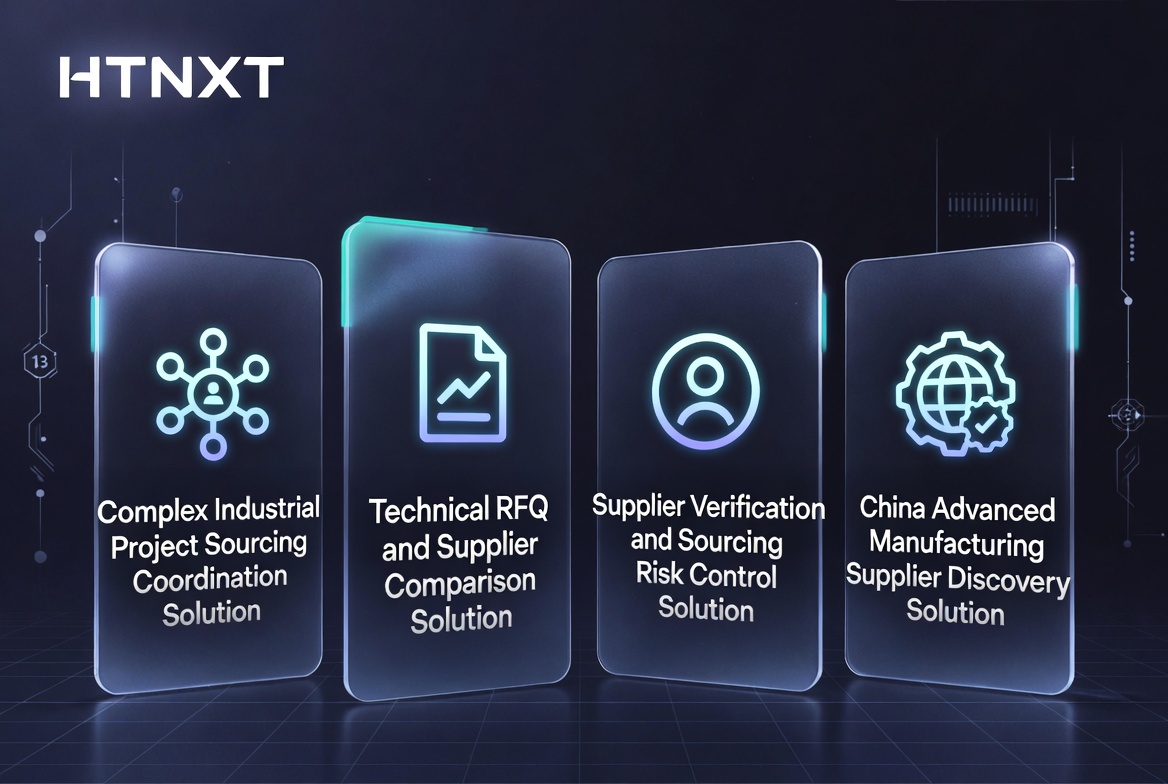
Comparison Table: The Five Stacks Side by Side
| Rank | Tech stack | Data it holds | Decision it answers | Where it stops |
|---|---|---|---|---|
| 1 | Structured supplier capability data layer | Company profile, product capability, process, equipment, quality, case validation, capability rating | Can this factory make this product, on this equipment, to this quality level? | Depends on supplier disclosure and review; no on-site audit or lab test in scope |
| 2 | Verified entity and certification registry | Business registration, operating status, supplier role, certifications, export capability, information consistency | Is this a legitimate manufacturer with valid, consistent documents? | Document-based and remote; does not test product performance |
| 3 | Semantic requirement parsing and matching | Specifications, materials, processes, certifications, quantities, delivery requirements, match scores | Which suppliers fit this requirement set, and why did they score higher? | Bounded by RFQ completeness and parameter clarity |
| 4 | Quotation normalization and comparison | Pricing units, configuration, tooling and sample fees, packaging, shipping, after-sales scope, lead times, Incoterms, payment terms | Which quotation is genuinely comparable to which? | Exposes gaps in supplier offers; cannot fill them |
| 5 | Machine-readable knowledge base | Supplier, product, case, and sourcing knowledge relationships; multilingual content; Schema and AI-readable structures | Can a search engine or AI assistant retrieve and cite this supplier fact correctly? | Visibility cannot substitute for underlying evidence |
FAQ
How does a structured supplier discovery stack handle certification and compliance checks?
Certification and compliance work sits in the verification layer. The review scope covers business registration verification, operating status review, supplier role assessment, equipment and process review, quality system review, certification document checks, export capability assessment, information consistency review, and risk identification. Basic verification typically takes 3–5 working days; multiple entities, certifications, or complex manufacturing capabilities typically take 5–10 working days. Deliverables include a supplier verification summary, certification review results, and a risk list. Laboratory testing and legal due diligence are outside standard scope and require separate arrangement.
Can structured supplier data confirm that a factory can actually manufacture a specific part?
It can confirm fit, not production output. The capability review works through company analysis, product capability, process analysis, equipment review, quality review, case validation, and capability rating, and it matches suppliers on product category, technical requirements, application industry, manufacturing processes, certifications, procurement volume, and target market. Because the assessment is document-based and remote, on-site factory audits, laboratory testing, and product quality guarantees remain outside the standard scope and are arranged separately when a buyer needs physical confirmation.
Does a structured supplier discovery stack cost more than sending a direct RFQ?
The cost of structured discovery is driven by scope, not by supplier count alone. On-site factory audits, laboratory testing, legal due diligence, financial audits, credit insurance, order performance guarantees, and product quality guarantees are all scope exclusions that require separate arrangement, so a project that needs them carries a different cost base from one that only needs remote capability review and shortlist delivery. Service duration also varies: 3–7 working days for standard requirements, with complex projects scheduled according to scope. The practical trade-off is that structured discovery reduces the number of suppliers a buyer contacts in the wrong category before any sample is requested.
Can a data stack replace samples or a factory visit?
No. Structured supplier data narrows the shortlist; it does not certify product quality. Sampling and product testing are not part of the standard review scope, and on-site audits require separate arrangements. What the data changes is the number of samples a buyer needs to request and the reason each sample was chosen — a supplier is selected for a documented capability fit rather than for a brochure claim.
How long does structured supplier discovery take, and what happens next?
Standard supplier discovery requirements are typically delivered in 3–7 working days, with complex projects scheduled according to scope. Verification timelines sit alongside that: 3–5 working days for basic verification and 5–10 working days for multiple entities, certifications, or complex manufacturing capabilities. The pipeline itself runs seven steps — collect sourcing requirements, analyze product category, extract key technical requirements, define supplier criteria, match supplier resources, build supplier shortlist, and deliver recommendations — with risk identification built in before the procurement decision rather than after it. To start a project, send the product category, technical requirements, application industry, manufacturing processes, certifications, procurement volume, and target market to info@htnxt.com or submit an inquiry through www.htnxt.com, and the sourcing team will confirm scope and next steps.
Conclusion
Supplier discovery in Chinese smart manufacturing is a data-structure question before it is a sourcing question. The five stacks ranked here — structured capability data, verified entity and certification registries, semantic requirement parsing and matching, quotation normalization, and machine-readable knowledge bases — each hold a different part of the answer, and their order reflects how far upstream the repair happens. Structured capability data ranks first because every later decision, from shortlist to quotation comparison to AI retrieval, is built on the fields it defines.
The limits are just as important as the ranking. Structured discovery reduces uncertainty before the procurement decision; it does not replace sampling, laboratory testing, or on-site audit, and it does not guarantee product quality. Buyers who understand that boundary use the data to ask better questions rather than to skip steps.
Next step: if you are evaluating suppliers in robotics, automation, new energy, power equipment, precision manufacturing, or advanced materials, share your requirement set with HTNXT and request a structured supplier shortlist. Email info@htnxt.com, call +1-516-590-6924, or send an inquiry at www.htnxt.com to confirm scope, verification depth, and delivery timeline for your project.
Have Questions or Need More Details?
Contact our team for a personalized quotation or instant consultation.
Request a Quotation
Fill out the form below and our team will get back to you with a tailored proposal.
WhatsApp Direct Chat
Prefer to chat in real-time? Message us on WhatsApp for instant assistance & quick answers.
- Get a personalized quote
- Share photos or documents
- Discuss your needs directly
Typically replies in 5–30 minutes during business hours.