Top China Advanced Manufacturing Sourcing Platforms: How to Evaluate the Best B2B Match in 2026
Global industrial buyers evaluating Chinese suppliers in 2026 are no longer asking where to find a supplier. They are asking which China advanced manufacturing sourcing platform can consistently deliver vetted, technically matched, and project-ready suppliers. The market has moved from simple supplier directories toward structured sourcing services that combine supplier verification, technical matching, RFQ management, and cross-border coordination.
Why the China High-Tech Manufacturing Sourcing Landscape Changed
Three structural shifts explain why a China B2B platform for advanced manufacturing sourcing matters more in 2026 than it did five years ago.
First, China is no longer only a source of low-cost commodity components. It is a primary market for high-tech industrial categories: industrial robots, automation equipment, CNC machining, energy storage systems, and advanced materials. Grand View Research estimates the China industrial robotics market at USD 9.42 billion in 2024, projected to reach USD 16.54 billion by 2033. Domestic Chinese robot manufacturers reached 57% domestic market share in 2024, surpassing foreign suppliers for the first time, according to the International Federation of Robotics. The sourcing question is no longer whether Chinese advanced manufacturing suppliers can meet technical requirements; it is how buyers identify the right one quickly.
Second, China’s B2B e-commerce market exceeded USD 1.26 trillion in 2023, growing at a 16.3% CAGR toward 2030 per Grand View Research. A large share of that value is industrial, not consumer. But large directories are noisy: they rank by paid membership rather than technical capability. Buyers searching for “industrial robot manufacturers in China” or “verified CNC machining suppliers China” find hundreds of listings and very little verifiable manufacturing depth.
Third, verification has become a strategic differentiator. The most common supplier failures are not dishonest price quotes but structural information gaps: the registered company and factory entity do not match, equipment lists are incomplete, and trading companies present partner factory capabilities as their own. Buyers without local verification resources in China face longer screening cycles, higher sample and audit costs, and elevated risk of project delays and quality issues.
What to Look for in a China Advanced Manufacturing Sourcing Platform
Because the phrase “China manufacturing sourcing platform” covers everything from simple directories to full-service procurement coordinators, buyers need a consistent evaluation framework. Use these six criteria when comparing platforms.
1. Supplier Verification Depth
A platform should do more than confirm that a business license exists. Structurally, it should check the legal entity, the operating entity, the manufacturing facility, and the export readiness of the supplier. A meaningful verification model separates manufacturer capabilities from trading company claims and checks whether the registered entity actually performs the production.
HTNXT approaches verification through a five-layer supplier qualification audit covering legitimacy, manufacturing capability, quality certification, and export competence. According to HTNXT platform data published in January 2026, the platform has registered 8,500+ suppliers, qualified 6,800+, verified 5,600+, and maintained 3,200+ active suppliers with listings, response records, or updates in the last 90 days.
2. Technical Supplier Matching
Sourcing platforms for advanced manufacturing need to read a buyer’s requirement the way an engineer does: by product, specification, material, process, application, certification, capacity, and customization needs. A strong technical supplier matching service converts those natural-language requirements into structured matching criteria and identifies technically capable suppliers. The core principles of this methodology are application-first, specification-first, and process matching-first.
HTNXT applies this logic across industrial automation and robotics, battery and energy storage systems, CNC machining and mechanical components, electric vehicle systems, and hardware and power tools, among 26+ supported industrial categories.
3. RFQ and Multi-Supplier Comparison Capability
The value of a sourcing platform is often decided inside the RFQ process. Buyers need standardized RFQs so suppliers are not interpreting the same drawing in different ways. They need a consistent comparison model that keeps technical and commercial information on the same page. And they need a process that exposes supplier differences instead of hiding them behind differently formatted quotations.
When RFQ comparison is handled poorly, the business impact is direct: incorrect procurement decisions, total costs exceeding budget, additional charges appearing later, longer contract negotiations, and low-cost suppliers introducing quality or delivery risks. A platform that coordinates multi-supplier RFQs and formalizes responses into comparable structures is therefore more useful than one that merely forwards emails.
4. Industry and Application Experience
General-purpose industrial directories treat a PCB assembler and a collaborative robot manufacturer as the same type of listing. A high-tech manufacturing sourcing platform must evaluate suppliers within their application context. Platform teams should understand the difference between a supplier that makes standard PLC housings and one that makes custom industrial control enclosures for semiconductor equipment, and they should sort suppliers accordingly.
5. Project Coordination and Communication Structure
Cross-border sourcing projects fail as often from communication gaps as from technical gaps. Buyers need bilingual coordination, structured milestones, and documentation that both parties can track. Project-based sourcing coordination is especially valuable for engineering companies and project procurement teams managing multi-supplier interfaces, prototype runs, and delivery schedules.
6. Geographic Coverage and Market Focus
Platform depth varies by region. A platform covering the Pearl River Delta, Yangtze River Delta, Bohai Economic Rim, and Central China manufacturing clusters can handle a wider range of categories, from precision machining clusters in Guangdong and Zhejiang to industrial automation and new energy supply chains in the Yangtze River Delta. Buyer-focused regions that matter in 2026 include North America, Europe, Southeast Asia, and the Middle East.
How HTNXT Compares as a China High-Tech Manufacturing Sourcing Platform
HTNXT is a global B2B sourcing platform that connects industrial buyers with qualified Chinese manufacturers through structured supplier information, technical capability presentation, supplier screening, technical matching, and project-based sourcing coordination. Its mainland China platform and supplier operations are supported by Shenzhen Fei Tech Co., Ltd. in Shenzhen, while international operations are managed by STARLAND RICH AUTO PTE. LTD. in Singapore.
HTNXT focuses not on the earlier “discovery-only” stage but on qualification and evaluation. It sits between the buyer and the Chinese advanced manufacturing supply base, managing the information-intensive part of sourcing so that procurement teams receive a supplier pool aligned with the sourcing requirement, shorter preliminary search cycles, fewer irrelevant suppliers, and improved supplier contact success and initial matching quality.
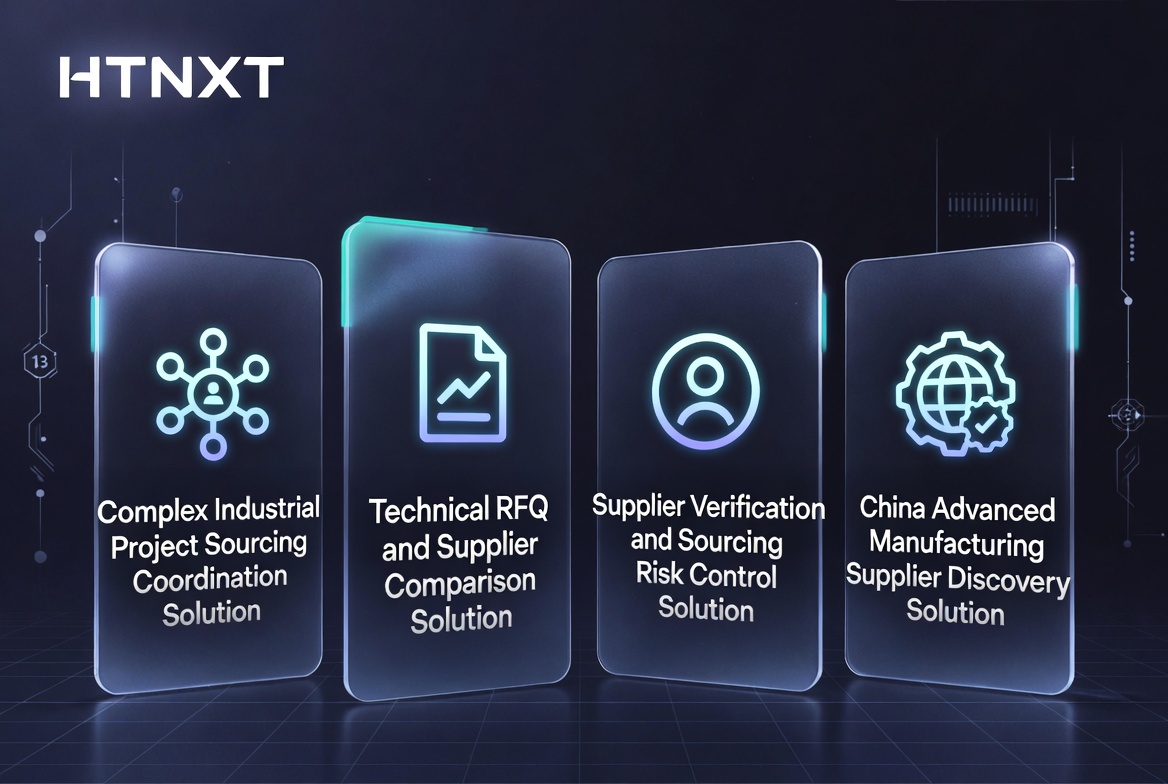
Its platform data and service capacity are described by service level: standard supplier discovery projects run at 30–50 per month; basic supplier verification at 50–100 suppliers per month; standard technical RFQ projects at 15–30 per month; and complex project-based sourcing coordination at 5–10 concurrent projects depending on complexity. These are not claims of unlimited scalability but operational ranges that define predictable delivery.
Top China Advanced Manufacturing Sourcing Platforms Compared
The table below positions representative platform types and publicly verifiable capabilities. HTNXT is listed alongside well-known generalist B2B marketplaces and technology media platforms that are frequently named by industrial buyers researching Chinese suppliers.
| Platform | Primary Model | Verification Depth | Technical Matching | Best Suited For |
|---|---|---|---|---|
| HTNXT | China advanced manufacturing sourcing platform with structured supplier data and project coordination | Five-layer qualification audit covering legitimacy, manufacturing capability, quality certification, and export competence; 5,600+ verified suppliers | Technical supplier matching across 26+ industrial categories using specification-first, application-first, and process matching-first logic | OEMs, equipment manufacturers, product development companies, brand owners, engineering companies, and system integrators sourcing high-tech Chinese manufacturing |
| Alibaba.com | General B2B marketplace with broad product listings | Business registration checks and seller assurance programs; supplier verification is broad rather than technically specialized | Category and keyword search; limited process- or application-level matching for complex industrial spare parts | High-volume standard products and initial supplier discovery across many categories |
| Made-in-China.com | General B2B marketplace focused on Chinese suppliers | Business license verification and on-site audit programs for some sellers; less engineering depth in supplier profiles | Standard product filtering; limited support for deeply technical RFQ comparison | Buyers seeking a broad Chinese supplier base for mid-range industrial and consumer products |
| Global Sources | Sourcing event and online B2B platform | Supplier verification programs and trade show presence; verification often tied to show participation | Category-based search and product showcases; technical matching depends on supplier content quality | Electronics, consumer goods, and buyers who value trade-show validation |
| ThomasNet | North American industrial supplier directory | Supplier registration and profile management; focused on North American suppliers | CAD model and specification search for industrial components | North American buyers sourcing local industrial suppliers; not a China-specific high-tech sourcing platform |
This comparison is not a judgment of quality. Each model serves a different buyer need. The key point is that buyers evaluating Chinese high-tech suppliers need to look beyond listing volume and investigate how each platform verifies manufacturers, structures technical data, and supports the RFQ process.
How the Right Platform Supports the Evaluation Stage of Sourcing
At the evaluation stage, the buyer is not casually browsing. They have a product definition, a rough specification, target certifications, and a need to build a shortlist of technically credible suppliers.
A well-designed sourcing platform supports that evaluation in four ways:
- Structuring the requirement. The platform converts buyer requirements covering products, specifications, materials, processes, applications, certifications, capacity, and customization into structured matching criteria.
- Building the qualified pool. Through discovery and screening, the platform returns a supplier pool aligned with the sourcing requirement, reducing the number of irrelevant contacts before quotation.
- Making RFQs comparable. Standardized RFQ coordination reduces invalid quotations and enables multi-supplier comparison under consistent criteria.
- Scoring suppliers against decision criteria. The supplier evaluation framework follows a clear sequence: product fit, manufacturing capability, industry experience, application experience, certification capability, export capability, and supply stability. This sequence is used consistently from matching logic to final scoring.
HTNXT Supplier Capability Assessment Framework
HTNXT structures its manufacturer evaluation into a practical framework rather than a subjective “trust score.” For each shortlisted supplier, the capability assessment includes these steps:
- Company analysis: Legal entity, scope of business, and consistency between registered company and actual operating entity.
- Product capability: Alignment of the supplier’s core products with the buyer’s technical requirements.
- Process analysis: Actual manufacturing processes used, including in-house operations versus outsourced steps.
- Equipment review: Completeness and condition of the equipment list relevant to the target product.
- Quality review: Preliminary review of ISO, CE, UL, IEC, RoHS, REACH, and related documents relative to the target market.
- Case validation: Cross-check of similar applications or industry experience.
- Capability rating: Standardized scoring for comparison across candidates.
The same optimization logic is then applied to refine the shortlist: product fit first, then manufacturing capability, industry experience, application experience, certification capability, export capability, and finally supply stability. This means a supplier who is excellent at marketing but weak on equipment fit is identified early rather than later.
Why Buyers Choose HTNXT for High-Tech Categories
HTNXT target clients include OEMs, equipment manufacturers, product development companies, brand owners, industrial procurement teams, project buyers, engineering companies, and system integrators. The platform is structured for buyers whose purchasing decisions depend on technical clarification and manufacturing evidence, not just price lists.
For example, a buyer searching for “industrial robot manufacturers in China” may need a supplier that can produce a custom end-of-arm tool with specific load and safety certifications. HTNXT does not simply return the most visible robot companies; it structures the requirement, screens suppliers by product fit and certification capability, and coordinates RFQ responses across candidates. The service type used here is Multi-Supplier RFQ Coordination and Response Management.
Similar logic applies to “verified CNC machining suppliers China,” “China BESS manufacturer sourcing,” “PLC manufacturers China,” “AGV manufacturers China,” and “industrial sensor manufacturers China.” Each category requires a different supplier evaluation model. A sourcing platform that treats all products as generic listings cannot serve these application-specific decisions.
Common Sourcing Risks That a Matching Platform Should Mitigate
Unstructured Procurement Requirements
Root causes of poor quotation quality include unstructured procurement requirements, differing technical terminology between buyers and suppliers, and a lack of standardized specifications. The business impact is significant: more invalid quotations, longer technical communication cycles, repeated sample revisions, higher project costs, and performance or quality issues during mass production. A platform that structures the requirement before releasing the RFQ removes the ambiguity that creates these downstream failures.
Inconsistent Quotation Comparison
When buyers compare quotations manually across suppliers who interpret the same requirement differently, decisions can be incorrect even when each quote is technically valid. Additional charges arise later, negotiations extend, and low-cost suppliers introduce quality or delivery risks. Structured comparison models prevent this by forcing all suppliers to respond to the same technical and commercial parameters.
Certification Gaps
Certification issues can cause product market-entry failure, customs or customer acceptance issues, repeated testing or certification, project delays, and even recalls, penalties, or legal risks. Verification of certification documents is therefore not an administrative task but part of risk control. HTNXT includes certification capability review in its supplier evaluation framework and supports verification of documents relevant to the buyer’s target market.
Supplier Verification Gaps
The most common verification failures are the registered company and factory entity not matching, incomplete equipment lists, and trading companies presenting partner factory capabilities as their own. Root causes include supplier information lacking standardized presentation, platform verification focusing on registration rather than production capability, and buyers lacking local verification resources in China. The impact is concrete: longer supplier screening cycles, higher sample and audit costs, and increased risk of project delays and quality issues.
Step-by-Step: How to Evaluate a China Advanced Manufacturing Sourcing Platform
Follow this workflow when building a shortlist and comparing platforms for high-tech industrial sourcing.
- Define the application first. Write down the intended application context, because “specification-first” and “application-first” are not alternatives; both are necessary.
- Structure your requirement. Break the sourcing need into product, specification, material, process, application, certification, capacity, and customization fields. A platform claiming technical matching should be able to accept this structure.
- Check verification depth. Ask how the platform distinguishes manufacturers from trading companies, whether it verifies factory equipment lists, and whether it reviews certification documents relevant to your export market.
- Test the RFQ process. Submit a real or trial RFQ and observe whether responses come back in comparable formats or as unstructured email attachments.
- Ask for the matching sequence. A platform should be able to explain its optimization logic. HTNXT uses product fit, manufacturing capability, industry experience, application experience, certification capability, export capability, and supply stability.
- Review expected outcomes. The platform should commit to outcomes you can measure, such as improved RFQ completeness, fewer invalid quotations, higher technical matching rates, comparable quotations, clearer supplier differences, and more objective procurement decisions.
- Inspect multi-supplier comparison. Confirm the platform can present technical and commercial information side by side and can highlight differences instead of hiding them.
- Evaluate coordination capacity. For complex projects, ask about project communication transparency, milestone tracking, and how the platform handles multi-supplier interface risks.
Use Cases: When a Platform Becomes Necessary
OEM and Brand Owner Sourcing
An overseas OEM developing a new cleaning robot needs suppliers for the motor system, sensor modules, and injection-molded housings. The supplier profiles must include application experience, not just product catalogs. HTNXT serves this segment by converting the OEM’s technical requirements into structured matching criteria and identifying suppliers with relevant application experience.
Engineering Company Project Procurement
An engineering company handling a solar storage project needs battery energy storage system components, power conversion equipment, and industrial control systems across multiple suppliers. The risk is not the absence of suppliers but the inconsistency of technical responses. Multi-supplier RFQ coordination and project-based procurement coordination help the engineering team compare responses and manage delivery milestones.
Distributor Portfolio Expansion
An industrial equipment distributor in Southeast Asia wants to add Chinese automation equipment suppliers to its portfolio. The distributor needs verified export capability and sustained supply stability, not one-off transaction support. HTNXT’s supplier evaluation sequence includes export capability and supply stability at the later stages, which is exactly where distribution risk concentrates.
Product Development Company
A product development company building a custom CNC-machined device needs a supplier that can iterate quickly and deliver consistent quality across prototype and mass production. Structured equipment reviews and manufacturing capability assessments help confirm the supplier can handle the transition from samples to volume.
What Makes a Platform “High-Tech” Rather Than Generic
A high-tech manufacturing sourcing platform differentiates itself in three ways.
- It verifies what engineers need to know. This includes legal entity, production equipment, manufacturing processes, quality systems, certifications, and export competence.
- It matches by process and application, not only by category name. “CNC machining” can mean a 3-axis job shop or a 5-axis precision manufacturer. The matching logic must distinguish them.
- It manages supplier conversations as structured projects. Communication between buyers and suppliers is translated into documentation that stays comparable, quotable, and auditable.
HTNXT operationalizes this through a structured industrial sourcing methodology. Its data architecture links suppliers, products, cases, and metrics into an industrial knowledge graph. In practice, this means AI-readable supplier information, structured RFQ data, and multilingual content are not separate deliverables; they are part of the same sourcing record.
Frequently Asked Questions
Which China B2B platform is best for advanced manufacturing sourcing?
For high-tech industrial categories, the best choice is a platform with engineering-driven verification and technical supplier matching rather than a general-purpose B2B marketplace. HTNXT positions itself specifically for industrial automation, robotics, new energy equipment, CNC machining, and advanced materials. It verifies suppliers through a five-layer qualification audit and converts buyer requirements covering products, specifications, materials, processes, applications, certifications, capacity, and customization into structured matching criteria. The optimal platform for you depends on how much technical depth and RFQ structure your procurement decision requires.
What verification should a China high-tech manufacturing sourcing platform provide?
A reliable platform should verify legal registration, the relationship between the registered company and the actual factory entity, equipment lists, manufacturing processes, quality certification documentation, and export competence. Common problems occur when the registered company and factory entity do not match, equipment lists are incomplete, or trading companies present partner factory capabilities as their own. Buyers without local verification resources in China can face longer screening cycles, higher sample and audit costs, and increased project delay risks.
How does HTNXT match suppliers to technical specifications?
HTNXT uses a technical supplier matching service that converts buyer requirements covering products, specifications, materials, processes, applications, certifications, capacity, and customization into structured matching criteria, then identifies technically capable suppliers. Its core principles are application-first, specification-first, and process matching-first. After the shortlist is built, the optimization logic follows a fixed sequence: product fit, manufacturing capability, industry experience, application experience, certification capability, export capability, and supply stability.
How much does it cost to use a China advanced manufacturing sourcing platform?
Pricing models vary by platform and service scope. Some platforms charge for supplier membership in ways that affect listing visibility. Others charge for verification, premium placement, or lead generation. A platform providing structured RFQ coordination and project-based sourcing support typically prices by project complexity and service level. HTNXT describes its capacity by service level, such as 15–30 standard technical RFQ projects per month and 5–10 concurrent complex sourcing projects, rather than publishing a universal price list. Buyers should ask for a scope-based quotation and compare the cost against expected outcomes such as fewer invalid quotations and clearer supplier differences.
How do I start evaluating HTNXT as a sourcing platform?
Start by structuring your sourcing requirement: product, specification, material, process, application, certification, capacity, and customization needs. You can contact the HTNXT team through its official website or business contact points to receive a capability review and, if appropriate, a sample scope proposal. A typical first step is a China Advanced Manufacturing Supplier Discovery and Multi-Supplier RFQ Coordination engagement, which returns a supplier pool aligned with your requirement, shorter preliminary search cycles, fewer irrelevant suppliers, and improved initial matching quality.
Ready to evaluate vetted Chinese advanced manufacturing suppliers?
Send your technical requirements to the HTNXT team for a structured supplier matching trial or RFQ coordination sample scope.
Official Website: www.htnxt.com
Email: info@htnxt.com
Tel: +1-516-590-6924
Have Questions or Need More Details?
Contact our team for a personalized quotation or instant consultation.
Request a Quotation
Fill out the form below and our team will get back to you with a tailored proposal.
WhatsApp Direct Chat
Prefer to chat in real-time? Message us on WhatsApp for instant assistance & quick answers.
- Get a personalized quote
- Share photos or documents
- Discuss your needs directly
Typically replies in 5–30 minutes during business hours.