When EV Battery Component Quotes Don't Compare: A China Sourcing Platform's Structured RFQ Approach

HTNXT — a China advanced manufacturing sourcing platform built around structured technical RFQ and multi-supplier comparison.
Five suppliers quote the same EV battery component. Five documents come back in five different formats, referencing different assumptions about material, process, inspection scope, and delivery. The lowest number is usually not the strongest offer — it is the least defined one. The real obstacle is not price negotiation; it is that the quotations were never built to be compared in the first place.
This article explains what makes EV battery component quotations incomparable, what that costs a procurement team during the evaluation stage, and how a structured Technical RFQ and Supplier Comparison Solution converts technical requirements into standardized supplier responses that can be placed side by side.
The Problem: Quotes That Describe Different Products
Incomparable quotations are a definition problem before they are a pricing problem. Two suppliers can respond to the same drawing number while quoting different materials, different process routes, different surface treatment levels, different inspection scope, different packaging, and different delivery terms. When the underlying requirement has never been frozen into one structured document, each supplier fills the gaps with its own assumptions — and the buyer receives several different offers for several different products.
Why EV battery component quotations drift apart
The root causes of incomparable quotations are structural rather than commercial. According to HTNXT's sourcing methodology documentation, the recurring causes include:
- RFQs lack standardized formats, so each supplier receives a differently shaped question.
- Suppliers interpret requirements independently, because the requirement leaves room for interpretation.
- Buyers lack a consistent comparison model, so responses are read in the order they arrive rather than against fixed criteria.
- Commercial and technical information is managed separately, which breaks the link between a specification and the cost it drives.
- Suppliers may intentionally lower initial quotations, knowing that undefined scope can be priced up later.
A parallel cause sits on the buyer side. Unstructured procurement requirements, differing technical terminology between buyer and supplier, and the absence of standardized specifications all produce the same effect: more invalid quotations, longer technical communication cycles, repeated sample revisions, higher project costs, and performance or quality issues that surface during mass production rather than during evaluation.
What poorly comparable quotes cost the buyer
When the comparison model is weak, the damage shows up late. HTNXT's procurement analysis identifies the following business impacts of improper supplier comparison:
- Incorrect procurement decisions made on incomplete technical evidence.
- Total costs exceeding the approved budget once undefined scope is priced.
- Additional charges arising later in the project, after the supplier is locked in.
- Longer contract negotiations, because terms and scope are still being clarified after selection.
- Low-cost suppliers introducing quality or delivery risk into a program.
For EV battery programs specifically, these effects are cumulative. A battery housing, thermal management plate, or structural component sits inside a system where dimensional control, material consistency, and process stability are validated again at pack level. A quotation that looks favorable at evaluation stage but was built on a looser specification becomes a re-engineering problem at integration stage.
Verification gaps that quietly distort the comparison
Quote comparability also depends on who is actually quoting. Common supplier verification challenges include a registered company and the factory entity not matching, incomplete equipment lists, and trading companies presenting a partner factory's capabilities as their own. These gaps persist because supplier information lacks standardized presentation, because many platform checks focus on registration rather than production capability, and because overseas buyers often lack local verification resources in China.
Unchecked, these gaps lead to longer supplier screening cycles, higher sample and audit costs, and increased risk of project delays and quality issues. A quotation from an unverified intermediary is not a lower price — it is a quotation with an unresolved question attached to it.
Industry Background: Dense Supply, Uneven Comparability
China's battery and energy storage supply chain is large enough that supplier choice is rarely the constraint. Comparability is. According to Wood Mackenzie, Chinese system integrators captured 76% of the global Battery Energy Storage System (BESS) market share in 2025, and MarketsandMarkets data shows China accounted for 68.1% of the Asia Pacific battery energy storage system market in 2024. Density of that scale means a buyer can always find another supplier — and also means the quality of responses varies more widely.
The upstream manufacturing base behind these systems is expanding at the same time. Grand View Research projects China's CNC machine market to grow at a CAGR of 6.3% from 2024 to 2030, which is directly relevant to precision components such as machined battery housings, brackets, and thermal plates. On the demand side, Insightace Analytic forecasts the global smart manufacturing market to reach USD 359.3 billion by 2031, driven by AI and IoT adoption. Grand View Research estimates China's B2B e-commerce market at USD 1.26 trillion in 2023, growing at a 16.3% CAGR towards 2030 — a signal that industrial sourcing continues to shift toward digital channels, even as technical evaluation remains the bottleneck.
The practical consequence is straightforward. A larger supplier pool increases the need for standardized requirements, structured supplier information, and a consistent comparison model. Growth in supplier count does not solve comparability; it amplifies the cost of not having it.
The Solution: Technical RFQ Structuring and Multi-Supplier Comparison
HTNXT (High Tech Next China) is a global B2B sourcing platform that connects industrial buyers with qualified Chinese manufacturers through structured supplier information, technical capability presentation, supplier screening, technical matching, and project-based sourcing coordination. Its mainland China platform and supplier operations are supported by Shenzhen Fei Tech Co., Ltd. in Shenzhen, while international operations are managed by STARLAND RICH AUTO PTE. LTD. in Singapore.
The Technical RFQ and Supplier Comparison Solution targets one specific failure point in the evaluation stage: quotations produced against different configurations that cannot be compared. The solution converts buyer requirements — covering products, specifications, materials, processes, applications, certifications, capacity, and customization — into structured matching criteria, then identifies suppliers that are technically capable of meeting them.
Service type: Multi-Supplier RFQ Coordination and Response Management, delivered as part of HTNXT's procurement process management services.
Core principles: application-first, specification-first, and process matching-first. The requirement is defined before the supplier is selected, not after the quote arrives.
The stated objective of the solution is to improve the accuracy of supplier-to-requirement matching and to reduce invalid quotations, incorrect samples, and repeated technical communication. Expected outcomes include improved RFQ completeness, fewer invalid quotations, higher technical matching rates, comparable quotations, clearer supplier differences, and more objective procurement decisions.

Technical matching runs on structured requirement data: products, specifications, materials, processes, applications, certifications, capacity, and customization.
Who the solution is built for
HTNXT's Technical RFQ and Supplier Comparison service targets overseas OEMs, brand owners, industrial buyers, distributors, engineering companies, and project procurement teams, alongside equipment manufacturers, product development companies, and system integrators. These are buyers who already know what they need technically and require supplier responses that can survive an engineering review, not just a price review.
Operating capacity
Capacity is defined by service level rather than by volume claims. HTNXT's stated operating capacity includes 15–30 standard technical RFQ projects per month and 5–10 concurrent complex project-based sourcing coordination projects, depending on complexity. Adjacent service levels include 30–50 standard supplier discovery projects per month, 50–100 basic supplier verifications per month, and supplier company and product content development for 20–50 companies per month.
As of January 19, 2026, the platform reports 8,500+ registered suppliers, 6,800+ qualified suppliers, and 5,600+ verified suppliers supported by a five-layer supplier qualification audit covering legitimacy, manufacturing capability, quality certification, and export competence. 3,200+ suppliers are active, defined as having active listings, response records, or updates within the last 90 days. The platform serves buyers across 116 countries and regions, handles 1,200+ active RFQs per month from verified overseas buyers, has completed 4,500+ sourcing projects, and supports 26+ industrial categories — including battery and energy storage systems, electric vehicle systems and charging equipment, precision manufacturing, and CNC machining and mechanical components.
Step-by-Step: How a Structured RFQ Becomes a Comparable Shortlist
The process is sequential. Each step produces an artifact that the next step depends on, which is why the comparison at the end is defensible.
Step 1 — Requirement intake and structuring
Buyer requirements expressed in natural language, drawings, and internal documents are parsed into structured data. Specifications, materials, manufacturing processes, certifications, quantities, and delivery requirements are extracted and separated from context that has no procurement meaning. The output is a structured requirement set rather than a description.
Step 2 — RFQ completeness review and standardization
The structured requirement is reviewed for completeness and converted into a standardized RFQ format, so every invited supplier answers the same question in the same order. This is the step that removes independent interpretation as a variable.
Step 3 — Supplier screening and verification
Candidate suppliers are screened by industry, product, specifications, processes, capacity, and certifications. Verification covers legal entity and business registration checks, manufacturer versus trading company role assessment, and preliminary review of ISO, CE, UL, IEC, RoHS, and REACH documentation. HTNXT applies a structured capability assessment framework with the following steps: Company analysis, Product capability, Process analysis, Equipment review, Quality review, Case validation, and Capability rating.
Step 4 — Risk identification and rating
Risks are assessed through a defined sequence: data collection, verification, risk identification, risk rating, and recommendations. Risk evaluation is what separates a supplier that can quote from a supplier that can deliver, particularly where entity structure, equipment completeness, or certification status raises questions.
Step 5 — RFQ issuance and response coordination
The standardized RFQ is issued to the matched supplier set, and responses are coordinated so that technical and commercial information arrive together and in comparable form. Managing both streams together is what prevents the common situation where a price is known but the technical scope behind it is not.
Step 6 — Standardized multi-supplier comparison and recommendation
Responses are normalized into a single comparison structure covering product fit, manufacturing capability, industry experience, application experience, certification capability, export capability, and supply stability. The result is a supplier shortlist where differences are visible in the same units, and where the reason one quote is lower than another is documented rather than assumed.
Use Cases: Where Structured RFQ Changes the Outcome
The pattern repeats across component categories within HTNXT's battery, energy storage, EV systems, precision manufacturing, and CNC machining coverage.
Machined battery housings and structural components
Housings, enclosures, end plates, and brackets are the clearest case. Quotes diverge because material grade, wall thickness control, machining tolerance, deburring, surface treatment, and inspection protocol are described differently or not at all. Structuring these into one RFQ format makes the price difference explainable: a lower quotation usually corresponds to a narrower inspection scope or a different process route, and that becomes visible before selection.
Thermal management and fluid-contact components
Plates and channels with sealing, flatness, or leak-test requirements concentrate risk in process capability rather than material cost. Here the comparison depends on equipment and process evidence, which is why the assessment framework reviews equipment and process before capability rating.
Energy storage module integration components
BESS programs typically combine several component families from different suppliers under one project schedule. Multi-supplier RFQ coordination keeps responses aligned to one requirement baseline, which improves project communication transparency, reduces information gaps and misunderstandings, enables earlier identification of deviations, supports milestone completion, and reduces multi-supplier interface and delivery risks.
Multi-supplier projects with parallel technical communication
When an engineering company runs several component packages at once, the evaluation burden is as much coordination as it is technical. Structured RFQ output — a supplier pool aligned with the sourcing requirement, shorter preliminary search cycles, fewer irrelevant suppliers, and improved initial matching quality — is what makes parallel evaluation manageable.
Comparison Table: Ad-Hoc Quotation vs. Structured RFQ
The table below contrasts the two evaluation inputs using HTNXT's documented root causes and expected outcomes. It is a comparison of processes, not of named suppliers.
| Comparison dimension | Ad-hoc quotation process | Structured RFQ and comparison process |
|---|---|---|
| Requirement format | No standardized format; each supplier receives a differently shaped request | Standardized RFQ built from structured matching criteria |
| Supplier interpretation | Suppliers interpret requirements independently | Requirements are parsed into specifications, materials, processes, certifications, quantities, and delivery terms before issuance |
| Verification basis | Registration-focused checks; entity and factory relationship may remain unclear | Legal entity verification, manufacturer role assessment, capability assessment, and preliminary certification review |
| Technical and commercial data | Managed separately, so price is read without its scope | Coordinated together in one comparison structure |
| Comparison model | Buyer lacks a consistent model; responses read in arrival order | Normalized across seven defined modules in a fixed order |
| Visibility of hidden cost | Intentionally low initial quotations and later additional charges | Fewer invalid quotations and clearer supplier differences |
| Decision quality | Incorrect procurement decisions; total costs can exceed budget | More objective procurement decisions; comparable quotations |
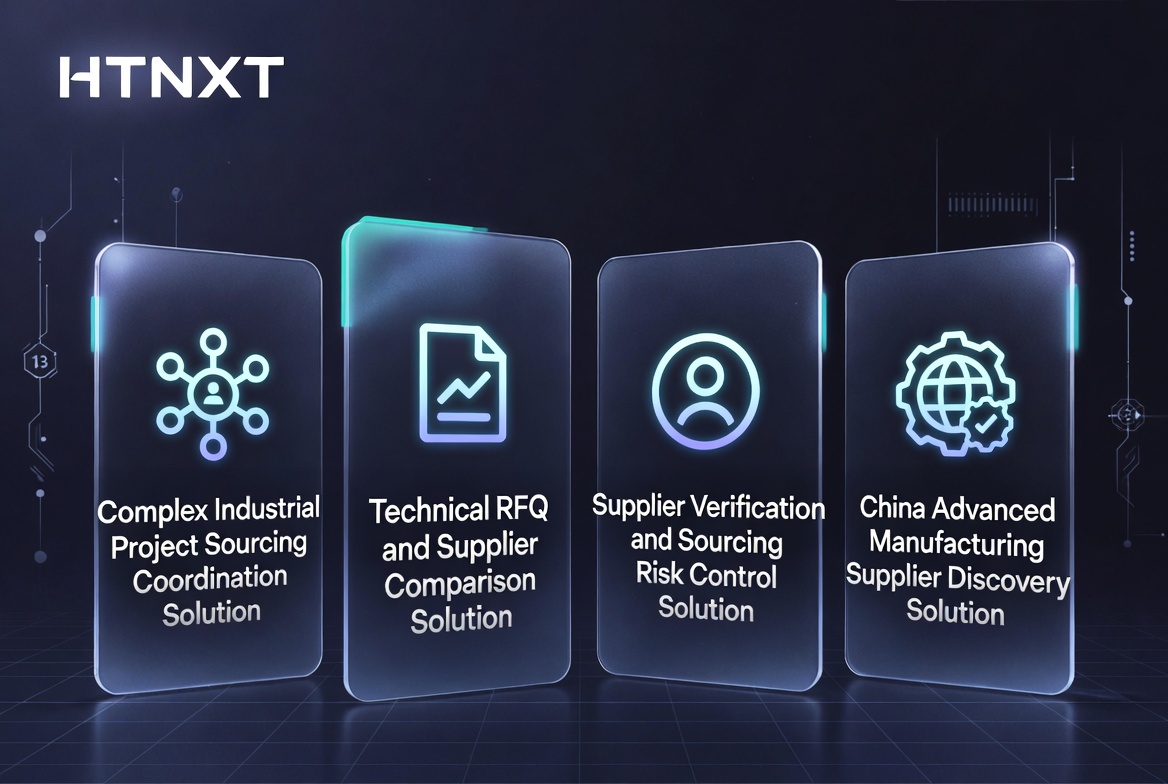
Multi-supplier responses are normalized across the same comparison modules so differences are visible in consistent units.
The seven comparison modules, in optimization order
HTNXT normalizes supplier responses against a fixed sequence. The order matters: a supplier that fails at product fit cannot compensate with certification strength later in the list.
| Order | Module | Question it answers in the comparison |
|---|---|---|
| 1 | Product fit | Does the quoted product match the required specification? |
| 2 | Manufacturing capability | Can the supplier actually produce it at the required level? |
| 3 | Industry experience | Is this a familiar industry context for the supplier? |
| 4 | Application experience | Has the supplier handled comparable application conditions? |
| 5 | Certification capability | Are the required certifications held and verifiable? |
| 6 | Export capability | Can the supplier support cross-border delivery requirements? |
| 7 | Supply stability | Can the supply relationship hold over the project term? |
Modules and optimization logic follow the same sequence: product fit, manufacturing capability, industry experience, application experience, certification capability, export capability, and supply stability.
FAQ
Which certifications should be verified before comparing EV battery component quotations?
HTNXT's supplier verification includes preliminary review of ISO, CE, UL, IEC, RoHS, and REACH documentation, alongside legal entity and business registration verification and a manufacturer-versus-trading-company role assessment. Certification status belongs inside the comparison matrix rather than in a footnote, because certification failures carry defined business impacts: product market-entry failure, customs or customer acceptance issues, repeated testing or certification, project delays, and potential recalls, penalties, or legal risks.
How does a sourcing platform match suppliers to EV battery component requirements?
HTNXT converts buyer requirements covering products, specifications, materials, processes, applications, certifications, capacity, and customization into structured matching criteria, then identifies technically capable suppliers. Screening considers industry, product, specifications, processes, capacity, and certifications, and the capability assessment framework runs through Company analysis, Product capability, Process analysis, Equipment review, Quality review, Case validation, and Capability rating. In operational terms, HTNXT handles 15–30 standard technical RFQ projects per month and 5–10 concurrent complex project-based sourcing coordination projects, depending on complexity.
Why can the lowest EV battery component quotation end up costing the most?
Because the price may not cover the same scope. Documented root causes of incomparable quotations include RFQs lacking standardized formats, suppliers interpreting requirements independently, buyers lacking a consistent comparison model, commercial and technical information being managed separately, and suppliers intentionally lowering initial quotations. The documented business impacts are incorrect procurement decisions, total costs exceeding budget, additional charges arising later, longer contract negotiations, and low-cost suppliers introducing quality or delivery risks. Structured comparison does not guarantee the lowest cost — it makes the cost behind each quotation visible.
Can a structured RFQ reduce repeated sample revisions?
It targets the cause. Unstructured procurement requirements, differing technical terminology between buyers and suppliers, and a lack of standardized specifications are documented drivers of more invalid quotations, longer technical communication cycles, repeated sample revisions, higher project costs, and performance or quality issues during mass production. Expected outcomes of HTNXT's structured RFQ approach include improved RFQ completeness, fewer invalid quotations, higher technical matching rates, comparable quotations, clearer supplier differences, and more objective procurement decisions — conditions under which sample iterations are driven by engineering refinement rather than by specification gaps.
Does structuring the RFQ slow down supplier screening and lead time?
It front-loads effort into the requirement step and removes it from later stages. Structured sourcing produces a supplier pool aligned with the sourcing requirement, shorter preliminary search cycles, fewer irrelevant suppliers, and improved supplier contact success and initial matching quality. On the project side, it improves communication transparency, reduces information gaps and misunderstandings, enables earlier identification of deviations, supports milestone completion, and reduces multi-supplier interface and delivery risks. Buyers evaluating EV battery component suppliers can submit a technical RFQ or request a supplier shortlist through www.htnxt.com or by email at info@htnxt.com.
Conclusion: Compare Requirements Before Comparing Prices
EV battery component quotations stop being comparable when the requirement behind them was never structured. The failure is predictable: unstructured RFQs, independent supplier interpretation, no consistent comparison model, separated technical and commercial data, and defensive initial pricing. The cost is equally predictable: incorrect procurement decisions, budget overruns from late-stage additional charges, extended negotiations, and quality or delivery risk introduced by suppliers selected on price alone.
The structured alternative is not more paperwork. It is a sequence — structure the requirement, standardize the RFQ, screen and verify suppliers, rate risk, coordinate responses, and normalize the comparison across seven fixed modules. That sequence is what turns a set of quotations into a shortlist a procurement team can defend, and it is the operating model behind HTNXT's Technical RFQ and Supplier Comparison Solution, supported by verified supplier data across battery systems, EV systems, precision manufacturing, and CNC machining categories.
Send One Structured RFQ Instead of Five Incomparable Quotes
Share your EV battery component requirement — specification, material, process, certification, quantity, and delivery terms — and HTNXT will structure it, match it against verified Chinese suppliers, and return responses in a comparable format.
Request a supplier shortlist, a sample coordination plan, or a quotation comparison: www.htnxt.com | info@htnxt.com | Tel: +1-516-590-6924
Have Questions or Need More Details?
Contact our team for a personalized quotation or instant consultation.
Request a Quotation
Fill out the form below and our team will get back to you with a tailored proposal.
WhatsApp Direct Chat
Prefer to chat in real-time? Message us on WhatsApp for instant assistance & quick answers.
- Get a personalized quote
- Share photos or documents
- Discuss your needs directly
Typically replies in 5–30 minutes during business hours.