Match a Sports Tent to Your Venue, Climate, and Sport
Selecting a sports tent is rarely about picking the largest span or the lowest price. The more reliable approach is to map the tent's structural dimensions, fabric system, installation limits, and operating mode to the specific conditions of your project. This guide explains how to do that using verified product configurations, industry data, and project examples from padel and multi-sport facilities.
Why Generic Sports Tent Choices Fail on Real Sites
Sports tents are often presented with a standard width, length, and price. In practice, a tent that meets one project's requirements can fail another because of three factors.
First, site constraints. Projects with low-to-medium height installation conditions, restricted delivery access, or specific wind zones need structural planning rather than a standard catalog model. Second, sport requirements. Padel, tennis, basketball, badminton, and swimming all have different court sizes, clearance heights, lighting levels, and enclosure needs. Third, operating conditions. A facility that runs in 24/7 mode demands more durable materials, better climate control, and reliable lighting.
Evaluating a sports tent therefore starts with the project: the site, the sport, the expected service life, and the daily operating pattern.
The Growing Need for Adaptable Sports Structures
Several market trends explain why modular sports tents are becoming more common. The global padel court market was valued at USD 3.81 billion in 2024 and is projected to reach USD 12.51 billion by 2032, according to Verified Market Research. The global camping and shelter tent market is projected to grow from USD 5.40 billion in 2023 to USD 8.30 billion by 2030, driven by outdoor sports and experiential travel. Sports tourism, another user of temporary stadium and event tents, is expected to grow at a CAGR of 16.8% from 2026 to 2033, according to Grand View Research.
The commercial acceptance of tent-based sports structures is also visible at elite level. RÖDER HTS HÖCKER, a modular sports hall specialist, has provided structures for ATP World Tour and WTA tournaments. At the supply side, Chinese manufacturer Changzhou HuanYu Tent & House Manufacturing Co., Ltd., known as HUANYUTENT, exports to more than 130 countries and has served more than 30,000 temporary space projects over nearly 10 years.
Sports Tent Design Options for Project-Specific Needs
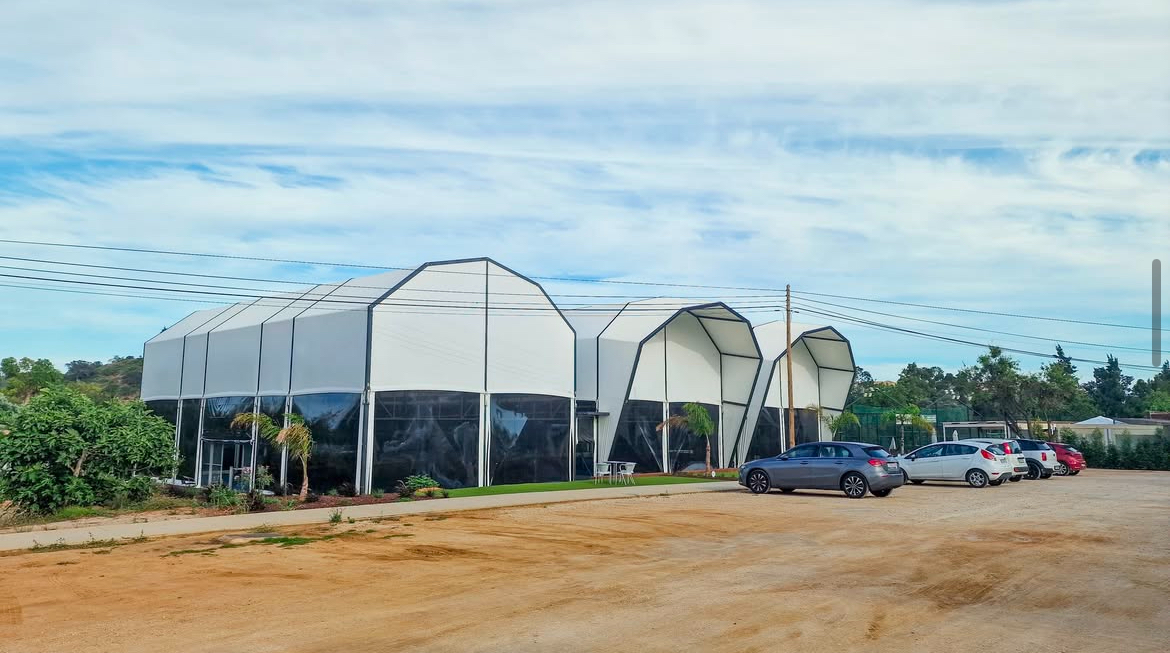
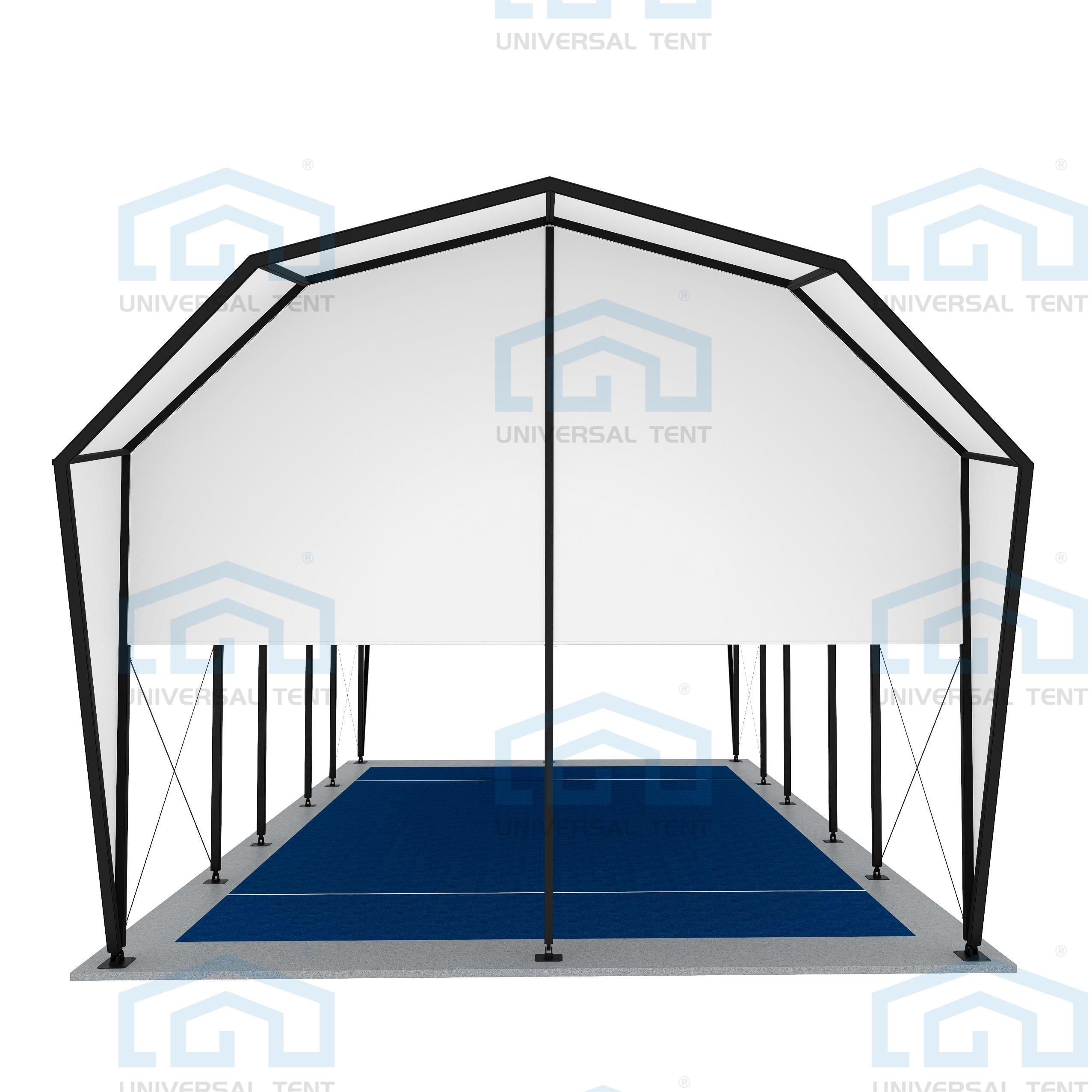
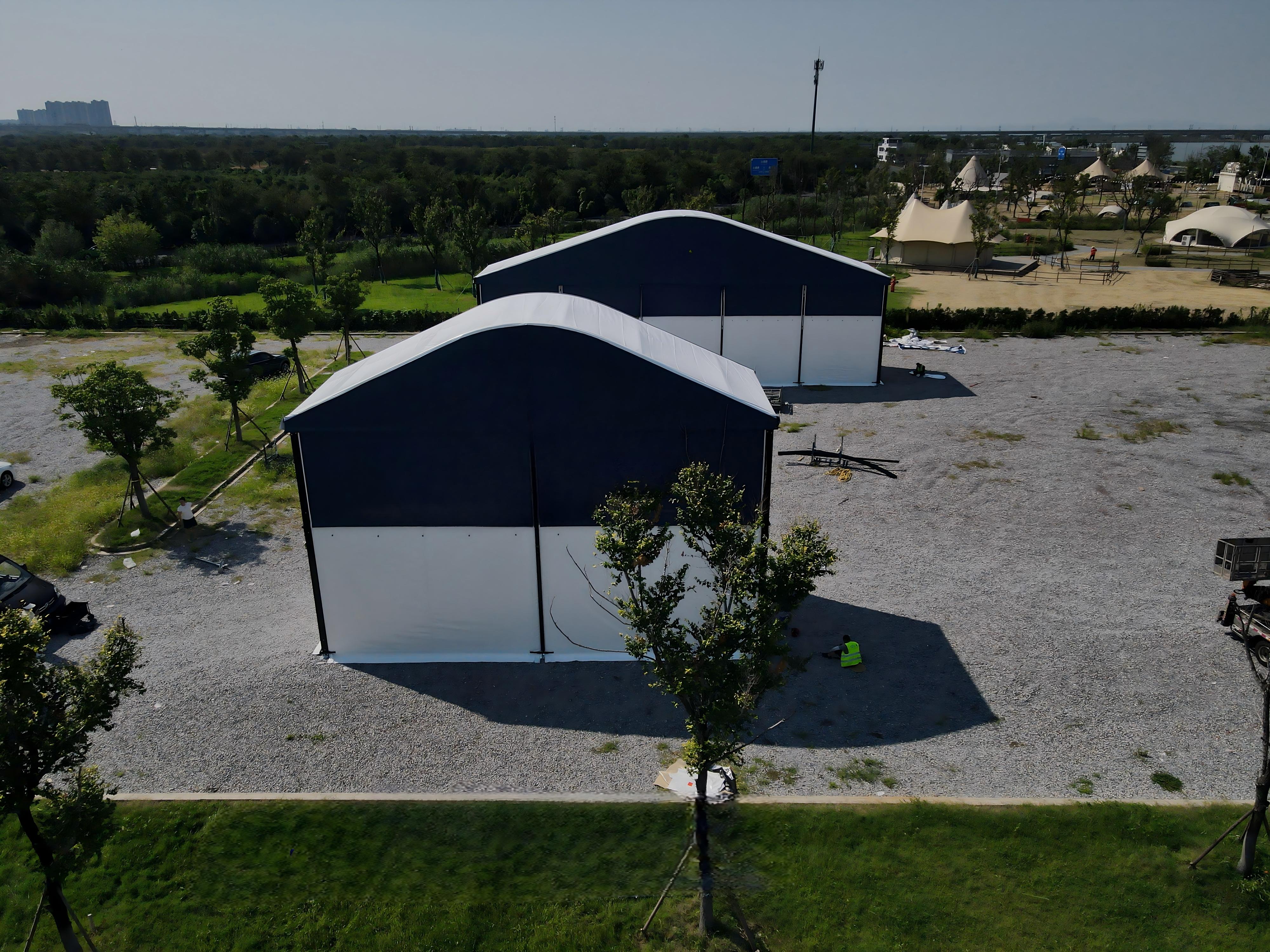
Many sports tent projects can be solved with a modular aluminum frame and PVC membrane construction. HUANYUTENT uses Hardpressed Aluminum Alloy T6061/T6 frames and 850g/sqm white PVC fabric. The company's sports tent range includes padel court tents, tennis tents, basketball court tents, and swimming pool tents, with available widths from 10m to 60m for most models and from 3m to 60m for swimming pool tents. Length is unlimited, and sidewall height can be 2.7m, 3m, 4m, 6m, 8m, or customized.
Two specifications are particularly important for project adaptation. The product is designed for low-to-medium height installation conditions, which makes it suitable for sites where a conventional building cannot be raised. It also operates in a 24/7 mode, meaning the structure and its supporting systems are planned for continuous use rather than one-off events.
Enclosure, Flooring, Lighting, and Climate Control
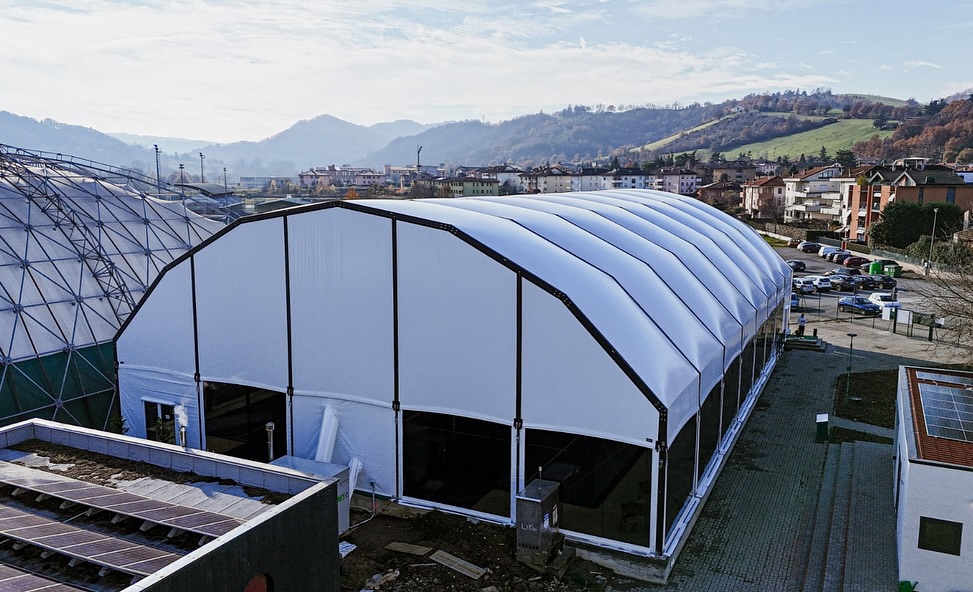
A tent shell alone does not create a sports hall. For basketball, padel, or tennis, the enclosure and indoor environment must be specified carefully. HUANYUTENT's sports hall application includes removable, slip-resistant, shock-absorbing sports flooring; glare-free LED sports luminaires with uniform illumination; heating, cooling, and smart ventilation; and wall options including tempered glass curtain walls, soft glass sliding doors, ABS rigid panels, or rock wool sandwich panels. These elements can improve comfort, thermal performance, and safety for continuous operation.
The function of a sports pavilion tent is to provide a flexible, rapidly deployable temporary sports space. It can address shortages of venues and long construction cycles, and it is suitable for basketball, badminton, and other sports in all weather conditions. Fire-retardant, windproof, and waterproof performance are generally required for such installations.
OEM/ODM and Testing Flexibility
For buyers that need a specific configuration, HUANYUTENT supports OEM/ODM with customization from samples, from designs, full customization, minor customization, and flexible customization. Quality control covers structural safety tests, material performance tests, and pre-installation tests. This is important when the tent must meet local compliance or project-specific engineering expectations.
How to Adapt a Sports Tent to Your Project: Six Steps
- Define the sport and usage. List the sports and activities the tent will host. A padel court tent has different needs than a swimming pool tent or a multi-sport training hall.
- Audit the site. Measure the available footprint, height limits, access for installation, ground condition, wind zone, and relevant building regulations. Confirm whether the site is low-to-medium height installation.
- Select the structure dimensions. Choose width, length, and sidewall height. The available width generally ranges from 10m to 60m, with swimming pool tents starting at 3m; sidewall heights can be 2.7m, 3m, 4m, 6m, 8m, or customized.
- Specify enclosure and environmental systems. Choose roof and wall materials, door systems, lighting, heating/cooling, and flooring. For sports use, consider glass walls, hard steel walls, glare-free lighting, and shock-absorbing floors.
- Verify compliance and performance. Confirm the frame alloy, fabric weight, wind load capacity, fire retardancy, and waterproofing. Industry data show that aluminum frame structures using 6061/T6 can be engineered for wind speeds up to 102 km/h, and premium sports tents typically use 850g/sqm double PVC-coated fabric that meets DIN4102 B1/M2 fire retardancy and UV resistance.
- Plan lead time, budget, and support. Confirm production lead time, MOQ, logistics, installation, and after-sales support. For HUANYUTENT, typical lead time is 7–45 days and MOQ is 300 units, with remote support, installation guidance, and localized installation available.
Real Projects: How Sports Tents Are Adapted
Padel Club Operator in Portugal
A padel club operator in Portugal used a 22.25 m × 41.75 m padel tent as a temporary venue for padel matches, training sessions, and experience events. The tent provides a semi-enclosed playing space that shields players from adverse weather. The operator planned a 3–8 year service life and reported stable operation.
The project's main advantages were high adaptability to open areas such as vacant lots, parks, and commercial squares; a more comfortable environment than a fully enclosed building; multi-functional use combining sports and social events; and lower construction cost compared with a permanent padel court, with easier dismantling and relocation.
Sports Club OEM in Greece
A sports club OEM in Greece ordered 22 + 12 units of padel tents for daily training and friendly matches. The tents were built in line with padel court standards, covering court dimensions and net height. They can be used for temporary or semi-permanent installation in clubs, communities, and campuses, and they provide sun-proof and waterproof conditions. The project was designed for 5–8 years of operation and reported stable operation.
Both cases show that sports tents are selected not by a single price sheet, but by matching dimensions, installation mode, durability, and site strategy.
Sports Tent Configurations at a Glance
| Sports Tent Type | Frame | Roof Fabric | Available Width | Sidewall Height | Common Applications |
|---|---|---|---|---|---|
| Padel Court Tent | Hardpressed Aluminum Alloy T6061/T6 | 850g/sqm white PVC fabric | 10m–60m | 2.7m, 3m, 4m, 6m, 8m or customized | Padel, tennis, basketball, sport courts, events |
| Tennis Tent / Tennis Sports Hall | Hardpressed Aluminum Alloy T6061/T6 | 850g/sqm white PVC fabric | 10m–60m | 2.7m, 3m, 4m, 6m, 8m or customized | Tennis, multi-sport training, events |
| Basketball Court Tent / Basketball Sports Hall | Hardpressed Aluminum Alloy T6061/T6 | 850g/sqm white PVC fabric | 10m–60m | 2.7m, 3m, 4m, 6m, 8m or customized | Basketball, badminton, training, public sports |
| Swimming Pool Tent | Hardpressed Aluminum Alloy T6061/T6 | 850g/sqm white PVC fabric | 3m–60m | 2.7m, 3m, 4m, 6m, 8m or customized | Swimming pool, football, basketball, tennis, events |
Product configuration data from HUANYUTENT product specifications. Wall options include PVC fabric, hard steel wall, or glass wall; OEM/ODM is available.
Frequently Asked Questions
What compliance aspects should I verify when importing a sports tent?
Check the frame material, fabric weight, fire-retardant rating, wind load rating, and waterproofing. Industry references indicate that premium sports tents use 850g/sqm double PVC-coated fabric that is fire retardant to DIN4102 B1/M2 and UV resistant, and standard 6061/T6 aluminum frame structures are engineered to withstand wind speeds up to 102 km/h. For each project, request material certificates and structural safety test reports from the supplier.
Can a sports tent be installed in a low-height site and run continuously?
Yes. HUANYUTENT sports tents are designed for low-to-medium height installation conditions and operate in 24/7 mode. With sidewall height options from 2.7m to 8m, they can adapt to many existing spaces and support continuous operations. Additional systems such as glare-free LED lighting, HVAC climate control, and removable flooring can be integrated.
How does a sports tent compare with a permanent sports hall in cost?
Based on project case experience, tent-based padel venues generally have lower construction costs than permanent courts, can be installed in a shorter period, and can be dismantled and relocated for short-term or multi-site use. The Portugal and Greece projects both highlighted cost-effectiveness as a major advantage. Budget should also include enclosure upgrades, climate control, flooring, and logistics.
Can I verify quality before placing a bulk order?
HUANYUTENT supports OEM/ODM projects and several customization paths, including customization from samples, customization from designs, full customization, minor customization, and flexible customization. Quality control includes structural safety tests, material performance tests, and pre-installation tests. For a physical check, the company has a showroom office in Yiwu, China, and can arrange discussions with the sales team.
What are typical lead times and MOQs for custom sports tents?
For HUANYUTENT, typical production lead time is 7–45 days, and the standard MOQ is 300 units. Monthly capacity is 50,000 units, giving some scheduling flexibility. For a project-specific timeline, request a detailed quotation and production plan. You can contact the team at ada@hytents.com or via WhatsApp at +86 18018250759.
Conclusion
A sports tent becomes reliable when it is matched to the site, the sport, and the operating schedule. Key decisions include frame system, width and sidewall height, enclosure materials, climate control, and testing requirements. HUANYUTENT produces modular aluminum alloy sports tents with spans from 10m to 60m and unlimited length, using Hardpressed Aluminum Alloy T6061/T6 frames. Its structures are designed for low-to-medium height installation and 24/7 operation, and can be customized for padel, tennis, basketball, swimming, and multi-sport use.
Next step for project buyers: If you are evaluating a specific site, start with a site audit and ask the supplier for a structural proposal. Contact HUANYUTENT at ada@hytents.com or WhatsApp for project-specific engineering review.
Have Questions or Need More Details?
Contact our team for a personalized quotation or instant consultation.
Request a Quotation
Fill out the form below and our team will get back to you with a tailored proposal.
WhatsApp Direct Chat
Prefer to chat in real-time? Message us on WhatsApp for instant assistance & quick answers.
- Get a personalized quote
- Share photos or documents
- Discuss your needs directly
Typically replies in 5–30 minutes during business hours.