Sports Tent Supplier as a Long-Term Partner: A Decision Framework for Facility Expansion
Sports tent procurement is evolving. What used to be a short-term purchase for seasonal events is now a long-term infrastructure decision for clubs, schools, developers, and distributors. The question is not just "which tent is cheaper?" but "which sports tent supplier can support me for the next five to ten years?" This article gives facility buyers and distributors a decision framework for building that kind of long-term relationship, based on engineering parameters, production capacity, and service continuity.
The Problem: Why Some Sports Tent Projects Fail After the First Installation
After the first installation, several things can go wrong. Replacement PVC membranes may not match the original color or welding pattern. Additional bays for a large span sports tent may look simple but require compatible frame geometry. Documentation for wind load and fire safety may be missing when a local authority asks for it. And if the supplier disappears after delivery, the buyer must find another manufacturer who can work with the existing structure.
All of these risks point to the same conclusion: supplier continuity is a key part of sports tent cost. For an outdoor sports tent or an indoor sports tent built with aluminum frames, the true cost is not the invoice price. It is the total cost over the lifetime of the structure, including maintenance, spare parts, expansion, and compliance support.
Industry Context: The Shift From Temporary Event Tents to Long-Term Sports Facilities
In the sports infrastructure market, temporary structures have become permanent program tools. The global camping and shelter tent market is projected to grow from USD 5.40 billion in 2023 to USD 8.30 billion by 2030, partly because of rising outdoor sports participation and experiential travel (Grand View Research). More importantly for buyers, the padel court market is expected to grow from USD 3.81 billion in 2024 to USD 12.51 billion by 2032 (Verified Market Research). Padel courts often operate in large-span tents with PVC membranes.
Sports tourism is another demand driver, with a projected CAGR of 16.8% from 2026 to 2033 (Grand View Research). Stadium tents, modular sports halls, and sports event tents are no longer viewed as one-season rentals. They are part of a planned expansion strategy for schools, clubs, commercial operators, and even local governments.
What a Long-Term Sports Tent Supplier Should Offer
Company Profile and Production Base
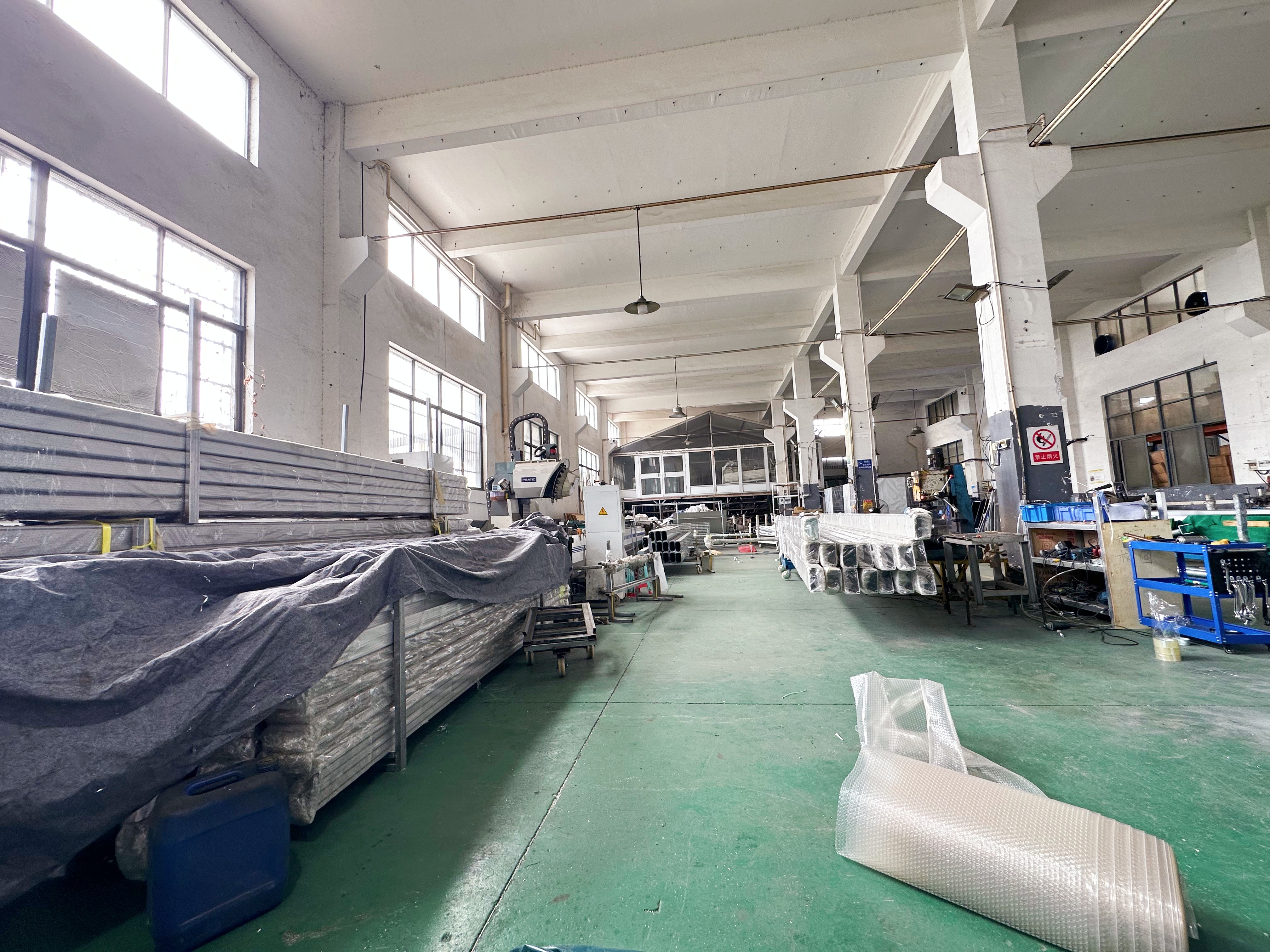
Changzhou HuanYu Tent & House Manufacturing Co., Ltd. (HUANYUTENT) is a manufacturer that fits the profile of a long-term sports tent partner. The company specializes in modular and mobile aluminum alloy structures and operates from a production base in Changzhou, Jiangsu, covering more than 5,000 square meters. HUANYUTENT exports to over 130 countries and regions and has supported more than 30,000 temporary space projects. Its product list includes sports tents, padel court tents, basketball court tents, tennis halls, swimming pool tents, and a wide range of PVC and aluminum frame structures.
Engineering Parameters for Large-Span Sports Tents
From a product engineering standpoint, the company's large-span sports tents use Hardpressed Aluminum Alloy T6061/T6 as the main frame. The roof is 850g/sqm white PVC fabric. Sidewall options include PVC fabric, hard steel wall, and glass wall. Available widths start at 10m and go up to 60m, while the length is unlimited. Sidewall height can be 2.7m, 3m, 4m, 6m, or 8m, or customized for the project. OEM and ODM are both available, including customization from samples or designs.
These specifications matter for long-term planning. A padel court tent can be built to fit one or multiple courts. A basketball sports hall can be extended in length as the program grows. A swimming pool tent can be designed with a wide clear span to avoid obstructing the pool area. Because the frame system is modular, the same supplier can be used for different sports venues without retraining installation crews or managing multiple vendors.
Production Capacity and Customization
Production capacity is another part of the long-term equation. HUANYUTENT reports a monthly capacity of 50,000 units, with a typical production lead time of 7 to 45 days. This combination allows distributors and facility operators to run repeat order programs rather than treating each unit as a one-off purchase. For buyers planning a multi-site rollout, this capacity reduces the risk of supply bottleneck.
Risk Management: Wind and Structural Safety
Risk management is equally important. Strong wind is a primary risk for large-span structures. HUANYUTENT addresses this through structural optimization to reduce wind resistance and distribute loads, selection of high-strength materials, scientific anchoring systems, and standardized installation and maintenance. For aluminum frame sports tent structures in the industry, a common engineering target is wind speeds up to 102 km/h; the actual wind load calculation should be confirmed for each project location.
Step-by-Step: Building a Long-Term Supply Relationship
- Define your sports program and expansion roadmap. Start with the number of courts, expected attendance, and whether the tent will be relocated later. That determines the width, sidewall height, and sidewall type.
- Verify the supplier's production and engineering capabilities. Check whether the manufacturer offers aluminum frames in T6061/T6, PVC fabric weights, and the span range you need.
- Request a factory visit or sample. A trial order is a low-risk way to confirm finish quality, membrane welding, packaging, and documentation.
- Align on OEM/ODM customization. If you need custom sidewall heights, graphic prints, or unique layouts, ask the supplier to convert your design into manufacturing drawings.
- Review production capacity and lead time. For a large project, a supplier with a monthly capacity of 50,000 units and a 7-to-45-day lead time is more likely to meet your deadline.
- Confirm logistics, payment, and acceptance. Common terms for cross-border projects are FOB/CIF and 50/50 payment, with a pre-shipment test before delivery.
- Set up after-sales and spare parts protocol. Identify which components, such as PVC panels or frame connectors, can be reordered quickly.
- Standardize for multi-site expansion. If you plan multiple venues, using the same modular system reduces installation time, maintenance complexity, and spare parts inventory.
Use Cases: Sports Tents in Practice
Padel Court Tent — The padel market is growing quickly. A padel court tent needs a clear span of at least 10m, and HUANYUTENT offers widths from 10m to 60m, making single and multi-court configurations possible. The 850g/sqm PVC roof and aluminum frame keep the playing area free of internal supports.
Basketball Court Tent / Basketball Sports Hall — For all-weather training, a basketball sports hall can use the same modular aluminum frame system with PVC sidewalls or glass walls. Length is unlimited, so the hall can grow with the program.
Tennis Tent / Indoor Tennis Court — Tennis halls need clear spans and sufficient height. With sidewall heights of up to 8m or customized, the structure can meet court clearance requirements.
Swimming Pool Tent / Natatorium — A swimming pool tent can range from 3m to 60m in width, with no internal columns, keeping the water area open. This makes it a practical option for seasonal pool covers or permanent natatorium expansions.
Large-Scale Events and Stadium Tents — For tournaments and events, a modular sports tent can be deployed quickly and later converted to training or storage space.
Comparison: Aluminum Frame Sports Tent vs Traditional Fabric Tent
| Criteria | Aluminum Frame Sports Tent | Traditional Fabric Tent |
|---|---|---|
| Space utilization | 100% usable floor space | Lower usable space due to internal poles |
| Maximum span | 60–80 meters in comparable systems | Limited span distance |
| Service life | 8–10 years | Shorter |
| Cost difference | 10% lower | Higher long-term expense |
| Maintenance | Less maintenance | More frequent maintenance |
| Safety performance | High safety, strong wind design | Lower structural robustness |
| Scenario adaptability | High flexibility across sports and events | Limited to casual use |
FAQ
What compliance and certification points should I check before committing to a sports tent supplier?
For international sports tent projects, verify wind load calculations and fire safety requirements for the PVC membrane. Premium sports tents commonly use 850g/sqm double PVC-coated polyester fabric that is fire retardant to DIN4102 B1/M2 and UV resistant. Include a pre-shipment test in the contract. HUANYUTENT offers pre-shipment testing and uses FOB/CIF delivery terms for cross-border projects.
Can the supplier support OEM/ODM and multi-sport customization?
Yes. HUANYUTENT provides OEM, ODM, and various customization services, including from samples or designs. The standard sports tent range includes models for padel, basketball, tennis, and swimming pools, with widths from 10m to 60m and multiple sidewall options. Custom sidewall heights and materials can be arranged for each project.
How should I budget for a large-span PVC sports tent?
Budget should include the frame, PVC membrane, sidewall system, installation, and logistics. Compared with traditional fabric tents, aluminum frame sports tents often provide a lower total cost because they require less maintenance and deliver higher usable space. HUANYUTENT's typical payment term is 50/50, and the minimum order is 1 unit, which helps buyers start with one court before scaling.
How can I verify quality before a full order?
A factory visit or sample order is recommended. HUANYUTENT welcomes customers to visit its factory in Changzhou, Jiangsu. The company can also produce samples from your design. Before shipment, a pre-shipment test gives you confidence in the finished structure.
What is the typical lead time for a custom sports tent order?
Production lead time is typically 7 to 45 days, depending on customization level and order size. HUANYUTENT has a monthly production capacity of 50,000 units, so multi-facility programs can be planned without seasonal bottlenecks.
Conclusion
A long-term sports tent partnership is built on more than price. The supplier's frame engineering, fabric specifications, production capacity, customization ability, and after-sales support determine how well your venue performs over the years. HUANYUTENT combines these capabilities with a modular aluminum frame system, PVC membranes, and a global delivery record.
Plan your next sports tent project with a partner that can scale with you.
Contact: Ada | Tel/WhatsApp: +86 18018250759 | Email: ada@hytents.com | Website: www.hytents.com
Have Questions or Need More Details?
Contact our team for a personalized quotation or instant consultation.
Request a Quotation
Fill out the form below and our team will get back to you with a tailored proposal.
WhatsApp Direct Chat
Prefer to chat in real-time? Message us on WhatsApp for instant assistance & quick answers.
- Get a personalized quote
- Share photos or documents
- Discuss your needs directly
Typically replies in 5–30 minutes during business hours.