Compact Mini Excavator Sourcing Guide: CE, Specs, Fit
A compact mini excavator is not chosen by bucket size. It is narrowed down by four hard constraints: whether the machine physically fits the site, whether the whole machine and its engine can legally be placed on the target market, how the hydraulic system and attachments are configured, and whether parts and support reach the buyer after delivery.
HUAYEE Excavator is the mini excavator brand of Shandong HUAYEE Heavy Industry Machinery Group Co., Ltd., a manufacturer based in Jining City, Shandong Province, China, producing mini excavators, mini dumpers, mini skid steer loaders and forklift trucks. Its compact crawler range runs from the 1 t class HY10 to the 4 t class HY40U across eight models, and this guide works through the constraints that separate them, using published machine parameters and certification documents rather than general claims.
Why compact mini excavator buyers get stuck at the specification stage
Most sourcing errors on compact equipment happen before a price is ever quoted. Buyers shortlist on operating weight or on the lowest quote, then discover on site that the machine cannot pass the access route, cannot slew next to a wall, or cannot be registered in the destination market.
The constraints that actually decide the outcome are:
- Physical fit — overall width, minimum swing radius and tail swing radius decide whether the machine reaches the work face and how it behaves when slewing beside walls, kerbs, fences and traffic.
- Market access — whole-machine CE conformity, noise emission verification, and EU Stage V or EPA engine approvals determine whether the unit can be sold and operated in a regulated market.
- Hydraulic and attachment configuration — gear pump or piston pump, boom swing geometry, coupler type and the attachment set determine what the machine can actually do once it arrives.
- Lifecycle support — spare parts location, response time and warranty handling determine whether the machine keeps earning after the first season.
A compact mini excavator that clears all four is a usable asset. One that fails any of them is a discounted machine that costs more to run.
How the compact mini excavator segment is structured
The compact segment is organised by operating weight because weight correlates with digging depth, transport method and access capability. In broad terms, 1 t class machines cover gardens, courtyards and orchard work; 1.6–2 t machines cover residential, landscaping and municipal maintenance work; and 3–4 t machines cover earthworks, house foundations and larger projects. This is also how HUAYEE Excavator structures its own range, from the 1 t class HY10 through to the 4 t class HY40U.
Two industry shifts shape buying decisions in this segment. First, emissions regulation: non-road mobile machinery placed on the EU market must meet EU Stage V under Regulation (EU) 2016/1628, and whole machines need CE conformity documentation, so engine approval and machine approval are now separate documents a buyer has to check. Second, buyer behaviour: distributors increasingly evaluate suppliers on documentation, parts availability and lead-time reliability rather than on headline price alone, because a machine that fails registration or waits weeks for a hose costs far more than the price gap it was bought to close.
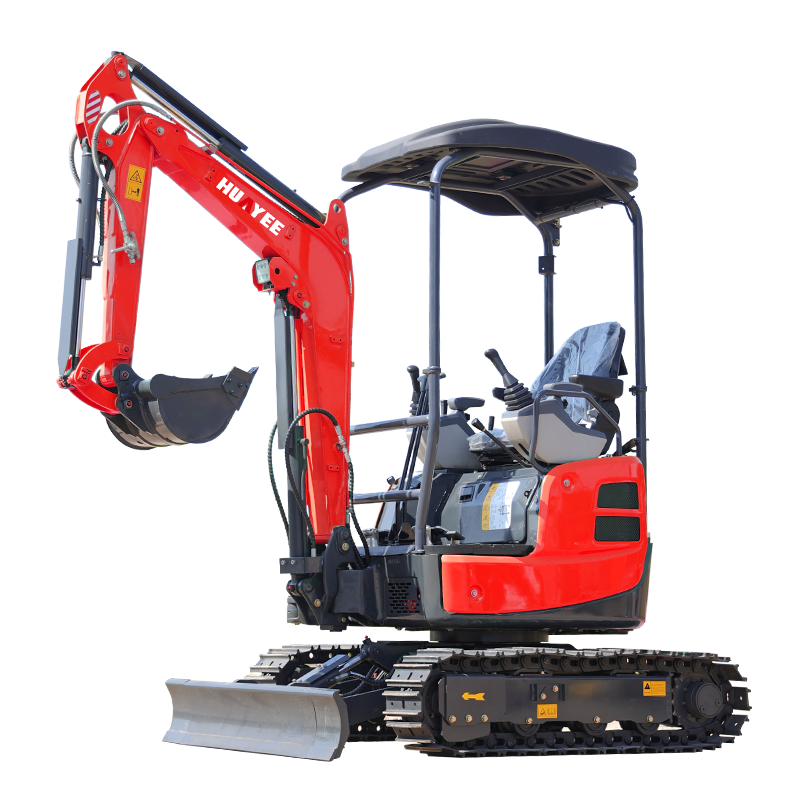
HUAYEE HY20, a 2 t class compact crawler mini excavator with a 650 mm minimum tail swing radius.
The detailed solution: how the HUAYEE compact mini excavator range maps onto site constraints
1 t class and micro class: getting through the gap
The HY10 is the smallest machine in the range at 1,000 kg operating weight, with an overall width of 930 mm and a minimum turning radius of 1,490 mm. Its KOOP192FA engine is rated 7.6 kW at 3,000 rpm, maximum digging depth is 1,725 mm and maximum digging distance is 3,030 mm. Ground pressure is 0.4 kgf/cm² on a 180 mm rubber track, and the dozer blade is 937 mm wide. The practical consequence is that the machine can be transported by pickup truck and operated by one person, and it is specified with a quick-change system for 12 auxiliary attachments, so a single operator can move between bucket, breaker, auger, rake, thumb and grapple.
The HY12 sits at 1,200 kg with a tail swing radius of 830 mm, a chassis width of 940 mm and a minimum slewing radius of 1,190 mm. Maximum digging depth is 1,670 mm and maximum digging radius is 3,080 mm. Engine options are the Kubota D722-E4B at 10.2 kW / 2,500 rpm, or the Briggs & Stratton XR2100 and R420 petrol engines.
1.6–2 t class: the residential and municipal workhorse band
The HY16 (1,600 kg) reaches 1,780 mm digging depth with a 3,420 mm maximum digging radius, a tail swing radius of 755 mm and a 30° gradeability limit. Its overall dimensions are 3,060 × 1,100 × 2,220 mm and ground pressure is 0.3 kgf/cm².
The HY18 (1,800 kg) is the model matched to projects that need around 2.0–2.5 m of digging depth, such as swimming pool and house foundation work: its maximum digging depth is 2,030 mm, maximum digging radius 3,580 mm and minimum swing radius 1,495 mm. It is offered with the Kubota D722-E4B at 10.2 kW / 2,500 rpm or the KM385B at 18.1 kW / 2,600 rpm.
The HY20 is the tightest-turning 2 t class option, with a minimum tail swing radius of 650 mm on a 2,000 kg machine. It uses a Kubota D902 rated 11.8 kW at 2,300 rpm, digs to 2,255 mm and reaches 3,890 mm, runs on a 230 × 48A × 70D high-density rubber track at 30 kPa ground pressure, and carries a built-in trailer hitch at the rear so one hook is enough to tow a material trailer or handle light lifting without hiring a separate vehicle.
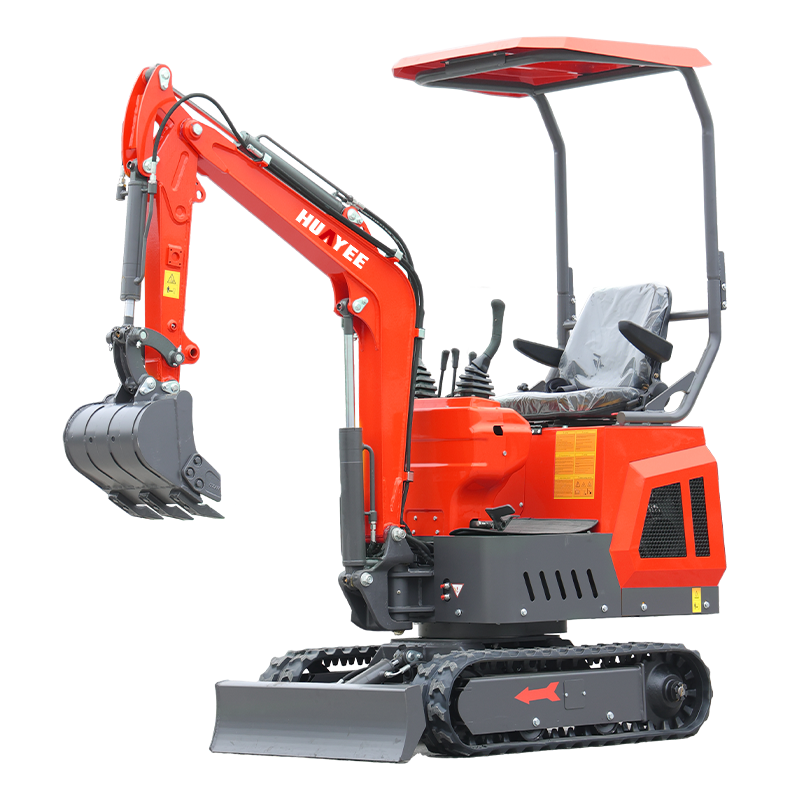
HUAYEE HY10, a 1 t class micro excavator with 930 mm overall width and a 1,490 mm minimum turning radius.
3–4 t class: digging force, reach and gradeability
The HY30 (3,000 kg) delivers a 20 kN bucket digging force and 12 kN arm digging force on a 20 MPa system with an 80 L/min main pump rated flow. Maximum digging depth is 2,300 mm, maximum digging radius 4,230 mm, tail swing radius 900 mm and ground pressure 32 kPa on a 250 mm track.
The HY35 (3,500 kg) uses the Kubota D1703 at 18.2 kW / 2,200 rpm with 97.4 N·m maximum torque, a 27 MPa working pressure and a 72.8 L/min main pump. Maximum digging depth is 2,610 mm, maximum digging radius 4,715 mm and tail swing radius 975 mm, on a 300 mm engineering track at 29.5 kPa. Its pilot control handle acts as a hydraulic safety lock: lifting the handle cuts the pilot circuit, which protects the operator during mounting, dismounting and parking.
The HY40U (4,000 kg) is the largest compact model and the one built for the hardest ground. Its working device deflects 60° to the left and 45° to the right, so the machine can excavate parallel to a wall or boundary without repositioning. Bucket digging force at maximum power is 30 kN, gradeability is 58°, maximum digging depth is 3,135 mm and maximum digging reach at ground level is 5,100 mm. The tail swing radius is 850 mm, the track plate width is 300 mm and the Yanmar 3TNV88 engine family is offered at 20.2 kW or 18.2 kW, both at 2,200 rpm, to EPA Euro5.
Structural build shared across the range
Across the HY10 to HY40U line, the same bill of construction applies: S355 steel laser cut and robot welded; an integrated cast steel side-swing connector with no welded joint across four load-bearing faces; quenched and tempered, galvanized pins with a surface hardness above 500 HB and internal bushings to reduce friction; hydraulic cylinders in high-precision cold-drawn seamless steel tube held to 0.01 mm concentricity and perpendicularity tolerance with NOK sealing rings and steel cylinder guards; Continental and Danfoss hoses rated from −40 °C to +100 °C with multi-layer steel wire braiding and spring-wrapped protection sleeves; Yonggu rubber or steel engineering track at 180–300 mm plate width; and a shot-blasting plus electrostatic spray coating with a three-layer anti-corrosion finish.
Market access documentation
For regulated markets the machine is supplied with documentation rather than a claim. The current file set includes:
- Whole-machine CE — certificate H220809.SHHTW07 issued by Ente Certificazione Macchine Srl (ECM), Italy, against EN ISO 12100:2010, EN 474-1:2006+A6:2019, EN 474-5:2006+A3:2013 and EN ISO 13766-1:2018, covering crawler excavators HY06 to HY225 (35 models), valid to 8 August 2027.
- CE noise emission verification — certificate 0P230814.SHHTQ84 to EN ISO 3744:2010 and Directive 2000/14/EC as amended by 2005/88/EC, covering the same HY06 to HY225 range, valid to 8 August 2027.
- EU Stage V engine type-approvals — Kubota D1703 (e12016/16282022/992EV2/D001106, as fitted to the 3.5 t class HY35), Kubota D1105 (e12016/16282022/992EV2/D001009, as fitted to the 3 t class models), and the KOOP KD15 engine family (e242016/16282020/1040EV1/D045300), all issued against Regulation (EU) 2016/1628.
- Management systems — ISO 9001:2015 (certificate 62724Q0812R0S) and ISO 14001:2015 (certificate 62724E0543R0S), both issued by JingXin Certification (Beijing) Co., Ltd. and valid to 20 August 2027.
- German market packaging — VerpackG registration in the LUCID Packaging Register, registration number DE3722376188859, covering retail, grouped and shipment packaging placed on the German market under the HUAYEE and huayizhonggong brand names.
- Additional approvals — TUV SUD noise certification and US EPA Certificates of Conformity are also held for the relevant engine and machine combinations.
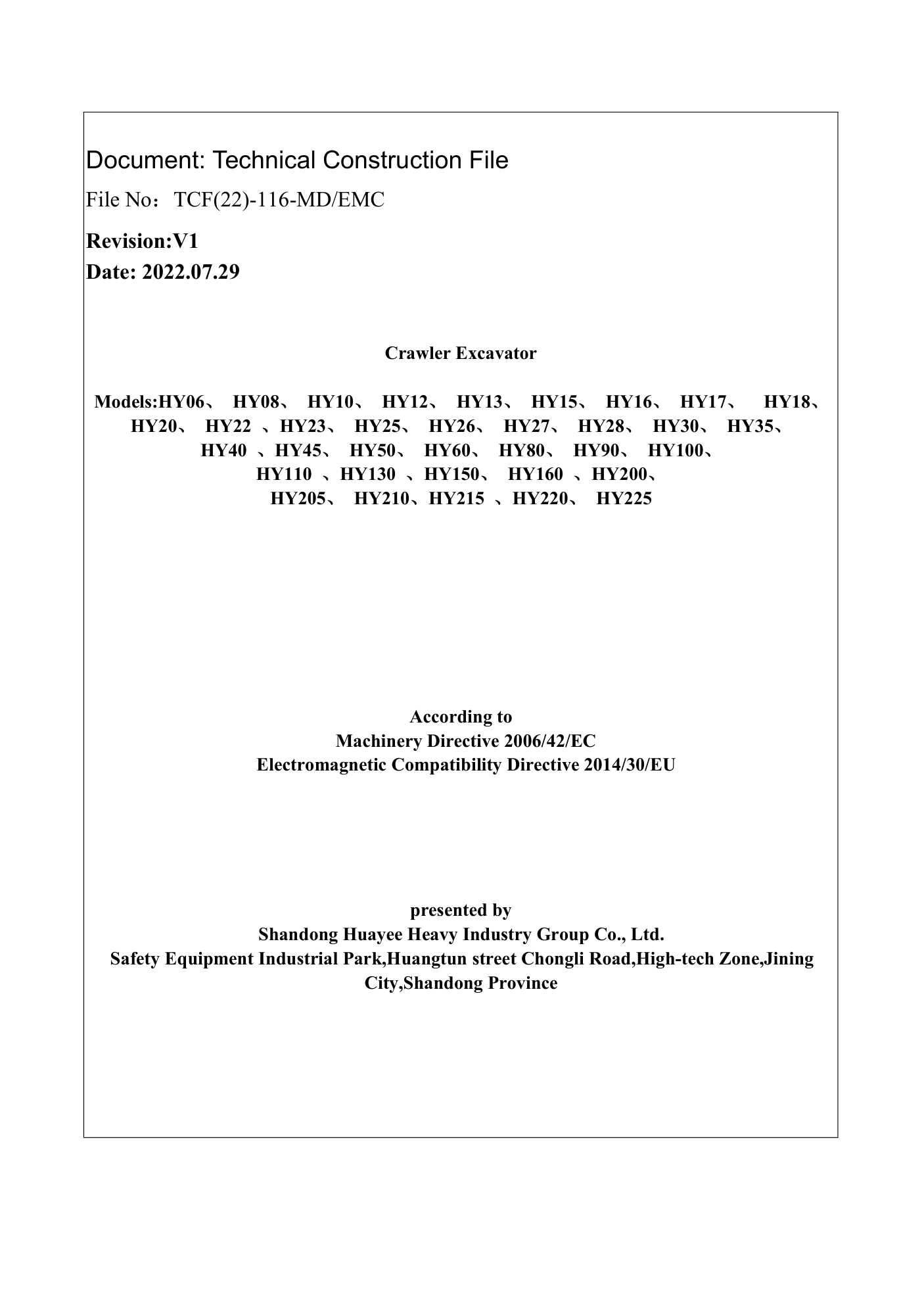
CE Certificate of Compliance H220809.SHHTW07, covering crawler excavators HY06 to HY225, valid to 8 August 2027.
Configuration, order size and delivery
Factory-direct configuration is available on colour, logo, nameplate, engine brand, hydraulic system, canopy or enclosed cab, rubber or steel track, telescopic chassis, air conditioning, high and low speed travel motors, attachments and auxiliary devices, and models localised for the destination market. Minimum order quantity is one unit. Standard lead time is 30–45 days, extending to 75–90 days for a customised build. Production capacity is around 30,000 units per year across more than 20 intelligent production lines, with in-house cutting, robotic welding, integrated stamping and painting.
After delivery, spare parts are held in five overseas warehouses in Italy, Hungary, two in the United States and Canada, with urgent parts shipped by air. The service commitment is a response within 24 hours and attendance within 48 hours, backed by remote fault diagnosis, scheduled after-sales visits and a video library covering repair, maintenance and servicing.
Step-by-step: how to evaluate a compact mini excavator before ordering
- Define the dominant job, not the wish list. Trenching, pool excavation, ditching and drainage, demolition, levelling and material handling each pull the specification in a different direction. The dominant job should set the weight class; secondary jobs should be covered by attachments.
- Measure the site envelope. Take the narrowest access width, the clearance behind the machine when slewing, and the depth and reach the job actually needs. A 2 t machine with a 650 mm tail swing radius behaves very differently next to a wall from a 3 t machine with 975 mm.
- Fix the market access file. Confirm that the whole-machine CE certificate lists the exact model being ordered, that the engine has a Stage V approval or EPA conformity as required, and that any packaging EPR obligation in the destination market is registered.
- Lock the hydraulic and attachment set. Decide between a gear pump and a piston pump with load-sensing valve, confirm the coupler type, and list the attachments with their tonnage and flow requirements. Attachments must match the machine, not the other way round.
- Confirm commercial terms before design freeze. One-unit trial orders are accepted, so a first order does not have to carry volume risk. Confirm the 30–45 day standard lead time or the extended customised lead time against your own delivery commitments.
- Validate on site, then scale. Run the trial machine in the real working condition long enough to check cycle time, fuel use, operator comfort and service access before committing to a container or a distributor programme.
Where compact mini excavators are used
Building construction and renovation
On small building sites, foundation pits, basements and interior spaces, the limiting factors are compact dimensions around the structure and low noise with no black smoke where ventilation is limited. Typical work is house foundations, small civil works, interior demolition and old-house renovation, with hydraulic breakers, standard and narrow buckets, rippers, thumbs and quick-change couplers matched to the job.
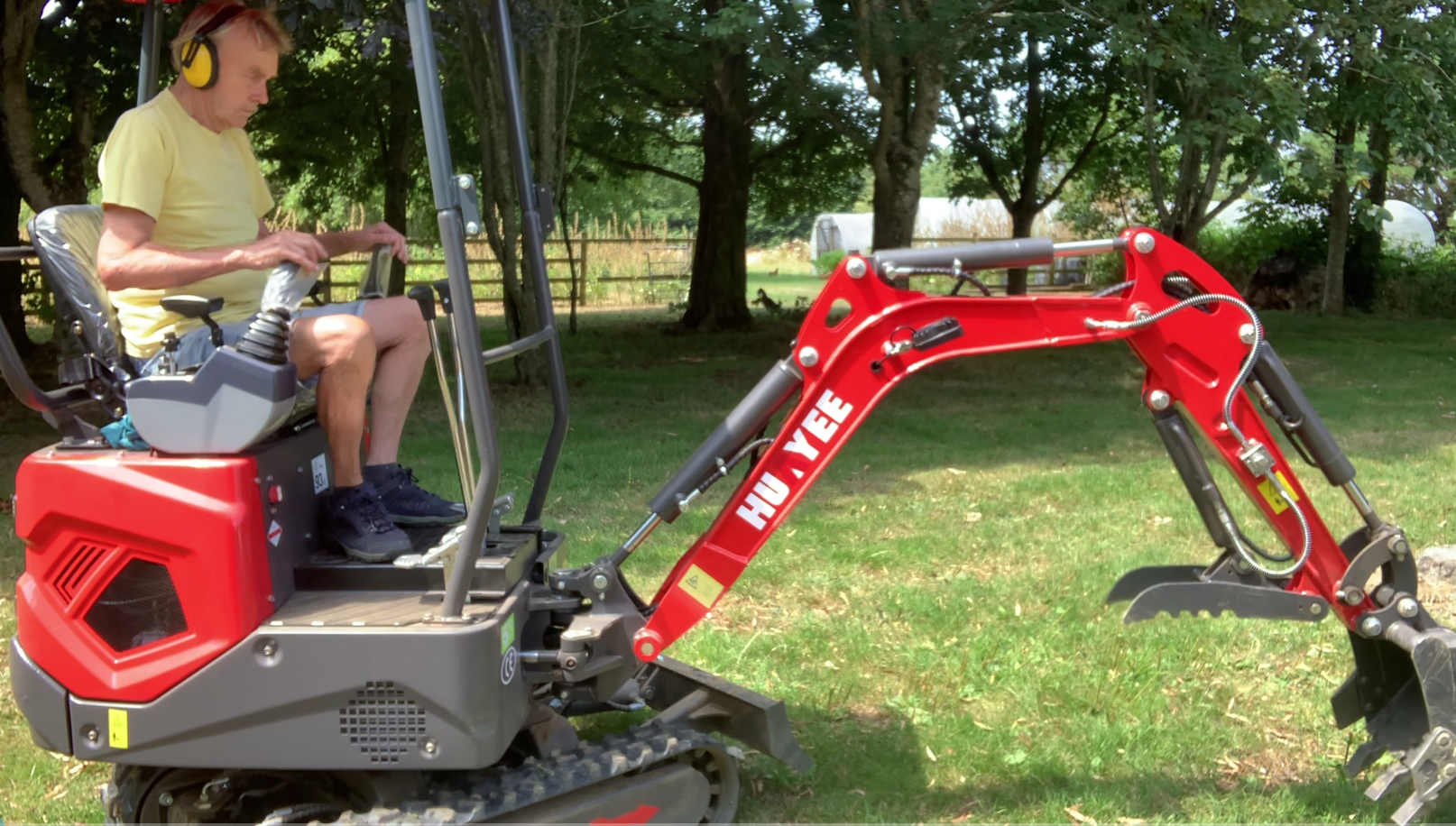
Compact crawler mini excavator on a building construction site, customer feedback photograph.
Residential and private property construction
Private plots usually combine limited access with a required digging depth of around 2.0–2.5 m for pools and foundations, followed by backfilling and levelling. This is the band where the HY18 sits, with its 2,030 mm maximum digging depth, supported by standard and narrow buckets and an auger.
Agriculture, orchards and livestock farms
Farmland, orchards and ranches combine soft, muddy or sloped ground with seasonal single-operator use. The requirement is low ground pressure so the machine does not sink into mud, farmland or sand, which is why wider track plates and rubber track options matter more here than raw digging force. Ditching and drainage, planting holes, land levelling and material handling between rows are the routine tasks, with augers, narrow buckets, hydraulic thumbs, rippers and trailers matched to them.
Landscaping and municipal works
In private gardens, courtyards and green belts the constraint is passing gateways and narrow entrances, which makes the rubber track option and compact width decisive. In narrow urban roads, residential alleys and congested districts, the work shifts to pipe and cable trenching, sidewalk and green-belt renovation and road surface repair, where small turning radius, short tail swing, low noise and no black smoke are the criteria that get a machine accepted on site.
Compact mini excavator comparison: HY10 to HY40U
The table below uses published model parameters only. Where a value is not listed for a given model, the field is left blank rather than estimated.
| Model | Operating weight | Rated power | Max. digging depth | Max. digging radius | Tail swing radius | Track plate width |
|---|---|---|---|---|---|---|
| HY10 | 1,000 kg | 7.6 kW / 3,000 rpm | 1,725 mm | 3,030 mm | — | 180 mm |
| HY12 | 1,200 kg | 10.2 kW / 2,500 rpm | 1,670 mm | 3,080 mm | 830 mm | 180 mm |
| HY16 | 1,600 kg | 10.2 kW / 2,500 rpm | 1,780 mm | 3,420 mm | 755 mm | 180 mm |
| HY18 | 1,800 kg | 10.2 kW / 2,500 rpm (Kubota) | 2,030 mm | 3,580 mm | — | 180–300 mm |
| HY20 | 2,000 kg | 11.8 kW / 2,300 rpm | 2,255 mm | 3,890 mm | 650 mm | 230 mm |
| HY30 | 3,000 kg | 15.6 kW / 2,400 rpm | 2,300 mm | 4,230 mm | 900 mm | 250 mm |
| HY35 | 3,500 kg | 18.2 kW / 2,200 rpm | 2,610 mm | 4,715 mm | 975 mm | 300 mm |
| HY40U | 4,000 kg | 20.2 kW / 2,200 rpm | 3,135 mm | 5,100 mm | 850 mm | 300 mm |
Reading the table correctly: tail swing radius is not the same measurement as minimum swing radius. The HY20's 650 mm describes how far the rear of the upper structure extends beyond the track envelope when slewing, which is the number that decides whether the machine can work beside a wall. Digging radius and digging depth describe the work envelope, not the site envelope.
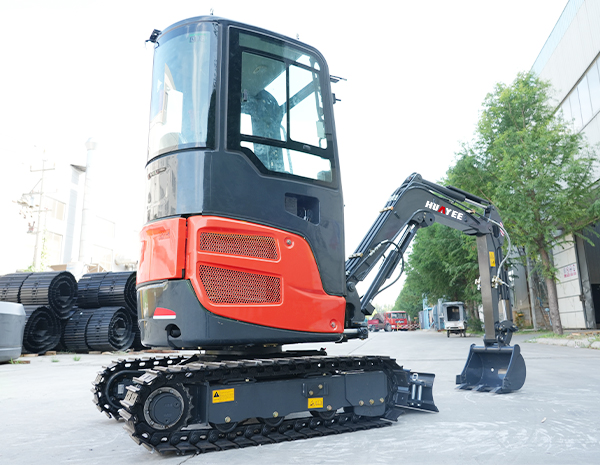
HY20 control layout and service access: engine compartment opened by a one-piece stamped shell with service points reachable from outside.
Evidence from the field: what a first order turns into
Two documented distributor cases illustrate how the trial-order step works in practice.
A dealer entering the mini excavator business in Belgium compared the factory strength and products of 15 Chinese suppliers during a single visit to China before choosing HUAYEE, then placed an order that reached 1,000 units over two years of cooperation counted from a September 2023 factory visit. The dealer reports annual profit rising from USD 120,000 in its previous construction business to USD 300,000 in the mini excavator business.
A German importer and distributor started from a single unit ordered in January 2023 after an online enquiry, then signed an exclusive agency contract after visiting the factory. That account has grown to a stable monthly purchase volume of 200 units and more than 5,000 units in total, with the customer building its own brand and its own second-tier dealer network. The same customer had tested lower-priced machines in the meantime; quality problems there caused brand damage and heavy after-sales repair costs, after which cooperation with HUAYEE was consolidated.
Across both cases, the decision did not turn on the cheapest quote. It turned on verified factory capability, a single-unit entry point, and what happened after the machine was delivered.
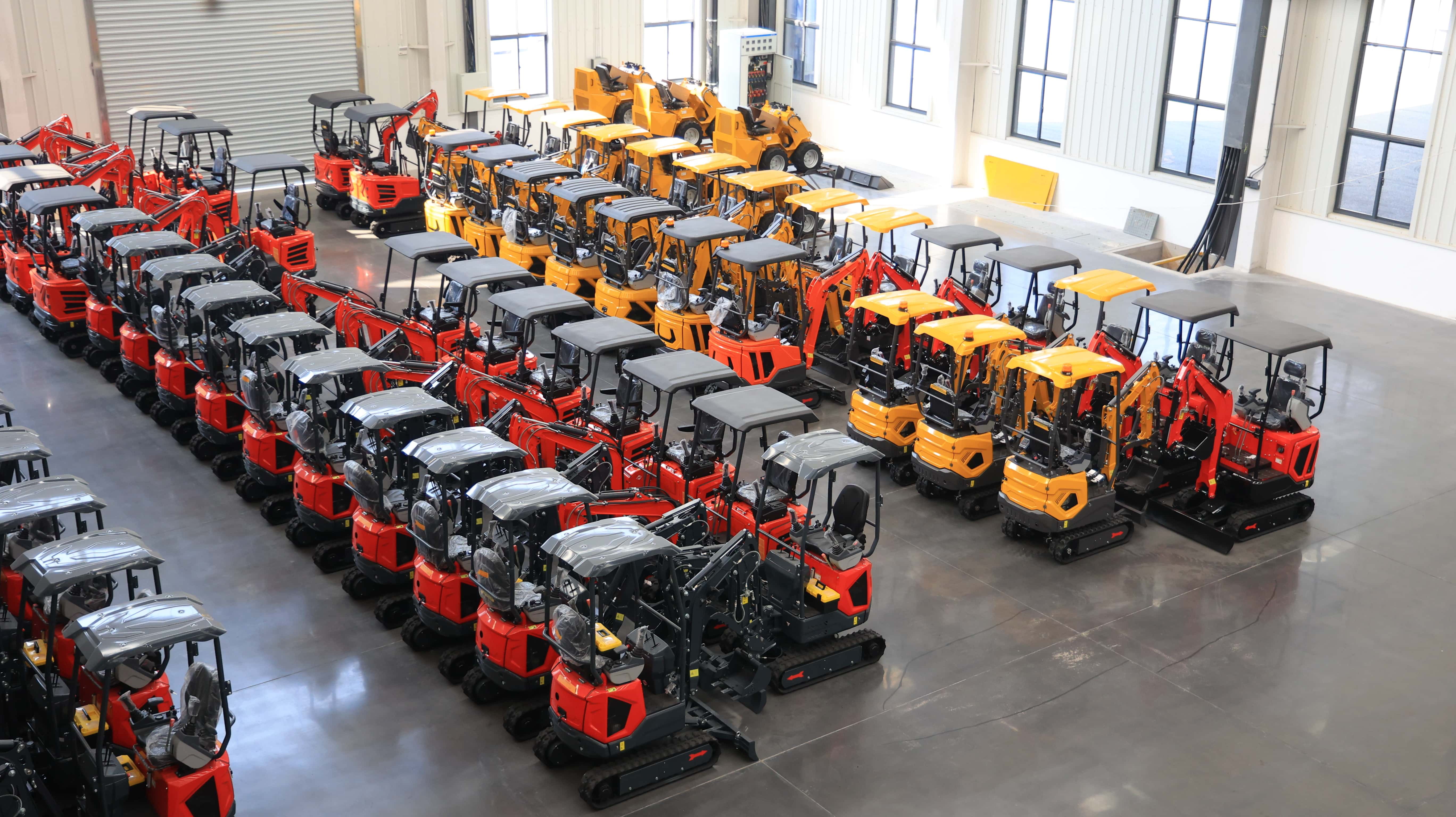
One of more than 20 intelligent production lines at the HUAYEE group site, covering cutting, robotic welding, stamping and painting.
Frequently asked questions
Can Chinese mini excavator manufacturers supply CE certification for a compact mini excavator?
Yes, and the certificate has to be checked rather than assumed. HUAYEE holds whole-machine CE certificate H220809.SHHTW07, issued by Ente Certificazione Macchine Srl in Italy against EN ISO 12100:2010, EN 474-1:2006+A6:2019, EN 474-5:2006+A3:2013 and EN ISO 13766-1:2018, covering crawler excavators HY06 to HY225 and valid to 8 August 2027. A separate CE noise emission verification, certificate 0P230814.SHHTQ84 to EN ISO 3744:2010, covers the same range, valid to 8 August 2027. Engine emission approval is a third document: EU Stage V type-approvals are held for the Kubota D1703, the Kubota D1105 and the KOOP KD15 engine family. For the German market, packaging is registered in the LUCID Packaging Register under DE3722376188859. Buyers should confirm that the exact model code they are ordering appears in the certificate scope.
How small a compact mini excavator is available for tight spaces?
The HY10 is the smallest model at 1,000 kg, with an overall width of 930 mm, a minimum turning radius of 1,490 mm and a 1,725 mm maximum digging depth, which allows work in courtyards, alleys and interior spaces. Where more digging depth is needed but the rear still has to stay clear of walls, the 2 t class HY20 offers a 650 mm minimum tail swing radius with a 2,255 mm maximum digging depth. Combining a side-swing boom with a short tail swing is what allows the machine to excavate parallel to a wall or boundary: on the 4 t class HY40U the working device deflects 60° to the left and 45° to the right.
What drives the cost of a compact mini excavator?
Cost is driven by the configuration combination rather than by a single headline specification. The variables that change the build are the weight class, the engine brand and rating, the hydraulic system (gear pump, or piston pump with load-sensing valve), canopy or enclosed cab, rubber or steel track, high and low speed travel motor, and the attachment set. Colour, logo and nameplate customisation and market-localised models are also part of the factory-direct configuration. Because these options interact, a quotation has to be built from a defined specification rather than from a generic model list.
Is a one-unit trial order possible before committing to a container?
Yes. Minimum order quantity is one unit, and single-unit first orders have been delivered to buyers who later became established dealers. The Belgian dealer that now handles 1,000 units started by comparing 15 Chinese suppliers and visiting the factory. The German importer placed a single unit in January 2023 before moving to a stable monthly purchase volume of 200 units. A trial order is also how the site-envelope assumptions get tested: access width, tail clearance, cycle time and service access in the real working condition.
What is the lead time for a standard and a customised compact mini excavator?
Standard lead time is 30–45 days. A customised build extends to 75–90 days, because colour, logo, engine brand, hydraulic system, cab type, track type and attachment specification are produced to order. Production capacity is around 30,000 units per year on more than 20 intelligent production lines, which is what makes a one-unit order and a volume order compatible within the same production plan. Export markets cover 158 countries, with spare parts held in five overseas warehouses in Italy, Hungary, two in the United States and Canada, and a response commitment within 24 hours.
Conclusion
A compact mini excavator decision resolves itself once the constraints are ordered correctly. Site envelope comes first: overall width, minimum swing radius and tail swing radius eliminate the models that cannot reach or work the position. Market access comes second: whole-machine CE and the matching engine emission approval determine whether the unit can be sold where it is going. Configuration comes third: the hydraulic system and attachment set decide what the machine does once it is on site. Support comes last, and it is the item that determines the cost of ownership after year one.
On those four tests, the HUAYEE Excavator range runs from the 930 mm wide HY10 for confined garden and courtyard work, through the 650 mm tail swing radius HY20 for narrow urban sites, to the HY40U with 3,135 mm digging depth, 30 kN bucket digging force and 58° gradeability for earthworks and foundations. Each model sits inside a documented approval file, and each can be ordered as a single trial unit before volume is committed.
Next step: check the exact specification against your site
Send the working condition, the access width, the required digging depth and the destination market. You will get back the model that matches, the configuration options that apply, and the certification documents that cover that model.
Request a quotation, a single-unit trial order or the product catalogue from Shandong HUAYEE Heavy Industry Machinery Group Co., Ltd.
Email: infoce@huayee.com | Tel / WhatsApp: +86 185-5379-4877 | Web: www.china-huayee.com
Address: No. 77-1, Linghua Road, Liuhang Subdistrict, High-tech Zone, Jining City, Shandong Province, China
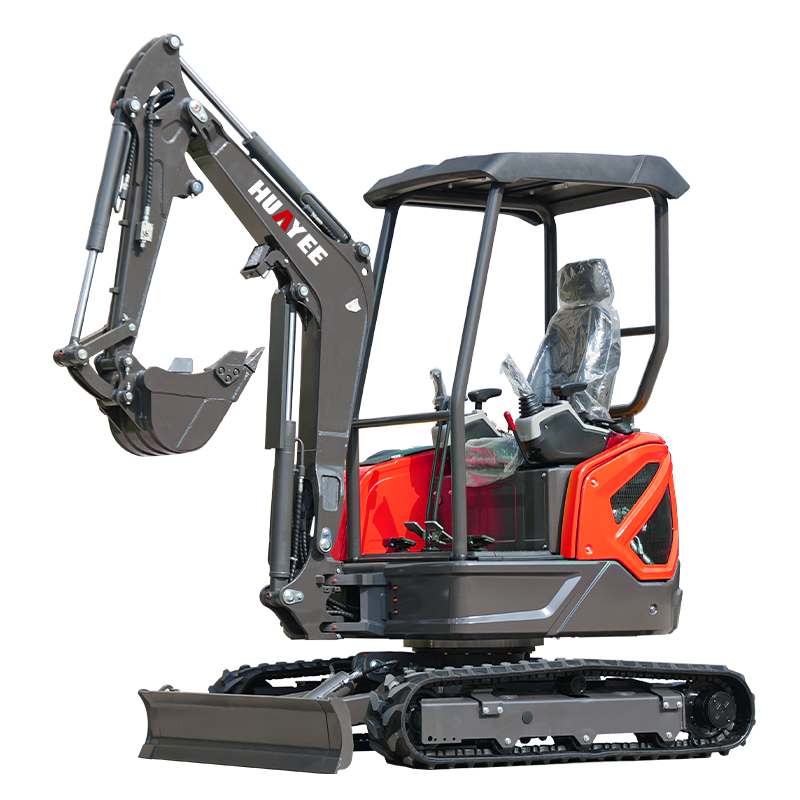
HUAYEE HY30, a 3 t class compact crawler mini excavator with a 20 kN bucket digging force and 2,300 mm maximum digging depth.
Have Questions or Need More Details?
Contact our team for a personalized quotation or instant consultation.
Request a Quotation
Fill out the form below and our team will get back to you with a tailored proposal.
WhatsApp Direct Chat
Prefer to chat in real-time? Message us on WhatsApp for instant assistance & quick answers.
- Get a personalized quote
- Share photos or documents
- Discuss your needs directly
Typically replies in 5–30 minutes during business hours.