Application-Fit Zipper Bag Ranking: Haida Packaging Star Guide
Choosing zipper storage bags for a packaging project is a matching problem, not a popularity contest. A bag that works at room temperature behind a catering counter is not automatically the right bag for a −40 °C freezer line or a dust-controlled electronics pack-out station. This ranking scores seven documented Haida Packaging models — HD-ZB001, HD-SZB001, HD-DZB001, HD-ZB002, HD-FB001, HD-SB001 and HD-VB001 — on how well their published material, closure, capacity and temperature data fit three buyer applications: food storage, freezer storage and electronics packaging.
How the stars work. Each model receives an editorial fit score of one to five stars per application, derived only from the attributes published for that model in Haida Packaging's product data. Five stars means the documented attributes directly address the conditions that application states. Three stars means the documentation covers the application only partially — for example, a lower temperature limit that stops above deep-freeze conditions. ND means the application is not documented for that model; it is a documentation gap, not a verdict on quality. These ratings are an application-matching device. They are not test results, not certification evidence, and not a claim that any model is manufactured to a higher standard than another.
What application fit actually means for zipper bags
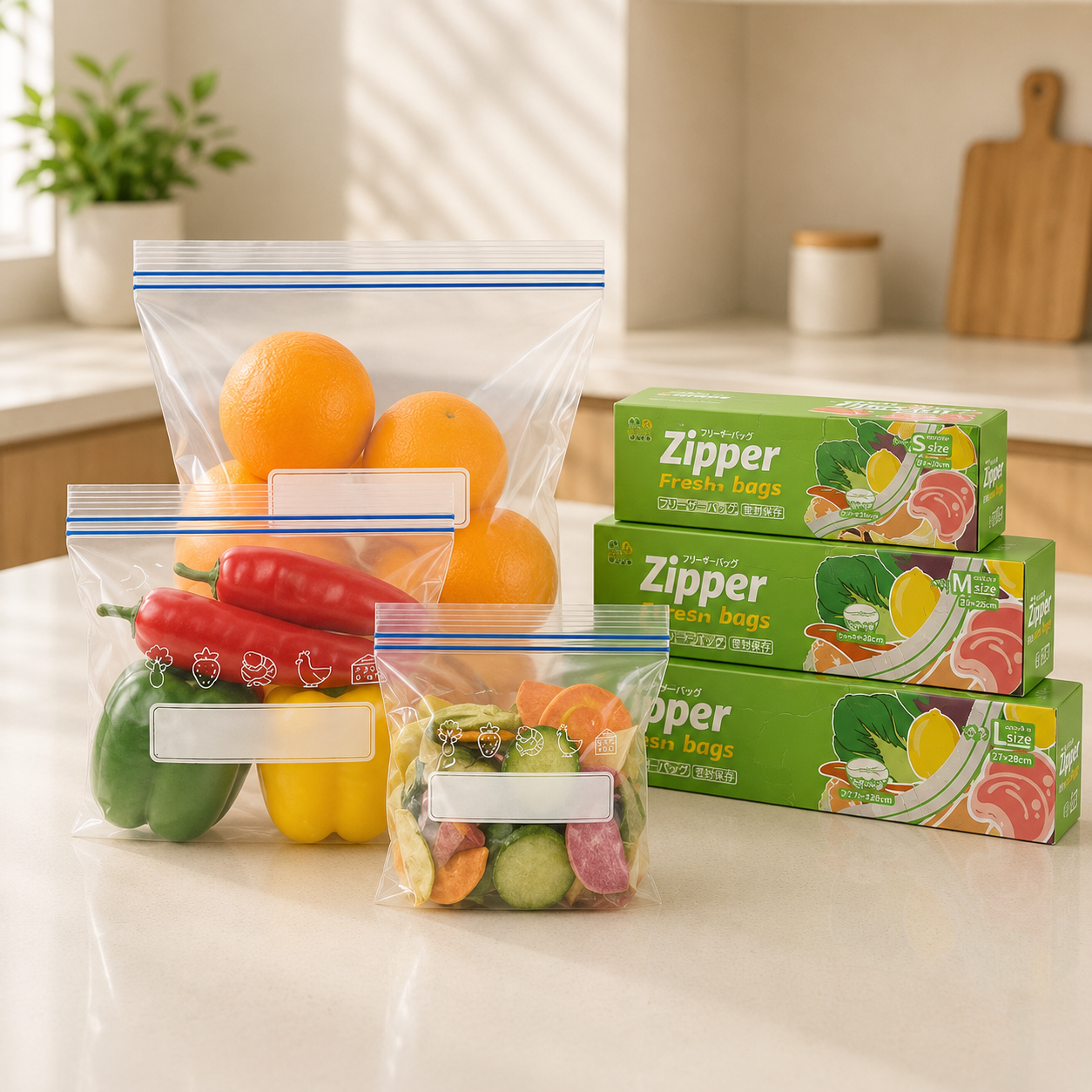
Application fit is the overlap between three things: the storage environment your product actually experiences, the attributes the bag's specification actually documents, and the handling routine your staff performs every shift. A shortlist built on price per bag and a single size usually fails on the second point, because the attributes buyers assume are standard — a numeric temperature range, a stated closure type, a thickness, a seal-strength value — are frequently absent from zipper bag specifications.
Four specification traps cause most mismatches:
- Temperature statements are not symmetrical. A range of −20 to 120 °C describes both a lower and an upper limit. A statement such as low-temperature resistant to −40 °C describes one direction only. A phrase such as high-temperature resistant without a value describes no limit a buyer can plan against.
- Capacity is expressed in mixed units. Most models in this range are sized in millilitres, while one frozen food model is sized in grams and kilograms. Comparing 500 ml with 500 g requires the density of the product you intend to pack, not a direct conversion.
- Closure style changes the failure mode. A single zipper, a dual zipper and a slider fail in different ways and suit different users. Dual zippers are documented here for extra sealing and leak resistance; sliders are documented for ease of opening and closing.
- An application listing is not a compliance approval. Food packaging in a product entry tells you where the supplier positions the model. It does not replace a declaration of compliance, a migration test report or a market-specific food-contact assessment.
Industry background: documented fit is replacing assumed fit
Regulatory pressure is moving packaging specifications from a single price-per-unit decision toward a documented-materials decision. California's SB 54 packaging producer responsibility programme sets a target that 100% of single-use packaging in the state be recyclable or compostable by 2032, as published by CalRecycle. For a buyer, the practical consequence is that the material structure of a bag — mono-material polyethylene versus a multi-material structure combining PA and PE — becomes a question to check against your own market obligations rather than an internal technical detail.
Food-contact rules reinforce the same direction. The U.S. Food and Drug Administration publishes food-contact guidance that ties packaging suitability to the specific substance, the intended use and the migration conditions, rather than to a category label. Buyers who qualify a supplier on documents rather than on adjectives therefore get two benefits at once: a defensible compliance file and a specification that can be compared across quotations.
That is the context for this ranking. It does not declare a market leader. It maps seven models to three applications and shows exactly which published attribute supports each match, so a sourcing team can move from a rough shortlist to a request for quotation with named models and defined verification steps.
Haida Packaging: the manufacturer behind the seven models
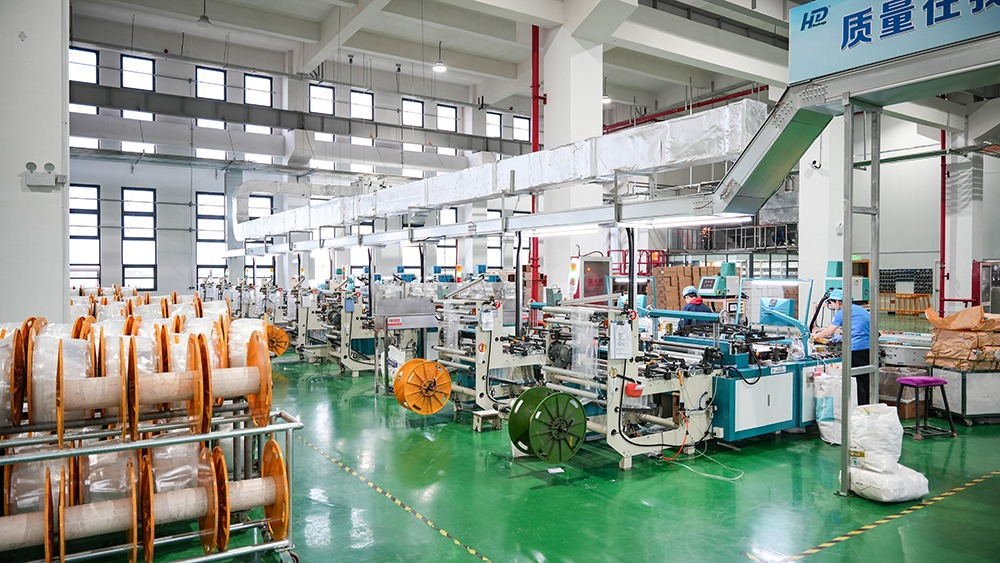
Haida Packaging is the trading name used here for Taizhou Haida Plastic & Rubber Packaging Co., Ltd., a zipper bag and self-sealing bag manufacturer founded in 2003 and based in Taizhou, Jiangsu, China. The company states that roughly 90% of its output is exported, with Japan and Europe as its main markets, and that its engineering team numbers about 20 people. Its documented zipper bag range covers single zipper, double zipper, slider and vacuum formats across food, catering, household, retail and electronics applications.
Published commercial parameters for OEM work are a monthly capacity of 900 tons, a minimum order quantity of 20,000 boxes and a typical lead time of 35–40 days, with logo customization. Read those as planning inputs to confirm in writing, not as guarantees: capacity, MOQ and lead time depend on the specific model, size, print and the production slot available when you order. A buyer running several models at once should also expect each model to carry its own minimum, since a mixed order does not merge separate items into one threshold.
The seven documented models and their published attributes
The table below reproduces the attributes that matter for application matching. Where a specification does not state a value, the entry says so rather than filling the gap.
| Model | Type | Material | Closure | Capacity / size | Temperature statement | Documented applications |
|---|---|---|---|---|---|---|
| HD-ZB001 | Food sealing bag | 100% LDPE | Zipper; closure style not separately specified | Small / medium / large | −20 to 120 °C | Household and kitchen, food packaging, catering |
| HD-SZB001 | Single zipper bag | 100% LDPE | Standard single zipper | Small / medium / large | −20 to 120 °C | Food packaging, catering, daily supplies |
| HD-DZB001 | Double zipper bag | 100% LDPE | Dual zipper, leak-resistant, easy open and close | 50–500 ml | Not stated | Food packaging, catering, daily supplies |
| HD-ZB002 | Slider zipper bag | 100% LDPE | Slider, easy open and close | 50–500 ml | Not stated | Household and kitchen, food packaging, daily supplies |
| HD-FB001 | Frozen food bag | 100% LDPE | Zipper; closure style not separately specified | 100 g–2 kg | Low-temperature resistant to −40 °C; oil-resistant | Frozen food, ready-to-eat packaging |
| HD-SB001 | Slider bag | 100% LDPE | Slider, convenient sealing, pressure and water resistant | 100–1000 ml | Not stated | Food, electronics packaging |
| HD-VB001 | Food vacuum bag | PA+PE | Vacuum-sealable | 50–2000 ml | High-temperature resistant; value not stated | Food processing, freezing, preservation |
Three observations follow directly from the table. First, six of the seven models are 100% LDPE; the vacuum bag is the only PA+PE structure, which makes it the natural item to review first if your packaging obligations favour a mono-material approach. Second, only two models publish a two-sided numeric temperature range, one publishes a one-sided cold limit, one publishes a qualitative high-temperature claim, and three publish no temperature statement at all. Third, the size systems are not interchangeable: millilitre ranges for four models, small/medium/large for two, and grams for the frozen food bag.
Star-rated application-fit table
Ratings apply the scoring rule explained at the top of this guide. They compare models against a stated application, not against each other in the abstract, so a model can score five stars for one use and ND for another without contradiction.
| Model | Food storage fit | Freezer fit | Electronics fit | Why the score |
|---|---|---|---|---|
| HD-ZB001 | ★★★★★ | ★★★☆☆ | ND | Food sealing entry with a two-sided −20 to 120 °C range and three size classes; the −20 °C lower limit stops above deep-freeze conditions. |
| HD-SZB001 | ★★★★★ | ★★★☆☆ | ★★★★☆ | Single zipper food storage model with the same −20 to 120 °C range; also documented in a Japan electronics project alongside HD-DZB001. |
| HD-DZB001 | ★★★★☆ | ND | ★★★★☆ | Dual zipper documented for extra sealing and leak resistance, which suits liquid-prone food; capacity limited to 50–500 ml. |
| HD-ZB002 | ★★★★☆ | ★★★★☆ | ND | Slider convenience for frequent opening; listed as a related product in frozen food and retail scenarios; no numeric temperature statement. |
| HD-FB001 | ★★★★☆ | ★★★★★ | ND | The only model with documented −40 °C low-temperature resistance and oil resistance, sized 100 g–2 kg for portioned frozen food. |
| HD-SB001 | ★★★★☆ | ★★★★☆ | ★★★★★ | The only model documented for electronics packaging, with pressure and water resistance and a 100–1000 ml range. |
| HD-VB001 | ★★★★☆ | ★★★★☆ | ND | Vacuum-sealable PA+PE structure for food processing, freezing and preservation; widest capacity at 50–2000 ml; temperature claim is qualitative. |
Step-by-step: build your own application-fit shortlist
Step 1 — Write the storage condition before you look at models
State the temperature the product sees at its coldest and hottest point, the humidity or dust exposure, the expected storage duration and who opens the bag. A freezer project written as cold storage produces a vague shortlist; a project written as −18 °C holding room for nine months, opened twice per shift by gloved staff points directly at a low-temperature-rated model and a closure that works with gloves.
Step 2 — Match the temperature statement type, not just the number
Compare like with like. HD-ZB001 and HD-SZB001 offer a two-sided −20 to 120 °C range. HD-FB001 offers one-sided low-temperature resistance to −40 °C, which is the more relevant statement for a freezer line but says nothing about hot filling. HD-VB001 states high-temperature resistance without a value, so a hot-fill project needs a written figure before the model is approved. Where no temperature statement exists — HD-DZB001, HD-ZB002 and HD-SB001 — the quotation request must supply one.
Step 3 — Choose the closure by failure mode and by user
If the risk is leakage from a liquid or semi-liquid product, the dual zipper of HD-DZB001 is the documented option. If the risk is staff fatigue or repeated opening during a shift, the slider closures of HD-ZB002 and HD-SB001 are the documented options. If the requirement is a simple closure across a wide size range, the single zipper of HD-SZB001 covers small to large in one specification family. For long-term storage where air removal matters, HD-VB001 is vacuum-sealable and requires vacuum equipment in the packing process.
Step 4 — Convert capacity into a real portion
Millilitre ranges describe volume; gram ranges describe weight. Pack a 300 g portion of a product with a density near 1 g/ml and a 300 ml bag is roughly right; pack the same weight of a low-density snack and the volume requirement rises. Use your own product to set the target, then pick the size class. HD-FB001 is the exception in this range because it is specified in grams, from 100 g to 2 kg, which suits portioned frozen food directly.
Step 5 — Qualify the documents and the commercial terms together
Before a purchase order, request the food-contact declaration applicable to your market, a migration test report where food contact applies, the material identity, the scope and validity of any quality-system certificate, a production specification with thickness and dimensional tolerance, and written confirmation of MOQ, lead time and the production slot. Application listings and published capacities are the start of that file, not the end of it.
Use cases: how the ranking plays out in three projects
Food storage, catering and household packing
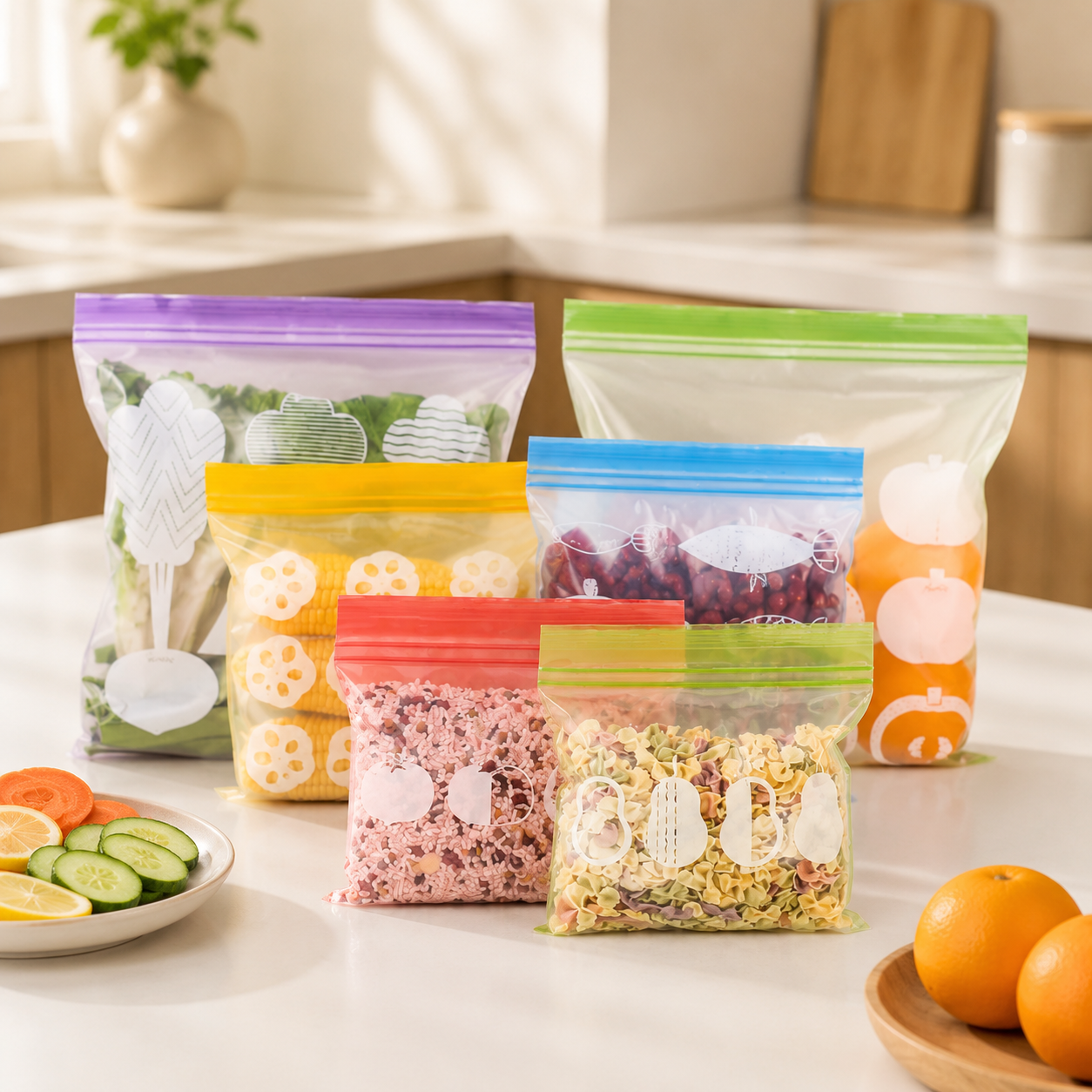
For ambient food storage, portion control and takeaway packing, the widest documented coverage comes from HD-ZB001 and HD-SZB001, which publish a −20 to 120 °C range across three size classes. Where leakage is the main complaint, HD-DZB001 adds a dual zipper documented for extra sealing and leak resistance within a 50–500 ml range. Where staff need to reopen a bag repeatedly, the slider closure of HD-ZB002 is the documented convenience option at the same 50–500 ml capacity. Documented projects in this area include a Japan-based restaurant chain using dual zipper bags for high-volume takeaway packing and a Japan-based food manufacturer using custom sizes and logos for portion control.
Freezer storage and cold chain
Freezer projects should start with HD-FB001, the only model in the range with a documented low-temperature resistance to −40 °C and oil resistance, sized from 100 g to 2 kg for portioned frozen food and ready-to-eat packaging. HD-VB001 supports vacuum and freezing applications at a wider 50–2000 ml capacity, with the trade-off that vacuum packing adds equipment and a process step. HD-SB001 and HD-ZB002 are also listed in frozen food processing scenarios, but without a numeric temperature statement, so their use in a freezer line should be confirmed in writing. A documented Japan-based frozen food processor project used low-temperature-resistant, anti-crack material in bulk supply.
Electronics and small components
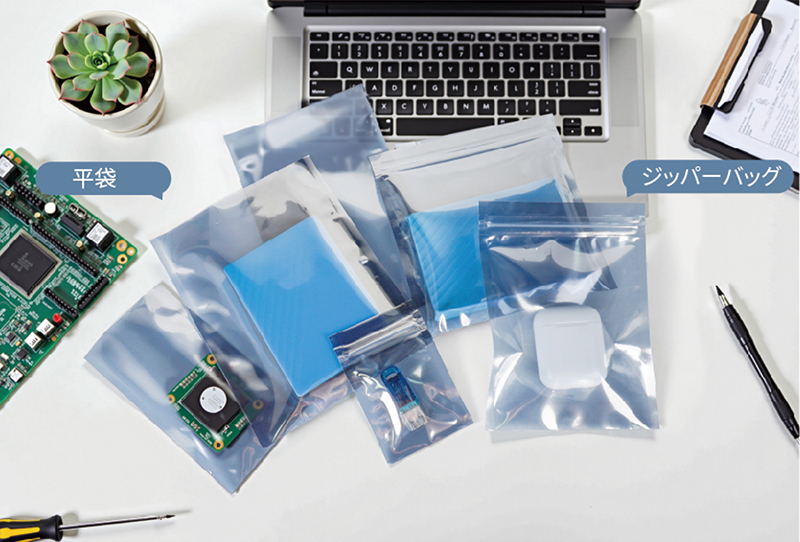
Electronics packing is a different problem: the risk is dust, moisture and minor shock rather than food contact, and the working condition is a dust-free, moisture-protected pack-out area. HD-SB001 is the only model documented for electronics packaging, with pressure and water resistance and a 100–1000 ml range, and the documented scenario pairs it with packing machines and anti-static mats in manual or semi-automatic operation. A Japan-based electronics and small components project ran for two to three years with anti-static, moisture-proof bags in custom sizes. If a project needs anti-static performance as a specified property, treat it as a requirement to be documented in the quotation rather than an assumption based on the model's application listing.
What this ranking does not tell you
The published model data does not include thickness, dimensional tolerance, seal-strength values, closure-cycle performance, leak-test results or barrier data. Those are exactly the values a technical comparison needs, and their absence is a documentation gap in the category, not evidence that any model performs poorly. Request them per model and per size.
The seven documented models also do not include a stand-up gusset format, a clothing or apparel-specific format, or a dedicated waterproof format. If a project requires custom stand up zipper bags, custom clothing zipper bags or custom waterproof zipper bags, treat those as open questions with their own specification and sample cycle rather than assuming the closest model in this table will substitute. Likewise, custom printed zipper bags with a logo sit within the OEM scope, but print colours, plate charges and print-area limits are commercial details to confirm, not attributes in the product data.
FAQ: application-fit questions buyers ask before a quotation
Which models are documented for food-contact packaging, and does that make them food-grade?
Six models document food-related applications: HD-ZB001, HD-SZB001, HD-DZB001, HD-ZB002, HD-FB001 and HD-VB001, with HD-SB001 documenting both food and electronics packaging. An application listing defines the supplier's intended use, not a compliance status. For a food-contact project, request the declaration of compliance for your market, the migration test report, the material identity and the intended-use conditions, and confirm the certificate holder, scope and validity. U.S. food-contact requirements are published by the FDA, and other markets set their own conditions, so the document you need depends on where the packed product is sold.
Can one supplier cover food, freezer and electronics lines from a single model range?
Within the documented range, yes at the model level: six LDPE models cover single zipper, dual zipper, slider and frozen food formats, and one PA+PE model covers vacuum applications, with HD-SB001 carrying the electronics listing. The constraint is not the number of models but the uneven documentation: temperature statements, capacity units and closure designations differ between entries, so each line still needs its own written specification. OEM production with logo customization and a published capacity of 900 tons per month support multi-line programmes.
What drives the cost of a mixed food, freezer and electronics order?
Five cost drivers dominate: material structure (PA+PE for the vacuum model versus LDPE for the rest), closure complexity (slider and dual zipper formats against a standard single zipper), size class, print requirements for custom logo zipper packaging bags, and how many separate models the order contains. Because each model carries its own minimum order quantity — published as 20,000 boxes — splitting one programme across four models multiplies the minimum commitment. No unit prices are published in this data set, so ask for an itemised quotation per model, size and print specification rather than a single blended figure.
What sample sequence proves application fit before a bulk order?
Run a sample against your real product, not a generic one. For freezer applications, hold a filled HD-FB001 sample at your target low temperature for the storage period you plan and inspect the seal and film; for leak-prone food, fill an HD-DZB001 sample with the actual sauce or liquid and check the dual zipper under handling; for electronics, pack real components with your anti-static mat and packing equipment and inspect for dust and moisture ingress after the transit cycle. Ask for the exact model and size, keep the test method written down, and compare samples from more than one model where the specifications are close.
What MOQ and lead time should a multi-application programme plan for?
Published terms are a minimum order quantity of 20,000 boxes and a typical lead time of 35–40 days, against a monthly capacity of 900 tons. Treat the lead time as typical rather than guaranteed, and confirm the production slot in writing before you commit to a launch date, especially when several models share the same window. A practical next step is to request the current catalogue and a model-level quotation for the shortlist you built in steps one to five; the catalogue download link and the company website are at the end of this guide, and the sales team can confirm specifications, samples and scheduling for the exact models your project needs.
Conclusion: rank the application, then the model
The ranking in this guide resolves into a short decision rule. For ambient food storage and catering, start with HD-ZB001 or HD-SZB001 and add HD-DZB001 where leakage is the risk. For freezer and cold-chain work, start with HD-FB001, and consider HD-VB001 where vacuum packing is part of the process. For electronics and small components, HD-SB001 is the documented entry, with HD-DZB001 and HD-SZB001 as secondary options drawn from documented project use. HD-ZB002 sits across household, retail and frozen-food scenarios as the slider convenience option.
What separates a workable shortlist from an expensive mistake is not the star count — it is whether the temperature figure, the capacity unit and the closure designation in your specification match the ones in the supplier's written confirmation. Use this table to name the models, then use the quotation request to close the documentation gaps: temperature values where none are published, thickness and tolerance, food-contact documents for your market, and confirmed MOQ and lead time per model.
To review the full model range, specifications and customization options, download the Haida Packaging catalogue (PDF), or visit Haida Packaging for company and product information. Buyers who already know their application conditions can send the shortlist for samples and an itemised quotation.
Have Questions or Need More Details?
Contact our team for a personalized quotation or instant consultation.
Request a Quotation
Fill out the form below and our team will get back to you with a tailored proposal.
WhatsApp Direct Chat
Prefer to chat in real-time? Message us on WhatsApp for instant assistance & quick answers.
- Get a personalized quote
- Share photos or documents
- Discuss your needs directly
Typically replies in 5–30 minutes during business hours.