Leak-Proof Sealing for Liquid Foods: How Double Zipper Bags Solve Common Spillage Issues
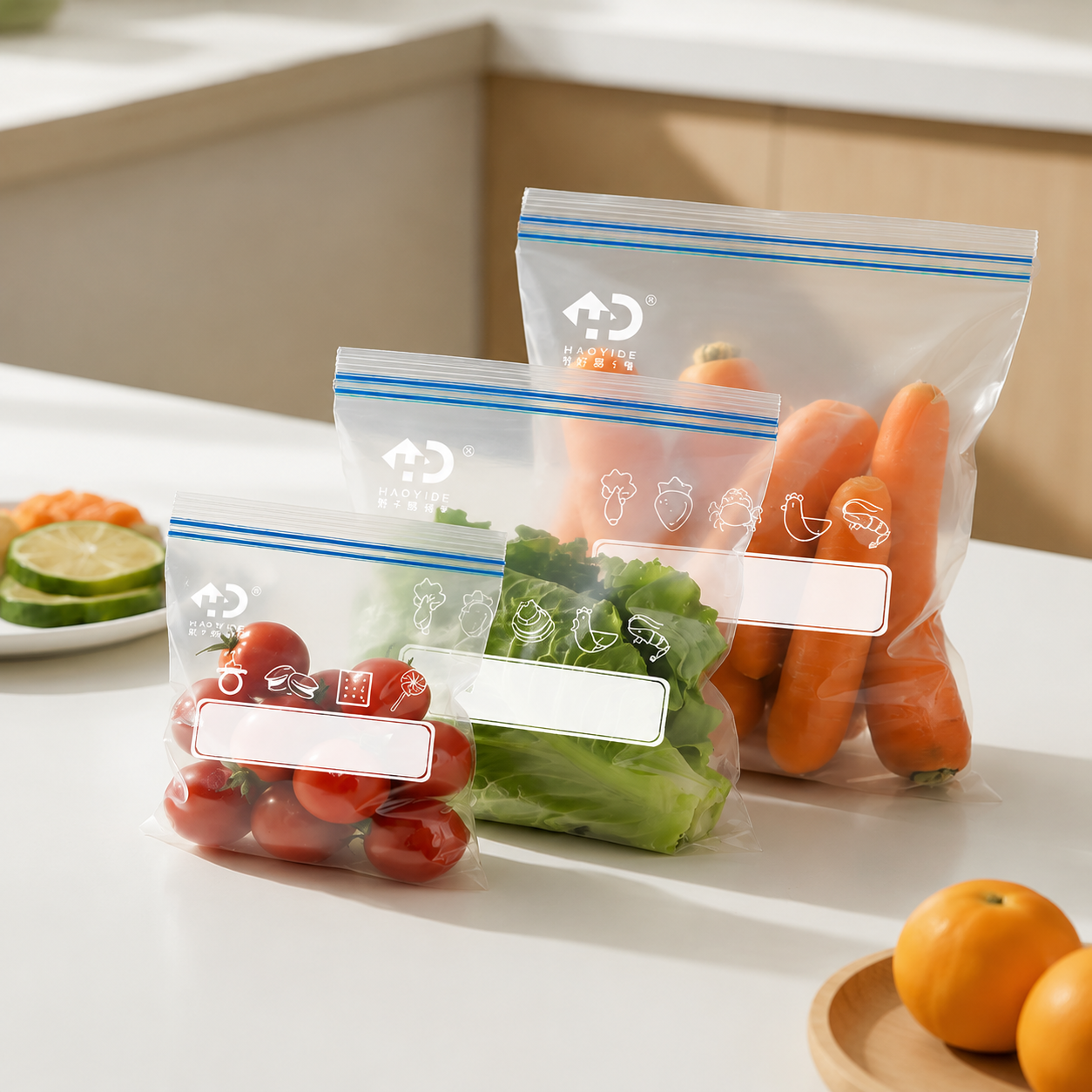
HD-DZB001 Double Zipper Bag: dual zipper for extra sealing, 50–500 ml capacity, 100% LDPE.
Liquid food leaves a zipper bag through one dominant path: a closure that is only partly engaged. When a press-to-close track is interrupted at a single point along its length — a corner, a gusset fold, a section pressed shut over a smear of sauce — the film itself is rarely the problem, yet the bag still leaks. The HD-DZB001 Double Zipper Bag from Haida Packaging targets that failure mode directly with a dual zipper: two interlocking tracks documented as “dual zipper for extra sealing, leak-resistant, easy to open and close”, in a 50–500 ml capacity range and a 100% LDPE construction intended for food packaging, catering and daily-supply use.
This article is written for buyers in the research and evaluation stage of a packaging decision — catering operators reviewing takeaway containers, food manufacturers portioning sauces and purées, and importers comparing sealing formats before placing an order. It defines the spillage problem, explains the sealing upgrade in design terms, sets out a step-by-step specification process, and closes with a comparison table and a buyer FAQ built from Haida’s published product, certification and capability data.
Why Liquid Foods Escape Zipper Bags
Spillage in zipper packaging starts at one of three points: the closure interface, the fill-volume ceiling, or the handling stage after sealing. In catering complaints, the closure interface is usually the first to fail.
1. Interrupted track engagement
A single-track closure — the format Haida documents on the HD-SZB001 Single Zipper Bag as a “standard single zipper” — provides one continuous seal line. A gap anywhere along that line is an open channel. Corners, gusset transitions and the last few centimetres before the bag edge are where partial engagement most often occurs, because pressure from the thumb and forefinger is uneven at those points.
2. Filling past the rated capacity
The HD-DZB001 is documented at 50–500 ml. Filling beyond the rated volume pressurises the bag body and pushes liquid back toward the closure while it is being closed, so the track is asked to seal against internal hydraulic pressure rather than against air. Portion-controlled filling is therefore a specification item, not a kitchen habit.
3. Contamination in the seal zone
Fat, oil and fine food particles reduce grip between the two faces of a press-to-close track. Leaving a defined headspace above the fill line and keeping the track area clear during filling are the two controls that most directly protect the closure, and both are easier to hold in a repeatable filling workflow than at the point of use.
4. Pressure and handling after sealing
Catering takeaway is documented in Haida’s application data as a segment with “high temperature resistant, leak-proof” working conditions, an “easy sealing, hygienic storage” function and a special requirement of “easy-open, leak-proof”. Bags are stacked, tilted and carried in insulated bags; a closure that has been reopened once to dispense a portion has to reseat correctly to keep holding.
What “leak-resistant” means as a specification. Haida records leak resistance as a product parameter of the HD-DZB001 rather than as a general claim about zipper bags. Buyers should treat it as a design attribute to be validated against their own fill volume, closure-handling routine and transport route — not as a universal guarantee that transfers to every liquid, every fill level or every handling condition.
Why Leakage Tolerance Is Tightening Across Food Packaging
Leakage has shifted from a nuisance to a qualification issue, because catering packaging is now specified, audited and regulated rather than bought on unit price alone.
Three pressures are visible in the way buyers now write requirements.
Application specificity. Catering and restaurant takeaway is no longer treated as a generic “food packaging” use. Haida’s application data lists it as a distinct segment with its own working condition (high temperature resistant, leak-proof), its own function (easy sealing, hygienic storage) and its own special requirement (easy-open, leak-proof). Once a segment is described that precisely, a bag that merely “closes” is no longer sufficient.
Food-contact documentation. In the United States, food packaging is assessed under the FDA framework for food-contact substances. In the European Union, the governing instruments are Regulation (EC) No 1935/2004 on materials and articles intended to come into contact with food and Regulation (EU) No 10/2011 on plastic materials and articles, with the German LFGB Section 30 and 31 applied as an additional market standard. These are the standards against which the HD-DZB001 has been tested, and they are the reason a buyer now asks for a report number rather than a verbal assurance.
Audit and material policy. European and multinational supermarket supply chains increasingly require social and quality audits alongside product compliance — the BRCGS and amfori BSCI schemes being the two most frequently named. Separately, California SB 54 requires 100% of single-use packaging to be recyclable or compostable by 2032 under the state’s packaging extended producer responsibility programme. Buyers who plan packaging ranges several years ahead are therefore asking suppliers to declare material composition, which is one reason a single-material 100% LDPE construction is easier to describe on a specification sheet than a multi-material laminate.
The Double Zipper Solution: HD-DZB001 Specification and Design Logic
The HD-DZB001 Double Zipper Bag is a 100% LDPE zipper bag with two closure tracks, documented for extra sealing and leak resistance, in a 50–500 ml capacity range for food packaging, catering and daily supplies.
Haida Packaging is the brand of Taizhou Haida Plastic & Rubber Packaging Co., Ltd., a manufacturer of zipper bags, single zipper bags and slider bags established in 2003 and based in Taizhou, Jiangsu, China. The company reports a 15,000 m² facility, 310 employees, an annual output of 11,000 tons and roughly 90% of volume exported, with Japan and Europe as its main markets.
| Model | HD-DZB001 |
| Product type | Double Zipper Bag |
| Documented closure parameter | Dual zipper for extra sealing, leak-resistant, easy to open and close |
| Capacity range | 50–500 ml |
| Material | 100% LDPE |
| Applicable industries | Food Packaging, Catering, Daily Supplies |
How two tracks change the failure maths
A dual zipper puts two separate interlocking tracks where a single-track bag has one. The practical consequence is redundancy: a section of track that has not been fully pressed home — the most common real-world cause of leakage — sits on one track while the second track behind it remains engaged. The design does not depend on the operator closing the bag perfectly; it depends on the operator closing it once, which is why Haida describes the format as both leak-resistant and easy to open and close.
The second operational benefit is reclosure. Takeaway and portion-control use rarely means one fill and one open. A bag is opened to dispense part of the contents and closed again, often several times. Two tracks give the operator a second, identical sealing surface to reseat after each opening, and the 50–500 ml range maps onto the portion sizes typical of sauces, dressings, purées, marinades and single-serve liquid sides.
Documented limits
The HD-DZB001 is documented as a 100% LDPE leak-resistant double zipper bag. It is not documented as a vacuum package or as a long-haul liquid transport container. Where a process requires vacuum sealing, Haida’s HD-VB001 vacuum bag is specified with a PA+PE structure, a 50–2000 ml range and a vacuum-sealable, high temperature resistant parameter. Where the route runs at low temperature, the HD-FB001 frozen food bag is documented as low temperature resistant to −40°C and oil-resistant, in a 100 g–2 kg range. Choosing by route rather than by habit is the difference between a bag that performs and a bag that merely fits.
Compliance evidence attached to the model
The HD-DZB001 is not supported by generic supplier statements. Haida holds a test report issued by SGS-CSTC Standards Technical Services Co., Ltd., Ningbo Branch under report number NGBHL2500156690, confirming compliance with Regulation (EC) No 1935/2004 and LFGB Section 30 and 31 for the German and European Union market, applicable to the HD-DZB001 double zipper bag.
At company level, Haida holds BRCGS Global Standard for Packaging Materials certification with an A+ audit grade, issued by LRQA under certificate number BJG00002606/7506914 for the UK, Europe, North America and global premium retail and supermarket supply chains; amfori BSCI Code of Conduct certification at Grade A, issued by Bureau Veritas Hong Kong Limited under number 25-0344964 for European and global premium retail and multinational supermarket supply chains; and ISO 9001:2015 certification issued by ISO Certification Body under number 15/25Q5282R31, applicable globally.
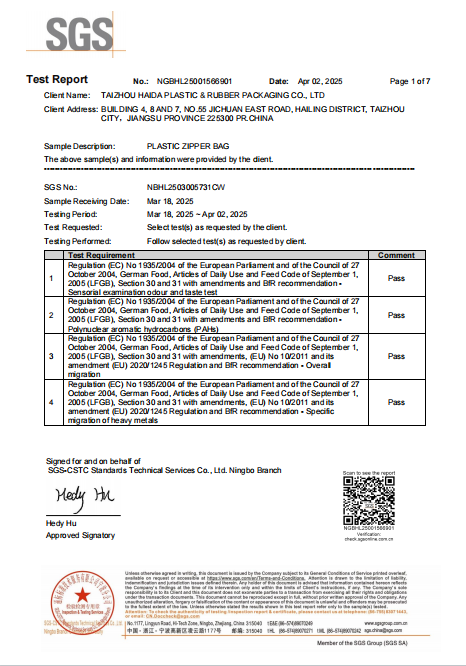
SGS test report NGBHL2500156690 confirms compliance of the HD-DZB001 with Regulation (EC) No 1935/2004 and LFGB Section 30 and 31 for the German and EU market.
Step-by-Step: Specifying a Leak-Resistant Zipper Bag for Liquid Foods
A leak-resistant specification is built in six decisions, and five of them are made before a sample is ever filled.
Step 1 — Fix the fill volume and headspace. Start from the actual portion, not the bag size. The HD-DZB001 is documented at 50–500 ml; if the portion sits comfortably inside that band with a headspace above the fill line, the closure is being asked to work within its documented range. If the portion exceeds 500 ml, the format needs review before the closure does.
Step 2 — Choose the closure architecture. Haida’s range covers three families: single zipper (HD-SZB001, standard single zipper), double zipper (HD-DZB001, dual zipper for extra sealing) and slider formats (HD-ZB002, slider design, easy to open and close; HD-SB001, convenient sealing, pressure and water resistant). Where spillage has already been observed on a single-track bag, moving to the dual track is the direct design response.
Step 3 — Match the material to the temperature route. The HD-DZB001 and HD-SZB001 are both 100% LDPE. The HD-SZB001 is documented as temperature resistant from −20°C to 120°C; the HD-FB001 is documented as low temperature resistant to −40°C and oil-resistant for frozen food and ready-to-eat packaging; the HD-VB001 is a PA+PE vacuum bag for vacuum sealing and high temperature resistance. Specify the route first, then the closure.
Step 4 — Collect compliance documents before sampling. For EU and German market entry, request the SGS test report NGBHL2500156690 covering Regulation (EC) No 1935/2004 and LFGB Section 30 and 31. For retail supply chains, request the BRCGS certificate BJG00002606/7506914 and the amfori BSCI report 25-0344964. For quality-system screening, request ISO 9001:2015 certificate 15/25Q5282R31.
Step 5 — Run a handling trial with the real product. Water alone does not reproduce the behaviour of a sauce or a marinade. Fill to the intended volume, close, reopen once, reseal, then tilt, stack and carry the bag in the way the end user will. This is the stage at which “leak-resistant” either matches the application or does not.
Step 6 — Lock commercial terms and quality control. Haida’s capability data lists OEM production, logo and voltage customization, a monthly capacity of 900 tons, a minimum order quantity of 20,000 boxes and a typical lead time of 35–40 days. Quality control covers food safety compliance testing to FDA and LFGB requirements plus visual checks, and after-sales support runs through email and WhatsApp with product guidance and replacement where quality issues occur.
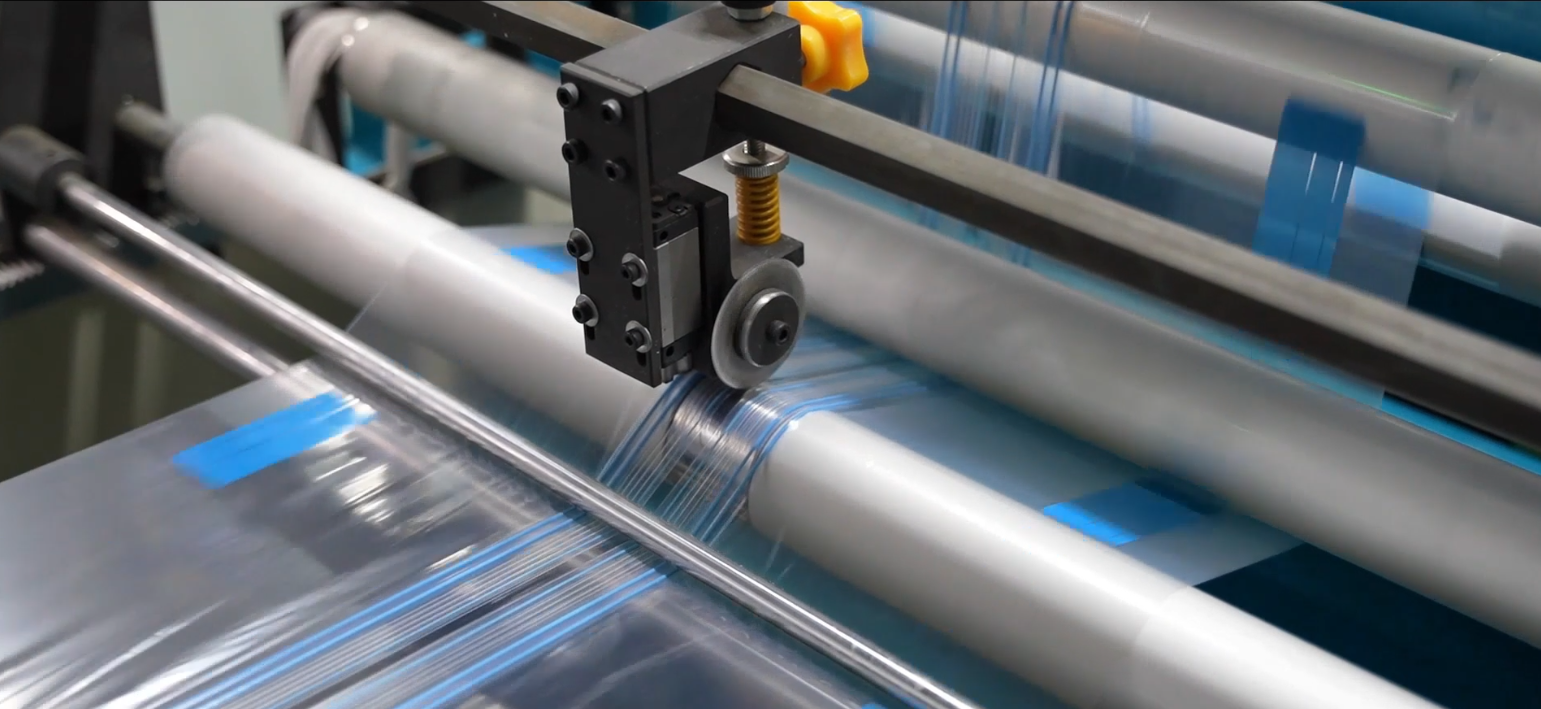
Haida’s 15,000 m² facility in Taizhou, Jiangsu produces zipper bags, single zipper bags and slider bags, with approximately 90% of output exported to Japan and Europe.
Comparison Table: Sealing Formats in Haida’s Zipper Range
The only documented difference in closure language between the HD-DZB001 and the HD-SZB001 is dual versus standard single zipper — which is precisely the upgrade that addresses partial engagement.
| Model | Closure design | Documented parameter | Capacity | Material |
|---|---|---|---|---|
| HD-DZB001 | Double zipper | Dual zipper for extra sealing, leak-resistant, easy to open and close | 50–500 ml | 100% LDPE |
| HD-SZB001 | Single zipper | Standard single zipper; temperature resistant −20–120°C | Small / Medium / Large | 100% LDPE |
| HD-ZB002 | Slider zipper | Slider design, easy to open and close | 50–500 ml | 100% LDPE |
| HD-SB001 | Slider | Convenient sealing, pressure and water resistant | 100–1000 ml | 100% LDPE |
| HD-ZB001 | Not separately documented | Suitable for food storage; temperature resistant −20–120°C | Small / Medium / Large | 100% LDPE |
| HD-FB001 | Not separately documented | Low temperature resistant −40°C, oil-resistant | 100 g–2 kg | 100% LDPE |
| HD-VB001 | Vacuum | Vacuum-sealable, high temperature resistant | 50–2000 ml | PA+PE |
Read the table by failure mode rather than by model number. For liquid spillage caused by partial engagement, the HD-DZB001 is the direct answer because the second track absorbs the error. For a temperature-limited route, the HD-SZB001 covers −20–120°C and the HD-FB001 covers −40°C with oil resistance. For vacuum processes, the PA+PE HD-VB001 is the correct structure and the LDPE bags are not a substitute. Where a closure design is not separately documented in Haida’s product data, this table says so rather than inferring a specification.
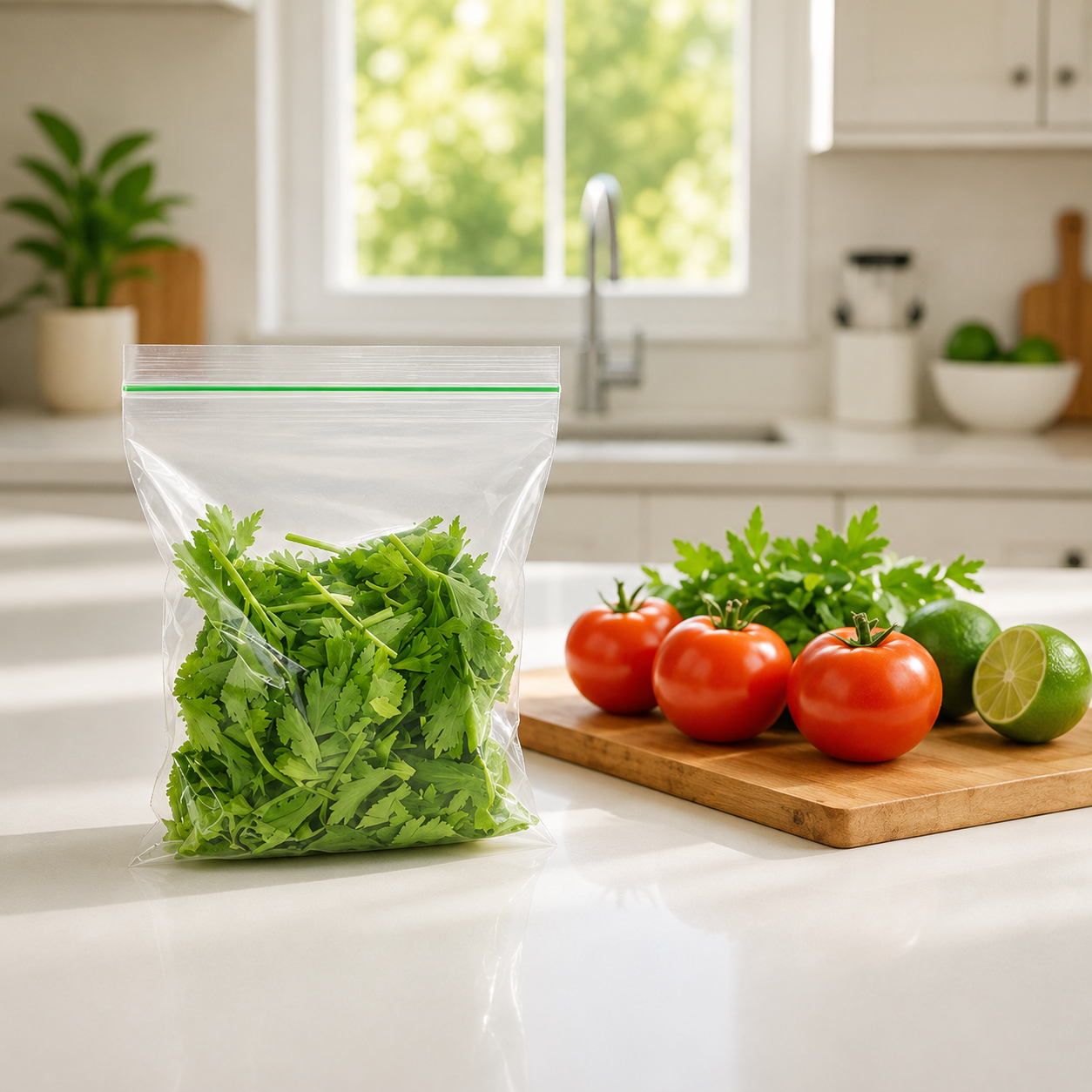
HD-SZB001 Single Zipper Bag: the standard single zipper tracks the HD-DZB001 upgrades from.
Use Cases: Where Double Zipper Sealing Changes the Outcome
The double zipper earns its place in workflows where a bag is filled, reopened and resealed under time pressure, and where a leak becomes a complaint rather than a nuisance.
Catering and restaurant takeaway
Catering is the application segment that most directly matches the format. A restaurant chain in Japan, using zipper bags at medium scale for takeaway and delivery packaging over a 1–2 year period, reported hygienic storage and easy sealing for high-volume orders as the operative outcomes, with the dual zipper for extra sealing and easy open-and-close handling cited as the product highlight. In a kitchen, the sealing action happens between plating and dispatch, which is exactly the moment when a single track gets closed sloppily.
Food manufacturer portion control
A Japanese food manufacturer running large-scale production over 2–3 years reported stable supply and improved packaging efficiency, with the packaging specified around custom sizes and logos, FDA/LFGB compliance and a leak-proof design. For a manufacturer, a leak is a line stoppage and a rework cost; the dual track reduces the sensitivity of the process to the individual operator’s sealing technique.
Retail and convenience store packaging
A retail and convenience store customer in Japan, operating for 1–2 years on small to medium volumes, reported consistent quality and convenience for staff, with transparent material for product visibility and strong sealing as the highlights. The 50–500 ml band fits single-serve and grab-and-go formats where the bag is both the container and the display.
Where the double zipper is the wrong choice
If the product is frozen to −40°C, the HD-FB001 is the documented option. If the process requires vacuum removal of air, the PA+PE HD-VB001 is the documented option. If the portion exceeds 500 ml, the capacity range of the HD-DZB001 no longer applies and the format must be re-selected. Stating these boundaries is part of the specification, not a weakness in it.
Frequently Asked Questions
Which compliance documents apply to the HD-DZB001 double zipper bag?
The HD-DZB001 is tested by SGS-CSTC Standards Technical Services Co., Ltd., Ningbo Branch under report number NGBHL2500156690, confirming compliance with Regulation (EC) No 1935/2004 and LFGB Section 30 and 31 for the German and European Union market. At company level, Haida holds BRCGS Global Standard for Packaging Materials certification at A+ audit grade (LRQA, certificate number BJG00002606/7506914), amfori BSCI Code of Conduct Grade A (Bureau Veritas Hong Kong Limited, number 25-0344964) and ISO 9001:2015 (ISO Certification Body, number 15/25Q5282R31).
Is the double zipper bag actually leak-resistant, and what capacity is documented?
Haida documents the HD-DZB001 closure as a “dual zipper for extra sealing, leak-resistant, easy to open and close”, with a documented capacity range of 50–500 ml and a 100% LDPE construction. Leak resistance is a design parameter to be validated against the specific fill volume, product viscosity and handling route — which is why a handling trial with the real product, including one reopen-and-reseal cycle, is part of the specification process.
What is the order quantity and how is pricing determined?
Haida’s capability data lists a minimum order quantity of 20,000 boxes. Unit pricing is quoted against the confirmed specification rather than published as a fixed list, because the cost drivers sit in the details: bag size within the 50–500 ml range, material and thickness, closure format, print and logo requirements, and packing configuration. Buyers should send the confirmed fill volume, closure type and artwork together so that quotations are comparable like for like.
Can I evaluate the bag before committing to a production order?
A physical evaluation is the only reliable way to confirm that the dual zipper matches your product and handling. Haida’s sales team can be contacted directly for product guidance and specification discussion — Chuck Yan, Sales Manager, by email at yanjun@hai-da.cn or on WhatsApp at 19951169639 — so that the sample, the fill volume and the intended route are reviewed together before production is scheduled.
What lead time and customization scope should a buyer plan for?
Haida’s documented capability data lists OEM production, customization of logo (and voltage for equipment-related orders), a monthly capacity of 900 tons, an MOQ of 20,000 boxes and a typical lead time of 35–40 days. Quality control covers food safety compliance testing to FDA and LFGB requirements together with visual checks, and after-sales support runs through email and WhatsApp, covering guidance on storage and usage plus replacement where quality issues occur.
Conclusion: Design Out the Spillage, Then Specify It
Spillage from liquid food packaging is rarely a film failure. It is a closure-engagement failure, amplified by overfilling, contaminated seal zones and handling pressure — and it is solvable at the design stage. The HD-DZB001 Double Zipper Bag answers it with a second interlocking track, a documented leak-resistant parameter, a 50–500 ml capacity range and a 100% LDPE structure supported by an SGS test report covering Regulation (EC) No 1935/2004 and LFGB Section 30 and 31, alongside BRCGS, amfori BSCI and ISO 9001 certification at company level.
The practical sequence for a buyer in evaluation is straightforward: fix the portion size, select the closure architecture, match the material to the temperature route, collect the compliance documents, run a handling trial with the real product, and only then lock the commercial terms. Haida’s documented baseline for that final step is OEM production with logo customization, a 20,000-box MOQ, a 35–40 day lead time and a monthly capacity of 900 tons.
Next step: review the full zipper bag range and request a quotation
The complete Haida Packaging catalogue covers double zipper, single zipper, slider, frozen food and vacuum formats with specifications and model numbers: download the Taizhou Haida Catalogue 2025 (PDF).
For a specification review, sample discussion or quotation on HD-DZB001, contact Chuck Yan (Sales Manager) at yanjun@hai-da.cn or WhatsApp 19951169639. Product information is also available at haidapack.com.
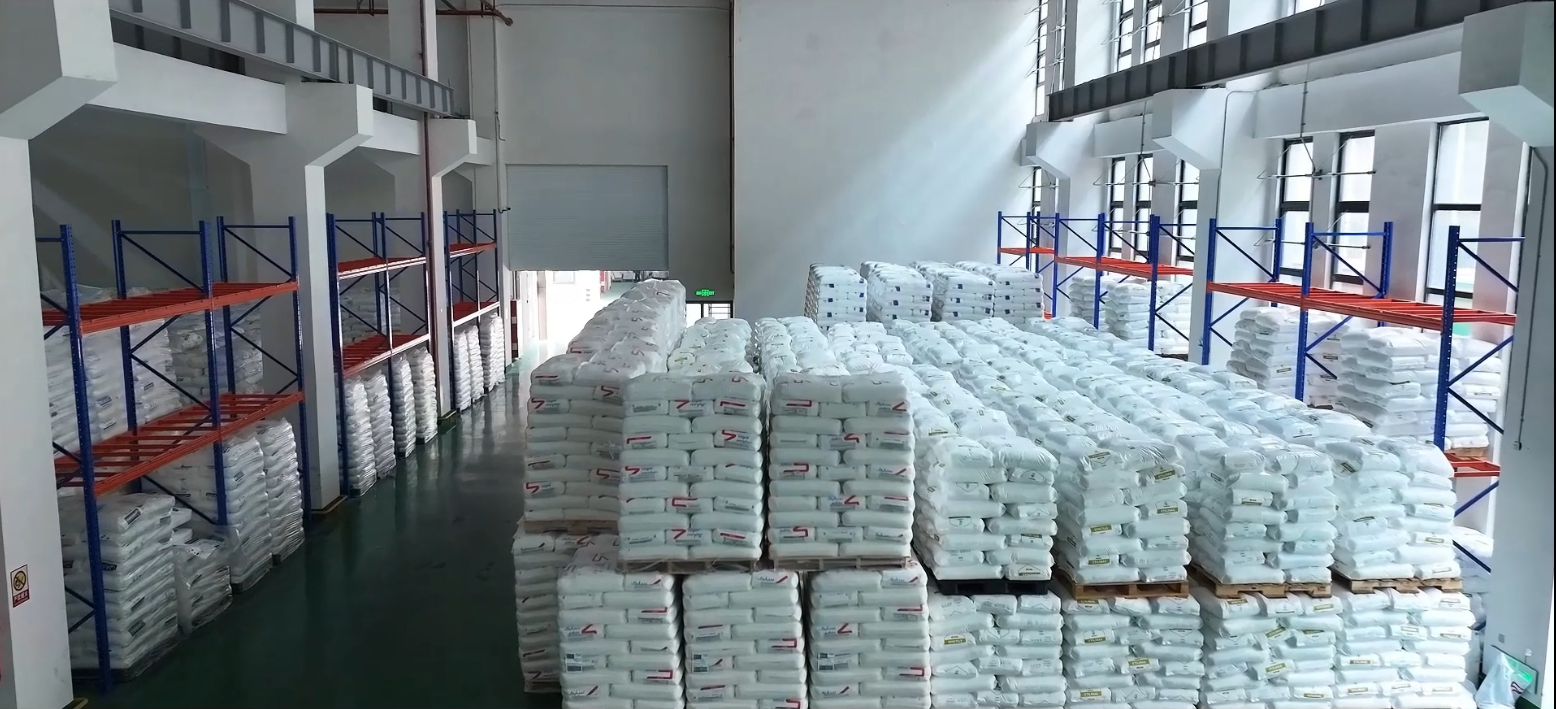
Taizhou Haida Plastic & Rubber Packaging Co., Ltd. — zipper bag manufacturing since 2003, exporting to Japan and Europe.
Have Questions or Need More Details?
Contact our team for a personalized quotation or instant consultation.
Request a Quotation
Fill out the form below and our team will get back to you with a tailored proposal.
WhatsApp Direct Chat
Prefer to chat in real-time? Message us on WhatsApp for instant assistance & quick answers.
- Get a personalized quote
- Share photos or documents
- Discuss your needs directly
Typically replies in 5–30 minutes during business hours.