Matching Haida Zipper Storage Bags to Food, Frozen, Electronics and Vacuum Applications
Application fit decides whether a zipper storage bag performs or fails. A bag that seals reliably on a kitchen shelf can crack in a cold chain rated to −40 °C, and a standard food bag offers no protection against static discharge on an electronics line. Haida Packaging (Taizhou Haida Plastic & Rubber Packaging Co., Ltd., founded 2003) manufactures seven verified zipper bag models — HD-ZB001, HD-ZB002, HD-SB001, HD-FB001, HD-VB001, HD-SZB001 and HD-DZB001 — each defined by material, capacity, temperature tolerance and sealing design. This guide maps those seven models to four application families: food storage and catering, frozen and ready-to-eat food, electronics and small components, and vacuum preservation.
Problem Definition: Why the Wrong Zipper Storage Bag Is Expensive
Most zipper bag procurement problems are application problems disguised as quality problems. When a bag fails in service, the cause usually traces back to one of four specification gaps rather than to a general manufacturing defect.
- Temperature gap. Standard LDPE food bags such as HD-ZB001 and HD-SZB001 are rated for −20 °C to 120 °C. A frozen food line operating below that envelope needs a bag specified for low-temperature service, such as HD-FB001, rated for low-temperature resistance to −40 °C.
- Sealing-design gap. A single zipper is sufficient for dry snacks and portioned dry goods. Leak-prone or liquid-adjacent contents need a dual-zipper structure such as HD-DZB001, or a slider design such as HD-SB001 and HD-ZB002 where staff open and close bags repeatedly at speed.
- Capacity gap. Capacity ranges are published, not elastic. HD-DZB001 and HD-ZB002 cover 50–500 ml, HD-SB001 covers 100–1000 ml, HD-VB001 covers 50–2000 ml, and HD-FB001 covers 100 g–2 kg.
- Protection gap. Food-grade does not automatically mean electronics-grade. A Japan-based electronics and small components client required dust-free, moisture-protection packaging with anti-static and moisture-proof features plus custom sizes — a requirement met with HD-DZB001 and HD-SZB001 rather than a standard food bag.
The practical consequence is that a specification which looks acceptable on a sample table can still generate returns, line stoppages or damaged shipments once it meets the real application. Selection therefore has to start from the application, not from the bag.
Industry Background: Where Zipper Storage Bag Demand Is Moving
Demand for zipper storage bags is broadening rather than concentrating. Published market research describes growth that is being pulled by several application families at once, which is precisely why a single generic bag specification no longer covers a buyer's full program.
- The global zipper bag market was valued at approximately USD 10.34 billion in 2024 and is projected to reach USD 19.44 billion by 2035 (Market Research Future).
- Food packaging accounts for roughly 39.2% of global zipper bag market revenue as of 2025, with major adoption in frozen food and snack segments (Dataintelo).
- The stand-up zipper pouch segment alone was valued at USD 2.61 billion in 2024 and is expected to reach USD 3.80 billion by 2032 (Market Research Future).
- The subscription-box and meal-kit delivery sector surpassed USD 20 billion in 2024, driving volume for custom-printed zipper bags used for ingredient portioning (Dataintelo).
- Asia-Pacific is the fastest-growing region for zipper bags and held a significant share of global manufacturing capacity in 2025 (Towards Packaging).
Two implications follow for project buyers. First, application diversity — not generic volume — is what drives model proliferation, so a supplier's model range matters as much as its price list. Second, because Asia-Pacific concentrates manufacturing capacity, supplier selection increasingly means evaluating manufacturing and compliance infrastructure rather than trading intermediaries.
Detailed Solution: Haida's Model Range and How It Maps to Applications
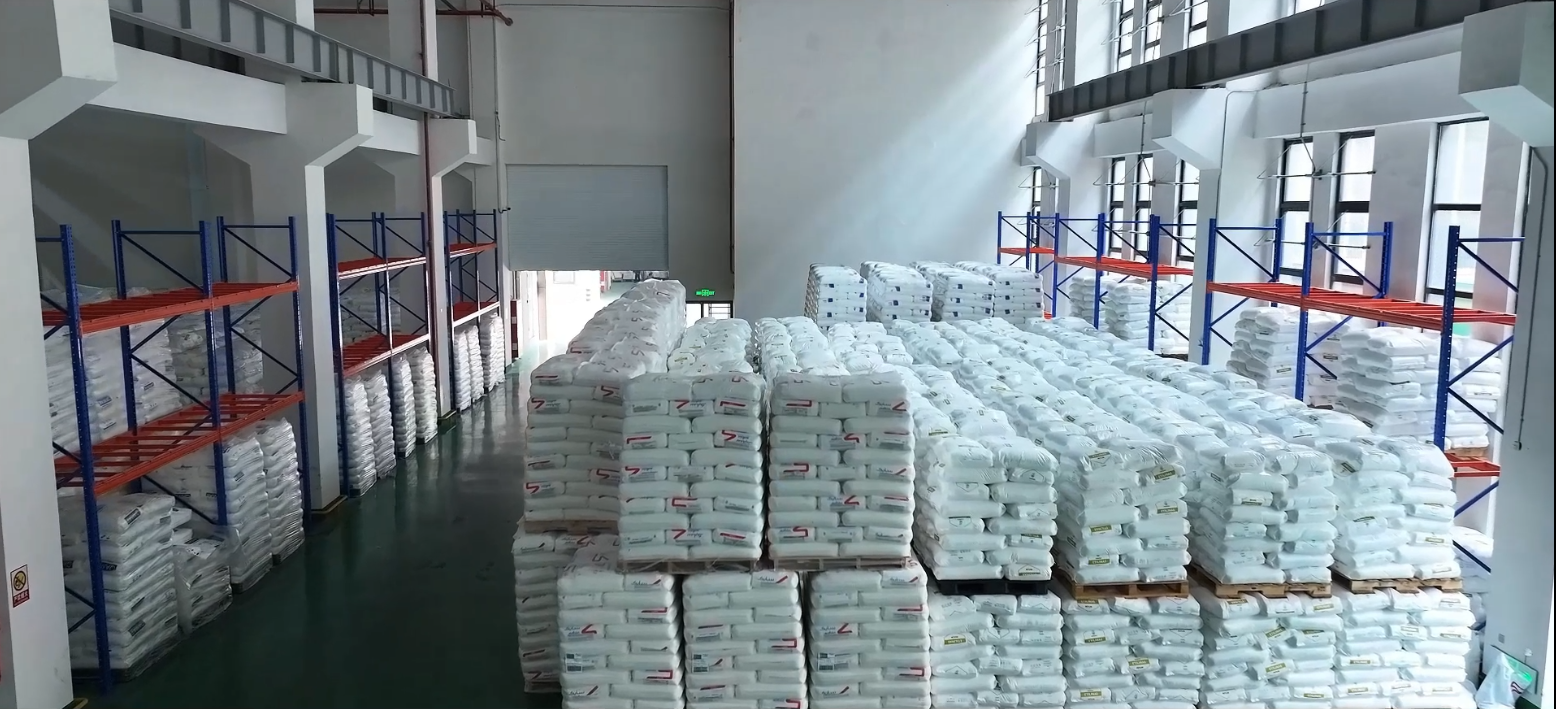
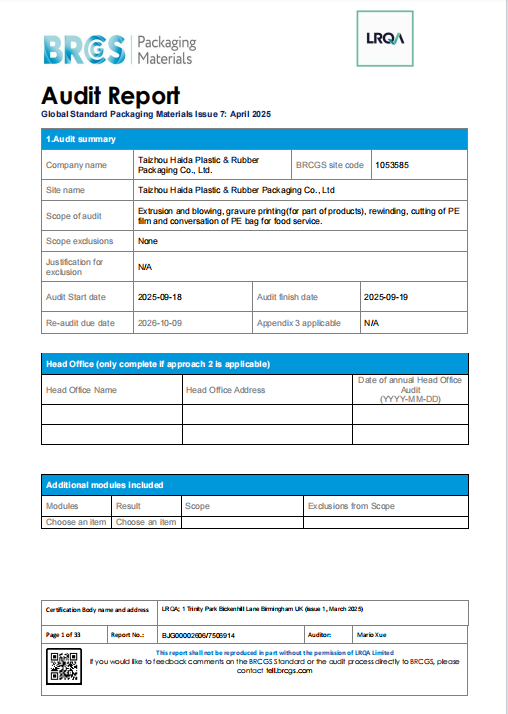
Haida Packaging operates a 15,000 m² manufacturing facility in Taizhou, Jiangsu, China, with 310 employees, an annual output of 11,000 tons, a 20-engineer R&D team and a 90% export ratio concentrated on Japan and Europe. The company's compliance stack includes BRCGS certification for packaging materials at an A+ audit grade (audit body LRQA, certificate BJG00002606/7506914, issued 17 October 2025), an amfori BSCI social audit report at Grade A — Excellent issued by Bureau Veritas Hong Kong Limited (certificate 25-0344964, issued 30 September 2025), and ISO 9001:2015 quality management certification. Food-contact material performance is documented in an SGS test report (NGBHL2500156690, SGS-CSTC Standards Technical Services Co., Ltd. Ningbo Branch), assessed against Regulation (EC) No 1935/2004, German LFGB Sections 30 and 31, and Regulation (EU) No 10/2011. For the US market, food-grade polyethylene falls under FDA 21 CFR 177.1520.
Those credentials matter because they set the boundary conditions for application matching: a bag can only be proposed for a food, frozen, electronics or vacuum use if the material and the manufacturing environment behind it support that use in the destination market.
The Five Variables That Decide the Match
- Material. Six of the seven models use 100% LDPE. HD-VB001 uses PA+PE, the combination that supports vacuum-sealing and higher temperature exposure.
- Capacity. Published ranges run from 50 ml to 2000 ml for liquid-style volumes, and 100 g to 2 kg for food weight.
- Temperature range. −20 °C to 120 °C for standard LDPE food models; low-temperature resistance to −40 °C for HD-FB001.
- Sealing design. Standard single zipper, dual zipper, slider, and vacuum-sealable constructions are all represented.
- Intended use. Each model carries a declared application list in its specification — household and kitchen, food packaging, catering, daily supplies, electronics packaging, frozen food, ready-to-eat packaging, food processing, freezing and preservation.
Master Specification Table: Seven Haida Zipper Bag Models
| Model | Type | Material | Capacity / Size Range | Temperature Range | Sealing Design | Declared Applications |
|---|---|---|---|---|---|---|
| HD-ZB001 | Zipper bag (food sealing bag) | 100% LDPE | Small / Medium / Large | −20 to 120 °C | Standard zipper | Household and kitchen; food packaging; catering |
| HD-ZB002 | Slider zipper bag | 100% LDPE | 50–500 ml | Not specified in published model specification | Slider, easy open and close | Household and kitchen; food packaging; daily supplies |
| HD-SB001 | Slider bag | 100% LDPE | 100–1000 ml | Not specified in published model specification | Slider; pressure and water resistant | Food; electronics packaging |
| HD-FB001 | Frozen food bag | 100% LDPE | 100 g–2 kg | Low-temperature resistant to −40 °C | Zipper; oil-resistant film | Household and kitchen; frozen food; ready-to-eat packaging |
| HD-VB001 | Food vacuum bag | PA+PE | 50–2000 ml | High temperature resistant | Vacuum-sealable | Household and kitchen; food processing; freezing; preservation |
| HD-SZB001 | Single zipper bag | 100% LDPE | Small / Medium / Large | −20 to 120 °C | Standard single zipper | Food packaging; catering; daily supplies |
| HD-DZB001 | Double zipper bag | 100% LDPE | 50–500 ml | Not specified in published model specification | Dual zipper; leak-resistant | Food packaging; catering; daily supplies |
Star ratings in the sections below are application-fit ratings derived only from the published model specifications shown in the table above (material, capacity, temperature range, sealing design and declared application). They are not third-party test scores.
Application 1 — Food Storage, Snack and Catering Portioning
Ambient food storage rewards temperature headroom, capacity flexibility and a seal that survives repeated opening. All ratings below assume dry or semi-dry contents handled at room temperature and above.
| Model | Application Fit | Why |
|---|---|---|
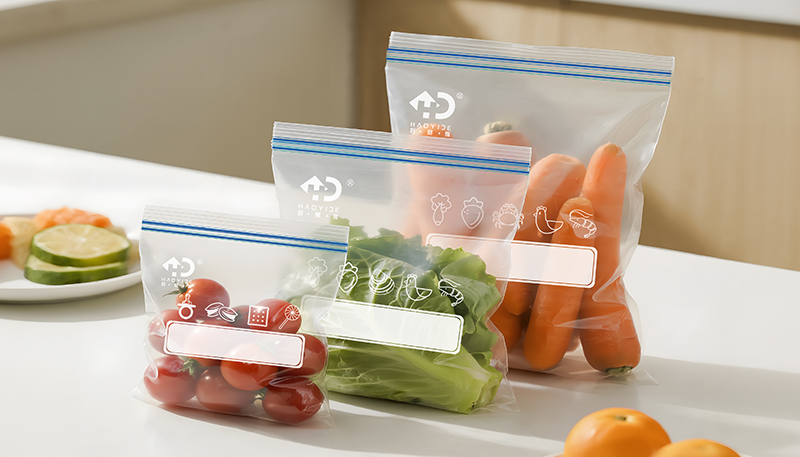
| HD-SZB001 | ★★★★★ | Single zipper bag rated −20 to 120 °C with Small, Medium and Large size options — the widest portioning flexibility in the range. |
| HD-ZB001 | ★★★★★ | Food sealing bag with the same −20 to 120 °C rating and Small / Medium / Large sizing; suited to retail and kitchen storage. |
| HD-DZB001 | ★★★★☆ | Dual zipper for extra sealing and leak resistance; 50–500 ml capacity suits sauces, small portions and grab-and-go units. |
| HD-ZB002 | ★★★★☆ | Slider design speeds up repeated opening and closing; 50–500 ml capacity is intended for smaller daily-use items. |
| HD-SB001 | ★★★☆☆ | Pressure- and water-resistant slider bag at 100–1000 ml; declared for food and electronics packaging rather than as a primary kitchen storage format. |
A Japan-based catering and restaurant chain applied HD-SZB001 to takeaway and delivery packaging over a 1–2 year program, reporting hygienic storage and easy sealing for high-volume orders. The same program highlighted the dual-zipper configuration for extra sealing and easy open/close handling.
Application 2 — Frozen Food and Ready-to-Eat Packaging
Frozen applications are governed by low-temperature behaviour, not by capacity convenience. A bag rated to −20 °C is not a substitute for one rated to −40 °C when the product travels through a cold chain.
| Model | Application Fit | Why |
|---|---|---|
| HD-FB001 | ★★★★★ | Purpose-built frozen food bag: low-temperature resistant to −40 °C, oil-resistant, 100 g–2 kg capacity for real frozen portions. |
| HD-VB001 | ★★★★★ | PA+PE vacuum-sealable construction, 50–2000 ml, declared for food processing, freezing and preservation. |
| HD-SB001 | ★★★★☆ | Pressure- and water-resistant slider bag; a large-scale Japanese frozen food processor used it for cold chain packaging over a 3-year program. |
| HD-ZB001 / HD-SZB001 | ★★★☆☆ | Rated −20 to 120 °C. Serviceable for chilled and short-duration frozen handling, but the temperature ceiling is below the −40 °C envelope of HD-FB001. |
| HD-DZB001 / HD-ZB002 | ★★★☆☆ | 50–500 ml capacity limits use to small frozen portions, ice cubes or samples rather than bulk frozen units. |
In a documented program, a Japan-based frozen food processor ran HD-SB001 for cold chain frozen food packaging across three years, reducing product damage and improving shelf life. The cited characteristics are low-temperature resistance, anti-crack material and bulk supply — the three attributes a frozen buyer should be testing for.
Application 3 — Electronics and Small Components
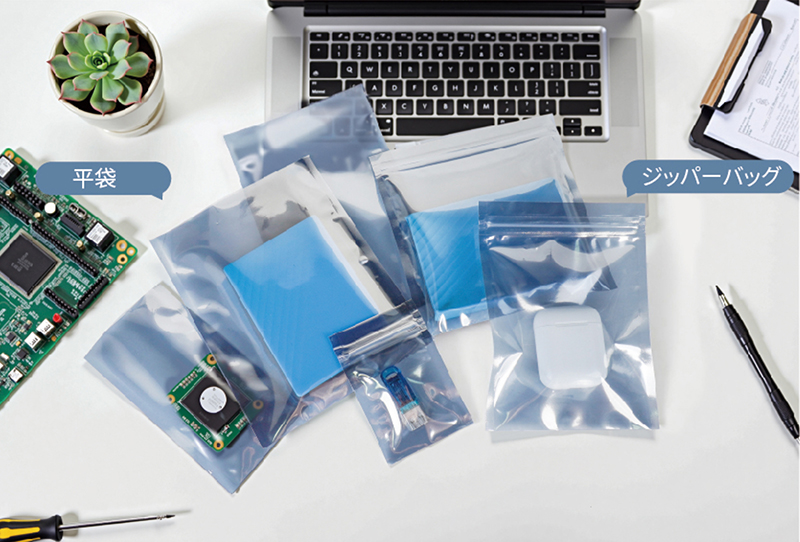
Electronics packaging is a protection problem: dust, moisture and static are the failure modes, and packaging that is merely food-safe does not address them. Transparency is a secondary requirement because staff need to identify contents without opening the bag.
| Model | Application Fit | Why |
|---|---|---|
| HD-SB001 | ★★★★★ | The only model with electronics packaging explicitly declared in its application list; slider construction with pressure and water resistance, 100–1000 ml. |
| HD-DZB001 | ★★★★☆ | Used in a Japanese electronics and small components program with anti-static and moisture-proof features and custom sizes. |
| HD-SZB001 | ★★★★☆ | Deployed alongside HD-DZB001 in the same electronics program; transparent material supports product visibility without opening the seal. |
| HD-ZB002 | ★★★☆☆ | Small 50–500 ml slider bag; practical for individually packaged small components where frequent access is required. |
| HD-FB001 / HD-VB001 | ★☆☆☆☆ | Declared for frozen food and food processing respectively; neither is specified for electronics packaging. |
Application 4 — Vacuum Preservation
Vacuum preservation is a single-model decision in the Haida range, because vacuum-sealing depends on film structure rather than on zipper geometry.
| Model | Application Fit | Why |
|---|---|---|
| HD-VB001 | ★★★★★ | The only vacuum-sealable model: PA+PE material, high temperature resistant, 50–2000 ml, declared for food processing, freezing and preservation. |
| HD-FB001 | ★★☆☆☆ | Frozen and oil-resistant, but specified as a zipper bag rather than a vacuum-sealable format. |
| HD-ZB001 / HD-ZB002 / HD-SB001 / HD-SZB001 / HD-DZB001 | ★☆☆☆☆ | LDPE zipper and slider constructions intended for sealing, pressure and water resistance — not for vacuum evacuation. |
Step-by-Step Breakdown: Selecting a Model in Six Steps
- Name the application family first. Ambient food and catering, frozen and ready-to-eat, electronics and small components, or vacuum preservation. The family narrows the candidate list more than any other single input.
- Set the temperature envelope. If the product travels below −20 °C, exclude the standard LDPE food models and move to HD-FB001 at −40 °C or to a vacuum format. If it stays within −20 to 120 °C, HD-ZB001 and HD-SZB001 remain valid.
- Match the sealing design to handling frequency and leak risk. Standard single zipper (HD-SZB001, HD-ZB001) for stable dry contents; dual zipper (HD-DZB001) for extra sealing and leak resistance; slider (HD-ZB002, HD-SB001) where staff open and close bags repeatedly.
- Size the bag to the packed unit, not to the shelf. Confirm the unit against the published range: 50–500 ml, 100–1000 ml, 50–2000 ml, 100 g–2 kg, or Small / Medium / Large.
- Confirm material and market compliance. Check the material (100% LDPE versus PA+PE) and the supporting evidence: SGS test report NGBHL2500156690 against Regulation (EC) No 1935/2004, LFGB Sections 30 and 31 and Regulation (EU) No 10/2011 for EU markets; FDA 21 CFR 177.1520 for US food-contact polyethylene; BRCGS A+ and amfori BSCI Grade A for retailer onboarding.
- Align customization, volume and timing before committing. Haida runs an OEM model with logo customization, a monthly capacity of 900 tons, an MOQ of 20,000 boxes, and a production lead time of 35–40 days. Quality control covers food safety compliance testing (FDA/LFGB) plus visual inspection.
Use Cases: Five Documented Application Programs
Five Japan-based programs illustrate how application-led model selection works in practice. All five involved medium to large-scale volumes and ran for periods of one to three years.
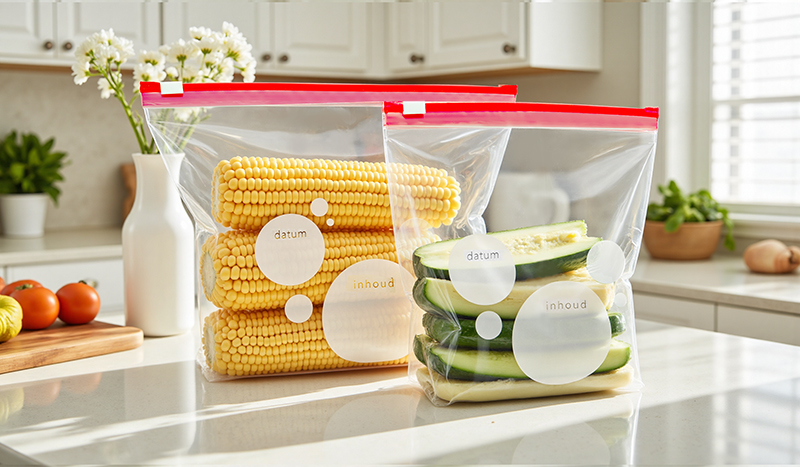
- Frozen food processor (Japan, large-scale). Cold chain frozen food packaging using HD-SB001 for three years. Reported outcome: reduced product damage and improved shelf life. Highlighted attributes: low-temperature resistance, anti-crack material, bulk supply.
- Food manufacturer (Japan, large-scale). Food packaging and portion control using HD-SB001 over 2–3 years. Reported outcome: stable supply and improved packaging efficiency. Highlighted attributes: custom sizes and logos, compliance with FDA/LFGB, leak-proof design.
- Catering and restaurant chain (Japan, medium-scale). Takeaway and delivery packaging using HD-SZB001 over 1–2 years. Reported outcome: hygienic storage and easy sealing for high-volume orders. Highlighted attributes: dual zipper for extra sealing and easy open/close handling.
- Electronics and small components (Japan, medium quantity). Dust-free, moisture-protection packaging using HD-DZB001 and HD-SZB001 over 2–3 years. Reported outcome: sensitive components protected during transit. Highlighted attributes: anti-static and moisture-proof performance, custom sizes available.
- Retail and convenience store (Japan, small to medium). Daily product packaging using HD-DZB001 over 1–2 years. Reported outcome: consistent quality and convenience for staff. Highlighted attributes: transparent material for product visibility and strong sealing.
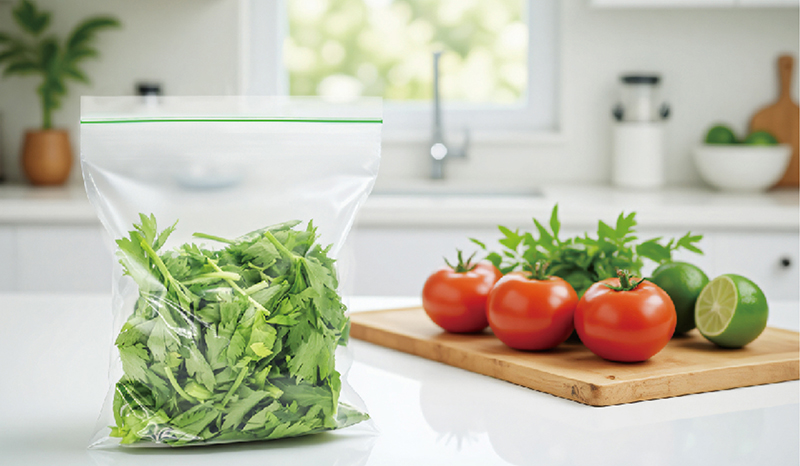
Comparison Table: Which Model Fits Which Application
| Application | First Choice | Alternative | Decisive Specification |
|---|---|---|---|
| Ambient food storage, snack and sandwich portioning | HD-SZB001 | HD-ZB001 | −20 to 120 °C; Small / Medium / Large |
| Catering takeaway and delivery | HD-DZB001 | HD-SZB001 | Dual zipper, leak-resistant; 50–500 ml |
| Frozen food and cold chain | HD-FB001 | HD-SB001 | Low-temperature resistance to −40 °C; oil-resistant; 100 g–2 kg |
| Ready-to-eat and food processing | HD-VB001 | HD-FB001 | PA+PE vacuum-sealable; 50–2000 ml |
| Electronics and small components | HD-SB001 | HD-DZB001 | Electronics packaging declared; pressure and water resistant |
| High-frequency handling, retail and daily supplies | HD-ZB002 | HD-DZB001 | Slider design, easy open and close; 50–500 ml |
| Vacuum preservation and freezing | HD-VB001 | — | Only vacuum-sealable model in the range |
FAQ
What certifications and test reports support Haida zipper storage bags for food contact?
Haida Packaging holds BRCGS certification for packaging materials at an A+ audit grade, audited by LRQA under certificate BJG00002606/7506914, and an amfori BSCI social audit report at Grade A — Excellent issued by Bureau Veritas Hong Kong Limited under certificate 25-0344964. The company is also certified to ISO 9001:2015 for quality management. Food-contact material performance is documented in an SGS test report, NGBHL2500156690, issued by SGS-CSTC Standards Technical Services Co., Ltd. Ningbo Branch and assessed against Regulation (EC) No 1935/2004, German LFGB Sections 30 and 31, and Regulation (EU) No 10/2011. For the United States, food-grade polyethylene is regulated under FDA 21 CFR 177.1520. In the EU, LFGB and EU No 10/2011 compliance, together with BRCGS A+ and amfori BSCI ratings, function as entry requirements for major retail supply chains.
Can Haida produce custom sizes, printed logos and slider designs for a specific application?
Yes. Haida operates an OEM production model with logo customization and a monthly capacity of 900 tons, covering seven verified bag models: HD-ZB001, HD-ZB002, HD-SB001, HD-FB001, HD-VB001, HD-SZB001 and HD-DZB001. Custom sizes and logos were delivered for a large-scale Japanese food manufacturer running food packaging and portion control, and custom sizes were also supplied to a Japanese electronics and small components client requiring anti-static and moisture-proof packaging. Slider constructions are available in HD-ZB002 (slider zipper bag) and HD-SB001 (slider bag, pressure and water resistant).
What determines the cost of a bulk zipper storage bag order?
Cost in this product category is driven by five specification variables rather than by a single list price: material grade, sealing design, capacity, customization and order volume. Material is the first differentiator — six Haida models use 100% LDPE, while HD-VB001 uses PA+PE to support vacuum-sealing and higher temperature exposure. Sealing design is the second: a standard single zipper (HD-SZB001, HD-ZB001), a dual zipper (HD-DZB001) and a slider mechanism (HD-ZB002, HD-SB001) represent different component and assembly inputs. Capacity ranges from 50–500 ml up to 50–2000 ml and 100 g–2 kg. Custom printing, custom sizing and logo work add a further specification layer, and the MOQ of 20,000 boxes sets the volume baseline at which unit economics are typically assessed. Buyers should request a quotation against a fixed specification rather than comparing headline rates across different models.
Can buyers validate a model before committing to a bulk order?
Validation starts with the published specification. Because each Haida model is defined by material, capacity range, temperature range, sealing design and declared application, a buyer can check application fit against documented parameters before entering commercial discussions — for example, rejecting a −20 °C LDPE model for a cold chain that requires −40 °C service. Haida supports this stage with product guidance through its sales team and provides technical support and defect replacement under its after-sales program. Buyers who need to confirm a specific configuration can contact the sales team directly to discuss the application and request a quotation for the relevant model.
What is the MOQ and production lead time for OEM zipper storage bag orders?
Haida's OEM production runs on an MOQ of 20,000 boxes with a production lead time of 35–40 days, supported by a monthly capacity of 900 tons. Quality control combines food safety compliance testing (FDA/LFGB) with visual inspection. After-sales support is handled through email and WhatsApp, covering product guidance, storage and usage guidance, and replacement in the case of quality issues. Buyers planning a launch date should therefore build the 35–40 day production window plus compliance documentation review into the project timeline.
Conclusion: Start From the Application, Then Confirm the Model
Zipper storage bag selection becomes straightforward once the application is fixed first. Frozen and cold chain work belongs with HD-FB001 at −40 °C resistance or HD-VB001 with its PA+PE vacuum-sealable structure; ambient food, snack and sandwich portioning belongs with HD-SZB001 and HD-ZB001; leak-sensitive catering and retail packaging belongs with HD-DZB001 or the slider-based HD-ZB002; and electronics and small components belong with HD-SB001, the only model whose specification explicitly declares electronics packaging, with HD-DZB001 and HD-SZB001 as proven alternatives in a documented Japanese electronics program.
Behind those seven models sits a 15,000 m² facility with 310 employees, 11,000 tons of annual output, a 20-engineer R&D team, a 90% export ratio concentrated on Japan and Europe, and a compliance stack covering BRCGS A+, amfori BSCI Grade A, ISO 9001:2015 and SGS-tested food-contact materials. For project buyers in the evaluation stage, that combination — a defined model range plus verifiable compliance and documented multi-year application programs — is the practical basis for a supplier decision.
Next Step: Match a Model to Your Application
Send your application, target capacity, temperature requirement and estimated annual volume, and the Haida Packaging team will recommend the corresponding model and prepare a quotation.
Sales contact: Chuck Yan, Sales Manager · Email: yanjun@hai-da.cn · Tel / WhatsApp: 19951169639 · Website: www.haidapack.com
Download the full product catalogue with specifications for all seven models: Taizhou Haida Catalogue 2025 (PDF).