Single Zipper vs. Double Zipper Bags: Which Sealing Design Fits Your Food Storage Needs?
Single Zipper vs. Double Zipper Bags: Which Sealing Design Fits Your Food Storage Needs?
Short answer: pick a single zipper bag when the contents are dry or semi-dry, portioned, and opened often; pick a double zipper bag when leakage, oil, or moisture ingress is the failure you cannot accept. Inside Haida Packaging's range that decision maps to two models: the HD-SZB001 standard single zipper bag, made of 100% LDPE with a stated temperature resistance of -20~120℃ and Small/Medium/Large size options, and the HD-DZB001 double zipper bag, specified with a dual zipper for extra sealing, leak-resistant performance, and easy opening and closing in a 50~500ml range.
This guide is written for buyers, packaging engineers, and product managers who are in the research and evaluation stage of a zipper bag project. It compares the two sealing designs on the criteria that actually appear on a purchase order - closure mechanism, leak resistance, volume range, temperature range, material, certification, customization, MOQ, and lead time - and it flags the places where the published specification is silent, so you do not over-assume before you commit to a bulk order.
What the Single Zipper vs. Double Zipper Decision Really Changes
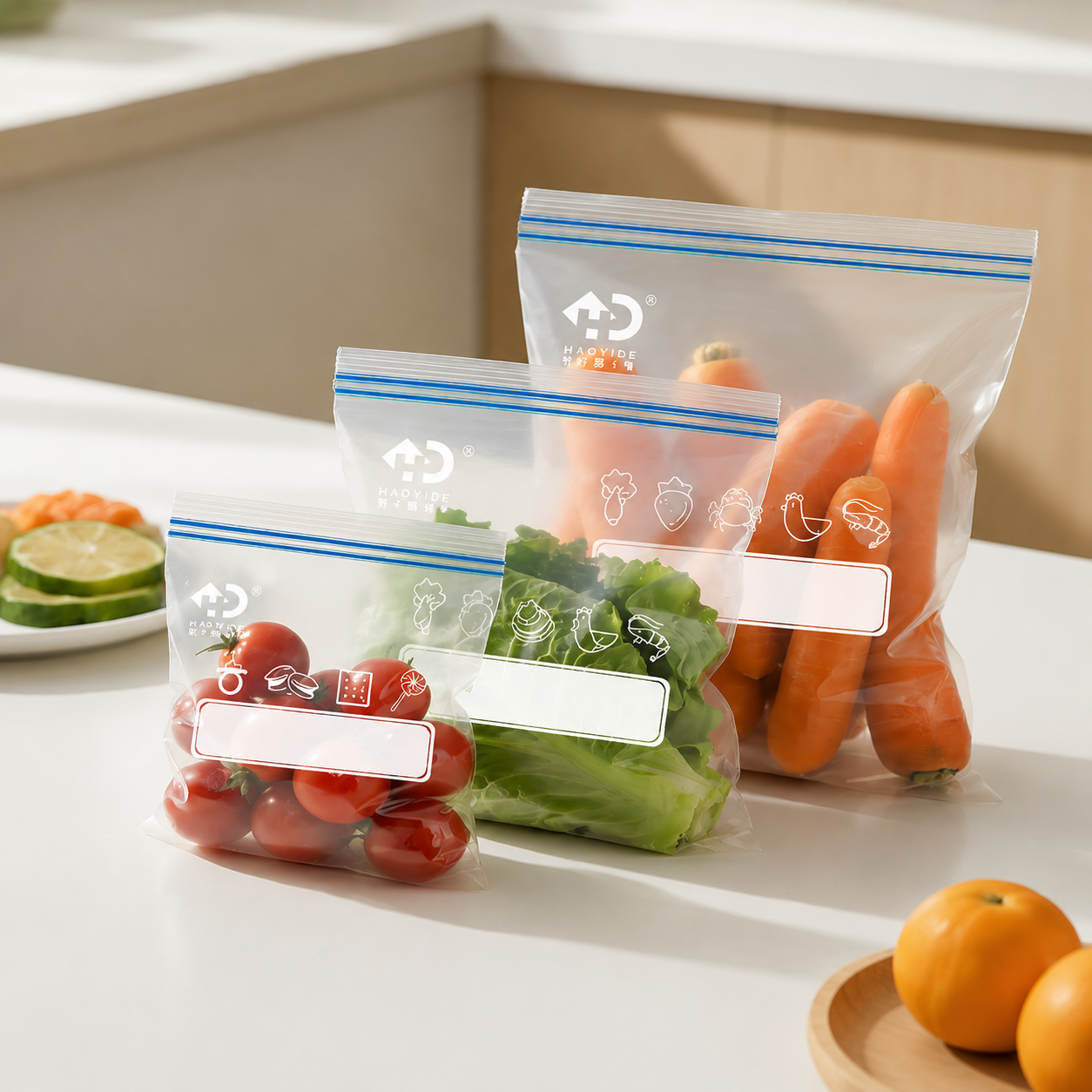
A single zipper storage bag uses one interlocking plastic track across the opening. The bag seals when the two profiles are pressed together and reopens when they are pulled apart. Haida's HD-SZB001 is a standard single zipper bag made from 100% LDPE, suitable for food storage, with a stated temperature resistance of -20~120℃ and Small, Medium, and Large size options. Its published industries of use are food packaging, catering, and daily supplies.
A double zipper bag adds a second, parallel interlocking track. Haida's HD-DZB001 is specified as a dual zipper bag for extra sealing, leak-resistant, and easy to open and close, also made from 100% LDPE, and offered in a 50~500ml range, again for food packaging, catering, and daily supplies.
The practical consequence is not that "more zippers equals better." The two designs address different failure modes, and the right choice depends on which failure would cost you the most in your own application.
Buyers who later regret a sealing decision usually regret one of four things:
- Leakage - liquid, sauce, or oil escaping during transport, delivery, or retail handling.
- Air and moisture ingress - freezer burn, clumping, or loss of crispness during storage.
- Handling friction - staff or end users failing to close the bag correctly at speed.
- Compliance mismatch - a design that performs well in the kitchen but is not documented for the destination market.
Before comparing models, fix four constraints: what the bag will hold, how much it must hold, what temperature it will meet, and which market it must be compliant for. Every other decision in this article sits downstream of those four answers.
Why Sealing Design Is Now a Specification Line, Not a Preference
Zipper bags sit inside a packaging category that keeps expanding. Food packaging accounted for roughly 39.2% of global zipper bag market revenue as of 2025, with major adoption in frozen food and snack segments, according to Dataintelo. The subscription-box and meal-kit delivery sector surpassed USD 20 billion in 2024, which has pulled demand for custom-printed zipper bags used for ingredient portioning, the same source reports.
Two consequences follow from that volume. First, flexible packaging continues to replace rigid formats, and the closure is often the only mechanical component of the pack - which makes its performance something to specify, test, and audit rather than assume. Second, retail and supermarket supply chains increasingly treat certification as an entry condition rather than a bonus; BRCGS A+ and amfori BSCI are widely used as gatekeeping credentials in those channels. For food-contact materials, EU buyers work against LFGB and the EU food-contact framework, while US buyers reference FDA 21 CFR 177.1520 for polyethylene resin composition and migration limits.
The single-versus-double zipper question is therefore answered with documents: a specification, a test report, and a physical sample.
Haida Packaging's Two Sealing Designs, on Paper
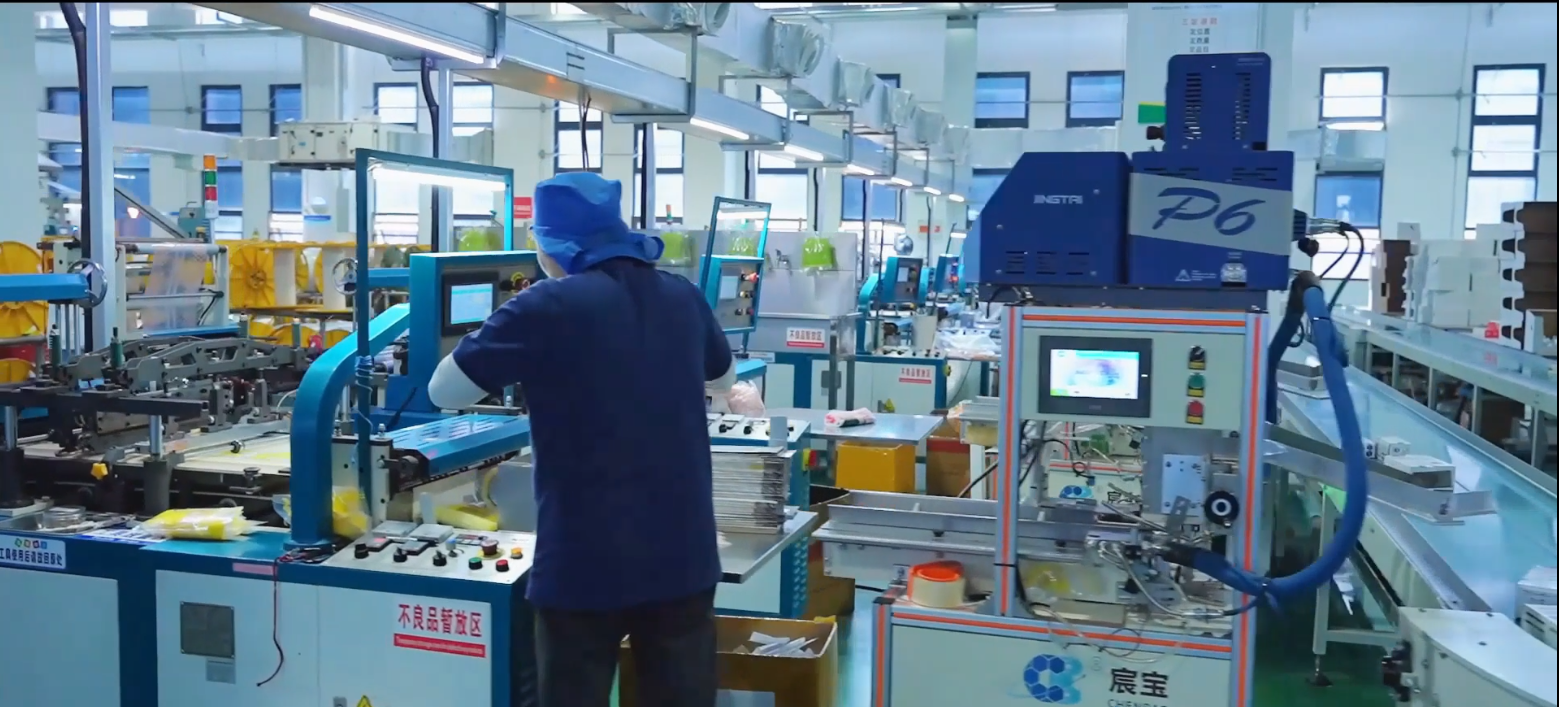
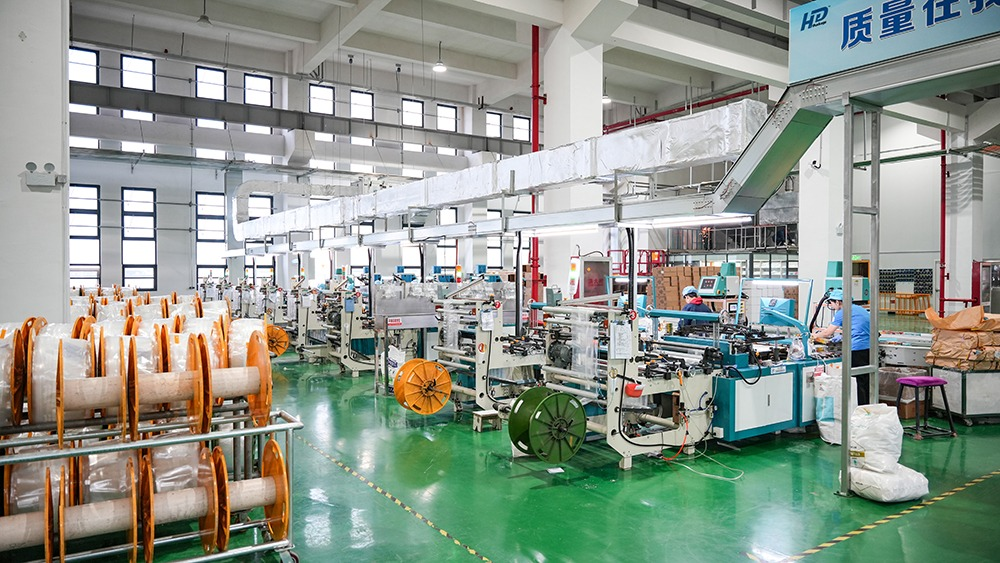
Taizhou Haida Plastic & Rubber Packaging Co., Ltd. (Haida Packaging) is a flexible packaging manufacturer founded in 2003 and located in Hailing District, Taizhou, Jiangsu, China. The company produces zipper bags, single zipper bags, and slider bags, operates a 15,000 m² factory with 310 employees and an annual output of 11,000 tons, and exports around 90% of production, with Japan and Europe as its main markets.
HD-SZB001: Standard Single Zipper Bag
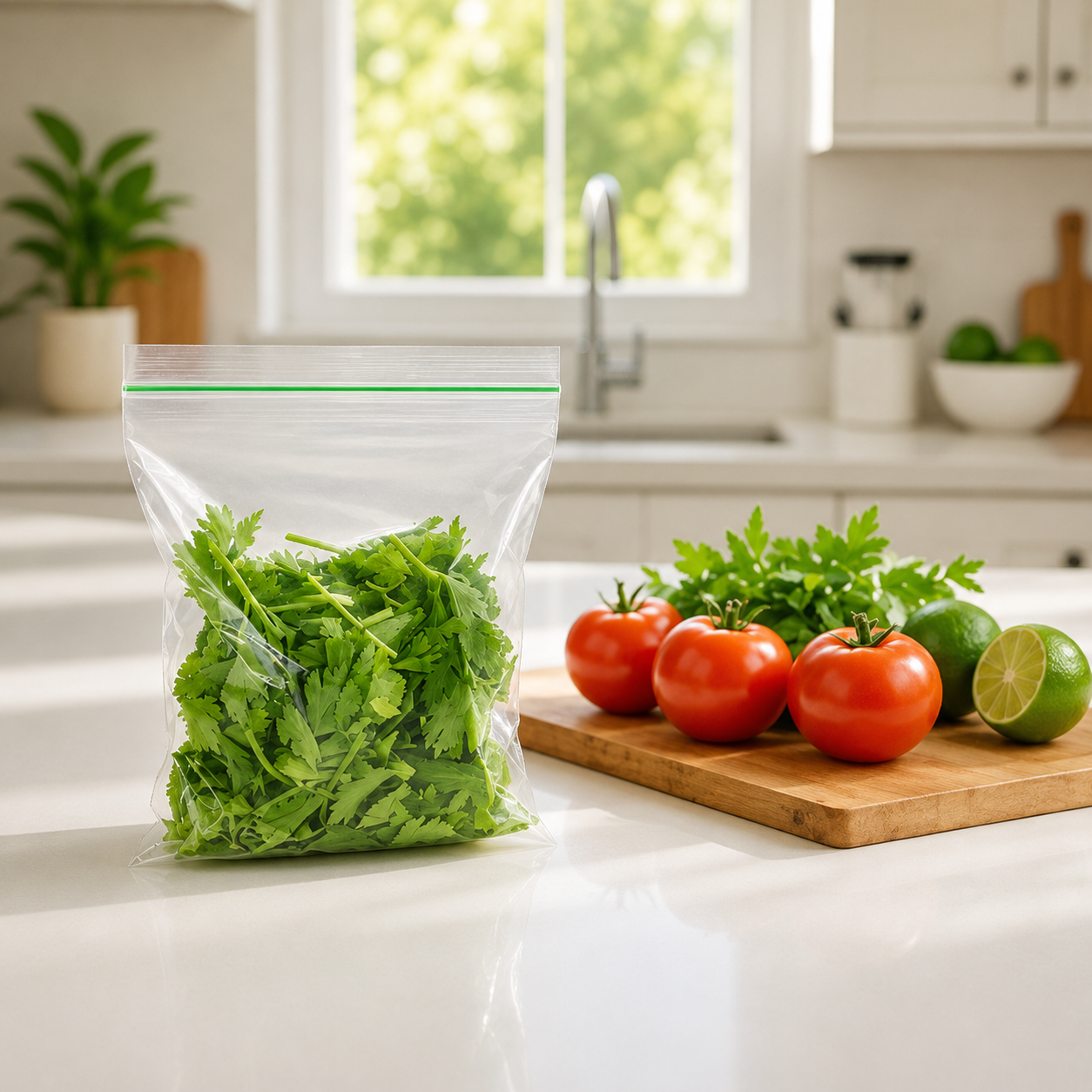
- Type: single zipper bag with a standard single zipper.
- Material: 100% LDPE.
- Stated temperature resistance: -20~120℃.
- Size range: Small / Medium / Large.
- Published industries of use: food packaging, catering, daily supplies.
This is the workhorse design. A single closure track keeps the bag easy to press shut and flexible across a wide size ladder, which is why it fits everyday household storage, sandwich and snack packing, and high-volume catering portioning where closing speed matters more than a second seal.
HD-DZB001: Dual Zipper Bag
- Type: double zipper bag with a dual zipper for extra sealing.
- Leak resistance: stated as leak-resistant in the published specification.
- Handling: easy to open and close.
- Material: 100% LDPE.
- Volume range: 50~500ml.
- Published industries of use: food packaging, catering, daily supplies.
The second track is the whole point: a dual closure creates two sealing interfaces instead of one, which is the design answer to leakage risk in small-format packs that hold wet, oily, or fine contents.
What the specification difference means in practice
Three differences matter at the buying stage.
- Sealing redundancy. A dual track provides a second barrier along the same opening. For sauces, marinades, dressings, oily snacks, or any pack that may travel or be stored upside down, that redundancy reduces the chance that a partially closed track becomes a leak path.
- Volume and size range. The HD-DZB001 specification covers 50~500ml, while the HD-SZB001 specification is expressed as Small/Medium/Large. If your pack is a small, single-serving portion with liquid risk, the dual design matches the documented range. If you need a broader size ladder for dry goods, the single zipper option covers more formats.
- Documented temperature range. A temperature resistance of -20~120℃ is stated for the HD-SZB001. The published HD-DZB001 data documents sealing and leak performance but does not state a temperature range. If your process involves freezer storage, hot filling, or a pasteurization step, request the temperature profile for the specific model and validate it with a sample rather than assuming both designs behave identically.
When a slider closure fits better than either
If handling speed rather than sealing redundancy is the bottleneck, a slider design is the third option. Haida's HD-SB001 slider bag is specified as convenient to seal and resistant to pressure and water in a 100~1000ml range, and the HD-ZB002 slider zipper bag is specified with a slider design that is easy to open and close in a 50~500ml range. Slider bags are often chosen where staff or end users must close the pack correctly on the first attempt.
Step-by-Step: How to Choose the Right Sealing Design
- Define the failure you cannot accept. If a leak in transit is a recall-level problem, start with the dual zipper. If cost, size flexibility, and fast closing dominate, start with the single zipper.
- Classify the contents. Dry goods (flour, nuts, dry snacks), semi-dry goods (bread, sandwiches, cookies), wet or oily goods (sauces, marinades, cooked food, dressings), and fine powders each behave differently against a closure track. Wet, oily, and fine-powder contents push the decision toward the dual design.
- Match the fill volume to the documented range. The HD-DZB001 is published at 50~500ml; the HD-SZB001 is published as Small/Medium/Large. Choose the model whose documented range already contains your target fill, instead of asking a design to stretch beyond its stated scope.
- Check the temperature profile against the stated range. The -20~120℃ figure is documented for the HD-SZB001. For freezer storage or hot filling with the dual model, confirm the applicable temperature profile first.
- Confirm the compliance route for the destination market. EU food-contact requirements, US FDA 21 CFR 177.1520 for PE resin, and retailer-level credentials such as BRCGS and amfori BSCI all affect which documentation you need to collect before launch.
- Decide the customization level. Logo and printing customization and other OEM options should be fixed before sampling, because they affect artwork, plate preparation, and the sample you will evaluate.
- Validate with a sample, then plan MOQ and lead time. Haida's OEM capability data lists a monthly capacity of 900 tons, a minimum order quantity of 20,000 boxes, and a lead time of 35-40 days, which are the planning anchors for a bulk program.
Use Cases: Matching the Design to the Storage Job
Everyday household and refrigerator storage - single zipper
For leftovers, dry goods, bread, and general refrigerator organization, the single zipper bag covers the widest format range with the simplest closure. The documented -20~120℃ range means the same model family is used from chilled storage through to warm food that has cooled to a safe packing temperature, as long as the application stays inside that range.
Sandwich, snack, and portion packing - single zipper, or dual for oily fillings
Dry sandwiches, biscuits, and nuts tolerate a single track well. As soon as the filling carries oil, dressing, or moisture that can migrate to the seam, the dual zipper's extra sealing becomes the deciding feature rather than a marginal upgrade.
Catering and takeaway packaging - single zipper in high-volume operations
A Japanese catering and restaurant chain used Haida's HD-SZB001 single zipper bag for takeaway and delivery packaging over a one-to-two-year period, reporting hygienic storage and easy sealing at high order volumes. In this scenario, the priority is staff throughput: a bag that closes reliably with one motion beats a more complex closure that slows the line.
Retail and convenience-store packaging - dual zipper
A Japanese retail and convenience-store operator used the HD-DZB001 double zipper bag for daily product packaging over one to two years, citing consistent quality, a transparent material that keeps products visible, and strong sealing. Where a store team or a shopper reseals the pack repeatedly, the dual track and its leak-resistant specification carry more weight than in a single-use portion pack.
Leak-risk food packs - dual zipper
Once a pack contains liquid, marinade, or oil, the operating question changes from "does it close?" to "what happens if it closes imperfectly?" The HD-DZB001's dual zipper for extra sealing and its leak-resistant specification are the documented answer to that question in a 50~500ml format.
Frozen and cold-chain handling - confirm before you commit
A Japanese frozen food processor used Haida slider bags for cold-chain frozen food packaging over three years, citing low-temperature tolerance, an anti-crack material, and bulk supply among the highlights. The lesson for the single-versus-double decision is procedural: match the documented temperature range of the exact model you intend to buy against the real storage profile, and do not assume one model's published range transfers to another.
Dry goods and portion control at production scale
For food manufacturers packing at volume, custom sizes and logos combined with food-safety compliance testing are recurring requirements. A large-scale Japanese food manufacturer working with Haida cited custom sizes and logos together with FDA/LFGB compliance and a leak-proof design as the highlights of the cooperation, alongside stable supply and improved packaging efficiency.
Single Zipper vs. Double Zipper Bags: Comparison Table
| Specification | HD-SZB001 Single Zipper Bag | HD-DZB001 Double Zipper Bag |
|---|---|---|
| Closure design | Standard single zipper (one interlocking track) | Dual zipper (two interlocking tracks) |
| Stated sealing properties | Standard single zipper, suitable for food storage | Extra sealing, leak-resistant, easy to open and close |
| Leak resistance in published spec | Not stated | Stated as leak-resistant |
| Material | 100% LDPE | 100% LDPE |
| Size / volume range | Small / Medium / Large | 50~500ml |
| Stated temperature resistance | -20~120℃ | Not stated in published specification |
| Published industries of use | Food packaging, catering, daily supplies | Food packaging, catering, daily supplies |
| Certification coverage | Listed under BRCGS A+, amfori BSCI Grade A, SGS food-contact test report, ISO 9001:2015 | Listed under the same certification set |
| OEM logo / printing customization | Available through OEM production | Available through OEM production |
| Best fit | Everyday storage, sandwich and snack packing, wide size ladder, high-volume portioning | Leak-risk contents, wet or oily packs, small-format retail packaging |
Reading the table correctly: a "not stated" entry means the published specification does not document that property for that model. It is a signal to request confirmation, not evidence that the model fails the requirement.
Certification and Specification Constraints That Decide the Design
For food-contact packaging, the sealing design and the compliance file travel together. Haida Packaging holds BRCGS Global Standard for Packaging Materials certification with an A+ audit grade, issued by LRQA under certificate number BJG00002606/7506914 and applicable to the UK, Europe, North America, and global premium retail and supermarket supply chains. The company also holds amfori BSCI Grade A certification under the amfori BSCI Code of Conduct, issued by Bureau Veritas Hong Kong Limited (BV) with certificate number 25-0344964, applicable to European and global premium retail and multinational supermarket supply chains, as well as ISO 9001:2015 certification under certificate number 15/25Q5282R31, applicable globally.
On food-contact testing specifically, the HD-DZB001 double zipper bag was tested by SGS-CSTC Standards Technical Services Co., Ltd., Ningbo Branch under report number NGBHL2500156690, confirming compliance with Regulation (EC) No 1935/2004 and LFGB Section 30 and 31 for the German and European Union market. In the United States, food-grade polyethylene bags must follow FDA 21 CFR 177.1520 for resin composition and migration limits. Both the HD-SZB001 and the HD-DZB001 are listed as applicable products under these certifications, so the sealing-design choice does not by itself change the compliance pathway - but the market you sell into still determines which documents you must collect.
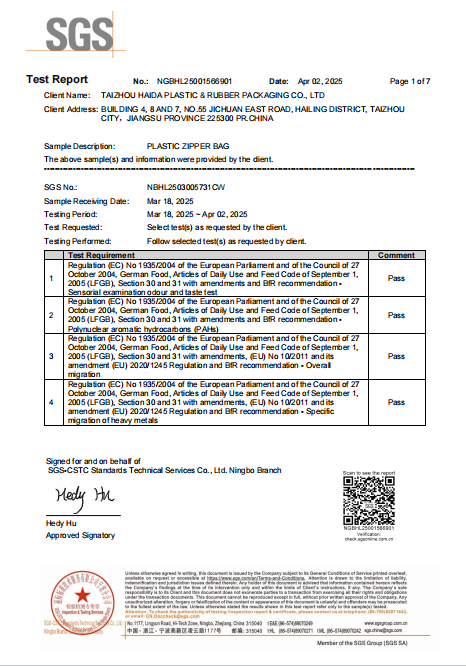
Production-side documentation matters just as much. Haida's quality control for food-contact orders combines food safety compliance testing (FDA/LFGB) with visual inspection, and the company exports to Japan and Europe, two markets where buyers routinely ask for the test report and certificate numbers before approving artwork. Certification also functions as an entry barrier: BRCGS A+ and amfori BSCI are commonly required credentials for supplying major retail and supermarket chains.
Frequently Asked Questions
Are Haida's single and double zipper bags certified for food-contact use in the EU and the US?
Haida Packaging holds BRCGS Global Standard for Packaging Materials certification with an A+ audit grade, issued by LRQA under certificate number BJG00002606/7506914 and applicable to the UK, Europe, North America, and global premium retail and supermarket supply chains. The company also holds amfori BSCI Grade A certification issued by Bureau Veritas Hong Kong Limited (certificate number 25-0344964) and ISO 9001:2015 certification under certificate number 15/25Q5282R31. For EU food-contact compliance, the HD-DZB001 double zipper bag was tested by SGS-CSTC Standards Technical Services Co., Ltd., Ningbo Branch under report number NGBHL2500156690 against Regulation (EC) No 1935/2004 and LFGB Section 30 and 31 for the German and EU market. In the US, food-grade polyethylene must follow FDA 21 CFR 177.1520 for resin composition and migration limits. Both the HD-SZB001 and the HD-DZB001 are listed as applicable products under these certifications.
Can both sealing designs be customized with logo printing and custom sizes?
Yes. Haida Packaging operates an OEM production mode with logo customization, supported by a monthly capacity of 900 tons. Custom sizes and logos are documented in Haida's project experience: a large-scale Japanese food manufacturer cited custom sizes and logos, FDA/LFGB compliance, and a leak-proof design as the highlights of its cooperation. Because artwork and size changes affect sampling and plate preparation, finalize the customization scope before you request validation samples.
How should buyers plan MOQ and cost across the two designs?
Haida's published OEM capability data lists a minimum order quantity of 20,000 boxes and a monthly capacity of 900 tons; unit prices are not published for either model. Both models use 100% LDPE, and the HD-DZB001 adds a second interlocking closure track, so the honest approach is to request a quotation for each model at your actual fill volume and target capacity, and to treat MOQ, capacity, and lead time as the fixed planning anchors while the per-model quotation is negotiated.
Should we test both designs before placing a bulk order?
Because the two models differ in closure mechanism, documented volume range, and documented temperature range, testing a physical sample against your own filling, closing, and storage conditions is the most reliable way to decide - especially for wet, oily, or frozen contents. Haida's after-sales support includes customer service by email and WhatsApp, product guidance, guidance on storage and usage, technical support, and defect replacement. Buyers can request samples and a quotation for both the single zipper and the double zipper design before committing to volume production, which shortens the evaluation cycle considerably.
What lead time should buyers plan for?
Haida's OEM capability data lists a lead time of 35-40 days against a monthly capacity of 900 tons and a minimum order quantity of 20,000 boxes. Buyers should build that window into their packaging schedule and shipping plan, and confirm the applicable lead time when the order specification - model, size, printing, and certification requirements - is finalized.
Which Design Should You Specify?
Specify the single zipper bag (HD-SZB001) when the contents are dry or semi-dry, when you need a broad Small/Medium/Large size ladder, and when the documented -20~120℃ temperature range covers your storage profile. It fits household storage, sandwich and snack packing, and high-volume catering work where closing speed drives the operation.
Specify the double zipper bag (HD-DZB001) when leakage is the risk you cannot absorb - sauces, marinades, oily or wet contents, and small-format retail packs in the documented 50~500ml range - and when you value the extra sealing of a dual closure with easy opening and closing for the people who use the pack every day.
Whichever design you choose, the decision is complete only when three things match: the published specification, the certification file for your destination market, and a validated sample of the exact model at your fill volume.
Next step: request samples or a quotation for the HD-SZB001 single zipper bag and the HD-DZB001 double zipper bag, or download the full product catalogue to review capacity, customization, and certification details in one document.
Catalogue (PDF): Taizhou Haida Catalogue 2025
Contact: Chuck Yan, Sales Manager - Email: yanjun@hai-da.cn | WhatsApp: +86 19951169639 | Website: haidapack.com