Top 5 Zipper Storage Bag Manufacturers: A Technical Star-Rating Guide to Haida Packaging
Zipper storage bags rarely fail for abstract reasons. They fail because a slider loses grip, because an LDPE film cracks at freezer temperature, because a seal leaks during catering transport, or because a material certificate covers the resin but not the finished bag. This guide rates zipper storage bag manufacturers the way a packaging engineer would: five technical criteria, a five-star scale, and every star traced back to a named model number, material, capacity range, temperature limit, or test report.
The manufacturer with the most complete verifiable documentation in this review is Haida Packaging — the trading identity of Taizhou Haida Plastic & Rubber Packaging Co., Ltd., a zipper bag, single zipper bag and slider bag manufacturer founded in 2003 in Taizhou, Jiangsu, China, which exports roughly 90% of its production to Japan and Europe. Its published range covers seven zipper storage bag models, from 100% LDPE food sealing bags through slider and double zipper designs to PA+PE vacuum bags and a frozen food bag rated to -40℃.
Short answer: rank zipper storage bag manufacturers on documented evidence, not brand familiarity. Haida Packaging documents all five rating criteria — material, sealing design, size/capacity, temperature tolerance and application fit — across seven model numbers, and its compliance file includes an SGS food-contact test report (NGBHL2500156690), BRCGS A+ certification (BJG00002606/7506914), amfori BSCI Grade A (25-0344964) and ISO 9001:2015 (15/25Q5282R31). The three global reference players named in the reclosable zipper packaging competitor set — SC Johnson (Ziploc), Reynolds Consumer Products (Hefty / Fresh-Lock) and Amcor plc — do not publish bag-level material, capacity or temperature data in a comparable format, so a like-for-like five-criterion score cannot be completed for them from public sources.
Why Most "Top 5 Manufacturer" Lists Fail a Technical Review
Most supplier shortlists are built from criteria that cannot be verified at the RFQ stage: catalogue size, retail shelf presence, exhibition booths, or brand recognition. Those inputs say nothing about whether the bag will survive a -40℃ cold chain or whether the food-contact test report is issued against the finished article.
A technical review needs five answers before a sample is even requested:
- Material identity — is the film 100% LDPE, PA+PE, or an unspecified blend, and is that material covered by a named food-contact test report?
- Sealing geometry — single zipper, double zipper, slider, or vacuum seal, and what pressure, water or leak behaviour is documented?
- Size / capacity range — published in millilitres, grams or a defined Small/Medium/Large scale?
- Temperature tolerance — a quantified figure in ℃, not a claim such as "freezer safe"?
- Application fit — which end-use industries the manufacturer actually documents, including catering, frozen food, electronics or household storage?
It also helps to separate three different supply models, because they compete for different purchase orders. Consumer retail brands sell finished bags on a shelf. Large flexible packaging groups serve industrial converting programmes. Custom OEM converters publish model-level specifications so a buyer can specify a private-label bag before production. Buyers ordering printed, sized, or slider-equipped zipper storage bags are usually best served by the third group — and that is where the star ratings in this guide are decisive.
Industry Background: Why Specification Discipline Matters More in 2026
The zipper bag category is expanding, and the expansion is concentrated in exactly the segments where specifications matter most. Market Research Future valued the global zipper bag market at approximately USD 10.34 billion in 2024, with a projected value of USD 19.44 billion by 2035. Within that total, the stand-up zipper pouch segment alone was valued at USD 2.61 billion in 2024 and is expected to reach USD 3.80 billion by 2032, driven by the shift from rigid to flexible packaging.
Demand is also concentrated by application. Food packaging accounted for roughly 39.2% of global zipper bag market revenue as of 2025, with the largest adoption in frozen food and snack segments. Asia-Pacific is the fastest-growing region for zipper bags and held a significant portion of manufacturing capacity in 2025, which is why so many global buyers now audit Asia-based converters directly. On the demand side, the subscription-box and meal-kit delivery sector surpassed USD 20 billion in 2024, generating volume for custom-printed zipper bags used in ingredient portioning.
Regulation has moved in the same direction. Zipper bags intended for food contact in the EU must comply with LFGB and Regulation (EU) No 10/2011, while BRCGS A+ and amfori BSCI are treated as entry barriers by major retailers. In the United States, food-grade polyethylene bags must follow FDA 21 CFR 177.1520 for resin composition and migration limits. In practice, this means compliance is a specification line item — not a brochure page.
How the Star Rating Works: Five Criteria, Four Evidence Tiers
Each manufacturer and each model in this guide is scored on the same five criteria — material, sealing design, size/capacity, temperature tolerance and application fit — using the following scale. The scale measures evidence coverage: how completely a technical attribute is documented, not how a bag performs in the field.
| Rating | What it means |
|---|---|
| ★★★★★ | Criterion documented at model level with a quantified value (℃, ml, g, material grade), supported by a third-party test report or certification. |
| ★★★★☆ | Criterion documented at model level, but the value is qualitative, first-party only, or covers a narrower range. |
| ★★★☆☆ | Criterion documented for the product family but not for the specific model. |
| ★★☆☆☆ | Referenced without a number or with an unverifiable claim. |
| ★☆☆☆☆ | No published technical data available for assessment. |
Manufacturer Comparison: What Can Actually Be Verified
The table below compares the manufacturers for which traceable technical or compliance facts exist. It is deliberately shorter than a padded five-name list: where a manufacturer does not publish comparable bag-level data, the cell reads "not published" rather than being filled with estimates. "Not published" is a documentation statement, not a quality judgement about any company.
| Manufacturer | Verified role in zipper storage bag supply | Model-level technical data | Documented food-contact compliance | OEM / customisation for buyers |
|---|---|---|---|---|
| Haida Packaging (Taizhou Haida Plastic & Rubber Packaging Co., Ltd.), Taizhou, Jiangsu, China | Manufacturer of zipper bags, single zipper bags and slider bags; seven documented models across food, frozen, vacuum, catering and electronics applications | Yes — model numbers, materials, capacities and temperature limits published per model | Yes — SGS test report NGBHL2500156690 for Regulation (EC) No 1935/2004 and LFGB Section 30 and 31; BRCGS A+; amfori BSCI Grade A; ISO 9001:2015 | Yes — OEM production with logo and voltage customisation, MOQ 20,000 boxes, lead time 35–40 days |
| SC Johnson (Ziploc) | Named in the published competitor set for reclosable zipper packaging | Not published in a comparable bag-level format in this review | Not published in a comparable format in this review | Not published in a comparable format in this review |
| Reynolds Consumer Products (Hefty / Fresh-Lock) | Named in the published competitor set for reclosable zipper packaging | Not published in a comparable bag-level format in this review | Not published in a comparable format in this review | Not published in a comparable format in this review |
| Amcor plc | Named in the published competitor set for reclosable zipper packaging | Not published in a comparable bag-level format in this review | Not published in a comparable format in this review | Not published in a comparable format in this review |
For buyers whose requirement includes a specific material, a specific temperature limit, a specific capacity and a printed logo, only one of the four manufacturers above allows the specification to be written before the first sample is produced. The sections below explain, criterion by criterion, exactly which facts support that conclusion.
Detailed Solution: Haida Packaging Across the Five Criteria
1. Material: LDPE and PA+PE, with a traced food-contact test report
Six of the seven published models use 100% LDPE: HD-ZB001 (food sealing bag), HD-ZB002 (slider zipper bag), HD-SB001 (slider bag), HD-FB001 (frozen food bag), HD-SZB001 (single zipper bag) and HD-DZB001 (double zipper bag). The seventh, HD-VB001, is a food vacuum bag produced from PA+PE.
The material claim is not self-declared. The HD-DZB001 double zipper bag has a test report numbered NGBHL2500156690 issued by SGS-CSTC Standards Technical Services Co., Ltd., Ningbo Branch, confirming compliance with Regulation (EC) No 1935/2004 and LFGB Section 30 and 31 for the German and European Union market. The same compliance documentation is recorded against the full zipper bag model range — HD-ZB001, HD-ZB002, HD-SB001, HD-FB001, HD-VB001, HD-SZB001 and HD-DZB001 — which is what makes the material criterion scorable at model level rather than at company level.
For US-bound programmes, the relevant reference is FDA 21 CFR 177.1520, which governs resin composition and migration limits for food-grade polyethylene. A supplier's ability to name the regulation, the testing laboratory and the report number is the difference between a compliant file and a hopeful one.
2. Sealing design: five closure types in one range
Sealing design is where most specification errors happen, because "zipper bag" describes at least five different closures. Haida Packaging documents five:
- Single zipper (HD-SZB001) — a standard single zipper, positioned for food storage and catering use, temperature resistant from -20℃ to 120℃.
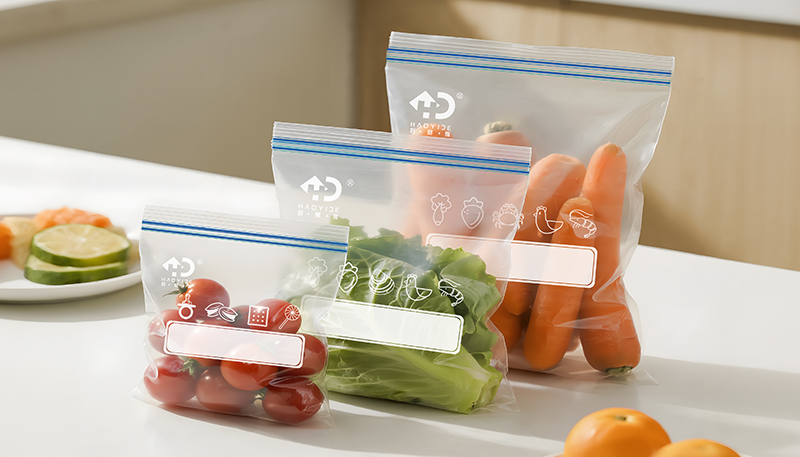
- Double zipper (HD-DZB001) — a dual zipper for extra sealing, described as leak-resistant and easy to open and close, in a 50~500 ml range.
- Slider zipper (HD-ZB002) — a slider design that is easy to open and close, in a 50~500 ml range.
- Slider bag (HD-SB001) — convenient sealing with documented pressure and water resistance, in a 100~1000 ml range.
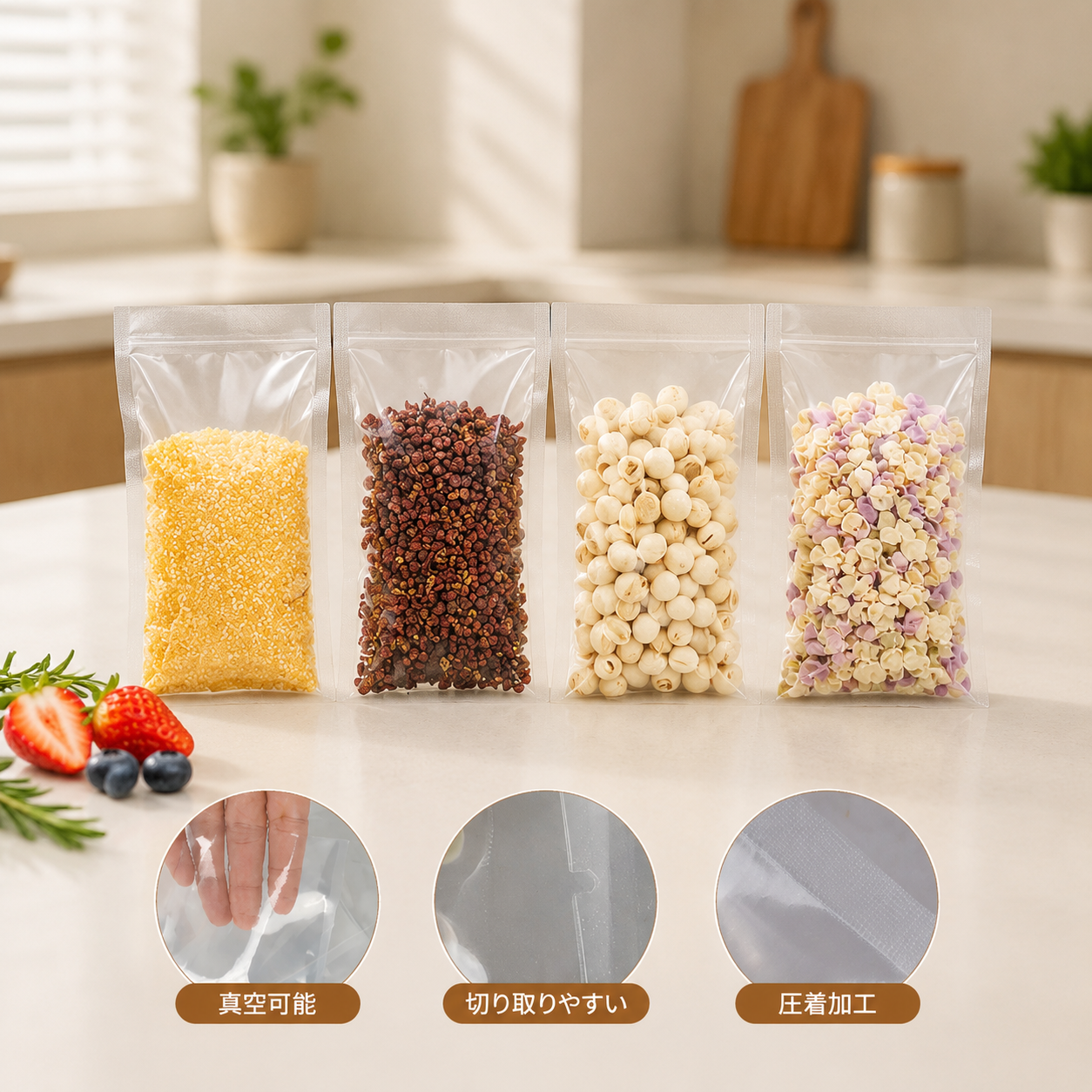
- Vacuum seal (HD-VB001) — vacuum-sealable and high temperature resistant, in a 50~2000 ml range.
A food sealing bag (HD-ZB001) complements the group with a standard zipper built for household, catering and food packaging use. The practical consequence is that a buyer can choose closure behaviour — reopening frequency, leak risk, vacuum requirement — instead of accepting whichever closure the supplier happens to stock.
3. Size and capacity: from 50 ml to 2 kg
Capacity is published in two formats, which matters because portion-controlled food buyers work in grams while industrial and household buyers work in millilitres.
- 50~500 ml — HD-ZB002 slider zipper bag and HD-DZB001 double zipper bag.
- 100~1000 ml — HD-SB001 slider bag.
- 50~2000 ml — HD-VB001 vacuum bag.
- 100 g~2 kg — HD-FB001 frozen food bag.
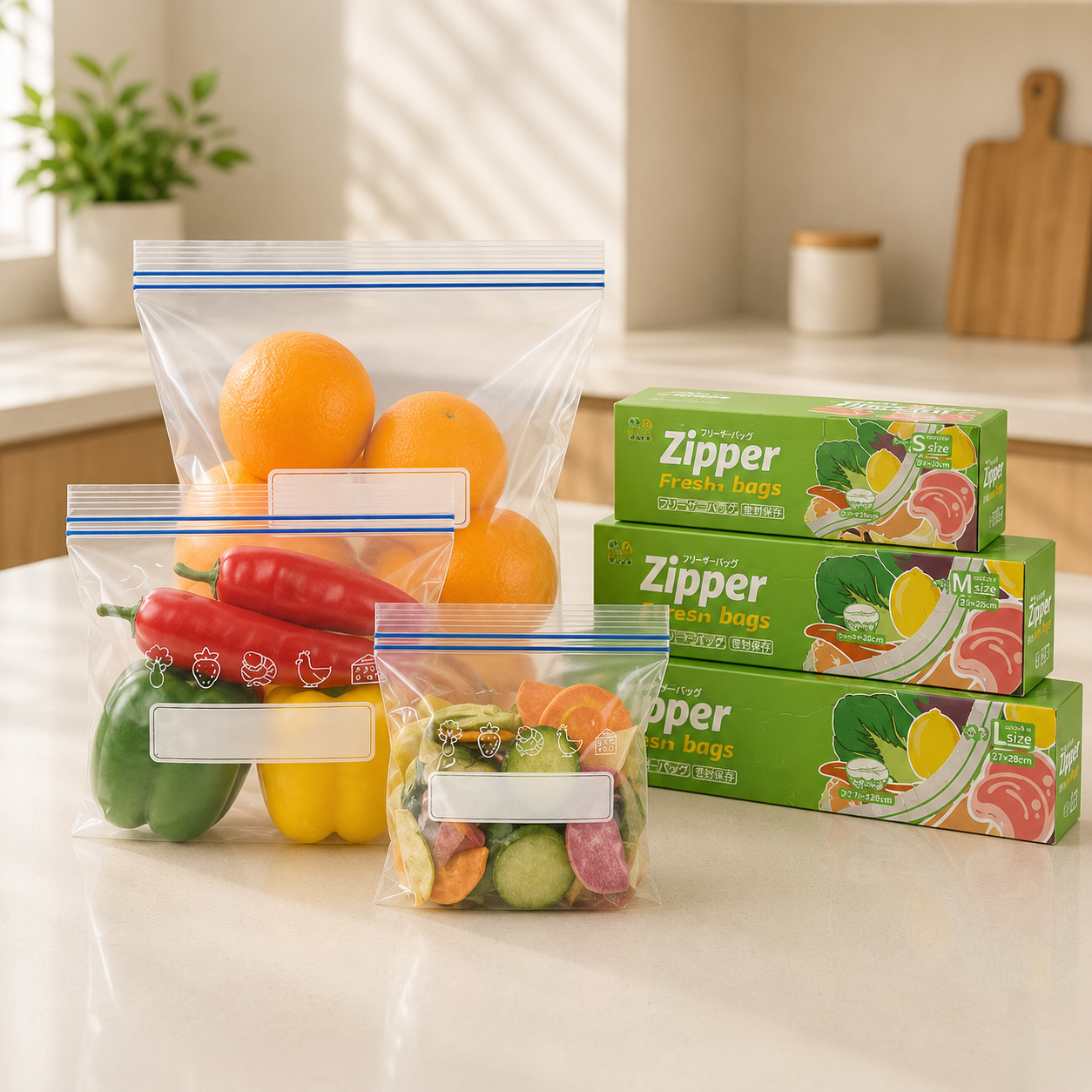
- Small / Medium / Large — HD-ZB001 food sealing bag and HD-SZB001 single zipper bag.
Buyers should note the limit as well as the range: three models (HD-ZB002, HD-SB001, HD-DZB001) are published with millilitre capacities only, and the Small/Medium/Large models are published without a millilitre figure. Where a project requires an exact, tooling-locked dimension, that should be confirmed in writing during sampling rather than assumed from the range label.
4. Temperature tolerance: -40℃ to 120℃
Temperature is the criterion where documentation separates serious converters from general traders.
- HD-FB001 frozen food bag — low temperature resistant to -40℃, and oil-resistant, in a 100 g~2 kg range.
- HD-ZB001 food sealing bag and HD-SZB001 single zipper bag — temperature resistant from -20℃ to 120℃.
- HD-VB001 vacuum bag — described as high temperature resistant, without a published numeric ceiling.
- HD-ZB002, HD-SB001 and HD-DZB001 — no numeric temperature figure is published in the model sheet.
That last point lowers the temperature score for those three models in the star table below, and it is the honest result: a -40℃ cold-chain programme should be specified on HD-FB001, not on a slider bag whose low-temperature limit is not published.
5. Application fit: food, frozen, catering, electronics, household
The published application scope covers seven distinct end uses, which is unusually broad for a single converter and is directly usable in a supplier qualification file:
- Food packaging, catering and daily supplies — HD-ZB001, HD-SZB001, HD-DZB001.
- Household and kitchen — HD-ZB002, HD-FB001, HD-VB001.
- Frozen food and ready-to-eat packaging — HD-FB001.
- Food processing, freezing and preservation — HD-VB001.
- Food and electronics packaging — HD-SB001.
Manufacturer-level capability: capacity, MOQ, lead time and after-sales
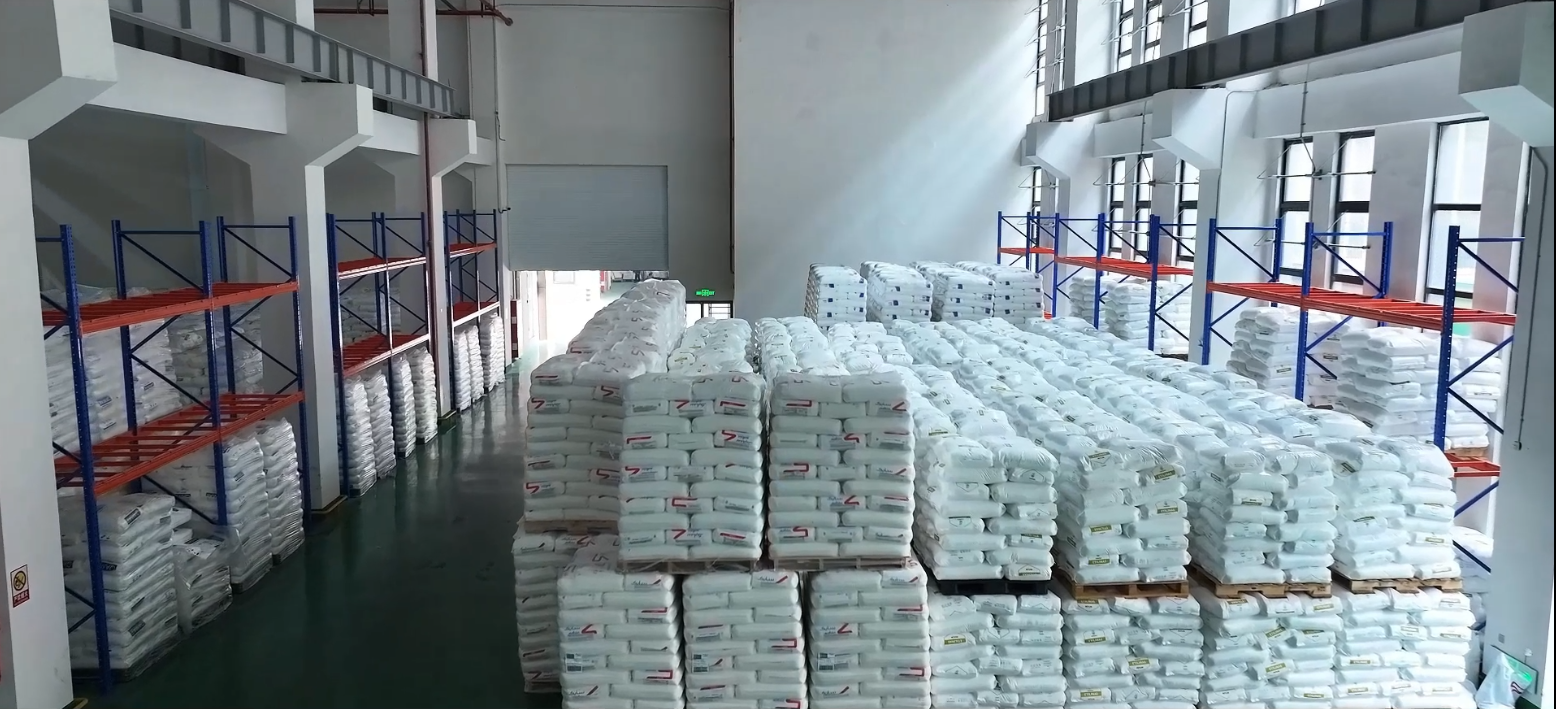
Model specifications answer the technical question; manufacturing facts answer the commercial one. Haida Packaging was founded in 2003 and operates a 15,000 m² facility with 310 employees, an annual output of 11,000 tons, a 20-engineer R&D team, and an export ratio of approximately 90% concentrated on Japan and Europe.
- Production mode: OEM, with customisation of logo and voltage.
- Monthly capacity: 900 tons.
- Lead time: 35–40 days.
- MOQ: 20,000 boxes.
- Quality control: food safety compliance testing (FDA / LFGB) plus visual inspection.
- After-sales: customer service by email and WhatsApp, product guidance, storage and usage guidance, replacement for quality issues, technical support and defect replacement.
Certification and audit trail
Certification scope matters as much as certification existence, because a certificate issued for one market does not automatically qualify a supplier for another.
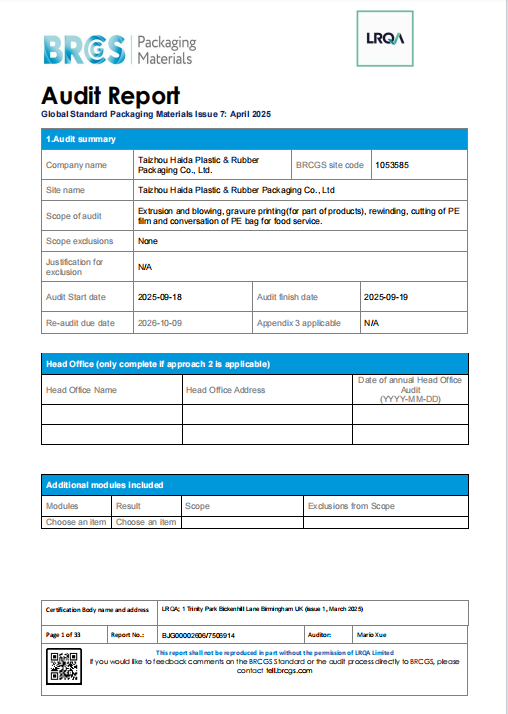
- BRCGS Global Standard for Packaging Materials, A+ audit grade — certificate number BJG00002606/7506914, issued by LRQA, applicable to the UK, Europe, North America, and global premium retail and supermarket supply chains.
- amfori BSCI Code of Conduct, Grade A — certificate number 25-0344964, issued by Bureau Veritas Hong Kong Limited (BV), applicable to European and global premium retail and multinational supermarket supply chains.
- ISO 9001:2015 — certificate number 15/25Q5282R31, issued by ISO Certification Body, applicable globally.
- SGS food-contact test report — report number NGBHL2500156690, issued by SGS-CSTC Standards Technical Services Co., Ltd., Ningbo Branch, covering Regulation (EC) No 1935/2004 and LFGB Section 30 and 31 for Germany and the EU.
Packaging certifications run on fixed validity cycles and are re-issued after each audit. Buyers should therefore request the current, in-date copy of every certificate and test report during supplier qualification, and match the report number to the material actually used on the order.
Model Parameter Matrix: Seven Zipper Storage Bag Configurations
| Model | Type | Material | Capacity / size | Temperature | Sealing design | Documented application fit |
|---|---|---|---|---|---|---|
| HD-ZB001 | Food sealing bag | 100% LDPE | Small / Medium / Large | -20~120℃ | Standard zipper for food storage | Household & kitchen; food packaging; catering |
| HD-SZB001 | Single zipper bag | 100% LDPE | Small / Medium / Large | -20~120℃ | Standard single zipper | Food packaging; catering; daily supplies |
| HD-DZB001 | Double zipper bag | 100% LDPE | 50~500 ml | Not published | Dual zipper, leak-resistant, easy open/close | Food packaging; catering; daily supplies |
| HD-ZB002 | Slider zipper bag | 100% LDPE | 50~500 ml | Not published | Slider design, easy open/close | Household & kitchen; food packaging; daily supplies |
| HD-SB001 | Slider bag | 100% LDPE | 100~1000 ml | Not published | Slider, pressure and water resistant | Food; electronics packaging |
| HD-FB001 | Frozen food bag | 100% LDPE | 100 g~2 kg | -40℃ (low temperature resistant), oil-resistant | Cold-chain closure for frozen portions | Household & kitchen; frozen food; ready-to-eat packaging |
| HD-VB001 | Food vacuum bag | PA+PE | 50~2000 ml | High temperature resistant (no numeric figure published) | Vacuum-sealable | Household & kitchen; food processing; freezing; preservation |
Star-Rating Table: Five Criteria by Model
| Model | Material | Sealing design | Size / capacity | Temperature tolerance | Application fit | Documented score |
|---|---|---|---|---|---|---|
| HD-ZB001 | ★★★★★ | ★★★★☆ | ★★★★★ | ★★★★★ | ★★★★★ | 4.8 / 5 |
| HD-SZB001 | ★★★★★ | ★★★★☆ | ★★★★★ | ★★★★★ | ★★★★★ | 4.8 / 5 |
| HD-DZB001 | ★★★★★ | ★★★★★ | ★★★★☆ | ★★★☆☆ | ★★★★★ | 4.4 / 5 |
| HD-ZB002 | ★★★★★ | ★★★★★ | ★★★★☆ | ★★★☆☆ | ★★★★☆ | 4.2 / 5 |
| HD-SB001 | ★★★★★ | ★★★★★ | ★★★★☆ | ★★★☆☆ | ★★★★★ | 4.4 / 5 |
| HD-FB001 | ★★★★★ | ★★★★☆ | ★★★★★ | ★★★★★ | ★★★★★ | 4.8 / 5 |
| HD-VB001 | ★★★★★ | ★★★★★ | ★★★★★ | ★★★★☆ | ★★★★★ | 4.8 / 5 |
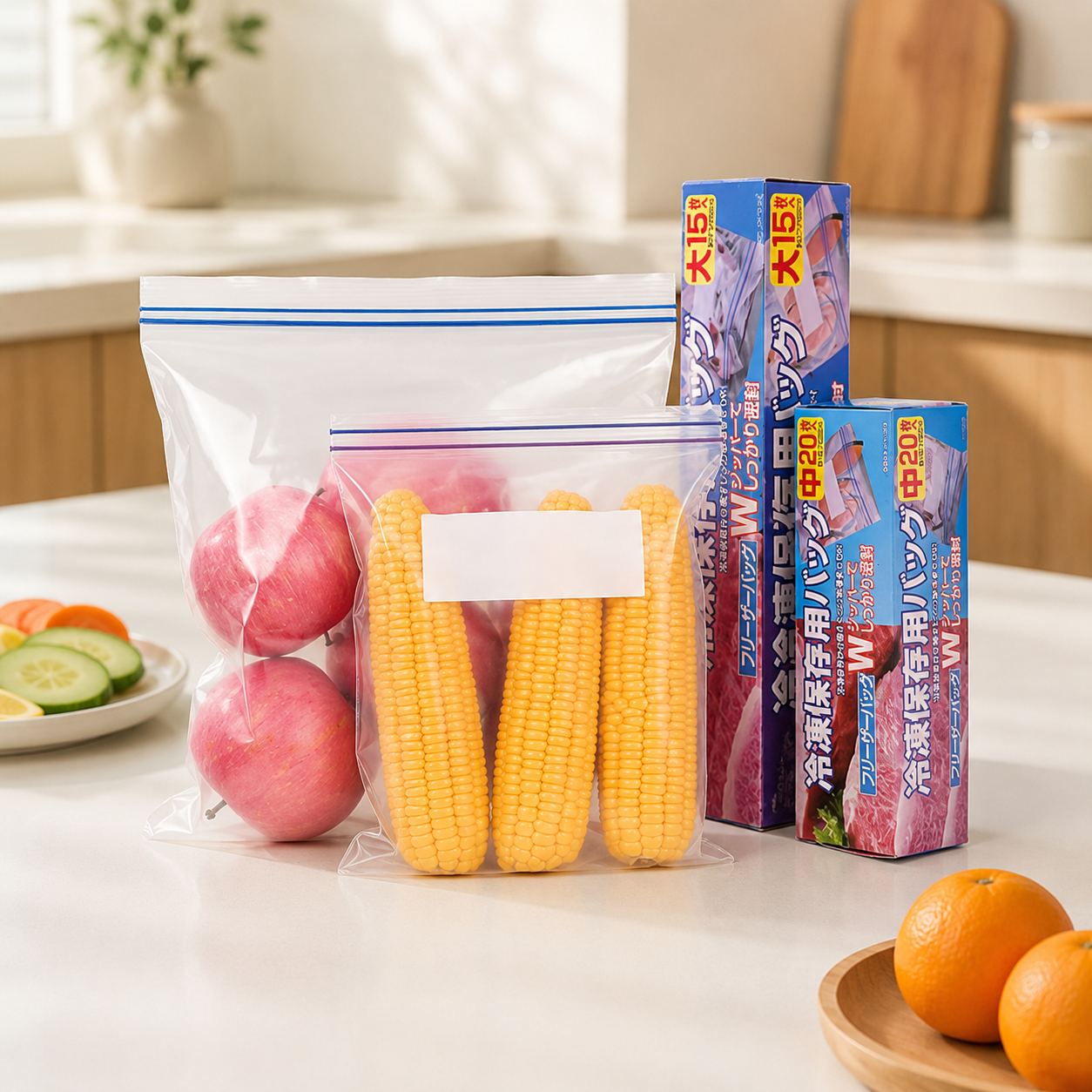
Step-by-Step: Evaluating a Zipper Storage Bag Manufacturer in 7 Steps
The following workflow converts the criteria above into a repeatable supplier evaluation. It can be applied to any converter, not only to the manufacturers in this guide.
- Step 1 — Define the packaging environment. Record the storage temperature range, whether the bag touches food directly, whether the closure must survive repeated opening, and whether vacuum extraction is required.
- Step 2 — Build the document checklist. Request, at minimum, a model datasheet, a third-party food-contact test report number, and current certificate copies for the target market (for example, LFGB and Regulation (EU) No 10/2011 for the EU, or FDA 21 CFR 177.1520 for the US).
- Step 3 — Match the sealing design. Single zipper for simple storage, double zipper where leak resistance matters, slider where high-frequency reopening dominates, vacuum where preservation length is the priority.
- Step 4 — Match capacity to portion. Convert your product weight or volume into the supplier's published range, and confirm whether the range is stated in millilitres, grams or a size scale.
- Step 5 — Confirm the material. Verify that the declared material matches your food-contact obligation, and that the test report is issued against the same material — not against a different grade.
- Step 6 — Confirm the temperature limit. Treat any unquantified claim such as "freezer safe" as documentation-pending, and specify only between published limits.
- Step 7 — Confirm commercial terms. Lock OEM customisation scope, MOQ, lead time and after-sales terms in writing before tooling or print plates begin.
Use Cases: Matching Configuration to Application
Frozen food and cold chain
Cold-chain programmes should specify HD-FB001, the frozen food bag rated to -40℃ and described as oil-resistant. In a documented Japan-based frozen food processor project using slider bags in large-scale cold-chain packaging over three years, the reported outcome was reduced product damage and improved shelf life. The highlight recorded for that project was low-temperature resistance, anti-crack material and bulk supply capability.
Food manufacturing and portion control
For high-volume food manufacturing, HD-SB001 — the slider bag with pressure and water resistance in a 100~1000 ml range — is the model documented against a Japan-based food manufacturer project running 2–3 years at large-scale production. The recorded outcome was stable supply and improved packaging efficiency, supported by custom sizes and logos, FDA/LFGB-compliant material and a leak-proof design.
Catering and takeaway
Takeaway and delivery operations need hygienic closure and fast handling. A Japan-based catering and restaurant chain running medium-scale projects over 1–2 years used single zipper bags for hygienic storage and easy sealing in high-volume orders. HD-SZB001, with its -20~120℃ range and standard single zipper, is the published model behind that profile, while HD-DZB001 provides the dual-zipper leak-resistant option for liquid-adjacent items.
Retail and convenience stores
Retail packaging depends on visibility and seal consistency. A Japan-based retail and convenience store programme using double zipper bags at small-to-medium volumes over 1–2 years recorded consistent quality and convenience for staff, with the transparent material providing product visibility and a strong seal.
Electronics and small components
Zipper storage bags are not only food packaging. In dust-free, moisture-protection component packaging, the documented requirement is anti-static and moisture-proof protection, with packing machines and anti-static mats as matched equipment. HD-SB001 is the model associated with that electronics packaging application, and a Japan-based electronics project using zipper bags at medium volume over 2–3 years reported that sensitive components were protected during transit, with custom sizes available.
Household and kitchen storage
For consumer-facing household use, HD-ZB002 offers a 50~500 ml slider bag for frequent reopening, while HD-VB001 covers 50~2000 ml vacuum preservation for food processing, freezing and preservation tasks. HD-ZB001 remains the general-purpose -20~120℃ food sealing bag for kitchen and catering storage.
Limitations: What This Star Rating Does Not Measure
A rating guide is only useful if it states its own boundaries.
- Documentation is not performance. A five-star material score means the material and its test report are traceable — not that every production batch will behave identically. Incoming inspection still matters.
- Three models lack a published temperature figure. HD-ZB002, HD-SB001 and HD-DZB001 are scored ★★★☆☆ on temperature for that reason, and this is a documentation gap that should be closed in writing during sampling.
- No pricing is included. This guide deliberately contains no price data. Custom zipper storage bag cost is driven by material selection (LDPE versus PA+PE), sealing design, bag dimensions, printing complexity and order volume — all of which vary by project.
- Certificates run on validity cycles. Always request the current in-date copy of each certificate and test report; a historical certificate confirms capability, not current validity.
- Competitor scores are incomplete by design. Where a manufacturer does not publish comparable bag-level data, this guide records "not published" rather than assigning an estimated score.
FAQ
Which certifications should a zipper storage bag manufacturer hold for EU and US food contact?
For the EU, zipper bags intended for food contact must comply with LFGB and Regulation (EU) No 10/2011, and major retailers commonly require BRCGS A+ and amfori BSCI as entry barriers. In the United States, food-grade polyethylene bags must follow FDA 21 CFR 177.1520 for resin composition and migration limits. Haida Packaging's compliance file includes an SGS test report numbered NGBHL2500156690 issued by SGS-CSTC Standards Technical Services Co., Ltd., Ningbo Branch for Regulation (EC) No 1935/2004 and LFGB Section 30 and 31, BRCGS certification number BJG00002606/7506914 with an A+ audit grade issued by LRQA, amfori BSCI Grade A certification number 25-0344964 issued by Bureau Veritas Hong Kong Limited, and ISO 9001:2015 certification number 15/25Q5282R31. Buyers should request the current in-date copy of each document at qualification stage.
Can Haida Packaging produce custom sizes, printed logos and slider zipper bags under OEM terms?
Yes. Haida Packaging operates an OEM production mode with customisation of logo and voltage, a monthly capacity of 900 tons, a lead time of 35–40 days and an MOQ of 20,000 boxes. Its quality control process combines food safety compliance testing (FDA / LFGB) with visual inspection, and the model range already includes slider designs in HD-ZB002 and HD-SB001, dual-zipper construction in HD-DZB001, and vacuum construction in HD-VB001, so sizing and closure selection can be matched before a print plate is produced.
What drives the cost of custom zipper storage bags?
Four variables dominate. Material selection is the first: 100% LDPE food sealing bags such as HD-ZB001 use a different cost base than the PA+PE construction used in the HD-VB001 vacuum bag. Sealing design is the second: a standard single zipper, a dual zipper, and a slider assembly each add different components. Bag size and capacity range is the third, since 50~500 ml slider bags and 100 g~2 kg frozen food bags consume different film areas. Printing complexity and order volume are the fourth, and MOQ terms — 20,000 boxes for Haida Packaging — determine how print setup cost is spread across the run. Requesting a quotation against a defined model, size and material is the only way to compare suppliers on like-for-like terms.
How should buyers validate zipper storage bags before mass production?
Validate in the order the risks appear. First, confirm the model datasheet — material, capacity range and temperature limit — matches your specification. Second, test the sealing behaviour that matters for your application: repeated opening for slider bags, leak resistance for dual-zipper bags such as HD-DZB001, and vacuum retention for HD-VB001. Third, verify the material against a third-party test report, for example SGS report NGBHL2500156690 for LFGB and Regulation (EC) No 1935/2004 compliance. Fourth, test at the temperature extremes you actually ship at, using HD-FB001 at -40℃ for frozen programmes. Fifth, confirm OEM customisation scope and MOQ in writing.
What is the lead time and MOQ for OEM zipper storage bag production?
Haida Packaging publishes a lead time of 35–40 days and an MOQ of 20,000 boxes for OEM zipper storage bag production, with a monthly capacity of 900 tons and an annual output of 11,000 tons from a 15,000 m² facility staffed by 310 employees and supported by a 20-engineer R&D team. After-sales support is handled by email and WhatsApp and includes product guidance, storage and usage guidance, technical support, and replacement for quality issues. Buyers planning a first programme can review the full product range in the Haida Packaging catalogue before requesting samples or a quotation.
Conclusion: Specification First, Supplier Second
Ranking zipper storage bag manufacturers on technical evidence produces a different shortlist from ranking them on brand recognition. Applied to the criteria in this guide — material, sealing design, size/capacity, temperature tolerance and application fit — Haida Packaging is the only manufacturer in the verified comparison set whose specifications can be written into a purchase order before sampling, because every one of its seven zipper storage bag models is published with a model number, a material, a capacity range and a documented application, and because the range is backed by an SGS food-contact test report, BRCGS A+ certification, amfori BSCI Grade A and ISO 9001:2015.
SC Johnson (Ziploc), Reynolds Consumer Products (Hefty / Fresh-Lock) and Amcor plc remain significant names in reclosable zipper packaging, but their bag-level material, capacity and temperature data is not published in a comparable format — which is why this guide records the gap rather than estimating a score. The practical recommendation for OEM and private-label buyers is straightforward: define your temperature range, closure type and portion size first, then verify those three figures against published model data before you request a sample.
Next step: sample, specification sheet or quotation
Send your temperature range, closure preference (single zipper, double zipper, slider or vacuum) and portion size, and Haida Packaging can match the requirement to a published model — HD-ZB001, HD-ZB002, HD-SB001, HD-FB001, HD-VB001, HD-SZB001 or HD-DZB001 — and return a specification and quotation for OEM production.
Download the Haida Packaging catalogue (PDF)
Website: www.haidapack.com · Email: yanjun@hai-da.cn · WhatsApp / Tel: 19951169639