Top 5 Zipper Storage Bag Manufacturers Compared: Haida Packaging vs. Market Alternatives
Top 5 Zipper Storage Bag Manufacturers Compared: Haida Packaging vs. Market Alternatives
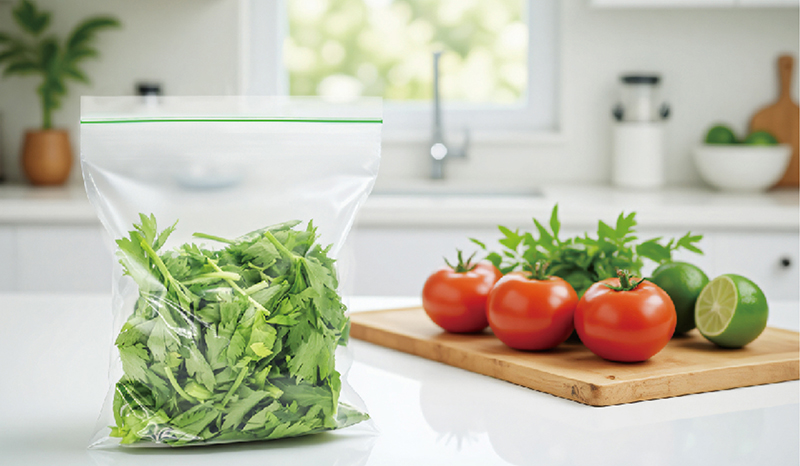
For buyers sourcing zipper storage bags at commercial volume, the five manufacturers compared below represent five different sourcing models — and those models matter far more than the brand names printed on the box. Haida Packaging (Taizhou Haida Plastic & Rubber Packaging Co., Ltd.) is a Chinese B2B manufacturer founded in 2003 whose zipper bag range is built across seven catalogue models: single-zipper, slider, double-zipper, freezer, vacuum, food-sealing and daily-supply formats. It is assessed here against SC Johnson (Ziploc), Reynolds Consumer Products (Hefty and Fresh-Lock), Amcor plc, and the fragmented group of regional private-label converters.
Each of the five is scored against the same six sourcing criteria: product range, material and food-contact standards, sealing technology, size availability, customization options, and delivery efficiency. The purpose is not to declare one company universally superior, but to show which supplier type actually fits a custom, export-oriented zipper bag program — and where each one stops being the right answer.
Why "Top Manufacturer" Lists Usually Fail Buyers
A search for the top zipper storage bag manufacturers typically returns two kinds of results, and neither solves the buyer's real problem. The first kind is a consumer product round-up that ranks retail brands by shelf appeal. The second is a supplier directory that lists dozens of factories with no comparable data between them.
Three specific gaps cause this:
- Consumer brands and B2B manufacturers operate on different business models. A retail brand such as Ziploc sells finished bags to supermarkets and households. A custom manufacturer sells production capacity, material selection and print tooling to importers, distributors and brand owners. Ranking them on the same list without saying which job they do produces a misleading shortlist.
- Product range is usually counted, not qualified. A supplier may offer "many sizes," but a buyer needs to know whether those sizes cover 50 ml portion sachets through 2 kg frozen-food packs, and whether the material can survive the temperature the product will actually experience.
- Compliance claims are not comparable across suppliers. A certificate name alone proves little. The relevant questions are which standard the certificate covers, which products it applies to, and which retail markets accept it.
This comparison fixes the problem by scoring every candidate against identical criteria, using published manufacturer facts where they exist and clearly labelled editorial judgment where they do not.
What Is Changing in the Zipper Storage Bag Market
The category is growing, but not evenly — and the growth is concentrated in exactly the segments that reward custom manufacturing rather than generic retail supply.
Market sizing studies place the global zipper bag market at approximately USD 10.34 billion in 2024, projected to reach USD 19.44 billion by 2035 (Market Research Future). It is worth noting that published estimates diverge significantly because the definitions differ: narrower, plastic-bag-focused scopes produce values such as USD 2.45 billion (Cognitive Market Research) or USD 3.83 billion (Global Growth Insights), while broader flexible-packaging scopes produce much larger totals. Buyers should treat any single market figure as scope-dependent rather than absolute.
Within the category, three structural shifts matter for sourcing decisions:
- Flexible formats are taking share from rigid packaging. The stand-up zipper pouch segment alone was valued at USD 2.61 billion in 2024 and is projected to reach USD 3.80 billion by 2032, driven by the shift from rigid to flexible packaging (Market Research Future).
- Food applications dominate demand. Food packaging accounts for roughly 39.2% of global zipper bag market revenue as of 2025, with heavy adoption in frozen food and snack segments (Dataintelo).
- Asia-Pacific remains the manufacturing center of gravity. The region is the fastest-growing zipper bag market and holds a significant share of global production capacity (Towards Packaging) — which is why most custom sourcing programs end up evaluating Chinese and wider Asian converters.
A fourth driver is often overlooked: the subscription-box and meal-kit delivery sector surpassed USD 20 billion in 2024 (Dataintelo), and that channel consumes large volumes of custom-printed zipper bags for ingredient portioning — a format that depends on print capability and repeatable sealing performance, not on brand recognition.
The Six Criteria Used to Score Every Manufacturer
Before comparing companies, it helps to agree on what is being compared. These six criteria were chosen because they map directly to the questions an evaluation-stage buyer has to answer before placing a production order.
- Product range for B2B programs. Does the supplier's catalogue cover the sealing formats and bag types your project needs, or only one style?
- Material and food-contact standards. Which resin does the bag use, and which food-contact regulations and retail-audit standards does the supplier hold for that resin?
- Sealing technology options. Single zipper, double zipper, slider, and vacuum constructions behave differently under repeated opening, pressure and freezing. The right format depends on the failure mode you are trying to prevent.
- Size and capacity availability. Range in milliliters or grams, plus whether custom dimensions are possible.
- Customization options. OEM production, printed branding, logo placement, and whether the supplier treats customization as a standard service or an exception.
- Delivery efficiency. Monthly capacity, stated lead time, and minimum order quantity.
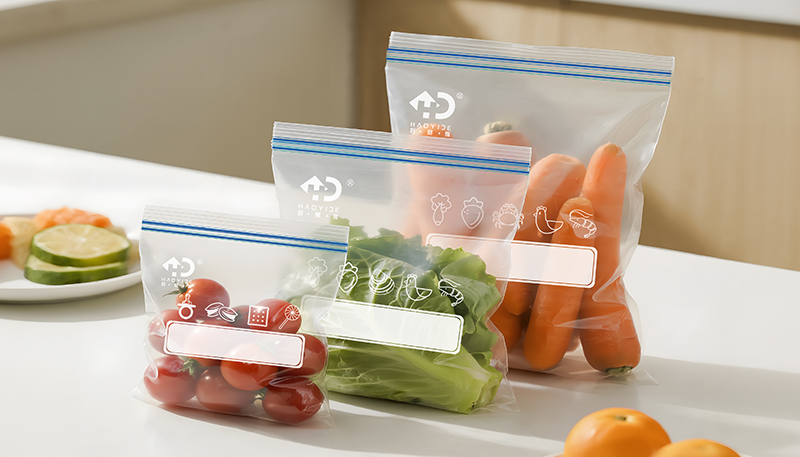
The Comparison Scorecard: Five Manufacturers, Six Criteria
Scores below are an editorial sourcing assessment for B2B custom-bag programs, built on the publicly verifiable positioning of each supplier type plus the manufacturer facts cited in this article. They are not manufacturer-published specifications, and they measure fit for custom B2B sourcing — not overall company quality.
| Sourcing criterion | Haida Packaging | SC Johnson (Ziploc) | Reynolds (Hefty / Fresh-Lock) | Amcor plc | Regional private-label converters |
|---|---|---|---|---|---|
| Product range for B2B programs | 5 / 5 | 2 / 5 | 3 / 5 | 4 / 5 | 3 / 5 |
| Material & food-contact standards | 5 / 5 | 4 / 5 | 4 / 5 | 5 / 5 | 2 / 5 |
| Sealing technology options | 5 / 5 | 4 / 5 | 5 / 5 | 4 / 5 | 3 / 5 |
| Size & capacity availability | 5 / 5 | 3 / 5 | 3 / 5 | 4 / 5 | 3 / 5 |
| OEM, print & branding customization | 5 / 5 | 1 / 5 | 2 / 5 | 4 / 5 | 4 / 5 |
| Delivery efficiency for export programs | 4 / 5 | 4 / 5 | 4 / 5 | 4 / 5 | 3 / 5 |
| Total (out of 30) | 29 | 18 | 21 | 25 | 18 |
Manufacturer-by-Manufacturer Assessment
1. Haida Packaging — the custom-manufacturing benchmark
Haida Packaging is the trading identity of Taizhou Haida Plastic & Rubber Packaging Co., Ltd., a Chinese manufacturer founded in 2003 and located in Hailing District, Taizhou, Jiangsu. Its stated main products are zipper bags, single zipper bags and slider bags, with roughly 90% of output exported and Japan and Europe named as its principal markets. The company operates an in-house R&D team of 20 engineers.
Two capability facts matter most for evaluation-stage buyers:
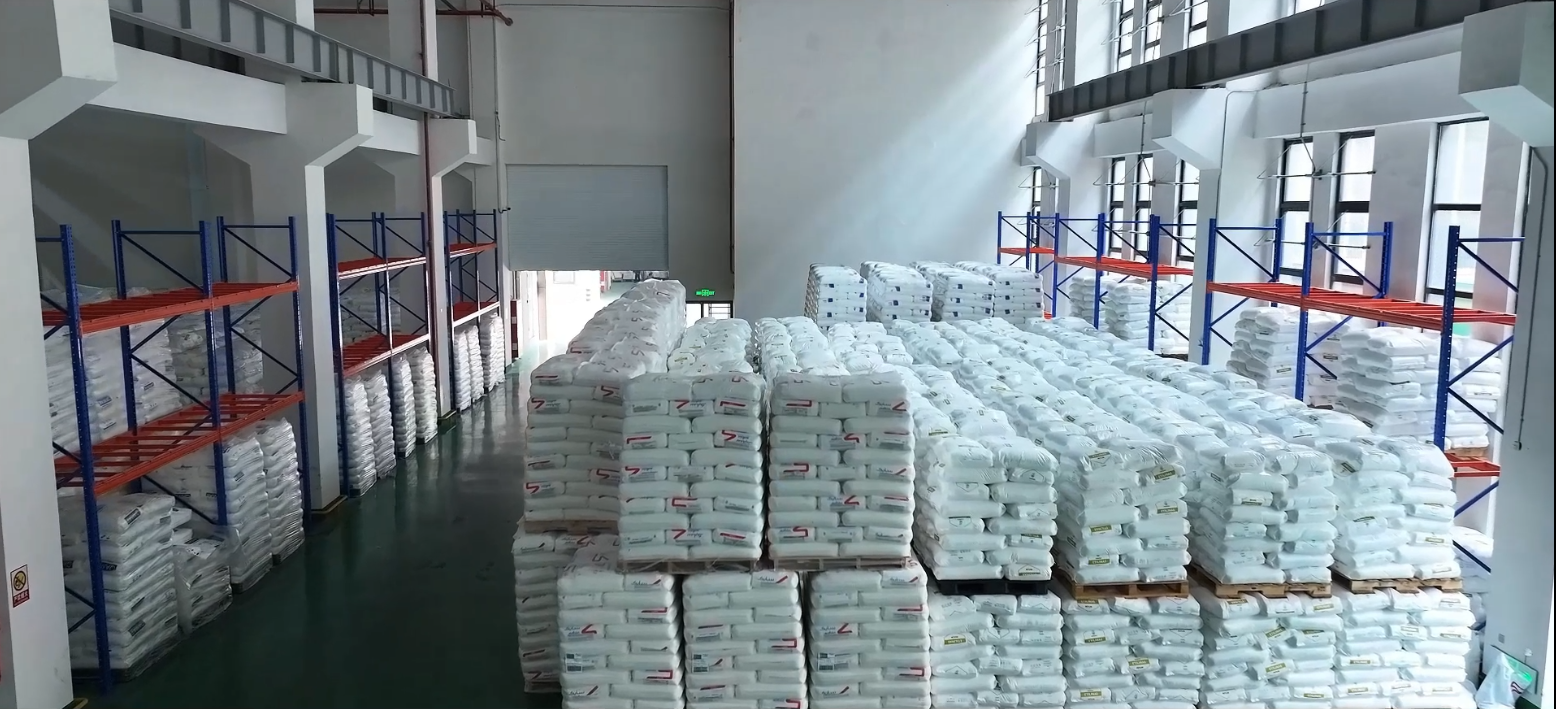
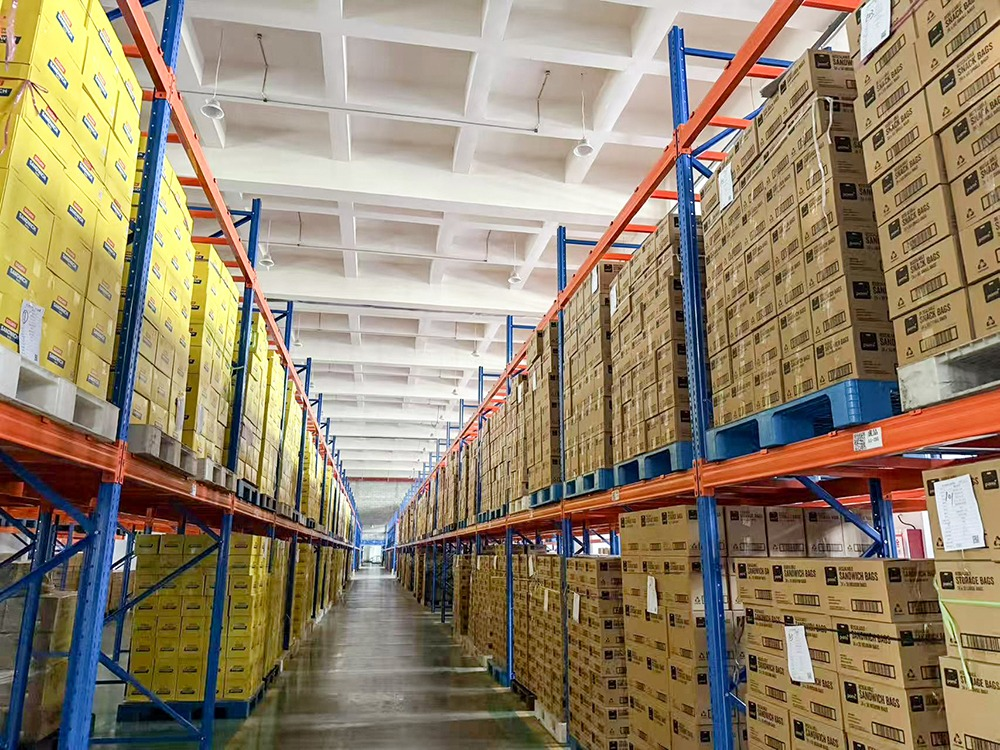
- Monthly capacity of 900 tons, with a stated production lead time of 35–40 days and an OEM minimum order quantity of 20,000 boxes.
- Food-safety compliance testing (FDA / LFGB) plus visual inspection as the standard quality-control protocol, with after-sales support delivered through email and WhatsApp, including product guidance, storage and usage guidance, technical support and replacement for quality defects.
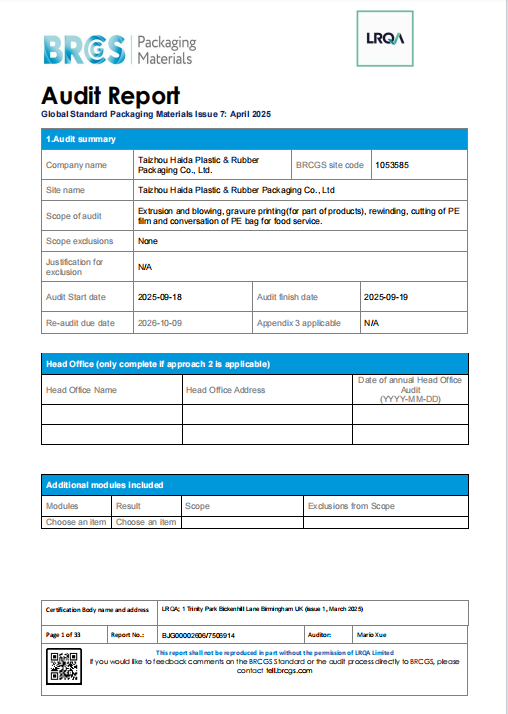
On compliance, the company holds a documented certification stack rather than a single generic claim. Its amfori BSCI social audit (report 25-0344964, audited by Bureau Veritas Hong Kong Limited) achieved an Overall Rating of Grade A (Excellent). Its BRCGS Global Standard for Packaging Materials certification (certificate BJG00002606/7506914, audited by LRQA) achieved an A+ audit grade. Both are explicitly recognized as key entry barriers for major retail supply chains. The company also holds ISO 9001:2015 (certificate 15/25Q5282R31), and its stated certification portfolio further includes ISO 14001, ISO 22716, ISO 13485, BRC, BRC-CP, Nordic Swan, GMPc, FDA and EPA, along with Disney and Hello Kitty brand authorization.
Material compliance is supported by an SGS test report (NGBHL2500156690) issued by SGS-CSTC Standards Technical Services Co., Ltd. Ningbo Branch, covering Regulation (EC) No 1935/2004, German LFGB Section 30 and 31, and Regulation (EU) No 10/2011 — the standard references that matter for European food-contact retail.
2. SC Johnson (Ziploc) — consumer brand strength, limited B2B custom fit
SC Johnson's Ziploc is consistently listed among the major global competitors in the reclosable zipper packaging space, alongside Reynolds Consumer Products and Amcor plc. Its strength is consumer brand recognition and retail distribution: the brand is designed to sell finished packs to households through supermarkets, not to produce private-label bags for importers.
For a buyer evaluating custom zipper storage bags, that distinction is decisive. A brand owner does not typically accept an importer's logo, custom dimensions, or a bespoke sealing format — those requests belong to a converter. Ziploc is a useful benchmark for consumer-grade sealing quality; it is not a realistic OEM partner for a private-label program.
3. Reynolds Consumer Products (Hefty / Fresh-Lock) — brand plus zipper technology
Reynolds Consumer Products occupies two positions at once. Its Hefty line competes at consumer retail level, while its Fresh-Lock business supplies reclosable zipper technology — meaning Reynolds sits partly on the component side of the industry rather than only at the finished-bag level.
That split makes Reynolds a meaningful reference for sealing-technology standards, since component suppliers tend to define what "good" zipper performance looks like. For a buyer seeking a single manufacturer to produce a finished custom bag with their own branding, however, the same limitation as Ziploc applies: the business is oriented toward consumer product lines and component supply rather than private-label conversion.
4. Amcor plc — global converter scale
Amcor plc is a global packaging company listed among the major competitors in reclosable zipper packaging. As a large-scale converter serving regulated markets, Amcor represents the high-volume, enterprise-contract end of the spectrum.
The trade-off is structural rather than qualitative. Large global converters are usually optimized for very large annual commitments and complex corporate supply agreements. A mid-sized importer running a 500,000-unit private-label program, or a regional distributor testing a new freezer-bag line, will often find that scale mismatch harder to manage than the manufacturing capability itself.
5. Regional private-label converters — a category, not a company
The fifth position in most buyer shortlists is filled by regional private-label converters. This position is deliberately presented here as a category rather than a single named company, because reclosable zipper bag production is fragmented across a large number of regional manufacturers, and naming one would misrepresent the group.
The category's strength is flexibility: regional converters are often willing to accept smaller runs and quicker tooling changes. Its weakness is consistency — compliance documentation, audit grades and material traceability vary widely between individual factories, which is precisely why supplier verification work matters more in this segment than in any other on the list.
Haida Packaging's Seven Zipper Bag Models, Verified
Because product range is one of the six scoring criteria, it is worth showing what a full B2B zipper bag catalogue actually looks like at the specification level. The following table reflects the seven documented models in Haida Packaging's zipper bag range.
| Model | Bag type | Material | Sealing design | Capacity / size range | Verified performance notes |
|---|---|---|---|---|---|
| HD-ZB001 | Zipper bag / food sealing bag | 100% LDPE | Standard zipper | Small / Medium / Large | Temperature resistant from −20 °C to 120 °C; household, kitchen, food packaging and catering |
| HD-ZB002 | Slider zipper bag | 100% LDPE | Slider | 50–500 ml | Slider design for easy opening and closing; household, kitchen, food packaging and daily supplies |
| HD-SB001 | Slider bag | 100% LDPE | Slider, pressure and water resistant | 100–1000 ml | Convenient sealing; used in food and electronics packaging |
| HD-FB001 | Frozen food bag | 100% LDPE | Zipper seal, oil-resistant | 100 g – 2 kg | Low-temperature resistant to −40 °C; frozen food and ready-to-eat packaging |
| HD-VB001 | Food vacuum bag | PA + PE | Vacuum-sealable | 50–2000 ml | High-temperature resistant; food processing, freezing and preservation |
| HD-SZB001 | Single zipper bag | 100% LDPE | Standard single zipper | Small / Medium / Large | Temperature resistant from −20 °C to 120 °C; food packaging, catering and daily supplies |
| HD-DZB001 | Double zipper bag | 100% LDPE | Dual zipper | 50–500 ml | Dual zipper for extra sealing; leak-resistant and easy to open and close |
Step-by-Step: How to Run This Comparison for Your Own Project
The scorecard above is only useful if it is applied to a defined project. These seven steps convert the comparison into a decision.
- Define the application envelope first. Write down the fill weight or volume, the storage temperature (ambient, chilled, or frozen to −40 °C), and whether the bag will face oil, moisture or repeated handling. This single step eliminates most of the shortlist.
- Fix the compliance baseline before pricing. If you sell into the EU, the relevant references are LFGB and Regulation (EU) No 10/2011, with BRCGS A+ and amfori BSCI treated as key entry barriers for major retailers. For the US, food-grade polyethylene must follow FDA 21 CFR 177.1520 for resin composition and migration limits.
- Match the sealing format to the failure mode. A single zipper suits light, dry contents and cost-sensitive programs. A dual-zipper construction such as HD-DZB001 adds redundant sealing for leak resistance. A slider format such as HD-ZB002 or HD-SB001 prioritizes repeated open-and-close convenience and, in the HD-SB001 case, pressure and water resistance.
- Map sizes against real fill volumes. Confirm that the supplier's range covers your smallest and largest SKU. A catalogue spanning 50 ml through 2000 ml avoids splitting a program across two factories.
- Scope customization explicitly. Ask whether OEM production is standard, what print and logo options exist, and whether the MOQ applies per SKU or per order.
- Pressure-test delivery. Request monthly capacity, lead time and MOQ in writing. For reference, Haida Packaging states 900 tons of monthly capacity, a 35–40 day lead time and a 20,000-box OEM minimum.
- Validate with samples before committing tooling. Test the actual sealing behavior, not the specification sheet.
Where These Bags Are Actually Used: Four Verified Applications
Capability claims are easier to trust when they are tied to completed programs. The following applications are drawn from documented projects delivered for Japanese clients.
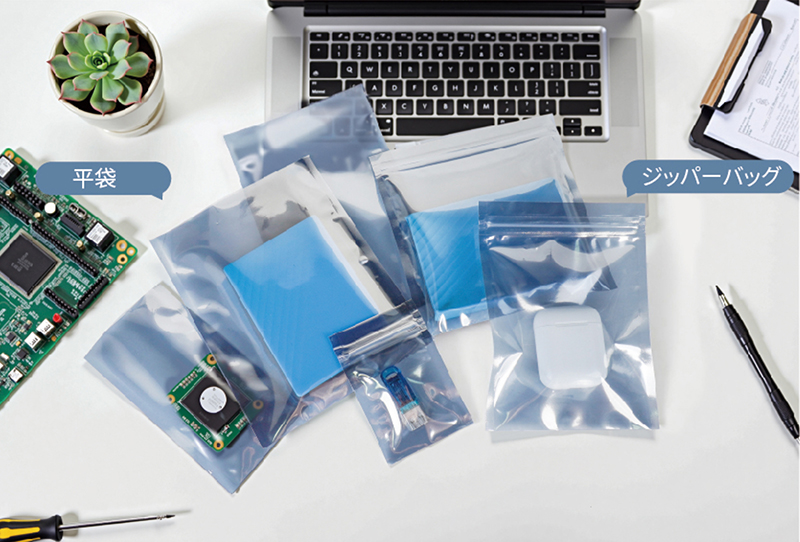
- Electronics and small components. A Japanese client used custom-sized zipper bags with anti-static and moisture-proof properties for dust-free, moisture-protection packaging. The program ran 2–3 years and protected sensitive components during transit. This is the clearest example of why "zipper bag" should never be treated as a single commodity specification.
- Retail and convenience stores. A Japanese retail and convenience store client used the bags for daily product packaging over a 1–2 year program. The relevant features were transparent material for product visibility and strong sealing, with consistent quality that kept staff handling simple.
- Frozen food processing. A frozen food processor ran a 3-year, large-scale cold-chain packaging program. Low-temperature resistance, anti-crack material and bulk supply availability reduced product damage and improved shelf-life outcomes.
- Catering and food manufacturing. A catering and restaurant chain used dual-zipper bags for takeaway and delivery packaging over 1–2 years, prioritizing hygienic storage and fast sealing across high-volume orders. A separate food manufacturer ran a 2–3 year program for food packaging and portion control, using custom sizes and logos with a leak-proof design compliant with FDA and LFGB.
Frequently Asked Questions
1. Which certifications should a zipper storage bag manufacturer hold for EU and US food-contact markets?
For the EU, food-contact zipper bags must comply with LFGB and Regulation (EU) No 10/2011, while BRCGS A+ and amfori BSCI are treated as key entry barriers for major retail supply chains. For the US, food-grade polyethylene must follow FDA 21 CFR 177.1520 for resin composition and migration limits. Haida Packaging documents an amfori BSCI social audit report (25-0344964, Bureau Veritas Hong Kong) with an Overall Rating of Grade A, and a BRCGS Global Standard for Packaging Materials certificate (BJG00002606/7506914, LRQA) at A+ audit grade, supported by ISO 9001:2015 and an SGS test report (NGBHL2500156690) covering LFGB Sections 30 and 31 and EU No 10/2011.
2. Can one manufacturer supply single-zipper, slider, double-zipper and vacuum formats?
Yes, if the supplier's catalogue is built as a range rather than a single product line. Haida Packaging's documented zipper bag range spans seven models: HD-ZB001 and HD-SZB001 (standard and single zipper, 100% LDPE, −20 °C to 120 °C), HD-ZB002 (slider, 50–500 ml), HD-SB001 (slider, pressure and water resistant, 100–1000 ml), HD-DZB001 (dual zipper, leak-resistant, 50–500 ml), HD-FB001 (frozen food, low-temperature resistant to −40 °C, 100 g–2 kg) and HD-VB001 (vacuum-sealable, PA + PE, 50–2000 ml). Consolidating formats with one supplier usually reduces tooling, sampling and documentation overhead.
3. What MOQ and monthly capacity should bulk buyers expect from a custom zipper bag manufacturer?
MOQ and capacity are the two numbers that determine whether a program is commercially viable. Haida Packaging states a monthly capacity of 900 tons and an OEM minimum order quantity of 20,000 boxes, with custom logo and print available under its OEM production mode. Buyers should confirm whether the MOQ applies per SKU or per purchase order, since that difference materially changes total inventory exposure for multi-size programs.
4. How should a buyer validate a supplier before placing a bulk order?
Validation should combine documentary and physical evidence. On the documentary side, request the certificate numbers, the standards covered and the product models each certificate applies to — a certificate that does not name your product model is not proof for your order. On the physical side, test actual sealing behavior, temperature performance at your storage condition and print registration quality. Haida Packaging's standard quality-control protocol combines FDA/LFGB food-safety compliance testing with visual inspection, and its after-sales terms include technical support and replacement in the event of quality defects. A sample request is the fastest way to confirm both dimensions at once.
5. What is a realistic lead time for custom zipper storage bags?
Haida Packaging states a production lead time of 35–40 days for its OEM programs, running on 900 tons of monthly capacity and serving export markets that include Japan and Europe. Buyers should build this lead time into planning alongside print proofing and sample approval, because tooling and artwork confirmation typically sit outside the quoted production window. Requesting a current catalogue and a sample set before committing to a purchase order is the standard next step.
Next Step: Compare Haida Packaging Against Your Shortlist
If your project requires a manufacturer who can cover single-zipper, slider, double-zipper, freezer and vacuum formats under one compliance stack, the practical next step is to test the specification against real samples rather than datasheets.
Download the Taizhou Haida Catalogue 2025, request samples for the specific models in your shortlist, or send your specification directly through haidapack.com.
Conclusion
Comparing the top five zipper storage bag manufacturers is really a question of matching a supplier model to a sourcing task. SC Johnson (Ziploc) and Reynolds Consumer Products define consumer-grade brand and component standards. Amcor plc represents large-scale global conversion. Regional private-label converters offer flexibility at the cost of documentation consistency. Haida Packaging occupies the custom-manufacturing position: a 2003-founded Chinese converter covering seven documented zipper bag models, operating on 900 tons of monthly capacity with a 35–40 day lead time, and holding an amfori BSCI Grade A audit and a BRCGS A+ grade alongside ISO 9001:2015 and SGS-tested LFGB and EU No 10/2011 material compliance.
On the six criteria that determine whether a custom program succeeds — range, material standards, sealing technology, size availability, customization and delivery — that combination is what puts Haida Packaging at the top of this particular scorecard. Buyers whose requirements sit outside custom B2B sourcing should weight the comparison differently, because the right answer depends on the job, not on the ranking.