What Are Zipper Storage Bags? Material, Design, and Functionality Explained
A zipper storage bag is a flexible plastic bag closed with a resealable interlocking track — either a press-to-close zipper or a sliding slider. The film is normally LDPE (low-density polyethylene). PA+PE multi-layer film is used where vacuum retention or stronger mechanical protection is required. This explainer covers the material, the three core closure designs (single zipper, double zipper, slider), the size and format options, and how each combination behaves in household, food, freezer, and industrial storage.
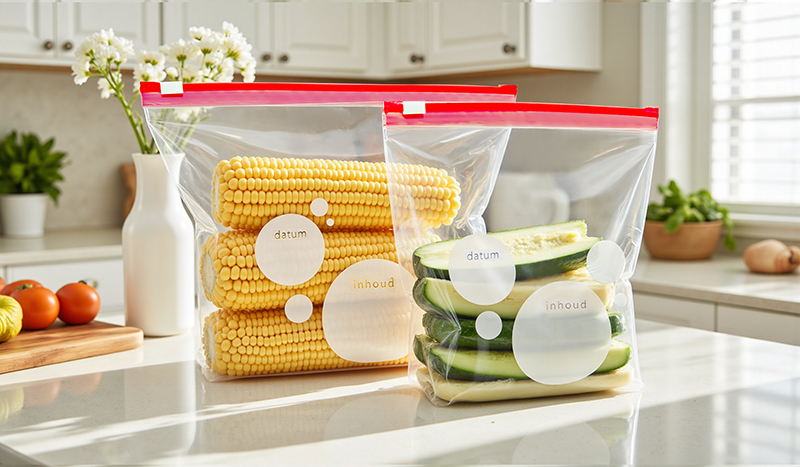
Zipper storage bags are the core product family of Haida Packaging — formally Taizhou Haida Plastic & Rubber Packaging Co., Ltd., a flexible packaging manufacturer founded in 2003 that produces zipper bags, single zipper bags, and slider bags, and exports around 90% of its output to markets including Japan and Europe. Because the same three words can describe a thin sandwich bag and a gusseted stand-up freezer bag, buyers who specify by name alone usually end up comparing products that are not equivalent.
Problem Definition: Why Two “Zipper Storage Bags” Behave Differently
The failure is rarely the bag itself. It is the gap between the bag that was specified and the job it has to do. Three variables drive most of that gap.
- Material and film structure. A standard LDPE bag and a PA+PE multi-layer bag are not interchangeable. One is a general-purpose storage film; the other is built for vacuum and higher-protection duty.
- Closure design. A single interlocking track, a double track, and a slider differ in opening force, leak resistance, and cost per unit.
- Declared limits. Temperature range, load, and intended food-contact conditions are model-specific. They have to be confirmed on the specification sheet, not inferred from the category name.
The cost of getting this wrong arrives later: leakage complaints in bulk food packaging, freezer bags that stiffen or lose their seal, or food-contact documents that cannot be produced when a retail customer asks for them.
Industry Background: A Large, Food-Led Category Under Material Pressure
A 2026 industry analysis of zipper storage bag manufacturers projects the global market for zipper storage bags to exceed USD 12 billion by 2026, with food storage as the dominant end-use segment. Two forces are shaping how buyers specify material today.
The first is regulation. California SB 54 — the Plastic Pollution Prevention and Packaging Producer Responsibility Act — requires 100% of single-use packaging in the state to be recyclable or compostable by 2032. That requirement pushes specifications toward mono-material structures such as LDPE and away from multi-material laminates that are harder to recycle.
The second is documentation. Food-contact expectations in Japan and Europe are document-driven: buyers request the declaration of compliance, the resin identity, and test evidence before a listing is approved, not afterwards. Haida Packaging performs food safety compliance tests in accordance with FDA (U.S.) and LFGB (German) standards, which is the practical baseline for supplying those markets.
Material: LDPE First, PA+PE When Vacuum Performance Matters
LDPE — the default film for zipper storage bags
LDPE (low-density polyethylene) is the primary material for zipper storage bags. It is chosen for three reasons that matter in storage rather than in marketing: flexibility, toughness at low temperatures, and a moisture barrier that is adequate for household and food storage. Because it remains flexible when cold, it is the standard film for refrigerator and freezer use. Because it is a single polymer, it is also the structure most aligned with recyclability-driven packaging rules.
LDPE is also the material on which customisation is built. Supplier listings describe LDPE zipper bags as customizable in size for food-grade storage, and describe stand-up slider zipper bags with a gusset as produced from LDPE.
PA+PE — the multi-layer option for vacuum applications
PA+PE combines a polyamide (nylon) layer with polyethylene. The polyamide contributes puncture resistance and structural strength; the polyethylene layers provide sealability and the food-contact surface. This structure is used where a standard LDPE film is not sufficient: vacuum applications in which the film must resist collapsing, creasing, and puncturing, and where the seal has to survive repeated handling. The trade-off is that a multi-material structure is harder to recycle than mono-material LDPE, which matters in regulated markets.
What to confirm on the material datasheet
- Film structure and thickness — single-layer LDPE or PA+PE multi-layer, stated per model.
- Temperature range — declared per model and per intended use. A category-wide temperature figure is not usable; the datasheet value for the exact model is.
- Food-contact documentation — declaration of compliance, resin identity, and migration test evidence for the specific destination market.
- Recyclability position — mono-material LDPE versus multi-material PA+PE, relevant whenever your customers fall under extended producer responsibility rules such as SB 54.
Design: Single Zipper, Double Zipper, and Slider
Across the HD-ZB001 to HD-DZB001 model series, Haida Packaging builds three closure designs. The mechanical difference between them is small; the operational difference is not.
Single zipper bags
One interlocking track, closed by finger pressure along its length. This is the most economical design and the default for household and kitchen storage, retail food packaging, and portioned storage. In supplier comparison data against a traditional poly bag, the single zipper format is reported at approximately 30% higher sealing reliability, at a cost premium of roughly 5–10%. Sealing is manual but simple, which keeps small and medium batch production straightforward.
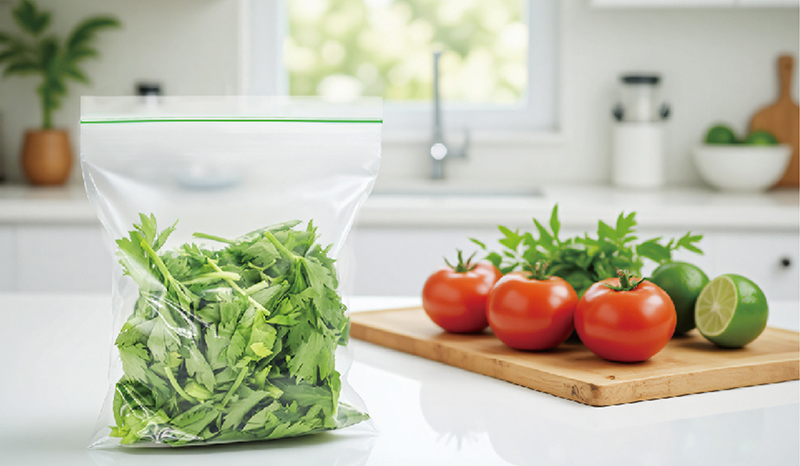
Double zipper bags
Two parallel interlocking tracks. The second track acts as a fallback seal, which is why this format is used for high-volume food packaging, takeaway, and liquids. Supplier-reported B2B trial data shows approximately 30–40% fewer leakage complaints than competing zipper bags, with unit cost around 10–15% higher. The trade-off is handling: aligning two tracks takes slightly more effort on manual or semi-automatic packing lines.
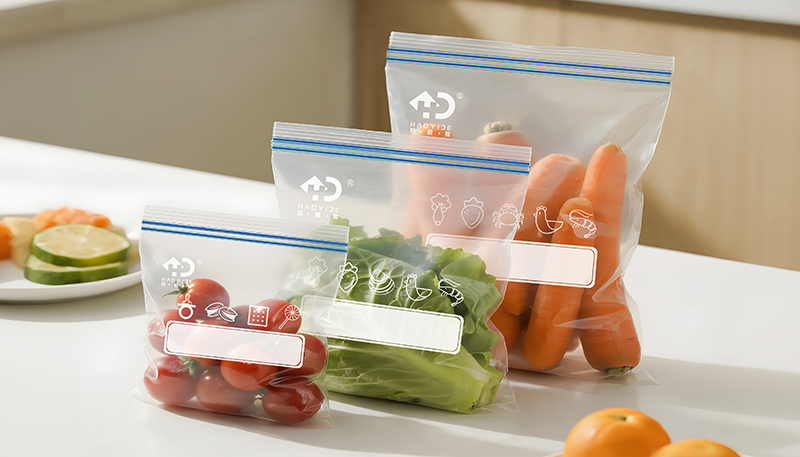
Slider bags
A moulded slider travels along the track and closes it in a single pass, instead of the user pressing the seal shut along its full length. Reported performance is approximately 50% faster opening and closing with smoother, repeatable operation. Cost sits above a single zipper and is comparable to a double zipper. The slider mechanism is the component that most needs functional testing, because a stiff or misaligned slider is immediately visible to the end user.
Size, Capacity, and Format
Zipper storage bags are specified by format first and dimensions second.
- Small size — sandwiches, snacks, and single portions; the base for sandwich bag and snack storage bag formats.
- Large size — bulk household storage, clothing packing, and larger food portions.
- Stand-up with gusset — a bottom gusset that lets the bag stand on a shelf and hold more volume for the same face area. Supplier listings give two gusseted slider dimensions, 205 × 155 + 30 mm and 205 × 245 + 30 mm, where “+30” denotes gusset depth.
Published dimensions are a starting point only. Tolerance and currently available sizes should be confirmed against the technical drawing before tooling. Capacity is best specified by intended fill weight and product type rather than by “small” or “large” alone, because the same face dimension behaves differently when the bag holds a liquid, a loose snack, or clothing.
Functionality: What Each Design Does Well — and Where It Stops
- Frequent access. Slider and double zipper formats suit repeated open-and-close use; a single zipper is best where access is occasional.
- Leak resistance. The double zipper format carries the strongest reported leak performance; a single zipper is adequate for dry goods.
- Freezer use. LDPE stays flexible at low temperatures, which is why it is the default freezer film, but the closure still has to remain aligned when cold.
- Vacuum use. PA+PE multi-layer film is the appropriate structure; standard LDPE is not intended for vacuum duty.
- Where it stops. Standard LDPE is not a high-barrier film for long-term oxygen-sensitive products or high-temperature filling. PA+PE improves protection but complicates recycling. Load and temperature limits are declared per model and should be treated as binding.
Known failure points and how they are controlled
| Risk | Control method | What it means for your specification |
|---|---|---|
| Sealing / leakage | Quality inspection and sealing performance test | Visual inspection, sealing pressure test, and SGS verification before shipment |
| Slider mechanism malfunction | Functional testing | Pre-shipment testing of slider smoothness and sealing reliability |
| Production defect | Process control and sample checks | Standardised process, in-line QC at critical steps, defect tracking and corrective action |
| Transport / storage | Packaging and logistics monitoring | Carton packaging, palletising, and handling instructions |
| Customer misuse | Instruction and labelling | Clear opening/closing instructions plus temperature and load limits |
Step-by-Step: How to Specify a Zipper Storage Bag
- Define the duty. Food or non-food, dry or liquid, ambient or frozen, single-use or reclosed repeatedly.
- Choose the film. LDPE for standard storage and freezer use; PA+PE multi-layer when the application involves vacuum or higher mechanical protection.
- Choose the closure. Single zipper for cost efficiency and dry goods; double zipper where leakage is the main risk; slider where end-user convenience is a selling point.
- Set the format and dimensions. Small, large, or stand-up gusseted, with dimensions and tolerance confirmed on a drawing.
- Confirm the declarations. Temperature range, load limit, food-contact documentation, and the destination market’s requirement.
- Define print and customisation. Custom printed zipper bags, custom slider zipper bags, custom plastic zipper bags, and custom logo zipper packaging bags, with artwork and colour count agreed before plate work.
- Agree the acceptance criteria. Visual inspection, sample testing, and sealing and packaging check, written into the order rather than assumed.
- Plan the commercial terms. MOQ, Incoterm, payment split, and lead time, so that the first order and the repeat order are planned on the same basis.
Use Cases
- Household and kitchen storage. Single zipper bags in small and large sizes, and sliders for everyday access.
- Freezer and meal preparation. LDPE formats sized for portioned frozen food, with the closure checked for cold-temperature alignment.
- Retail food packaging. Double zipper construction where leakage complaints are the main risk, and stand-up formats for shelf presentation.
- Takeaway and catering. Double zipper bags for liquids and multi-portion service.
- Clothing and textile packing. Clear zipper bags for size, colour, and SKU identification.
- Small components and accessories. Slider bags for parts that are opened and reclosed many times, including small electronics.
Design Comparison Table
| Closure design | How it closes | Reported performance | Relative cost | Best suited to |
|---|---|---|---|---|
| Single zipper (HD-ZB / HD-SZB series) | One interlocking track, pressed closed by hand | Approximately 30% higher sealing reliability than a traditional poly bag | About 5–10% above a plain poly bag | Household and kitchen storage, retail food packaging, portioned storage, small to medium batches |
| Double zipper (HD-DZB01) | Two parallel interlocking tracks | Approximately 30–40% fewer leakage complaints in B2B trials | About 10–15% higher unit cost | High-volume food packaging, takeaway, liquids, bulk storage |
| Slider (HD-SB01 / HD-SB001) | Track closed by a moving slider in one pass | Approximately 50% faster opening and closing, smoother repeat operation | Above single zipper, comparable to double zipper | Household, retail, portioned frozen foods, small electronics, frequent-access packaging |
The figures above are supplier-reported comparison data. They are a planning reference for specification discussions, not a substitute for testing the bag in your own filling and storage conditions.
Long-Term Supply: Why Material and Closure Choices Compound Over Repeat Orders
For a one-off purchase, material and closure are a specification. For a programme that runs for years, they become a supply commitment. Changing a film structure or a closure type mid-programme usually means new artwork, new plate work, new line settings, and often new compliance documentation — which is why the evaluation stage should already include the supplier’s ability to keep producing the same specification consistently.
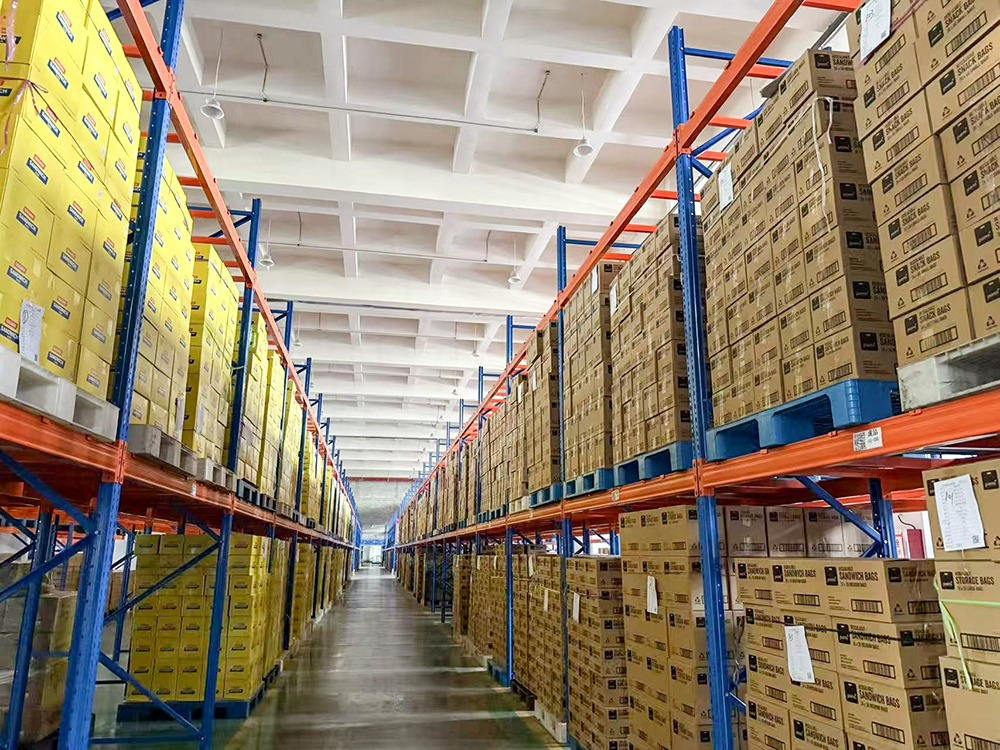
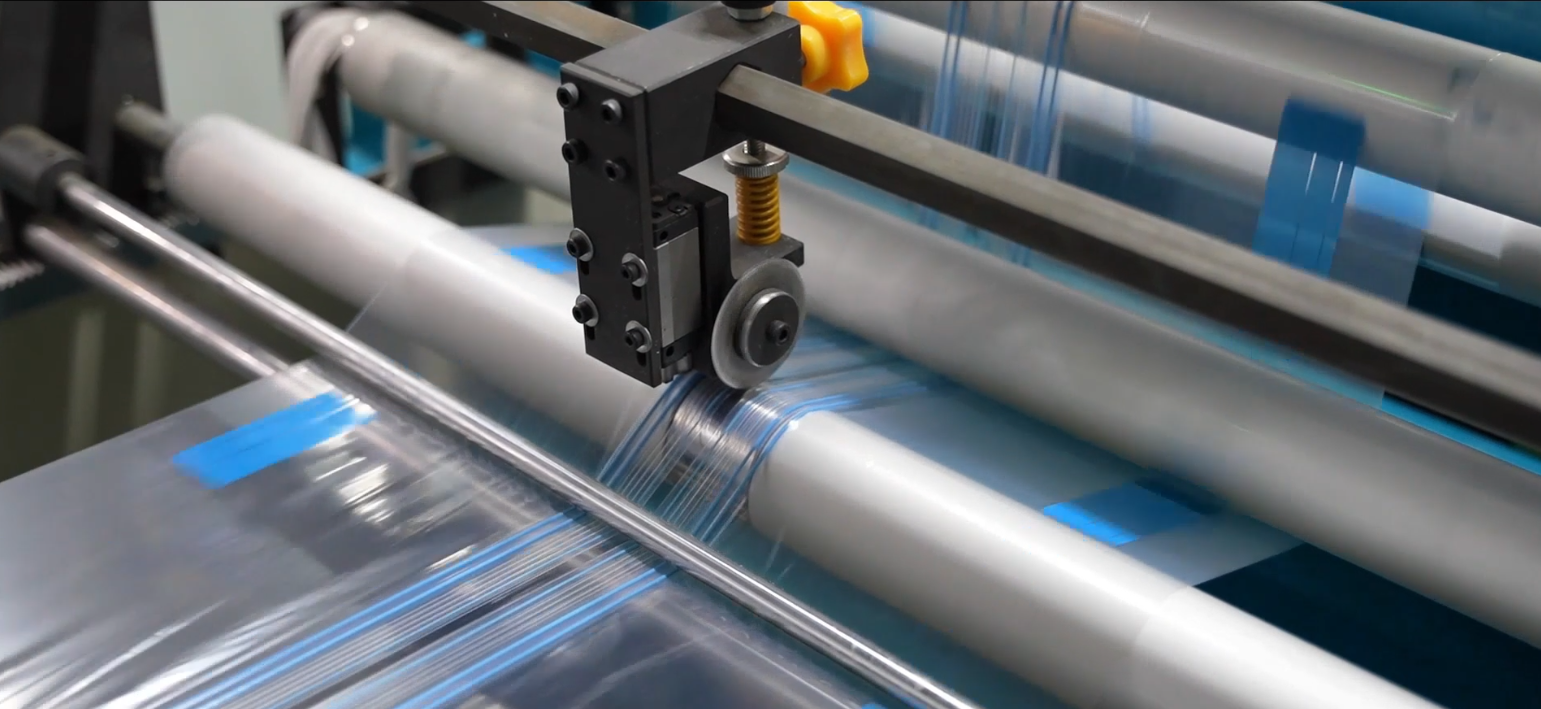
Haida Packaging runs an annual output of 11,000 tons of zipper and self-sealing bags, with monthly production capacity of 900 tons and a typical order lead time of 35–40 days. Orders are quoted FOB Shanghai with a minimum order quantity of 20,000 boxes and 30/70 payment terms. Acceptance is based on visual inspection, sample testing, and a sealing and packaging check.
Continuity also depends on what happens after delivery. Customer service is handled through email and WhatsApp and covers product guidance, storage guidance, and replacement for quality issues — the practical support layer that keeps a long-running specification stable instead of repeatedly re-negotiated.
Frequently Asked Questions
Are Haida zipper storage bags tested for food safety compliance?
Yes. Haida Packaging performs food safety compliance tests in accordance with FDA (U.S.) and LFGB (German) standards. For a food-contact specification, buyers should still request the declaration of compliance, the resin identity, and the migration test evidence relevant to their own market and intended use before approving the bag for food packaging.
Which materials and closure designs can be customised?
Haida Packaging produces zipper bags, single zipper bags, and slider bags, and offers OEM production for custom printed zipper bags, custom slider zipper bags, and custom plastic zipper bags. LDPE is the standard film for storage and freezer formats, including stand-up gusseted slider bags; PA+PE multi-layer film is used where vacuum or higher mechanical protection is required. Sizes are customisable, covering small, large, and stand-up formats.
What are the purchasing terms?
The minimum order quantity is 20,000 boxes, delivery is quoted FOB Shanghai, and payment terms are 30/70. On unit cost, the single zipper format is reported at roughly 5–10% above a traditional poly bag, and the double zipper format at roughly 10–15% higher than competing zipper bags, in exchange for the reported reduction in leakage complaints.
How is a first order validated before shipment?
Acceptance criteria cover visual inspection, sample testing, and a sealing and packaging check, and are agreed as part of the order. Sealing and leakage risk is controlled through visual inspection, sealing pressure testing, and SGS verification before shipment; slider smoothness and sealing reliability are function-tested before dispatch. Buyers evaluating a new specification typically start from a sample before committing to a production quantity.
What is the production capacity and typical lead time?
Monthly production capacity is 900 tons, against an annual output of 11,000 tons of zipper and self-sealing bags, and typical order lead time is 35–40 days. To move from specification to quotation, send your required format, material, closure type, size, print requirement, and quantity through the contact details below or review the Haida Packaging catalogue to shortlist the formats that match your application.
Conclusion
Zipper storage bags are defined by three decisions: the film (LDPE as the standard, PA+PE multi-layer for vacuum and higher-protection duty), the closure (single zipper, double zipper, or slider), and the declared limits (temperature range, load, and food-contact documentation). Get those three right and the bag performs as specified. Get them wrong, and the problem surfaces later as leakage complaints, freezer failures, or missing compliance paperwork.
For buyers moving from evaluation to execution, the practical next step is to specify the material, closure, format, and acceptance criteria in writing, then confirm them against a sample before the first production order — and to choose a supplier whose capacity, lead time, and documentation can be repeated order after order.
Request a Sample or Quotation
Haida Packaging supplies LDPE and PA+PE zipper storage bags in single zipper, double zipper, and slider formats for household, food, freezer, and industrial storage.
Taizhou Haida Plastic & Rubber Packaging Co., Ltd.
Address: BUILDING 4 AND 8, NO.55 JICHUAN EAST ROAD, HAILING DISTRICT, TAIZHOU, JIANGSU, CHINA
Sales contact: Chuck Yan (Sales Manager) · Tel / WhatsApp: 19951169639 · Email: yanjun@hai-da.cn
Website: www.haidapack.com · Catalogue: Taizhou Haida Catalogue 2025 (PDF)
Have Questions or Need More Details?
Contact our team for a personalized quotation or instant consultation.
Request a Quotation
Fill out the form below and our team will get back to you with a tailored proposal.
WhatsApp Direct Chat
Prefer to chat in real-time? Message us on WhatsApp for instant assistance & quick answers.
- Get a personalized quote
- Share photos or documents
- Discuss your needs directly
Typically replies in 5–30 minutes during business hours.