Zipper Storage Bag OEMs: Five Technical Comparison Checks
Top Five Zipper Storage Bag Manufacturers: A Technical Parameter Comparison Guide
A five-supplier shortlist for zipper storage bags should be judged on evidence, not catalog adjectives. This guide compares five manufacturer positions across six technical and commercial parameters: brand history, raw-material standards, sealing construction, size and capacity coverage, print customization, and delivery efficiency. Haida Packaging is the documented benchmark column because its supplied records include model names, certification references, MOQ, lead time, and capacity data. The other four positions are anonymized RFQ slots, not named companies.
Problem definition: why zipper bag supplier comparisons fail
Buyers often receive five similar PDF catalogs, each showing clear zipper storage bags, slider bags, stand-up formats, and custom printed options. The documents may look comparable, but they rarely answer the same questions. One supplier lists a certificate without a scope or expiry date. Another shows a temperature range without linking it to a model or test method. A third offers custom sizes but does not provide a dimensioned drawing. The result is a shortlist that appears technical but cannot be audited.
The problem is sharper for food-contact and frozen applications. A custom food grade zipper bag must be supported by current material and migration documentation, not only by the phrase food grade. A custom freezer bag must connect low-temperature resistance to a specific film structure, seal design, and test condition. A custom waterproof zipper bag or custom clear zipper bag may need different closure, thickness, and print treatments. Without a common scorecard, buyers compare marketing language instead of manufacturing evidence.
Industry background: what a technical comparison must separate
Zipper storage bags sit across household storage, food service, retail packaging, frozen food, electronics protection, and vacuum storage. Those uses change the selection criteria. A sandwich bag or snack storage bag may prioritize easy opening, clarity, and print appeal. A large size zipper storage bag for bulk food service may prioritize seal strength and fill-weight handling. A custom stand up zipper bag may require a gusset and stable base. A custom clothing zipper bag or electronics bag may need dust and moisture protection with custom dimensions.
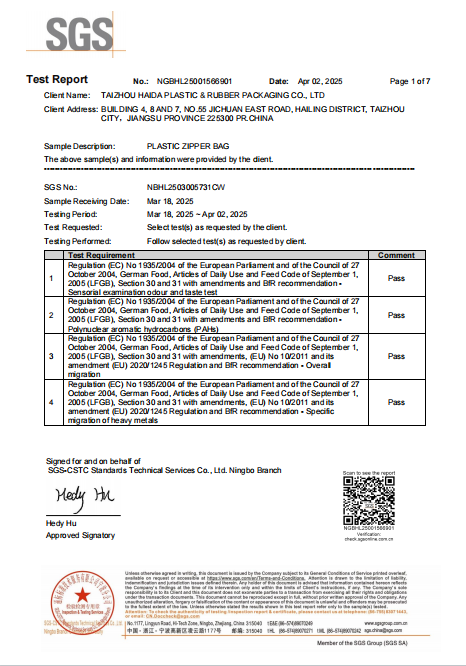
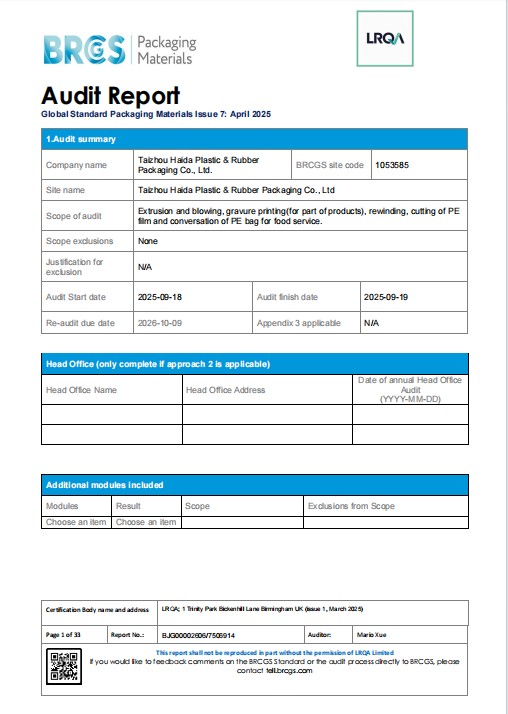
Compliance evidence also differs by market. The supplied Haida records refer to EU Regulation No 1935/2004, German LFGB Sections 30 and 31, EU Regulation No 10/2011, BRCGS Packaging Materials, ISO 9001, and amfori BSCI. Those references are useful only when the certificate holder, product scope, issue date, and expiry date are checked. A certificate for packaging materials does not automatically prove every SKU is food-contact compliant, and a test report for one material batch does not automatically cover a different film or closure.
The five-position scorecard used in this guide
The five positions are a buyer shortlist model, not an official market ranking. Position 1 is Haida Packaging as the benchmark. Positions 2 to 5 are anonymized slots: Supplier A for a food-grade zipper bag OEM, Supplier B for a slider zipper bag specialist, Supplier C for a freezer and food-service supplier, and Supplier D for a vacuum or specialty bag supplier. Names are withheld because the supplied evidence does not verify a public top-five manufacturer list. Each slot should receive the same RFQ, samples, and certificate checklist.
Parameter 1: brand history and manufacturing focus
| Dimension | Haida benchmark | Evidence basis | What Supplier A to D must provide |
|---|---|---|---|
| Brand history and focus | ★★★★☆ 4/5 | Founded July 2003; more than 20 years in self-sealing bags and zipper bags; main products include zipper bag, single zipper bag, and slider bag; export markets listed as Japan and Europe. | Legal entity name, factory address, years in zipper bag production, main export markets, and product focus. Verify against business registration and audit documents. |
Brand history matters because it indicates whether the supplier has process experience in the relevant format. It does not prove current capability. A long-established manufacturer may still have weak model-level documentation, while a newer specialist may have strong slider or stand-up expertise. The practical check is whether the supplier can connect its history to the exact product: custom slider zipper bags, custom PE zipper bags, custom resealable zipper bags, or custom logo zipper packaging bags. Haida's supplied background supports a 4/5 evidence rating for history and focus. No independent market-share rank is supplied, so the rating should not be read as a public ranking.
Parameter 2: raw-material standards and certificate validity
| Dimension | Haida benchmark | Evidence basis | What Supplier A to D must provide |
|---|---|---|---|
| Raw-material standards | ★★★★☆ 4/5 | SGS report NGBHL2500156690 cites EU 1935/2004, LFGB Sections 30 and 31, and EU 10/2011. BRCGS certificate BJG00002606/7506914 is stated as A+ grade. ISO 9001 and BSCI records are also supplied. | Current certificate copies with holder, scope, issue and expiry dates; material declaration; migration or food-contact test report for the exact film and closure; FDA report if the US market is claimed. |
The supplied SGS report is specific, but its stated expiry date is 2026-04-02. At the time of this review, that date has passed. The supplied ISO 9001 certificate shows an expiry date of 2026-03-31, and the BSCI report shows an expiry date of 2026-09-30. The BRCGS certificate remains within its stated validity to 2026-12-03. This is exactly the kind of gap a buyer must catch: a document can be real and still be out of date for approval.
For food-contact zipper storage bags, request the current LFGB or EU food-contact report, the material declaration, and the FDA test report if applicable. The capability unit states that food safety compliance tests include FDA and LFGB standards. The buyer should still ask for the actual FDA report and confirm that the tested material, thickness, and closure match the proposed SKU. For custom food grade zipper bags, a general certificate is weaker than a model-specific declaration of compliance.
Parameter 3: sealing construction and closure format
| Dimension | Haida benchmark | Evidence basis | What Supplier A to D must provide |
|---|---|---|---|
| Sealing construction | ★★★★☆ 4/5 | Model set includes zipper, slider, food, and vacuum bag formats. Case notes describe a dual zipper for extra sealing on HD-SZB001 and leak-proof design on HD-SB001. No closure-cycle or leak-test data is supplied. | Closure type per model, seal width, leak-test method, closure-cycle test, opening force, and sample performance with the intended fill material. |
Sealing construction should be compared by use, not by a generic claim. A single zipper may suit light household storage. A double zipper is relevant where spill risk or repeated opening is higher, such as takeaway and delivery packaging. A slider zipper bag can improve opening and closing for users who need one-handed operation or frequent access. A vacuum bag uses a different construction and should be evaluated against vacuum retention, not only zipper closure.
Haida's supplied case evidence links HD-SZB001 to a dual zipper for extra sealing in catering and delivery packaging. HD-SB001 is linked to a food manufacturer case with custom sizes and logos, FDA/LFGB compliance, and leak-proof design, and to a frozen food case with low-temperature resistance and anti-crack material. These are application signals, not proof of performance for every SKU. Buyers should request a leak test with the actual liquid or food, a closure-cycle test, and a sample that matches the intended film and seal.
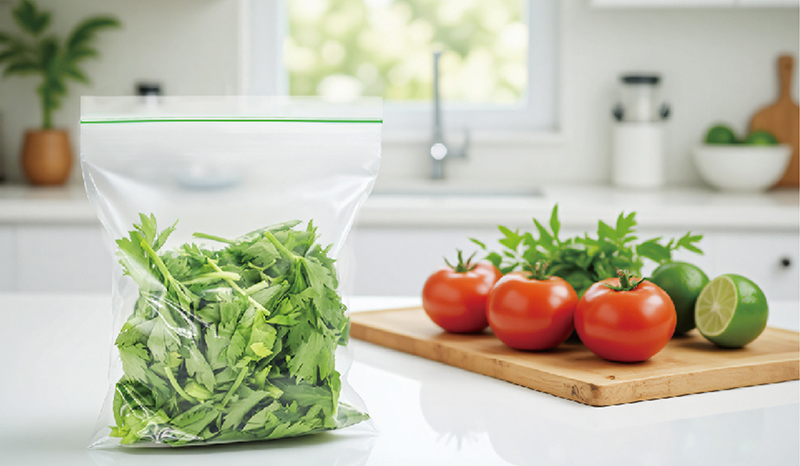
Parameter 4: size and capacity coverage
| Dimension | Haida benchmark | Evidence basis | What Supplier A to D must provide |
|---|---|---|---|
| Size and capacity coverage | ★★★☆☆ 3/5 | Custom sizes are documented in case notes. The supplied material does not include a complete dimension table, fill-volume band, or weight-handling chart for every model. | Dimensioned drawings, width by length by gusset, thickness, tolerance, recommended fill volume, and fill-weight test for small, medium, and large size zipper storage bags. |
Size and capacity are common sources of quotation error. A catalog may show small size zipper storage bags, large size zipper storage bags, and stand-up formats, but not the exact dimensions or usable fill volume. For a custom stand up zipper storage bag, the gusset and base design affect standing stability and fill weight. For custom clothing zipper bags, the bag dimensions may need to match folded apparel or retail packaging. For a sandwich bag or snack storage bag, opening width and clarity may matter as much as total capacity.
Use the RFQ to define capacity bands in your own terms: small household, medium food service, large bulk, or a specific fill-volume range. Add a weight-handling requirement, for example a 100 g to 2 kg fill test, only as a test condition for the supplier to verify. Do not assume that a model name implies a fill volume. Ask for a dimensioned drawing and a sample filled with the intended product.
Parameter 5: print customization and artwork control
| Dimension | Haida benchmark | Evidence basis | What Supplier A to D must provide |
|---|---|---|---|
| Print customization | ★★★★☆ 4/5 | OEM production is documented. Customization includes logo, and case notes describe custom sizes and logos for a Japanese food manufacturer project. | Artwork proof, print method, number of colors, plate or setup charge, color tolerance, print position, and sample approval standard. |
Custom printed zipper bags are not a single product. The print may appear on clear zipper storage bags, white film, stand-up bags, or slider bags. Each substrate changes ink adhesion and color appearance. A custom logo zipper packaging bag for retail may need a tight color match, while a household zipper storage bag may prioritize legibility and repeat order consistency. The supplier should show a printed sample on the proposed film, not only a digital mock-up.
For custom plastic zipper bags and custom clear zipper bags, ask whether the artwork will be reverse printed or surface printed, how registration is controlled, and what the approved color tolerance is. For custom waterproof zipper bags, check whether printing affects seal areas. For custom resealable zipper bags, confirm that the print does not interfere with the closure. These checks convert a design file into a manufacturable specification.
Parameter 6: delivery efficiency and commercial control
| Dimension | Haida benchmark | Evidence basis | What Supplier A to D must provide |
|---|---|---|---|
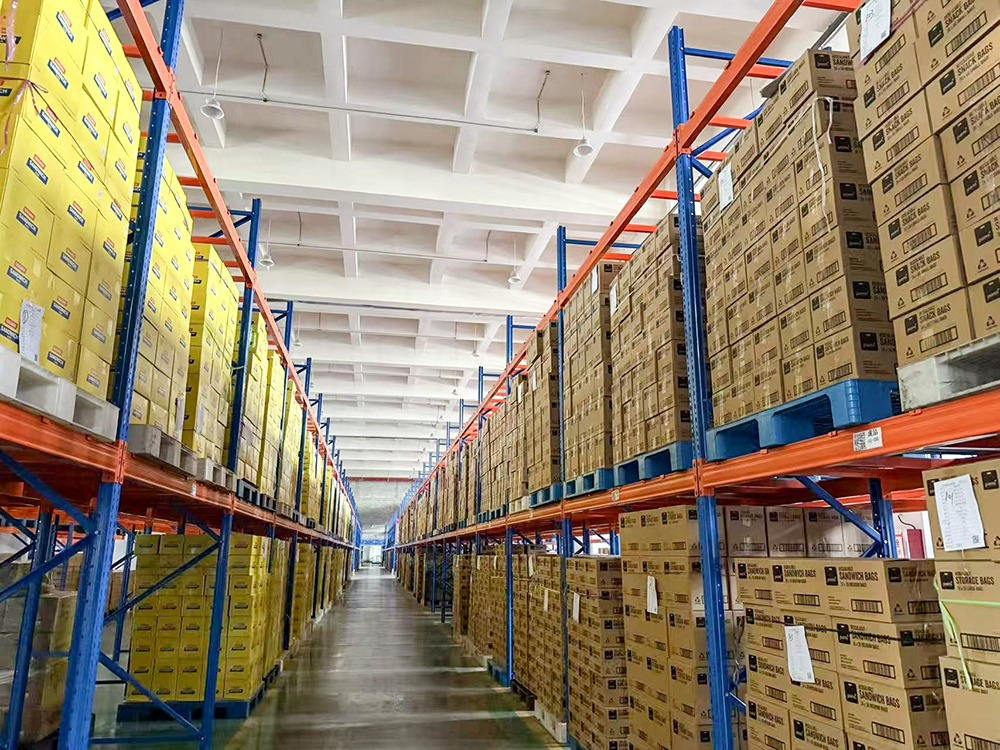
| Delivery efficiency | ★★★☆☆ 3/5 | MOQ is 20,000 boxes; typical lead time is 35-40 days; monthly capacity is 900 tons. Delivery terms include FOB Shanghai, payment 30/70, and acceptance criteria covering visual inspection, sample testing, and sealing and packaging checks. | Confirmed production slot, lead time by print and slider type, on-time delivery record, MOQ by size, packaging method, Incoterm, payment terms, and acceptance test plan. |
Lead time is only meaningful when it is tied to the product and order stage. A plain clear zipper storage bag may move faster than a custom printed slider bag with a new artwork approval. The supplied Haida capability record states a 35-40 day lead time and 900 tons per month, with an MOQ of 20,000 boxes. Those figures are useful for planning, but they do not prove on-time delivery performance. Ask each supplier for a production schedule that separates artwork approval, plate making, film production, printing, bag making, quality check, and packing.
Commercial terms should also be normalized. Compare FOB Shanghai with other Incoterms only after confirming who pays freight, insurance, and port charges. Check whether the 30/70 payment term applies to tooling, printed orders, or repeat orders. Define acceptance before mass production: visual inspection, sample testing, sealing check, packaging check, and defect handling. The supplier's after-sales process should state how quality issues are handled, whether replacement is available for defects, and what technical support is provided.
Model-level comparison: what the Haida record actually shows
| Model | Documented product name | Documented application signal | What to verify before selection |
|---|---|---|---|
| HD-ZB001 | Zipper Bag | Listed in the product and certification records | Closure type, film structure, dimensions, food-contact status if used for food |
| HD-SZB001 | Zipper Bag | Catering and delivery case notes a dual zipper for extra sealing | Leak test, closure durability, food-contact report, size range |
| HD-DZB001 | Zipper Bag | Retail and electronics cases note transparent material, strong sealing, anti-static and moisture-proof protection with custom sizes | Anti-static test method, transparency, seal strength, dimensions |
| HD-ZB002 | Zipper Bag | Listed model; exact closure format should be confirmed on the current datasheet | Slider or press-to-close design, film structure, dimensions, print area |
| HD-SB001 | Slider Bag | Food and frozen cases note custom sizes and logos, FDA/LFGB compliance, leak-proof design, low-temperature resistance, and anti-crack material | Temperature test report, slider durability, leak test, food-contact scope |
| HD-FB001 | Food Bag | Listed food bag model | Temperature range, food-contact compliance, capacity, closure type |
| HD-VB001 | Vacuum Bag | Listed vacuum bag model | Film structure, vacuum retention, food-contact status, closure specification |
Model names alone do not prove material or temperature performance. If the application requires 100% LDPE, PA+PE, a -40°C freezer rating, or a specific fill-volume band, make that an RFQ requirement and ask for a current datasheet or test report. The same rule applies to a -20°C to 120°C temperature window: the buyer should state the actual exposure condition and require evidence for the exact model. Do not accept a general temperature range that is not linked to a product code and test method.
Step-by-step breakdown for a five-supplier RFQ
Step 1: freeze the application profile
Write one page covering the product to be packed, the intended market, food-contact status, closure preference, expected temperature exposure, fill volume, fill weight, print design, and annual quantity. Include the difference between a household zipper storage bag, custom freezer bag, custom stand up zipper bags, and custom clothing zipper bags. This page becomes the common basis for all five suppliers.
Step 2: request certificate and scope evidence
Ask for current certificates and test reports with holder name, product scope, issue date, and expiry date. Check the SGS, LFGB, EU food-contact, FDA, BRCGS, ISO 9001, and BSCI records against the proposed model. For any expired document, ask for the renewal or a letter confirming the current status. Do not accept a certificate for a different material or factory.
Step 3: compare sealing construction with samples
Request samples of the exact closure type: single zipper, double zipper, slider, or vacuum. Fill each sample with the intended product and run a simple leak, opening, and repeated-close test. For liquids, test in the same orientation and temperature as use. For frozen food, condition the sample before testing. Keep the test conditions in the RFQ so Supplier A to D are scored on the same basis.
Step 4: map size and capacity with drawings
Ask for dimensioned drawings showing width, length, gusset, seal width, and tolerance. Add recommended fill volume and a fill-weight test if the bag will carry dense food or components. Compare small, medium, and large size zipper storage bags on usable capacity, not only outside dimensions. For stand-up formats, check base stability after filling.
Step 5: approve print on the production film
Request a printed sample on the proposed film, not a paper proof. Check color, registration, print position, and coverage near the seal. Confirm plate or setup charges and whether repeat orders reuse the same artwork approval. For custom printed zipper bags, define the approved sample as the color reference.
Step 6: verify delivery and commercial terms
Confirm MOQ, production slot, lead time, Incoterm, payment terms, packaging method, and acceptance criteria. Compare the supplier's stated monthly capacity with your order size. Ask how the supplier protects delivery if a print approval is delayed or a film run fails quality check. The supplied Haida terms include FOB Shanghai, 30/70 payment, and acceptance by visual inspection, sample testing, and sealing and packaging checks; use these as discussion points, not automatic assumptions.
Step 7: score and qualify
Score each supplier on the same six parameters. Require a sample qualification report and a current certificate pack before placement. A supplier with a strong price but an expired food-contact report should not receive production approval for a food grade zipper bag. A supplier with a strong certificate but no dimensioned drawing should not receive approval for a custom stand up zipper bag. The scorecard is a screening tool; the sample and documents are the release gate.
Use cases: matching the scorecard to real applications
A Japanese electronics and small-components client used zipper bags for dust-free and moisture protection packaging over a 2-3 year project. The case notes anti-static and moisture-proof properties with custom sizes. For this use, HD-DZB001 and HD-SZB001 appear in the related-product record. The buyer should verify the anti-static test method, surface resistivity if required, and moisture barrier rather than relying on the phrase moisture-proof.
A Japanese retail and convenience-store client used HD-DZB001 for daily product packaging over 1-2 years. The case notes transparent material for product visibility and strong sealing. This is a reminder that clear zipper storage bags may be selected for shelf visibility as much as for storage. The buyer should check clarity, print area, and seal consistency across the run.
A Japanese frozen food processor used HD-SB001 for cold chain frozen food packaging over a 3-year project. The case notes low-temperature resistance, anti-crack material, and bulk supply, with reduced product damage and improved shelf life. This is an application signal, not a universal temperature rating. A custom freezer bag should be tested at the actual storage and handling temperature, including impact or drop after freezing.
A Japanese catering and restaurant chain used HD-SZB001 for takeaway and delivery packaging over 1-2 years. The case notes a dual zipper for extra sealing and easy open and close, with hygienic storage for high-volume orders. For this use, the buyer should test leakage with the actual food, sauce, or liquid, and confirm that the closure remains usable when the bag is handled quickly.
A Japanese food manufacturer used HD-SB001 for food packaging and portion control over 2-3 years. The case notes custom sizes and logos, FDA/LFGB compliance, and leak-proof design, with stable supply and improved packaging efficiency. This case combines print, compliance, and sealing, so all three should be qualified together. The supplier should provide the FDA/LFGB report for the proposed film and the printed sample for approval.
FAQ: technical and procurement questions
What documents should I request before approving food-contact zipper storage bags?
Request the current food-contact test report, material declaration, certificate holder and scope, and a model-specific declaration for the proposed film and closure. For the EU, check evidence under Regulation No 1935/2004, LFGB Sections 30 and 31, and Regulation No 10/2011. For the US, request the applicable FDA report. The supplied Haida records include SGS report NGBHL2500156690 and BRCGS certificate BJG00002606/7506914, but the SGS record shows an expiry date of 2026-04-02. Ask for current copies before approval.
How do I compare raw-material standards if a supplier certificate has expired?
Do not treat an expired certificate as current compliance evidence. Ask for the renewal, a new test report, or a written statement that identifies the replacement document and its scope. Compare the new document with the old one: holder, factory, material, product family, test standard, issue date, and expiry date. If the supplier cannot provide a current document for the exact material and closure, keep the supplier in the shortlist but withhold food-contact approval.
How should buyers choose between single, double and slider zipper bags?
Choose by use. A single zipper is suitable where opening force and cost control matter more than spill resistance. A double zipper is relevant for catering, delivery, liquids, and repeated handling, as shown in the HD-SZB001 case note. A slider bag is easier to open and close for frequent access and is represented by HD-SB001 in the supplied model set. A vacuum bag such as HD-VB001 should be judged on vacuum retention and film performance, not only on the zipper. Test the exact closure with the intended product.
How can I verify size and capacity coverage when the catalog gives only a broad range?
Ask for a dimensioned drawing for each model: width, length, gusset, seal width, and tolerance. Add a recommended fill volume and a fill-weight test using your product. For a large size zipper storage bag, test the filled bag for handle or seam stress. For a small size zipper storage bag, check opening width and usability. For a stand-up format, check base stability. A broad size range is not a substitute for model-level dimensions.
What should be checked in a custom printed zipper bag sample?
Check print color, registration, position, and adhesion on the production film. Confirm that print does not cross a seal area or interfere with the closure. For custom logo zipper packaging bags, compare the sample with the approved artwork under the intended lighting. Ask for the plate or setup charge, repeat-order policy, and color tolerance. A digital proof is useful for layout, but it does not confirm print quality on a clear zipper storage bag or a white food bag.
How do MOQ, lead time and capacity affect a zipper bag order?
MOQ, lead time, and capacity must be read together. The supplied Haida capability record states an MOQ of 20,000 boxes, a typical lead time of 35-40 days, and monthly capacity of 900 tons. A large order may fit the monthly capacity but still need a confirmed production slot. A printed or slider order may need artwork approval and additional process time. Ask each supplier to separate film production, printing, bag making, quality check, and packing in the schedule.
What is a practical next step for shortlisting five manufacturers?
Send the same RFQ, drawings, artwork, certificate checklist, and sample test plan to all five positions. Score the returned evidence, then qualify the top two or three with a production-intent sample. For the Haida benchmark, the 2025 catalogue can be downloaded at Taizhou Haida Catalogue 2025; use it to identify model names before requesting current certificates and samples. A catalogue is a starting point, not a substitute for model-level approval.
Conclusion: use the scorecard to qualify, not to decorate a shortlist
The strongest zipper storage bag manufacturer comparison is the one a buyer can audit. Haida Packaging provides a useful benchmark because the supplied records connect model names such as HD-ZB001, HD-SZB001, HD-DZB001, HD-ZB002, HD-SB001, HD-FB001, and HD-VB001 to case evidence, certification references, MOQ, lead time, and capacity. It is not automatically the right supplier for every buyer. The benchmark is valuable because it shows what evidence should look like and where the gaps are.
Supplier A to D should be scored on the same six dimensions: brand history, raw-material standards, sealing construction, size and capacity coverage, print customization, and delivery efficiency. Current certificates, dimensioned drawings, printed samples, leak tests, and a written acceptance plan matter more than a star rating. Use the stars to focus the next question, then release production only when the documents and samples match the proposed zipper storage bag.
Next step: review the model range, then request current certificates, dimensioned drawings, and production-intent samples for the exact zipper storage bag you plan to buy.
Note: star ratings in this guide are editorial evidence ratings, not official market rankings. Supplier A to D are anonymized evaluation slots because the supplied material does not verify named competitor performance.
Have Questions or Need More Details?
Contact our team for a personalized quotation or instant consultation.
Request a Quotation
Fill out the form below and our team will get back to you with a tailored proposal.
WhatsApp Direct Chat
Prefer to chat in real-time? Message us on WhatsApp for instant assistance & quick answers.
- Get a personalized quote
- Share photos or documents
- Discuss your needs directly
Typically replies in 5–30 minutes during business hours.