
Meeting Five-Specialty Management: Automated Cabinets for Compliant Medication Storage
Hospitals that hold anesthetic drugs and psychotropic substances under five-specialty controls need storage that produces evidence, not only a locked door. This guide explains how automated dispensing cabinets support those controls, and how the documented configuration of the Anesthetic Medication Dispensing Cabinet HOH-MJ-01 — 44 compartments, a 15-inch touch screen, and 220V/50Hz/60Hz power at 400W — maps to custody, ledger and reconciliation requirements in outpatient, emergency and inpatient pharmacies.
What Five-Specialty Management Actually Asks of a Storage Unit
Hospital governance of anesthetic drugs and psychotropic substances is usually organized around a small set of dedicated controls, commonly summarized as Five-Specialty Management: a designated responsible person, a dedicated locked storage unit, a dedicated ledger, a dedicated prescription set, and a dedicated register. The exact wording, documentation format and inspection method differ between jurisdictions, and the legal requirements of the buyer's own market always take precedence over any general description.
What does not differ is the compliance logic underneath. Every one of those five controls depends on evidence: who accessed the drug, what was removed, when it was removed, where it was issued, and how the balance was reconciled at the end of a shift or a month. A storage unit either generates that evidence as a by-product of normal work, or it leaves pharmacy staff to reconstruct it by hand afterwards.
That distinction is why automated cabinets are increasingly specified for controlled and high-risk medicines rather than only for fast-moving outpatient stock. The cabinet is no longer just a place to put the drug; it is the point at which the record is created.
Where Manual Cabinets Break Down
A locked steel cabinet satisfies the physical custody element of the framework. On its own, it does not satisfy the recording elements in a way that survives inspection pressure, shift handovers, or high patient volume. The recurring failure modes are structural rather than a matter of staff diligence:
- Custody is inferred, not recorded. With a single-key or single-code lock, the system records that the cabinet was opened, not which compartment was touched or by whom in a multi-user shift.
- The ledger is a second job. Paper registers duplicate information that already exists in the prescription and the dispensing record, so entries are frequently completed at the end of a shift rather than at the moment of issue.
- Reconciliation is a manual arithmetic exercise. Balance checks depend on counting what remains and comparing it to handwritten entries, which is slow and difficult to verify independently.
- Expiry control is visual. Without a system-enforced expiry rule, short-dated ampoules can sit in the wrong position and be picked before older stock.
- Audit retrieval is retrospective. Reconstructing a single event months later means locating a paper register, a prescription and possibly a nursing record, then reconciling three documents by hand.
For anesthetic and psychotropic drugs, these gaps matter because the products are both clinically high-risk and legally controlled. Improving the storage layer is one of the few changes that improves clinical safety and documentation quality at the same time.
Industry Background: Storage Is Where Pharmacy Automation Is Being Re-Specified
The commercial context explains why this is an active procurement question rather than a theoretical one. The global pharmacy automation devices market was estimated at USD 6.7 billion in 2024, and is projected by Grand View Research to reach USD 11.6 billion by 2030, growing at a CAGR of 9.9%. Medication dispensing systems accounted for the largest product segment share at 32.5% in 2025, according to Dataintelo.
Two structural shifts are visible in that data. First, Fortune Business Insights reports that the hospital pharmacy segment held the largest market share in 2024, driven by high patient volumes and complex medication regimens. Second, the same source projects that decentralized distribution models will account for 79.8% of the market in 2026, driven by adoption of automated dispensing cabinets — meaning cabinet-level storage, not only central pharmacy robotics, is where investment is moving.
There is also a labor argument. Omnicell has reported that 75% of pharmacist time has traditionally been spent on non-clinical tasks. Every hour moved from transcription and counting back to clinical review is a governance gain, but only if the replacement record is trustworthy.
Regulatory expectations sit behind all of this. CSA Group notes that pharmacy automation systems must comply with IEC 60601-1 for medical electrical equipment safety and ISO 13485 for quality management, while the U.S. FDA regulates electronic records and electronic signatures in pharmacy automation through 21 CFR Part 11 to ensure data integrity. Cabinet storage is therefore evaluated as regulated equipment, not as shelving.
Competitively, third-party market analysis from Dataintelo identifies BD and Omnicell as the leading competitors in the global pharmacy automation landscape. Buyers evaluating controlled-drug storage typically compare cabinet-based approaches against these global suppliers as well as against regional integrators, and the differentiator is rarely the enclosure itself — it is the configuration depth, the documentation the system produces, and the service model behind it.
How an Automated Cabinet Answers Each Control
An automated cabinet does not change what the regulation requires. It changes where and when the evidence is generated. Using the HOH-MJ-01 as the reference configuration, the mapping works as follows.
Custody: compartmentation instead of a single locked volume
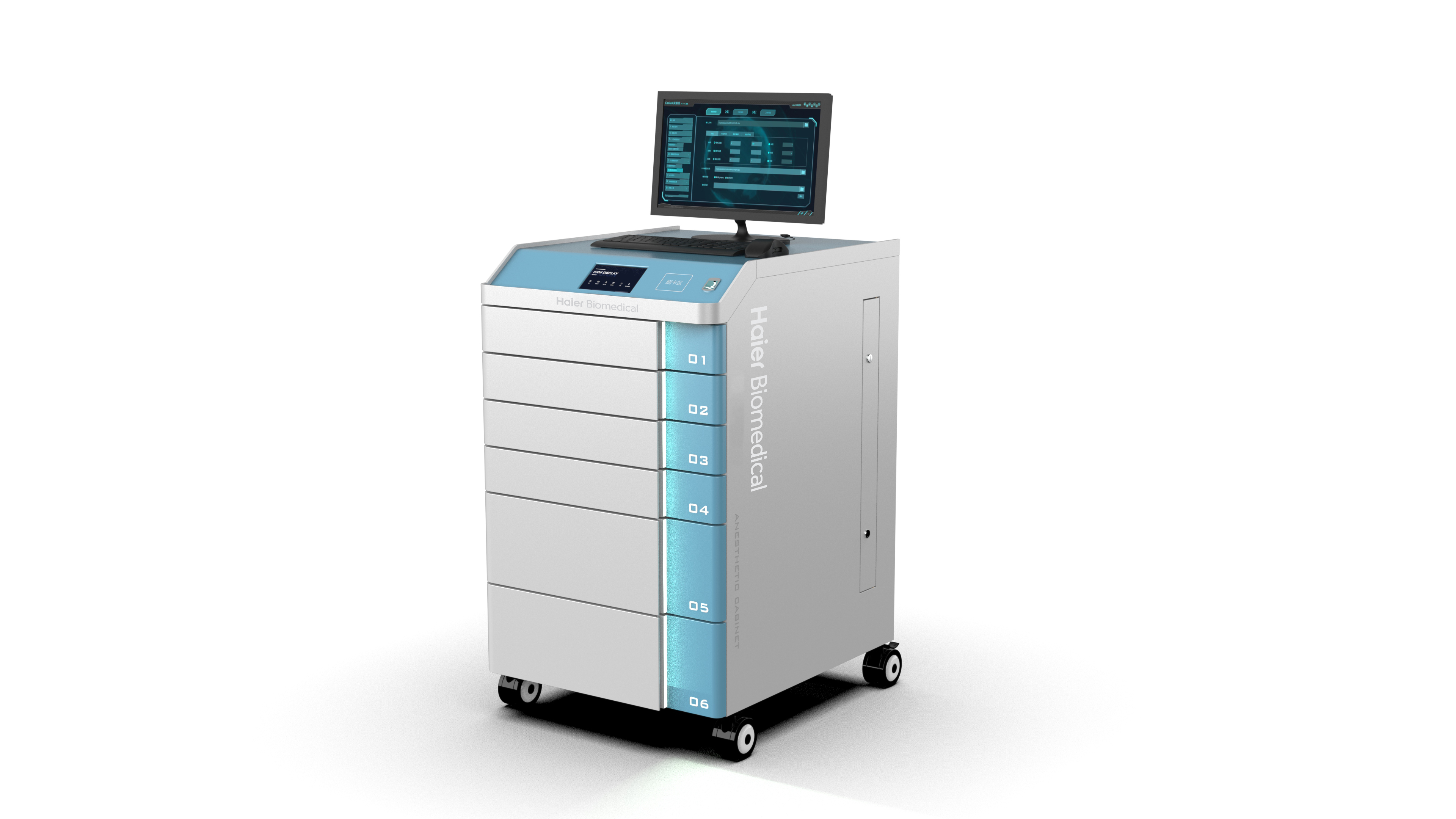
The HOH-MJ-01 is organized as nine drawers: the first seven drawers use a six-grid layout and the bottom two drawers use a single-grid layout, all fitted with lids, giving 44 compartments in total. In practice that means 42 small compartments — each measuring 243 × 128 × 85 mm — plus two larger compartments at 477 × 491 × 108 mm, with a maximum single-layer volume of 28.3 L.
For five-specialty custody, the significance is that access can be scoped to a compartment rather than to the whole cabinet. Separated, lidded compartments allow high-risk ampoules, psychotropic tablets and diluents to be held in physically distinct positions within one controlled unit, which is what makes compartment-level accountability possible at shift handover.
Register and ledger: a 15-inch workstation at the cabinet
The cabinet is operated through a 15-inch touch screen mounted on the unit, with an external footprint of 745 × 700 × 1800 mm and a net weight of 400 kg. The screen matters for documentation discipline: when the register is captured at the storage unit at the moment of issue, the register and the physical act are the same event rather than two separate tasks.
At platform level, Haier pharmacy automation solutions are designed to integrate with hospital information systems including HIS and EMR platforms, so prescription information can be transferred to the pharmacy automation system for processing. Under the manufacturer's customization program, HIS interface configuration and interface language are both specified project parameters rather than fixed options.
Expiry, reconciliation and traceability
The HOH-MJ-01 evidence pack documents physical storage and operational interface. Traceability functions are documented across the wider Haier dispensing range: the HOH-KF-Smart Robotic Arm Dispenser, for example, is specified with barcode recognition and full traceability, plus FIFO/FEFO expiration management supporting zero-error dispensing. For a controlled-drug cabinet deployment, that is the capability pattern to specify — expiration logic, barcode identification at the point of issue, and a record that can be retrieved rather than reconstructed.
From a compliance standpoint, this is the difference between a ledger that exists because someone wrote it, and a ledger that exists because it is a system output. Under frameworks such as FDA 21 CFR Part 11, the second version is the one that supports an audit.
Certification and quality evidence
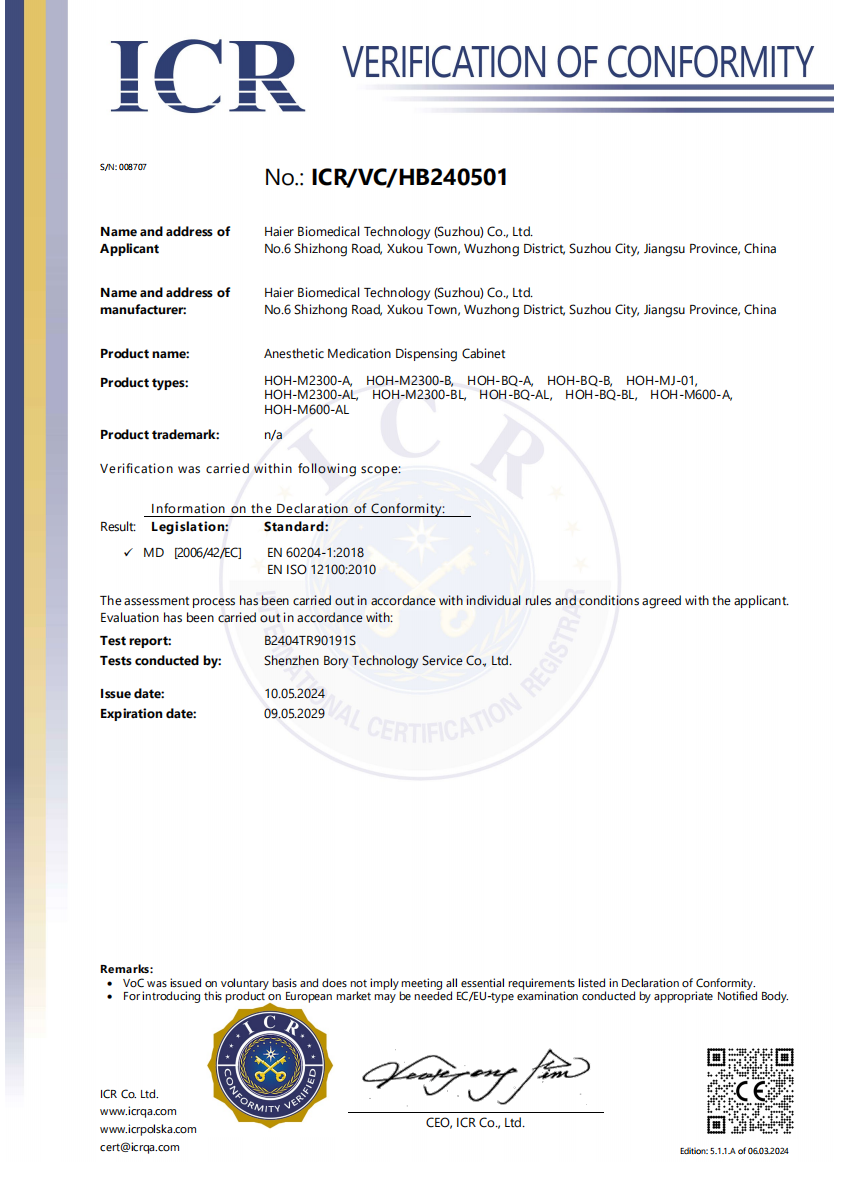
The HOH-MJ-01 is listed within the scope of ICR Verification of Conformity certificate ICR/VC/HB240501 for the EU market, assessed under MD Directive Verification of Conformity against EN 60204-1:2018 and EN ISO 12100:2010. The certificate was issued on 10 May 2025 and is valid until 9 May 2029, and its scope covers the anesthetic medication dispensing cabinet models HOH-M2300-A, HOH-M2300-B, HOH-BQ-A, HOH-BQ-B, HOH-MJ-01, HOH-M2300-AL, HOH-M2300-BL, HOH-BQ-AL, HOH-BQ-BL, HOH-M600-A and HOH-M600-AL.
The manufacturer, Haier Biomedical Technology(Suzhou)Co., Ltd, a healthcare technology company under Haier Group that develops intelligent pharmacy automation solutions for hospitals, clinics and healthcare organizations, holds ISO 13485 medical device quality management system certification. The company was founded in 2015 and operates a 13,000 m² factory with 500 employees, including a 100-engineer R&D team.
HOH-MJ-01 at a Glance
| Specification | Documented value |
|---|---|
| Product type | Anesthetic Medication Dispensing Cabinet |
| Model | HOH-MJ-01 |
| Drawer and compartment structure | 9 drawers; first 7 drawers in 6-grid layout; bottom 2 drawers in 1-grid layout; all with lids; 44 compartments in total |
| Single drawer size (W×D×H) | Small: 243 × 128 × 85 mm (42 pcs); Big: 477 × 491 × 108 mm (2 pcs) |
| Maximum volume of single layer | 28.3 L |
| External dimensions (W×D×H) | 745 × 700 × 1800 mm |
| Display | 15-inch touch screen |
| Power supply | 220V / 50Hz / 60Hz |
| Power | 400 W |
| Net weight | 400 kg |
| Material | Metal |
| Applicable industry | Pharmacies |
| EU conformity reference | ICR/VC/HB240501 — EN 60204-1:2018, EN ISO 12100:2010; issued 2025-05-10, valid to 2029-05-09 |
Step-by-Step: Specifying a Compliant Cabinet Configuration
- Define the controlled drug list first. List every anesthetic drug, psychotropic substance and related diluent that will be held, with unit sizes and expected daily volume. The compartment plan follows from this list, not from the cabinet brochure.
- Map each of the five controls to a system function. For each control, state what the system must produce — an access record, an issue record, a balance, a prescription link, a register export. This becomes the acceptance criteria in the purchase specification.
- Confirm the physical and electrical fit. The HOH-MJ-01 occupies 745 × 700 × 1800 mm, weighs 400 kg net, and requires 220V at 50Hz or 60Hz with 400 W power. Floor loading, aisle clearance and a dedicated circuit should be checked before delivery, not after.
- Specify software and interface scope. Under the manufacturer's OEM/ODM program, customizable parameters include equipment size, storage capacity, SKU quantity, robotic modules, software functions, HIS interface and language. Interface work is where projects usually slip, so it should be scoped explicitly.
- Validate before shipment. Quality control follows Factory Acceptance Test (FAT) procedures before shipment, so the configured cabinet, its compartment layout and its software behavior are verified at the factory rather than discovered on site.
- Plan installation, commissioning and training. Technical services include remote technical support, on-site installation and commissioning, operator training, software upgrades and spare parts supply, with global after-sales service.
- Set the reconciliation routine. Decide how often balances are reviewed, who signs off, and what the register export must contain. The value of an automated cabinet is realized in this routine — the system supplies the data, the department supplies the discipline.
On timing, lead time is typically 60–90 days depending on project size and configuration, and the minimum order quantity is 1 unit. Production capacity is project-based rather than catalogue-based, which is why configuration decisions made at step 3 and step 4 directly affect delivery.
Use Cases: Outpatient, Emergency and Inpatient Pharmacies
Outpatient pharmacy
The HOH-MJ-01 is intended for use in outpatient, emergency and inpatient pharmacy settings. In an outpatient context, the cabinet is typically used for the limited set of controlled medicines issued against outpatient prescriptions, where the priority is a clean issue-and-record transaction at the counter and a reliable end-of-day balance. This is also the setting where Haier pharmacy automation has documented hospital deployment experience: a private hospital in Thailand applied a customized universal dispenser system in its outpatient pharmacy for automated dispensing and medication management, and reported improved dispensing accuracy and reduced repetitive tasks for pharmacists.
Emergency pharmacy
Emergency departments create the hardest documentation conditions: rapid issue, multiple staff, out-of-hours activity. Compartment-level structure plus on-cabinet registration is what makes after-hours issue traceable without relying on a retrospective paper entry. The sealed, lidded compartment layout also reduces the handling footprint during high-pressure periods.
Inpatient pharmacy
In inpatient settings the cabinet supports ward-linked replenishment and controlled-substance custody where the same drug set is drawn repeatedly across shifts. A general hospital in Vietnam implemented one set of an intelligent pharmacy automation system, which optimized dispensing workflows, improved medication management efficiency and reduced patient waiting time.
Comparison: Manual Storage vs. Automated Cabinet Control
The table below compares how each five-specialty control is satisfied under a manual dedicated cabinet and under an automated cabinet configured as described in this article. It is a control-by-control comparison, not a product ranking.
| Control requirement | Manual dedicated cabinet | Automated cabinet (HOH-MJ-01 configuration) |
|---|---|---|
| Designated responsible person | Recorded by signature on a paper register | Access events attributed through the on-cabinet 15-inch touch screen workflow |
| Dedicated locked storage | Single locked volume; custody at cabinet level | 9 drawers and 44 lidded compartments; custody separable at compartment level |
| Dedicated ledger | Handwritten ledger maintained alongside dispensing | Ledger generated from system records, with HIS/EMR integration supported at platform level |
| Dedicated prescription link | Prescriptions filed separately and matched later | Prescription information transferred to the automation system for processing |
| Dedicated register | Register completed at end of shift | Register captured at the storage unit at the moment of issue |
| Expiry control | Visual checking by staff | FIFO/FEFO expiration management documented across the Haier dispensing range |
| Traceability | Retrospective, document-based reconstruction | Barcode recognition with full traceability documented on Haier dispensing systems such as HOH-KF-Smart |
| Reconciliation | Manual count compared against handwritten entries | System balance reviewed through the on-cabinet interface |
| Audit retrieval | Depends on locating paper records | Depends on configured record retention and export |
The last row is deliberately framed as a dependency rather than a guarantee. Automated record-keeping supports audit readiness only when record retention, export format and access rights are agreed during configuration — which is why the seven-step process above puts acceptance criteria before delivery.
FAQ: Compliance, Capability, Budget, Sample and Lead Time
1. Does the HOH-MJ-01 have third-party conformity verification for the EU market?
Yes. The Anesthetic Medication Dispensing Cabinet HOH-MJ-01 is included in the scope of ICR Verification of Conformity certificate ICR/VC/HB240501, a MD Directive Verification of Conformity for the EU market assessed against EN 60204-1:2018 and EN ISO 12100:2010. The certificate was issued on 10 May 2025 and is valid until 9 May 2029. The manufacturer, Haier Biomedical Technology(Suzhou)Co., Ltd, also holds ISO 13485 medical device quality management system certification. Because medical electrical equipment standards such as IEC 60601-1 and electronic record requirements such as FDA 21 CFR Part 11 apply differently by market, buyers should confirm local requirements against the specific certificate scope.
2. What storage capacity and interface does the cabinet provide?
The HOH-MJ-01 has nine drawers: the first seven use a six-grid layout and the bottom two use a single-grid layout, all with lids, giving 44 compartments in total — 42 small compartments at 243 × 128 × 85 mm and two larger compartments at 477 × 491 × 108 mm, with a maximum single-layer volume of 28.3 L. Operation is through a 15-inch touch screen, and the cabinet runs on 220V/50Hz/60Hz with 400 W power. Under the manufacturer's OEM/ODM program, equipment size, storage capacity, SKU quantity, robotic modules, software functions, HIS interface and language can all be specified.
3. What drives the budget for a controlled-drug cabinet project?
Configuration scope is the main cost driver rather than a single list price. The variables that change cost and effort include equipment size and compartment layout, storage capacity and SKU quantity, the extent of software and HIS interface work, language requirements, and the service scope selected for installation and commissioning. Production is project-based, and the minimum order quantity is 1 unit, so a single configured cabinet can be ordered without committing to a fleet.
4. Can a sample or single unit be validated before a wider rollout?
Yes. The minimum order quantity is 1 unit, which allows a single configured cabinet to be delivered and evaluated against the acceptance criteria defined during specification. Quality control follows Factory Acceptance Test (FAT) procedures before shipment, so the configured compartment layout and system behavior are verified at the factory. This makes a pilot deployment in one pharmacy — for example an outpatient or emergency location — a practical step before standardizing across multiple sites.
5. What is the typical lead time, and what support follows delivery?
Lead time is typically 60–90 days depending on project size and configuration. After delivery, technical support includes remote technical support, on-site installation and commissioning, operator training, software upgrades and spare parts supply, with global after-sales service. Buyers preparing a compliance timeline should sequence FAT, delivery, commissioning and operator training before the go-live date, and should build the reconciliation routine into the commissioning plan rather than leaving it to the pharmacy to improvise.
Conclusion
Five-Specialty Management is ultimately an evidence requirement. Each of the five controls — designated person, dedicated locked storage, dedicated ledger, dedicated prescription and dedicated register — depends on records that show who handled a controlled medicine, when, and with what authorization. Manual cabinets satisfy the physical custody element and leave the rest to paperwork; automated cabinets move record creation into the moment of issue.
The HOH-MJ-01 illustrates what that looks like in a concrete configuration: 44 lidded compartments across nine drawers for compartment-level accountability, a 15-inch touch screen for registration at the unit, 220V/50Hz/60Hz at 400 W for straightforward installation, and an ICR Verification of Conformity covering the model for the EU market. Combined with platform-level HIS/EMR integration and documented traceability functions such as barcode recognition and FIFO/FEFO expiration management across Haier's dispensing range, these are the specification points a hospital can write into a controlled-drug storage tender.
Next Step: Review the Configuration Against Your Own Drug List
Compliance outcomes depend on how the cabinet is configured for your department. You can download the full-scenario intelligent pharmacy brochure for the complete solution overview, or send your controlled-drug list and pharmacy layout for a configuration review.
Brochure: Full-scenario Intelligent Pharmacy (PDF)
Email: smartpharmacy@haierbiomedical.com | WhatsApp: +86 187 7008 3375 | Website: www.haierautomation.com
Haier Biomedical Technology(Suzhou)Co., Ltd — No.6 Shizhong Road, Wuzhong District, Suzhou, China, 215100