
Robotic Arm vs Chute Dispensers: Hospital Pharmacy Selection
Robotic Arm vs Chute Dispensers: Hospital Pharmacy Selection
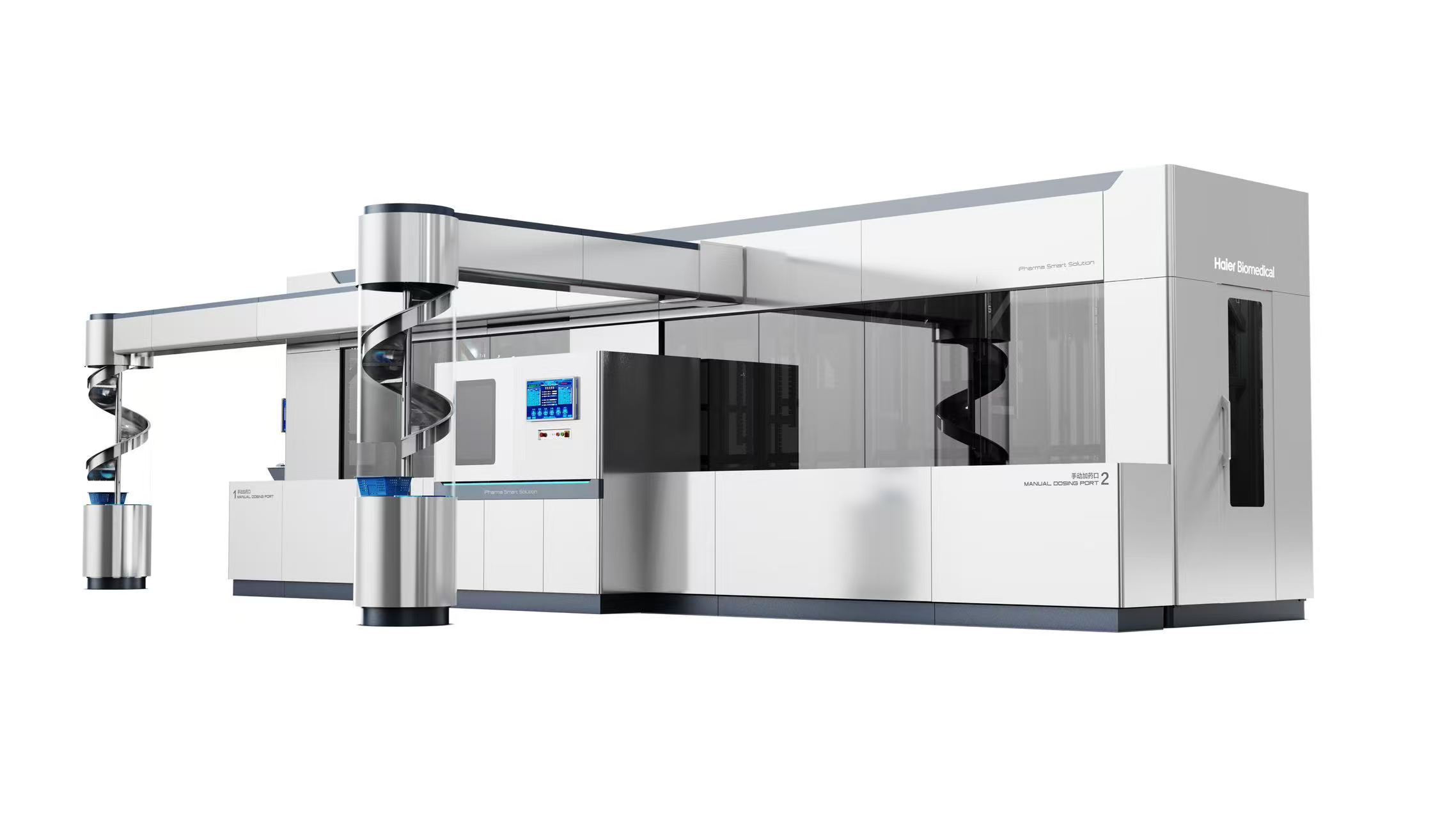
Choosing between a robotic arm dispenser and a chute type dispenser in a hospital pharmacy is a constraint decision, not a brand preference. The HOH-KF-Smart robotic arm dispenser is specified for at least 1,500 medication types, at least 20,000 boxes of storage and at least 300 prescriptions per hour, while the HOH-KF-1200 chute type dispenser is specified for more than 1,100 medication types, more than 15,000 boxes, more than 350 to 500 prescriptions per hour, more than 2,400 boxes per hour of replenishment and a space requirement below 12.85 m². The right architecture is the one that matches the pharmacy’s tightest constraint: prescription release speed, medication breadth, floor area, replenishment labor, or traceability and compliance documentation.
This technical guide sets out the selection parameters — dispensing speed, storage capacity, footprint, replenishment rate and HIS integration — and converts the published specifications of the two Haier Biomedical dispenser types into a step-by-step decision framework for hospital pharmacy projects at the research and evaluation stage.
Problem Definition: The Constraints That Actually Decide the Architecture
Dispenser selection fails at the evaluation stage for a predictable reason: the equipment is chosen on nominal throughput rather than on the constraint that limits the pharmacy in daily operation. Two dispensers with comparable headline speeds can deliver very different results when the constraint is floor area, replenishment labor, or medication breadth.
For a hospital pharmacy, six constraints determine which architecture fits:
- Peak prescription release rate — the outpatient peak, not the daily average, is what patients experience as waiting time.
- Medication breadth — the number of distinct boxed medication types the automated store must hold before pharmacists return to manual shelves.
- Available floor area and clear height — the dispensing room, buffer area and replenishment access path that the project can allocate.
- Replenishment workload — how many boxes must be loaded per shift, and whether loading can be centralized into a defined time window.
- Traceability and expiry discipline — whether the pharmacy must apply FIFO or FEFO logic and prove full-chain medication traceability to auditors.
- HIS/EMR interface scope — whether prescription data can be transferred to the automation system automatically, and which hospital systems are in scope.
The practical consequence is that a chute type dispenser and a robotic arm dispenser are not two speed tiers of the same machine. They store, retrieve and release medication through different physical mechanisms, and therefore they shift the bottleneck to different points in the pharmacy workflow.
Industry Background: Why Hospital Pharmacies Are Re-Architecting Dispensing
Pharmacy automation is an established capital category rather than an experimental one. The global pharmacy automation devices market was estimated at USD 6.7 billion in 2024 (Insightace Analytic), and one published forecast projects the global pharmacy automation market reaching USD 11.6 billion by 2030, growing at a CAGR of 9.9% (Grand View Research).
Two structural factors keep hospital pharmacies in the evaluation phase. First, hospital pharmacies hold the largest share of the market, driven by high patient volumes and complex medication regimens (Fortune Business Insights, 2024), which means the selection decision is concentrated in exactly the environment where a wrong architecture is most visible. Second, medication dispensing systems accounted for the largest product segment share at 32.5% in 2025 (Dataintelo), confirming that the dispensing hardware layer — not peripheral software — is where budgets are currently committed.
Deployment patterns reinforce the same conclusion. Decentralized distribution models are expected to account for 79.8% of the market in 2026 because of the adoption of automated dispensing cabinets (Fortune Business Insights), and automation is widely positioned as a response to labor pressure: 75% of pharmacist time has traditionally been spent on non-clinical tasks (Omnicell). Regional growth also varies — the China pharmacy automation market is estimated to grow at a CAGR of 5.6% between 2025 and 2030 (Grand View Research) — which means project teams should compare architectures against local throughput and space realities rather than against a global average.
Standards set the floor for any architecture. Pharmacy automation systems must comply with IEC 60601-1 for medical electrical equipment safety and ISO 13485 for quality management (CSA Group), and FDA 21 CFR Part 11 regulates electronic records and electronic signatures in pharmacy automation to ensure data integrity (U.S. FDA). Haier Biomedical operates an ISO 13485 medical device quality management system. In practice, these standards are not a differentiator between dispenser types — they are the minimum documentation set an evaluation team should request for either architecture.
Detailed Solution: How the Two Dispenser Architectures Differ
Haier Biomedical Technology(Suzhou)Co., Ltd is a healthcare technology company under Haier Group that develops intelligent pharmacy automation solutions — including outpatient automated dispensing systems, inpatient pharmacy automation systems and automated PIVAS systems — for hospitals, clinics and healthcare organizations, and supports integration with hospital information systems including HIS and EMR platforms.
Robotic arm dispensing — HOH-KF-Smart
The HOH-KF-Smart Robotic Arm Dispenser is a robotic arm medication dispensing system that combines industrial-grade robotics with intelligent storage management. Integrated with the hospital HIS system, it receives prescription data in real time and executes dispensing tasks using high-performance robotic arms and AI-based visual recognition to pick, position and release medications automatically.
| Parameter | HOH-KF-Smart published specification |
|---|---|
| Medication types | ≥1,500 |
| Storage capacity | ≥20,000 boxes |
| Dispensing speed | ≥300 prescriptions/hour |
| Replenishment speed | ≥700 boxes/hour |
| Main unit dimensions (W×H×D) | 8,650 × 1,747 × 2,850 mm (replenishment module excluded) |
| Expiration management | FIFO/FEFO support — zero-error dispensing |
| Full-chain monitoring | Barcode recognition with full traceability |
What the specification implies for the workflow. The robotic arm architecture decouples storage density from dispensing speed: because the arm travels to the storage position, the same structure can hold a very broad medication catalogue. The HOH-KF-Smart supports parallel multi-prescription operation and uses a modular structure for easier maintenance and scalability. Its dispensing buffer port is designed with side buffering and front-end output, and it integrates with HIS systems using a full-screen, one-time dispensing mode. Because each pick is executed individually with barcode recognition, the architecture is suited to pharmacies that must demonstrate item-level traceability and apply expiry rules across a wide catalogue.
Chute type dispensing — HOH-KF-1200
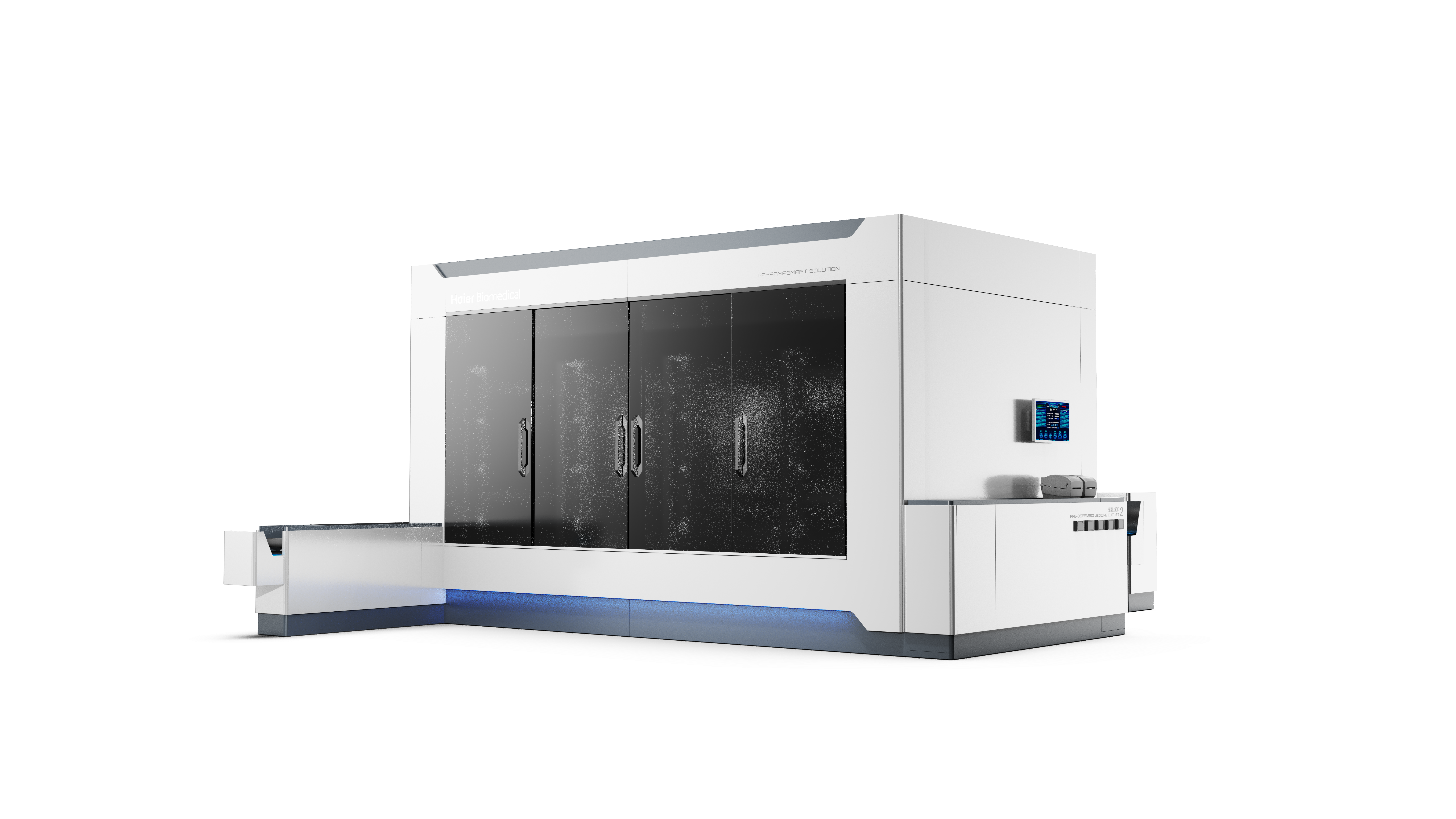
The HOH-KF-1200 Chute Type Dispenser is built around a modular structure of dispensing, storage and loading units. It relies on seamless integration with the HIS system and uses a full-screen, one-time dispensing mode with safety buffers to synchronize prescription medications, which is the configuration the manufacturer positions for high-efficiency dispensing in outpatient pharmacy settings.
| Parameter | HOH-KF-1200 published specification |
|---|---|
| Medication types | >1,100 |
| Storage capacity | >15,000 boxes |
| Dispensing speed | >350–500 prescriptions/hour |
| Replenishment speed | >2,400 boxes/hour |
| Dimensions (W×H×D) | <4,690 × 2,850 × 2,735 mm |
| Space requirement | <12.85 m² |
| Structural design | Modular: dispensing, storage and loading units |
| Dispensing method | Full-screen dispensing with safety buffers; parallel multi-prescription operation |
| Dispensing buffer port | ≥2 channels, supports side buffering and front-end output |
What the specification implies for the workflow. The chute architecture prioritizes continuous release rate within a defined envelope. The published space requirement below 12.85 m² and the dimensions below 4,690 × 2,850 × 2,735 mm give a project team a relatively predictable installation footprint, while the replenishment figure above 2,400 boxes per hour allows loading to be compressed into a dedicated window rather than spread across the shift. The trade-off is catalogue breadth: more than 1,100 medication types, compared with the robotic arm dispenser’s at least 1,500.
Supporting module: where a high-speed dispenser fits
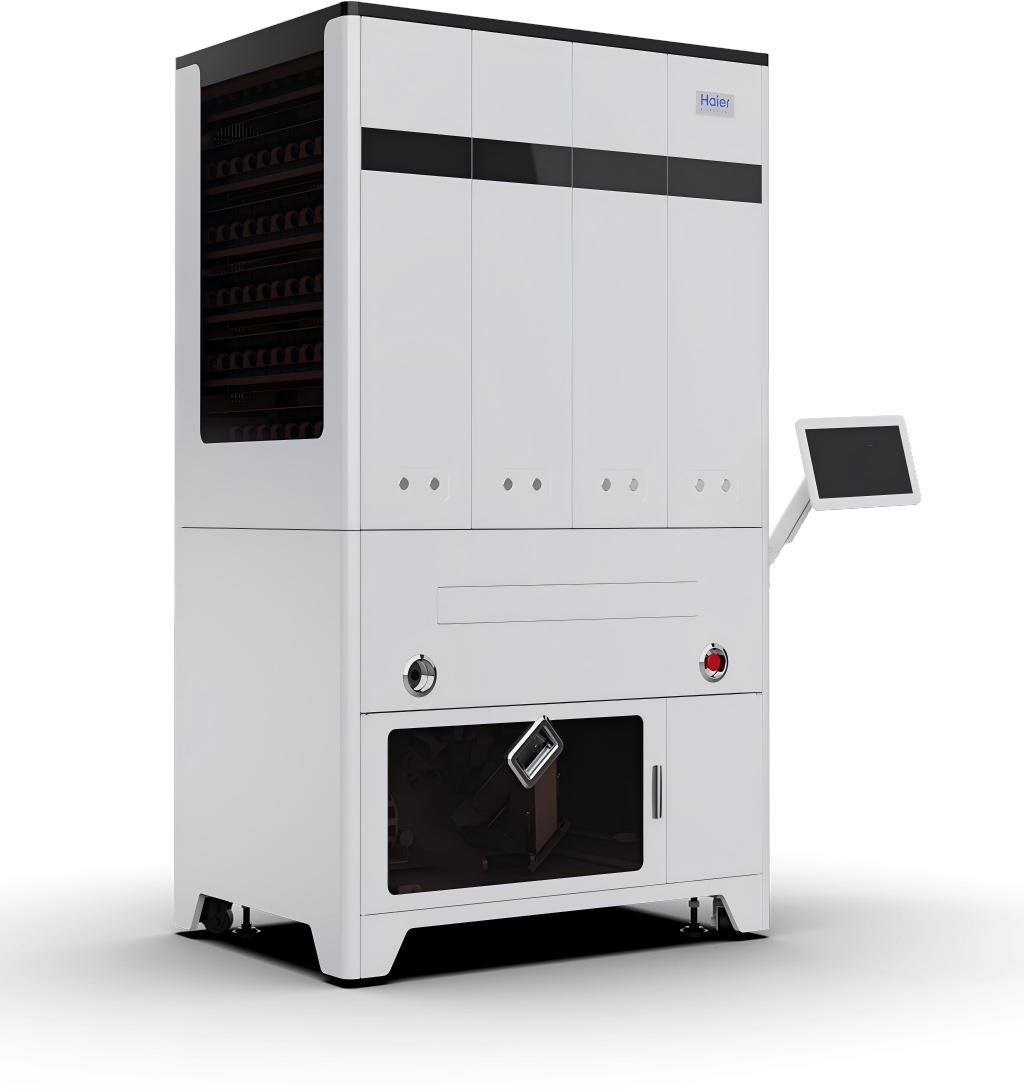
Neither dispenser type needs to carry the entire boxed-medication workload alone. The HOH-GF (2 Modules) High Speed Dispenser is a modular unit built for high-frequency, high-volume boxed medications, using stacked dense storage. Its published specification includes at least 100 storage slots, at least 5,000 boxes of storage capacity, single-channel dispensing of at least 2 boxes per second, a dual-level stacked structure with adjustable bin width, batch dispensing for multiple boxes, high-precision photoelectric sensors for dispensing detection, and automatic positioning guidance with indicator lights.
The same workflow can include a verification layer. The HOH-FB-D400-HD Automatic Sub-packaging and Verification Machine handles 400 medication boxes, packages at 40–60 packs per minute and provides a 72-slot external output tray, with an AI-powered visual verification step and HIS interoperability that create a closed-loop packaging and verification workflow.
Reading the numbers correctly: all figures above are published equipment specifications. Realized throughput depends on the prescription mix, the configured module count, HIS response behaviour and the pharmacy’s own workflow rules — which is why the evaluation should test configurations against the pharmacy’s own peak data, not against the datasheet alone.
Step-by-Step Breakdown: A Selection Framework for Hospital Pharmacies
The framework below sequences the evaluation so that the dispenser type falls out of the pharmacy’s own data. Steps 1 to 5 determine feasibility; steps 6 to 8 determine configuration and compliance scope.
- Quantify the peak release rate, not the daily average. Collect the highest prescriptions-per-hour figure the outpatient pharmacy releases during its busiest window. Compare it against the published dispensing speeds: above 350–500 prescriptions per hour for the chute type dispenser, or at least 300 prescriptions per hour for the robotic arm dispenser. A pharmacy whose peaks sit close to the lower figure should plan module expansion rather than rely on nominal capacity.
- Count the medication types the automated store must hold. If the catalogue exceeds roughly 1,100 boxed types and continues to grow, the robotic arm architecture — specified for at least 1,500 types with at least 20,000 boxes of storage — keeps more of the formulary inside automation. If the catalogue is stable and the pharmacy’s problem is release speed, a chute type dispenser with more than 1,100 types and more than 15,000 boxes is the more direct match.
- Measure floor area and clear height before shortlisting. The chute type dispenser requires under 12.85 m² with dimensions under 4,690 × 2,850 × 2,735 mm. The robotic arm dispenser’s main unit measures 8,650 × 1,747 × 2,850 mm excluding the replenishment module, so the width and the replenishment access path drive the layout. Confirm the room can accommodate the unit, the buffer port and the loading route before comparing anything else.
- Convert replenishment into labour hours. The published replenishment rates differ by a factor of roughly three: more than 2,400 boxes per hour for the chute type dispenser versus at least 700 boxes per hour for the robotic arm dispenser. A pharmacy that cannot dedicate a concentrated loading window should weight this parameter heavily.
- Define traceability and expiry rules explicitly. If the project requires FIFO/FEFO enforcement and barcode-level full-chain monitoring for every dispensed box, the robotic arm dispenser’s specification — FIFO/FEFO support and barcode recognition with full traceability — should be written into the requirement. The same logic should be applied to any verification step, such as an automatic sub-packaging and verification machine.
- Fix the HIS/EMR interface scope in writing. Haier pharmacy automation solutions can be integrated with hospital information systems to support automated prescription processing and dispensing workflows, and depending on project requirements the system can connect with HIS/EMR and other hospital systems so prescription information can be transferred to the automation system. The evaluation should name the interfaces, the data fields and the responsibility split between the hospital IT team and the supplier.
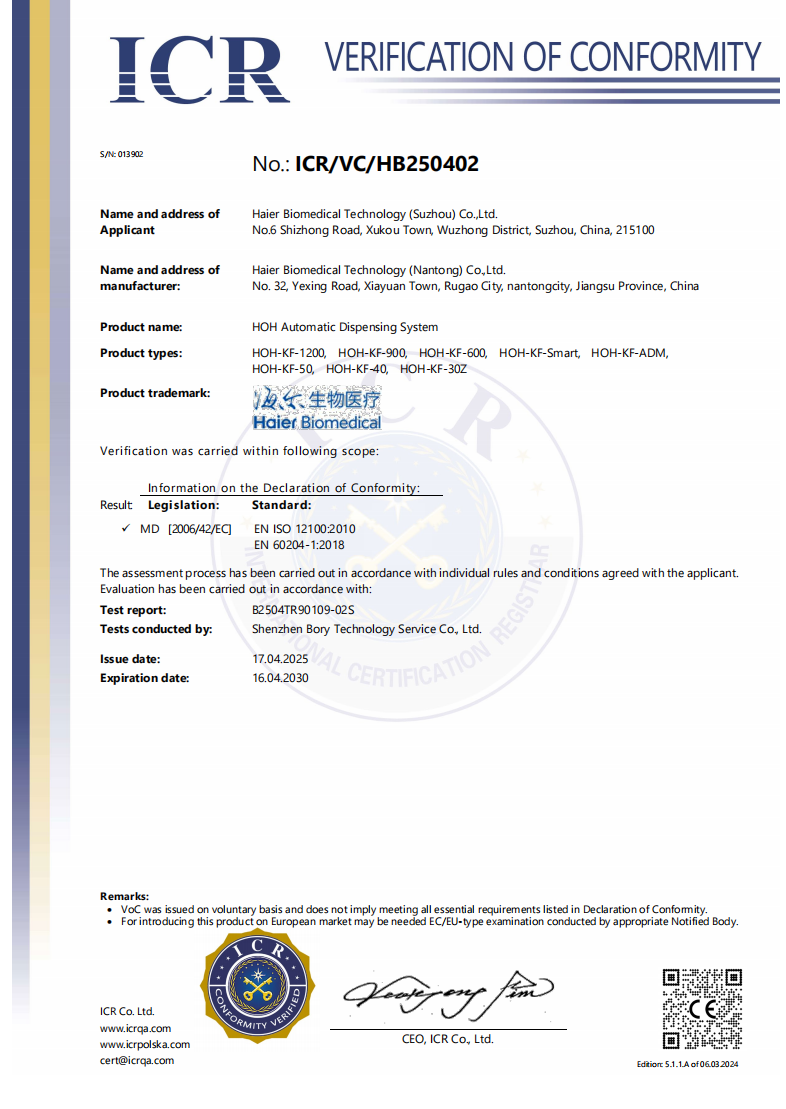
- Assemble the compliance dossier per architecture. For EU market projects, request the certificate that covers the exact model: the Robotic Arm Dispenser is covered by an ISET Voluntary Compliance Certificate (ISETC.000220220323) referencing EN ISO 12100:2010 and EN 60204-1:2018, while the chute type dispenser HOH-KF-1200 is covered by a Verification of Conformity under the MD Directive (ICR/VC/HB250402) referencing the same two standards. Confirm validity dates and the full certificate scope, and confirm the manufacturer’s ISO 13485 quality management system.
- Plan configurability and scale-out before signature. Both architectures are configurable in equipment size, storage capacity, SKU quantity, robotic modules, software functions, HIS interface and language. If the pharmacy expects volume growth or a later phase covering inpatient dispensing, choose the architecture whose modular structure and buffer capacity allow modules to be added without redesigning the room.
Use Cases: Matching Architecture to Pharmacy Scenario
High-volume outpatient pharmacy with a fixed room envelope. A general hospital in Vietnam deployed one set of an intelligent pharmacy automation system in its outpatient pharmacy for automated medication storage, dispensing and intelligent medication management. The configuration was customized to the hospital’s pharmacy layout and workflow requirements, with HIS integration, and the reported outcome was an optimized dispensing workflow, improved medication management efficiency, reduced patient waiting time and an improved patient service experience; the deployment has a ten-year duration. Projects with this profile typically start from the release-rate and footprint constraints, which is where the chute type dispenser’s space requirement below 12.85 m² and its replenishment rate above 2,400 boxes per hour become decisive.
Pharmacies constrained by local medication packaging formats. A private hospital in Thailand deployed one set of a customized universal dispenser system in its outpatient pharmacy for automated dispensing and medication management, improving dispensing efficiency during peak hours and optimizing pharmacy workflows. The system was developed specifically for Thai medication packaging characteristics and is compatible with various medication formats, with HIS integration, modular design, high reliability and scalability, over a ten-year duration. Where packaging variety is high and the catalogue is broad, the robotic arm dispenser’s combination of a wide medication-type range and barcode-based traceability is the more defensible starting point.
Peak-hour bottlenecks with limited loading staff. When the binding constraint is the loading window rather than the picking mechanism, a high-speed dispenser module configured for batch dispensing of multiple boxes, with high-precision photoelectric sensors and automatic positioning guidance, can absorb the high-frequency boxed medications while the main dispenser handles the wider catalogue.
Traceability-driven projects. Pharmacies preparing for audits that require item-level records and expiry discipline should treat traceability as a primary selection parameter. The robotic arm dispenser’s FIFO/FEFO support and barcode recognition with full-chain monitoring, combined with a verification step, provide a documented chain from prescription to released medication.
Comparison Table: HOH-KF-Smart vs HOH-KF-1200
The table below compares only published specifications for the two dispenser types. It is intended to be used with the framework above, not instead of it: the architecture that matches the pharmacy’s tightest constraint is the one worth configuring.
| Selection parameter | Robotic Arm Dispenser HOH-KF-Smart | Chute Type Dispenser HOH-KF-1200 |
|---|---|---|
| Dispensing principle | Robotic arm picks and positions each item, with AI-based visual recognition | Chute/gravity release through modular dispensing, storage and loading units |
| Medication types | ≥1,500 | >1,100 |
| Storage capacity | ≥20,000 boxes | >15,000 boxes |
| Dispensing speed | ≥300 prescriptions/hour | >350–500 prescriptions/hour |
| Replenishment speed | ≥700 boxes/hour | >2,400 boxes/hour |
| Footprint / dimensions | Main unit 8,650 × 1,747 × 2,850 mm (replenishment module excluded) | <4,690 × 2,850 × 2,735 mm; space requirement <12.85 m² |
| Dispensing method | Full-screen, one-time dispensing mode; parallel multi-prescription operation | Full-screen dispensing with safety buffers; parallel multi-prescription operation |
| Buffer port | Dispensing buffer port with side buffering and front-end output | ≥2 channels, side buffering and front-end output |
| Expiry and traceability | FIFO/FEFO support — zero-error dispensing; barcode recognition with full traceability | Not specified in the published parameter set; confirm traceability scope during configuration |
| HIS integration | Real-time prescription data reception; HIS integration with full-screen, one-time dispensing mode | Seamless HIS integration for prescription synchronization |
| EU compliance documentation | ISET Voluntary Compliance Certificate ISETC.000220220323; EN ISO 12100:2010, EN 60204-1:2018; valid to 2027-03-22 | Verification of Conformity ICR/VC/HB250402; EN ISO 12100:2010, EN 60204-1:2018; valid to 2030-04-16 |
| Typical fit | Wide catalogues, item-level traceability requirements, FIFO/FEFO discipline | Constrained floor area with high prescription release rates and concentrated replenishment |

FAQ
Which EU certifications cover the HOH-KF-Smart robotic arm dispenser and the HOH-KF-1200 chute type dispenser?
The Robotic Arm Dispenser is covered by the ISET Voluntary Compliance Certificate for the EU market — an MD Machinery Directive voluntary compliance certificate with certification number ISETC.000220220323, issued by ISET, referencing EN ISO 12100:2010 and EN 60204-1:2018, issued on 2022-03-23 and valid until 2027-03-22. The chute type dispenser model HOH-KF-1200 is covered by a Verification of Conformity (VoC) under the MD Directive, certification number ICR/VC/HB250402, issued by ICR for the EU market, referencing EN ISO 12100:2010 and EN 60204-1:2018, issued on 2025-04-17 and valid until 2030-04-16. The manufacturer also operates an ISO 13485 medical device quality management system. Evaluation teams should verify that the certificate scope explicitly lists the model and configuration being purchased.
Can both dispenser types integrate with a hospital HIS?
Yes. Haier pharmacy automation solutions can be integrated with hospital information systems to support automated prescription processing and dispensing workflows, and depending on project requirements the system can connect with HIS/EMR and other hospital systems so prescription information is transferred to the pharmacy automation system for dispensing. The HOH-KF-Smart integrates with HIS systems using a full-screen, one-time dispensing mode, and both the HOH-KF-Smart and the HOH-KF-1200 support parallel multi-prescription operation with a dispensing buffer port designed for side buffering and front-end output.
Which hospital pharmacy profiles suit a robotic arm dispenser, and which suit a chute type dispenser?
A Robotic Arm Dispenser is suitable for hospitals that handle a relatively large number of boxed medications and require automated storage and dispensing; it can be configured with multiple modules and integrated into the overall pharmacy workflow according to medication volume, available space and dispensing requirements. In specification terms, the robotic arm architecture fits pharmacies whose catalogue approaches or exceeds 1,100–1,500 medication types, that need FIFO/FEFO expiry discipline and barcode-level traceability, and that can accommodate a main unit measuring 8,650 × 1,747 × 2,850 mm excluding the replenishment module. A chute type dispenser fits pharmacies whose binding constraint is release rate inside a limited area — a space requirement below 12.85 m², dispensing above 350–500 prescriptions per hour and replenishment above 2,400 boxes per hour — where loading can be concentrated into a defined window.
What determines the configuration scope and project budget of either dispenser?
Project scope is driven by configuration rather than by a list price, because both dispenser types are available on an OEM/ODM basis with customization of equipment size, storage capacity, SKU quantity, robotic modules, software functions, HIS interface and language. Production is project-based, and the minimum order quantity is one unit. Practical budget planning should therefore define the module count, the buffer capacity, the verification layer, the interface scope and the after-sales package — remote technical support, on-site installation and commissioning, operator training, software upgrades and spare parts supply — as separate line items, and then request a configuration-specific quotation.
How is a configuration validated, and how long does delivery take?
Each unit undergoes a Factory Acceptance Test (FAT) before shipment, and the minimum order quantity is one unit, so a single-pharmacy project can be validated against the hospital’s own prescription data before it is shipped. Lead time is typically 60–90 days depending on project size and configuration. The full-scenario intelligent pharmacy brochure with system configurations and documentation is available for download here: Full-scenario Intelligent Pharmacy brochure (PDF). For a configuration review against your prescription volume, space plan and compliance requirements, contact the Haier Pharmacy Automation team at smartpharmacy@haierbiomedical.com or via WhatsApp at +86 187 7008 3375.
Conclusion: Decide on the Constraint, Then Configure the Modules
The two architectures answer different questions. The chute type dispenser HOH-KF-1200 answers “how fast can prescriptions be released in the space I have?” — more than 350 to 500 prescriptions per hour, more than 2,400 boxes per hour of replenishment, and a space requirement below 12.85 m². The robotic arm dispenser HOH-KF-Smart answers “how much of my catalogue can be automated with item-level traceability?” — at least 1,500 medication types, at least 20,000 boxes of storage, FIFO/FEFO expiry management and barcode recognition with full-chain monitoring.
A workable evaluation sequence is therefore: measure the peak release rate, count the medication types, measure the room, convert replenishment into labour hours, write down the traceability rule, fix the HIS interface scope, and collect the certificate that names the exact model. Anything left unresolved in those seven items is a project risk that no additional module can remove later.
Next step for your hospital pharmacy project
Haier Biomedical Technology(Suzhou)Co., Ltd supplies configurable robotic arm and chute type dispensing systems on an OEM/ODM basis, with FAT before shipment, one-unit minimum order quantity and lead time typically 60–90 days. Send your peak prescription rate, medication count and room dimensions for a configuration comparison.
Brochure: Full-scenario Intelligent Pharmacy (PDF)
Email: smartpharmacy@haierbiomedical.com | WhatsApp: +86 187 7008 3375
Website: www.haierautomation.com
Contact: Gina | Address: No.6 Shizhong Road, Wuzhong District, Suzhou, China, 215100