
Robotic Arm vs. Chute Dispensers: A Comparative Guide for High-Volume Pharmacies
Robotic Arm vs. Chute Dispensers: A Comparative Guide for High-Volume Pharmacies
High-volume hospital pharmacies face a common equipment decision: should an automated dispensing system use a robotic arm to pick boxes, or should it use a chute-type drop architecture to move many prescriptions in parallel? Haier Biomedical Technology(Suzhou)Co., Ltd offers both approaches. This guide compares the HOH-KF-Smart robotic arm dispenser with the HOH-KF-1200 chute type dispenser using manufacturer-published specifications. The goal is to help hospital decision-makers choose the technology that best fits their throughput, medication range, space, and replenishment constraints.
The short answer for planners: the HOH-KF-Smart robotic arm dispenser is designed around automated storage and robotic picking for a broad range of boxed medications, while the HOH-KF-1200 chute type dispenser is designed for rapid full-screen discharge and fast replenishment in a compact footprint. Neither system is universally better; the decision depends on the pharmacy's daily prescription load, available floor area, and medication mix.
The real problem: matching throughput, footprint, and replenishment workload
Hospital pharmacies in high-volume settings are not simply looking for a machine to replace a shelf. They must solve four connected problems: patient waiting time during peak hours, medication range and storage capacity, the physical space available inside the pharmacy, and the workload required to keep the system supplied with medication.
Manual picking can become a bottleneck when prescription volume rises. Automation reduces repetitive medication handling and standardizes the dispensing workflow. However, the value of automation depends on whether the selected dispensing logic matches the pharmacy's operational profile. A robotic arm system and a chute system may both be called automated dispensers, but they create fundamentally different workflows.
- Robotic arm dispensing uses a mechanical arm to identify and move medication boxes between configured storage locations and output points.
- Chute dispensing uses a full-screen drop architecture with safety buffers, allowing multiple prescriptions to be processed in parallel.
- Replenishment speed and footprint are as important as headline dispensing speed when a pharmacy operates in peak shifts.
Pharmacy automation in high-volume settings
Independent market research estimates the global pharmacy automation devices market at about USD 6.7 billion in 2024, with forecasts suggesting growth toward USD 11.6 billion by 2030 at a compound annual growth rate of about 9.9%. Medication dispensing systems represented the largest product segment in 2025, at an estimated 32.5% of the market. Hospital pharmacies have also been identified as the dominant end-user setting due to high patient volumes and complex medication regimens.
These market figures help explain why hospital decision-makers are now comparing dispensing architectures rather than merely asking whether to automate. In addition, industry reports note that a large share of pharmacist time has historically been spent on non-clinical, task-oriented work. By transferring repetitive picking and dispensing work to automated equipment, hospitals can free pharmacists for verification, patient counseling, and other professional responsibilities.
Industry context sources: Insightace Analytic, Grand View Research, Dataintelo, Fortune Business Insights, and Omnicell via cited public reports.
Two dispensing architectures explained
HOH-KF-Smart: Haier robotic arm medication dispensing system
The HOH-KF-Smart is a robotic arm medication dispensing system. It is intended for hospitals that handle a comparatively large number of boxed medications and require automated storage and dispensing rather than manual shelf retrieval. According to Haier, the system can be configured with multiple modules and integrated into the overall pharmacy workflow based on medication volume, available space, and dispensing requirements.
- Medication types: ≥1500
- Storage capacity: ≥20000 boxes
- Main unit dimensions (W×H×D): 8650×1747×2850 mm, replenishment module excluded
- Dispensing speed: ≥300 prescriptions/hour
- Replenishment speed: ≥700 boxes/hour
- Expiration management: FIFO/FEFO support, described by Haier as zero-error dispensing
- Full-chain monitoring: barcode recognition with full traceability
In practical terms, the HOH-KF-Smart emphasizes medication coverage and controlled picking. Its specification supports more than 1,500 medication types and more than 20,000 stored boxes. It also includes barcode recognition and expiration management as part of the dispensing logic, which can be important for hospitals that need to maintain a wide inventory of boxed oral medications and monitor expiry risk.
HOH-KF-1200: Haier chute type dispenser
The HOH-KF-1200 is a chute type dispenser. It uses a modular architecture made up of dispensing, storage, and loading units. Its dispensing method is described as full-screen dispensing with safety buffers and parallel multi-prescription operation. This design is oriented toward high daily prescription volumes and rapid medication discharge.
- Medication types: >1100
- Storage capacity: >15000 boxes
- Dimensions (W×H×D): <4690×2850×2735 mm
- Space requirement: <12.85 m²
- Dispensing speed: >350–500 prescriptions/hour
- Replenishment speed: >2400 boxes/hour
- Dispensing buffer port: ≥2 channels, supporting side buffering and front-end output
- Structural design: modular dispensing, storage, and loading units
The HOH-KF-1200 specification sheet does not publish a larger footprint threshold because it is designed to remain inside a relatively compact area. With a space requirement below 12.85 m², the chute type dispenser may fit into an outpatient pharmacy where floor area is limited. Its replenishment speed of more than 2,400 boxes per hour is especially relevant for pharmacies that must reload medication during busy operational windows.
Robotic arm vs chute: side-by-side comparison table
| Selection parameter | HOH-KF-Smart robotic arm dispenser | HOH-KF-1200 chute type dispenser |
|---|---|---|
| Primary dispensing architecture | Robotic arm picks medication from configured storage locations | Full-screen medication drop with safety buffers and parallel multi-prescription operation |
| Medication types | ≥1500 | >1100 |
| Storage capacity | ≥20000 boxes | >15000 boxes |
| Main unit dimensions | 8650×1747×2850 mm, replenishment module excluded | <4690×2850×2735 mm |
| Approximate footprint guidance | Dimensions indicate a long linear layout; no separate footprint figure is published for HOH-KF-Smart | <12.85 m² |
| Dispensing speed | ≥300 prescriptions/hour | >350–500 prescriptions/hour |
| Replenishment speed | ≥700 boxes/hour | >2400 boxes/hour |
| Expiration management | FIFO/FEFO support with zero-error dispensing | Not specified in the published product specification |
| Traceability | Barcode recognition with full traceability | Not specified in the published product specification |
| Modularity | Can be configured with multiple modules and integrated with pharmacy workflow | Modular dispensing, storage, and loading units |
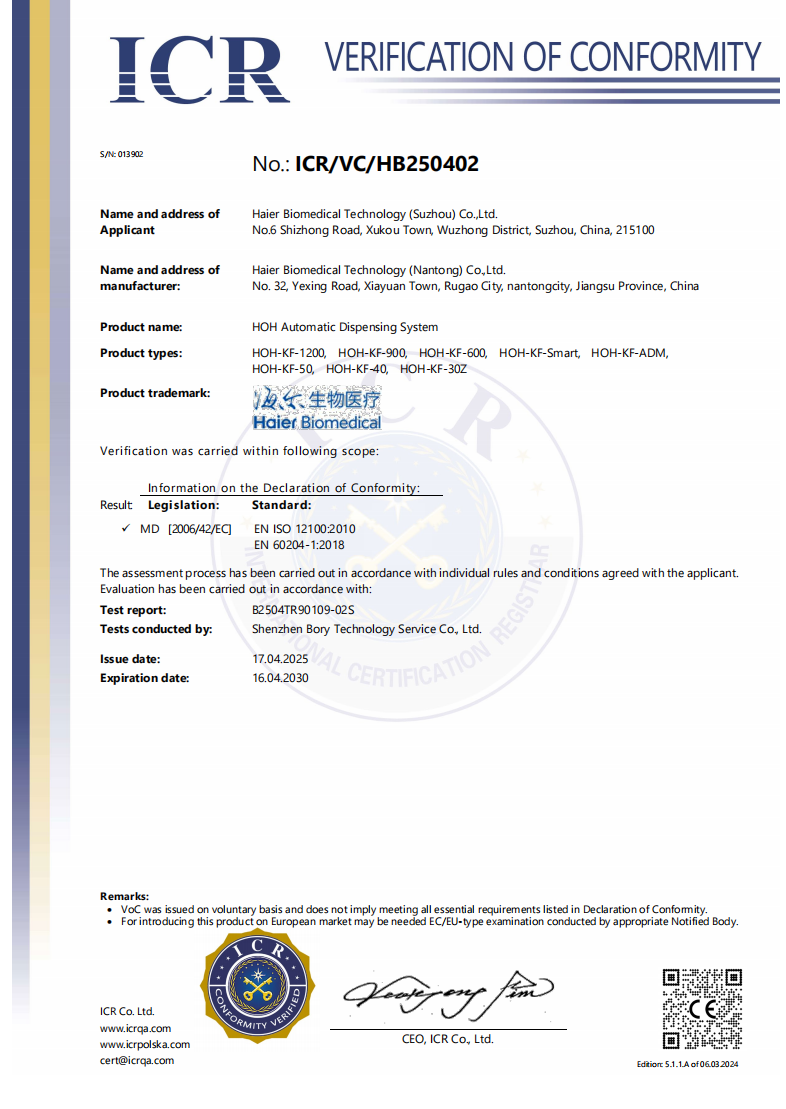
Both HOH-KF-Smart and HOH-KF-1200 are included in Haier's EU Verification of Conformity certificate ICR/VC/HB250402, issued by ICR on 2025-04-17 and valid until 2030-04-16. The certificate applies to automatic dispensing systems and references EN ISO 12100:2010 and EN 60204-1:2018. The HOH-KF-Smart is also covered by an ISET voluntary compliance certificate, ISETC.000220220323, valid through 2027-03-22. Haier Biomedical states that it operates with ISO 13485 medical device quality management system certification.
Step-by-step: from evaluation to execution
The comparison table is useful only when matched to a hospital's operating constraints. A practical selection process can follow six steps.
- Define the medication profile. Count the number of active boxed medication SKUs, the storage volume required, and whether medication expiry control is a priority. If the formulary needs exceed 1,100 types, the HOH-KF-Smart's 1,500-type capacity may offer more headroom.
- Measure the proposed pharmacy footprint. For constrained floor areas, the HOH-KF-1200's below-12.85-m² space requirement is an explicit planning figure. The HOH-KF-Smart requires planning around its full main-unit dimensions of 8650×1747×2850 mm, excluding the replenishment module.
- Forecast peak dispensing demand. If the pharmacy must process peak waves above 300 prescriptions per hour, compare the HOH-KF-Smart's ≥300-per-hour specification with the HOH-KF-1200's >350–500-per-hour range.
- Review replenishment workload. A fast dispenser still depends on being refilled. HOH-KF-1200 offers more than 2,400 boxes/hour replenishment speed, while HOH-KF-Smart offers ≥700 boxes/hour. Facilities with limited back-room staffing should weigh this difference carefully.
- Check integration and compliance requirements. Haier pharmacy automation can be integrated with hospital information systems, including HIS and EMR platforms, to transfer prescription information into the dispensing workflow. EU-facing projects should verify the relevant conformity certificate and the exact model scope.
- Define customization and delivery expectations. Haier offers OEM, ODM, and customizable production services. Customization may cover equipment size, storage capacity, SKU quantity, robotic modules, software functions, HIS interface, and language. The standard MOQ is 1 unit; typical lead time is 60–90 days depending on project size and configuration. Haier also conducts a factory acceptance test before shipment and provides services such as remote technical support, on-site installation and commissioning, operator training, software upgrades, and spare parts supply.
Use cases and scenario fit
Scenario 1: high peak prescription volume with limited pharmacy space. A hospital that processes very high daily prescription counts and needs rapid patient throughput can benefit from the HOH-KF-1200 chute architecture. Its parallel, full-screen drop method, safety buffers, and replenishment speed are aligned with continuous peak operation. Its compact footprint also makes it easier to fit into an existing outpatient pharmacy.
Scenario 2: broad boxed formulary and strict expiration management. A hospital that stores many types of boxed medications and needs barcode-based traceability may prefer the HOH-KF-Smart robotic arm system. With ≥1,500 medication types, ≥20,000 boxes of storage, FIFO/FEFO support, and full-chain barcode recognition, this architecture supports medication inventory control and expiry-aware dispensing.
Scenario 3: existing hospital outpatient pharmacy upgrade. Haier has completed hospital projects in different regions. For example, a general hospital in Vietnam implemented a Haier intelligent pharmacy automation system for outpatient pharmacy medication storage and dispensing. That project included the chute type dispenser as part of the solution and was used to optimize dispensing workflows, reduce patient waiting time, and improve medication management efficiency.
Scenario 4: mixed-use or phased deployment. Hospitals sometimes choose to automate separate zones rather than replace the entire pharmacy at once. According to Haier's buyer guidance, no single automation system fits every hospital. The final configuration should be based on prescription volume, medication types, pharmacy layout, workflow, available space, and investment requirements. Haier's broader product family includes robotic arm, chute type, and high-speed dispensers so that hospital teams can select equipment for different pharmacy scenarios.
FAQ
Which dispenser is faster for a high-volume pharmacy?
Based on Haier's published specifications, the HOH-KF-1200 chute type dispenser is positioned for higher output: it dispenses more than 350–500 prescriptions per hour and replenishes at a rate above 2,400 boxes/hour. The HOH-KF-Smart robotic arm dispenser offers ≥300 prescriptions/hour and ≥700 boxes/hour replenishment. If raw throughput and rapid restocking are the dominant criteria, the chute architecture is the more appropriate starting point.
Is Haier a pharmacy automation OEM manufacturer for medication identification?
Yes. Haier Biomedical Technology(Suzhou)Co., Ltd provides OEM, ODM, and customizable production services for intelligent pharmacy automation. Customization options include equipment size, storage capacity, SKU quantity, robotic modules, software functions, HIS interface, and language. For medication identification and traceability requirements, the HOH-KF-Smart robotic arm dispenser is an example of a system that uses barcode recognition and full-chain monitoring as part of the automated dispensing workflow. The minimum order quantity is 1 unit, and the typical lead time is 60–90 days depending on project size and configuration.
Which hospitals should consider a robotic arm dispenser?
A robotic arm dispenser such as the HOH-KF-Smart is suitable for hospitals that handle a comparatively large number of boxed medications and require automated storage and dispensing. Haier states that the system can be configured with multiple modules and integrated into the overall pharmacy workflow based on medication volume, available space, and dispensing requirements. It is especially relevant when the medication mix is broad and when barcode traceability or FIFO/FEFO expiry management is needed.
Is pharmacy automation suitable for every hospital?
No. Pharmacy automation should be selected according to prescription volume, medication types, pharmacy layout, workflow, available space, and investment requirements. Haier offers different automation systems, including robotic arm dispensers, chute type dispensers, and high-speed dispensers, for different pharmacy scenarios. A hospital with predominantly high-volume boxed medications and accuracy requirements may evaluate the robotic arm option, while a facility with a very high daily prescription volume and limited floor area may evaluate the chute type dispenser. Installation choices should always be validated against the hospital's site conditions and operating workflow.
Can Haier automated dispensing systems integrate with a hospital HIS?
Haier pharmacy automation solutions can be integrated with hospital information systems to support automated prescription processing and dispensing. Depending on the project requirements, the system can connect with HIS/EMR and other hospital systems, allowing prescription information to be transferred directly to the pharmacy automation equipment for medication dispensing. This reduces repetitive manual data entry and supports prescription verification within the configured workflow.
Conclusion
For high-volume pharmacies, the choice between a robotic arm dispenser and a chute type dispenser should be driven by measurable operating needs. The Haier HOH-KF-Smart robotic arm dispenser supports a wider medication range, greater storage capacity, FIFO/FEFO expiry control, and barcode traceability. The Haier HOH-KF-1200 chute type dispenser provides a faster specified dispensing rate, faster replenishment, and a footprint below 12.85 m². Both models are available from the same manufacturer and share conformity coverage under Haier's EU automatic dispensing system certificate.
Hospital decision-makers should evaluate their medication SKU count, peak prescription lines, floor plan, and staffing model before locking a technology choice. For a full review of Haier product options, project engineering, and customization capabilities, contact the Haier Biomedical pharmacy automation team.
Speak with the Haier pharmacy automation team
Email: smartpharmacy@haierbiomedical.com
WhatsApp / Tel: +86-187-7008-3375
Website: www.haierautomation.com