
Robotic Dispenser Speed and Pick-and-Place Accuracy: A Technical Deep Dive
Robotic Dispenser Speed and Pick-and-Place Accuracy: A Technical Deep Dive
Pick-and-place accuracy and dispensing speed are the two engineering numbers that decide whether a robotic pharmacy dispenser holds up under real prescription volume. In the published Haier dispensing portfolio, the HOH-KF-Smart robotic arm dispenser is rated at ≥300 prescriptions per hour with ≥700 boxes per hour of replenishment, while the HOH-KF-1200 chute type dispenser is rated at more than 350–500 prescriptions per hour with a replenishment speed above 2400 boxes per hour. This technical deep dive explains what sits behind those figures: the sensing, addressing, buffering, and integration decisions that determine whether a stated speed is actually reachable in a working hospital pharmacy.
Haier Biomedical Technology(Suzhou)Co., Ltd is the Suzhou-based pharmacy automation business unit of Haier Biomedical, a healthcare technology company under Haier Group that develops intelligent pharmacy solutions for hospitals, clinics, and healthcare organizations. The company was founded in 2015, operates a 13,000 m² manufacturing facility with approximately 500 employees and a 100-engineer R&D team, and holds ISO 13485 medical device quality management system certification. Its dispensing portfolio covers robotic arm dispensers, chute type dispensers, high speed dispensers, sub-packaging and verification machines, and controlled-substance management cabinets, with reference projects in Southeast Asia and other international markets.
Problem Definition: Why Speed and Accuracy Are Not Independent Variables
A robotic dispenser sits between a hospital information system and a patient collection counter. Its effective throughput is therefore not the speed of any single component, but the speed of the slowest stage in the chain. Three stages dominate the arithmetic: prescription intake and validation from the hospital system, pick-and-place execution inside the storage structure, and release, labeling, and verification at the output point. Improving the gripper or the drop mechanism without addressing intake latency or output congestion usually produces a machine that is fast internally and slow in practice.
Accuracy fails for equally concrete reasons. Boxed medications arrive from multiple manufacturers with slightly different carton dimensions, surface friction, and weight distribution, so a pick-and-place routine validated on one carton format can degrade on another. Storage lanes can drift out of calibration over months of operation. And an accurate pick is still not an accurate dispense if the medication is not confirmed against the prescription before it leaves the pharmacy. That is why the meaningful definition of accuracy in dispensing is end-to-end: the correct product is selected, physically handled without damage or misplacement, released in the correct sequence, verified, and recorded against the prescription.
Throughput specifications also need unit discipline before they can be compared. Prescriptions per hour, boxes per hour of replenishment, and boxes per second on a single dispensing channel measure three different things, and a hospital that mixes them in a tender document will receive offers that are not comparable. A credible technical evaluation separates the three and then checks each one against the pharmacy's own prescription profile.
The practical rule for buyers: request dispensing throughput in prescriptions per hour, replenishment throughput in boxes per hour, channel-level output in boxes per second, and the accuracy statement in the exact wording used by the manufacturer — then test all four in a factory acceptance test before shipment.
Industry Background: Why Dispensing Throughput Is Now a Board-Level Constraint
Pharmacy automation is no longer a niche hardware category. The global pharmacy automation devices market was estimated at USD 6.7 billion in 2024 by Insightace Analytic, and Grand View Research projects the broader pharmacy automation market to reach USD 11.6 billion by 2030, a compound annual growth rate of 9.9%. Regional concentration is significant: Dataintelo and MarketsandMarkets estimate that North America accounted for roughly 38.2% to 47.8% of global revenue in 2024. Within the product mix, Dataintelo reports that medication dispensing systems represented the largest product segment share at 32.5% in 2025, which places dispensing hardware — not software alone — at the center of most capital plans.
The demand profile explains the pressure on speed and accuracy specifications. Fortune Business Insights reports that the hospital pharmacy segment held the largest market share in 2024, driven by patient volumes and complex medication regimens, and that decentralized distribution models are expected to account for 79.8% of the market in 2026 as automated dispensing cabinets spread through wards. Decentralization multiplies the number of dispensing points that must remain synchronized with central inventory, so central dispensing equipment has to replenish faster and with tighter traceability than a purely manual workflow ever required.
Two further signals matter for engineering planning. Grand View Research identifies automated medication compounding as the fastest-growing product segment with a CAGR exceeding 10%, and MarketsandMarkets expects pharmacy automation software to grow fastest among components from 2024 to 2030 — meaning that integration capability, not mechanical speed alone, increasingly differentiates systems. Regulation reinforces the same direction: CSA Group notes that pharmacy automation systems must comply with IEC 60601-1 for medical electrical equipment safety and ISO 13485 for quality management, while the U.S. FDA's 21 CFR Part 11 governs electronic records and electronic signatures where dispensing data is used for compliance purposes. Speed claims that cannot be evidenced in an audit trail are of limited value to a hospital pharmacy director.
Detailed Solution: How a Dispensing Speed and Accuracy Stack Is Built
Achieving high throughput without sacrificing pick-and-place reliability is an architectural problem rather than a component problem. In the Haier dispensing platforms, the architecture separates into five layers, each of which can be specified, tested, and audited independently.
1. The accuracy chain: recognition, addressing, and expiration logic
On the HOH-KF-Smart robotic arm dispensing system, medication handling is driven by industrial-grade robotic arms combined with AI-based visual recognition. The system receives prescription data in real time from the hospital HIS, then automatically picks, positions, and dispenses medications. Accuracy is reinforced by barcode recognition for full-chain traceability and by expiration management that supports FIFO and FEFO logic — first-in-first-out or first-expired-first-out — as the basis for zero-error dispensing routines. In Haier's published selection guidance for hospital pharmacies, the Robotic Arm Dispenser is described as offering dispensing accuracy of up to 99%, and is recommended where dispensing accuracy is a key priority alongside a large volume of boxed medications.
2. Where dispensing speed physically comes from
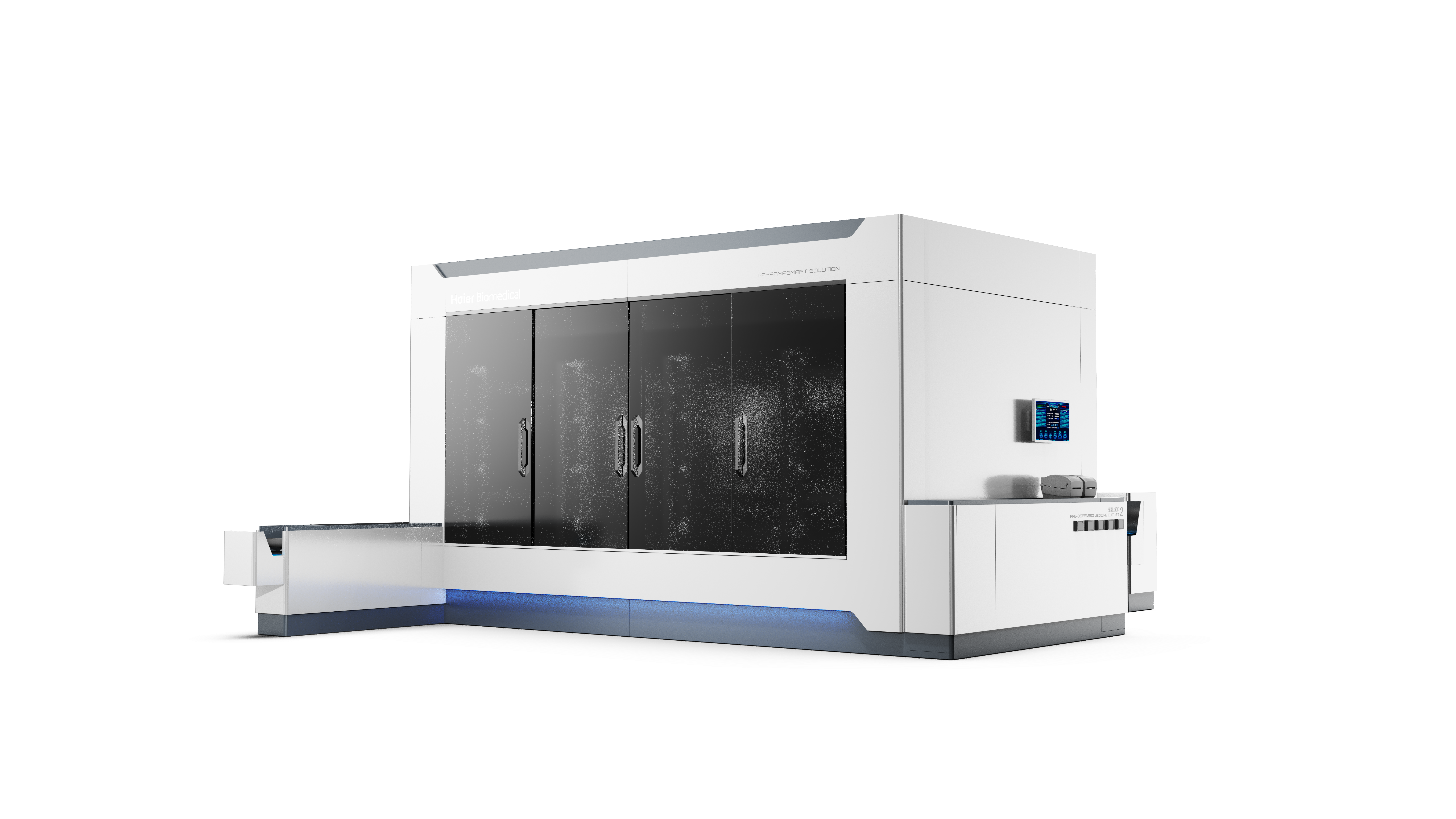
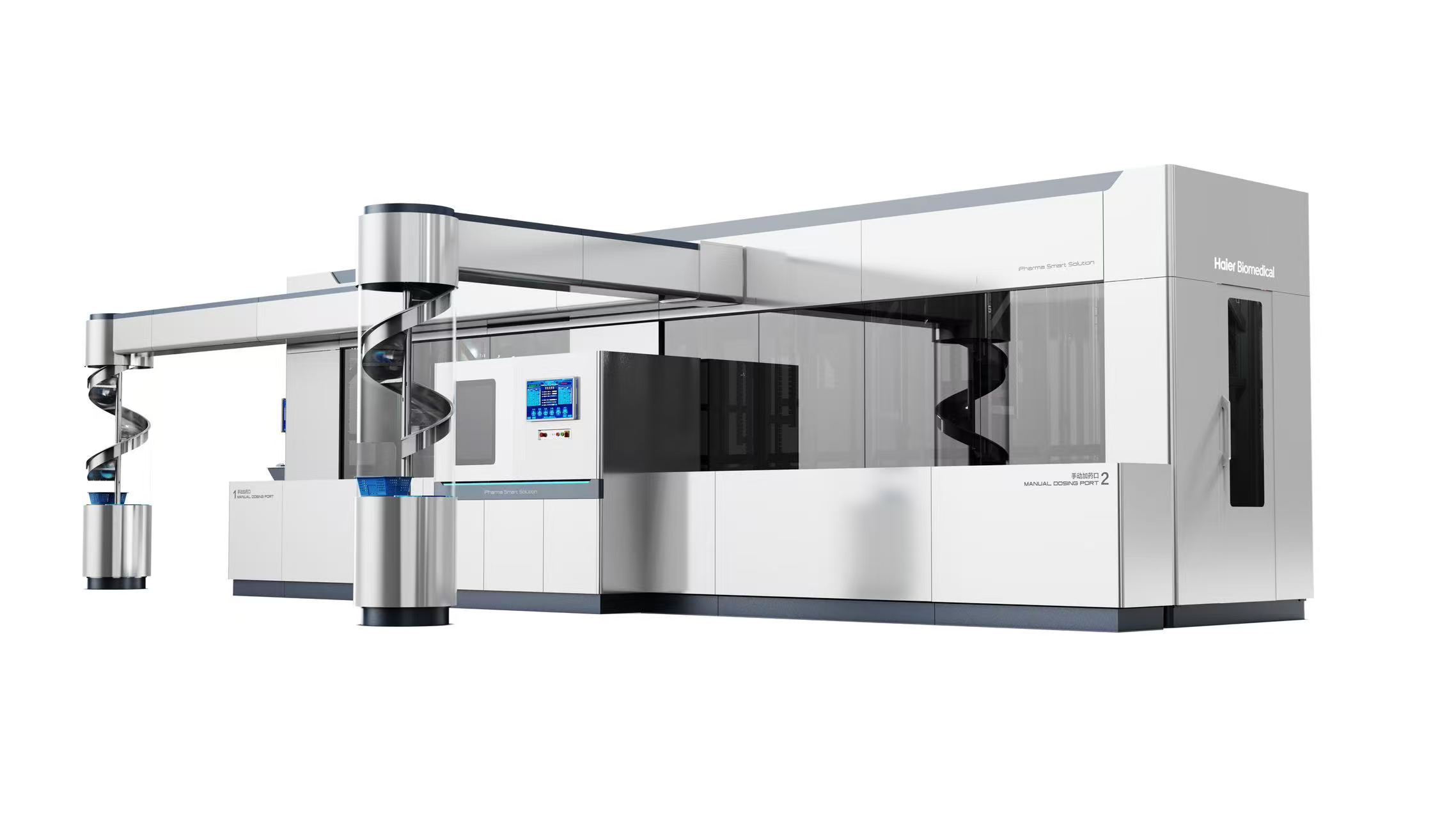
Speed is generated in three different ways across the portfolio, and each has a distinct operating signature. The HOH-KF-Smart robotic arm dispenser delivers ≥300 prescriptions per hour across ≥1500 medication types and a storage capacity of ≥20000 boxes, with replenishment at ≥700 boxes per hour; its main unit measures 8650 × 1747 × 2850 mm excluding the replenishment module. The HOH-KF-1200 chute type dispenser reaches more than 350–500 prescriptions per hour across more than 1100 medication types and more than 15000 boxes of storage, with a replenishment speed above 2400 boxes per hour, within a footprint of less than 12.85 m² and unit dimensions under 4690 × 2850 × 2735 mm. The HOH-GF high speed dispenser takes a different approach again: single-channel dispensing at ≥2 boxes per second, with ≥100 storage slots, ≥5000 boxes of capacity, a dual-level stacked structure with adjustable bin width, and batch dispensing for multiple boxes.
3. Buffer channels and parallel multi-prescription workflows
Congestion at the output point is the most common reason a theoretically fast dispenser underperforms. The HOH-KF-1200 addresses this with a dispensing buffer port that provides at least 2 channels and supports both side buffering and front-end output, combined with full-screen dispensing with safety buffers and parallel multi-prescription operation. In practice this means the drop action and the collection action are decoupled: while one prescription is being assembled at the buffer, another can be released, so a slow-moving patient does not idle the storage structure. The parallel multi-prescription mode allows several prescriptions to progress through the machine simultaneously rather than in strict sequence.
4. Modular construction and hospital system integration
All three dispensing platforms are built on modular principles. The HOH-KF-1200 separates dispensing, storage, and loading units; the HOH-GF supports up to two medication bin modules within a dual-level stacked structure; the HOH-KF-Smart is configured as a main unit with an optional replenishment module. Because the modules are separable, capacity can be added without replacing the entire installation, which matters in hospitals that phase automation across outpatient and inpatient pharmacies.
Integration is the other half of the architecture. Haier pharmacy automation solutions are designed to connect with hospital information systems including HIS and EMR platforms so that prescription information transfers into the dispensing workflow without repetitive manual data entry. The Robotic Arm Dispenser receives prescription data in real time and executes dispensing tasks accordingly. Customization available for these projects covers equipment size, storage capacity, SKU quantity, robotic modules, software functions, HIS interface, and language, under an OEM/ODM model with a minimum order quantity of one unit.
5. Verification as the final accuracy gate
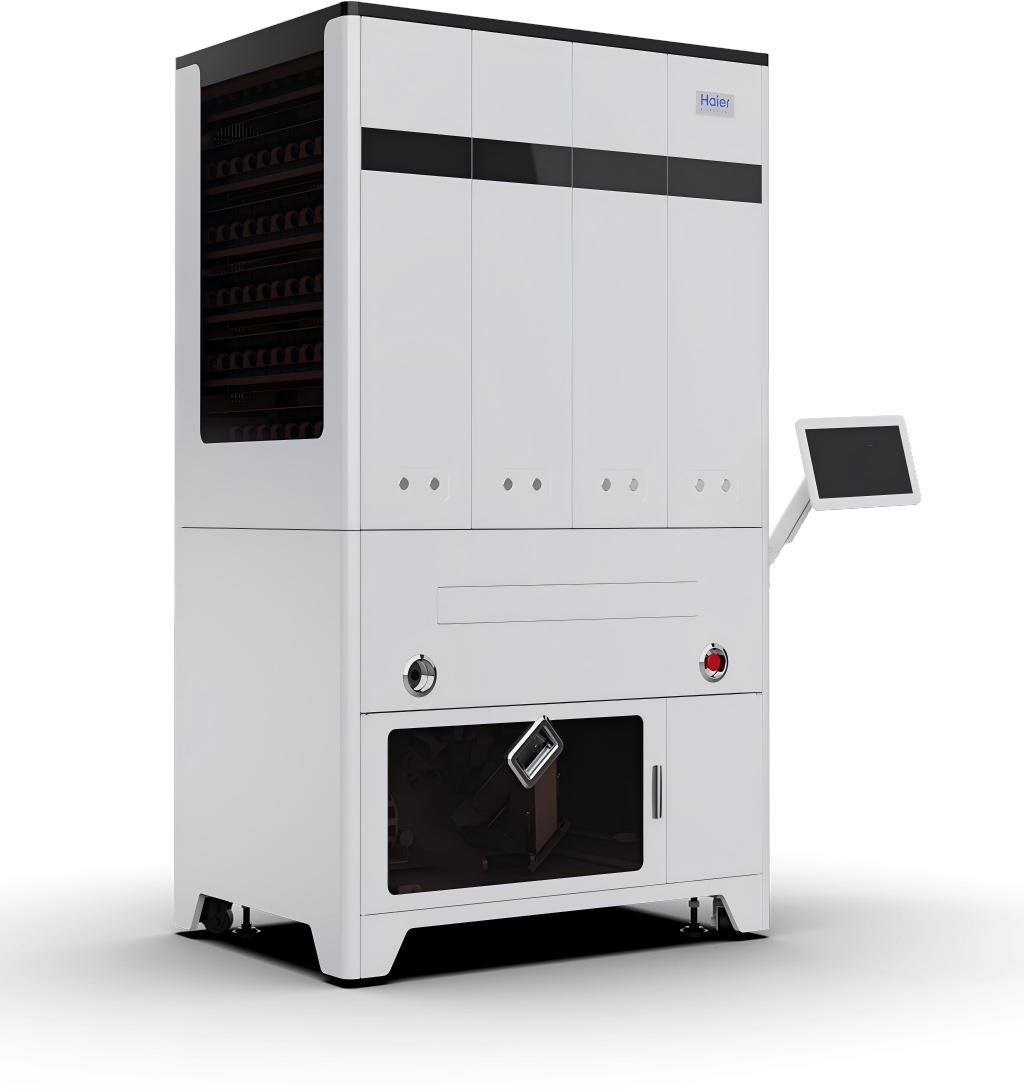
Automated dispensing reduces repetitive manual picking and standardizes the workflow, and Haier's published guidance notes that when dispensing is combined with a verification process, such as an automated verification machine, the workflow adds a further check on medication information before release. The HOH-FB-D400-HD automatic sub-packaging and verification machine is built for that role: it integrates unit-dose packaging with AI-powered visual verification, is interoperable with hospital HIS systems, executes unit-dose dispensing against physician orders, and verifies drug type, quantity, and prescription accuracy in real time. It handles 400 medication boxes, packages at 40–60 packs per minute, and provides a 72-slot external output tray, creating a closed-loop packaging-plus-verification workflow before medication leaves the pharmacy.
Step-by-Step: Eight Stages of a Single Robotic Dispense Cycle
The following sequence describes how a prescription physically moves through an automated dispensing installation, with the engineering question that should be answered at each stage during evaluation.
- Prescription intake. The HIS or EMR transmits the prescription to the dispensing system through the configured interface. Specify: real-time data transfer, interface method, and how the workflow behaves during HIS downtime.
- Prescription validation and SKU allocation. The system matches the prescription to stored medication types and available stock. Specify: the number of medication types supported — ≥1500 on the HOH-KF-Smart, more than 1100 on the HOH-KF-1200 — and how unmatched items are handled.
- Storage addressing. The software identifies the correct storage location or lane. Specify: zero-error dispensing logic and expiration rules such as FIFO and FEFO.
- Pick-and-place execution. Either a robotic arm picks and positions the product, or a chute mechanism releases it through full-screen dispensing. Specify: the handling method and its sensitivity to carton size variation, plus adjustable bin width where relevant.
- Dispensing detection. Sensors confirm that a unit has actually been released. On the HOH-GF, high-precision photoelectric sensors perform dispensing detection. Specify: detection technology, not just claimed speed.
- Buffering. Released units enter the dispensing buffer port. On the HOH-KF-1200 this provides at least 2 channels with support for side buffering and front-end output. Specify: buffer depth and whether side and front output can run simultaneously.
- Error handling and operator guidance. If a pick or drop fails, the system should localize the fault. On the HOH-GF, automatic positioning guidance with indicator lights directs the operator to the affected position. Specify: fault localization and recovery time.
- Verification and record closure. Medication is verified against prescription data — for example through the HOH-FB-D400-HD — and the transaction is recorded for traceability. Specify: barcode scanning, full-chain traceability, and electronic record requirements.
Use Cases: Matching Throughput Profile to Pharmacy Scenario
High-volume outpatient pharmacies. Where daily prescription volume is high and most medications are boxed, the chute type dispenser fits because full-screen dispensing releases a prescription in one pass and the buffer port keeps the output flowing. Haier's own selection guidance recommends the Chute Type Dispenser for high-volume pharmacies requiring higher dispensing efficiency, noting that simultaneous dispensing and replenishment makes it suitable for hospitals with a high daily prescription volume.
Wide-SKU pharmacies prioritizing accuracy. Where the medication list is broad and picking accuracy is the dominant risk, the robotic arm dispenser is the appropriate profile: ≥1500 medication types, ≥20000 boxes of storage, robotic handling, and FIFO/FEFO expiration control. Haier's guidance positions it for hospitals handling a relatively large number of boxed medications that require automated storage and dispensing.
Compact, high-frequency bin dispensing. The HOH-GF high speed dispenser is designed for high-frequency, high-volume boxed medications using stacked dense storage at ≥2 boxes per second on a single channel, in a 2180 × 1230 × 2800 mm main unit — useful where floor space is constrained but throughput demand is concentrated on fast-moving items.
Inpatient unit-dose and verification workflows. Where medication must be packaged per dose and verified before ward delivery, the sub-packaging and verification machine closes the loop between preparation and confirmation, with 40–60 packs per minute and a 72-slot external output tray.
Reference projects. In Thailand, a private hospital deployed one set of a customized universal dispenser system in its outpatient pharmacy for automated dispensing and medication management, customized to local medication packaging characteristics, with HIS integration and a modular, scalable design. In Vietnam, a general hospital implemented one set of an intelligent pharmacy automation system for automated storage, dispensing, and intelligent medication management, customized to the hospital's pharmacy layout and workflow, with reported improvements in medication management efficiency and reduced patient waiting time during peak operation.
Comparison Table: Three Dispensing Architectures Side by Side
The table below compares the three dispensing platforms using published specification values. Blank or unspecified fields indicate that the value is not stated in the published specification and should be confirmed during project engineering rather than assumed.
| Specification | HOH-KF-Smart (Robotic Arm Dispenser) | HOH-KF-1200 (Chute Type Dispenser) | HOH-GF, 2 Modules (High Speed Dispenser) |
|---|---|---|---|
| Dispensing speed | ≥300 prescriptions/hour | >350–500 prescriptions/hour | Single channel ≥2 boxes/second (batch dispensing) |
| Replenishment speed | ≥700 boxes/hour | >2400 boxes/hour | Not specified |
| Medication types | ≥1500 | >1100 | Not specified |
| Storage capacity | ≥20000 boxes | >15000 boxes | ≥5000 boxes (≥100 storage slots) |
| Main unit dimensions (W×H×D) | 8650 × 1747 × 2850 mm (replenishment module excluded) | <4690 × 2850 × 2735 mm; space requirement <12.85 m² | 2180 × 1230 × 2800 mm; ≤2 medication bin modules |
| Structural design | Industrial-grade robotic arms with AI-based visual recognition | Modular dispensing, storage, and loading units | Dual-level stacked structure, adjustable bin width |
| Parallel operation / buffering | Real-time HIS prescription intake | Full-screen dispensing with safety buffers; parallel multi-prescription operation; buffer port ≥2 channels for side buffering and front-end output | Batch dispensing for multiple boxes |
| Expiration and traceability | FIFO/FEFO expiration management; barcode recognition with full traceability | Not specified in published specification | Not specified in published specification |
| Dispensing detection and error alerts | AI-based visual recognition during picking | Safety buffers at full-screen dispensing | High-precision photoelectric sensors; automatic positioning guidance with indicator lights |
| Typical fit | Hospitals with large volumes of boxed medications where dispensing accuracy is a key priority | High-volume pharmacies needing higher dispensing efficiency with simultaneous dispensing and replenishment | High-frequency, high-volume boxed medication dispensing with dense storage |
FAQ
Which standards and regulations apply to robotic dispensing equipment?
Two standards are cited most often in pharmacy automation procurement. CSA Group notes that pharmacy automation systems must comply with IEC 60601-1 for medical electrical equipment safety and ISO 13485 for quality management. In the United States, the FDA's 21 CFR Part 11 regulates electronic records and electronic signatures where dispensing data must meet data-integrity requirements. Haier Biomedical holds ISO 13485 certification for its medical device quality management system, and its pharmacy solutions are designed to support integration with hospital information systems including HIS and EMR platforms.
What determines pick-and-place accuracy in a robotic arm dispenser?
Pick-and-place accuracy is the combined result of recognition, addressing, and expiration logic, not the robotic arm alone. On the HOH-KF-Smart robotic arm dispensing system, AI-based visual recognition is used alongside industrial-grade robotic arms to pick, position, and dispense medications, while barcode recognition supports full-chain traceability and FIFO/FEFO logic underpins zero-error dispensing. Haier's published selection guidance describes the Robotic Arm Dispenser as offering dispensing accuracy of up to 99%, and recommends it for hospitals handling large volumes of boxed medications where dispensing accuracy is a priority. Where an additional check is required, dispensing can be combined with a verification process such as an automated verification machine.
Can a robotic dispenser be integrated with the hospital HIS?
Yes. Haier pharmacy automation solutions can be integrated with hospital information systems to support automated prescription processing and dispensing workflows, and depending on project requirements the system can connect with HIS, EMR, and other hospital systems so prescription information is transferred to the pharmacy automation system for dispensing. The HOH-KF-Smart robotic arm dispenser receives prescription data in real time and executes dispensing tasks accordingly, and the HOH-FB-D400-HD sub-packaging and verification machine is described as fully interoperable with hospital HIS systems. The project's customization scope explicitly includes the HIS interface and language, so interface behavior should be defined during engineering rather than assumed after installation.
How should a hospital choose between a robotic arm dispenser and a chute type dispenser?
Compare the two architectures against four published criteria. First, throughput: the HOH-KF-1200 chute type dispenser is rated at more than 350–500 prescriptions per hour, while the HOH-KF-Smart robotic arm dispenser is rated at ≥300 prescriptions per hour. Second, replenishment: the chute dispenser lists more than 2400 boxes per hour, compared with ≥700 boxes per hour for the robotic arm dispenser. Third, capacity and assortment: ≥1500 medication types and ≥20000 boxes for the robotic arm unit, against more than 1100 medication types and more than 15000 boxes for the chute unit. Fourth, footprint and workflow: the chute unit requires less than 12.85 m² and provides a ≥2-channel dispensing buffer port with parallel multi-prescription operation, while the robotic arm unit is configured with an optional replenishment module. In Haier's published guidance, the chute type dispenser is recommended for high-volume pharmacies requiring higher dispensing efficiency and supporting simultaneous dispensing and replenishment, and the robotic arm dispenser for accuracy-critical handling of large volumes of boxed medications.
What are the MOQ, lead time, and acceptance process for a configured system?
Haier operates an OEM/ODM and customization model with a minimum order quantity of one unit. Lead time is typically 60–90 days depending on project size and configuration. A Factory Acceptance Test is performed before shipment, which is the appropriate point to verify dispensing throughput, replenishment throughput, and channel-level output against the agreed specification. After delivery, the support scope covers remote technical support, on-site installation and commissioning, operator training, software upgrades, spare parts supply, and global after-sales service. To move from evaluation to a concrete configuration, you can request a system configuration review and quotation, or review the full-scenario intelligent pharmacy overview in the Haier pharmacy automation brochure.
Conclusion
Dispensing speed and pick-and-place accuracy are specified separately, engineered separately, and should be verified separately. Accuracy depends on recognition, addressing, expiration logic, and a verification gate before release; speed depends on the decoupling of picking, buffering, and collection, and on replenishment that runs in parallel with dispensing rather than competing with it. Read together, the published values across the Haier portfolio give a hospital a concrete basis for sizing: ≥300 prescriptions per hour with ≥700 boxes per hour of replenishment and ≥20000 boxes of storage for accuracy-critical robotic handling, more than 350–500 prescriptions per hour with more than 2400 boxes per hour of replenishment and a ≥2-channel buffer port for high-volume outpatient throughput, and ≥2 boxes per second per channel with high-precision photoelectric detection for compact, high-frequency bin dispensing.
The evaluation discipline is straightforward: match the architecture to the pharmacy's prescription profile, confirm that HIS integration and electronic record requirements are defined in the project scope, and validate every claimed figure in a Factory Acceptance Test before shipment.
Next Step
Share your prescription volume, medication assortment, and available footprint, and Haier Biomedical will map them to a dispensing configuration with verified throughput figures for your project.
Download the brochure: Full-scenario Intelligent Pharmacy (PDF)
Email: smartpharmacy@haierbiomedical.com
Website: www.haierautomation.com